Journal of Textile Research ›› 2024, Vol. 45 ›› Issue (12): 50-57.doi: 10.13475/j.fzxb.20231002501

• Textile Engineering • Previous Articles     Next Articles

Multi-focal plane fusion imaging of fiber component detection based on focal pixels

YANG Ning1,2, YANG Zhijun1, WANG Peisen1, ZHOU Quan1, SUN Han1,2()   

  1. 1. State Key Laboratory of Precision Electronic Manufacturing Technology and Equipment, Guangdong University of Technology, Guangzhou, Guangdong 510006, China
    2. Hua Dao Super Precision Technology Company Limited, Foshan, Guangdong 528225,China
  • Received:2023-10-09 Revised:2024-08-29 Online:2024-12-15 Published:2024-12-31
  • Contact: SUN Han E-mail:sunhan@gdut.edu.cn

Abstract:

Objective Currently, textile testing technology requires high-quality fiber images as a fundamental condition to observe the fineness and maturity of textiles. However, obtaining high quality fiber images is challenging due to the out-of-focus blurring of overlapping fibers in the visual field during single image imaging. Therefore, achieving the effect of global texture sharpness focusing by multi-focal plane fusion, based on obtaining only the locally clearest source image of overlapping fibers, holds great theoretical significance and application value.

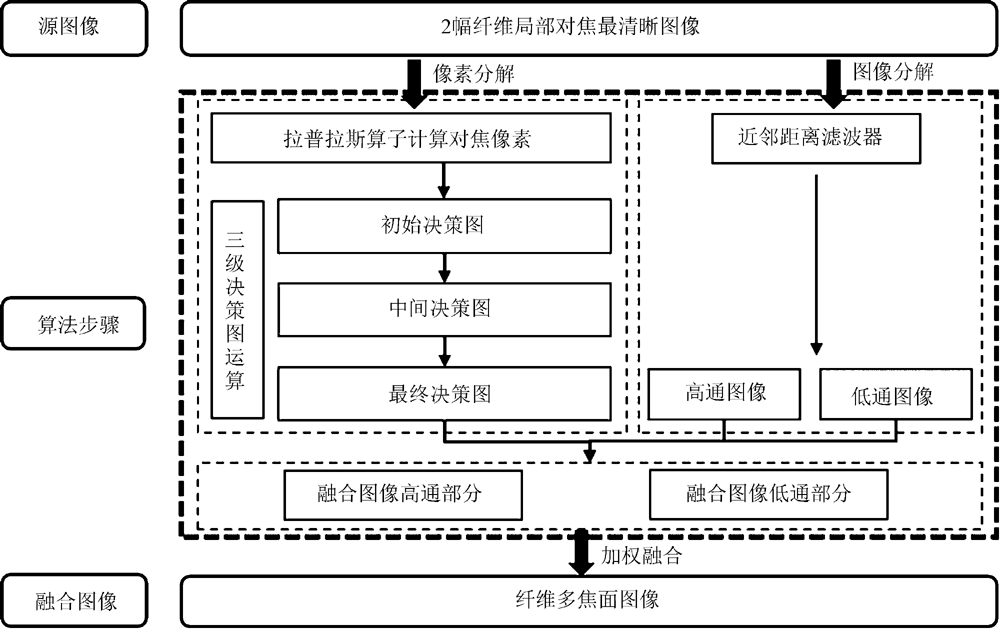
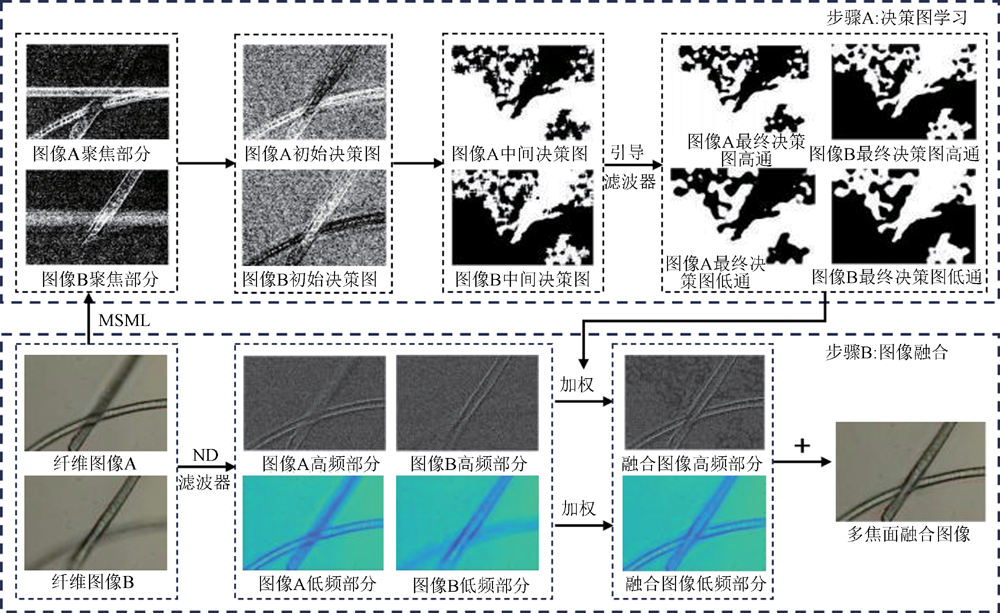
Method To address the problem of defocus blur of overlapping fibers in the visual field during single image imaging, this research proposed a multi-focal plane fusion algorithm based for fibers on focal pixels. Firstly, two locally clearest source images were determined from the overlapping fiber images. Focal pixels were then obtained by multi-scale modified Laplacian algorithm to generate the initial decision map. The intermediate decision map was generated by slice calculation, and the guide filter was used to get the final decision map. Subsequently, the source image was processed with high-pass and low-pass respectively by the nearest neighbor distance filter. Finally, the fusion image was weighted.

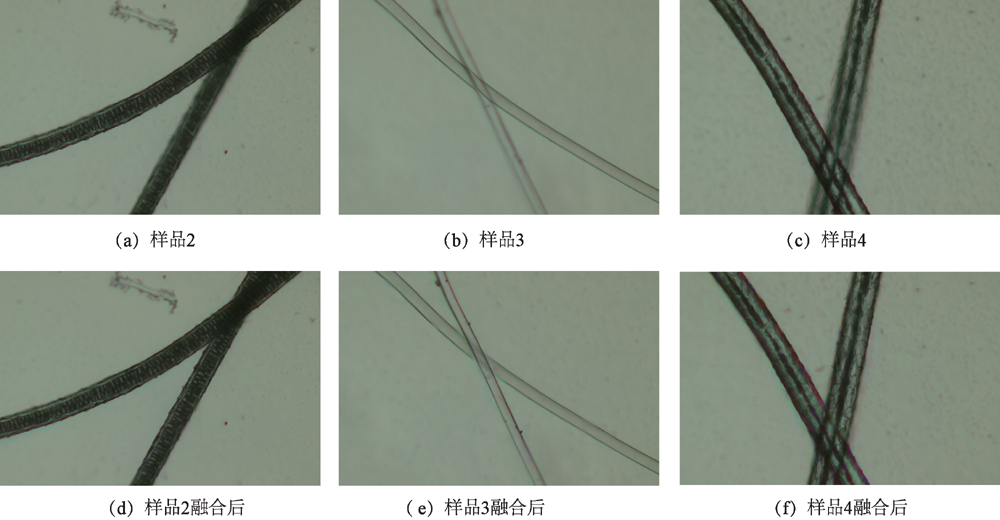
Results The fiber multi-focal plane fusion algorithm based on focal pixels was proved suitable for different fiber samples. In the experiment, four types of fiber samples were listed, named as sample 1 (wool), sample 2 (down hair), sample 3 (cotton) and sample 4 (rabbit hair). By comparing the locally out-of-focus fuzzy original images of different samples with the fused images, it was seen that the texture details and edge structures of different samples were very clear after processing by the proposed multi-focal plane algorithm. Overlapping wool fiber samples in the same region were selected to compare the differences among the multi-focal plane fusion algorithm based on focus pixels and multi-mode fusion algorithm, three-layer decomposition sparse fusion denoising algorithm and non-down sampled continuous transformation algorithm. In order to better compare the four algorithms, Subjective evaluations were employed as auxiliary evaluation, and objective evaluation index was established as the evaluation benchmark. Three objective evaluation indexes of image mutual information, peak signal-to-noise ratio and edge information result retention were used to evaluate the algorithms. From the evaluation data, it was found that the evaluation values of each index of the multi-focal plane fusion algorithm were 3.543, 0.624 6 and 29.425 3, respectively. Compared with the other three algorithms, the evaluation value of each index of the proposed algorithm was the largest, and the larger the evaluation value, the better the image fusion. Thus, the superiority of the multi-focal plane fusion algorithm proposed in this paper was verified.

Conclusion The study provided data support and characterization to verify the effectiveness of the fiber multi-focal plane fusion algorithm based on focus pixels to solve the out-of-focus fuzzy problem of overlapping fibers. The factors leading to local blurring of overlapping fibers were analyzed from the perspective of high-power microscopic imaging. The multi-focal plane fusion algorithm was designed according to the characteristics of microscopic imaging to achieve globally clear imaging of overlapping fibers. It has been proven that the algorithm is suitable for different fiber types and has high adaptability. Compared with other multi-focal plane fusion algorithms, the fiber image processed by this fusion algorithm can best achieve the effect of globally sharp texture and focus.

Key words: neighbor distance filter, decision map learning, multi-focal plane fusion algorithm, fiber image, microscopic detection of fiber component

CLC Number: 

  • TP311.1

Fig.1

Flow chart of multi-focal plane fusion algorithm"

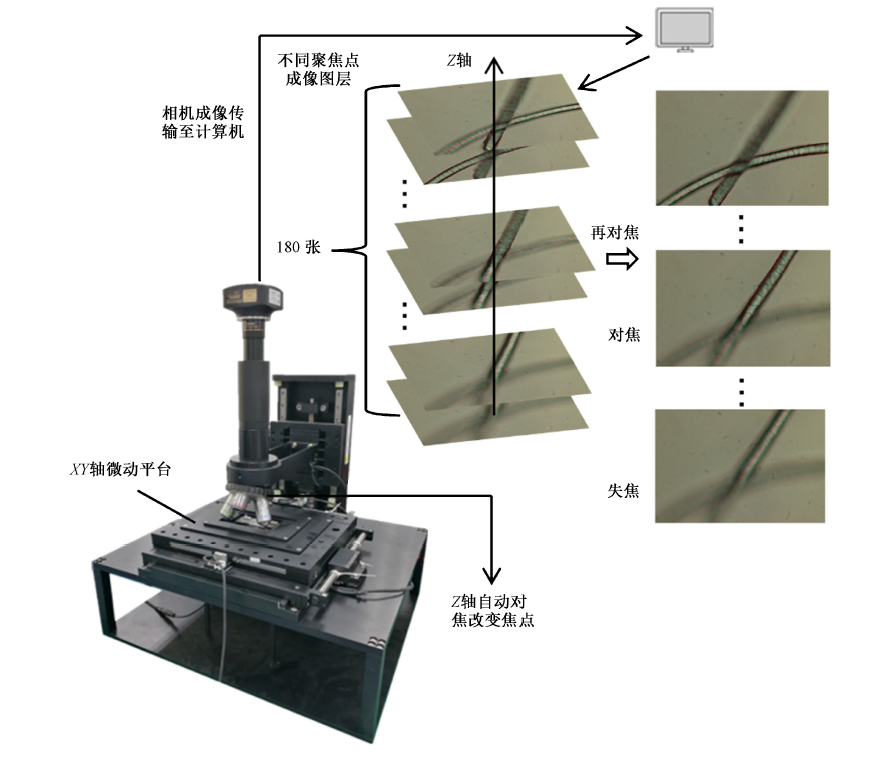
Fig.2

Schematic diagram of image acquisition process"

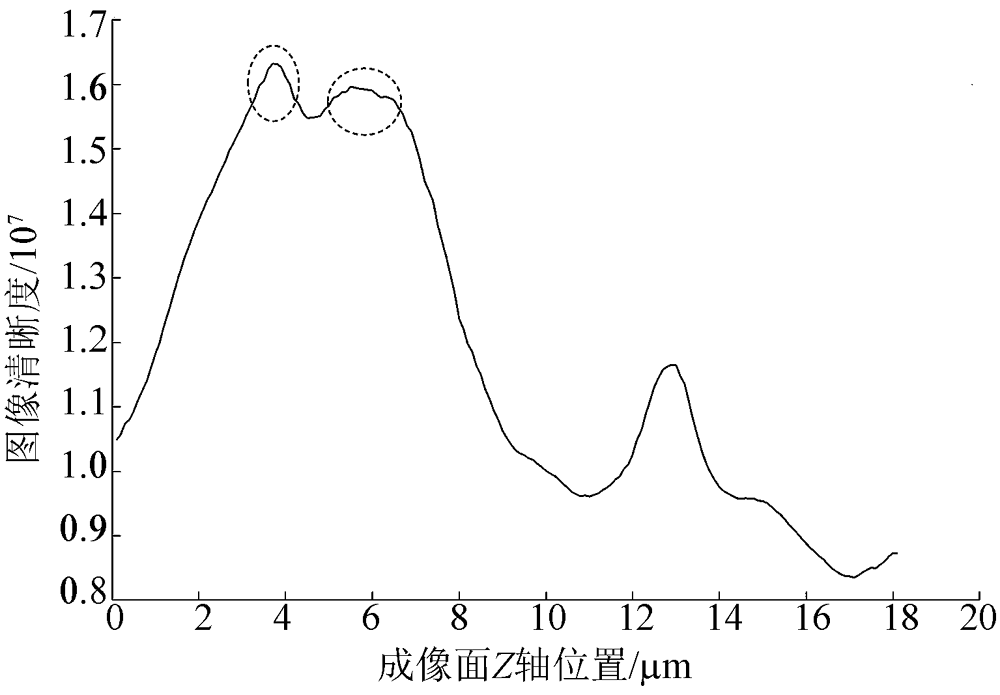
Fig.3

Evaluation curve of fiber multi-focal surface sharpness"

Fig.4

Fiber multi-focal plane fusion process"

Fig.5

Fusion effect diagram of different algorithms for overlapping wool. (a) Textual algorithm; (b) Multi-modal fusion algorithm; (c) Three-layer decomposition sparse fusion denoising algorithm; (d) Non-down sampled continuous transformation algorithm"

Fig.6

Original images and fusion effects of 3 other samples. (a) Sample 2; (b) Sample 2 after fusion; (c) Sample 3; (d) Sample 3 after fusion; (e) Sample 4; (f) Sample 4 after fusion"

Tab.1

Fusion image quality objective evaluation table"

算法类型 MI QAB/F PSNR
多模态融合算法 2.352 0.502 1 25.361 5
3层分解稀疏融合去躁算法 2.634 0.531 4 26.527 3
非下采样连续变换算法 1.872 0.497 5 20.471 4
本文算法 3.543 0.624 6 29.425 3
[1] LI Huafeng, HE Xiaoge, TAO Dapeng, et al. Joint medical image fusion, denoising and enhancement via discriminative low-rank sparse dictionaries learning[J]. Pattern Recognition, 2018,79: 130-146.
[2] YANG Yong, YANG Mei, HUANG Shuying, et al. Robust sparse representation combined with adaptive PCNN for multifocus image fusion[J]. IEEE Access, 2018, 6: 20138-20151.
[3] MA Jiayi, MA Yong, LI Chang. Infrared and visible image fusion methods and applications: a survey[J]. Information Fusion, 2019,45:153-178.
[4] LI Shutao. Multisensor remote sensing image fusion using stationary wavelet transform: effects of basis and decomposition level[J]. International Journal of Wavelets, Multiresolution and Information Processing, 2008, 6(1):37-50.
[5] LI H, MANJUNATH B S, MITRA S K. Multisensor image fusion using the wavelet transform[J]. Graphical Models and Image Processing, 1995, 57(3):235-245.
[6] SELESNICK I W, BARANIUK R G, KINGSBURY N C. The dual-tree complex wavelet transform[J]. IEEE Signal Process magazine, 2005, 22(6): 123-151.
[7] DO M N, VETTERLI M. The contourlet transform: An efficient directional multiresolution image representa-tion[J]. IEEE Transactions on Image Processing, 2005, 14(12): 2091-2106.
[8] DA CUNHA A L, ZHOU J, DO M N. The nonsubsampled contourlet transform: theory, design, and applications[J]. IEEE Transaction on Image Process, 2006, 15(10):3089-3101.
[9] LI S T, YANG B, HU J W. Performance comparison of different multiresolution transforms for image fusion[J]. Information Fusion, 2011, 12(2): 74-84.
[10] ZHANG Q, GUO B. Multi-focus image fusion using the nonsubsampled contourlet transform[J]. Signal Process, 2009, 89(7): 1334-1346.
[11] MITIANOUDIS N, STATHAKI T. Pixel-based and region-based image fusion schemes using ICA bases[J]. Information Fusion, 2007, 8(2): 131-142.
[12] REDONDO R, ŠROUBEK F, FISCHER S, et al. Multifocus image fusion using the log-Gabor transform and a multisize windows technique[J]. Information Fusion, 2009, 10(2): 163-171.
[13] YANG Y, TONG S, HUANG S Y, et al. Multifocus image fusion based on NSCT and focused area detec-tion[J]. IEEE Sensors Journal, 2014, 15(5): 2824-2838.
[14] LI H F, QIU H M, YU Z T, et al, Infrared and visible image fusion scheme based on NSCT and low-level visual features[J]. Infrared Physical & Technology, 2016, 76: 174-184.
[15] LIU Y, CHEN X, PENG H, et al. Multi-focus image fusion with a deep convolutional neural network[J]. Information Fusion, 2017, 36: 191-207.
[16] HUANG W, JING Z. Multi-focus image fusion using pulse coupled neural network[J]. Pattern Recognition Letters, 2007, 28(9): 1123-1132.
[17] 毕天华, 杜文华. 一种改进的Brenner清晰度评价函数[J]. 电子测量技术, 2019, 42(9):80-84.
BI Tianhua, DU Wenhua. An improved Brenner articulation evaluation function[J]. Electronic Measurement Technology, 2019, 42(9):80-84.
[18] LI X S, ZHOU F Q, TAN H S, et al. Multimodal medical image fusion based on joint bilateral filter and local gradient energy[J]. Information Sciences, 2021, 569: 302-325.
[19] LI X S, ZHOU F Q, TAN H S. Joint image fusion and denoising via three-layer decomposition and sparse representation[J]. Knowledge-Based Systems, 2021. DOI:10.1016/j.knosys.2021.107087.
[20] LI X S, ZHOU F Q, TAN H S, et al. Multi-focus image fusion based on nonsubsampled contourlet transform and residual information removal[J]. Signal Processing, 2021. DOI:10.1016/j.sigpro.2021.108062.
[1] SHAO Jinxin, ZHANG Baochang, CAO Jipeng. Fiber detection and recognition technology in cotton fiber carding process based on image processing and deep learning [J]. Journal of Textile Research, 2020, 41(07): 40-46.
[2] ZHANG Zhengye, XIN Binjie, DENG Na, CHEN Yang, XING Wenyu. Research and application of algorithm for measuring hemp fiber cross-sectional parameters based on boundary tracking [J]. Journal of Textile Research, 2020, 41(02): 39-43.
[3] . Concave points matching and segmentation algorithm for overlapped fiber image [J]. JOURNAL OF TEXTILE RESEARCH, 2017, 38(11): 143-149.
[4] . Level set of central axis method of cashmere and wool diameter [J]. JOURNAL OF TEXTILE RESEARCH, 2017, 38(09): 14-18.
Viewed
Full text


Abstract

Cited

  Shared   
  Discussed   
No Suggested Reading articles found!