Journal of Textile Research ›› 2025, Vol. 46 ›› Issue (03): 90-99.doi: 10.13475/j.fzxb.20230901401

• Textile Engineering • Previous Articles     Next Articles

Wearability of woven fabrics with antibacterial and odorizing composite functions

WANG Zhefeng1,2, CAI Wangdan1,3,4, LI Shiya1,3,4, XU Qingyi2, ZHANG Hongxia1,3,4, ZHU Chengyan1,3,4, JIN Xiaoke1,3,4()   

  1. 1. Key Laboratory of Advanced Textile Materials and Manufacturing Technology, Ministry of Education, Zhejiang Sci-Tech University, Hangzhou, Zhejiang 310018, China
    2. Zhejiang Dunnu United Industrial Co., Ltd., Haining, Zhejiang 314400, China
    3. National & Local Joint Engineering Research Center for Textile Fiber Materials and Processing Technology, Zhejiang Sci-Tech University, Hangzhou, Zhejiang 310018, China
    4. Zhejiang Provincial Key Laboratory of Fiber Materials and Manufacturing Technology, Zhejiang Sci-Tech University, Hangzhou, Zhejiang 310018, China
  • Received:2023-09-07 Revised:2024-10-18 Online:2025-03-15 Published:2025-04-16
  • Contact: JIN Xiaoke E-mail:xiaoke.jin@zstu.edu.cn

Abstract:

Objective Antibacterial textiles are the textiles with antibacterial agents in the interior or surface of fibers through physical or chemical treatment, which adhere and evenly diffuse on the surface of fibers to achieve long-lasting antibacterial properties. It is known that antibacterial textiles cannot completely remove textile odors, and the market demand for textiles with deodorizing functions is high. This article aims to explore the effects of the picking ratio of two types of functional yarns as well as fabric structure, and to quantitatively and systematically analyze the samples with the best comprehensive performance through mathematical methods.

Method This article selects mulberry silk as the warp yarn, and antibacterial nylon and honeycomb deodorized polyester yarns as the weft. Through controlling the parameters, the performance in the antibacterial function, deodorizing function, and other wearing properties of the fabric were explored under different factors. A sample with the best comprehensive performance was found through fuzzy mathematics comprehensive evaluation method.

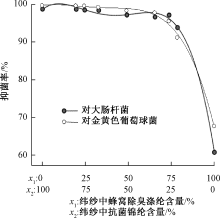
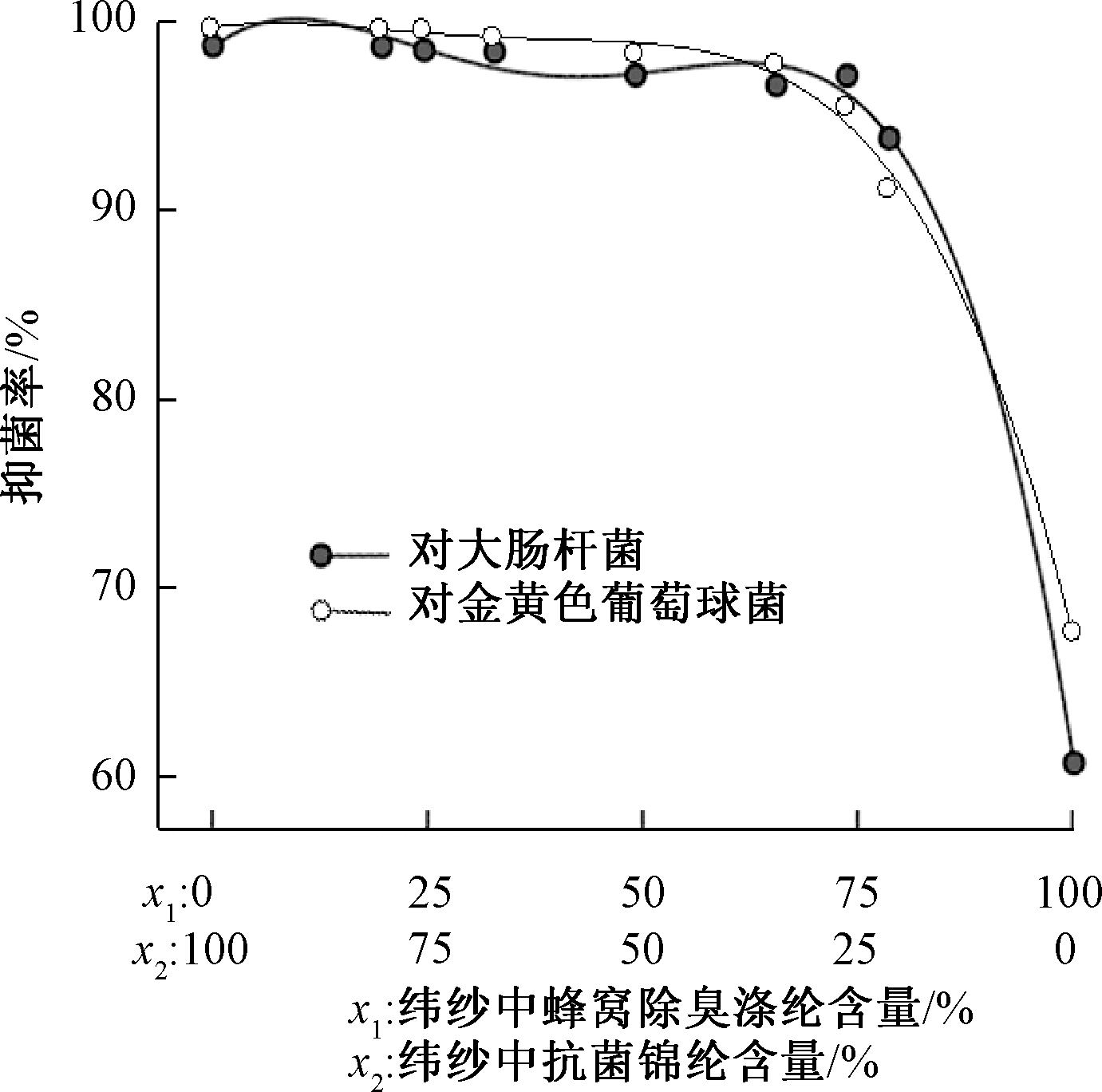
Results When other conditions of the fabric are same, the antibacterial performance of the fabric showed improvement with the increase of the antibacterial nylon content in the weft yarn. When the antibacterial nylon content in the weft yarn was increased from 0% to 21.44% (i.e. the ratio of honeycomb deodorized polyester yarn to antibacterial nylon in the weft yarn being 4∶1), the antibacterial rate of the fabric against E. coli and S.aureus reached over 90%, showing a rapid growth. When the antibacterial nylon content in the weft yarn continues to increase, the antibacterial rate of the fabric tended to be constant. When all other conditions of the fabric are same, the deodorizing function of the fabric demonstrated increases with the increase of the content of honeycomb deodorized polyester in the weft yarn. Among the five types of woven fabrics, plain weave fabric showed the worst deodorizing effect, while satin fabric with six variations has the best deodorizing effect. In the A series samples, the longitudinal and transverse breaking strength of the samples gradually decreased along with the decrease in content of antibacterial nylon in the weft yarn, be ause of the superior breaking strength of antibacterial nylon compared to honeycomb deodorized yarn. In B series samples, different structures demonstrated certain impact on the tensile fracture performance of the samples. The plain weave fabric exhibited the best fabric strength, while double damask showed the worst. Owing to the honeycomb structure of the deodorizing fiber, the air permeability of the A series sample was enhanced with the increase of the honeycomb deodorizing yarn in the weft yarn. The fabric structure in the B series samples also had a significant impact on the air permeability, with double damask fabric having the best permeability and plain fabric having the worst. With the change of the picking ratio, the fluctuation of the sharp elastic wrinkle recovery angle and the slow elastic wrinkle recovery angle of the sample was not significant, and the order of wrinkle recovery performance of different structure samples was found to be plain weave < twill<six variable satin< double damask <honeycomb tissue. The difference in the content of honeycomb deodorizing yarn and antibacterial nylon in weft yarn showed little impact on the anti-fuzzing and pilling performance of the fabric, while the fabric structure has a significant impact. It was verified that the less likely the yarn was to slip, the better its anti-pilling performance would be. Plain weave fabrics showed the best anti-pilling performance, while honeycomb structure showed the worst. Using fuzzy mathematics comprehensive evaluation to select the sample with the best comprehensive performance in each series, it was found that sample A8 had the best comprehensive performance in the A series samples, and, sample B4 had the best comprehensive performance in the B series samples.

Conclusion When the picking ratio of honeycomb deodorized polyester yarn to antibacterial nylon was 4∶1, the comprehensive performance of the fabric is the best. When the fabric structure is double damask, the comprehensive performance of the fabric is the best.

Key words: antibacterial function, deodorzing function, picking ratio, fabric weave, interwoven fabric, silk, antibacterial nylon, honeycomb deodorized polyester yarn

CLC Number: 

  • TS101.923

Tab.1

Specification parameters of woven fabric under different picking ratio conditions"

试样编号 甲纬与
乙纬比例
蜂窝除臭涤纶
纱线含量/%
抗菌锦纶
含量/%
A1 0∶1 0.00 100.00
A2 1∶4 19.64 80.36
A3 1∶3 24.55 75.45
A4 1∶2 32.73 67.27
A5 1∶1 49.10 50.90
A6 2∶1 65.47 34.53
A7 3∶1 73.65 26.35
A8 4∶1 78.56 21.44
A9 1∶0 100.00 0

Tab.2

Specification parameters of different weave structures"

试样编号 组织 蜂窝除臭涤纶纱
线含量/%
抗菌锦纶
含量/%
B1 平纹 49.10 50.90
B2 二上一下右斜纹 49.10 50.90
B3 六枚变则缎纹 49.10 50.90
B4 八枚缎纹 49.10 50.90
B5 蜂巢组织 49.10 50.90

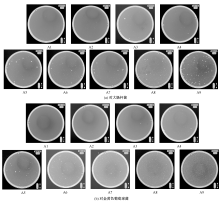
Fig.1

Comparison of antibacterial effects against E. coli (a) and S.aureus (b) in different fabrics"

Tab.3

ANOVA for quadratic model-bacteriostatic rate of E.coli"

来源 平方和 自由度 均方 F p 显著性
模型 1 212.14 4 303.04 379.44 < 0.000 1 显著
线性混合
模型
536.12 1 536.12 671.30 < 0.000 1
x1x2 286.97 1 286.97 359.33 < 0.000 1
x1x2(x1-x2) 203.79 1 203.79 255.17 < 0.000 1
x1x2(x1-x2)2 31.21 1 31.21 39.08 0.003 3
残差 3.19 4 0.798 6
总变异 1 215.34 8
R2=
0.997 4
R a d j 2=
0.994 7
R p r e 2=
0.676 1

Tab.4

ANOVA for quadratic model-bacteriostatic rate of S.aureus"

来源 平方和 自由度 均方 F p 显著性
模型 861.35 4 215.34 342.29 <0.000 1 显著
线性混合
模型
471.19 1 471.19 748.97 <0.000 1
x1x2 216.78 1 216.78 344.59 <0.000 1
x1x2(x1-x2) 90.64 1 90.64 144.08 0.000 3
x1x2(x1-x2)2 5.01 1 5.01 7.96 0.047 7
残差 2.52 4 0.629 1
总变异 863.86 8
R2=
0.997 1
R a d j 2=
0.994 2
R p r e 2=
0.555 7

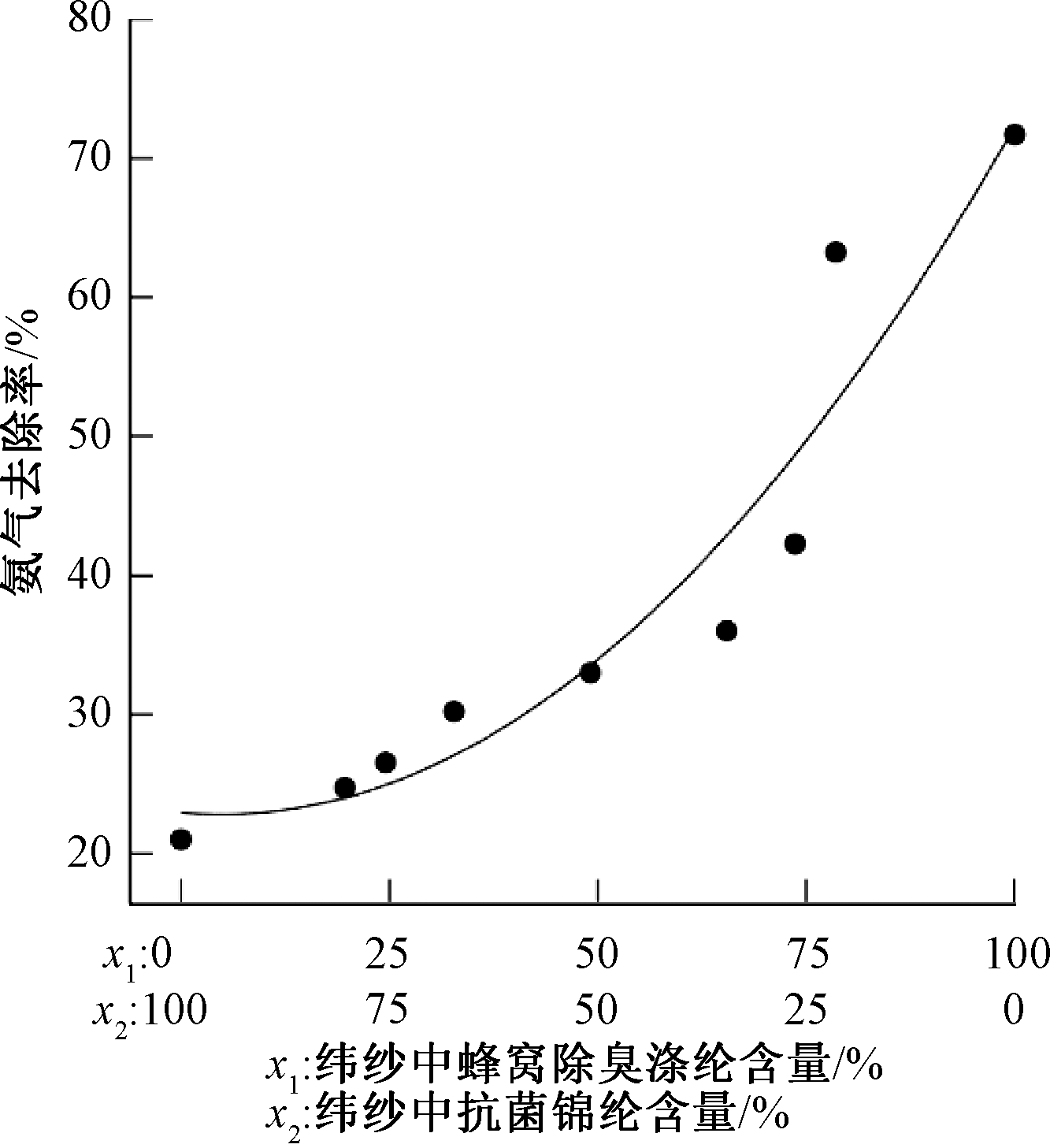
Fig.2

Model graph of antibacterial rate"

Tab.5

ANOVA for quadric model-ammonia removal rate"

来源 平方和 自由度 均方 F p 显著性
模型 2 252.43 2 1 126.21 30.51 0.000 7 显著
线性混合
模型
2 046.45 1 2 046.45 55.44 0.000 3
x1x2 205.98 1 205.98 5.58 0.056 1
残差 221.46 6 36.91
总变异 2 473.89 8
R2=
0.910 5
R a d j 2=
0.880 6
R p r e 2=
0.834 1

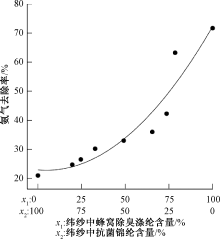
Fig.3

Ammonia removal rate model graph of A series fabrics"

Tab.6

Test results of strength and elongation of yarn"

纱线种类 断裂伸长率/% 断裂强力/cN 断裂强度/(cN·dtex-1 )
蜂窝除臭涤纶 9.5 210.7 1.8
抗菌锦纶 17.5 790.8 6.7

Tab.7

Test results of tensile property of A series samples"

试样
编号
断裂强力/N 断裂伸长/mm 断裂伸长率/%
经向 纬向 经向 纬向 经向 纬向
A1 627.2 484.3 52.1 54.2 26.05 27.10
A2 632.3 289.3 50.9 27.9 25.45 13.95
A3 617.6 282.3 50. 7 29.1 25.35 14.55
A4 624.0 285.7 51.7 30.5 25.85 15.25
A5 575.3 257.7 48.5 31.9 24.25 15.95
A6 557.0 240.0 47.6 33.7 23.80 16.85
A7 541.3 225.7 45.6 31.4 22.80 15.70
A8 536.3 216.2 43.5 29.6 21.75 14.80
A9 510.9 215.7 41.7 28.2 20.85 14.10

Tab.8

Test results of tensile property of B series specimens"

试样
编号
断裂强力/N 断裂伸长/mm 断裂伸长率/%
经向 纬向 经向 纬向 经向 纬向
B1 575.3 257.7 48.5 31.9 24.25 15.95
B2 564.3 199.3 46.1 28.0 23.05 14.00
B3 504.3 197.3 43.6 26.7 21.80 13.35
B4 486.1 185.3 41.7 24.0 20.85 12.00
B5 492.7 192.0 44.7 26.7 22.35 13.35

Tab.9

Test results of air permeability of A series samples"

试样
编号
纬纱中蜂窝除臭
纤维含量/%
纬纱中抗菌
锦纶含量/%
透气率/
(mm·s-1)
A1 0 100.00 16.96
A2 19.64 80.36 26.72
A3 24.55 75.45 28.09
A4 32.73 67.27 31.80
A5 49.10 50.90 47.29
A6 65.47 34.53 70.07
A7 73.65 26.35 86.63
A8 78.56 21.44 142.12
A9 100.00 0 164.67

Tab.10

Test results of air permeability of B series samples"

试样
编号
纬纱中蜂窝除臭
纱线含量/%
纬纱中抗菌
锦纶含量/%
组织 透气率/
(mm·s-1)
B1 49.10 50.90 平纹 47.95
B2 二上一下斜纹 240.30
B3 六枚变则缎纹 854.73
B4 八枚缎纹 987.93
B5 蜂巢组织 567.30

Tab.11

Test results of wrinkle recovery of A series samples"

试样
编号
纬纱中蜂窝
除臭纱线
含量/%
纬纱中
抗菌锦纶
含量/%
急弹性折皱
回复角/(°)
缓弹性折皱
回复角/(°)
经向 纬向 经向 纬向
A1 0 100.00 88.76 71.93 113.85 84.00
A2 19.64 80.36 93.64 72.56 113.13 85.62
A3 24.55 75.45 98.80 68.75 112.42 82.17
A4 32.73 67.27 89.17 67.44 108.8 80.53
A5 49.10 50.90 86.74 67.82 108.11 80.93
A6 65.47 34.53 86.18 66.39 110.99 79.38
A7 73.65 26.35 83.37 61.19 107.15 78.73
A8 78.56 21.44 83.45 61.67 106.20 78.41
A9 100.00 0 76.15 60.20 103.49 76.77

Tab.12

Test results of wrinkle recovery of A series samples"

试样
编号
织物
组织
急弹性折皱
回复角/(°)
缓弹性折皱
回复角/(°)
经向 纬向 经向 纬向
B1 平纹 72.59 61.25 80.65 70.12
B2 二上一下斜纹 88.40 74.77 99.50 86.26
B3 六枚变则缎纹 93.68 94.64 103.23 97.86
B4 八枚缎纹 93.87 94.10 107.68 108.14
B5 蜂巢组织 111.90 105.52 131.09 119.73

Tab.13

Pilling performance rating sheet"

试样
编号
纬纱中蜂窝除臭
涤纶含量/%
纬纱中抗菌
锦纶含量/%
起毛起球
等级
A1 0 100.00 5
A2 19.64 80.36 5
A3 24.55 75.45 4.5
A4 32.73 67.27 5
A5 49.10 50.90 5
A6 65.47 34.53 4.5
A7 73.65 26.35 4.5
A8 78.56 21.44 4.5
A9 100.00 0 5
B1 49.10 50.90 5
B2 49.10 50.90 4.5
B3 49.10 50.90 3.5
B4 49.10 50.90 3
B5 49.10 50.90 1.5

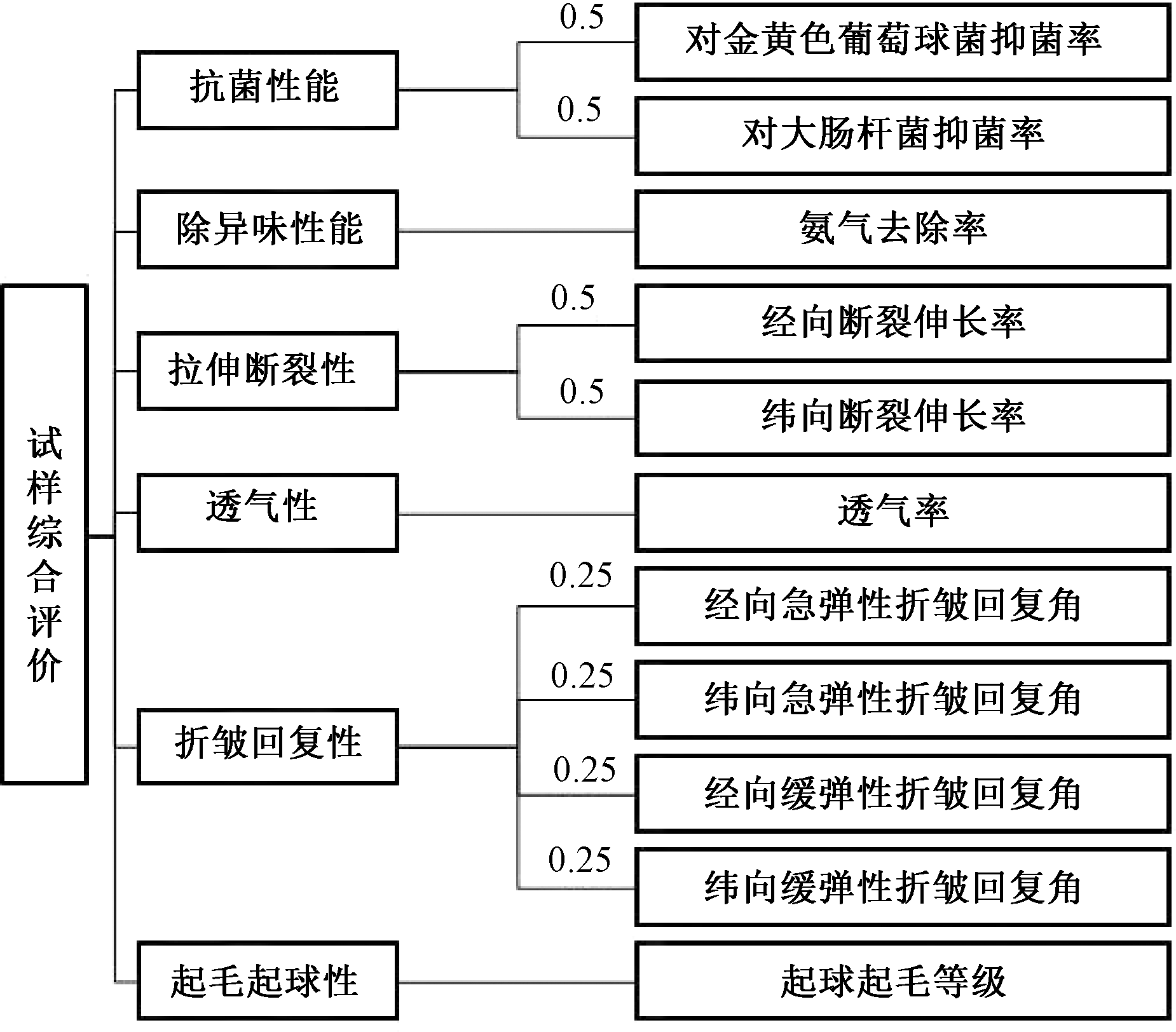
Fig.4

Index hierarchy"

Tab.14

Evaluation factors and weight coefficients"

评价因素 平均得分 权重系数
抑菌性能 26.7 0.267
除异味性能 42.1 0.421
拉伸断裂性能 3.2 0.032
透气性 9.6 0.096
折皱回复性能 4.1 0.041
起毛起球等级 5.3 0.053
其它性能 9.1 0.091
[1] 曹聪聪, 汤龙世, 刘元军, 等. 无机抗菌织物的研究进展[J]. 纺织学报, 2022, 43(11):203-211.
doi: 10.13475/j.fzxb.20210309409
CAO Congcong, TANG Longshi, LIU Yuanjun, et al. Research progress of inorganic antibacterial fabrics[J]. Journal of Textile Research, 2022, 43(11):203-211.
doi: 10.13475/j.fzxb.20210309409
[2] HU Y, LI Y, CAI W, et al. Comfort and functional evaluation of silk/ profiled antibacterial polyester fabric[J]. Journal of The Textile Institute, 2024, 115(5): 1-13.
[3] 李诗雅, 金肖克, 田伟, 等. 维生素E护肤纺织品的研究现状及发展趋势[J]. 现代纺织技术, 2023, 31(1):293-300.
doi: 10.19398/j.att.202206002
LI Shiya, JIN Xiaoke, TIAN Wei, et al. Research status and development trend of vitamin E loaded cosmetotextile products[J]. Advanced Textile Technology, 2023, 31(1): 293-300.
doi: 10.19398/j.att.202206002
[4] ISLAM-Ul-Shahid, SUN G. Thermodynamics, kinetics, and multifunctional finishing of textile materials with colorants extracted from natural renewable sources[J]. ACS Sustainable Chemistry & Engineering, 2017, 5(9):7451-7466.
[5] 胡云中泽, 夏帅飞, 祝成炎, 等. 低温阳离子抑菌吸湿快干涤纶织物的开发与性能研究[J]. 丝绸, 2022, 59(1):51-57.
HU Yunzhongze, XIA Shuaifei, ZHU Chengyan, et al. Studies on the development and performance of low temperature cationic antibacterial hygroscopic fast drying polyester fabric[J]. Journal of Silk, 2022, 59(1):51-57.
[6] 沈妙音, 王姗姗, 乔明伟, 等. 抗菌改性聚酯纤维混纺机织面料的抗菌性能[J]. 丝绸, 2021, 58(8):18-23.
SHEN Miaoyin, WANG Shanshan, QIAO Mingwei, et al. Research on the antibacterial properties of anti-microbial modified polyester blended weaving fabric[J]. Journal of Silk, 2021, 58(8):18-23.
[7] 蒋佳怡, 张红霞, 祝成炎, 等. 吸湿快干抗菌真丝交织物的性能研究[J]. 丝绸, 2021, 58(6):15-19.
JIANG Jiayi, ZHANG Hongxia, ZHU Chengyan, et al. Research on the properties of hygroscopic and quick-drying antibacterial silk intertextures[J]. Journal of Silk, 2021, 58 (6):15-19.
[8] 刘伟时. 抗菌纤维的发展及抗菌纺织品的应用[J]. 化纤与纺织技术, 2011, 40(3):22-27.
LIU Weishi. Development of antibacterial fiber and application of antibacterial textile[J]. Chemical Fiber & Textile Technology, 2011, 40(3):22-27.
[9] 刘亚楠, 贺荣, 张惠芳, 等. 抗菌负氧离子真丝交织物墙布窗帘织物的性能[J]. 丝绸, 2023, 60(7):26-32.
LIU Yanan, HE Rong, ZHANG Huifang, et al. Properties of antibacterial and negative oxygen ion silk fabrics for wall cloth curtains[J]. Journal of Silk, 2023, 60(7):26-32.
[10] MCQUEEN R H, VAEZAFSHAR S. Odor in textiles: a review of evaluation methods, fabric characteristics, and odor control technologies[J]. Textile Research Journal, 2020, 90(9/10): 1157-1173.
[11] 蔡王丹, 范硕, 田伟, 等. 纺织品异味及除异味技术研究现状及进展[J]. 丝绸, 2023, 60(3):82-89.
CAI Wangdan, FAN Shuo, TIAN Wei, et al. Research status and progress of textile odors and deodorizing technology[J]. Journal of Silk, 2023, 60(3):82-89.
[12] ABNEY S E, IJAZ M K, MCKINNEY J, et al. Laundry hygiene and odor control: state of the science[J]. Applied and Environmental Microbiology, 2021, 87(14):1-12.
[13] 顾娟红, 严敏, 柳艳, 等. 吹扫捕集-气相色谱/质谱法测定纺织品中多种异味物质[J]. 印染助剂, 2021, 38(4):55-59.
GU Juanhong, YAN Min, LIU Yan, et al. Determination of odour compounds in textiles by gas purge and trap-gas chromatography mass spectrometry[J]. Textile Auxiliaries, 2021, 38(4):55-59.
[14] 刘荣飞. 一种等离子改性接枝抗菌纤维及其制备方法、应用: 111206412A[P]. 2020-05-29.
LIU Rongfei. A kind of plasma modified graft antibacterial fiber and its preparation method and application: 111206412A[P]. 2020-05-29.
[15] 谢建强. 高效蜂窝除汗臭纤维及其制备工艺与应用: 116732633A[P]. 2023-09-12.
XIE Jianqiang. High efficiency honeycomb deodorant fiber and its preparation technology and application: 116732633A[P]. 2023-09-12.
[16] 杨恩惠, 沈海生, 邱华. 机织物透气性研究进展[J]. 服装学报, 2020, 5(1): 6-11.
YANG Yinhui, SHEN Haisheng, QIU Hua. Research progress on air permeability of woven fabrics[J]. Journal of Clothing Research, 2020, 5(1): 6-11.
[17] 孙浪涛. 纯棉机织物结构与透气性的关系研究[J]. 武汉纺织大学学报, 2018, 31(6): 11-14.
SUN Langtao. Study on the relationship between structure and permeability of pure cotton woven fabric[J]. Journal of Wuhan Textile University, 2018, 31(6): 11-14.
[18] CHAKRABORTY S, PRASAD K. A quality function deployment-based expert system for cotton fibre selection[J]. Journal of The Institution of Engineers (India): Series E, 2018, 99(1): 43-53.
[19] WANG Y J. A fuzzy multi-criteria decision-making model based on simple additive weighting method and relative preference relation[J]. Applied Soft Computing, 2015, 30: 412-420.
[1] LUO Xin, WANG Lei, WANG Xiaoyou, WU Tao, ZHANG Zhenzhen, ZHANG Yifan. Advances in self-assembly mechanism of hierarchical structures and their reconstructed materials [J]. Journal of Textile Research, 2025, 46(03): 225-235.
[2] ZHAN Kejing, YANG Xin, ZHANG Yinglong, ZHANG Xin, PAN Zhijuan. Fabrication and mechanical reinforcement of self-coagulated regenerated silk fibroin micro-nanofiber membranes [J]. Journal of Textile Research, 2025, 46(02): 10-19.
[3] YANG Xin, ZHANG Xin, PAN Zhijuan. Structure and properties of fibroin nanofibril reinforced regenerated silk protein/polyvinyl alcohol fiber [J]. Journal of Textile Research, 2024, 45(11): 1-9.
[4] LOU Hao, LÜ Wangyang, CHEN Wenxing, JIANG Wenbin. Design of cooked cocoon conveying device based on cocoon feeding trolley [J]. Journal of Textile Research, 2024, 45(11): 199-206.
[5] JIANG Kexin, MAO Ying, PAN Mengyao, LÜ Wangyang, JIANG Wenbin. Comparison of cocoon quality and raw silk performance between coccons produced from whole instar artificial diet and mulberry leave reared silkworm [J]. Journal of Textile Research, 2024, 45(10): 16-22.
[6] LI Meng, DAI Mengnan, YU Yangxiao, WANG Jiannan. Research progress in application of silk fibroin-based biomaterials for bone repair [J]. Journal of Textile Research, 2024, 45(10): 224-231.
[7] WANG Boxiang, XU Hangdan, LI Jia, LIN Jie, CHENG Dehong, LU Yanhua. Preparation and biocompatibility of temperature-sensitive composite membrane of tussah silk fibroin nanofiber [J]. Journal of Textile Research, 2024, 45(09): 18-25.
[8] WANG Yujia, WANG Yi, WANG Yasi, DAI Fangyin, LI Zhi. Preparation and sensing performance of flexible pressure sensor based on natural flat silk cocoon structure [J]. Journal of Textile Research, 2024, 45(09): 10-17.
[9] DAI Jiayang, HU Yifeng, WANG Yujing, WU Dongping, BIAN Xinger, XU Jianmei. Carbon footprint accounting and evaluation during silk refining stage [J]. Journal of Textile Research, 2024, 45(08): 190-197.
[10] LIU Shu, HOU Teng, ZHOU Lele, LI Xianglong, YANG Bin. Properties of Bombyx mori silkworm silk obtained by forced reeling [J]. Journal of Textile Research, 2024, 45(06): 11-15.
[11] HUANG Qing, SU Zhenyue, ZHOU Yifan, LIU Qingsong, LI Yi, ZHAO Ping, WANG Xin. Analysis of silks from silkworms reared with artificial diet and mulberry leaves [J]. Journal of Textile Research, 2024, 45(05): 1-9.
[12] CHEN Kun, XU Jingying, ZHENG Yiqian, LI Jialin, HONG Xinghua. Conductivity and electrical heating properties of reduced graphene oxide modified silk fabric by screen printing [J]. Journal of Textile Research, 2024, 45(03): 122-128.
[13] LEI Caihong, YU Linshuang, JIN Wanhui, ZHU Hailin, CHEN Jianyong. Preparation and application of silk fibroin/chitosan composite fiber membrane [J]. Journal of Textile Research, 2023, 44(11): 19-26.
[14] ZHANG Zifan, LI Pengfei, WANG Jiannan, XU Jianmei. Research progress in silk fibroin drug-loaded nanoparticles [J]. Journal of Textile Research, 2023, 44(10): 205-213.
[15] TAN Ting, LI Zheyang, MA Mingbo, ZHOU Wenlong. Study of transdermal characteristics of antioxidant substances in naturally green-colored silk [J]. Journal of Textile Research, 2023, 44(10): 75-80.
Viewed
Full text


Abstract

Cited

  Shared   
  Discussed   
No Suggested Reading articles found!