Journal of Textile Research ›› 2025, Vol. 46 ›› Issue (11): 19-25.doi: 10.13475/j.fzxb.20250300101

• Fiber Materials • Previous Articles     Next Articles

Synthesis and characterization of poly(trimethylene terephthalate)-block-poly(tetramethylene glycol) copolymers

DONG Hailiang1,2,3, WEI Ting3, KUANG Jun3, CHEN Ye1,2()   

  1. 1. State Key Laboratory of Advanced Fiber Materials, Donghua University, Shanghai 201620, China
    2. College of Materials Science and Engineering, Donghua University, Shanghai 201620, China
    3. Sinopec Shanghai Research Institute of Petrochemical Technology Co., Ltd., Shanghai 201208, China
  • Received:2025-02-21 Revised:2025-08-14 Online:2025-11-15 Published:2025-11-15
  • Contact: CHEN Ye E-mail:chenye@dhu.edu.cn

Abstract:

Objective To enrich the variety of traditional polybutylene terephthalate-based thermoplastic polyether ester elastomer and address the poor elastic recovery performance in the field of fiber materials, new types of thermoplastic polyether ester elastomer (TPEE) were synthesized by direct esterification and melt polycondensation using bio-based poly(trimethylene terephthalate) as hard segment contents, aiming to achieve a series of poly(trimethylene terephthalate)-block- poly(tetramethylene glycol) (PTT-b-PTMG)with different hardness. This study aims to investigate the effects of different soft segment contents on the structure and properties of PTT-b-PTMG, so as to provide support for the development and application of the thermoplastic polyether ester elastomer.
Method A series of PTT-b-PTMG copolymers with different hardness were synthesized by direct esterification melt polycondensation. The structure and properties of PTT-b-PTMG copolyesters were characterized by FT-IR, 1H-NMR, gel permeation chromatography (GPC), viscosity analyzer, differential scanning calorimeter (DSC), thermogravimetry (TG), wide-angle X-ray diffraction (WAXS), etc.
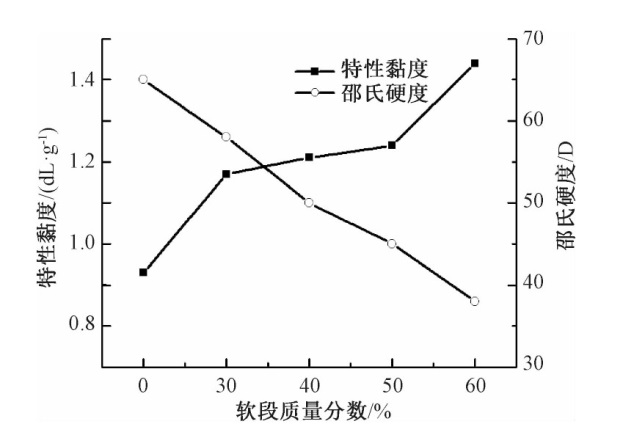
Results The results showed that PTT-b-PTMG copolyester was successfully synthesized evidenced by FT-IR, 1H-NMR, and GPC analysis and the soft segment mass fraction calculated by 1H-NMR spectra were close to the theoretical addition value.The influences of soft segment contents on the structure and properties of PTT-b-PTMG copolyesters were studied by changing the soft segment contents. The results showed that as the content of soft segments increase, the intrinsic viscosity and molecular weight of copolyesters increased with the increase of soft segments ratio from 0% to 60%. With the increase of soft segments content, the length of PTT hard segment segments in the molecular sequence structure decreased from 16.3 to 4.5, the elongation at break increased from 49% to 542%, the tensile strength decreased from 26 MPa to 13 MPa, the Young's modulus decreased from 2 012 MPa to 62 MPa and the Shore hardness decreased from 65 to 38. WAXS revealed that all copolymers had the same crystal structure of homo-PTT at room temperature. With the increase of soft segments content, melting point shifted from 223.2 ℃ to 178.7 ℃ with the enthalpy of melting decreased from 43.2 J/g to 16.2 J/g and crystallization temperature shifted from 178.0 ℃ to 132.5 ℃with the enthalpy of crystallization decreased from 49.0 J/g to 19.5 J/g. The thermal degradation performance showed that all copolyester had good thermal stability, with the increase of soft segments content, the residual carbon content decrease from 6.8% to 1.0%, when the content of soft segments is 60%, the thermal stability of the copolyester show better than other content, slightly worse than pure PTT.
Conclusion A series of PTT-b-PTMG copolyesters were successfully synthesized by direct esterification and melt polycondensation. The crystal structure of PTT-b-PTMG copolyesters was found to be consistent with that of PTT by WAXS. With the increase of soft segment content, the intrinsic viscosity and molecular weight of the copolyesters increased, the mean chain length of the hard segment PTT of the molecular sequence structure decreased, the hardness, melting point and crystallization temperature decreased, and the crystallization property deteriorated. The thermal stability results suggest that copolyesters have good thermal stability, and the residual carbon content decreases with the increase of soft segment content. In addition, the increase of soft segment content leads to the change of mechanical properties, the decrease of tensile strength and tensile modulus, and the increase of elongation at break. In this paper, the properties of PTT-b-PTMG with different proportion of soft and hard segments are studied. By changing the content of soft segments, the hardness, tensile modulus, elongation at break and other mechanical properties could be precisely controlled. This work provides more raw material options for the application in the field of TPEE elastic fiber materials.

Key words: poly(trimethylene terephthalate), direct esterification, soft segment content, block copolymer, hardness, molecular sequence structure, thermoplastic polyether ester elastomer

CLC Number: 

  • TQ334

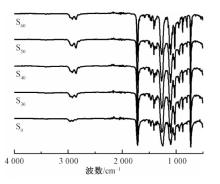
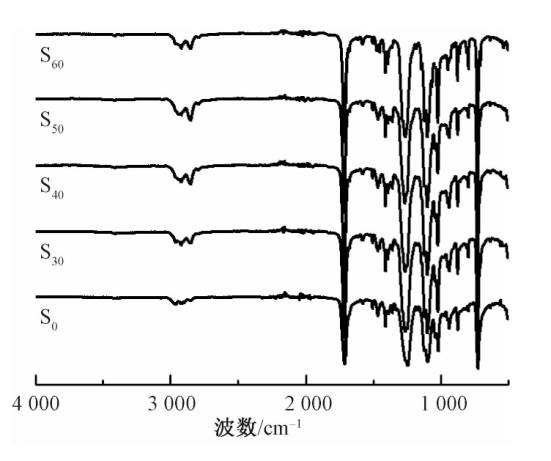
Fig.1

Infrared spectra of PTT-b-PTMG"

Fig.2

Chemical structural formula of PTT-b-PTMG"

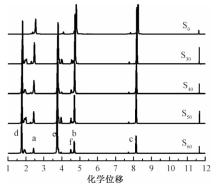
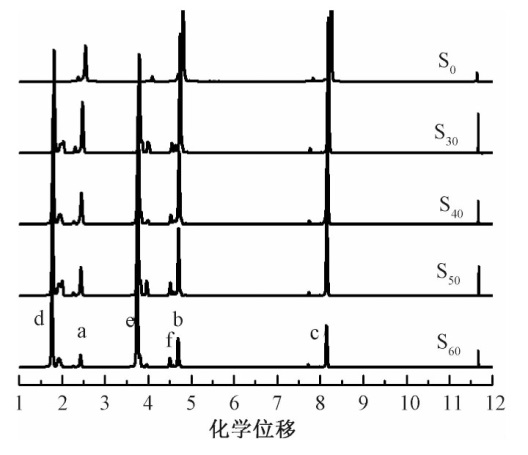
Fig.3

1H-NMR spectra of PTT-b-PTMG"

Tab.1

Physical properties of PTT-b-PTMG"

样品
编号
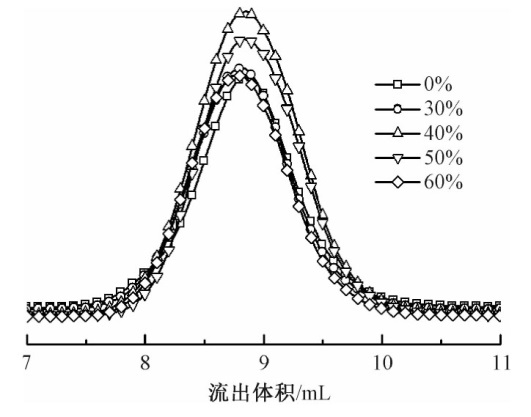
WPTMG/% Mn ×103/
(g·mol-1)
Mw×103/
(g·mol-1)
Mw/Mn Ln
S0 38.6 71.3 1.84
S30 28.0 40.8 77.3 1.89 16.3
S40 39.4 42.2 79.4 1.84 9.4
S50 49.7 43.9 81.3 1.85 6.5
S60 61.1 46.6 82.9 1.78 4.5

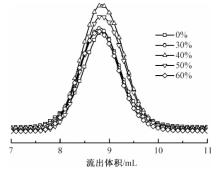
Fig.4

GPC patterns of PTT-b-PTMG"

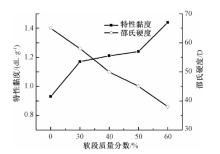
Fig.5

Change of viscosity and hardness of PTT-b-PTMG with proportion of soft segments"

Fig.6

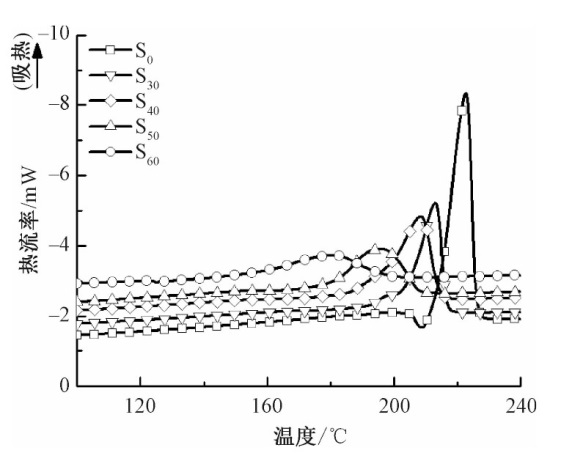
DSC curves of second heating of PTT-b-PTMG"

Fig.7

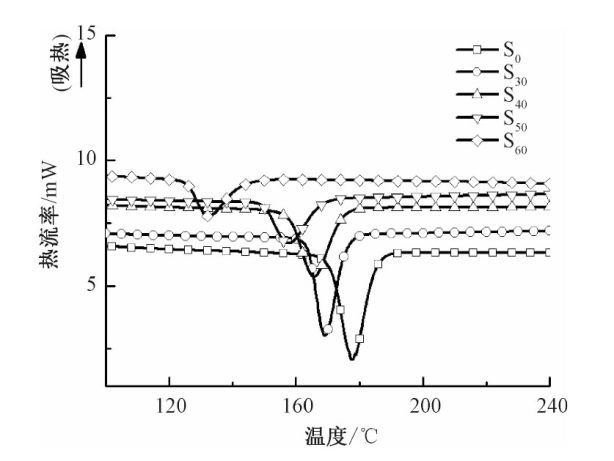
DSC curves of cooling of PTT-b-PTMG"

Tab.2

Thermal performance parameters of PTT-b-PTMG"

样品编号 Tm/℃ ΔHm(J·g-1) Tp/℃ ΔHc(J·g-1)
S0 223.2 43.2 178.0 49.0
S30 213.7 38.8 169.1 35.1
S40 209.5 32.2 165.1 35.0
S50 194.9 22.0 157.5 19.6
S60 178.7 16.2 132.5 19.5

Fig.8

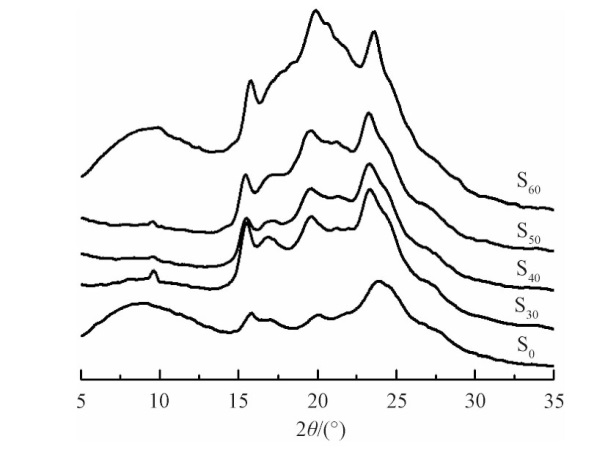
WAXS plot of PTT-b-PTMG"

Tab.3

Thermal stability of PTT-b-PTMG"

样品编号 T5%/℃ T25%/℃ T 50 %/℃ Tmax/℃ Wf/%
S0 367.5 388.0 399.3 399.7 6.8
S30 364.2 384.9 398.0 401.7 4.7
S40 361.7 386.5 399.2 402.7 3.1
S50 360.2 387.2 398.0 403.1 2.2
S60 365.0 388.8 401.0 405.0 1.0

Fig.9

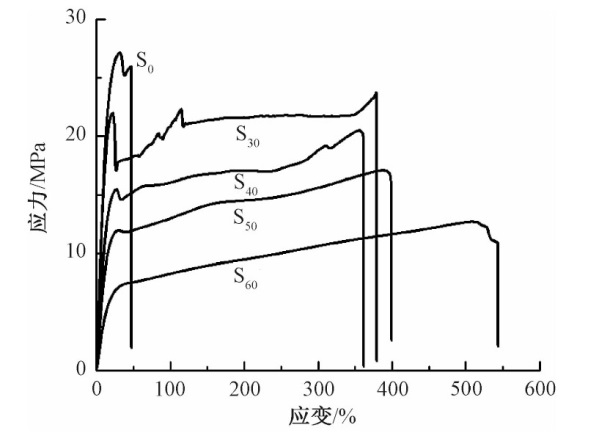
Tensile curves of PTT-b-PTMG"

Tab.4

Mechanical property parameters of PTT-b-PTMG"

样品名称 拉伸模量/MPa 断裂强度/MPa 断裂伸长率/%
S0 2 012±3.2 26±0.3 49±10
S30 289±3.5 24±0.2 387±15
S40 178±2.6 21±0.3 353±13
S50 107±2.1 17±0.2 395±16
S60 62±2.3 13±0.5 542±14
[1] 张梦茹, 王灿, 肖汪洋, 等. 聚醚酯弹性纤维的制备及其结构与性能[J]. 纺织学报, 2024, 45(8): 81-88.
ZHANG Mengru, WANG Can, XIAO Wangyang, et al. Preparation of polyether ester elastic fiber and its structure and properties[J]. Journal of Textile Research, 2024, 45(8): 81-88.
[2] 何崎, 李军令, 靳高岭, 等. 高卷曲聚醚酯/聚酯并列复合纤维的制备及其性能[J]. 纺织学报, 2022, 43(9): 70-75.
HE Qi, LI Junling, JIN Gaoling, et al. Preparation and properties of tetrahydrofuran homopolyether-polybutylene terephthalate/polyethylene terephthalate parallel composite fiber[J]. Journal of Textile Research, 2022, 43(9): 70-75.
[3] 王杰, 邢喜全, 何肖, 等. 不同软硬段含量PBT-b-PTMG嵌段共聚物的合成与性能[J]. 高分子材料科学与工程, 2023, 39(9): 27-34.
WANG Jie, XING Xiquan, HE Xiao, et al. Synthesis and properties of PBT-b-PTMG block copolymers with different soft and hard segment contents[J]. Polymer Materials Science & Engineering, 2023, 39(9): 27-34.
[4] JEON S H, JEONG J E, KIM S, et al. Hardness modulated thermoplastic poly(ether ester) elastomers for the automobile weather-strip application[J]. Polymers, 2021, 13(4): 525.
doi: 10.3390/polym13040525
[5] CHEN Z M, LIU Y, YAO C G, et al. The influences of polyethylene glycol molecular weight on thermal stability, nonisothermal crystallization behavior, and morphology of poly(trimethylene terephthalate)/poly(ethylene oxide terephthalate) copolymers[J]. Polymer Testing, 2012, 31(5): 685-696.
doi: 10.1016/j.polymertesting.2012.03.008
[6] CHEN Z M, YAO C G, YANG G S. Nonisothermal crystallization behavior, and morphology of poly(trimethylene terephthalate)/polyethylene glycol copolymers[J]. Polymer Testing, 2012, 31(3): 393-403.
doi: 10.1016/j.polymertesting.2011.12.001
[7] PIESOWICZ E, PASZKIEWICZ S, SZYMCZYK A. Phase separation and elastic properties of poly(trimethylene terephthalate)-block-poly(ethylene oxide) copolymers[J]. Polymers, 2016, 8(7): 237.
doi: 10.3390/polym8070237
[8] GAN Z Y, BING D X, QU S, et al. In situ synthesis of poly(ether ester) via direct polycondensation of terephthalic acid and 1, 3-propanediol with sulfonic acids as catalysts[J]. Polymer Chemistry, 2019, 10(26): 3629-3638.
doi: 10.1039/C9PY00550A
[9] PASZKIEWICZ S, SZYMCZYK A, ŠPITALSKY Z, et al. Structure and properties of nanocomposites based on PTT-block-PTMO copolymer and graphene oxide prepared by in situ polymerization[J]. European Polymer Journal, 2014, 50: 69-77.
doi: 10.1016/j.eurpolymj.2013.10.031
[10] 吴美琰, 施曼丽, 程友青, 等. 聚对苯二甲酸丁二酯-聚四亚甲基醚多嵌段共聚物的研究[J]. 高分子通讯, 1980, 11(2): 77-83.
WU Meiyan, SHI Manli, CHENG Youqing, et al. The study on poly (tetra-methylene terephthate)-poly(tetramethylene ether) multi-block copolymer[J]. Acta Polymerica Sinica, 1980, 11(2): 77-83.
[11] WANG B J, LI C Y, HANZLICEK J, et al. Poly(tri-methylene teraphthalate) crystal structure and morphology in different length scales[J]. Polymer, 2001, 42(16): 7171-7180.
doi: 10.1016/S0032-3861(01)00046-5
[12] 吴华志. 热塑性聚酯弹性体TPEE的热性能研究[J]. 合成技术及应用, 2024, 39(3): 43-48.
WU Huazhi. Study on thermal properties of thermoplastic polyester elastomer TPEE[J]. Synthetic Technology & Application, 2024, 39(3): 43-48.
[1] LIANG Zhi, JI Kangrui, LI Zhangcheng, HE Yu, WANG Can, HOU Chong. Preparation of thermochromic fiber membrane and its temperature-sensing performance [J]. Journal of Textile Research, 2025, 46(11): 1-8.
[2] YANG Hanbin, ZHANG Shengming, WU Yuhao, WANG Chaosheng, WANG Huaping, JI Peng, YANG Jianping, ZHANG Tijian. Preparation of polyamide 6-based elastic fibers and its structure and properties [J]. Journal of Textile Research, 2023, 44(03): 1-10.
[3] GAO Feng, SUN Yanlin, XIAO Shunli, CHEN Wenxing, LÜ Wangyang. Microstructure and properties of polyester composite fibers with different drafting ratios [J]. Journal of Textile Research, 2022, 43(08): 34-39.
[4] BAO Zhenghong;ZHU Shigen;DING Hao;DI Ping. Effect of tempering process on elasticity and hardness of knitting needles [J]. JOURNAL OF TEXTILE RESEARCH, 2008, 29(4): 119-122.
Viewed
Full text


Abstract

Cited

  Shared   
  Discussed   
No Suggested Reading articles found!