



在TENG纤维设计中,介电皮层材料需具备高介电常数以增强电荷储存能力,而导电芯层需实现电荷高效传导[15-16]。本文选用聚偏氟乙烯-六氟丙烯(PVDF-HFP)作为介电材料,其兼具高介电常数和压电特性,在机械应力下可有效产生/储存电荷,提升能量转换效率[17-18]。该材料良好的柔韧性、耐腐蚀性与易加工性,使其适于作为皮芯结构纤维的皮层[19]。导电芯层采用丝素蛋白-1-乙基-3-甲基咪唑醋酸盐(EMImAc)离子液体(SE)复合体系,通过离子导体特性维持动态环境下的导电稳定性,同时离子液体的高热稳定性和低挥发性保障了器件的可靠性。丝素蛋白的引入提升了纺丝液黏度并降低了雷诺数,确保微流控过程中形成稳定层流,从而获得结构均匀的连续纤维[10]。这种组合不仅优化了材料的力学稳定性,同时也提升了其摩擦电性能。
本文通过微流控纺丝技术,一步法制备了用于单电极摩擦纳米发电机(TENG)的PVDF-HFP-SE皮芯结构纤维(PSE-TENG纤维),并进一步探讨了纺丝参数对纤维结构的影响,评估了纤维的力学性能,且深入分析了不同频率下纤维的输出信号、长期使用稳定性,以及外力大小对纤维输出性能的影响,为开辟可穿戴自供能材料的实践应用新方向提供参考。
1 实验部分
1.1 实验材料
SU-83025光刻胶,美国Microchem公司;丙二醇甲醚醋酸酯,上海阿拉丁生化科技股份有限公司;异丙醇、碳酸氢钠(NaHCO3)、无水乙醇,国药集团化学试剂有限公司;聚二甲基硅氧烷(PDMS)试剂盒SYLGARDTM 184,美国道康宁公司;聚偏氟乙烯-六氟丙烯(PVDF-HFP),上海爱纯生物科技有限公司;N'N-二甲基甲酰胺(DMF),上海泰坦科技股份有限公司;削口蚕茧,嵊州陌桑高科股份有限公司;1-乙基-3-甲基咪唑醋酸盐(EMImAc),青岛奥立科新材料科技有限公司。
1.2 实验仪器
菲林掩膜版,深圳极显光电有限公司;硅片,深圳瑞格锐思科技有限公司;玻璃片,合肥易铭科学仪器有限公司;JHG-2/W氮气枪,乔索科技(深圳)有限公司;P20导管,美国Scientific Commodities公司;注射器,浙江康德莱医疗器械股份有限公司;EZ4-S-PP匀胶机,江苏雷博科学仪器有限公司;HP550LED数显加热板,大龙兴创实验仪器(北京)股份公司;M365L2-C1 360 nm紫外灯,美国Thoelabs公司;LDO-9076A电热恒温鼓风干燥箱,上海龙跃仪器设备有限公司;LDO-9076A等离子清洗机,美国Harrick Plasma公司;MS-0212磁力搅拌器、VD-R6真空干燥箱、XPB-4双级旋片泵,上海泰坦科技股份有限公司;NE-510恒流注射泵,美国New Era公司;Xtl220体式显微镜,上海天省仪器有限公司;MV- XG51GM-T高速摄像机,深圳迈德威视科技有限公司;57XG04收丝电动机,无锡三拓电气设备有限公司;ISC150离子溅射仪,深圳市速普仪器有限公司;JSM-7800F扫描电子显微镜,日本电子株式会社;万用材料力学测量仪,美国Instron公司;MK-9635-1疲劳测试机,东莞市迈科仪器设备有限公司;TBS-1052EDU示波器,美国Keithley公司。
1.3 试样制备
1.3.1 微流控芯片的制备
采用PDMS软光刻技术制备微流控芯片。首先,为了制备母版,将SU-83025光刻胶以1 400 r/min的速度自旋涂在直径为7.62 cm的硅片上,形成约80 μm厚的均匀SU-8层。在95 ℃温度下前烘20 min后,盖上菲林掩膜版,在120 mW紫外灯下曝光5 min。随后在95 ℃温度下后烘约10 min。重复上述“旋涂—前烘—曝光—后烘”过程2次,以2 000 r/min速度旋涂,获得240 μm厚的均匀SU-8层。然后在丙二醇甲醚醋酸酯中显影12 min。依次用异丙醇和无水乙醇清洗制作好的母版,并用氮气枪吹干。然后,将PDMS前驱体与固化剂以10:1的质量比混合,倒在母版上,在60 ℃温度下固化12 h。将固化后的PDMS从母版上剥离,并使用0.7 mm打孔器打孔获得进口和出口。最后,通过等离子体处理将PDMS黏合到干净的玻璃基底上,获得微流控芯片。
1.3.2 PVDF-HFP纺丝液的制备
将2 g PVDF-HFP粉末加入到14 g DMF中,室温搅拌至完全溶解,获得质量分数为12.5%的PVDF-HFP纺丝液(PVDF-HFP/DMF)。
1.3.3 脱胶丝的制备
使用4 L NaHCO3(质量分数为0.5%)溶液将20 g削口蚕茧先后进行2次持续30 min的煮沸脱胶。脱胶后的蚕丝用去离子水洗涤,在60 ℃的烘箱内烘干12 h,获得脱胶丝。
1.3.4 丝素蛋白离子液体纺丝液的制备
将0.31 g脱胶丝加入到10 g EMImAc中,在100 ℃温度下搅拌至脱胶丝完全溶解。溶液冷却至室温后,使用真空法除去溶液中的气泡,获得质量分数为3%的丝素蛋白-EMImAc离子液体(SE)纺丝液。
1.3.5 PSE-TENG纤维的制备
皮层纺丝液基础参数:质量分数为12.5%的PVDF-HFP/DMF,注射速率为2.4 mL/h;芯层纺丝液基础参数:质量分数为3%的SE,注射速率为0.1 mL/h。将2种溶液分别转移到10 mL和1 mL注射器中。将2个注射器分别用P20导管与微流控芯片连接。随后在室温下,通过注射泵将2种溶液分别按各自注射速率泵入微流控芯片中。纺丝液挤入去离子水中后,立即生成具有皮芯结构的PVDF-HFP-SE纤维。通过收丝电动机,同步将纤维收集在卷轴上,获得PSE-TENG纤维。收丝速度分别为10、15、20 m/h。微流控芯片通道长度分别为1.5、3 cm。改变收丝速度或微流控芯片通道长度时,保持纺丝液基础参数不变。具体纺丝参数如表1所示。
表1 PSE-TENG纤维纺丝参数
Tab.1
| 纺丝方案 | 皮层纺丝液 | 芯层纺丝液 | 收丝速度/ (m·h-1) | 微流控芯片 通道长度/cm | ||
|---|---|---|---|---|---|---|
| 质量分数/% | 流速/(mL·h-1) | 质量分数/% | 流速/(mL·h-1) | |||
| 基础参数 | 12.5 | 2.4 | 3 | 0.1 | 20 | 1.5 |
| 改变收丝速度 | 12.5 | 2.4 | 3 | 0.1 | 10、15、20 | 1.5 |
| 改变皮层纺丝液含量 | 12.5、20.0 | 2.4 | 3 | 0.1 | 20 | 1.5 |
| 改变芯片通道长度 | 12.5 | 2.4 | 3 | 0.1 | 20 | 1.5、3 |
1.4 测试与表征
1.4.1 PSE-TENG纤维的形貌观察
将PSE-TENG纤维放入液氮中,用锋利刀片切断,获得平整切面,用于观察纤维截面。将PSE-TENG纤维固定在铜胶带基底上,用于观察纤维表面。先用离子溅射仪喷金处理30 s,再用扫描电子显微镜观察PSE-TENG纤维的截面和表面形貌。
1.4.2 PSE-TENG纤维的力学性能测试
1.4.3 PSE-TENG纤维摩擦发电机的性能表征
2 结果与讨论
2.1 PSE-TENG纤维的设计与制备及结构
在本文实验中,采用微流控湿法纺丝技术制备PSE-TENG纤维(见图1)。纺丝装置由纺丝液注入部分、微流控芯片、收丝部分组成,可以实现自动化批量纺丝—收丝。PVDF-HFP溶液和丝素蛋白离子液体在微流控通道中形成分层,经过纺丝出口后,PVDF-HFP快速发生相变固化形成皮层,紧密包裹芯层的丝素蛋白离子液体。
图1

图1
PSE-TENG纤维制备过程示意图
Fig.1
Schematic diagram of preparation process of PSE-TENG fiber
通过对微流控芯片的设计,综合考虑溶液可纺性能,可以获得直径在200~400 μm之间的纤维。较小的直径有利于提升PSE-TENG纤维的比表面积,提高摩擦电发电效率,同时更有利于将PSE-TENG纤维集成为轻量化织物。图2为PSE-TENG纤维SEM照片。可看出,PSE-TENG纤维具有典型的皮芯结构。由于芯层为丝素蛋白离子液体,因此并未在SEM照片中呈现。PVDF皮层具有致密的表面,内部为多孔结构。致密表面作为一种屏障,有助于防止外部水分和污染物的渗入。这不仅能保护纤维内部多孔结构,还能降低环境因素对其电学性能的影响。同时可减少物理和化学环境损害,提高纤维的耐久性,继而延长摩擦纳米发电机的使用寿命。材料内部的多孔结构有利于PSE-TENG纤维吸收机械压力,使纤维具有更好的抗破裂性和柔韧性,有利于其经受TENG应用中反复的机械变形。
图2
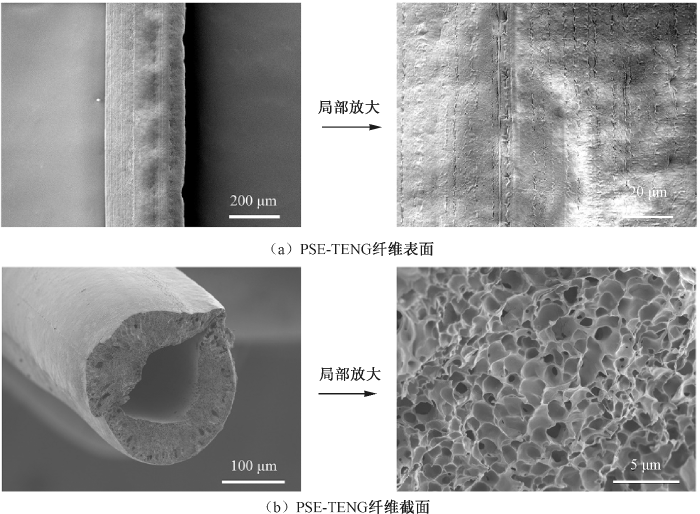
图2
PSE-TENG纤维的SEM照片
Fig.2
SEM images of PSE-TENG fiber.
(a) Surface of PSE-TENG fiber; (b) Cross section of PSE-TENG fiber
图3
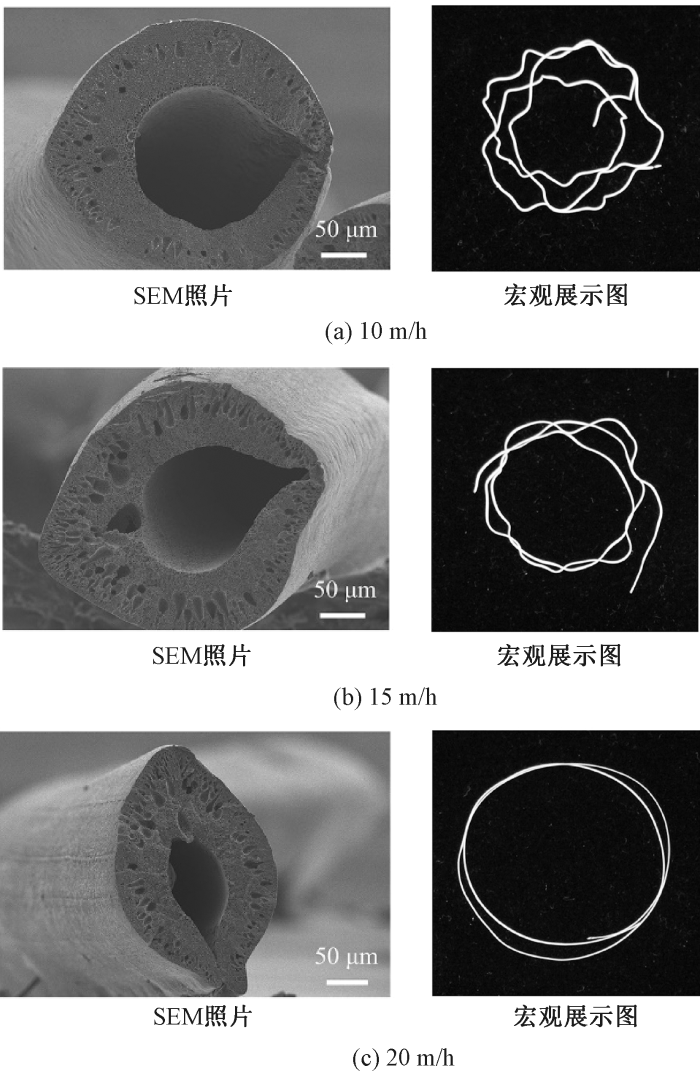
图4
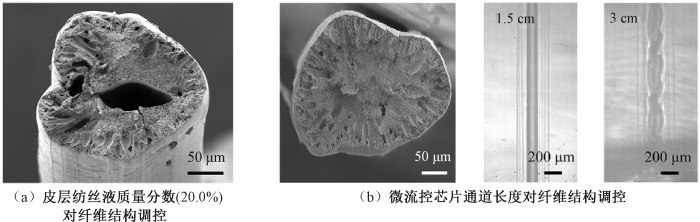
图4
纺丝参数对纤维结构的调控
Fig.4
PSE-TENG fiber structure regulated by concentration of sheath spinning solution (a) and channel length of microfluidic chip (b)
由图3可知,当收丝速度增加时,纤维的芯层空间会逐渐变小,纤维宏观结构从无规弯曲变为直线型。这是因为收丝速度的增加导致纤维在凝固浴中受到更大的拉伸牵引作用,使芯层被压缩,纤维被拉直。由图4(a)可知,仅提高PVDF-HFP纺丝液质量分数(20% PVDF-HFP/DMF),此时纺丝液含量过高,纤维在凝固浴中难以充分固化,使得纤维在收丝过程中变形,无法形成预设的皮芯结构。由图4(b)可知,仅增加芯片通道长度时,因为芯层与皮层溶液之间存在较长的接触时间,且存在微小湍流或扰动的可能性增加,提升了二者之间扩散的机会,同时流体速度的变化以及剪切效应的增加,共同导致芯层与皮层之间存在界面不稳定,发生部分混合,使得纤维难以形成稳定的皮芯结构[22]。因此,为了稳定制备具有皮芯结构的PSE纤维,本文最终采用收丝速度为20 m/h、PVDF-HFP纺丝液质量分数为12.5%、芯片通道长度为1.5 cm的纺丝参数。
2.2 PSE-TENG纤维的力学性能
图5
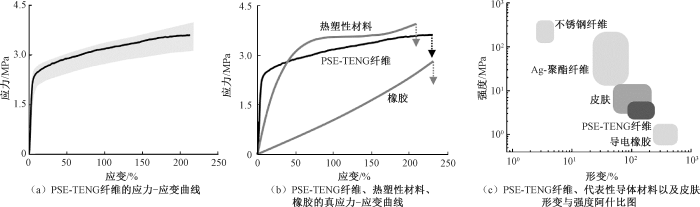
图5
PSE-TENG纤维的力学性能
Fig.5
Mechanical properties of PSE-TENG fiber.
(a) Stress-strain curve of PSE-TENG fiber; (b) True stress-elongation curves of PSE-TENG fiber, thermoplastic materials and rubber; (c) Ashby plots of strain and strength of PSE-TENG fiber, representative conductive materials and skin
在初始拉伸阶段,PSE-TENG纤维发生较小的应变变化,就会产生较大的应力变化。在这段应变范围内,纤维发生的是弹性形变,符合胡克定律,应力会随应变的增加以恒定的斜率增加,通过计算得到纤维的弹性模量为(66.9±14.6)MPa。应力-应变曲线达到一定应力值后,纤维开始进入塑性形变阶段。随着塑性形变的增加,纤维的应力水平也随之增加,纤维强度提升、更难以形变。最终,当应力达到纤维的断裂强度(3.32±0.19)MPa时,纤维发生断裂,断裂应变为(176.83±27.14)%。
2.3 PSE-TENG的功能应用
图6示出TENG的工作原理。SE芯层作为导电电极材料,PVDF-HFP皮层作为负摩擦电材料。可看出,当PSE-TENG与丁腈远离时,二者表面未发生电荷转移。当PSE-TENG与丁腈靠近时,由于PVDF-HFP的高表面电子亲和力, 丁腈表面与PSE-TENG的PVDF-HFP皮层表面产生极性相反的电荷,负电荷从丁腈表面转移至PVDF-HFP表面。PVDF-HFP表面上未屏蔽的负电荷吸引SE中的正电荷移动到SE/PVDF-HFP界面,进行电荷补偿。而SE中的负电荷移动到SE与铜导体之间的界面,铜导体中的自由电子流向地面。当PSE-TENG与丁腈完全接触时,系统整体电荷得到平衡。但如果PSE-TENG与丁腈重新分离,电荷的运动逆转,自由电子从地面流向铜导体。当PSE-TENG与丁腈完全远离时,系统整体电荷得到平衡,没有电信号输出。总之,如果PSE-TENG与丁腈反复接触-分离,则输出信号是循环的,且符号相反[26-27]。图7(a)示出用于自动循环测试的设备。该设备用于定量评估PSE-TENG性能在恒定频率(0.5~3 Hz)下响应恒定负载压力(2~12 N)的长期稳定性。由图7(b)可知,在相同压力下,输出电压V与接触频率呈正相关。V=QR/t,其中Q为每个接触产生的传递电荷,t为接触时间[28]。在这种情况下,Q被当作常数,因为接触面积本质上是常数。也就是说,该式表明,工作频率越高,PSE-TENG电极与地之间的电荷转移越快,从而输出电压随着外部负载频率的增加而增加。这种特性适用于高频(例如瞬时运动或振动)传感应用,因为信号强度随着测试频率的增加而呈线性增加。
图6
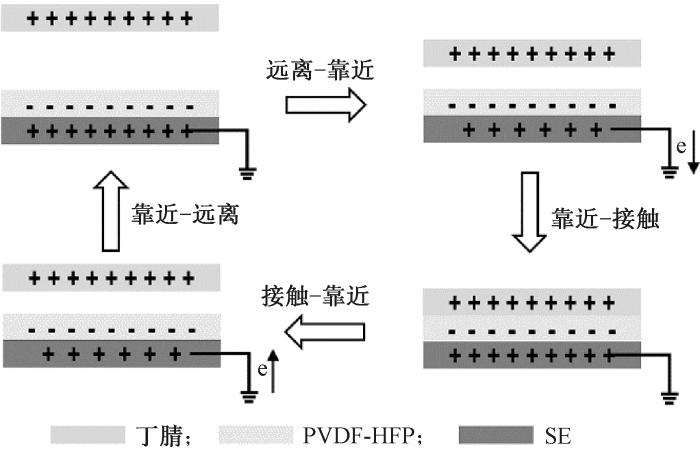
图6
PSE-TENG单电极工作原理
Fig.6
Working principle of PSE-TENG in single-electrode mode
图7
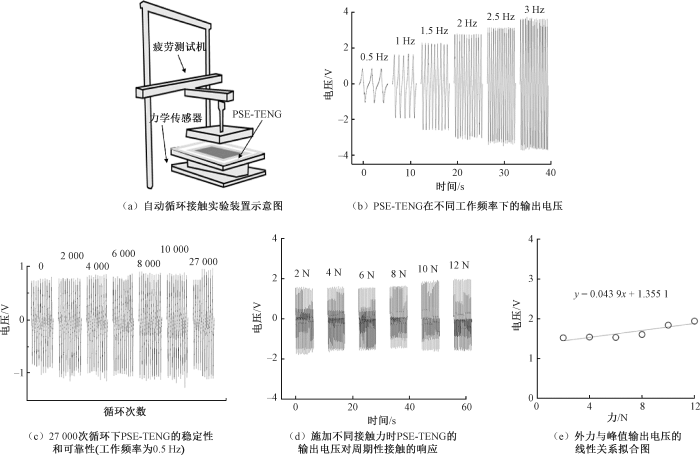
图7
PSE-TENG的电输出特性
Fig.7
Characterization of electrical output from PSE-TENG.
(a) Schematic illustration of automatic cyclic contact test device; (b) Output voltages of PSE-TENG at different working frequencies; (c) Stability and reliability of PSE-TENG at 27 000 cycles with working frequency of 0.5 Hz; (d) Output voltages of PSE-TENG in response to periodic compression with different contact forces applied; (e) Fitting diagram of linear relationship between external force and peak output voltage
3 结论
本文通过微流控湿法纺丝技术制备的用于摩擦纳米发电机的具有皮芯结构的纤维(PSE-TENG纤维),由聚偏氟乙烯-六氟丙烯(PVDF-HFP)皮层和丝素蛋白离子液体(SE)芯层组成,其具有良好的柔韧性和力学强度,可确保纤维在使用过程中的力学完整性以及满足可穿戴摩擦纳米发电机织物所需具有的柔软性。PSE-TENG纤维在不同频率的接触-分离动作下,会产生不同峰值的信号,且电压值与频率呈线性正相关。此外,PSE-TENG纤维还具有长期稳定性,在2万多次的接触-分离动作下,仍稳定输出信号。同时,纤维输出的信号仅与触觉相关,受外力大小影响较小。所制备的PSE-TENG纤维有潜力作为摩擦纳米发电机应用到自供能的可穿戴智能织物领域。
参考文献
Flexible energy storage devices to power the future
[J].
Triboelectric nanogenerator based self-powered sensor for artificial intelligence
[J].
Nanogenerator-based self-powered sensors for wearable and implantable electronics
[J].
Reviving vibration energy harvesting and self-powered sensing by a triboelectric nanogenerator
[J].
A review on the progress in core-spun yarns (CSYs) based textile TENGs for real-time energy generation, capture and sensing
[J].
Large-scalable fabrication of liquid metal-based double helix core-spun yarns for capacitive sensing, energy harvesting, and thermal management
[J].
包缠复合纱摩擦纳米发电机的制备及其电学性能
[J].
Preparation and electrical properties of triboelectric nanogenerator based on wrapped composite yarn
[J].
Conductance-stable liquid metal sheath-core microfibers for stretchy smart fabrics and self-powered sensing
[J].
Conductive composite fiber with customizable functionalities for energy harvesting and electronic textiles
[J].
Digitally tunable physicochemical coding of material composition and topography in continuous micro-fibres
[J].
DOI:10.1038/nmat3108
PMID:21892177
[本文引用: 2]

Heterotypic functional materials with compositional and topographical properties that vary spatiotemporally on the micro- or nanoscale are common in nature. However, fabricating such complex materials in the laboratory remains challenging. Here we describe a method to continuously create microfibres with tunable morphological, structural and chemical features using a microfluidic system consisting of a digital, programmable flow control that mimics the silk-spinning process of spiders. With this method we fabricated hydrogel microfibres coded with varying chemical composition and topography along the fibre, including gas micro-bubbles as well as nanoporous spindle-knots and joints that enabled directional water collection. We also explored the potential use of the coded microfibres for tissue engineering applications by creating multifunctional microfibres with a spatially controlled co-culture of encapsulated cells.
Review of microfluidic approaches for fabricating intelligent fiber devices: importance of shape characteristics
[J].
DOI:10.1039/d0lc01208d
PMID:33710187
Shape characteristics, which include the physical dimensions (scale), apparent morphology, surface features, and structure, are essential factors of fibrous materials and determine many of their properties. Microfluidic technologies have recently been proposed as an approach for producing one-dimensional (1D) fibers with controllable shape characteristics and particle alignment, which impart specific functionality to the fiber. Moreover, superfine 1D fibers with a high surface area and ordered structure have many potential applications as they can be directly braided or woven into textiles, clothes, and tissues with two- or three-dimensional (2D or 3D) structures. Previous reviews of microfluidic spinning have not focus on the importance of the shape characteristic on fiber performance and their use in intelligent fiber design. Here, the latest achievements in microfluidic approaches for fiber-device fabrication are reviewed considering the underlying preparation principles, shape characteristics, and functionalization of the fibers. Additionally, intelligent fiber devices with shapes tailored by microfluidic approaches are discussed, including 1D sensors and actuators, luminous fibers, and devices for encoding, energy harvesting, water collection, and tissue engineering applications. Finally, recent progress, challenges, and future perspectives of the microfluidic approaches for fiber device fabrication are discussed.
Microfluidic generation of microsprings with ionic liquid encapsulation for flexible electronics
[J].
Multifunctional micro/nanoscale fibers based on microfluidic spinning technology
[J].
Structure-tunable graphene oxide fibers via microfluidic spinning route for multifunctional textiles
[J].
A highly stretchable and washable all-yarn-based self-charging knitting power textile composed of fiber triboelectric nanogenerators and supercapacitors
[J].
DOI:10.1021/acsnano.7b05317
PMID:28901749
[本文引用: 1]
Rapid advancements in stretchable and multifunctional wearable electronics impose a challenge on corresponding power devices that they should have comparable portability and stretchability. Here, we report a highly stretchable and washable all-yarn-based self-charging knitting power textile that enables both biomechanical energy harvesting and simultaneously energy storing by hybridizing triboelectrical nanogenerator (TENG) and supercapacitor (SC) into one fabric. With the weft-knitting technique, the power textile is qualified with high elasticity, flexibility, and stretchability, which can adapt to complex mechanical deformations. The knitting TENG fabric is able to generate electric energy with a maximum instantaneous peak power density of ∼85 mW·m and light up at least 124 light-emitting diodes. The all-solid-state symmetrical yarn SC exhibits lightweight, good capacitance, high flexibility, and excellent mechanical and long-term stability, which is suitable for wearable energy storage devices. The assembled knitting power textile is capable of sustainably driving wearable electronics (for example, a calculator or temperature-humidity meter) with energy converted from human motions. Our work provides more opportunities for stretchable multifunctional power sources and potential applications in wearable electronics.
Progress on wearable triboelectric nanogenerators in shapes of fiber, yarn, and textile
[J].
DOI:10.1080/14686996.2019.1650396
PMID:31497178
[本文引用: 1]
Textile has been known for thousands of years for its ease of use, comfort, and wear resistance, which resulted in a wide range of applications in garments and industry. More recently, textile emerges as a promising substrate for self-powered wearable power sources that are desired in wearable electronics. Important progress has been attained in the exploitation of wearable triboelectric nanogenerators (TENGs) in shapes of fiber, yarn, and textile. Along with the effective integration of other devices such as supercapacitor, lithium battery, and solar cell, their feasibility for realizing self-charging wearable systems has been proven. In this review, according to the manufacturing process of traditional textiles starting from fibers, twisting into yarns, and weaving into textiles, we summarize the progress on wearable TENGs in shapes of fiber, yarn, and textile. We explicitly discuss the design strategies, configurations, working mechanism, performances, and compare the merits of each type of TENGs. Finally, we present the perspectives, existing challenges and possible routes for future design and development of triboelectric textiles.
High-performance triboelectric nanogenerator based on electrospun PVDF-graphene nanosheet composite nanofibers for energy harvesting
[J].
Manipulating relative permittivity for high-performance wearable triboelectric nanogenerators
[J].
DOI:10.1021/acs.nanolett.0c01987
PMID:32584050
[本文引用: 1]
As the world marches into the era of the Internet of Things (IoT), the practice of human health care is on the cusp of a revolution, driven by an unprecedented level of personalization enabled by a variety of wearable bioelectronics. A sustainable and wearable energy solution is highly desired, but challenges still remain in its development. Here, we report a high-performance wearable electricity generation approach by manipulating the relative permittivity of a triboelectric nanogenerator (TENG). A compatible active carbon (AC)-doped polyvinylidene fluoride (AC@PVDF) composite film was invented with high relative permittivity and a specific surface area for wearable biomechanical energy harvesting. Compared with the pure PVDF, the 0.8% AC@PVDF film-based TENG obtained an enhancement in voltage, current, and power by 2.5, 3.5, and 9.8 times, respectively. This work reports a stable, cost-effective, and scalable approach to improve the performance of the triboelectric nanogenerator for wearable biomechanical energy harvesting, thus rendering a sustainable and pervasive energy solution for on-body electronics.
A comprehensive review on fundamental properties and applications of poly(vinylidene fluoride) (PVDF)
[J].
Electroassisted core-spun triboelectric nanogenerator fabrics for intellisense and artificial intelligence perception
[J].
DOI:10.1021/acsnano.1c10680
PMID:35238534
[本文引用: 4]
IntelliSense fabrics that can sense transient mechanical stimuli are widely anticipated in flexible and wearable electronics. However, most IntelliSense fabrics developed so far are only sensitive to quasi-static forces, such as stretching, bending, or twisting. In this work, a sheath-core triboelectric nanogenerator (SC-TENG) yarn was developed via a rational design, electroassisted core spinning technique, that consisted of a rough nanoscale dielectric surface and mechanically strong and electrically conductive core yarns. The resulting system was used to sense and distinguish the instantaneous mechanical stimuli generated by different materials. To further improve the sensing accuracy, a machine learning model, based on a classification coding and recurrent neural network, was built to predict the type of contact materials from the peak profiles of output voltages. With these experimental and algorithmic optimizations, we finally used SC-TENG yarn to identify the type of materials in real-time. Moreover, by applying Internet of Things techniques, we investigated that SC-TENG yarn could be integrated into an IntelliSense system to recognize and control various electronic and electrical systems, demonstrating promising applications in wearable energy supply, IntelliSense fabrics, and human-machine interactions.
Biomimetic spun silk ionotronic fibers for intelligent discrimination of motions and tactile stimuli
[J].
Effect of flow velocity on laminar flow in microfluidic chips
[J].
Chameleon-like elastomers with molecularly encoded strain-adaptive stiffening and coloration
[J].
DOI:10.1126/science.aar5308
[本文引用: 1]
Active camouflage is widely recognized as a soft-tissue feature, and yet the ability to integrate adaptive coloration and tissuelike mechanical properties into synthetic materials remains elusive. We provide a solution to this problem by uniting these functions in moldable elastomers through the self-assembly of linear-bottlebrush-linear triblock copolymers. Microphase separation of the architecturally distinct blocks results in physically cross-linked networks that display vibrant color, extreme softness, and intense strain stiffening on par with that of skin tissue. Each of these functional properties is regulated by the structure of one macromolecule, without the need for chemical cross-linking or additives. These materials remain stable under conditions characteristic of internal bodily environments and under ambient conditions, neither swelling in bodily fluids nor drying when exposed to air.
Mimicking biological stress-strain behaviour with synthetic elastomers
[J].
Interlaced amphiphobic nanofibers for smart waterproof and breathable membranes with instant waterproofness monitoring ability
[J].
Triboelectric nanogenerator: structure, mechanism, and applications
[J].
DOI:10.1021/acsnano.0c09803
PMID:33427457
[本文引用: 1]
With the rapid development of the Internet of Things (IoT), the number of sensors utilized for the IoT is expected to exceed 200 billion by 2025. Thus, sustainable energy supplies without the recharging and replacement of the charge storage device have become increasingly important. Among various energy harvesters, the triboelectric nanogenerator (TENG) has attracted considerable attention due to its high instantaneous output power, broad selection of available materials, eco-friendly and inexpensive fabrication process, and various working modes customized for target applications. The TENG harvests electrical energy from wasted mechanical energy in the ambient environment. Three types of operational modes based on contact-separation, sliding, and freestanding are reviewed for two different configurations with a double-electrode and a single-electrode structure in the TENGs. Various charge transfer mechanisms to explain the operational principles of TENGs during triboelectrification are also reviewed for electron, ion, and material transfers. Thereafter, diverse methodologies to enhance the output power considering the energy harvesting efficiency and energy transferring efficiency are surveyed. Moreover, approaches involving not only energy harvesting by a TENG but also energy storage by a charge storage device are also reviewed. Finally, a variety of applications with TENGs are introduced. This review can help to advance TENGs for use in self-powered sensors, energy harvesters, and other systems. It can also contribute to assisting with more comprehensive and rational designs of TENGs for various applications.
Stretchable, washable, and ultrathin triboelectric nanogenerators as skin-like highly sensitive self-powered haptic sensors
[J].
On Maxwell's displacement current for energy and sensors: the origin of nanogenerators
[J].

 京公网安备11010502044800号


