



近年来,典型的柔性天线的构建方法主要有以下3种:导电浆料涂覆、丝网印刷、编织。其中,通过将有机硅导电银胶等导电浆料作为辐射贴片涂覆在如聚二甲基硅氧烷(PDMS)柔性透明基体上得到柔性薄膜状微带天线[6],一方面,PDMS聚合物薄膜基底透气性差,另一方面,薄膜与电子织物的模量不匹配,在织物频繁复杂形变中,其性能易受损;此外,通过丝网印刷技术将导电油墨在织物表面形成特定形状的导电涂层可得到印刷织物天线[7],由于导电油墨与织物之间界面不稳定,在织物反复摩擦、水洗等情况下易出现导电涂层磨损和脱落情况,进而导致天线失效;相比之下,通过编织将导电纱线在织物基底表面形成特定的导电辐射单元[8],得到的织物天线具有结构稳定、透气性好等优点。
基于此,本文采用数字编织的方法构建Wi-Fi双频缝隙织物天线。首先,基于电磁仿真软件仿真设计得到宽频带、结构简单的2.45 GHz和5.2 GHz双频微带缝隙天线的结构;进一步通过数字编织的方法,将镀银锦纶在棉织物基底上形成特定形状,构建Wi-Fi双频织物天线。研究了该Wi-Fi双频织物天线的工作频段、增益性能和人体安全性。探究了在织物发生弯曲、扭曲形变下天线性能的稳定性;同时考察了Wi-Fi双频织物天线的透气性。Wi-Fi双频织物天线在电子织物领域展示出巨大的应用潜力,为电子织物的无线通信功能提供了一种新的解决方案。
1 Wi-Fi双频织物天线仿真设计与构建
1.1 Wi-Fi双频织物天线的仿真设计
微带缝隙天线具有低剖面、共形能力强、结构简单等特点,为满足电子织物集成系统对于织物天线的需求,本文基于镀银锦纶和棉织物基底设计了一种Wi-Fi双频织物天线,即2.4 GHz和5.2 GHz双频微带缝隙织物天线,结构如图1所示。织物天线的整体尺寸为长98 mm、宽93.4 mm、厚4.5 mm,导电功能层为31.11 tex镀银锦纶(电阻率为2.7 Ω·cm,东莞市粤顺新材料有限公司);柔性介电基底为棉织物(面密度为250 g/m2,杭州宇迈纺织品有限公司),介电常数为1.84,损耗正切为0.07;织物天线由上表面缝隙天线单元、中间层介电基底和地板3层组成,靠近馈线一侧则通过导电线连接上下表面的地板,增强天线的抗干扰能力。
图1
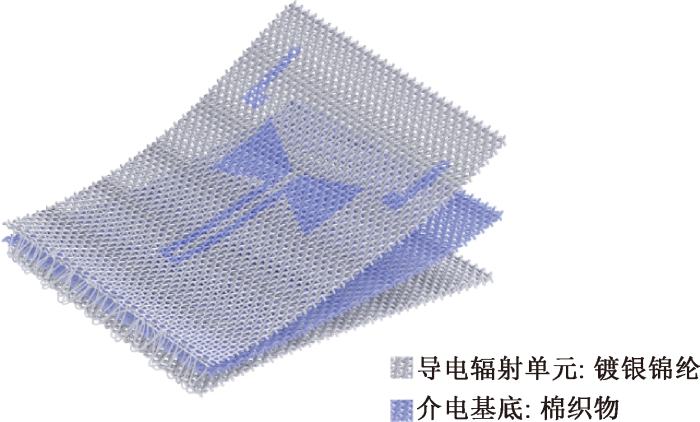
图1
Wi-Fi双频织物天线的结构示意图
Fig.1
Structure schematic diagram of Wi-Fi dual-band fabric antenna
图2示出Wi-Fi双频织物天线结构的设计过程[12]。首先,针对低剖面、易共形、易加工的应用需求,设计了基于接地共面波导的矩形缝隙天线Ant-1,根据巴比涅原理和电磁对偶原理,设置缝隙的初始尺寸为工作波长的一半,即λ/2。然而,该缝隙天线在2.4 GHz频段下的反射系数仅勉强达到-10 dB的要求,裕量较小,且无法同时覆盖2.4 GHz和5.2 GHz频段;为改善天线在2.4 GHz频段的反射系数,将矩形缝隙改为渐变型[13],得到Ant-2;最后,为实现天线在2.4 GHz和5.2 GHz频段的同时覆盖,在矩形缝隙上方添加一对对称的L型缝隙,得到Ant-3。本文所设计的天线结构及参数如图3所示。
图2
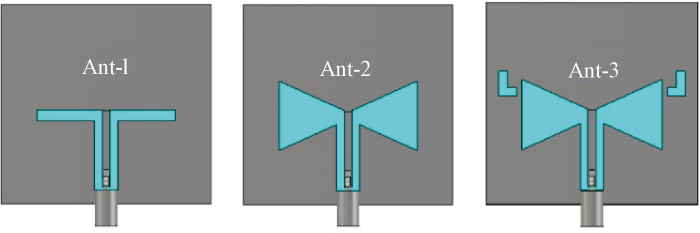
图2
双频织物天线的结构演变过程示意图
Fig.2
Schematic diagram of evolution process of dual-band fabric antenna structure
图3
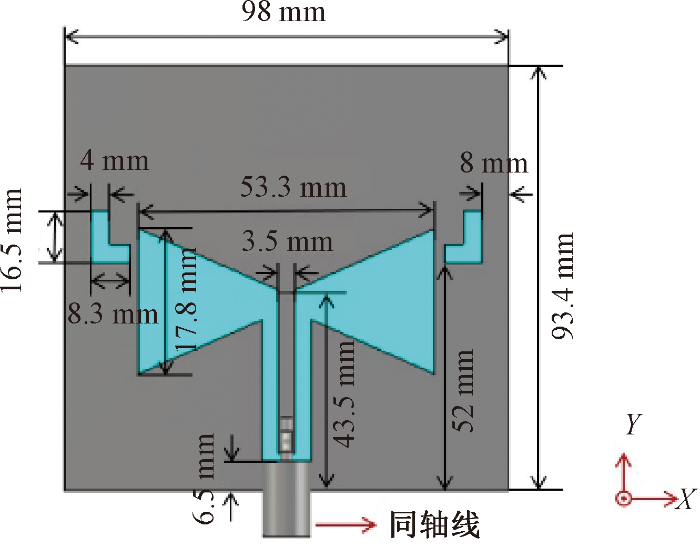
图4
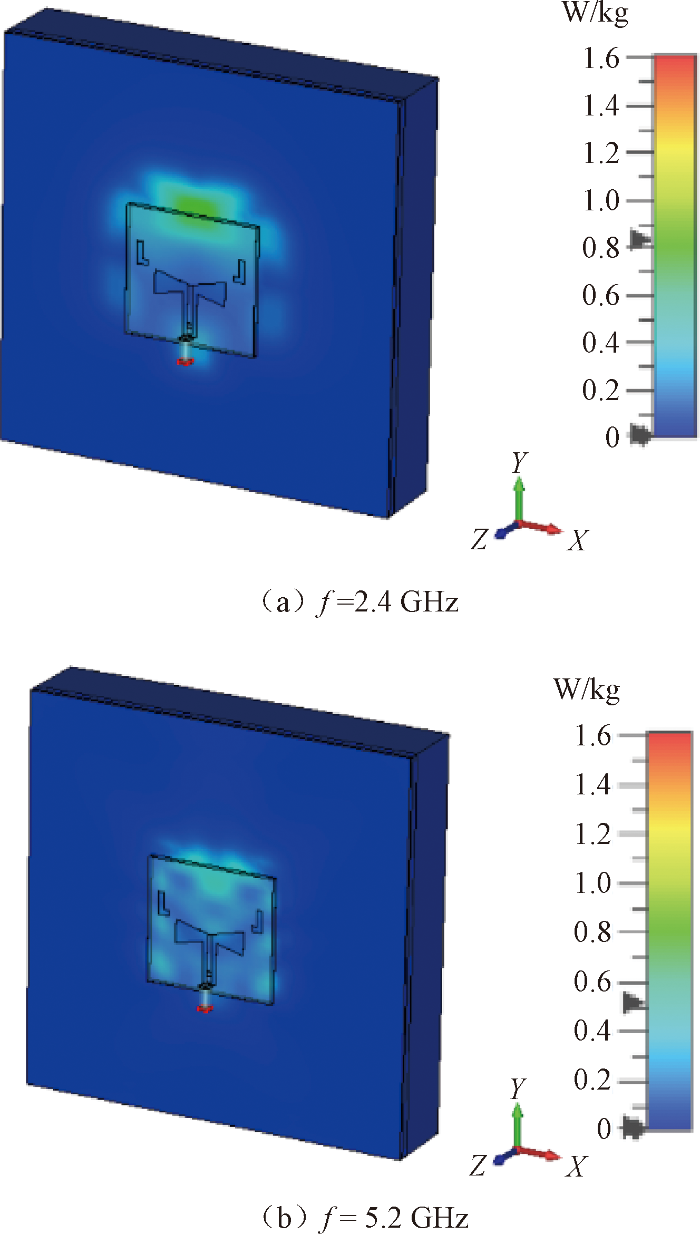
图4
Wi-Fi双频织物天线的比吸收率分布仿真结果
注:f表示频率。
Fig.4
Simulated results of specific absorption rate distribution of proposed antenna
表1 人体组织的电磁特性参数表
Tab.1
| 人体组织 | 介电常数 | 电导率/(S·m-1) | 密度/(kg·m-3) |
|---|---|---|---|
| 皮肤 | 35.11 | 3.72 | 1 100 |
| 脂肪 | 4.95 | 0.29 | 910 |
| 肌肉 | 48.48 | 4.96 | 1 041 |
1.2 Wi-Fi双频织物天线的构建
首先将电磁仿真软件中设计的天线图案导入4.5版本商用软件(威尔克姆大豪科技股份有限公司)中,将导电辐射单元的图案转化为刺绣针脚轨迹图。随后使用FT-1201数字绣花机(浙江合和机电有限公司)在棉织物上分别用镀银锦纶刺绣缝隙天线正面图案和导电地板,其中数字绣花机的工作范围设置为10 cm × 10 cm;最后,利用JA007电动缝纫机(兄弟(中国)商业有限公司)用镀银锦纶将天线正面靠近馈电线一侧与地板进行缝合,得到Wi-Fi双频织物天线。Wi-Fi双频织物天线的实物照片如图5所示。
图5
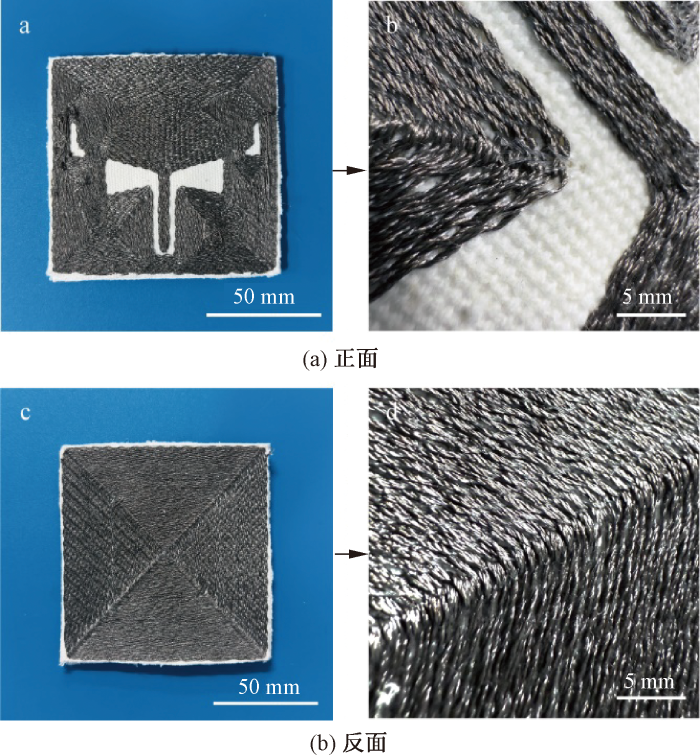
图5
Wi-Fi双频织物天线正面与反面及细节照片
Fig.5
Front (a) and back (b) detailed images of Wi-Fi dual-band fabric antenna
2 Wi-Fi双频织物天线的性能测试
2.1 反射系数及带宽测试
采用ZNA50矢量网络分析仪(罗德与施瓦茨(中国)科技有限公司)测试Wi-Fi双频织物天线在2~6 GHz范围内的反射系数(|S11|)。
2.2 辐射方向图测试
在微波无回波暗室中,对Wi-Fi双频织物天线进行远场辐射性能测试,获得其在2~6 GHz的辐射方向图。
2.3 弯曲稳定性测试
将Wi-Fi双频织物天线分别沿图案水平(X)和垂直(Y)方向弯曲,弯曲直径分别为20和40 cm,采用矢量网络分析仪分别测试不同方向不同弯曲角度下的反射系数。
2.4 摩擦稳定性测试
参考GB/T 3920—2008《纺织品 色牢度试验 耐摩擦色牢度》,将Wi-Fi双频织物天线固定在平台上,用直径50 mm的圆柱体摩擦头在天线表面施以向下的压力,进行往复直线摩擦运动,采用矢量网络分析仪分别测试摩擦前后的反射系数。
2.5 水洗稳定性测试
将Wi-Fi双频织物天线在清水中充分搅拌,待织物样品完全浸湿后取出,并在57 ℃温度下烘干,采用矢量网络分析仪分别测试水洗前后的反射系数。
2.6 透气性测试
参考GB/T 5453—1997《纺织品 织物透气性的测定》,采用YG461E-III全自动透气量仪测试Wi-Fi双频织物天线和商用棉织物对比样(面密度为250 g/m2,杭州宇迈纺织品有限公司)的透气性。分别将Wi-Fi双频织物天线和商用棉织物夹持在试样圆台上,使空气在压降为100 Pa下通过测试面积为20 cm2的试样,1 min后记录气流流量,在同一样品不同部位测定10次后取平均值。测试温度为(23±2) ℃,湿度为(49±1)%。
3 Wi-Fi双频织物天线的性能分析
3.1 反射系数及带宽分析
|S11|是天线设计中的重要指标之一。通常规定|S11|<-10 dB的频率范围为天线的有效工作带宽。Wi-Fi双频织物天线的反射系数的实测和仿真曲线如图6所示。其中灰色阴影部分分别为Wi-Fi 2.45 GHz(2.4~2.48 GHz)和5.2 GHz(5.15~5.35 GHz)频段的频率覆盖范围,可看出,Wi-Fi双频织物天线在2.43 GHz的实测|S11|为-13.4 dB,在5.15 GHz的实测|S11|为-10.3 dB,能够覆盖Wi-Fi 2.4 GHz和5.2 GHz 2个工作频段。天线的缝隙长度和宽度是影响反射系数的主要参数,由于数字绣花机的加工精度为2 mm,实际加工的天线缝隙的尺寸与仿真设计存在一定的误差,导致实际测量的反射系数曲线与仿真结果存在误差。
图6
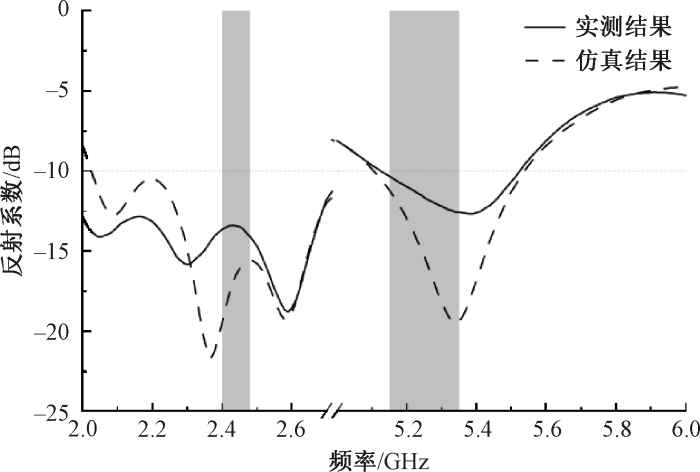
图6
Wi-Fi双频织物天线反射系数的实测和仿真结果
Fig.6
Measured and simulated reflection coefficients of Wi-Fi dual-band fabric antenna
3.2 辐射方向图分析
图7
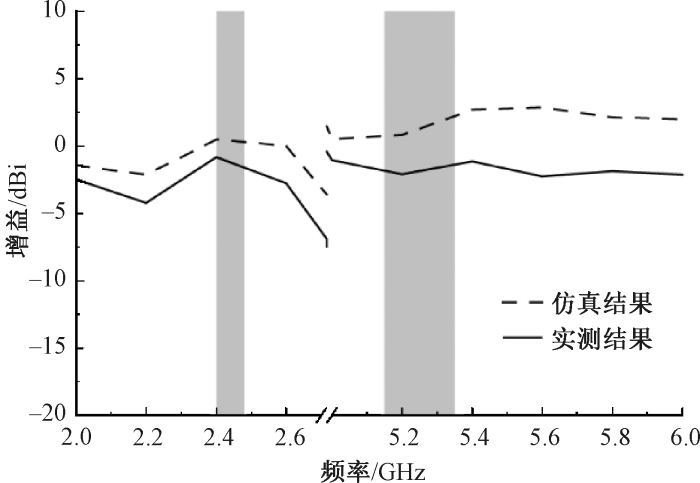
图7
Wi-Fi双频织物天线增益的实测和仿真结果
Fig.7
Measured and simulated gains of Wi-Fi dual-band fabric antenna
图8
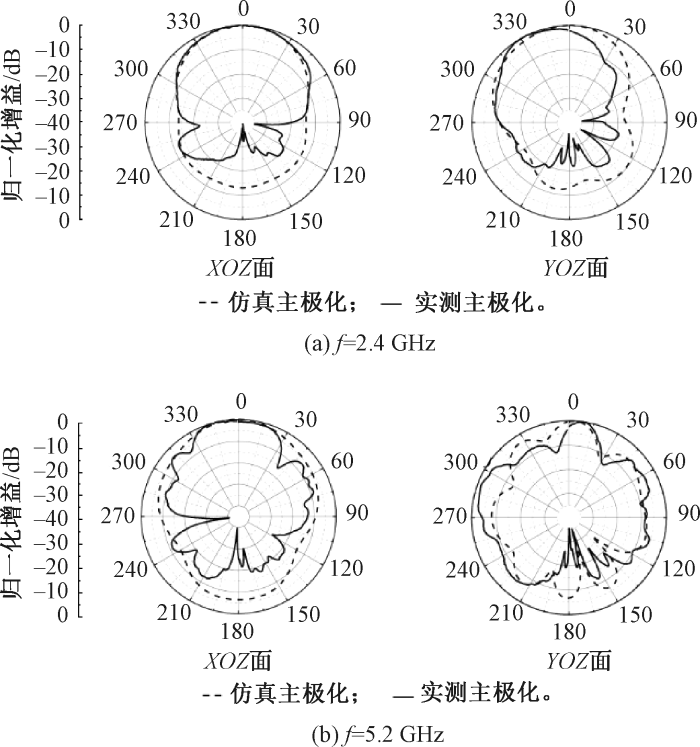
图8
Wi-Fi双频织物天线辐射方向图的实测和仿真结果
Fig.8
Measured and simulated radiation patterns of Wi-Fi dual-band fabric antenna
3.3 织物天线的电性能稳定性分析
织物天线作为电子织物系统的一部分,在实际应用过程中不可避免会遇到弯曲、摩擦和水洗等情况,织物天线在上述条件下保持性能稳定对于织物天线的实际应用具有重要的意义[16]。|S11|是反映天线工作性能稳定可靠的核心指标,在发生形变、表面受损等情形时,天线往往易因为|S11|<-10 dB的频带发生偏移而导致性能受损。
从Wi-Fi双频织物天线的反射系数曲线可以看到,该天线在|S11|<-10 dB的频率范围比2.4 GHz和5.2 GHz的实际工作范围更广,因此在天线由于形变发生轻微频偏时,其带宽仍能覆盖Wi-Fi 2.4 GHz和5.2 GHz这2个工作频段,从而能保持稳定工作。
将Wi-Fi双频织物天线分别沿着图案水平(X)和垂直方向(Y)弯曲后的|S11|曲线如图9所示。可看出,Wi-Fi双频织物天线在发生弯曲时,谐振频率发生轻微偏移,但由于天线的带宽足够宽,其仍可覆盖Wi-Fi 2.4 GHz和5.2 GHz 这2个工作频段,从而可保持稳定工作。
图9
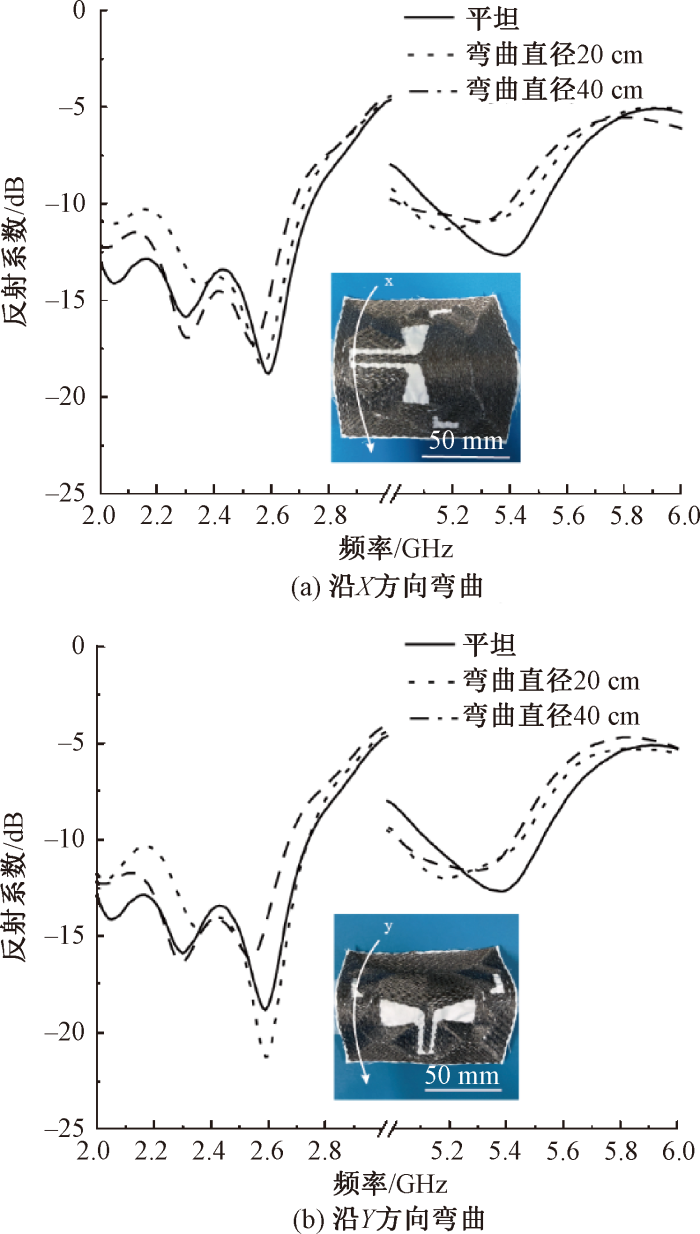
图9
Wi-Fi双频织物天线弯曲时的反射系数
Fig.9
Reflection coefficients of Wi-Fi dual-band fabric antenna when bent. (a) In X direction. (b) In Y direction
将Wi-Fi双频织物天线表面反复摩擦后,织物天线的反射系数曲线如图10所示。可看出,织物天线在经历50、100次摩擦后,其谐振频率仍足以覆盖Wi-Fi 2.4 GHz和5.2 GHz这2个工作频段,从而可保持稳定工作。
图10
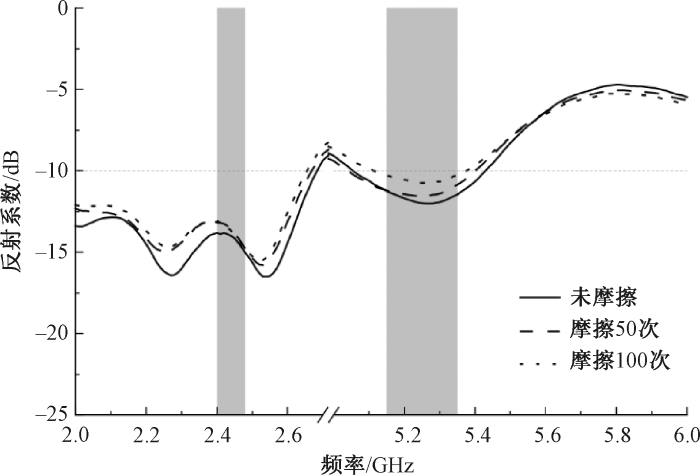
图10
Wi-Fi双频织物天线摩擦前后的反射系数
Fig.10
Reflection coefficients of Wi-Fi dual-band fabric antenna before and after rubbing
Wi-Fi双频织物天线水洗前后的反射系数曲线如图11所示。可看出,织物天线在水洗后谐振频率发生轻微偏移,但由于其带宽足够宽,天线仍足以覆盖Wi-Fi 2.4 GHz和5.2 GHz这2个工作频段,从而可保持稳定工作。
图11
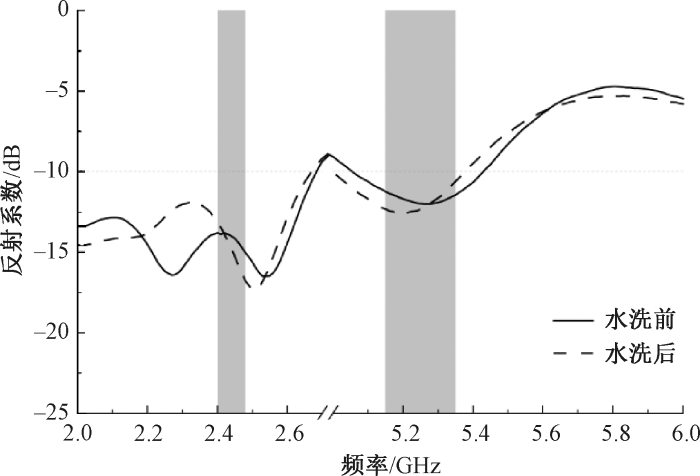
图11
Wi-Fi双频织物天线水洗前后的反射系数
Fig.11
Reflection coefficients of Wi-Fi dual-band fabric antenna before and after washing
3.4 织物天线的透气性分析
作为可穿戴电子器件,除对电磁性能进行研究外,穿戴舒适性对于实际应用也有非常重要的研究意义[17],其中,透气性是衡量穿戴舒适性的重要指标之一,是判断织物能够有效排出湿气并保持皮肤干爽的关键性能。Wi-Fi双频织物天线与相同厚度的商用棉织物对比样的透气率测试结果分别为67.74、89.10 mm/s。二者透气性在同一数量级,说明Wi-Fi双频织物天线的透气性可以满足人体日常穿戴过程中对舒适性的需求。
4 结论
通过电磁仿真软件设计Wi-Fi双频织物天线的结构,通过刺绣方法将镀银锦纶绣在棉织物表面,制备出导电纤维-棉织物-导电纤维3层结构的Wi-Fi双频缝隙织物天线,并对其电磁性能、弯曲稳定性、安全性和透气性等进行表征,得到如下主要结论。
1)基于缝隙天线结构设计的Wi-Fi双频织物天线具有宽带宽、结构简单的特性,能够覆盖2.45 GHz和5.2 GHz 2个频段。
2)实际应用过程中,Wi-Fi双频织物天线在弯曲形变、摩擦、水洗情况下,其反射系数低于-10 dB的频带均能完全覆盖Wi-Fi的2.4 GHz和5.2 GHz频段,展现出优异的电磁性能稳定。
3)在穿着舒适性和安全性方面,Wi-Fi双频织物天线均满足实际应用的需求,透气率达67.74 mm/s,与商用棉织物相当;且在2.4 GHz和5.2 GHz 2个频率下,其比吸收率最大值分别为0.831和0.515 W/kg,低于IEEE C95.1—2005规定的标准值(1.6 W/kg)。
参考文献
Single body-coupled fiber enables chipless textile electronics
[J].
DOI:10.1126/science.adk3755
PMID:38574120
[本文引用: 1]

Intelligent textiles provide an ideal platform for merging technology into daily routines. However, current textile electronic systems often rely on rigid silicon components, which limits seamless integration, energy efficiency, and comfort. Chipless electronic systems still face digital logic challenges owing to the lack of dynamic energy-switching carriers. We propose a chipless body-coupled energy interaction mechanism for ambient electromagnetic energy harvesting and wireless signal transmission through a single fiber. The fiber itself enables wireless visual-digital interactions without the need for extra chips or batteries on textiles. Because all of the electronic assemblies are merged in a miniature fiber, this facilitates scalable fabrication and compatibility with modern weaving techniques, thereby enabling versatile and intelligent clothing. We propose a strategy that may address the problems of silicon-based textile systems.
Electronic textile with passive thermal management for outdoor health monitoring
[J].
Large-area display textiles integrated with functional systems
[J].
Design, analysis and applications of wearable antennas: a review
[J].
Design and SAR analysis of a dual band wearable antenna for WLAN applications
[J].
Stretchable and bendable poly-dimethylsiloxane-silver composite antenna on PDMS/air gap substrate for 5G wearable appli-cations
[J].
Wearable dual-band dual-polarized screen-printed fabric antenna enabled with electromagnetic bandgap structure for ISM and WLAN communications
[J].
Digitally-embroidered liquid metal electronic textiles for wearable wireless systems
[J].
DOI:10.1038/s41467-022-29859-4
PMID:35449159
[本文引用: 1]
Electronic textiles capable of sensing, powering, and communication can be used to non-intrusively monitor human health during daily life. However, achieving these functionalities with clothing is challenging because of limitations in the electronic performance, flexibility and robustness of the underlying materials, which must endure repeated mechanical, thermal and chemical stresses during daily use. Here, we demonstrate electronic textile systems with functionalities in near-field powering and communication created by digital embroidery of liquid metal fibers. Owing to the unique electrical and mechanical properties of the liquid metal fibers, these electronic textiles can conform to body surfaces and establish robust wireless connectivity with nearby wearable or implantable devices, even during strenuous exercise. By transferring optimized electromagnetic patterns onto clothing in this way, we demonstrate a washable electronic shirt that can be wirelessly powered by a smartphone and continuously monitor axillary temperature without interfering with daily activities.© 2022. The Author(s).
Fully textile-integrated microstrip-fed slot antenna for dedicated short-range communications
[J].
On the development of a novel mixed embroidered-woven slot antenna for wireless applications
[J].
Wearable textile multiband antenna for WBAN applications
[J].
基于基片集成波导的双频缝隙天线设计
[J].
Design of dual-frequency slot antenna based on chip-integrated waveguide
[J].
Wideband CPW-fed flexible bow-tie slot antenna for WLAN/WiMax systems
[J].
A wearable PIFA with an all-textile metasurface for 5 GHz WBAN applications
[J].
DOI:10.1109/LAWP.2018.2889117
[本文引用: 1]
In this letter, a wearable all-textile metasurface antenna (MSA) for 5 GHz wireless body area network (WBAN) applications is proposed. All the components of the proposed MSA are made of the comfort textile materials. A metasurface with high permittivity values is placed right above a wide-bandwidth planar inverted-F antenna to realize size miniaturization and gain enhancement. The proposed MSA has a profile of 4 mm (0.07 lambda(0)) and occupies an area of 42 mm x 28 mm (0.77 lambda(0) x 0.51 lambda(0)). Moreover, this antenna realizes a measured peak gain of 6.70 dBi, an average efficiency of 77%, and an operating band from 4.96 to 5.90 GHz that covers the 5 GHz WBAN band. In addition, the on-body studies show that the MSA is suitable for wearable applications.
A compact printed antenna for triple-band WLAN/WiMAX applications
[J].
Highly bendable AMC-based antenna for wearable applications
[J].
Breathable textile rectangular ring microstrip patch antenna at 2.45 GHz for wearable applications
[J].

 京公网安备11010502044800号


