



电子织物作为下一代轻便舒适的可穿戴设备,继承了传统纤维/纺织品的轻便性、柔韧性、透气性和一定的延展性,同时具备电子功能,引起了科学和工程界的广泛关注[1-
尽管有关柔性储能系统的研究正在迅速扩展,织物锂电池的研究仍相对较少。因此,总结这个新兴研究领域的最新进展显得尤为重要。本文首先综述了织物锂电池的组成与反应机制;接着基于纺织品基材及其独特技术特点,详细探讨了织物电极的制造技术、集成方法以及电化学性能;最后分析了织物电池在柔韧性、伸缩性和可洗性等方面的挑战与进展。
1 织物锂电池组成与反应机制
电子织物不仅能够实现与外部医疗设备或植入式生物电子器件的交互,还可持续监测、收集和传输各种生理参数,而织物锂电池能够作为可靠的穿戴电源给其提供电力。图1为织物锂电池为可穿戴设备供电并监测生理参数示意图。20世纪90年代初,日本索尼公司推出了基于锂插层化合物的锂离子电池(LIBs)技术。锂离子电池通常由正极、负极和电解质组成,正负电极之间由隔膜分隔。电极上的活性材料附着在集流体上,负责电荷存储;而集流体作为导电基板,将电极与外部电路连接以进行电荷传输。隔膜则用于隔开正负电极,防止短路。锂离子在正负电极之间通过电解质迁移[7],而电解质可以是液态、准固态或固态。在放电过程中,锂离子通过电解质从负极迁移到正极,同时电子通过外部电路从负极流向正极。充电时,以上过程则反向进行。LIBs是一种通过锂离子与活性材料之间的法拉第反应将电能转化为化学能的能源装置。由于其具有较高的能量密度、较长的循环寿命、无记忆效应、高工作电压以及成熟的生产技术,锂离子电池在便携式设备和可穿戴设备领域占据了主导地位。LIBs的典型正极材料包括层状结构的LiMO2(M表示Co、Ni、Mn)、尖晶石型LiM2O4(M表示Co、Ni、Mn)和橄榄石型LiMPO4(M表示Fe、Ni、Mn、V)[8]。最具代表性且广泛使用的负极材料是石墨、Li4Ti5O12和硅[9]。
图1

图1
织物锂电池为可穿戴设备供电并监测生理参数
Fig.1
Textile lithium batteries powering wearable devices and monitor physiological parameters
图2(a)为锂离子电池组成与反应机制示意图。为进一步提升锂离子电池的能量密度,研究人员开发了新型锂电池,如Li-S电池和Li-O2电池。图2(b)示出Li-O2电池的组成和工作机制[10]。放电时,锂金属负极被氧化,释放出Li+到电解质中;充电时该过程可逆。空气中的O2进入多孔正极,并溶解在孔内的电解质中,放电过程中在电极表面还原。图2(c)示出Li-S电池的组成和工作机制 [10]。放电时正极S被还原,形成各种多硫化物,这些多硫化物与锂结合,最终生成Li2S。Li-S电池和Li-O2电池展现出许多吸引人的特点,包括:1)S或O2正极材料来源丰富、成本低;2)电池的理论能量密度高。然而,这些新型的锂电池技术仍面临着一些关键挑战,如寿命短、功率密度低等,仍需研究人员开发新材料与新技术克服这些挑战,从而进一步提升织物锂电池的电化学性能。
图2
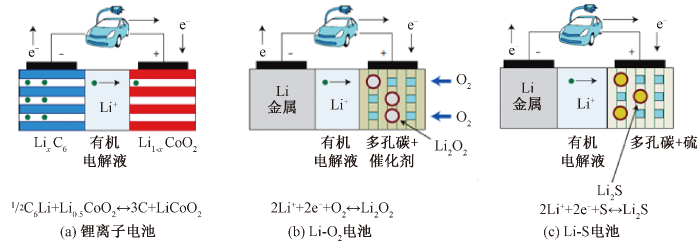
图2
锂离子电池组成与反应机制示意图
Fig.2
Schematic diagram of lithium-ion battery compositions and reaction mechanism.
(a) Lithium-ion battery; (b) Li-O2 battery; (c) Li-S battery
2 织物锂电池的构筑
织物锂电池的制造过程主要包括织物电极的制备和织物电池的组装。本节首先综述了织物电极制造,其直接决定了最终织物锂电池的电化学性能和可穿戴功能;随后,探讨了如何将这些先进电极组装成织物电池,并概述一维纤维型和二维织物型锂电池的独特优势和最新进展。
2.1 织物电极制备
电极的制造过程主要包括选择合适的纤维、纱线或织物作为基底,设计高效的集流体,选用高性能电极材料,并采用简便、高效的方法将电极材料沉积到织物基材上。值得注意的是,应当使用简便且可扩展的加工方法,将这些高性能电极材料加工成织物形式,同时尽量保持织物的固有属性。
2.1.1 织物基材上涂覆材料
尽管大多数织物基材,如棉、涤纶和锦纶等,本质上是不导电的,但其作为可穿戴储能设备的组件表现出巨大的潜力。这主要得益于其固有的灵活性、轻质特性和较大的表面积。因此,需通过引入导电材料来制备织物电极。一种常见的方法是在非导电织物基材上涂覆导电材料,从而赋予其导电功能。为实现这个目标,研究人员已采用多种导电材料,包括导电聚合物复合材料、金属以及碳基材料(如碳纳米管、碳纳米粉和石墨烯等)。在织物基材上涂覆导电材料和活性材料的主要方法包括浸涂和刮刀涂覆。
浸涂是一种在织物上形成均匀薄层材料的工艺,具有简单、高效、可扩展和低成本的优点。该方法通过将织物浸入涂层液中,使液体充分渗透并润湿织物。涂层液的黏度通常较低,能够在织物离开涂层液时自然流走。随后,织物以可控速度从涂层液中取出,去除多余的涂层材料,从而在织物表面形成均匀液膜[11]。然而,活性材料的负载量取决于织物的表面特性。使用不同类型的织物时,涂层的厚度和表面均匀性可能会存在显著差异,导致涂层不均匀。通常采用“浸涂-干燥”循环工艺来实现较高的活性材料负载量。控制涂层液的参数和优化织物表面特性有助于提高浸涂工艺在织物储能领域的应用前景。
刮刀涂覆是另一种广泛应用于大面积表面薄膜生产的技术。该过程通过刀片与织物之间的恒定相对运动,使涂层材料均匀扩散,干燥后形成薄膜。该技术操作速度较快,可达到每分钟几米。薄膜的厚度范围从几十微米到数百微米,但不适合纳米级薄膜的应用[12]。尽管如此,刮刀涂覆因其简便性、多功能性和可扩展性,仍广泛应用于工业领域。与浸涂相比,刮刀涂覆技术能够在连续受控的过程中,更精确、均匀地控制导电材料和活性材料的负载量。
2.1.2 织物基材上印刷材料
印刷工艺涉及将材料以预定义图案的方式受控沉积到织物基材上。印刷方法主要有3种:正接触、负接触和非接触印刷。正接触印刷类似于冲压原理,如印刷机和木刻。凹版印刷或丝网印刷则属于负接触印刷。非接触印刷中,打印头不与基材接触。喷墨印刷是最常见的非接触印刷方式,墨水通过喷嘴喷出并沉积在基底上。丝网印刷是一种模板印刷工艺[13-14]。印刷油墨通过模板转移到基底上。模板由绷在框架上的细丝、合成纤维或金属线制成的细网支撑,刮刀或刀片将油墨压过网格的开口部分。丝网印刷的最大优势之一是基材的多样性,包括纸张、纸板、聚合物材料、纺织品、木材、金属、陶瓷、玻璃和皮革等。选择印刷油墨时,必须考虑基材的类型和表面特性。喷墨印刷能够打印具有特定电气、化学、生物、光学或结构功能的材料[15-16]。喷墨印刷的主要优点包括能够实现纳米到微米级的薄膜沉积、减少材料浪费以及兼容各种具有不同力学柔性的基材。
2.1.3 织物基材上原位生长材料
除将活性材料涂覆到纺织基材上外,研究人员还探索了织物电极的原位生长策略,该策略通过各种化学反应将导电材料和活性材料直接合成到纺织品表面,常用合成方法包括电沉积和水热反应。电沉积方法被广泛用于将过渡金属氧化物和导电聚合物沉积到导电纺织品上[17-18]。该过程采用三电极系统,包括工作电极、参比电极(如Ag/AgCl或饱和甘汞电极)和对电极(通常为Pt)。通过调节电位、电流密度、沉积时间和溶液成分等实验参数,电沉积过程能够精确控制材料的沉积,进而在织物上创建定制的电极结构。然而需注意的是,电沉积可能导致活性材料的负载量较低,这会影响织物电极的比容量。水热反应是一种简单而有效的合成方法,适用于原位生长各种材料,如还原氧化石墨烯、金属氧化物、金属氢氧化物以及导电聚合物(如聚苯胺、聚吡咯和聚3,4-乙烯二氧噻吩)[19-20]。该技术能够精确控制材料沉积并确保均匀覆盖在织物表面。
2.1.4 基于纺丝工艺的织物电极制备
除在现有织物表面涂覆和原位生长导电活性材料外,开发具有本征储能功能的新型纱线和织物也被认为是一种极具前景的方法。为实现这个目标,可采用多种纺丝技术,例如干/湿纺丝、熔融纺丝和静电纺丝。通过这些技术制造的织物电极能够显著提升活性材料与纺织基材之间的界面黏附性,从而有效解决因接触不良导致的电导率下降和容量衰减等问题。更为重要的是,这种方法不仅能够实现高质量的活性材料负载,还与大规模纺织加工具有良好的兼容性,为织物电极的实际应用铺平道路。常用的纺丝技术包括干纺、湿纺、静电纺丝和熔融纺丝等。1)干纺是一种将聚合物溶解在有机溶剂中,与添加剂混合并过滤后制备低黏度聚合物溶液(即“纺丝原液”)的技术[21]。纺丝原液经过过滤、脱气和预热处理,并通过过滤器泵送以确保达到适当的稠度。随后,纺丝原液被挤出到纺丝管中,通过喷丝头的细孔射出。当聚合物溶液的喷射流与热气流接触时,溶剂迅速蒸发,使长丝中的聚合物浓度增加并最终凝固,从而无需额外的干燥步骤。尽管干纺能够制造高性能纤维,其工艺复杂性使得生产成本极高。2)湿纺是另一种纺丝技术[22],通过将聚合物溶液从喷丝头的细孔泵入凝固浴中,并通过卷取辊拉制成连续长丝。溶剂随后从纺出的长丝中移除,使其凝固,并最终收集成连续的丝束或绳。由于纤维凝固依赖于溶剂挥发,因此湿纺的生产速度较慢。湿纺和干纺均可制造直径为微米级的纺丝纤维,而静电纺丝则能够制备直径为数纳米的超细纤维。3)静电纺丝是一种利用聚合物熔体或溶液在高压电场下形成喷射流进行纺丝加工的技术 [23]。该方法简单且经济高效,能够连续生产细长的超细纤维。制备的纤维具有高表面体积比、高纵横比、可控孔径以及优异的力学性能。值得注意的是,通过向纳米纤维基质中掺入少量纳米材料(如石墨烯、碳纳米管、银或镍),可以显著提升纤维的电化学性能。4)熔融纺丝则是合成纤维长丝生产中最常用的一种技术[24]。不同于湿纺和干纺,熔融纺丝无需使用溶剂,因此工艺更加简单且成本低廉。在该工艺中,聚合物颗粒或粒料被送入挤出机加热熔融,随后在压力作用下泵入喷丝头。长丝通过冷空气淬火后凝固,形成连续纤维。后续的拉伸工艺进一步提高了纤维的结晶度,从而增强其力学性能。由于熔融纺丝具备简单性、经济性、与大规模生产的兼容性,以及制造纳米级纤维的能力,因此其在开发高性能织物电池方面展现出重要潜力。
2.2 织物锂电池组装
织物电池的组装包括在织物电极上引入电解质、使用隔膜分隔正负电极,以及对整个设备进行封装。织物电池可采用液态或凝胶/固态电解质,其中,凝胶/固态电解质凭借显著的安全性优势,在柔性可穿戴设备领域展现出独特的适配性。此外,封装是提升设备耐用性和稳定性的关键步骤。封装不仅能防潮和防尘,还可防止受外力而损坏,从而延长电池寿命。常用的封装材料包括塑料管、聚对苯二甲酸乙二醇酯(PET)膜和聚二甲基硅氧烷(PDMS)膜。这些材料在提供保护的同时,可保持设备的柔性和轻量化。然而,目前针对织物电池有效封装方法的研究仍较为有限。因此,开发新型封装材料和技术,已成为实现可穿戴织物储能设备的主要挑战之一。
2.2.1 一维纤维型电池
图3
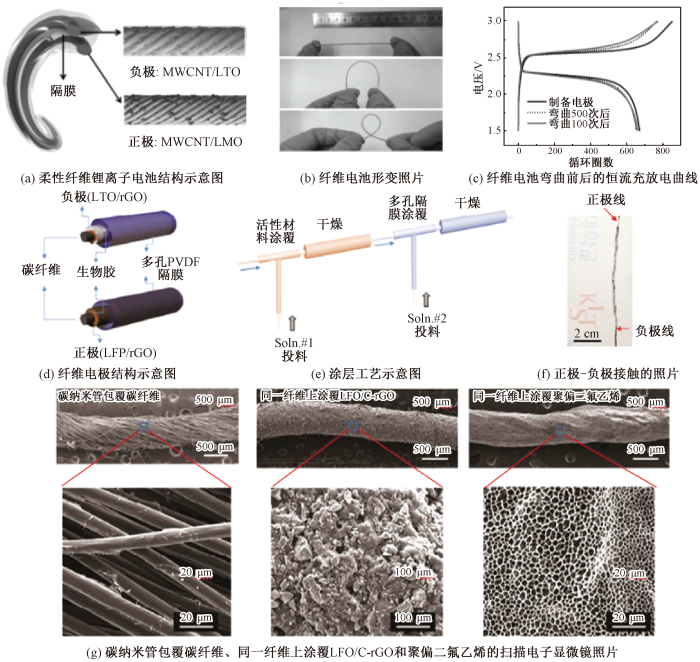
图3
一维纤维型锂离子电池
Fig.3
One-dimensional fiber-type lithium-ion batteries.
(a) Schematic diagram of structure of flexible fiber lithium-ion battery, with MWCNT/LTO and MWCNT/LMO composite yarns as anode and cathode, respectively; (b) Photos of fiber battery deformed into different shapes; (c) Galvanostatic charge/discharge (GCD) curves of fiber battery before and after bending; (d) Schematic diagram of fiber electrode structure; (e) Schematic diagram of coating process; (f) Photo of anode-cathode contact; (g) SEM images of carbon nanotube-coated carbon fiber, LFO/C-rGO active material and polyvinylidene fluoride coated on same fiber
具体而言,首先采用气相沉积(CVD)方法合成多壁碳纳米管(MWCNT)阵列,然后从阵列中制备直径为2~30 μm,长度可达100 m的取向碳纳米管纤维。该纤维具有高达1.3 GPa的优异力学强度和103 S/cm的高电导率。随后在碳纳米管纤维上分别沉积Li4Ti5O12(LTO)和LiMn2O4(LMO)作为负极和正极组装成纤维型锂离子电池,其体积比容量达到109.62 mA·h/cm3。此外,Ha等[26]开发了一种由4种同心结构组成的纤维型锂离子电池。该电池由碳纤维作为集流体、导电生物黏合层、纳米混合活性材料以及多孔膜层组成,LiFePO4/C-rGO和Li4Ti5O12/rGO分别用于正极和负极(见图3(d)~(g))。这种独特的一体化结构结合了自动涂覆工艺,在实现1.6 mA·h/cm高线性容量的同时,展现出优异的柔性和力学稳定性。
图4
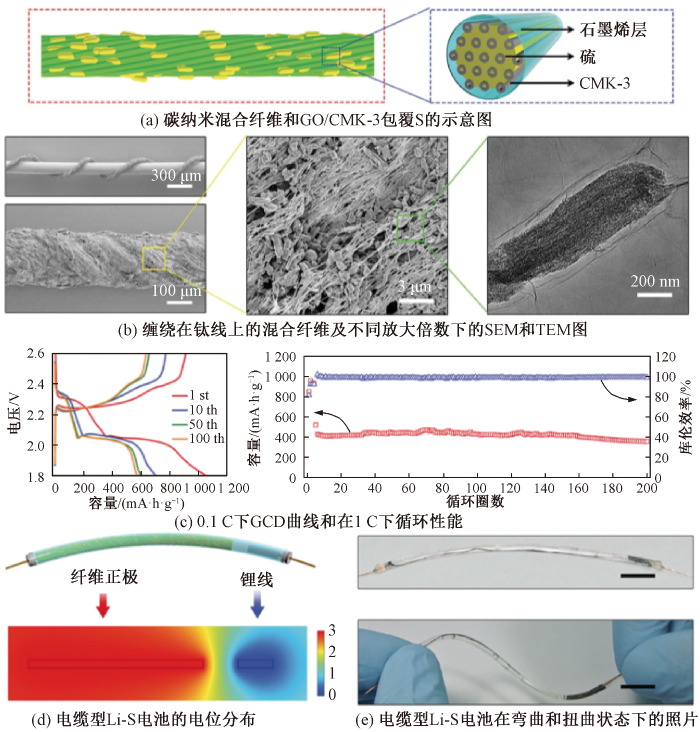
图4
一维纤维型Li-S电池
Fig.4
One-dimensional fiber-type Li-S batteries.
(a) Schematic diagram of carbon nanocomposite fibers and GO/CMK-3/S; (b) Hybrid fibers wrapped around titanium wire and SEM and TEM images at different magnifications; (c) GCD curves at 0.1 C and cycle performance at 1 C; (d) Potential distribution of cable-type Li-S battery; (e) Photos of cable-type Li-S battery in bent and twisted states
Wang等[28]通过结合低密度聚乙烯(LDPE)薄膜、凝胶电解质和LiI氧化还原介质,创建了基于碳纳米管电极的Li-O2电池(见图5(a)、(b))。LDPE薄膜可以抑制环境空气中Li2O2放电产物转变为Li2CO3的副反应,而LiI则有助于促进充电过程中Li2O2的电化学分解。因此,纤维型Li-O2电池在空气中表现出高达610次循环的优异稳定性(见图5(c)、(d))。柔性纤维型Li-O2电池为便携式和可穿戴电子产品的制造提供了可能性。Zhang等[29]通过设计一种固态同轴结构,采用锂化硅/碳纳米管混合纤维作为负极,聚合物凝胶作为中间电解质,裸露的碳纳米管作为正极,成功制备了具有高能量密度和超高柔韧性的纤维型LixSi-O2电池(见图5(f)、(g)),其能量密度高达512 W·h/kg。LixSi/CNT混合纤维不仅避免了枝晶形成和锂金属的安全隐患,还展现出极高的柔韧性。该纤维型LixSi-O2电池在经历20 000次弯曲循环后仍能保持有效工作(见图5(h)、(i))。
图5

图5
一维纤维型Li-O2电池
Fig.5
One-dimensional fiber-type Li-O2 batteries.
(a) Schematic diagram of working mechanism of Li-O2 batteries with and without LDPE film in air; (b) Schematic diagram of structure of fiber-type Li-O2 battery; (c) Charge and discharge curves and cycle performance at 2 000 mA/g; (d) Charge and discharge curves of fiber-type Li-O2 battery after 500 and 1 000 bending cycles; (e) Structure and photo of fiber-type LixSi-O2 battery; (f) Charge and discharge curves of fiber-type LixSi-O2 battery; (g) Performance of fiber-type LixSi-O2 battery under various deformations
2.2.2 二维织物型电池
图6

图6
二维织物型锂离子电池
Fig.6
Two-dimensional textile-type lithium-ion batteries.
(a) Schematic diagram of textile-type lithium-ion battery; (b) Photos of battery coated on textile; (c) SEM images of cross-section of textile-type lithium-ion battery; (d) Charge and discharge curves of textile-type lithium-ion battery at different bending angles; (e) Schematic diagram of preparation of graded silicon-carbon textile electrodes; (f) SEM image of silicon nanowires uniformly coated on carbon fibers; (g) Voltage tests of textile-type lithium-ion battery in different bending states
图6(c)为织物型锂离子电池的横截面图。其中集流体、正极、隔膜和负极层彼此牢固连接。集流体、正极、隔膜和负极层的平均厚度分别为25、19、23和60 μm。PEO的存在能有效抑制材料在组装过程中的降解,使得材料可在开放大气环境中安全涂覆。织物型锂离子电池的开路电压为 2.67 V,放电时间为约为2 000 s,且弯曲不会影响其充放电行为(见图6(d))。Liu等[31]开发了分层硅纳米线/碳织物电极,并将其用作织物型锂离子电池中的负极(见图6(e))。单根硅碳复合纤维的SEM 照片显示,大量约10 μm长的均匀硅纳米线紧密黏附在单根碳纤维的表面上(见图6(f))。组装的织物型锂离子电池展现出高容量(在0.2 C下,比容量为2 950 mA·h/g)、长循环寿命(可达200次循环)、良好的倍率性能以及在不同温度、湿度和曲率下的优异稳定性(见图6(g))。
2.2.3 从一维纤维型电池到二维织物型电池
柔性可穿戴织物电池代表了纤维型电池发展的未来趋势,但这种发展不可避免地需要更严格的标准和复杂的制造工艺。考虑到目前的技术,实现与天然/合成织物一样完美的致密而柔软的织物电池仍具有挑战性,这是因为纤维型电池的直径通常较大,且具有复杂的层状结构和增大的弹性模量。目前,已有2种通用的解决方案:1)将纤维型电池缝制到现有织物中;2)利用纤维型电池单元制造松散的电池织物。Ha等[26]开发了高容量纤维型锂离子电池,并将其用普通针或小织机编织到棉织物中制成织物电池。即使在50%的拉伸条件下,这种织物电池也能保持84%的线性容量(见图7(a))。除织物锂离子电池外,Peng等[27-28]率先研究了其它可编织/可针织纤维型Li-S电池(见图7(b))和Li-O2电池(见图7(c))。
图7

图7
从一维纤维型电池到二维织物型电池
Fig.7
From one-dimensional fiber batteries to two-dimensional textile batteries.
(a) Fiber-type lithium-ion battery woven into cotton textile; (b) Fiber-type Li-S battery woven into textile; (c) Fiber-type Li-O2 battery woven into fabric; (d) Fiber-type lithium-ion battery woven into flexible textile battery; (e) Fiber-type LixSi-O2 battery woven into flexible textile battery
纤维型电池可与各种柔性结构集成,且可弯曲、拉伸和扭曲成各种结构,显示出其在可穿戴应用的巨大潜力。此外,松散编织纤维型电池形成织物电池是实现大规模应用的另一种可行策略。Ren等[25]报道了一种线密度为12 mg/m纤维型锂离子电池,可编织成多种不同结构的织物(见图7(d)),其能量密度高达27 W·h/kg(或17.7 mW·h/cm)。同样,Zhang等[29]通过设计一种同轴结构,开发出一种具有高能量密度和优异柔韧性的纤维型Li-O2电池。这种同轴纤维型电池非常薄,直径仅为500 mm,表现出很高的柔性,因此能够编织成多种柔性纺织品,既能承受各种变形(包括弯曲、折叠和扭曲),又能为商用LED屏幕提供持续电力供应,如图7(e)所示。
2.2.4 织物电池与发电装置的集成
图8

图8
织物电池与摩擦纳米发电机集成
Fig.8
Integration of textile-based batteries and TENG cloth.
(a) Photo of original Ni cloth substrate, LiFePO4 coated cathode and Li4Ti5O12 coated anode; (b) Photo of electrode bending; (c) SEM image of electrode after complete folding; (d) Photo of textile-type lithium-ion battery; (e) Voltage curves and cycle performance of textile-type lithium-ion battery bent at different angles; (f) Equivalent circuit and photo of self-charging system composed of textile battery and TENG textile
图9
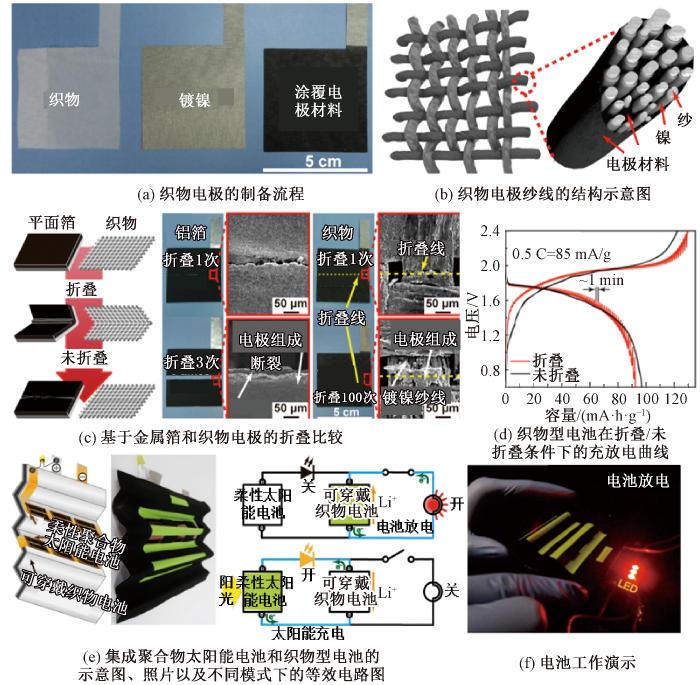
图9
织物电池与太阳能电池集成
Fig.9
Integration of textile-based batteries and solar cells.
(a) Textile electrode preparation process; (b) Schematic diagram of structure of textile electrode yarn; (c) Comparison of electrodes based on metal foil and textile during folding; (d) Charge and discharge curves of textile-based batteries under folded/unfolded conditions; (e) Schematic diagram, photos, and equivalent circuit diagrams of integrated polymer solar cells and textile-based batteries in different modes; (f) Battery operation demonstration
3 织物锂电池的挑战
除优异的电化学性能外,织物电池还应继承纺织品的固有优势,包括柔韧性、伸缩性、可洗性、透气性、兼容性和可加工性。下面从纺织品的角度重点介绍了织物电池的面临的挑战和潜在解决方案。
1)柔韧性。与常用的金属箔基材相比,由于纺织纤维的天然柔软性和织物的交织结构,织物电池展现出优异的柔韧性。纤维/纱线型电池具有高纵横比,表现出优异的柔韧性,其一维结构有利于与各种产品进行无缝集成。为进一步促进纤维/纱线型电池与最终产品的集成,扭曲和同轴组装形式在柔性能量纺织品的开发中越来越收到青睐[34]。
2)伸缩性。由于储能装置是以纺织品为基础设计的,仅凭柔性和耐用性不足以应对人类日常活动中持续变形所带来的挑战[35]。因此,可伸缩性对于缓解显著的机械变形方面尤为重要,特别是在极限拉伸、剧烈弯曲或过度扭曲的情况下。此外,对于旨在编织/针织成织物的纤维/纱线型电池而言,可伸缩性至关重要,因为在机器编织/针织过程中,电池不可避免地会经历较大形变。将可伸缩性融入织物电池的策略主要有2种。第1种方法是利用具有固有可拉伸性质的纤维/织物基材制造储能装置,这是一种简单且理想的方法[36]。第2种方法是设计具有可伸缩结构的电池。将纤维/纱线电极缠绕在预拉伸的弹性体上,然后释放应变以形成规则或随机的皱纹,或将纤维/纱线电极组装成波浪、蛇形或弹簧结构,从而提高电池可伸缩性[37]。
3)可洗性。目前织物电池的可洗性仍是可穿戴电子产品面临的主要挑战之一[38]。织物电池的可洗性主要受纤维/纱线固有特性和后处理工艺的影响。解决这个问题简单而有效的策略之一是利用可洗材料来构造电极,以确保电池在洗涤过程中不会失去功能[39]。此外,洗涤过程中引入的高张力、剪切和磨损应力可能会导致各种问题,如界面黏附力下降、力学耐久性差和设备完整性受损等。另一种解决方案是选择优异的封装材料[40]。常见的封装材料如塑料管、PET膜以及PDMS膜已被广泛应用于柔性包装层,但长时间暴露于潮湿环境中或经历多次机洗循环后,仍表现出不足的耐久性。此外,封装材料可能会增加纤维/纱线装置的直径和厚度,从而影响织物电池的柔韧性和伸缩性。要实现类似日常服装一样可洗的织物电池,需要进一步优化材料选择、制造工艺以及封装技术。这不仅有助于提升织物电池的使用寿命,还能够推动智能纺织行业的快速发展和市场扩展。
4 结束语
目前,柔性织物电池为智能和可穿戴电子产品供电的潜力引起了广泛关注。本文旨在全面介绍基于纺织品基材的柔性织物电池的最新研究进展。首先,本文概述了织物锂电池的构型和反应机制。接着,结合纺织品基材和技术的独特特性,详细回顾了织物电池领域的最新研究成果,特别是织物电极的制造技术、集成方法和电化学性能方面的进展。还综述了织物电池在柔性、可伸缩性和可洗性等方面面临的挑战,提出了可能的解决方案。针对织物电池的未来发展,提出了以下展望:首先,作为可穿戴设备的能量来源,织物电池必须具备优异的电化学性能,以满足实际应用需求。织物电池的电化学性能受到多种因素的显著影响,如活性材料的结构、密度以及协同电荷转移效应等。因此,为提升织物电池的电化学性能,必须实现活性材料的可控生长,并实现快速的电子/离子输运。此外,尽管近年来织物电池在能量密度和能量效率方面取得了显著进展,但在实际应用中,耐用性、稳定性、安全性和设备集成等方面仍面临许多挑战。为提高织物电池的耐用性和稳定性,研究人员需要开发柔性、可伸缩且耐清洗的织物电极,制备可拉伸且坚固的固态电解质,采用适合的包装材料,并结合更先进的纺织技术。这些方法将有助于提高织物电池的长期可靠性和实际应用性能。高性能织物电池的开发在满足智能纺织品和电子设备能源需求方面展现出巨大的应用潜力。
参考文献
Alternating current electroluminescent fibers for textile displays
[J].
Solution-processable, soft, self-adhesive, and conductive polymer composites for soft electronics
[J].
Sign-to-speech translation using machine-learning-assisted stretchable sensor arrays
[J].
An overview of fiber-shaped batteries with a focus on multifunctionality, scalability, and technical diffi-culties
[J].
Perspective in textile energy storage integrated textile elements: textile materials, structure, and manufactured methods
[J].
Textile energy storage: structural design concepts, material selection and future perspectives
[J].
Electrical energy storage for the grid: a battery of choices
[J].
DOI:10.1126/science.1212741
PMID:22096188
[本文引用: 1]

The increasing interest in energy storage for the grid can be attributed to multiple factors, including the capital costs of managing peak demands, the investments needed for grid reliability, and the integration of renewable energy sources. Although existing energy storage is dominated by pumped hydroelectric, there is the recognition that battery systems can offer a number of high-value opportunities, provided that lower costs can be obtained. The battery systems reviewed here include sodium-sulfur batteries that are commercially available for grid applications, redox-flow batteries that offer low cost, and lithium-ion batteries whose development for commercial electronics and electric vehicles is being applied to grid storage.
A reflection on lithium-ion battery cathode chemistry
[J].
Recent developments in nanostructured anode materials for rechargeable lithium-ion batteries
[J].
Li-O2 and Li-S batteries with high energy storage
[J].
Highly conductive, scalable, and machine washable graphene-based e-textiles for multifunctional wearable electronic applications
[J].
Lithium-ion textile batteries with large areal mass loading
[J].
UV curable conductive ink for the fabrication of textile-based conductive circuits and wearable UHF RFID tags
[J].
Direct-write printing process of conductive paste on fiber bulks for wearable textile heaters
[J].
Microstructures in all-inkjet-printed textile capacitors with bilayer interfaces of polymer dielectrics and metal-organic decomposition silver electrodes
[J].
In-situ deposition of polyaniline and polypyrrole electroconductive layers on textile surfaces by the reactive ink-jet printing technique
[J].
Weavable, conductive yarn-based NiCo//Zn textile battery with high energy density and rate capability
[J].
DOI:10.1021/acsnano.7b03322
PMID:28813141
[本文引用: 1]
With intrinsic safety and much higher energy densities than supercapacitors, rechargeable nickel/cobalt-zinc-based textile batteries are promising power sources for next generation personalized wearable electronics. However, high-performance wearable nickel/cobalt-zinc-based batteries are rarely reported because there is a lack of industrially weavable and knittable highly conductive yarns. Here, we use scalably produced highly conductive yarns uniformly covered with zinc (as anode) and nickel cobalt hydroxide nanosheets (as cathode) to fabricate rechargeable yarn batteries. They possess a battery level capacity and energy density, as well as a supercapacitor level power density. They deliver high specific capacity of 5 mAh cm and energy densities of 0.12 mWh cm and 8 mWh cm (based on the whole solid battery). They exhibit ultrahigh rate capabilities of 232 C (liquid electrolyte) and 116 C (solid electrolyte), which endows the batteries excellent power densities of 32.8 mW cm and 2.2 W cm (based on the whole solid battery). These are among the highest values reported so far. A wrist band battery is further constructed by using a large conductive cloth woven from the conductive yarns by a commercial weaving machine. It powers various electronic devices successfully, enabling dual functions of wearability and energy storage.
Flexible supercapacitors: a materials perspec-tive
[J].
Hydrothermally activated graphene fiber fabrics for textile electrodes of supercapacitors
[J].
DOI:10.1021/acsnano.7b05092
PMID:29035519
[本文引用: 1]
Carbon textiles are promising electrode materials for wearable energy storage devices owing to their conductive, flexible, and lightweight features. However, there still lacks a perfect choice for high-performance carbon textile electrodes with sufficient electrochemical activity. Graphene fiber fabrics (GFFs) are newly discovered carbon textiles, exhibiting various attractive properties, especially a large variability on the microstructure. Here we report the fabrication of hierarchical GFFs with significantly enlarged specific surface area using a hydrothermal activation strategy. By carefully optimize the activation process, the hydrothermally activated graphene fiber fabrics (HAGFFs) could achieve an areal capacitance of 1060 mF cm in a very thin thickness (150 μm) and the capacitance is easily magnified by overlaying several layers of HAGFFs, even up to a record value of 7398 mF cm. Meanwhile, a good rate capability and a long cycle life are also attained. As compared with other carbon textiles, including the commercial carbon fiber cloths, our HAGFFs present much better capacitive performance. Therefore, the mechanically stable, flexible, conductive, and highly active HAGFFs have provided an option for high-performance textile electrodes.
Manipulating hierarchical orientation of wet-spun hybrid fibers via rheological engineering for Zn-ion fiber batteries
[J].
High-performance stretchable supercapacitors based on centrifugal electrospinning-directed hetero-structured graphene-polyaniline hierarchical fabric
[J].
Electrical and morphological properties of PP and PET conductive polymer fibers
[J].
Elastic and wearable wire-shaped lithium-ion battery with high electrochemical performance
[J].
Fibrous all-in-one monolith electrodes with a biological gluing layer and a membrane shell for weavable lithium-ion batteries
[J].
A cable-shaped lithium sulfur battery
[J].
DOI:10.1002/adma.201504241
[本文引用: 2]
A carbon nanostructured hybrid fiber is developed by integrating mesoporous carbon and graphene oxide into aligned carbon nanotubes. This hybrid fiber is used as a 1D cathode to fabricate a new cable-shaped lithium-sulfur battery. The fiber cathode exhibits a decent specific capacity and lifespan, which makes the cable-shaped lithium-sulfur battery rank far ahead of other fiber-shaped batteries.
A Li-air battery with ultralong cycle life in ambient air
[J].
An ultraflexible silicon-oxygen battery fiber with high energy density
[J].
A facile methodology for the development of a printable and flexible all-solid-state rechargeable battery
[J].
Hierarchical silicon nanowires-carbon textiles matrix as a binder-free anode for high-performance advanced lithium-ion batteries
[J].
A self-charging power unit by integration of a textile triboelectric nanogenerator and a flexible lithium-ion battery for wearable electro-nics
[J].
Wearable textile battery rechargeable by solar energy
[J].
Design of novel wearable, stretchable, and waterproof cable-type supercapacitors based on high-performance nickel cobalt sulfide-coated etching-annealed yarn electrodes
[J].
All-in-one stretchable coaxial-fiber strain sensor integrated with high-performing supercapacitor
[J].
Wearable energy generating and storing textile based on carbon nanotube yarns
[J].
All-in-one fiber for stretchable fiber-shaped tandem super-capacitors
[J].
Knittable and washable multifunctional MXene-coated cellulose yarns
[J].
Bioinspired interface design of sewable, weavable, and washable fiber zinc batteries for wearable power textiles
[J].
Additive functionalization and embroidery for manufacturing wearable and washable textile supercapacitors
[J].

 京公网安备11010502044800号


