



本文首先探讨了膜表面化学性质调控机制和表面物理结构调控对分离性能的强化作用;其次,以纤维分离膜在染料吸附、油水分离、蛋白分离等领域的应用为主线,系统梳理了其功能改性的研究进展。最后,提出未来研究应进一步突破材料创新和结构优化,聚焦智能和多功能,以进一步提高纤维基分离膜的综合性能。
1 纤维基分离膜的功能改性
优化纤维基分离膜的表面化学组成和表面物理结构,能显著提升其分离效率、分离选择性和抗污染性能,从而满足多样化应用需求[10]。本节将聚焦于2类关键调控策略:一是通过表面化学设计引入亲水或电荷基团;二是通过表面和内部结构设计调控膜表面粗糙度。通过上述调控,制备具有特定功能的纤维基分离膜,以实现高效、稳定的分离效果。
1.1 化学性质调控
图1
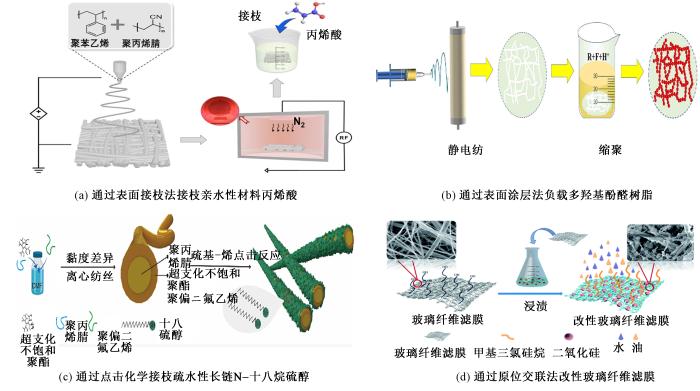
图1
常见表面化学改性策略及制备流程示意图
Fig.1
Schematic diagram of surface chemical modification strategies and preparation processes. (a) Grafting of hydrophilic acrylic acid by low-temperature plasma-induced liquid-phase grafting; (b) Loading of polyhydroxyphenolic resin by surface coating method; (c) Grafting of hydrophobic long-chain N-octadecanethiols by click chemistry; (d) Modification of glass fiber separation membrane by in-situ crosslinking method
通过表面改性使分离膜达到超亲水或超疏水状态,可减少或防止膜污染。其中,超亲水改性通过增强材料表面的水亲和性实现防污性能提升,其核心机制是利用多巴胺、单宁酸、丙烯酸等亲水性材料在膜表面构建稳定的水化层,以此阻隔污染物附着[13]。例如,Yang等[14]采用表面接枝法,将丙烯酸接枝到静电纺聚苯乙烯/聚丙烯腈复合膜表面(见图1(a))。亲水性基团的引入显著提升了膜的表面亲水性和水下超疏油性,使膜表面水接触角从137.4°降至15.8°;此外,该膜在仅由重力驱动的情况下,即可实现大于99.8%的分离效率,同时展现出优异的防污性以及良好的可回收性。如图1(b)所示,Hao等[15]利用表层涂层法使多羟基酚醛树脂包覆聚醚酰亚胺分离膜,使其具有超亲水性,接触角从120°降至0°。更重要的是,改性后的纤维基分离膜在各种油水混合物分离中表现出优异的性能,相应的分离通量和效率均在2 600 L/(m2·h)和99%以上。超疏水性也能显著提高纤维基分离膜的抗污性、防潮性以及自清洁能力,从而延长膜的使用寿命[16-17]。Zhang等[18]通过点击反应,将疏水性长链N-十八烷硫醇引入纤维表面(见图1(c))。接枝改性后的纤维基分离膜兼具粗糙表面结构和低表面能特性,水接触角高达156.0°,表现出显著的超疏水性能。此外,该膜分离油包水乳液的分离通量和分离效率分别可达 7 562 L/(m2·h)和99.27%。Zhou等[19]利用原位交联法将甲基三氯硅烷成功交联在玻璃纤维滤膜表面,使得优化改性的膜具有出色的超疏水性能,从0°提升至138°。同时,该膜不仅表现出分离粒径小于20 μm的油包水乳液的能力,而且分离的去除效率达到99.98%,其改性策略及制备流程如图1(d)所示。
此外,引入带电基团也是一种重要的改性策略。通过官能化反应或缩合反应引入带电基团如氨基、羧基、磺酸基等可将不带电体系转变为带电体系,从而实现对蛋白质、染料或金属离子等带电物质的分离[20-21]。Luo等[18]以胶原纤维为原料,经胺化改性,制得阳离子吸附剂。由于改性胶原纤维上的阳离子含量增加,增强截留阴离子染料能力,实现了对水体中有机染料的有效分离。Zhou等[22]则通过缩合反应将带负电的磺酸基引入丝素蛋白/纤维素共混纳米纤维基分离膜,以提高其对溶菌酶的吸附能力。该纳米纤维不仅直径 超细(148 nm),还展现出快速的吸附平衡速率、优异的吸附容量(636.00 mg/g)和良好的再利用能力。
综上所述,表面化学性质调控可有效改变纤维基分离膜表面亲疏水性以及电荷情况,从而实现其分离性能的提升[23]。
1.2 物理结构调控
表面粗糙度调控是通过构筑纤维基分离膜表面微观结构,以优化其物理化学性能和功能特性的方法,常用实现手段包括表面结晶生长法、喷涂法、去模板法等。例如,Yue等[24]通过调控晶体在纤维素膜表面的生长过程(见图2(a)左图),成功在膜表面构筑出粗糙结构,使膜的水接触角从118°增加到151°左右;该改性膜在不同酸碱(pH值为1~12)条件下均展现出稳定的超疏水性,可有效分离多种类型的油水混合物,分离效率超过93%。而Mohd等[25]则采用喷涂法在氟化纤维基分离膜表面涂覆聚(偏二氟乙烯-co-六氟丙烯)、氟硅烷和氧化锌纳米颗粒的复合材料(见图2(a)右图),在膜表面形成了复杂的微/纳多级结构;得益于表面粗糙度的提高以及低表面能物质(氟硅烷)的协同作用,该膜的水接触角高达154.4°。
图2
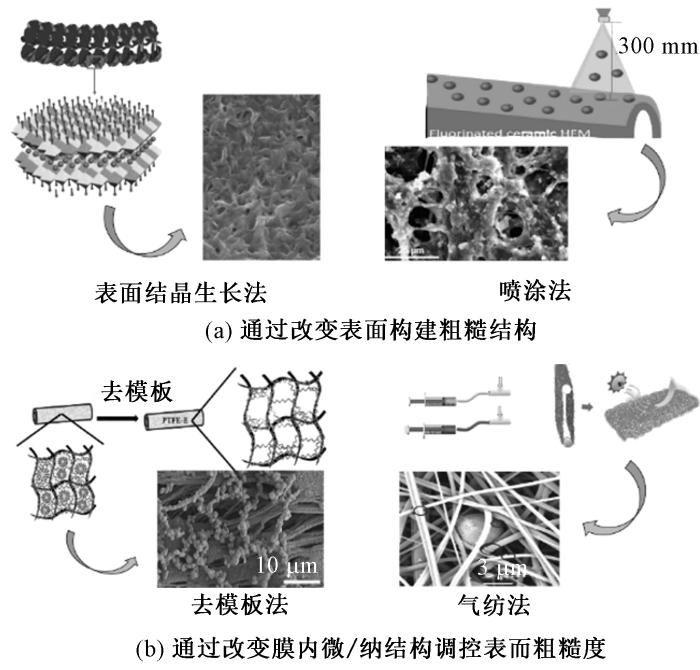
图2
表面粗糙度改性示意图
Fig.2
Schematic of surface roughness modification. (a) Modulation of surface roughness by altering surface structure; (b) Modulation of surface roughness by altering micro/nano structure within membrane
表面粗糙度调控亦能通过改变膜内部的微纳结构实现,改性示意图如图2(b)所示。Wu等[26]提出采用自制微乳液模板法控制交联程度,避免聚合物膜完全覆盖中空膜表面孔道:水溶性聚乙烯醇(PVA)与交联剂戊二醛先扩散至膜孔内并占据孔隙,随后形成包覆膜纤维的交联网络;移除模板后,释放的孔道为水传输提供了通道,同时水接触角由122.4°降至0°。该改性在提升表面粗糙度的同时,成功保留了开放的孔道结构,使膜的孔隙率从32.5%提升至47.2%,水通量则显著提高至(1 624±20) L/(m2·h),改性示意图如图2(b)左图。Zhang等[9]则通过在锦纶-6基质中引入球状SiO2颗粒,制备成具有二维窄孔和三维蓬松结构的复合膜(见图2(b)右图)。尽管该膜的孔隙率由83%降至75%,但其对细小颗粒物的捕获能力显著增强,展现出优异的颗粒物去除效率(99.99%)。
综上分析,通过改性纤维基分离膜的表面物理结构以赋予其特定润湿性能,对于开发高性能的分离材料至关重要。这种改性不仅能提升分离选择性,还可有效改善膜通量问题,进而提升整体分离效率。
2 纤维基分离膜的应用
纤维基分离膜凭借高比表面积、可调控的开放孔隙结构、低传质阻力及多样化的制备技术等优势而备受关注。通过前文所述的表面化学调控和物理结构调控策略,可进一步提升其分离性能并赋予新功能,从而满足多样化应用需求。本节将围绕纤维基分离膜在染料吸附、油水分离和蛋白分离领域的具体应用展开讨论。
2.1 染料吸附
图3
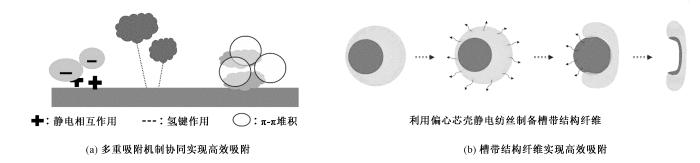
图3
纤维基分离膜在染料吸附领域应用及机制示意图
Fig.3
Application and mechanism schematic of fibrous membrane in dye absorption. (a) Efficient adsorption through multiple adsorption mechanism; (b) Efficient adsorption by fibers with groove banding structure
纤维膜实现高效染料吸附的机制主要包括物理吸附、化学吸附及二者的协同作用。其中,纳米纤维膜可通过范德华力、氢键、π-π相互作用或毛细作用等物理作用高效捕获染料分子,展现出优异的物理吸附性能。例如:Juang等[29]合成了接枝聚乙烯亚胺的壳聚糖/聚乙烯醇复合纤维膜,该膜借助聚乙烯亚胺链上带正电的质子化氨基与甲基橙(阴离子染料)间的静电相互作用,对甲基橙的吸附量达70.80 mg/g。 Lu等[6]通过微流控静电纺丝技术制备了氧化石墨烯-聚多巴胺/热塑性聚氨酯复合纤维膜,其表面电负性对阳离子染料的优异选择性吸附能力,染料去除率高达99%。此外,纤维基体和功能填料的多样,使其表面富含—OH、—NH2、—COOH等表面官能团,这些官能团可与染料分子发生离子交换、络合或共价键合等作用,进而实现高效吸附。例如,Fan等[30]在聚丁二酸丁二醇酯纤维膜表面负载罗丹宁,利用罗丹宁分子中N、O、S原子与染料的络合作用,使该复合膜对刚果红、结晶紫的最大吸附量分别达到138.50 、109.40 mg/g。
通过协同多种吸附作用,纤维膜可进一步提升吸附容量和吸附选择性。例如:Li等[31]制备了含ZIF-8纳米粒子的聚丙烯腈复合膜,其对刚果红、Pb2+和Cu2+的吸附效率分别高达89%、92%和76%。其中,ZIF-8主要通过静电相互作用、氢键作用和π-π相互作用吸附刚果红,同时通过Pb2+与ZIF-8中Zn2+之间的离子交换和化学吸附实现对Pb2+、Cu2+的去除;Wang等[32]则设计制备了聚偏氟乙烯/聚多巴胺/β-环糊精复合静电纺丝膜,借助静电吸引、π-π堆积、氢键和包合物形成等协同作用,该膜对亚甲基蓝、酚酞均表现出优异吸附性能,最大吸附容量分别可达188.30、203.70 mg/g(见图3(a))。
此外,通过表面形貌调控,还可赋予纳米纤维膜更优异的比表面积,进而提升其吸附性能。例如,Chen等[33]将聚丙烯腈与聚乙烯吡咯烷酮共混,采用静电纺丝法制备纤维膜;随后通过水热处理去除部分聚乙烯吡咯烷酮,在膜表面构筑出粗糙多孔结构,这一改性不仅增大了纤维的比表面积,还暴露了更多功能性羧基。最终,该纤维膜对孔雀石绿、亚甲基蓝、结晶紫的吸附量分别达到735.77、429.31、607.21 mg/g。Teng等[34]则选用富含官能团的玉米蛋白作为吸附剂和分离介质制备微/纳米纤维膜;为进一步优化吸附性能,他们设计了具有优异结构特性的槽带型纤维以增大比表面积。结果表明,当初始溶液质量浓度为1 000.00 mg/L时,槽带形态的玉米蛋白纤维膜对刚果红、Pb2+吸附容量分别为168.00、189.00 mg/g(见图3(b))。
综上所述,通过化学组分的选择和表面形貌的设计,能够有效调控纤维膜的吸附性能,助力其在染料吸附及其它污染治理领域发挥关键作用。
2.2 油水分离
随着工业含油废水与海洋溢油污染问题日益严峻,开发高效、高选择性的油水分离膜材料,已成为环境治理领域的重要研究方向。纤维基分离膜作为油水分离领域的前沿材料,凭借高孔隙率、高比表面积和可调控润湿性,已成为解决此类环境污染问题的关键材料之一[35-36]。目前,聚偏氟乙烯[37]和聚丙烯腈[38]等聚合物可通过静电纺丝[39]、非溶剂诱导相分离[40]等技术制备成纤维基分离膜并应用于油水分离;这类膜虽在初始通量和分离效率上表现突出,但仍面临亚微米级乳液分离效率低、孔隙易堵塞导致膜污染等瓶颈问题[41]。针对上述挑战,研究者大都通过微观结构设计、表面化学修饰等策略优化膜性能,以提升其油水分离效果。图4为纤维基分离膜在油水分离领域应用及机制示意图。
图4
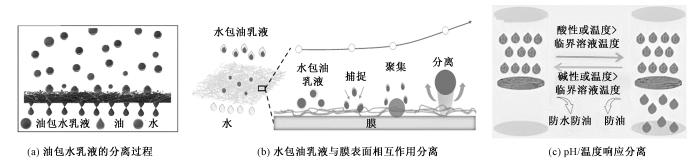
图4
纤维基分离膜在油水分离领域应用及机制示意图
Fig.4
Application and mechanism schematic of fibrous membrane in oil-water separation field. (a) Separation process of water-in-oil emulsions; (b) Interaction of oil-in-water emulsions with membrane surface during separation; (c) pH/temperature responsive separation
通过仿生微纳结构设计调控超润湿性,可赋予膜材料定向输运与抗污染特性。例如:Feng等[42]采用电喷雾辅助静电纺丝技术,在碳纤维基底上构筑仿荷叶多级粗糙结构,制备出兼具超疏水性(水接触角约为158.0°)和超亲油性(油接触角约为0°)的柔性超疏水纤维基分离膜;该膜孔径分布处于亚微米范围内,可有效提升其乳液分离性能,在油包水乳液分离中表现出15 800 L/(m2·h)的高通量和99%的分离效率,其分离机制如图 4(a)所示,该膜的超亲脂性致使油包水乳液发生瞬时破乳。同时,小孔径与超亲脂性协同增强了毛细作用力,从而实现了油相的快速捕获与分离。而释放的水滴不断聚结变大,因其尺寸远大于膜孔而被有效排斥,并最终在浮力作用下上浮实现分离。与之对应,超亲水超疏油膜则可实现水包油乳液的高效分离,其设计思路同样是通过特殊表面结构设计与性能组合,达成优异分离效果。例如,Ge等[43]通过同步电喷涂与静电纺丝,在聚丙烯腈膜表面构建具有仿荷叶微/纳结构的纳米纤维皮肤,利用分层粗糙度与亲水基体的协同效应,使膜兼具超亲水(水接触角约为0°)和水下超疏油性(油接触角约为150.0°),其分离机制为:油滴首先被亚微米多孔皮肤层拦截,液滴在液压动力的驱动下,在波动的表面上自由滚动,并由于膜优异的抗油性能而聚结,其中直径较大的聚结油滴完全脱离膜表面而不结垢,并根据斯托克斯定律破乳形成游离油(见图 4(b),最终实现对水包油乳液高达5 152 L/(m2·h)的通量和大于99%的分离效率。
通过微观结构与表面化学修饰的协同作用,可破解更复杂的乳液分离难题。Liu等[44] 提出了一种简便的表面改性方法:在高密度聚乙烯纤维基分离膜的一侧涂覆聚多巴胺和超亲水聚电解质,在增加表面粗糙度的同时提高亲水性,最终制备出具有独特疏水性/亲水性的 Janus 纤维基分离膜。该Janus 高密度聚乙烯(HDPE)纤维基分离膜表现出高分离通量(428 L/(m2·h))和高分离效率(99.9%)。
Zhu等[45]则采用二步静电纺丝和化学交联法,制备出具有串珠结构的聚乙烯醇(PVA)/海藻酸钠(SA)复合纳米纤维膜;其串珠结构的微纳粗糙度(1.88 μm),与PVA/SA固有的亲水基团产生协同作用,使纤维膜兼具超亲水(水接触角约为0°)和水下超疏油(油接触角大于158.0°)。基于此特性,该膜在分离柴油/水乳液时,水能优先浸润并形成稳固的水合层,从而高效通过膜孔,同时将油相彻底阻挡在外。这种由微纳粗糙结构强化的水化层极大地减少了油污的附着与堵塞,从而实现了高效分离并显著增强了膜的防污性能。其通量可维持在1 319 L/(m2·h),且经10次循环后,通量回收率仍大于99%。Fang等[46]通过在纤维素和热敏感聚合物间构建互穿网络、采用共沉淀嵌入法将光热介质(Fe3O4纳米颗粒)引入体系,并通过接枝氨基硅烷进行化学改性,制备出智能响应型纤维膜。该膜在交替pH/温度刺激下,可快速呈现出pH/温度响应性润湿性(见图4(c)),并能稳定在亲水性(水接触角约30.0°)和疏水性(水接触角约110.0°)之间切换。凭借这一可切换的传输特性,该膜可用于分离各类不相溶油水混合物和表面活性剂稳定型乳液,且展现出优异的分离性能,分离效率高达98.53%、分离通量达225 L/(m2·h),同时具备良好的循环稳定性,经10次循环使用后仍能保持90%以上的分离效率。
综上所述,纤维基分离膜在油水分离领域的研究不断深入,通过多种策略的探索与优化,其性能得到了显著提升(见表1)。未来需进一步探索界面润湿机制与动态分离过程的构效关系,开发多种智能响应型膜材料,并加强规模化制备技术。
表1 不同改性方式对纤维基分离膜性能的影响
Tab.1
| 改性方式 | 接触角/(°) | 电荷 | 分离效果 | 应用 | 文献 |
|---|---|---|---|---|---|
| 接枝 | — | 不带电→带正电 | 对甲基橙的吸附量为70.80 mg/g | 染料吸附 | [29] |
| 共混 | — | 不带电→带负电 | 高效吸附孔雀石绿(735.77 mg/g)、亚甲基蓝(429.31 mg/g) 和结晶紫(607.21 mg/g) | 染料吸附 | [33] |
| 接枝 | 137.4~5.8 | — | 分离通量由1 390 L/(m2·h)升至6 460 L/(m2·h), 分离效率>99.8% | 油水分离 | [16] |
| 去模板法 | 122.4~0 | — | 分离通量由995 L/(m2·h)升至1 624 L/(m2·h), 分离效率>95% | 油水分离 | [27] |
| 接枝 | — | 不带电→带负电 | 可分离BSA/溶菌酶 | 蛋白分离 | [47] |
| 官能化反应 | — | 不带电→带负电 | 有效分离BSA/Hb | 蛋白分离 | [48] |
2.3 蛋白分离
图5为纤维基分离膜在蛋白分离领域应用及机制示意图。根据蛋白质特性,可通过接枝、共混等改性策略对纤维基分离膜进行功能化修饰,使其能借助静电相互作用、靶向亲和、尺寸筛分等机制实现蛋白分离。例如,Wang等[47]在PVA纳米纤维基分离膜表面接枝马来酸酐(MAH),成功制备出高度羧化的PVA/MAH纳米纤维基分离膜,该膜表面带有负电荷。正是利用膜表面负电基团与带正电溶菌酶分子间的静电相互作用,该分离膜对溶菌酶展现出有良好的综合吸附性能,吸附量可达177.00 mg/g。Jiang等[52]则采用浸渍法,将丁烷四羧酸(BTCA)接枝到热塑性聚(乙烯醇-乙烯)(EVOH)纳米纤维基分离膜上,所制得的纳米纤维基分离膜不仅具备优异的结构稳定性与良好的亲水性,还因接枝反应引入丰富的活性羧基,可选择性吸收体系中的带正电荷蛋白质,其最大吸收量达749.30 mg/g;经过10次吸收-洗脱循环后,该膜仍保持相对稳定的吸附能力(见图5(a))。Ma等[53]通过蛋白A/G对聚醚砜(PES)进行修饰和功能化,所得材料可特异性吸附免疫球蛋白G,吸附容量为11.40 μg/mg(见图5(b))。此外,Li等[48]先通过官能化反应制备磺化聚醚砜(SPES),随后采用双层喷丝板共挤工艺,成功制备出兼具高亲水性与带电性的SPES中空纤维基分离膜。研究表明,通过调控原料种类及配比,可实现对纤维基分离膜孔径大小与分布的调控,并最终成功应用于牛血清白蛋白(BSA)和血红蛋白(Hb)混合溶液的分离。该膜的优异分离性能,一方面源于2种蛋白分子与SPES中磺酸基间的强静电作用(包括静电吸引力与静电排斥力);另一方面,纤维基分离膜的孔隙大小及孔径分布也对BSA/Hb的分离效果产生影响(见图5(c))。具体而言,孔径更大、孔径分布更宽,会削弱Hb分子与SPES的磺酸基间的静电吸引力,导致原本无法透过膜的Hb分子更易穿过膜,进而造成BSA/Hb的分离性能变差。
图5
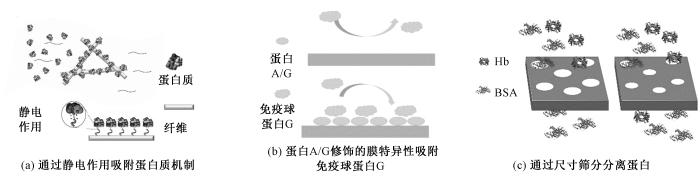
图5
纤维基分离膜在蛋白分离领域应用及机制示意图
Fig.5
Application and mechanism schematic of fibrous membrane in protein separation. (a) Protein adsorption mechanism through electrostatic interaction; (b) Protein A/G modified membrane specific adsorption of immunoglobulin G;(c) Protein separation through size sieving
以上研究表明,纤维基分离膜的表面化学修饰及功能化是提升蛋白质分离性能的核心(见表1),在孔隙调控、功能基团稳定性等方面可进一步优化。
2.4 其它应用
在生物医用领域的血液透析应用中,纳米纤维基分离膜的互联多孔结构为水分子和毒素的运输提供了直接通道;同时,通过在膜表面引入具备良好生物相容性和亲水性的功能材料,还能进一步提升透析膜的血液相容性与防污性能[56]。在电池隔膜领域,纤维基分离膜依托三维贯通的孔道结构、可调的孔径大小和孔隙分布,可有效提升电解质的吸收效率和电池的离子电导率[57]。此外,纳米纤维基分离膜也是柔性电子器件的重要组成部分,不仅具有良好的柔韧性和对三维曲面的顺应性,而且其微孔结构可赋予穿戴电子器件透气透湿性。通过引入多种亲水性材料,还可进一步提高纤维基分离膜的吸水性,加速汗水的传输和蒸发,从而减少穿戴过程中的不适感和炎症风险,显著提升其在柔性电子器件中的耐用性[45,58]。
3 结束语
本文系统综述了纤维基分离膜的功能改性方法。其中,通过化学改性调控膜表面的亲疏水性和电荷状态,不仅能显著提升分离性能,还可赋予其抗污染等功能;而通过粗糙度调控构建具有特殊润湿性的膜表面,则能有效增强膜的抗污染性能、分离选择性和渗透通量。通过多种改性策略的探索与优化,纤维基分离膜在染料吸附、油水分离、蛋白分离等领域的应用性能得到了进一步提升。
针对未来研究方向,可重点围绕以下方面展开突破:其一,开发新型智能响应材料,设计可在外界刺激下实现表面形貌或化学组成动态变化的界面,进而构建“自适应”界面,以此有效应对复杂污染物环境的黏附问题,显著提升膜的环境适应性和自清洁能力,减少膜的清洗频率及相关能耗;其二,引入人工智能技术用于膜性能与结构的预测与优化,例如借助机器学习模型预测不同聚合物/溶剂系统的成膜特性,或通过深度学习模型建立膜结构与水通量、截留率等指标间的关联,为高效分离膜的精准设计提供技术支撑。
参考文献
Graphite fiber electrode by continuous wet-spinning
[J].DOI:10.1021/acsaem.2c01446 URL [本文引用: 1]
Fabrication and characterization of meltblown poly(vinylidene difluoride) membranes
[J].DOI:10.1021/acsapm.0c00395 URL
Biobased fibers from natural to synthetic: processing, manufacturing, and application
[J].DOI:10.1016/j.matt.2024.04.006 URL
Fabrication of nanofiber meltblown membranes and their filtration properties
[J].DOI:10.1016/j.memsci.2012.09.050 URL [本文引用: 1]
Electrospun nanofibrous composite membranes for separations
[J].DOI:10.1021/accountsmr.2c00219 URL [本文引用: 1]
Graphene oxide-polydopamine loaded uniform fibrous membranes via robust multi-channel microfluidic-electrospinning method
[J].DOI:10.1016/j.seppur.2024.130014 URL [本文引用: 2]
Superhydrophobic membrane: progress in preparation and its separation properties
[J].
DOI:10.1515/revce-2017-0030
URL
[本文引用: 1]

Superhydrophobic membrane that is highly resistant to wetting by aqueous solution has gained great attention because of its potential to be applied in many emerging membrane processes such as membrane gas absorption (MGA) and membrane distillation (MD). Numerous approaches have been proposed to obtain membranes with superhydrophobic surface from materials with various degrees of hydrophobicity. This paper then reviews the progress in superhydrophobic membrane preparation and its separation properties. A brief description of superhydrophobicity is firstly presented. Preparation methods of the superhydrophobic membrane are subsequently reviewed, including direct processing method and surface modification of the existing membrane. Finally, the separation properties and challenges of superhydrophobic membranes are discussed. This article could provide an insight for further development of superhydrophobic membrane.
Multilayer structure ammoniated collagen fibers for fast adsorption of anionic dyes
[J].
DOI:10.1021/acsomega.1c03643
PMID:34693127
[本文引用: 1]
Dye wastewater has become one of the difficult industrial wastewaters due to its significant characteristics such as high chroma and poor biodegradability. Here, we use collagen fibers (CFs) as the matrix, glutaraldehyde as the cross-linking agent, and polyethyleneimine (PEI) as the ammoniating modifier to prepare cationic-modified collagen fibers (CF-PEI). The CF-PEI still maintained the original fibrous structure with a larger adsorption area. The content of primary amino groups on CF-PEI was significantly increased, which not only improved the hydrophilic swelling performance of CFs but also improved the adsorption capacity. The adsorption capacity of CF-PEI for soap yellow and acid red could reach 538.2 and 369.7 mg g, respectively. The adsorption rate was fast, and the adsorption equilibrium could be reached in about 60 min. Desorption regeneration studies have shown that 0.1 mol L HCl could achieve a better desorption effect, and the CF-PEI had a good recycling performance. The ammoniated modified CF-PEI was an excellent adsorption treatment material for anionic dye wastewater. It is expected to become an effective way for high-value resource utilization of waste dander in the leather industry.© 2021 The Authors. Published by American Chemical Society.
Nylon-6/SiO2 composite fiber membranes with 2D narrow pore but 3D fluffy structure for high-efficiency and comfortable PM0.1 filter
[J].DOI:10.1016/j.memsci.2025.123714 URL [本文引用: 2]
Design and fabrication of superwetting fiber-based membranes for oil/water separation applications
[J].DOI:10.1016/j.cej.2019.01.149 URL [本文引用: 1]
Electrospun nanofibers membrane of carbon quantum dots loaded onto chitosan-polyvinyl alcohol for removal of rhodamine B dye from aqueous solutions: adsorption isotherm, kinetics, thermodynamics and optimization via Box-Behnken design
[J].DOI:10.1016/j.ijbiomac.2025.140951 URL [本文引用: 1]
Chemical modification of membrane surface: overview
[J].DOI:10.1016/j.coche.2018.01.002 URL [本文引用: 1]
One-step modification of electrospun PVDF nanofiber membranes for effective separation of oil-water emulsion
[J].
DOI:10.1039/D1NJ05436H
URL
[本文引用: 1]
TA-APTES-SP coating is used to optimize the wettability and stability of PVDF nanofiber membranes for oil–water separation.
Acrylic acid-grafted pre-plasma nanofibers for efficient removal of oil pollution from aquatic environment
[J].
DOI:S0304-3894(19)30228-6
PMID:30849571
[本文引用: 1]
Oily wastewater is a worldwide problem threatening the environment and humans. High flux and low-energy consumption separation of oil and water is urgently required but still faces great challenges. In this study, nanofibrous membranes with superhydrophilic and underwater superoleophobic surfaces were fabricated by grafting acrylic acid onto plasma-treated electrospun polystyrene/polyacrylonitrile (PS/PAN) membranes. The morphologies, chemical compositions, mechanical and surface properties of the membranes were examined in detail. The water contact angles of the PS/PAN membranes were 137.4°, 130.1°, 119.5°, 88.1° and 80.2°, respectively, which decreased to 76.5°, 47.9°, 34.4°, 0° and 0° after grafting treatment, proving that the modification improved the surface hydrophilicity of the membranes due to the introduction of hydrophilic groups. In addition, a gravity-driven filtration device was utilized to investigate the oil/water separation potential of the membranes. The results indicated that the grafted PS/PAN membranes separated the layered oil/water mixtures with permeate flux up to 57509 L m h, while high fluxes of 1390-6460 L m h for the separation of different oil-in-water emulsions. Importantly, the membranes still maintained high flux and efficiency even after several cycles of separation. Therefore, the reusable membranes can be expected to be potential cost-effective materials for oil/water treatment.Copyright © 2019 Elsevier B.V. All rights reserved.
Polyhydroxy phenolic resin coated polyetherimide membrane with biomimetic super-hydrophily for high-efficient oil-water separa-tion
[J].DOI:10.1016/j.seppur.2024.126278 URL [本文引用: 1]
Fabricating superhydrophobic surfaces via coating amine-containing fluorinated emulsion and Michael addition reaction
[J].DOI:10.1007/s11998-021-00600-y [本文引用: 2]
Superhydrophobic and multi-responsive fabric composite with excellent electro-photo-thermal effect and electromagnetic interference shielding performance
[J].DOI:10.1016/j.cej.2019.123537 URL [本文引用: 1]
Centrifugally spun superhydrophobic fibrous membranes with core-sheath structure assisted by hyper branched polymer and via click chemistry for high efficiency oil-water separa-tion
[J].DOI:10.1016/j.seppur.2024.127480 URL [本文引用: 2]
A facile and effective strategy to develop a super-hydrophobic/super-oleophilic fiberglass filter membrane for efficient micron-scale water-in-oil emulsion separation
[J].
DOI:10.1039/d1ra08841f
PMID:35425375
[本文引用: 1]
In order to achieve efficient micron-scale water-in-oil emulsion separation, a facile and effective strategy is developed to prepare a super-hydrophobic/super-oleophilic fiberglass filter membrane (FGm). Methyl-trichlorosilane (MTS) is successfully cross-linked on the surface of the fiberglass filter membrane (FGm) and aggregates into a 3D nanowire array to provide low surface energy. Nano fumed hydrophobic silica (SH-SiO) is used to construct the well-defined nanosphere structure on the surface of FGm and enhance the ability of the membrane to resist extreme conditions. The optimally modified membrane displays outstanding super-hydrophobic properties with a contact angle of 156.2°. It is impressive to find that the MTS@SH-SiO@FGm not only demonstrates the ability to separate water-in-oil emulsions with a particle size of less than 20 μm, but also the removal efficiency of separation has reached 99.98%. More attractively, the membrane still has stable super-hydrophobic features and reusable water-in-oil emulsion separation performance even under exposure to diverse harsh conditions, including extremely acidic corrosive solutions and ultra-high temperature systems.This journal is © The Royal Society of Chemistry.
Robust Fe3O4@attapulgite-intercalated carboxylated graphene oxide composite membrane for efficient and stable oil-in-water emulsion separation
[J].DOI:10.1016/j.colsurfa.2025.136605 URL [本文引用: 1]
Super-hydrophilic polyetherimide membrane with surface amino exposed for highly efficient oil-water separation
[J].DOI:10.1007/s12221-024-00483-x [本文引用: 1]
Fabrication of sulfated silk fibroin-based blend nanofibrous membranes for lysozyme adsorption
[J].DOI:10.1007/s42765-021-00104-9 [本文引用: 1]
Advances in nanofiber filtration membranes: from principles to intelligent applications
[J].DOI:10.1002/adfm.v35.27 URL [本文引用: 1]
In situ one-step fabrication of durable superhydrophobic-superoleophilic cellulose/LDH membrane with hierarchical structure for efficiency oil/water separation
[J].DOI:10.1016/j.cej.2017.07.026 URL [本文引用: 1]
Superhydrophobic ball clay based ceramic hollow fibre membrane via universal spray coating method for membrane distillation
[J].DOI:10.1016/j.seppur.2022.120574 URL [本文引用: 1]
Superhydrophilic modification of polytetrafluoroethylene (PTFE) hollow fiber membrane by a novel miniemulsion template method
[J].DOI:10.1016/j.memsci.2025.123920 URL [本文引用: 1]
Zeolitic imidazolate framework (AMCD-ZIF) functionalised membrane for the removal of dyes from water
[J].DOI:10.1016/j.jece.2022.108019 URL [本文引用: 2]
聚琥珀酰亚胺纳米纤维膜改性及其染料吸附性能
[J].
Modification of polysuccinimide nano fibrous membrane and its dye adsorption properties
[J].
Polyaminated electrospun chitosan fibrous membranes for highly selective removal of anionic organics from aqueous solutions in continuous operation
[J].DOI:10.1016/j.seppur.2023.124043 URL [本文引用: 2]
Adsorbability of Modified PBS Nanofiber Membrane to Heavy Metal Ions and Dyes
[J].DOI:10.1007/s10924-021-02086-6 [本文引用: 1]
A novel nanofibrous PAN ultrafiltration membrane embedded with ZIF-8 nanoparticles for effective removal of Congo red, Pb(II), and Cu(II) in industrial wastewater treat-ment
[J].DOI:10.1016/j.chemosphere.2022.135285 URL [本文引用: 1]
Bendable poly(vinylidene fluoride)/polydopamine/β-cyclodextrin composite electrospun membranes for highly efficient and bidirectional adsorption of cation and anion dyes from aqueous media
[J].DOI:10.1016/j.compscitech.2021.109256 URL [本文引用: 1]
Fabrication of porous fibrous membranes with rough surfaces via PAN-H/PVP for cation dye removal and oil/water emulsion separation
[J].DOI:10.1021/acs.langmuir.5c00049 URL [本文引用: 2]
Zein adsorbents with micro/nanofibrous membrane structure for removal of oils, organic dyes, and heavy metal ions in aqueous solution
[J].DOI:10.1016/j.jhazmat.2021.128004 URL [本文引用: 1]
聚多巴胺涂覆改性聚丙烯腈纳米纤维膜及其油水分离性能
[J].
Properties of polydopamine-coated electrospun polyacylonitrile membrane in oil/water separation
[J].
用于油水分离的静电纺纳米纤维膜研究进展
[J].
Progress in electrospun nanofibrous membranes used for oil-water separation
[J].
In-situ growth of robust and superhydrophilic nano-skin on electrospun Janus nanofibrous membrane for oil/water emulsions separation
[J].DOI:10.1016/j.seppur.2023.123728 URL [本文引用: 1]
Super-hydrophilic electrospun PAN nanofibrous membrane modified with alkaline treatment and ultrasonic-assisted PANI in situ polymerization for highly efficient gravity-driven oil/water separation
[J].DOI:10.1016/j.seppur.2022.123032 URL [本文引用: 1]
Electrospun frogspawn structured membrane for gravity-driven oil-water separation
[J].
DOI:S0021-9797(19)30405-9
PMID:30952075
[本文引用: 1]
The aim of this study is to prepare a fibrous membrane scaffold that possesses a frogspawn structure for high-efficiency oil-water separation. Polyamic acid was first electrospun onto a rotating wheel-collector to obtain the fibrous membrane. Subsequently, post-processing by immersion in a polydimethylsiloxane solution and a silica nanoparticles suspension, followed by a thermal treatment generated a frogspawn-structured fibrous membrane. The obtained membrane achieved superhydrophobicity and superoleophilicity, with the water contact angle as high as 155.75° and the oil contact angle lower than 10°. The separation efficiencies of the membrane were higher than 99.55% and the permeate flux was maintained at greater than 4400 L/m∙h after 20 separation cycles. Additionally, the wettability studies suggested the membrane exhibits high stability because it can resist damages due to high temperature (150 °C), acid/basic conditions and organic/inorganic solvents. These findings indicated that this composite membrane has great potential for use in gravity-driven oil-water separation and can extend the range of its application for treatments of oil spills incident, oily wastewater and spent liquor.Copyright © 2019. Published by Elsevier Inc.
Biomimetic nanonet membranes with UV-driven self-cleaning performance for water remediation
[J].DOI:10.1016/j.memsci.2023.122047 URL [本文引用: 1]
Leaf vein-inspired microfiltration membrane based on ultrathin nanonetworks
[J].DOI:10.1039/D0EN00644K URL [本文引用: 1]
Bio-inspired superhydrophobic fiber membrane for oil-water separation and non-destructive transport of liquids in corrosive environments
[J].DOI:10.1016/j.memsci.2024.122852 URL [本文引用: 1]
Biomimetic and superwettable nanofibrous skins for highly efficient separation of oil-in-water emulsions
[J].DOI:10.1002/adfm.v28.10 URL [本文引用: 1]
High-density polyethylene Janus fibrous membrane with enhanced breathability and moisture permeability via PDA assisted hydrophilic modification
[J].DOI:10.1002/marc.v46.11 URL [本文引用: 1]
A superwetting rough structured nanofibrous membrane with enhancing anti-fouling performance for oil-water separation
[J].DOI:10.1016/j.seppur.2024.130800 URL [本文引用: 2]
Electrospun cellulose nanofibers membranes with photothermal/pH-induced switchable wettability for oil-water separation and elimination of bacteria
[J].DOI:10.1016/j.cej.2025.164394 URL [本文引用: 1]
In situ cross-linked and highly carboxylated poly(vinyl alcohol) nanofibrous membranes for efficient adsorption of proteins
[J].DOI:10.1039/C5TB01192B URL [本文引用: 2]
Exploration of highly sulfonated polyethersulfone (SPES) as a membrane material with the aid of dual-layer hollow fiber fabrication technology for protein separation
[J].DOI:10.1016/j.memsci.2007.10.006 URL [本文引用: 2]
高分子材料在蛋白分离应用中的研究进展
[J].
Advances in polymer materials for protein separation applica-tions
[J].
Minimizing the influence of fluorescent tags on IgG partition in PEG-salt aqueous two-phase systems for rapid screening applications
[J].DOI:10.1002/biot.v14.8 URL [本文引用: 1]
阳离子树脂填充EVAL中空纤维膜吸附剂对牛血清/牛血红蛋白质混合物的分离性能
[J].
Separation of BSA/Hb protein mixture by cation resin filled EVAL hollow-fiber membrane adsorbents
[J].
Fabrication of highly carboxylated thermoplastic nanofibrous membranes for efficient absorption and separation of protein
[J].DOI:10.1016/j.colsurfa.2023.131203 URL [本文引用: 1]
Electrospun polyethersulfone affinity membrane: membrane preparation and performance evaluation
[J].
DOI:10.1016/j.jchromb.2009.09.019
PMID:19775944
[本文引用: 1]
Non-woven polyethersulfone (PES) membranes were prepared by electrospinning. After heat treatment and surface activation, the membranes were covalently functionalized with ligands to be used as affinity membranes. The membranes were characterized in terms of fiber diameter, porosity, specific area, pore size, ligand density and binding capacities. To evaluate the binding efficiency of the membrane, dynamic adsorption of bovine serum albumin (BSA) on the Cibacron blue F3GA (CB) functionalized PES membrane was studied. Experimental breakthrough curves were fitted with the theoretical curves based on the plate model to estimate plate height (H(p)) of the affinity membrane. The high value of H(p) (1.6-8 cm) of the affinity membrane implied a poor dynamic binding efficiency, which can be explained by the intrinsic microstructures of the material. Although the electrospun membrane might not be an ideal candidate for the preparative affinity membrane chromatography for large-scale production, it still can be used for fast small-scale protein purification in which a highly efficient binding is not required. Spin columns packed with protein A/G immobilized PES membranes were demonstrated to be capable of binding IgG specifically. SDS-PAGE results demonstrated that the PES affinity membrane had high specific binding selectivity for IgG molecules and low non-specific protein adsorption. Compared with other reported affinity membranes, the PES affinity membrane had a comparable IgG binding capacity of 4.5 mg/ml, and had a lower flow through pressure drop due to its larger pore size. In conclusion, the novel PES affinity membrane is an ideal spin column packing material for fast protein purification.
静电纺丝纤维材料在太阳能海水淡化领域的应用进展
[J].
Progress of research into electrospun fibrous materials for solar-driven seawater desalination
[J].
Porous graphene/polyimide membrane with a three-dimensional architecture for rapid and efficient solar desalination via interfacial evaporation
[J].
Cellulose acetate-polyvinyl alcohol blend hemodialysis membranes integrated with dialysis performance and high biocompatibility
[J].DOI:10.1016/j.msec.2021.112127 URL [本文引用: 1]
Sustainable APTES-modified nano-TiO2/PVA composite nanofibrous separators for thermally stable lithium-ion battery
[J].

 京公网安备11010502044800号


