



最早开发的智能调温纤维为Oulast纤维,该材料于1998年由美国航空航天局(NASA)研制而成。通过将包裹有石蜡烃的相变微胶囊应用于宇航服,这些微胶囊能够在极端宇宙环境下自动调节相态,从而提升宇航服的热性能以抵御太空中的极端温度[10]。近年来,对相变微胶囊调温纺织品的研究日益深入,相关产品已获得广泛应用。进一步探索相变微胶囊与纺织材料的有效结合方式,不仅有助于研发具备优异热调节性能的功能性纺织品,还可为智能纺织品带来新的发展机遇。
本文通过将相变微胶囊乳液引入粘胶纤维的纺丝原液中,采用湿法纺丝制备出相变温度为28 ℃和33 ℃的相变微胶囊-粘胶复合纤维。进一步将其与本质阻燃纤维(如腈氯纶、芳纶1313及阻燃粘胶)进行混合配比研究,经过阻燃性能测试以确定最佳纤维比例。分析不同相变温度的相变微胶囊对纤维、复合纱线以及织物调温和阻燃性能的影响,并在织造过程中加入导电锦纶纱,实现织物的多功能化。最终,本文成功开发出具备智能调温、阻燃及防静电功能的多功能织物,这种新型织物有望在石油、化工及消防等领域得到广泛应用,为提高相关行业的安全性和舒适性提供新的解决方案。
1 实验部分
1.1 实验材料与仪器
材料:28 ℃相变微胶囊乳液(壳材为聚甲基丙烯酸甲酯,芯材为正十八烷,粒径为5~10 μm)、33 ℃相变微胶囊乳液(壳材为聚甲基丙烯酸甲酯,芯材为正二十烷,粒径为5~10 μm),宇田相变储能科技有限公司;纤维素磺酸酯(分析纯)、氢氧化钠(分析纯)、稀硫酸(分析纯),上海阿拉丁生化科技股份有限公司;导电锦纶纱线(77.8 tex),山东同赢新材料有限公司;芳纶1313(10 tex)、芳纶1414(10 tex),泰和新材集团股份有限公司;阻燃粘胶纤维(10 tex)、腈氯纶(10 tex),明达纺织有限公司;棉织物(平纹,面密度为280 g/m2),市售。
仪器:FA002自动抓棉机、FA106 豪猪式开棉机、FA046 振动棉箱,郑州宏大新型纺机有限责任公司;FA221B梳棉机,青岛宏大纺织机械有限责任公司;FA311F并条机,沈阳宏大纺织机械有限责任公司;FA458A粗纱机,天津宏大纺织机械有限公司;FA506环锭细纱机,经纬纺织机械股份有限公司;SL8900型半自动小样织机,浙江三禾纺织机械有限公司;小型湿法纺丝机,长沙纳仪仪器科技有限公司; FTT0077氧指数测试仪,广州欧美大地仪器设备有限公司;Quanta-450-EFG型扫描电子显微镜,英国牛津 FEI 公司;VHX·5000型超景深三维显微镜,上海幻点工业科技有限公司;Q2000型差示扫描量热仪,美国TA公司;YG606型平板式织物保温仪,兴成有限公司;PTi120红外热成像仪,仪诚实验设备有限公司;YG815B垂直法织物阻燃性能测定仪,瑞沃德科技有限公司;Spotlight400傅里叶红外光谱仪,赛默飞世尔科技公司;701-D热防护性能仪器,福码实验设备有限公司;YG406织物电阻率测试仪,富勒姆科技有限公司;FX3150全自动织物透湿量测试仪,瑞士Textest公司。
1.2 相变粘胶纤维的制备
按10%(质量分数)纤维素磺酸酯,8%(质量分数)氢氧化钠,82%(质量分数)去离子水制备粘胶纤维纺丝原液。将28 ℃和33 ℃相变微胶囊乳液分别与粘胶纤维纺丝原液按质量比为4∶1混合后置于反应容器中,在常温状态下以500 r/min搅拌2 h,得到均匀的相变粘胶纤维纺丝原液。随后,将制备的纺丝原液转移至针管中,并连接孔径为0.06~0.1 mm的喷丝头进行湿法纺丝。纺丝过程中,喷出的丝条首先通过质量分数为10%的氢氧化钠溶液凝固浴,随后经过质量分数为5%的稀硫酸凝固浴,最后进行充分水洗。水洗后的纤维在70 ℃下干燥18 h,最终得到具有28 ℃和33 ℃相变温度的相变粘胶纤维。
1.3 调温阻燃复合纱线的制备
相变粘胶纤维为非阻燃纤维,要使开发的纺织品具备阻燃性能,必须采用混配的方式将调温纤维和不同阻燃机制的阻燃纤维合理混合,利用各种纤维之间的协同效应,达到阻燃效果。为探究阻燃纤维与所制备的相变粘胶纤维的最佳阻燃混纺比例,同时为方便测试,选用28 ℃相变粘胶纤维与选定的阻燃纤维按照表1所示的配比混合。采用棉纺普梳系统进行纺纱,具体流程包括:采用开清棉联合机(FA002→FA106→FA046,开松辊800 r/min、打手450 r/min)对相变粘胶纤维与多组分阻燃纤维进行预混开松;经梳棉机(FA221B,锡林360 r/min,刺辊850 r/min,隔距0.18~0.25 mm)分梳后,通过并条机(FA311F,总牵伸6.2~8.0倍)、粗纱机(FA458A,锭速900 r/min)和环锭细纱机(FA506,锭速14 000 r/min)完成纺纱。通过对比不同混纺比例下样品的极限氧指数(LOI)测试结果,评估其阻燃性能,确定最佳的纤维混纺比例。最后,根据最佳混纺比,将28 ℃相变粘胶纤维和33 ℃相变粘胶纤维分别与阻燃纤维混合,制备出28 ℃相变阻燃纱线和33 ℃相变阻燃纱线。
表1 混合纤维配比
Tab.1
| 试样编号 | 纤维配比 |
|---|---|
| 1 | 相变粘胶纤维30%,腈氯纶70% |
| 2 | 相变粘胶纤维40%,腈氯纶60% |
| 3 | 相变粘胶纤维30%,阻燃粘胶纤维70% |
| 4 | 相变粘胶纤维30%,芳纶1313 70% |
| 5 | 相变粘胶纤维30%,腈氯纶15%,阻燃粘胶纤维15%,芳纶1313 30%,芳纶1414 10% |
| 6 | 相变粘胶纤维30%,阻燃粘胶纤维20%,芳纶1313 50% |
1.4 调温阻燃防静电复合织物的制备
将28 ℃(或33 ℃)相变阻燃纱线与导电锦纶纱线1∶1合股并作为经纱和纬纱。随后进行整经、穿综、穿筘等织前准备工序,采用半自动小样织机以平纹组织进行织造。织造过程中选用英制筘号为70根(5.08 cm)的钢筘,采用顺穿法,每筘穿入2 根纱线。最终分别织制出28 ℃和33 ℃调温阻燃防静电织物,分别简称为28 ℃和33 ℃相变复合织物,2种织物的经密均为234根/(10 cm),纬密均为220根/(10 cm),面密度为285 g/m2。
1.5 性能测试
参照GB/T 5454—2015《纺织品 燃烧性能试验 氧指数法》,使用氧指数测试仪测试织物的LOI值,样品在标准大气压下先平衡24 h以上。
使用扫描电子显微镜和型超景深三维显微镜观察微观形貌。
使用差示扫描量热仪测试织物热性能。温度范围为-10~60 ℃,升降温速率为5 ℃/min。升降温测试在温度为(20±2) ℃,相对湿度为(50±3)%的环境下进行。
使用平板式织物保温仪和红外热成像仪,对所制28 ℃和33 ℃相变复合织物试样进行测试,同时测试棉织物进行对比分析。环境温度为25 ℃,相对湿度为65%,保温仪设定温度为40 ℃,将试样放在保温仪上,每隔5 s记录温度变化;然后将试样取出,每5 s记录温度变化。
参照GB/T 5455—2014《纺织品 燃烧性能试验 垂直法》,使用垂直法织物阻燃性能测定仪测试样品的垂直燃烧指标值,样品尺寸为300 mm×100 mm。
使用傅里叶红外光谱仪进行化学结构分析,测量波数范围为4 000~600 cm-1。
使用热防护性能仪器测试热防护性能。样品在(20±2) ℃和(65±3)%温湿度条件下平衡24 h,总热通量设定为83 W/m2。
防静电性能参照GB 12014—2019《防护服装 防静电服》,使用YG406织物电阻率测试仪进行点对点电阻测试。施加测试电压为100 V,持续时间为15 s。
参照GB/T 12704.2—2009《纺织品 织物透湿性试验方法 第2部分:蒸发法》,使用全自动织物透湿量测试仪测试织物透湿率。
2 结果与分析
2.1 相变纤维与阻燃纤维配比优化
表2 阻燃性能测试结果
Tab.2
| 试样编号 | LOI值/% | 续燃时间/s | 阴燃时间/s |
|---|---|---|---|
| 1 | <26 | — | — |
| 2 | <26 | — | — |
| 3 | 28.0 | 3 | 12 |
| 4 | <26 | — | — |
| 5 | 28.0 | 3 | 7 |
| 6 | 28.2 | 0 | 0 |
根据表2中数据可知,试样3(相变粘胶/阻燃粘胶(30/70))、试样5(多组分混纺)和试样6(多组分混纺)的极限氧指数(LOI)分别为28.0%、28.0%和28.2%,达到阻燃要求(LOI≥28%),其中试样6表现最佳,试样3阴燃时间较长,阻燃效果差于试样5;而试样1、2、4(LOI<26%)因普通粘胶比例过高或芳纶1313混纺异常导致阻燃失效。可认为:阻燃纤维比例需大于或等于30%,且需多组分协同增效(如阻燃粘胶纤维与芳纶组合)才可达到最佳阻燃效果;普通粘胶占比过高显著降低阻燃性;试样4的异常提示芳纶混纺工艺需优化;试样3的较长阴燃时间(12 s)需抑制炭化残留。
通过对比试样5和6的阻燃性能发现,试样6具有更高的极限氧指数,且无续燃和阴燃现象,综合阻燃效果更为理想。试样6采用的纤维配比为30%相变粘胶纤维、20%阻燃粘胶纤维和50%芳纶1313。基于上述结果,选定试样6的纤维配比作为最佳方案,用于后续研究。根据最佳混纺比,将28 ℃相变粘胶纤维和33 ℃相变粘胶纤维与阻燃纤维混合,按照相变粘胶纤维30%,阻燃粘胶纤维20%,芳纶1313 50%的比列混合制备出28 ℃相变阻燃纱线和33 ℃相变阻燃纱线。
2.2 外观形貌
图1

图1
相变粘胶纤维、相变阻燃纱线及其织物的表面形貌照片
Fig.1
Surface morphology of phase change fibers (a), phase change flame-retardant yarns (b) and fabrics (c)
2.3 调温性能
图2示出28 ℃和33 ℃的相变粘胶纤维、相变阻燃纱线和相变复合织物的DSC曲线。从中可以观察到,在温度升高和降低的过程中,所有样品都呈现出明显的吸热峰和放热峰,所有样品在升/降温过程中均呈现成对且对称的吸热峰与放热峰,其熔融峰温度与微胶囊标称值高度吻合,结合28 ℃织物更高的熔融焓(3.221 J/g)与结晶焓(3.657 J/g)及33 ℃织物更高的熔融焓(3.347 J/g)与结晶焓(4.345 J/g)表明,33 ℃复合织物不仅具有更大的温度调节范围,而且其熔融焓和结晶焓均高于28 ℃复合织物,说明33 ℃复合织物具有更强的温度调节能力。证实了由于相变粘胶纤维的引入,纱线和织物都具备了双向调温能力。
图2
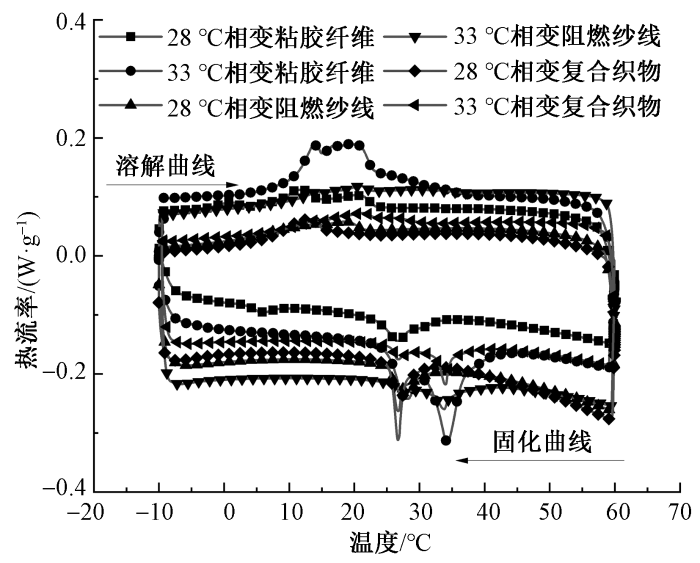
图2
相变纤维、纱线及其织物的DSC曲线
Fig.2
DSC curves of phase change fibers, yarns and fabrics
图3(a)示出28 ℃、33 ℃相变复合织物和普通棉织物的升温曲线。结果显示,28 ℃和33 ℃相变复合织物相比普通织物表现出更缓慢的升温速率和更长的升温时间。这种现象可归因于相变粘胶纤维中的微胶囊在达到相变温度时发生固-液相转变,吸收环境热量,从而减缓纤维表面温度的变化速度,实现调节温度的效果。图3(b)呈现的织物降温曲线同样反映了相变织物的独特性能,与普通棉织物进行对比,28 ℃和33 ℃相变复合织物表现出更缓慢的降温速率。这是由于相变粘胶纤维中的微胶囊在降温过程中发生了液-固相转变,释放热量,从而延缓了织物温度的下降速度。这2个过程共同证实了相变复合织物具有优异的双向温度调控能力,为其在温度控制应用中的潜力提供了实验依据。
图3

图3
相变复合织物的升降温曲线
Fig.3
Rising (a) and cooling (b) curves of phase change composite fabric
2.4 阻燃性能
表3示出28 ℃和33 ℃相变复合织物的垂直燃烧测试结果。数据分析表明,2种复合织物均满足国家标准对B级阻燃防护服的阻燃性能要求,展现出良好的阻燃特性。
表3 相变复合织物的垂直燃烧测试结果
Tab.3
| 相变温 度/℃ | 织物 方向 | 损毁长 度/mm | 续燃时 间/s | 阴燃时 间/s | 熔融 滴落 |
|---|---|---|---|---|---|
| 28 | 经向 | 88 | 0 | 0.7 | 无 |
| 28 | 纬向 | 98 | 0.6 | 1.0 | 无 |
| 33 | 经向 | 95 | 0 | 0 | 无 |
| 33 | 纬向 | 93 | 0 | 0 | 无 |
对比发现,33 ℃相变复合织物表现出更优异的阻燃效果,该织物在测试过程中未出现续燃和阴燃现象,且损毁长度符合标准规定的小于100 mm的要求。相比之下,28 ℃相变复合织物在经向和纬向测试中出现了阴燃和续燃现象。这一对比结果表明,33 ℃相变复合织物在阻燃性能方面具有显著优势。这种性能差异可能源于2种材料间存在着微观结构及相变特性上的差别。
纺织品的阻燃性能与残炭的致密性密切相关,致密的残炭结构能有效抑制纺织品在燃烧过程中释放的烟和热量。这种致密残炭层形成的保护性覆盖层可有效包覆燃烧碎片,从而提高纺织品的整体阻燃性能。图4示出28 ℃和33 ℃相变复合织物的残炭表面形貌特征。可以看出,28 ℃和33 ℃相变复合织物的残炭均呈现出线条状网络结构,具有良好的致密性和连续性,未观察到小孔洞的形成。这种致密的残炭结构不仅有效阻断了热量的纵向传递,还在织物与氧气之间形成了物理隔离层。残炭的致密性主要源于芳纶的凝聚相阻燃机制,芳纶在燃烧过程中形成致密残炭,同时与阻燃粘胶的燃烧残留物形成紧密黏合,而腈氯纶通过气相阻燃机制释放的阻燃组分进一步稀释了局部氧气浓度,这3种组分的协同作用最终达到了显著的阻燃效果。
图4

图4
不同相变复合织物燃烧后表面形貌照片
Fig.4
Surface morphology of different phase change composite fabrics after combustion. (a) 28 ℃ phase change composite fabrics; (b) 33 ℃ phase change composite fabrics
图5为28 ℃和33 ℃相变复合织物及其燃烧残炭的红外光谱图。对比分析表明,2种相变复合织物及其残炭的红外吸收峰基本一致,证实了它们在燃烧过程中经历了相似的化学结构变化。在波数为750 cm-1附近,残炭的C—H特征吸收峰强度降低,这归因于芳纶热分解。在波数为1 000 cm-1附近,残炭中C—Cl的特征吸收峰强度明显减弱,这种现象可归因于腈氯纶在燃烧过程中释放出氯化氢而产生阻燃效应。值得注意的是,残炭与原织物的其它官能团吸收峰差异较小,表明残炭保留了较为完整的化学结构,燃烧损伤程度有限,这进一步证实了织物优异的耐热性能和阻燃性。尽管相变粘胶纤维本身不具备阻燃性能,且在纺纱织造过程中含量高达30%,但燃烧后残炭仍然表现出良好的致密性。这一现象说明具有不同阻燃机制的阻燃纤维之间,以及阻燃纤维与非阻燃的相变纤维之间存在显著的协同阻燃效应。
图5
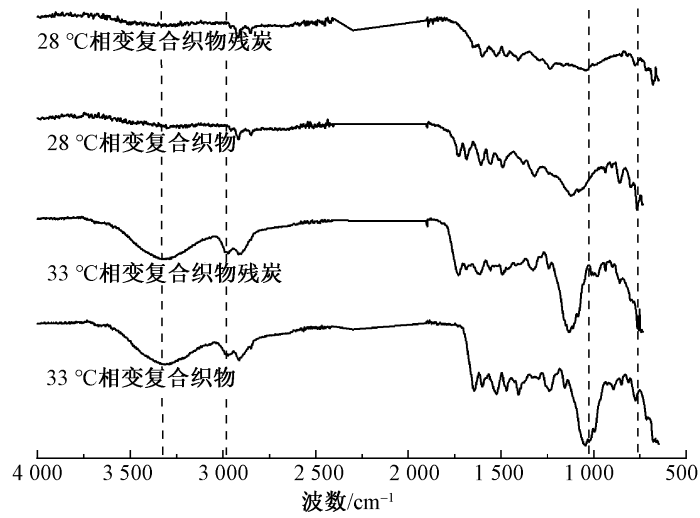
图5
不同相变复合织物与其燃烧残炭的红外光谱图
Fig.5
FT-IR spectra of different phase change composite fabrics and their combustion char residues
经测试,28、33 ℃相变复合织物的热防护性能值分别为390.2、419.8 kW·s/m2,说明33 ℃相变复合织物的热防护效果更好。
2.5 防静电性能
图6示出28 ℃和33 ℃相变复合织物的点对点电阻和透湿率。测试结果表明,28 ℃和33 ℃相变复合织物的防静电性能均达到GB 12014—2019的要求。具体而言,2种织物的点对点电阻值均低于规定的上限标准,表现出良好的电荷耗散能力。透湿率测试结果显示,2种织物的透湿率均超过5 000 g/(m2·24 h)的标准要求,这不仅确保了织物具备足够的透气性,也有助于减少静电积累。
图6
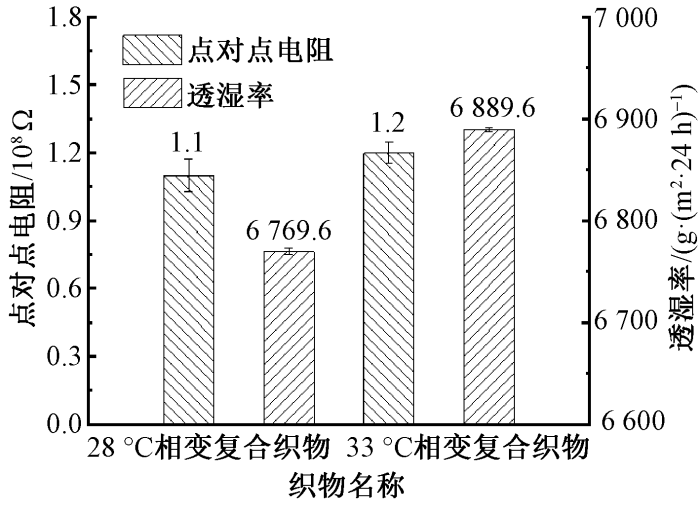
图6
相变复合织物的点对点电阻值和透湿率
Fig.6
Point-to-point resistance and moisture permeability of phase change composite fabrics
通过对比分析发现,33 ℃相变复合织物展现出更优异的防静电性能,其电阻更低,静电耗散效果更好。这种性能差异可能与织物内部导电通道的形成和分布有关,其中导电锦纶纱线的均匀分布和与其它纤维的有效结合起到了关键作用。上述实验结果表明,所开发的复合织物不仅具备调温和阻燃功能,还实现了可靠的防静电作用,为其在特殊工作环境下的应用提供了重要保障。
3 结论
本文通过将33 ℃相变微胶囊乳液与粘胶纺丝液共混,采用湿法纺丝工艺成功制备了具有优异调温性能的相变微胶囊-粘胶纤维。进一步将该纤维与阻燃粘胶纤维和芳纶1313按30∶20∶50的比例混纺,利用多组分间的协同阻燃效应,开发出兼具双向调温和阻燃功能的复合纱线。通过将该复合纱线与导电锦纶纱线合股作为经纬纱进行织造,最终制备了集调温、阻燃和防静电性能于一体的多功能智能织物。该材料在热防护性能、阻燃性能和防静电性能方面均达到国家相关标准,为其在石油、化工、消防等领域中的应用提供了理论参考。
参考文献
充气调温抗浸服的研制与保暖性评价
[J].
Development and evaluation of heat retention properties of inflatable thermostatic anti-immersion clothing
[J].
气凝胶复合材料在干式潜水服内胆隔热性能提升中的应用
[J].
Application of aerogel composites in improving thermal insulation performance of dry wetsuit inner liner
[J].
相变材料微胶囊的研究进展
[J].
Research progress of phase change materials microcapsules
[J].
个体冷却服的研究现状与发展趋势
[J].
DOI:10.13475/j.fzxb.20221003402

个体冷却服可缓解在户外高温环境中工作人员所出现的热应激问题从而提高工作效率。为解决个体冷却服在研发和使用过程中所出现的冷却时间短、衣内潮湿、冷却介质泄漏等关键问题,结合国内外最新研究成果,从冷却系统及其质量、降温区间、移动方式、使用场景等角度,分别介绍了气体冷却、液体冷却、相变冷却、混合冷却 4种类型的基础冷却服的研究进展,并重点归纳总结了热电冷却系统、辐射冷却系统、新材料冷却系统和真空干燥剂冷却系统4种新型冷却系统。从冷却材料包装、温度控制技术、新材料等影响冷却服性能的主要因素出发认为,未来冷却服的研发要关注6个方面:面料选择、新型冷却材料研发、制冷介质包装优化、自动调节热交换网络设计、冷却服综合工效学评价、微型智能温控面料及系统开发。
Research status and development trend of individual cooling suits
[J].
DOI:10.13475/j.fzxb.20221003402
<p id="p00010"><strong>Significance</strong> In high-temperature environments during the summer and high heat scene, workers' body core temperature keeps rising, leading to heat stress issues such as heat exhaustion, heat stroke, and heat cramp. Individual cooling garment are capable of mitigating heat stress issues that workers may experience in high-temperature environments. By regulating the temperature inside the clothing, they enhance the comfort of the wearer and improve their work efficiency. These suits serve as effective protective equipment with notable cooling effect. Traditional individual cooling garment face key issues such as short cooling duration, hot and humid when worn, and coolant leakage. The emergence of new cooling systems has provided research directions for improving cooling garment. Based on the latest research findings, the classification of cooling garment from a cooling system perspective has been introduced. The latest cooling system designs have been summarized, and the main factors influencing cooling garment performance have been analyzed. Additionally, the future development trends have been outlined with the aim of providing reference for the research and development of cooling garment.<br><strong>Progress</strong> It is crucial to develop new cooling systems and find solutions to enhance the comfort of cooling garment. Researchers have conducted extensive studies to improve cooling systems, aiming to enhance cooling effectiveness and refrigeration efficiency. In the field of gas cooling garment, researchers have compared the impact of garment size and ventilation rate on thermal resistance and cooling effectiveness. The results indicate that loose-fitting gas cooling garment exhibit superior ventilation efficiency and cooling effectiveness compared to form-fitting suits. To address practical applications, researchers have developed gas cooling garment with adjustable fan speeds. The results demonstrate that incorporating fans both in the front and back of the garment not only improves comfort but also reduces energy waste while maintaining longer cooling effects. In the field of liquid cooling garment, the latest approach for pipe preparation involves using PU fabric and heat pressing techniques to create cooling pipes. Liquid cooling garment designed with semiconductor refrigeration devices have effectively addressed coolant leakage issues and improved thermal comfort for wearers. Regarding pipe layout, research indicates that transverse arrangement of cooling pipes yields higher cooling efficiency compared to longitudinal arrangement. In the field of phase-change cooling garment, multiple studies have shown that increasing the temperature difference between the cooling pack and the environment improves cooling efficiency. Therefore, scholars have developed hybrid cooling jackets using dry ice and fans, resulting in improved refrigeration efficiency, extended cooling duration, and easier cleaning of the cooling garment. In the development of new cooling garment, thermoelectric refrigeration systems are gaining attention. These systems do not require compressors and allow for quick and accurate adjustment of cooling efficiency by regulating electric current. The temperature range that can be controlled is wide (-130 ℃ to 90 ℃), and there is no risk of refrigerant leakage with semiconductor cooling plates. Radiative cooling is another research direction of interest. Nanofabricated silk cooling garment based on radiative cooling principles can lower skin temperature by 8 ℃ in high-temperature environments, meeting comfort requirements. Furthermore, it is essential to develop new materials that offer excellent wearer comfort, high cooling efficiency, and enhanced environmental sustainability for new cooling systems. Examples include temperature-sensitive shape-memory bacteria and nanoporous polyethylene materials. Addressing the portability issues of convection-based gas cooling garment and insufficient power supply for cooling devices, a vacuum desiccant cooling (VDC) system has been developed. VDC pads are prepared and initialized by a high-performance vacuum pump, with the vacuum layer facilitating evaporation for cooling effects.<br><strong>Conclusion and Prospect</strong> The development of cooling clothing in the future is mainly reflected in the research and development of green functional fabrics with good cooling effect, and in optimizing the packaging of the cooling medium to reduce energy waste. The future development of cooling clothing is mainly reflected in the development of green functional fabrics with good cooling effects and new lightweight and durable materials. The following are believed to represent the research directions: optimization of the packaging of cooling medium to reduce energy wastel; further research and development of automatic adjustment heat exchange network to improve wearing comfort; more comprehensive ergonomic evaluation of cooling garment, taking into account the thermal perceptual response and ergonomics and other factors to improve the performance of cooling garment, and development of more intelligent, simple, miniaturized intelligent temperature control system.</p>
Synthesis and properties of multifunctional microencapsulated phase change material for intelligent textiles
[J].
Long-term autonomic thermoregulating fabrics based on microencapsulated phase change materials
[J].
DOI:10.1021/acsaem.1c02170
PMID:35128339
[本文引用: 1]
Microcapsules loaded with n-docosane as phase change material (mPCMs) for thermal energy storage with a phase change transition temperature in the range of 36-45 °C have been employed to impregnate cotton fabrics. Fabrics impregnated with 8 wt % of mPCMs provided 11 °C of temperature buffering effect during heating. On the cooling step, impregnated fabrics demonstrated 6 °C temperature increase for over 100 cycles of switching on/off of the heating source. Similar thermoregulating performance was observed for impregnated fabrics stored for 4 years (1500 days) at room temperature. Temperature buffering effect increased to 14 °C during heating cycle and temperature increase effect reached 9 °C during cooling cycle in the aged fabric composites. Both effects remained stable in aged fabrics for more than 100 heating/cooling cycles. Our study demonstrates high potential use of the microencapsulated n-docosane for thermal management applications, including high-technical textiles, footwear materials, and building thermoregulating covers and paints with high potential for commercial applications.© 2021 American Chemical Society.
Controlled latent heat phase-change microcapsules for temperature regulation
[J].
Preparation and evaluation of thermo-regulating bamboo fabric treated by microencapsulated phase change materials
[J].
DOI:10.1177/0040517518813681
[本文引用: 1]
Two types of microencapsulated phase change materials (ENPCMs) were synthesized by polymerization. The core material of ENPCM was n-octadecane and the shell materials were polymethyl methacrylate-butyl acrylate and polymethyl methacrylate-butyl acrylate-hydroxyethyl methacrylate. Subsequently, the synthesized ENPCMs were applied onto bamboo fabric by the dip and dry method. The properties of ENPCMs were analyzed in terms of surface morphology, size distribution and latent heat; the treated bamboo fabrics were evaluated in terms of surface morphology, hydrophilicity, washing fastness and heat storage capacity. The results showed that polymethyl methacrylate-butyl acrylate/n-octadecane (PMBO) microcapsules had an irregular shape, while polymethyl methacrylate-butyl acrylate-hydroxyethyl methacrylate/n-octadecane (PMBHO) microcapsules were spherical, and the mean diameters of both microcapsules were less than 1 mu m. The latent heat of phase change material (PCM) microcapsules was almost the same at a thermal storage capacity of 110 J/g. There were many more and more even PMBHO microcapsules deposited on bamboo fabric than that of PMBO microcapsules deposited on bamboo fabric. Bamboo fabrics treated by both microcapsules were hydrophilic, and the hydrophilicity of fabric treated by PMBHO microcapsules was even better. The ratio of PCM microcapsules to bamboo fabric was about 1:4, and the latent heat of treated bamboo fabrics was about 20 J/g. Moreover, the treated bamboo fabrics exhibited excellent washing fastness due to the strong binding strength between the highly hydrophilic microcapsules and bamboo fibers. Approximately 72% of PCM microcapsules were retained on the fabric after 15 washing cycles.
Phase change materials meet microfluidic encapsulation
[J].
A reversibly flame-retardant thermal regulation material inspired by leaf transpiration
[J].
Construction of layered double hydroxide-modified silica integrated multilayer shell phase change capsule with flame retardancy and highly efficient thermoregulation performance
[J].

 京公网安备11010502044800号


