



高速发展的现代科技带领人类进入了信息化、智能化社会,也暴露了其对不可再生石油资源的高度依赖性。随着石油资源的日渐枯竭,为应对气候变化,减少碳排放的压力,全球正在加速能源的多元化转型。纤维素作为可再生的天然资源,广泛存在于天然植物纤维中,具有来源广、成本低、可降解、易回收等特点,因此纤维素基材料被应用于各种领域。
纤维素基材料的制备可分为“自上而下”与“自下而上”2种方法。“自上而下”法指通过物理或化学手段将木材、植物纤维或废旧报纸等天然纤维素解离成更小的结构单元——纳米纤维素。常见的方法包括机械研磨、超声波处理、化学处理(如酸水解)等,由其制备的纳米纤维素已被广泛应用于造纸、涂料、药用辅料以及复合材料等行业。此外,通过化学修饰处理后的纳米纤维素还可用于高效吸附剂的气体分离膜等。“自下而上”法指通过溶解再生组装纤维素分子或聚集纳米纤维素来合成纤维素基材料,这种方法可精确控制纤维素分子的排列和结构,适用于制备再生纤维素纤维、再生纤维素膜、纤维素气凝胶等材料,得益于其良好的力学性能、生物相容性,已在伤口敷料、组织工程等方面得到广泛应用。尽管已有文献基于天然纤维素原料对其某一应用进行综述,但对于天然纤维素的多维结构演变尚未有清晰的综述报道。
本文涵盖了低维纳米纤维素、一维再生纤维素纤维、二维再生纤维素膜以及三维纤维素气凝胶4类材料的制备与应用。这种多维结构的分类视角,揭示了不同维度结构的纤维素材料在功能、力学性能、加工方法和应用领域上的显著差异。特别强调了各类纤维素材料在环境友好、可降解及功能化方面的最新研究进展,结合当前工业应用需求,提出了纤维素基材料在不同维度结构之间转换的可行性和未来发展方向,以期为该领域的研究人员提供新的启发和指导。
1 天然纤维素的多维结构演变
较低的成本与高纤维素含量的植物纤维是纤维素基材料制备的优选。棉花纤维的纤维素含量最高,约90%;麻与竹原纤维的纤维素含量为60%~85%。通过“自上而下”低维水解或“自下而上”溶解再生的解构方式,可使棉花纤维、麻纤维、竹原纤维等天然纤维的形态从一维向多维结构演变。基于天然纤维素的低维纳米纤维素、一维纤维素再生纤维、二维纤维素再生膜、三维纤维素气凝胶因其可降解性、环境友好性、加工适应性、多功能性等优势,已经成为现代经济转型过程中的关键驱动力,如图1(a)所示。
图1
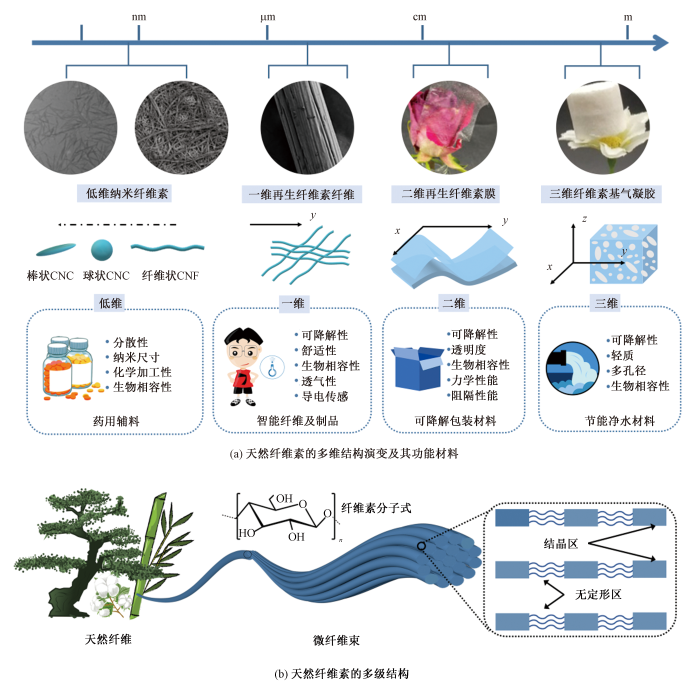
图1
天然纤维素的多维结构演变及其功能材料研究进展
Fig.1
Multidimensional structural evolution of natural cellulose and progress in functional materials. (a) Multidimensional structural evolution of natural cellulose and its functional materials; (b) Hierarchical structure of natural cellulose
1.1 低维纳米纤维素
从天然纤维素中提取纳米纤维素的传统方法主要为机械法与酸水解法。机械法能耗高,破坏强度大,容易导致纳米纤维素的尺寸分布不匀。尽管通过浓硫酸对纤维素进行处理得到的纳米纤维素的尺寸分布较为均匀,但该方法产率低,且由此生成的磺酸基团是纳米纤维素热稳定性差的主要原因。近年来,甲酸/盐酸、柠檬酸/盐酸、马来酸/盐酸等混酸水解工艺通过有机酸-费歇尔(Fischer)酯化策略,极大提高了纳米纤维素的产率(大于90%)与热稳定性(初始热降解温度大于330 ℃),并实现了纤维素羟基(—OH)的功能性修饰。另外,为避免酸的使用造成环境污染,高碘酸钠、过硫酸铵、过氧化氢以及无机盐等无酸法可通过自由基的引入提取纳米纤维素。最近,以氯化胆碱、柠檬酸和水组成的低共熔溶剂[2]可制备超细长CNF,长径比高达2 500,这种技术因其高产率、高固含量、低生产成本与可回收性有望实现工业化生产。然而,考虑到工业化的放大生产过程,还存在溶剂稳定性、循环效率、纤维均一性与溶剂回收的技术难点。首先,这种低共熔溶剂对纤维素原料的木质素含量与硅含量较为敏感,因此,未漂白浆料与甘蔗渣等高硅农业废弃物的产率较低;其次,在中试放大实验中,超声波处理(20 kHz)可能会使纳米纤维素的均匀性受限,在大规模工业化生产中需要开发高压均质设备或连续流系统。总体来说,这种水合低共熔溶剂生产纳米纤维素纤维的方法是能媲美2,2,6,6-四甲基哌啶-1-氧化物(TEMPO)氧化法的新方法,在克服大规模工业化生产中面临的实际问题后,能够用于羧基化纤维素纳米纤维的大规模经济化生产。
得益于较高的结晶度、分散性与力学性能,低维纳米纤维素在药用辅料、高性能复合材料、传感器、纺织品以及纳米复合材料等方面有广泛的应用前景。另外,Vignolini研究团队报道了大规模制造有色纤维素纳米晶薄膜与颜料的制备方法[3],通过优化CNC悬浮液的配方以及沉积和干燥条件,利用连续卷绕式沉积工艺来大规模生产CNC光子薄膜与颜料,显示了低维纳米纤维素在替代不可生物降解微塑料闪粉与致癌、不可持续的二氧化钛以及云母产品方面的潜能与应用前景。
1.2 一维再生纤维素纤维
数千年来,纤维为人类的日常生活提供舒适、健康和实用保障。尽管合成纤维在性能和成本上有明显优势,但在透气性、舒适性和环保性等方面存在不足。再生纤维素纤维(RCF)有助于克服合成纤维的局限性,并且保留天然纤维的优点[4]。然而再生纤维素纤维的制备高度依赖于特定溶剂的使用。因此,目前大量的研究均在寻找适合纤维素的溶剂体系,以期实现对纤维素的再生增值利用。
20世纪初,粘胶纤维与铜氨纤维作为革新产物最早实现RCF的工业化生产。铜氨纤维以铜氨溶液为溶剂,具有类蚕丝的抗静电与悬垂性,常用于高端纺织品和医用纺织材料,但由于生产工艺中涉及到铜盐的使用,不环保且会加重环境负担[5]。粘胶纤维则以氢氧化钠/二硫化碳(NaOH/CS2)为溶剂进行湿法纺丝,生产过程中会产生大量有毒废物[6]。20世纪末,以环保溶剂N-甲基吗啉-N-氧化物(NMMO)通过溶剂纺丝制备的莱赛尔纤维(Lyocell)在奥地利首次实现了大规模工业生产[7]。Lyocell纤维凭借其出色的舒适性、环保性、力学性能与抗皱性,在纺织服装行业得到广泛认可,然而,NMMO溶剂的回收需要较高成本。利用碱脲溶剂(NaOH/Urea)进行纺丝的方法相较于NMMO溶剂法,具有低成本、低能耗与工艺简单的优势。另外,由于碱脲法能适用于大多数的纤维素原料,在废弃纺织品的回收方面显示出巨大的应用潜力[8]。除溶剂外,纤维素溶液的黏度与纺丝牵伸倍数也是影响RCF性能的关键因素。黏度是溶液能挤出成丝的基础,需要将纤维素溶液的浓度保持在可纺范围;而纺丝牵伸倍数通过控制纤维素链的取向度影响RCF的力学性能。
1.3 二维再生纤维素膜
二维再生纤维素膜与一维再生纤维素纤维的制备都依赖天然纤维素的溶解与再生。然而,与再生纤维素纤维相比,再生纤维素成膜的过程解除了对纤维素溶液黏度的要求,因此其溶剂选择的范围会更广。近年来,无机盐[13]、有机/无机混酸[14]、二氧化碳转换系统[15]与低共熔溶剂[16]也被广泛应用于再生纤维素膜的制备。纤维素的充分溶解促进了纤维素溶液的均匀性、膜表面的平整度以及膜内部的孔隙结构,因此,溶剂的选择主要通过溶解度对再生纤维素膜的透明度、力学性能与热稳定性能产生影响。另外,凝固浴(水、乙醇、甲醇、丙酮)的选择也会影响成膜性能。对凝固浴进行功能设计可以通过控制再生过程从而实现纤维素膜的疏水改性与热封改性[17-18]。另有研究表明,以有机溶剂为凝固浴可提高纤维素膜表面的致密与光滑程度[19]。然而,溶剂对凝固浴的溶剂选择也会产生影响。例如,当以混酸溶解纤维素时,碱性NaOH凝固浴能极大提高再生纤维素膜的强度(122 MPa)[20]。然而,不经额外改性处理的再生纤维素膜很难满足应用要求,目前,疏水、抗菌、抗紫外线以及导电的再生纤维素膜多有报道,显示了其在包装、传感、储能等领域的应用潜力。
1.4 三维纤维素气凝胶
气凝胶为多孔轻质材料,而纤维素气凝胶由于具有较低的密度、极高的孔隙率与良好的绝缘性,是新一代气凝胶的代表,也是新型纤维素基材料的研究热点。基于前文所述的水解(或氧化)与溶解,均可制备纤维素气凝胶,而其关键步骤在于干燥过程形成三维网状结构。
通过破坏天然纤维素中的氢键溶解纤维素,随后通过凝固浴再生的纤维素气凝胶,由于经历了溶解再生的过程,纤维素分子链的排布发生了由平行到反平行的变化,使纤维素的晶体结构由I型转变为II型,II型纤维素气凝胶的力学性能以及热稳定性能都有不同程度的下降[1]。另外,从天然纤维素中直接提取的CNF具有较大的长径比,形状大都为易缠结的纳米长纤维,这些纤维可通过氢键作用形成三维网络骨架,在水中直接分散后经干燥即可形成气凝胶。因此,与溶解再生的纤维素气凝胶相比,CNF气凝胶通常具有更高的强度与模量,更优的尺寸稳定性以及更好的变形能力。
制备CNF气凝胶需要通过分子内/间氢键的形成得到物理交联的三维网络。然而,只依靠物理交联的CNF气凝胶仍然无法满足实际应用中对力学性能、尺寸稳定性以及功能性的要求。因此,将化学交联与物理交联结合可显著提高气凝胶内部交联的程度,从而改善其各项性能。研究表明,以高聚合活性的有机硅氧烷为交联剂,不仅有效改善气凝胶的力学性能,还通过对纤维素表面—OH基团的修饰实现纤维素气凝胶的功能改性。冻干法利用水的冰晶升华去除水分,留下空隙结构来生产CNF气凝胶,是目前最接近产业化的制备方法。在此基础上发展的液滴冷冻与热解方法,也具备规模化制备CNF气凝胶球的潜力,这种气凝胶球除高比表面积与高化学稳定性外,还表现出优异的电磁波吸收性能[21]。除此之外,采用常压干燥法制备的复合气凝胶在添加活性物质后显现出储能气凝胶的巨大应用潜力,由于这种气凝胶的各种形状与结构特征可通过3D打印进行调控,因此具有大规模生产的前景[22]。
2 基于天然纤维素的多维材料应用进展
2.1 药用辅料
图2
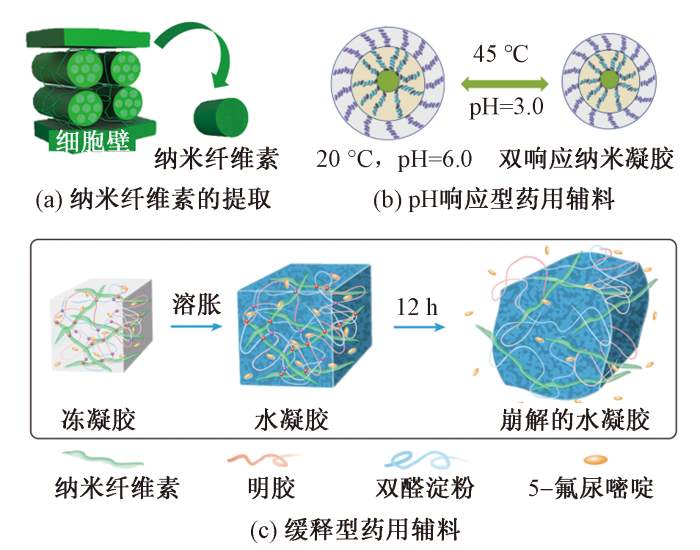
图2
低维纳米纤维素的药用辅料应用
Fig.2
Application of low-dimensional nanocellulose as pharmaceutical excipients. (a) Extraction of nanocellulose; (b) pH-responsive pharmaceutical excipients; (c) Sustained release pharmaceutical excipients
然而,纳米纤维素具有较大的比表面积,氢键作用强,易发生聚集导致分散性下降,进而限制其应用效果。此外,亲水性基团的大量存在使得纳米纤维素无法负载疏水性药物。通过对表面活性基团进行化学修饰,使其转化为氨基、羧基、醛基等,可有效改善其分散性以及与药物的复合性。例如,利用硫酸水解制备CNC,可在氯乙酸/碘化钾/醋酸钠体系中制备羧甲基纳米纤维素(N—CMC)[24]。通过醚化试剂制备季胺化纳米纤维素(N—QC),引入的C—N基团取代纳米纤维素表面的—OH,使纳米纤维素由带负电荷变化为带正电荷。动物甩尾镇痛实验结果显示,以带正电荷的N—QC为载体的药物具有更长的镇痛持续时间与更强的镇痛强度。另外,采用酯化法制备多羧基化纳米纤维素,实现—OH的可控取代,可延长顺铂在血液循环中的时间[25]。由此可见,对CNC表面的基团进行化学修饰,不仅可以改善其分散性,还可以在保证药物化学稳定性的前提下,延长药物的释放时间。
CNF与CNC相比,具有更大的长径比(>50),在纳米尺度下以纤维的形态存在,因此,以CNF为模板可制备多孔药物载体。采用阳离子CNF和表面活性剂(月桂酸钠盐),将药物悬浮在稳定的湿泡沫中干燥后可得到不同厚度、形状和药物负载量的柔性蜂窝状CNF材料,通过改变干泡沫的尺寸控制药物释放动力学,相比之下,厚度为0.009 mm的薄膜的药物释放速度最快,可以在1 h内释放72%的药物[26]。
pH应药用辅料是近年来药物制剂领域的一个重要研究方向。这类辅料通常被用在控释药物系统中,可以在特定的pH值环境下响应并发挥其控制药物释放的作用(见图2(b))。例如,药物可被设计成在胃酸环境(pH值在1.5~3.5之间)中稳定,直至到达肠道(pH值在5.5~7.5之间)时才释放活性。一些抗肿瘤药物也需要通过pH响应使药物到达病灶时释放。壳聚糖对pH值具有敏感性,将壳聚糖与CNF进行复合制备药物载体可用于治疗滴虫病,研究结果表明,最终得到的载药体系具有pH响应性,其载药量与包封率分别为24.4%和64.56%,可以实现药物的控释,减少副作用[27]。通过将叶酸偶联的纳米纤维素进行聚合制备的姜黄素有效给药系统,在pH值为5.5时的药物释放量最大,可作为癌症治疗中姜黄素靶向输送和控制释放的潜在装置。另外,由于纳米纤维素具有良好的相容性与亲水性,通过二醛淀粉的化学交联构建的纳米纤维素/明胶复合低温凝胶可在模拟肠道环境中持续释放12 h,与人体代谢周期一致(见图2(c))[28]。
纳米纤维素因其优异的力学性能、生物降解性、无毒性,可通过化学修饰或物理交联对表面基团进行功能化,在药物缓释、控释、靶向给药以及溶解性改善等方面展示了广泛的应用潜力,已成为未来药物制剂中不可或缺的关键材料。
2.2 智能纤维及制品
结合现代纺织技术,再生纤维素纤维可被应用于智能纺织品,进而提升其功能性和应用范围,特别是在健康检测、环境响应、能源收集等领域。得益于其表面丰富的活性基团,在再生纤维素纤维内部或表面负载不同的功能材料可制备相变调温、传感监测以及光电感应等功能的智能纤维及制品。再生纤维素纤维一般通过湿法纺丝进行制备,在纺丝液中复合或在凝固浴中沉积功能粒子,进而将其负载在再生纤维素纤维上,赋予其不同的功能性,如图3(a)所示。
图3
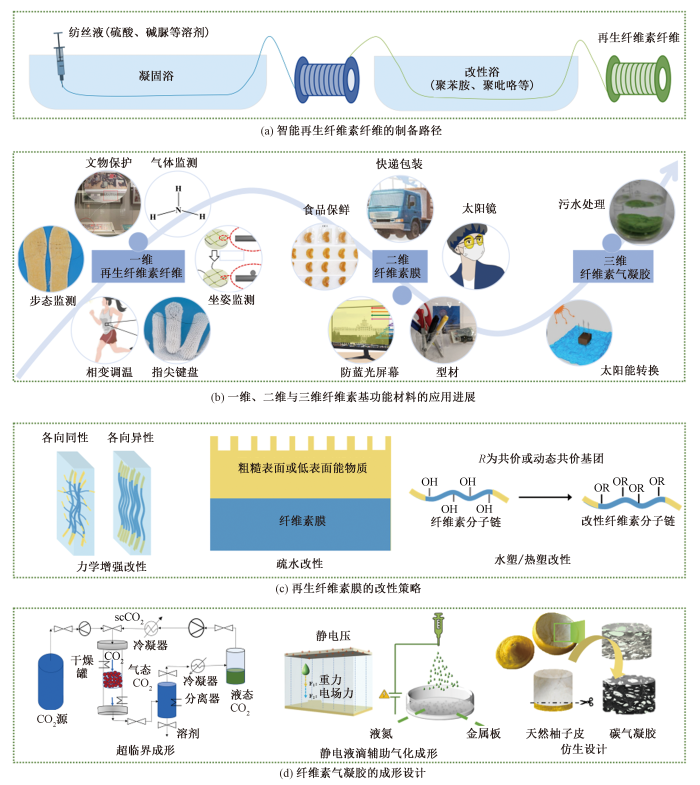
图3
一维、二维与三维纤维素基功能材料的研究策略与应用进展
Fig.3
Research strategies and application of 1D, 2D, and 3D cellulose-based functional materials. (a) Preparation path of regenerated cellulose fibers; (b) Applications of 1D, 2D and 3D cellulose-based functional materials; (c) Modification of cellulose films; (d) Molding of cellulose aerogels
随着人工智能向生活各领域的渗透,智能纺织品得到了越来越多的关注。基于纤维的智能纺织品因具有更高的灵活性,更适于可穿戴与可植入式传感应用,而具有生物相容性、可降解性的再生纤维素纤维由于其环保性、舒适性、灵活性也被广泛应用于智能纺织品。聚苯胺(PANI)作为导电高分子材料,由于其良好的导电性能、可逆掺杂性能和良好的环境稳定性成为赋予再生纤维素纤维导电性的优势材料。PANI可通过氢键在溶剂中与纤维素形成PANI-纤维素皮芯结构复合纤维,也可在凝固浴中沉积后通过湿法纺丝制备玉米状PANI/纤维素复合纤维,这种纤维具有优异的检测有毒气体(甲醛)的功能[12]。然而,与聚吡咯(PPy)相比,PANI在灵活性以及密度方面存在缺陷。PPy具有高导电性、氧化还原性、环境稳定性、成本低廉的优点,可制备耐磨的导电再生纤维素纤维。通过原位冷冻聚合辅助的层层自组装技术[29],在复合纤维内形成一个连续、稳定的导电网络,具有极高的耐久性,通过优异的温湿度感应性能可以进行文物保护;另外,通过压力传感装置还可以进行有效的人体久坐提醒与步态监测。若将导电纤维交织于针织手套中,在纤维交叉点施加压力即可实现信息传输(见图3(b))。
由此可见,再生纤维素纤维凭借天然环保的优势和良好的加工性能,不仅能够为智能纺织品提供传统纺织品的舒适性,还能赋予其温度调节、传感监测、光电响应等功能。这些创新应用使得再生纤维素纤维在智能服装、运动装备、医疗纺织品等领域具有广阔的应用前景。
2.3 可降解包装材料
保留天然纤维基材料的各向异性结构可以大幅度提升纤维素膜的强度至350 MPa[35]。然而,再生纤维素膜需要通过预取向辅助双交联的方法控制其在凝胶状态下纤维素链的聚集而制备各向异性的高强度纤维素膜(见图3(c))。此外,采用该种方法制备的纤维素膜还具有低雾度(小于3%)与双折射行为[36]。然而,这种在溶解再生后额外进行机械拉伸的改性方法,难以进行工业化生产。目前,主要通过重排纤维素内部的氢键网络提高纤维素膜的强度。亲水基团的存在使纤维素膜呈现亲水性,其湿强大幅降低,在包装、一次性吸管、传感器等领域的应用受到阻碍。提高纤维素膜疏水性的改性方法主要分为2种:降低表面能与提高表面粗糙度(见图3(c))[37]。降低表面能通过引入硅烷、含氟有机物等疏水性物质对纤维素表面进行改性,制备疏水性纤维素膜,而增加表面粗糙度则需要改变表面的三维微结构[38-39]。受自然界中荷叶的超疏水表面启发,模拟荷叶的微观结构已被证实可有效改善纤维素膜的疏水性[40]。疏水性薄膜由于其防水性以及良好的力学性能有望应用在快递包装领域。除此之外,再生纤维素膜的抗菌、抗紫外线以及阻隔性能都可以通过基于功能性粒子的共混技术加以实现[41-42]。羧甲基壳聚糖、肉桂醛、季铵盐、金属纳米粒子/线等可以赋予再生纤维素膜抗菌性,从而使纤维素膜在水果保鲜的应用中体现出明显优势。木质素和金属有机框架与纤维素分子链的有效复合则可赋予纤维素膜紫外线阻隔性能,由此制备的纤维素膜甚至可在太阳眼镜与防蓝光屏幕方面显现应用优势(见图3(b))。
尽管随着生产技术的发展,纤维素膜已兼具了高透明、高强度、疏水、抗菌、抗紫外线以及阻隔等优异性能,但在作为可降解包装材料应用时,由于纤维素固有的不熔融缺陷,再生纤维素膜无法似石油基塑料一般进行自由的形状加工,导致其与石油基塑料相比,丧失了型材加工的竞争优势。目前,通过小分子接枝引入动态共价网络或通过残留的无机盐溶剂实现限域微溶的方法已被用于赋予纤维素膜热加工性[17,43]。考虑到基于热的形状加工对能源的依赖性,近期,通过调控纤维素膜的亲疏水性制备的水塑纤维素膜引起了极大的关注[44]。这种水塑性纤维素膜只通过水即可进行形状变换,并具备高强度、高透明度与形状记忆性,是目前纤维素膜材料的研究热点[45-46]。
目前,国内市场占比较高的可降解生物聚酯代表有聚乳酸(PLA)与聚己二酸对苯二甲酸丁二醇酯(PBAT)。其中PLA刚性大、延展性差,而PBAT刚性低、柔韧性好。与之相比,已有研究报道将纤维素膜的断裂强度提高至200 MPa以上,且断裂伸长率达到20%,展现出良好的强韧性[36]。PBAT生物降解垃圾袋的降解周期为5~6月,PLA的降解需要依赖特定的温湿度与堆肥条件,若将PLA材料随意丢弃在环境中,其降解周期或与传统塑料无异。然而,大量研究数据表明,纤维素材料在简单的土壤条件下就可完成降解,由无机盐溶剂制备的纤维素膜在100 d内就可完成99%的降解[47]。此外,PBAT与PLA膜的造价分别为20 000、25 000元/t左右[48]。纤维素膜的原料,如棉花、木浆的成本低,大部分的成本预算来自于溶剂的使用,因此,纤维素膜的造价高低取决于溶剂的成本。
2.4 净水节能材料
三维纤维素气凝胶因具有高孔隙率、轻质性、低热导率,在净水节能材料领域的应用潜力巨大。气凝胶的成形过程主要可分为常规干燥、冷冻干燥以及超临界干燥成形三大类。常规干燥虽然操作简单,但有结构损坏的风险,并且不适用于高孔隙材料。冷冻干燥相对于常规干燥来说,能够更好地保留结构,但能耗相对较大。与之相媲美的超临界干燥,具有更完美的结构保留能力,且能处理各种类型的溶剂与凝胶,但由此也带来更高昂的成本[49]。
传统吸附剂通常存在去除能力低、捕获动力学慢、分离困难、粉体材料二次污染、回收能力不强等问题,纤维素气凝胶表面具有丰富的羟基等官能团,能够与重金属离子发生络合反应,从而有效去除水中的重金属离子如铅、贡、镉等。随着生产技术的发展,基于冷冻干燥的静电液滴辅助气化成形法能够可控地制备形态与大小不同的纤维素微球(见图3(d))[51],由此制备的纤维素微球对重金属铬的吸附量可达190.2 mg/g。相关研究结果证明,利用多羟基纤维素的羟基诱导效应制备三维钛酸盐气凝胶,由于纤维素表面的羟基带负电,对阳离子具有吸引力,可以将阳离子(Pb2+、Cu2+、Sr2+、Ra2+、Cd2+)聚集在钛酸盐气凝胶表面或内部,并永久固定于钛酸盐层间结构中[50]。对—OH进行功能化处理还能使其对多种有机物(如染料、农药)等产生较强的吸附能力[51]。
此外,保留天然纤维的结构制备仿生气凝胶也是行之有效的策略。保留低成本的废弃柚子皮的结构后对其进行炭化,可制备三维多孔网状碳气凝胶。这种仿生设计使制备的碳气凝胶保持着“软-硬”结构,并表现出优异的太阳能转换效率(85.1%),在太阳能转换上提供了有效的解决方案[52]。另外,太阳能光热材料可以收集太阳光,将其转化为热量,并加速海水的蒸发产生淡水。纤维素碳气凝胶在应用于加速海水蒸发的光热转换材料时,具有亲水性差的缺点。通过乙烯基三甲氧基硅烷对纳米纤维素改性得到的碳气凝胶,其亲水性、导电性和力学性能在导电聚合物原位生成后得到同时提高。与传统炭化多孔生物质材料应用于海水淡化的策略相比,这种生物碳气凝胶同时具备光热转换特性与电热转换特性,即使在没有阳光的情况下也可进行水蒸发,具备全天候连续生产淡水的能力[53]。采用金属-有机骨架和有机胺共修饰的方法还能制备具有二氧化碳捕获能力的纤维素气凝胶(见图3(b)),有望能减轻二氧化碳对社会与生态系统的负面影响[50]。总体而言,纤维素气凝胶不仅在节能净水,在减碳应用中也具有重要的价值和应用潜力。
3 结束语
纤维素基材料因其具有可再生性、生物相容性和可降解性,已成为近年来可持续材料的研究热点。源自天然纤维素制得的多维结构纤维素基材料展现出优异的力学性能、吸附性能、导电性能以及形状记忆特性,在环境修复、生物医药、柔性电子以及可降解包装等领域具有广泛的前景。尽管取得了显著进展,但纤维素基材料的高附加值利用仍存在以下挑战。
1)低维纳米纤维素的生产通常需要高能量消耗的机械剪切或复杂的化学处理,规模化生产时难以平衡性能和成本。作为药用辅料,低维纳米纤维素的毒理学和安全性评估尚未全面开展。尽管纤维素本身具有良好的生物相容性,但在纳米尺度下可能会出现新的生物效应,对人体潜在的免疫反应、细胞毒性以及长期蓄积效应需要进一步研究,以满足药物监管机构的安全要求。
2)一维再生纤维素纤维与二维再生纤维素膜都依赖天然纤维素的溶解。然而,绿色溶剂体系的开发仍面临技术和成本的瓶颈。此外,再生纤维素纤维在湿态下的强度较低,影响其在高湿环境下的稳定性;而二维再生纤维素膜则亟需通过物理或化学改性获得形状可加工性,以增强与石油基不可降解塑料的竞争能力。基于再生纤维素膜的生命周期评估体系也有待建立,以此通过直接的评价结果来证明纤维素膜的环境友好性。
3)三维纤维素气凝胶的制备过程通常需要冷冻干燥或超临界干燥,导致高昂的生产成本。此外,气凝胶仍存在力学性能较差、实际应用过程中易碎等缺陷。提升气凝胶的力学性能、降低生产成本以及实现规模化连续生产是其工业化应用面临的主要挑战。
参考文献
A comprehensive investigation on cellulose nanocrystals with different crystal structures from cotton via an efficient route
[J].
Scalable production of carboxylated cellulose nanofibres using a green and recyclable solvent
[J].
Large-scale fabrication of structurally coloured cellulose nanocrystal films and effect pigments
[J].
A review of nanocellulose as a new material towards environmental sustainability
[J].
Fabrication of hollow materials by fast pyrolysis of cellulose composite fibers with heterogeneous structures
[J].
A randomised, blinded, trial of clopidogrel versus aspirin in patients at risk of ischaemic events
[J].
A critical review of manufacturing processes used in regenerated cellulosic fibres: viscose, cellulose acetate, cuprammonium, LiCl/DMAc, ionic liquids, and NMMO based lyocell
[J].
Continuous meter-scale wet-spinning of cornlike composite fibers for eco-friendly multifunctional electronics
[J].
Unconventional methods in cellulose functionalization
[J].
Dissolution of celluose with ionic liquids
[J].
Recent progress in regenerated cellulose fibers by wet spinning
[J].
Homogeneous wet-spinning construction of skin-core structured PANI/cellulose conductive fibers for gas sensing and e-textile applications
[J].
Highly efficient and superfast cellulose dissolution by green chloride salts and its dissolution mechanism
[J].
Efficient cellulose dissolution and derivatization enabled by oxalic/sulfuric acid for high-performance cellulose films as food packaging
[J].
Sustainable one-pot cellulose dissolution and derivatization via a tandem reaction in the DMSO/DBU/CO2 switchable solvent system
[J].
New natural and renewable low transition temperature mixtures (LTTMs): screening as solvents for lignocellulosic biomass processing
[J].
A binder-free method to produce heat-sealable and transparent cellulose films driven by confined green solvent
[J].
Molecular dissociation of DTMS tailoring cellulose regeneration and hydrophobic modification for building highly transparent cellulose films
[J].
不同凝固浴对纤维素膜特征影响的研究
[J].
DOI:10.16606/j.cnki.issn0253-4320.2020.08.034
[本文引用: 1]

以棉浆板为纤维素原料、ZnCl<sub>2</sub>溶液为溶剂,分别以水、甲醇、乙醇、丙酮为凝固浴,通过相转化法制备了4种纤维素膜。通过膜的微观形貌对比分析了其形成机理,测定了不同膜在水通量、孔隙率及干燥后力学性能的差异。结果表明,4种膜内部均为纤维网状结构,其中以水为凝固浴制得的膜的内部纤维较为舒展、粗大,表皮为多孔状;而以有机溶剂制得的膜的内部纤维为卷曲、结团状,且出现指状孔,表皮为致密光滑状。4种膜的FT-IR、XRD、TG表征结果无显著差异,均由纤维素Ⅰ型变为纤维素Ⅱ型,结晶度降低,热稳定性降低30℃左右,残碳量增高。
Effect of different coagualtion baths on characteristics of cellulose membrane
[J].
DOI:10.16606/j.cnki.issn0253-4320.2020.08.034
[本文引用: 1]
Four kinds of cellulose membranes are manufactured from cotton pulp board through the phase inversion method,with ZnCl<sub>2</sub> solution as solvent,and water,methanol,ethanol and acetone as coagulation baths,respectively.The microstructure of the membranes is observed and the formation mechanism is analyzed.Sequentially,the differences of those membranes in water flux,porosity and mechanical properties after drying are determined.The results show that the inner structure of all four membranes is a fibrous network structure.The membrane made with water as a coagulation bath has relatively stretched and thick internal fibers,as well as a porous skin,while the membrane made with organic solvents possesses curled and clumped internal fibers with finger-shaped pores,and dense and smooth skin.There is no significant differences among the four kinds of membranes in FT-IR,XRD and TG characterization.Compared with cotton linter,the membrane's crystal form changes from cellulose I to cellulose Ⅱ,its crystallinity decreases,its thermal stability decreases by about 30℃,and the residual carbon amount within the membrane increases.
Tailoring hydronium ion driven dissociation-chemical cross-linking for superfast one-pot cellulose dissolution and derivatization to build robust cellulose films
[J].
DOI:10.1021/acsnano.3c11335
PMID:38456442
[本文引用: 1]
Concepts of sustainability must be developed to overcome the increasing environmental hazards caused by fossil resources. Cellulose derivatives with excellent properties are promising biobased alternatives for petroleum-derived materials. However, a one-pot route to achieve cellulose dissolution and derivatization is very challenging, requiring harsh conditions, high energy consumption, and complex solubilizing. Herein, we design a one-pot tailoring hydronium ion driven dissociation-chemical cross-linking strategy to achieve superfast cellulose dissolution and derivatization for orderly robust cellulose films. In this strategy, there is a powerful driving force from organic acid with a p below 3.75 to dissociate H and trigger the dissolution and derivatization of cellulose under the addition of HSO. Nevertheless, the driving force can only trigger a partial swelling of cellulose but without dissolution when the p of organic acid is above 4.26 for the dissociation of H is inhibited by the addition of inorganic acid. The cellulose film has high transmittance (up to ∼90%), excellent tensile strength (∼122 MPa), and is superior to commercial PE film. Moreover, the tensile strength is increased by 400% compared to cellulose film prepared by the ZnCl solvent. This work provides an efficient solvent, which is of great significance for emerging cellulose materials from renewable materials.
Scalable manufacturing of light, multifunctional cellulose nanofiber aerogel sphere with tunable microstructure for microwave absorption
[J].
Large-scale preparation of electrically conducting cellulose nanofiber/carbon nanotube aerogels: ambient-dried, recyclable, and 3D-printable
[J].
Preparation and characterization of nanostarch-based green hard capsules reinforced by cellulose nanocrystals
[J].
DOI:10.1016/j.ijbiomac.2020.11.078
PMID:33189752
[本文引用: 1]
The green hard capsules were prepared with corn nano-starch (CNS) and cellulose nanocrystal (CNC) in this study, the glycerol and carrageenan were used as plasticizer and gelling agent in the CNS/CNC gel solution, respectively. The capsule-films with different CNC content were prepared by casting method, and the dipping method was used in preparation of the corresponding capsules. The compatibility of CNS/CNC capsules was analyzed by Fourier Transform Infrared spectroscopy (FTIR) and X-Ray Diffraction (XRD), and the morphology of the capsules was analyzed by Scanning Electron Microscopy (SEM). The results showed that the tensile strength of the CNS based capsule-film was significantly improved with the addition of CNC. When the content of CNC was 6.0%, the tensile strength increased by 238.10%. The transparency of the capsule with different CNC contents was slightly reduced, but was greater than 87.0%. The loss on drying of CNS/CNC capsule was between 12.87% and 15.03%, and it could be completely dissolved in the artificial gastric juice within 6.0 min, which was in accordance with the provisions of Chinese Pharmacopoeia (2015).Copyright © 2020 Elsevier B.V. All rights reserved.
多羧基纤维素纳米晶的制备与性能研究
[J].
Study on preparation and properties of multi-carboxyl cellulose nanocrystal
[J].
Solid cellulose nanofiber based foams: towards facile design of sustained drug delivery systems
[J].
Chitosan nanocapsule-mounted cellulose nanofibrils as nanoships for smart drug delivery systems and treatment of avian trichomoniasis
[J].
Nanocellulose/gelatin composite cryogels for controlled drug release
[J].
Freeze polymerization to modulate transverse-longitudinal polypyrrole growth on robust cellulose composite fibers for multi-scenario signal monitoring
[J].
A regenerated cellulose fiber with high mechanical properties for temperature-adaptive thermal management
[J].
Coconut oil-cellulose beaded microfibers by coaxial electrospinning: an eco-model system to study thermoregulation of confined phase change materials
[J].
Cellulose derivatives as basic materials for plastics
[J].
Largely improved dielectric energy performances and safety of BOPP film via surface engineering
[J].
Recent advances in composites based on cellulose derivatives for biomedical applica-tions
[J].
Anisotropic, transparent films with aligned cellulose nanofibers
[J].
Highly transparent, hydrophobic, and durable anisotropic cellulose films as electronic screen protectors
[J].
Functional and versatile superhydrophobic coatings via stoichiometric silanization
[J].
Purity of the sacred lotus, or escape from contamination in biological surfaces
[J].
Wetting and self-cleaning properties of artificial superhydrophobic surfaces
[J].The wetting and the self-cleaning properties (the latter is often called the "Lotus-Effect") of three types of superhydrophobic surfaces have been investigated: silicon wafer specimens with different regular arrays of spikes hydrophobized by chemical treatment, replicates of water-repellent leaves of plants, and commercially available metal foils which were additionally hydrophobized by means of a fluorinated agent. Water droplets rolled off easily from those silicon samples which had a microstructure consisting of rather slender spikes with narrow pitches. Such samples could be cleaned almost completely from artificial particulate contaminations by a fog consisting of water droplets (diameter range, 8-20 microm). Some metal foils and some replicates had two levels of roughening. Because of this, a complete removal of all particles was not possible using artificial fog. However, water drops with some amount of kinetic impact energy were able to clean these surfaces perfectly. A substrate where pronounced structures in the range below 5 microm were lacking could not be cleaned by means of fog because this treatment resulted in a continuous water film on the samples.
Robust and versatile superhydrophobic cellulose-based composite film with superior UV shielding and heat-barrier performances for sustainable packaging
[J].
Quaternized chitosan as an antimicrobial agent: antimicrobial activity, mechanism of action and biomedical applications in orthopedics
[J].
Bio-inspired, UV-blocking, water-stable and antioxidant lignin/cellulose films combining high strength, toughness and flexibility
[J].
A biodegradable, waterproof, and thermally processable cellulosic bioplastic enabled by dynamic covalent modification
[J].
Hydroplastic polymers as eco-friendly hydrosetting plastics
[J].
Hydrogen-bonding affords sustainable plastics with ultrahigh robustness and water-assisted arbitrarily shape engineering
[J].
Reprogrammable, sustainable, and 3D-printable cellulose hydroplastic
[J].
Novel strategy to interpret the degradation behaviors and mechanisms of bio- and non-degradable plastics
[J].
Biodegradable, colorless, and odorless PLA/PBAT bioplastics incorporated with corn stover
[J].
The potential of supercritical drying as a ″green″ method for the production of food-grade bioaerogels: a comprehensive critical review
[J].
A 3D titanate aerogel with cellulose as the adsorption-aggregator for highly efficient water purification
[J].
Biohybrid hydrogel and aerogel from self-assembled nanocellulose and nanochitin as a high-efficiency adsorbent for water purification
[J].
Waste pomelo peels-derived ultralow density 3D-porous carbon aerogels: mechanisms of ″soft-rigid″ structural formation and solar-thermal energy storage conversion
[J].
Highly efficient carbonization of nanocellulose to biocarbon aerogels with ultrahigh light absorption efficiency and evaporation rate as bifunctional solar/electric driven steam generator for water purification
[J].

 京公网安备11010502044800号


