



导电聚合物因其独特的电学和光学特性,成为突破有机低发射率材料研究的关键方向[10-11]。其中,聚苯胺(PANI)凭借其独特的电致变色能力、轻量化特性、低成本及易加工性,为红外隐身领域提供了新的解决方案,并通过与其它材料的复合进一步拓展了应用潜力。然而,尽管PANI及其衍生物具有结构多样性和易加工的优点,但其难熔的特性增加了材料制备的复杂性和成本,并限制了最终产品的成形加工性能。实际应用中,为改善聚苯胺的加工性能,通常需要采用特殊工艺或添加助剂,此外,PANI在加工成均匀薄膜或涂层时需依赖复杂工艺(如溶液浇铸、电化学沉积),且成品柔韧性差、易脆裂剥落,难以适应可穿戴设备的应用需求[12-13]。同时,聚苯胺涂料在织物基材上的应用通常依赖于黏合剂,而黏合剂所具有的高发射率特性,显著增加了复合体系在8~14 μm波段的红外发射率,导致材料整体红外隐身性能受到影响[14-15],因此,要充分发挥聚苯胺的优势,需针对具体应用场景开发更有效的技术,优化材料性能以克服上述限制。
纳米多孔聚丙烯薄膜(nanoPP)、聚酰亚胺(PI)薄膜是具有高红外透明性的有机聚合物[16],因此本文选用这些薄膜作为负载低发射率聚苯胺涂料的基材,成功制得了兼有低发射率和良好柔韧性的复合薄膜,克服了聚苯胺直接成膜时柔韧性差、易脆裂剥落的缺陷。同时,利用基材的孔径结构特征,实现机械互锁效应和分子间范德华力的协同作用,使得PANI涂层牢固附着。该设计有效规避了传统高发射率黏合剂对材料整体隐身效果的影响,为聚苯胺在可穿戴红外隐身领域的应用提供了新思路。
1 实验部分
1.1 实验材料及仪器
薄膜:纳米多孔聚丙烯薄膜(A273),厚度为16 μm(nanoPP16),聚丙烯薄膜,厚度为25 μm(nanoPP25),美国Celgard公司;聚酰亚胺薄膜,深圳市润海电子有限公司。
试剂:苯胺、过硫酸铵(AR,国药集团化学试剂有限公司);盐酸、氨水、L-樟脑磺酸、间甲酚、无水乙醇(AR,上海泰坦科技股份有限公司)。
仪器:Nicolet iS50型傅里叶变换红外光谱仪(赛默飞世尔科技有限公司);TM-3030型扫描电子显微镜、SU8010型场发射扫描电子显微镜(日立有限公司);209F3型热重分析仪(德国耐驰仪器公司);FLIR T540型红外热成像仪(美国福禄克电子仪器仪表公司);Zetasizer Nano ZS型纳米粒度及Zeta电位分析仪(英国Malvern Panalytical公司)。
1.2 样品的制备
1.2.1 低发射率聚苯胺涂料的制备
根据课题组前期的研究[17],利用化学氧化聚合法制备本征态聚苯胺,制备步骤如下:以过硫酸铵为引发剂,在冰水浴条件下缓慢滴入苯胺的盐酸溶液中,于0~5 ℃下反应6 h,反应结束后,将产物充分洗涤后,置于氨水溶液中充分搅拌12 h,得到本征态聚苯胺。最后,将聚苯胺与樟脑磺酸以1∶0.8的量比混合后充分研磨掺杂,在间甲酚溶液中充分搅拌48 h,得到低发射率聚苯胺(PANI-CSA)涂料。
1.2.2 柔性红外隐身复合薄膜的制备
将所选取的薄膜PI、nanoPP16、nanoPP25,用无水乙醇进行充分洗涤干燥,基于课题组前期对聚苯胺(PANI)涂料体系参数的深入研究[18],设置42 μm的高度将PANI-CSA涂料用刮刀均匀涂覆在薄膜上,室温下自然干燥,制得柔性低发射率薄膜PANI/PI、PANI/PP16、PANI/PP25。
1.3 性能表征与测试
1.3.1 形貌观察
使用场发射扫描电子显微镜和扫描电子显微镜观察基材PI、nanoPP16、nanoPP25薄膜以及涂覆聚苯胺后PANI/PI、PANI/PP16、PANI/PP25柔性低发射率薄膜的表面形貌。在载物台上贴上导电胶,将待测样品贴在上面放入喷金装置中喷金60 s,取出后放入仪器中观测样品表面的形态结构,最大加速电压为5 kV。
1.3.2 化学结构表征
使用傅里叶变换红外光谱仪对聚苯胺及柔性聚苯胺复合薄膜进行官能团分析,以确认聚苯胺的成功负载及柔性薄膜的结构特征。扫描范围为4 000~400 cm-1,扫描次数为32。
1.3.3 热稳定性能表征
使用热重分析仪对样品进行热分解分析,研究样品的热稳定性能。选取约8 mg样品制成坩埚试样,在氮气氛围下,以10 ℃/min的升温速率,在30~600 ℃范围内对样品进行热分解分析。
1.3.4 发射率测试
使用傅里叶变换红外光谱仪对不同基材制备的柔性红外隐身薄膜PANI/PI、PANI/PP16、PANI/PP25进行发射率测试。扫描范围为4 000~400 cm-1,扫描次数为32。
当物体表面接受能量时,对于透明物体,其吸收率α、反射率β和透过率γ之间的关系满足α+β+γ=1。基尔霍夫热辐射定律:在热平衡状态下,物体的吸收率与发射率相等。
根据上述定义将傅里叶变换红外光谱仪测量数据通过计算得到材料的发射率。
1.3.5 红外隐身效果测试
使用红外热成像仪对放置于手掌的不同基材制备的柔性薄膜拍摄红外热成像图和测量辐射温度。
1.3.6 平均粒度以及Zeta电位测试
将所制备的PANI-CSA涂料在超声清洗器中超声波处理30 min,使PANI在间甲酚溶剂中充分分散,使用纳米粒度及Zeta电位分析仪对PANI-CSA涂料进行平均粒度以及Zeta电位的测试,探究涂料的平均粒径以及其稳定性。
2 结果与讨论
2.1 柔性红外隐身薄膜的化学结构分析
图1示出PANI/PP16、nanoPP16和PANI/PI、PI的傅里叶红外光谱图。从图1(a)可见,在nanoPP16的红外光谱中,2 950~2 800 cm-1区域的强吸收峰归因于聚丙烯分子链中甲基亚甲基(—CH2—)和(—CH2)的C—H键伸缩振动,1 455和1 376 cm-1处吸收峰分别对应亚甲基的剪式振动和甲基的变形振动,证实了聚丙烯分子链中富含甲基和亚甲基单元。PANI/PP16薄膜的红外光谱在3 500~3 200 cm-1区域出现宽而强的吸收峰,对应于—N—H—基团的伸缩振动,表明分子链上存在氨基或亚氨基结构。1 583和1 500 cm-1处的吸收峰分别对应醌式结构中—C=N—键和苯式结构中C=C键的伸缩振动,反映了聚苯胺分子链中的“苯-醌”交替结构。1 316 cm-1处的吸收峰归属于C—N键的伸缩振动,1 165和827 cm-1处的吸收峰分别对应苯环上C—N键的面内和面外弯曲振动,这些吸收峰进一步证明PANI/PP16薄膜表面聚苯胺的成功负载。如图1(b)所示,在PI的红外光谱中1 776和1 712 cm-1处的吸收峰为酰亚胺环上C=O不对称伸缩振动峰和对称伸缩振动峰;1 362 cm-1处吸收峰为酰亚胺环上C—N—C伸缩振动峰,反映了酰亚胺环的基本结构特征;1 496 cm-1处的峰与苯环的C=C振动有关;721 cm-1处的吸收峰为酰亚胺环的面外弯曲振动(O=C—N—C=O),进一步确认聚酰亚胺的化学结构。在PANI/PI复合薄膜的红外谱图中,聚苯胺的特征峰包括:3 040~2 810 cm-1区域的N—H伸缩振动峰,1 460和1 396 cm-1处的C=N键和C=C键的伸缩振动峰,以及1 260 cm-1处的C—N键伸缩振动峰,表明PANI在PI上的成功负载。
图1
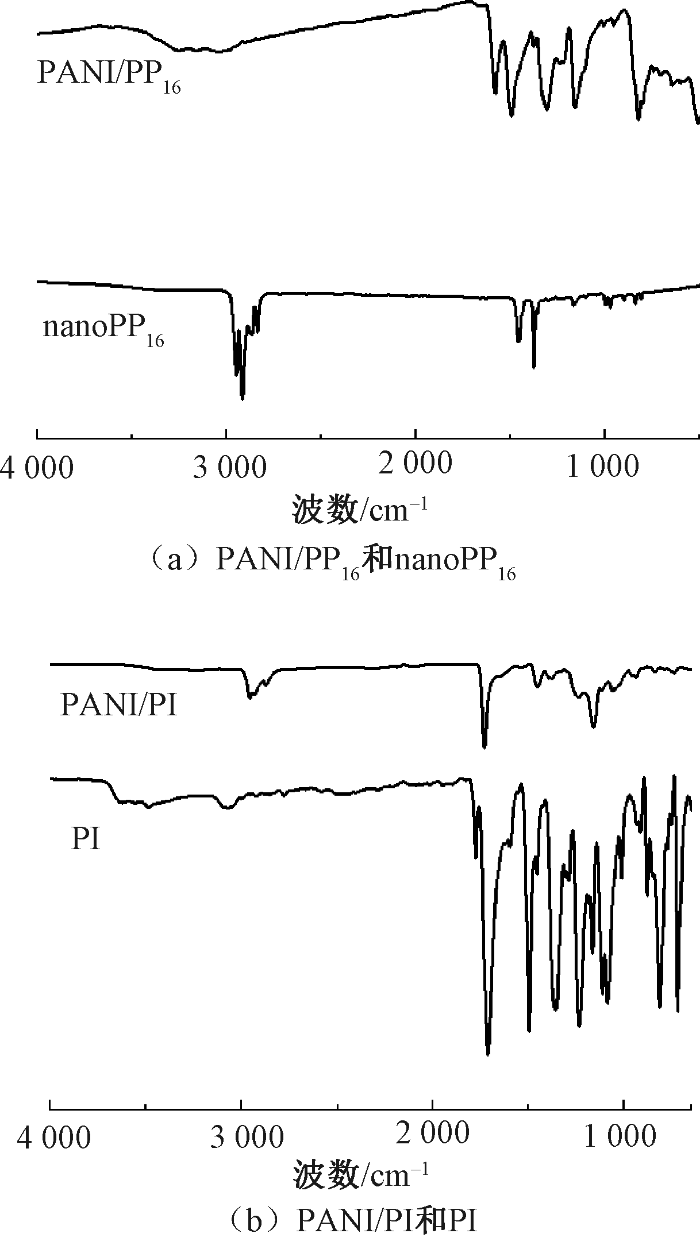
图1
不同薄膜的FT-IR光谱图
Fig.1
FT-IR spectra of different films. (a) PANI/PP16 and nanoPP16; (b) PANI/PI and PI
2.2 孔隙对柔性低发射率薄膜的影响
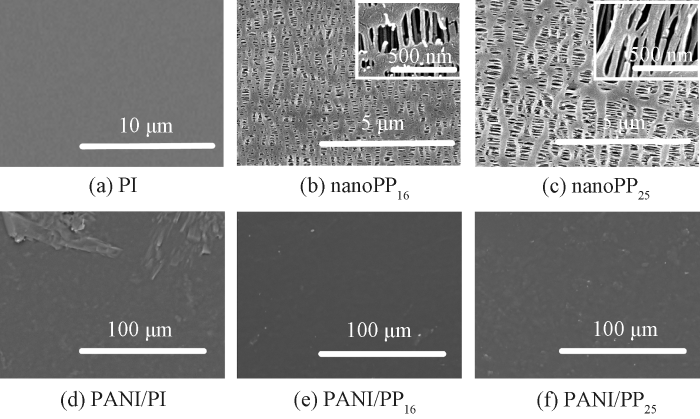
图2示出PI、nanoPP16、nanoPP25基材薄膜以及涂覆相同厚度聚苯胺的PANI/PI、PANI/PP16、PANI/PP25薄膜形貌结构的扫描电镜照片。可知不同薄膜的微观结构存在显著差异,图2(a)显示,PI薄膜表面光滑,无明显孔隙结构。对于nanoPP薄膜:图2(b)中,nanoPP16呈现扁长且相互贯通的狭缝状多孔结构,孔径分布集中且规则;图2(c)中,nanoPP25的孔隙结构与nanoPP16相似,但孔径更大且分布更宽泛,多为微米级孔隙。因此,nanoPP薄膜整体表现出稳定且均匀的孔隙结构,有利于聚苯胺在其表面附着。如图2(d)所示,涂覆相同厚度聚苯胺涂料后,PI薄膜因含有极性基团而具有较高的表面能,聚苯胺可附着在薄膜表面,但分布不均匀,存在少量裂纹。相比之下,PANI/PP16,PANI/PP25表面聚苯胺涂层紧密附着,形成光滑的低发射率表面。
图2
对PANI-CSA涂料的平均粒径和Zeta电位进行测试,结果如图3所示。
图3
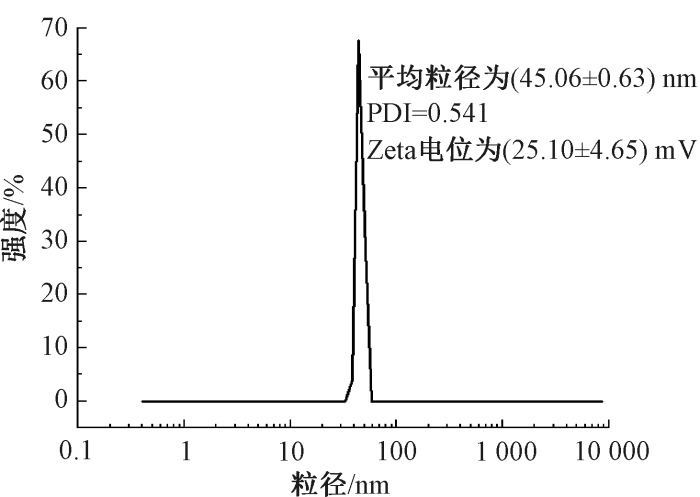
图3
PANI-CSA涂料的粒径和Zeta电位
Fig.3
Particle size and Zeta potential of PANI-CAS coating
图4
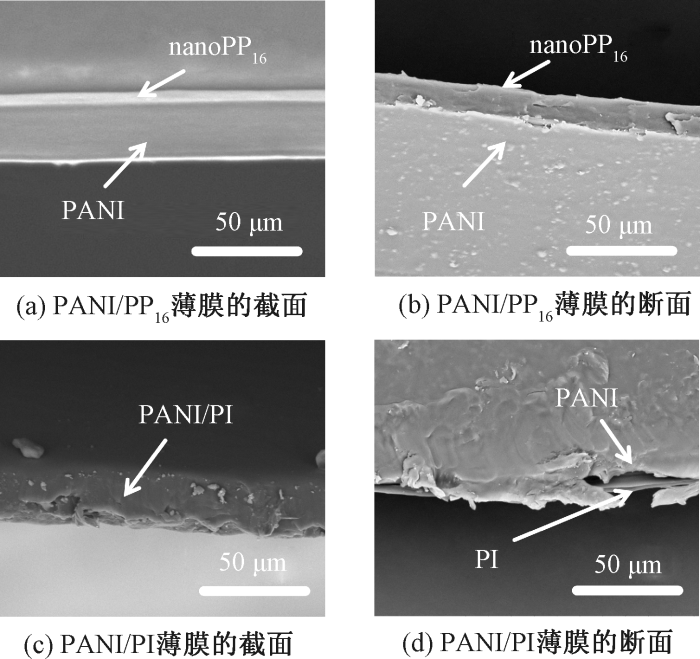
图4
柔性薄膜的截面和断面扫描电镜照片
Fig.4
SEM images of cross-sections and sections of flexible films. (a) Cross-section of PANI/PP16 film;(b) Section of PANI/PP16 film; (c) Cross-section of PANI/PI film; (d) Section of PANI/PI film
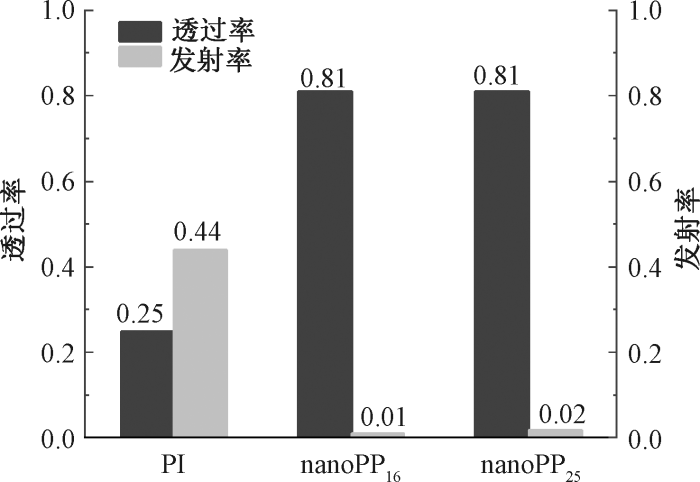
图5示出不同基材在8~14 μm波段的红外透过率和发射率。本文所选择的基材PI,nanoPP16和nanoPP25薄膜均为高红外透过率薄膜,其中PI薄膜的透过率为0.25,nanoPP16和nanoPP25薄膜的透过率均为0.81。因此,基材PI拥有较低的发射率(0.44),而nanoPP16(0.01)和nanoPP25(0.02)薄膜拥有极低的发射率,但由于其高透过率的特性,无法阻挡隐身目标的热量溢出,因此基材薄膜的发射率在本文研究中不具备讨论意义。
图5
以nanoPP薄膜为基材制备柔性薄膜,测试了PANI/PI、PANI/PP16、PANI/PP25的反射率和发射率,结果如图6所示。红外反射率测试结果表明这3种复合薄膜的红外发射率都较低,成功避免了黏合剂对发射率造成的影响,满足红外隐身的需求[19]。然而PANI/PI薄膜由于表面存在团聚现象,不够光滑平整(见图2),影响了材料的反射性能,因此表现出的发射率为0.3。在nanoPP薄膜中,nanoPP的狭缝状孔隙结构能够更好地负载聚苯胺涂层,表层聚苯胺形成均匀平整的表面与孔隙中的聚苯胺合成一体,增加涂层的牢度,同时平整的表面体现了聚苯胺的低红外发射率性能。与nanoPP25相比,nanoPP16薄膜由于表面孔径结构和大小的优势,更小的孔径可以使聚苯胺分子更均匀地深入孔隙内部并与基材形成紧密连接,同时有效防止聚苯胺在干燥过程中的团聚,有助于维持涂层的致密和平整,从而实现更低的发射率(0.21)。因此,以低的发射率,而nanoPP16薄膜为基材的PANI/PP16复合薄膜呈现出最低的红外发射率。
图6
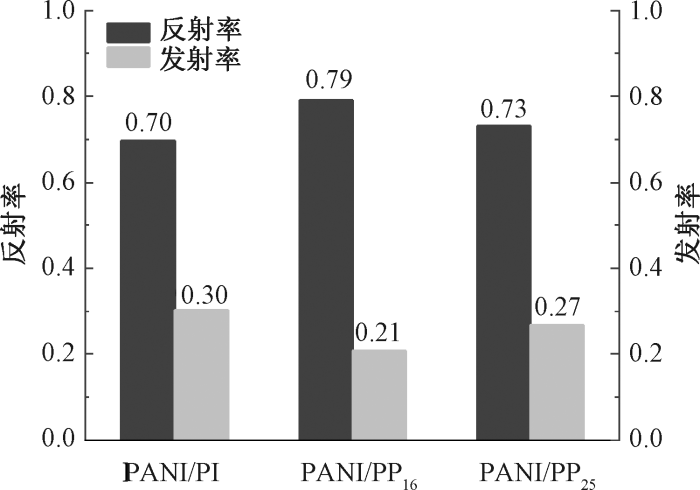
图6
不同基材制备的复合薄膜的反射率和发射率
Fig.6
Reflectance and emissivity of composite films prepared from different substrates
2.3 不同基材涂覆聚苯胺的红外隐身效果分析
图7示出PI、nanoPP16、nanoPP25、PANI/PI,PANI/PP16和PANI/PP25薄膜在60 min内于人体手掌上的红外隐身效果。
图7
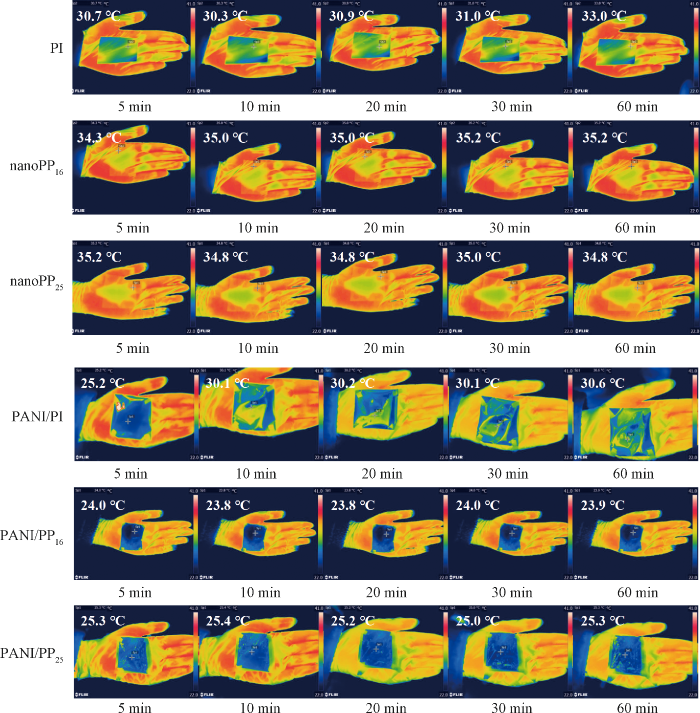
为进一步探究不同薄膜的红外隐身性能,选取PI、nanoPP16、nanoPP25、PANI/PI、PANI/PP16和PANI/PP25薄膜置于手掌心,利用红外热成像仪监测其60 min内的红外隐身效果。如图7所示,nanoPP16和nanoPP25,由于存在孔结构,无法有效减少人体热量向外界环境的辐射,因此能够清晰展现手掌的原始温度,不具备隐身效果。相比之下,尽管PI薄膜具备一定的隔热性能,但高红外透过率导致其无法有效遮蔽热辐射信号,因此不具备有效的隐身效果。PANI/PI薄膜在初始5 min内表现出良好的隐身效果,表面辐射温度为25.2 ℃,但随着时间延长,隐身效果逐渐不均匀,20 min时辐射温度上升至30.2 ℃,30 min后完全失去隐身效果。相比之下,PANI/PP16薄膜因其表面均匀致密且光滑平整的聚苯胺涂层,展现出优异的红外隐身性能,在60 min内表面辐射温度稳定维持在23~24 ℃,与人体手掌保持9~10 ℃的温差,能够有效隐匿人体温度,满足长时间红外隐身需求。PANI/PP25薄膜的性能与PANI/PP16类似,但由于PANI/PP16薄膜凭借更低的发射率和更优异的柔性,在人体服用红外隐身领域展现出更大的应用潜力,为后续发展提供了新思路。
2.4 PANI/PP16薄膜的柔性分析
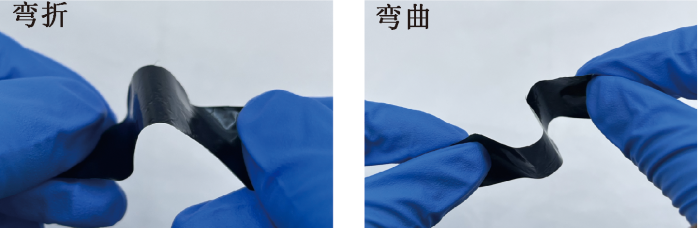
图8示出PANI/PP16薄膜的柔性性能。由图可知,纳米多孔聚丙烯薄膜的特殊多孔结构和优异柔性有效中和了聚苯胺作为刚性聚合物的脆性问题。nanoPP薄膜的纳米孔隙结构通过机械互锁效应以及分子间范德华力的协同作用,有效抵抗界面剥离,因此,PANI/PP16薄膜可在不使用高发射率黏合剂的情况下将聚苯胺涂料紧密附着在nanoPP16薄膜表面,随意弯曲扭转都不会使聚苯胺涂层剥落,不仅具有更低的红外发射率,还兼具优异的柔性,更适合应用于人体可穿戴红外隐身材料。
图8
2.5 PANI/PP16薄膜的热稳定性分析
为探究PANI/PP16薄膜的热稳定性,对nanoPP16、PANI、PANI-CSA以及PANI/PP16进行了TG和DTG分析,结果如图9所示。可以看出,nanoPP16在350 ℃开始热分解,并于455 ℃达到最快分解速率,此时其主链结构降解,“碳—碳”单键和双键交替结构被破坏,生成多种气态产物,最终在490 ℃完成分解,仅留下微量碳质残留物。PANI的热分解主要集中在450~600 ℃之间,分解速率在530 ℃达到峰值,此时“苯-醌”交替结构遭到破坏,生成多种气态产物;在100 ℃附近,约10%的质量损失归因于吸附水或结合水的蒸发,而当温度接近600 ℃时,大部分有机成分已完全分解,残留质量约为初始质量的60%。PANI-CSA在100 ℃附近同样表现出约6%的吸附水或结合水蒸发,在240~350 ℃范围内发生CSA脱掺杂及分解,随着温度升高,分子链段运动增强,导致更多掺杂剂脱除;随后在400~580 ℃范围内,聚苯胺主链发生断裂分解,再次引发显著的质量损失。作为涂覆PANI-CSA的nanoPP薄膜,PANI/PP16的热分解曲线与PANI-CSA类似,在370~510 ℃范围内同时发生聚丙烯主链和聚苯胺主链的断裂分解,呈现出明显的质量下降趋势(见图9(b))。因此,可以适用于240 ℃以下的红外隐身场景。
图9
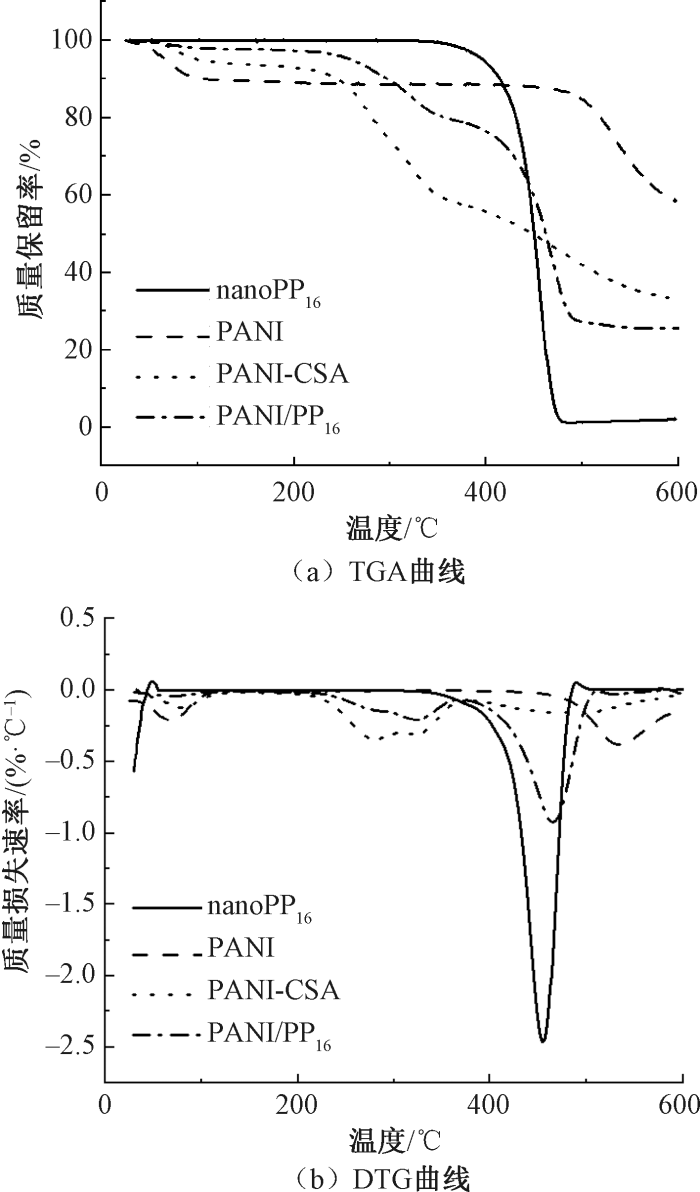
图9
nanoPP16、PANI、PANI-CSA和PANI/PP16在氮气条件下的TGA曲线和DTG曲线
Fig.9
TGA curves (a) and DTG curves (b) of nanoPP16, PANI, PANI-CSA and PANI/PP16 under nitrogen gas conditions
3 结论
利用简单的刮涂法制备了具有良好柔性的低发射率薄膜:负载聚苯胺的聚酰亚胺(PANI/PI),负载聚苯胺厚度为16 μm的纳米多孔聚乙烯(PANI/PP16)和负载聚苯胺厚度为25 μm的纳米多孔聚乙烯(PANI/PP25),通过实验得到如下主要结论。
1) 所制备PANI/PI,PANI/PP16和PANI/PP25薄膜表面的聚苯胺涂层均匀紧密,因此都具有较低的发射率表面。
2) 得益于薄膜优异的耐有机溶剂性能和纳米多孔结构特性,可以在不使用高发射率黏合剂的情况下使聚苯胺涂料紧密附着,避免了黏合剂对体系发射率的影响,制得具有低发射率(0.21)和良好的柔性的PANI/PP16薄膜,成功克服了聚苯胺直接成膜时柔韧性差、易脆裂剥落和涂覆黏合剂影响发射率的问题。
3) PANI/PP16薄膜具有良好的热稳定性,可以满足于240 ℃以下场景的红外隐身需求,且在60 min内能够保持良好的红外隐身效果,其优异的柔性使其适用于红外隐身纺织品材料,为聚苯胺在可穿戴红外隐身领域的应用提供了新思路。
参考文献
Broadband multispectral compatible absorbers for radar, infrared and visible stealth application
[J].DOI:10.1016/j.pmatsci.2023.101088 URL [本文引用: 1]
Novel infrared camouflage technology based on electroc-hromism
[J].
Unique applications of carbon materials in infrared stealth: a review
[J].DOI:10.1016/j.cej.2022.139147 URL [本文引用: 1]
低红外发射率控温热红外伪装材料的制备与性能
[J].
Preparation and properties of low infrared emissivity temperature-controlled thermal infrared camouflage materials
[J].
Research progress and recent advances in development and applications of infrared stealth materials: a comprehensive review
[J].DOI:10.1002/lpor.v18.12 URL [本文引用: 1]
Nanostructured materials and architectures for advanced infrared photodetection
[J].DOI:10.1002/admt.v2.8 URL [本文引用: 1]
Research on attitude measurement compensation technology under the influence of solar infrared radiation interference
[J].DOI:10.1016/j.infrared.2022.104142 URL [本文引用: 1]
Recent progress in two-dimensional nanomaterials of graphene and MXenes for thermal camouflage
[J].DOI:10.1016/j.ceramint.2022.12.034 URL [本文引用: 1]
红外隐身涂料的研究与进展
[J].
Research and progress of infrared stealth coatings
[J].
导电高分子材料在智能隐身技术中的应用
[J].
The application of conductive polymer materials in the field of smart stealth technonogy
[J].
高分子材料在红外隐身中的应用
[J].
The application of polymer materials in infrared stealth
[J].
Infrared stealth and anticorrosion performances of organically modified silicate-NiZn ferrite/polyaniline hybrid coatings
[J].DOI:10.1002/pola.v46:3 URL [本文引用: 1]
红外隐身超材料
[J].
DOI:10.11868/j.issn.1001-4381.2019.001019
[本文引用: 1]

论述红外辐射与红外隐身技术的基本原理和方法,阐明多波段光谱灵活调控是实现兼容雷达隐身、激光隐身和可见光隐身的红外隐身功能的关键。概括传统红外隐身材料的研究现状并阐明其发展瓶颈问题,进而提出具有光谱剪裁功能的红外隐身超材料的设计思想、研究基础和发展优势。综述红外隐身超材料实现与雷达隐身兼容、具有红外散热窗口以及与激光和可见光隐身兼容的红外隐身功能的研究现状与未来发展。
Infrared stealth metamaterials
[J].
聚苯胺复合涂料红外与吸波性能研究
[J].
Infrared and microwave absorbing properties of polyaniline composite coatings
[J].
Polyaniline/hollow glass beads/carbon fiber powder composite film for multifunctional military tarpau-lins
[J].
Radiative human body cooling by nanoporous polyethylene textile
[J].Thermal management through personal heating and cooling is a strategy by which to expand indoor temperature setpoint range for large energy saving. We show that nanoporous polyethylene (nanoPE) is transparent to mid-infrared human body radiation but opaque to visible light because of the pore size distribution (50 to 1000 nanometers). We processed the material to develop a textile that promotes effective radiative cooling while still having sufficient air permeability, water-wicking rate, and mechanical strength for wearability. We developed a device to simulate skin temperature that shows temperatures 2.7° and 2.0°C lower when covered with nanoPE cloth and with processed nanoPE cloth, respectively, than when covered with cotton. Our processed nanoPE is an effective and scalable textile for personal thermal management.Copyright © 2016, American Association for the Advancement of Science.
Variable infrared emittance mechanisms of electrochromic film based on poly(aniline) under various doping concentrations of camphorsulfonic acid
[J].DOI:10.1016/j.dyepig.2022.110179 URL [本文引用: 1]

 京公网安备11010502044800号


