



变色龙和头足类动物可以自适应地改变肤色,将其隐藏在环境背景中,以达到保护自身的目的[1]。受此启发,研究人员通过仿生学手段模拟生物变色机制,开发具有伪装功能的防护材料[2]。传统的伪装主要依靠静态迷彩图案的伪装网或伪装衣,例如,张典典等[3]使用分散染料直接印花,制备了常见绿色植被可见光-近红外反射光谱特征的印花织物。罗巧玲等[4]使用酸性染料对生物基锦纶56直接进行染色,制备仿绿色植被织物。这些材料虽然能在特定环境中提供一定的隐蔽效果,但难以适应复杂多变的环境变化[5]。为突破静态伪装在动态背景下识别率高的技术瓶颈,近年来基于智能变色材料的动态伪装技术成为研究热点[6-7]。这类材料可以根据外界环境的变化,做出快速响应并智能调节自身特性,实现与背景的高度融合[8]。
在众多环境刺激响应材料中,温致变色材料因其颜色可调、显色效果好、简单易用等优点,成为变色材料中应用最多的一类[9]。然而,当前大多数温致变色材料都存在灵敏度较低的问题,例如,Karagam等[10]将热致变色着色剂在棉织物上印制成绿棕色迷彩图案,可在60 ℃条件下加热2 min,变为沙漠色迷彩,用于军事领域。Xue等[11]通过微胶囊化和涂层技术将碳纳米管引入热致变色体系,可以使变色温度控制在30~35 ℃。Pu等[12]合成的一种三组分低温变色指示剂可在4~8 ℃内实现由深蓝色至白色的转变,用于低温环境检测。这种相对较宽的温度响应范围导致材料难以呈现显著的颜色变化,限制了温致变色材料在自适应伪装领域的应用[13-14]。
针对上述问题,本文创新性地设计合成了一种新型荧烷染料,并通过物理共混法将其与相变材料复合,构建了高灵敏度的双组分温致变色体系。为进一步提升材料稳定性,采用微胶囊封装技术对该体系进行包覆处理,使其在高温条件下仍能保持优异性能。在此基础上,通过调控变色微胶囊与普通分散染料的比例,成功制备出适用于自然环境伪装的温致变色色浆。基于该色浆,采用丝网印花技术开发了智能温致变色织物,可模拟真实树冠中树叶随季节变化的颜色演变过程,并系统研究了色浆用量对织物颜色伪装性能的影响。研究结果不仅为温致变色材料在智能纺织品中的应用提供了理论支持,还为自适应伪装技术的发展提供了新的技术路径。
1 实验部分
1.1 实验材料与设备
材料:红、黄、蓝色分散染料(工业级),上海安诺其化工股份有限公司;罗丹明B、3-二乙氨基酚、四三苯基膦钯(生物级),上海阿拉丁生化科技股份有限公司;3-溴邻苯二甲酸酐、2-羟基苯硼酸、五氧化二铌、十四醇、黏合剂(DM-5128)、增稠剂(DM-5221G),上海麦克林有限公司;聚乙烯醇(PVA)、聚甲基丙烯酸甲酯(PMMA)、石油醚、无水乙醇(分析纯),国药集团上海试剂有限公司;二氯甲烷、甲醇(分析纯),上海泰坦科技有限公司;涤纶/棉织物(面密度为116 g/m2),山东鸿泰纺织有限公司。
仪器:Nicolet iS10傅里叶红外光谱仪(赛默飞世尔科技中国有限公司);Avance III 400 MHZ全数字化核磁共振波谱仪(德国布鲁克公司);S4800场发射扫描电子显微镜(日立公司);LASX热台偏光显微镜(德国Leica公司);Q-500热重分析仪;Q200差示扫描量热仪(美国TA仪器公司);Datacolor 800分光光度仪(美国爱色丽公司);Y571 L染色摩擦色牢度仪(莱州市电子仪器有限公司);SW-12A耐洗色牢度试验机(无锡纺织仪器厂)。
1.2 实验方法
1.2.1 染料合成
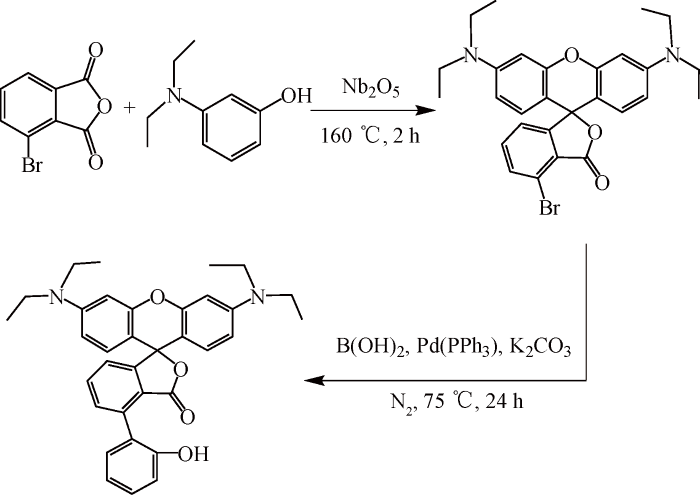
在100 mL干燥的三口烧瓶中加入40 mmol 3-二乙氨基酚、20 mmol 3-溴邻苯二甲酸酐、10 mmol五氧化二铌,升温至140 ℃,熔融反应2 h,反应完成后冷却至室温,加入少量二氯甲烷溶解,用石油醚重结晶,获得的粗产物用硅胶色谱法分离提纯(洗脱剂:二氯甲烷与甲醇的体积比为20∶1),得到紫色粉末,即3-Br中间体。
其次,将31 mmol 3-Br中间体、68 mmol 2-羟基苯硼酸、3.1 mmol 碳酸钾分别溶于30 mL甲苯、10 mL无水乙醇、10 mL水,置于100 mL的圆底烧瓶中,先通入5 min氮气,再加入0.06 mmol四三苯基膦钯,反应全程在氮气氛中进行,回流24 h。反应完成通过减压旋蒸除去溶剂,加入少量二氯甲烷溶解,用石油醚重结晶得到粗产物,再用柱层析(洗脱剂:二氯甲烷与甲醇的体积比为20∶1)提纯得到紫色荧烷染料Flu-1,其合成路线如图1所示。
图1
1.2.2 温致变色复配物的制备
双组分温致变色复配物的制备:将紫色荧烷染料Flu-1、十四醇按照质量比为1∶100混合均匀,在60 ℃条件下磁力搅拌30 min,得到混合均匀的温致变色复配物。
同时制备了三组分温致变色复配物用于比对实验:将罗丹明B、双酚A、十四醇按照质量比为1∶3∶50混合均匀,在60 ℃条件下磁力搅拌30 min,得到混合均匀的温致变色复配物。
1.2.3 温致变色微胶囊的制备
按质量比为2∶1称取温致变色复配物和PMMA,溶于10 mL二氯甲烷中,制得油相混合物;称取1 g PVA和99 mL去离子水于250 mL的烧杯中,在75 ℃条件下磁力搅拌30 min,制备成质量分数为1%的PVA水溶液;将油相混合物加入到50 mL的PVA水溶液中,在转速为8 000 r/min下剪切乳化30 min,得到均匀细化的乳化液;在室温敞口条件下以转速为350 r/min低速机械搅拌8 h,使二氯甲烷缓慢挥发,反应结束后,静置12 h,取下层微胶囊,经水洗、乙醇洗后得到紫色温致变色微胶囊。
1.2.4 温致变色织物的制备
取0.5 g温致变色微胶囊、3 g增稠剂和5 g黏合剂在去离子水中搅拌均匀,制备成温致变色色浆;配制质量分数为1%的分散红、分散蓝、分散黄母液,按1∶2∶3的质量比称取相应试剂,并加入3 g增稠剂、5 g黏合剂,最后加水补满100%,搅拌均匀配制分散染料色浆;将温致变色色浆与分散染料色浆按2∶1、3∶1、4∶1、5∶1和6∶1的质量比,配制成不同比例的温致变色复配色浆。
采用丝网印花技术将复配色浆整理到涤纶/棉织物上,在60 ℃温度下,预烘5 min后放入到100 ℃的焙烘机中,固化处理3 min,制得温致变色织物。
1.3 性能测试与表征
1.3.1 染料结构表征
取35 mg干燥纯荧烷染料置于核磁管中,然后使用氘代二甲基亚砜(DMSO-d6)溶解,在核磁共振波谱仪上测定1H NMR 谱。
1.3.2 微胶囊表观形貌表征
将微胶囊样品的悬浮液用乙醇稀释至适宜浓度,取样滴于洁净的硅片上,在室温条件下自然晾干;对干燥后的样品进行喷金,再置于扫描电子显微镜样品室中进行微观形态特征的观察。
1.3.3 微胶囊热力学性能测试
热重(TG)曲线:称取5 mg左右的芯材、壁材和微胶囊制成坩埚样品,在热重分析仪中测得热失重曲线,测试温度范围为20~800 ℃,升温速度为10 ℃/min。
差示扫描量热(DSC)曲线:称取5 mg左右的芯材、壁材和微胶囊制成坩埚样品,在差示扫描量热仪中测得热流曲线,从而得出样品的玻璃化转变温度,测定温度范围为10~140 ℃,升温速度为10 ℃/min。
1.3.4 颜色性能和变色性能测试
采用恒温加热平台控制温度,观察复配物和温致变色织物的变色情况。在D65光源和10°标准光源下,使用Datacolor 800分光光度仪测定印花织物在不同温度下的颜色参数。
2 结果与讨论
2.1 荧烷染料结构分析
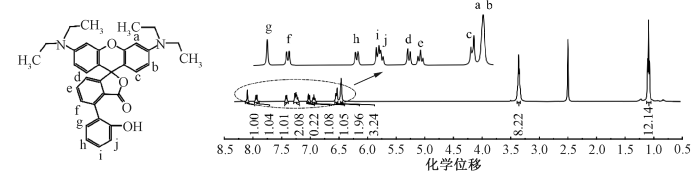
采用核磁共振波谱仪器对化合物的结构进行表征,其1H NMR谱如图2所示。1H NMR (400 MHz, DMSO) δ 8.10 (s, 1 H), 7.94 (dd, J=8.0, 1.6 Hz, 1 H), 7.45-7.39 (m, 1 H), 7.29-7.19 (m, 2 H), 7.02 (d, J=8.1 Hz, 1 H), 6.94 (t, J=7.4 Hz, 1 H), 6.54 (d, J=9.5 Hz, 2 H), 6.48-6.44 (m, 3 H), 3.36 (d, J=6.6 Hz, 8 H), 1.09 (t, J=6.9 Hz, 12 H)。
图2
2.2 温致变色复配物变色性能分析
为研究双组分热致变色体系的响应性能,探讨了变色温度对体系的影响,结果如图3所示。Flu-1和十四醇组成的双组分复配物在32.1~35.4 ℃的加热过程中,由紫红色变为浅粉色,变色温度范围为2.5 ℃;与双组分体系进行比对实验,由罗丹明B、双酚A和十四醇组成的三组分复配物在30.5~36.8 ℃的加热过程中,由紫红色变为浅粉色,变色温度范围为5 ℃,这表明羟基基团的引入提高了荧烷染料的变色灵敏度。
图3

图3
双组分和三组分复配物在升/降温过程中颜色变化
Fig.3
Color changes of two-component (a) and three-component (b) compounds during heating/cooling process
2.3 温致变色微胶囊性能分析
2.3.1 表观形貌分析
采用偏光显微镜和扫描电子显微镜观察温致变色微胶囊形貌和温致变色芯材的包覆状态,结果如图4所示。微胶囊样品呈规则球形,表面比较光滑,平均粒径约为12 μm,且具有明显的核壳结构,紫色温致变色材料被包覆在胶囊内部,壳层很好地保护了芯材复配物,避免在高温或酸碱状态下发生泄露。
图4
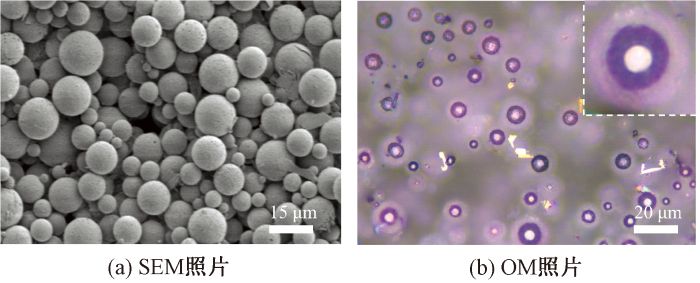
图4
温致变色微胶囊的电镜照片和显微镜照片
Fig.4
SEM (a) and OM (b) images of thermochromic microcapsules
2.3.2 热力学性能分析
通过热重曲线分析温致变色微胶囊、双组分复配物和PMMA壳层的热稳定性,结果如图5所示。复配物在115~225 ℃内发生质量损失,其最大热失重峰在200 ℃;PMMA在350~500 ℃内发生质量损失,在415 ℃左右质量损失率达到最大;温致变色微胶囊在220~340 ℃和360~500 ℃发生出现热失重特征峰,分别对应芯材复配物和壳材PMMA的热分解。表明PMMA成功将温致变色复配物封装在微胶囊内部,且对其具有一定保护作用。
图5
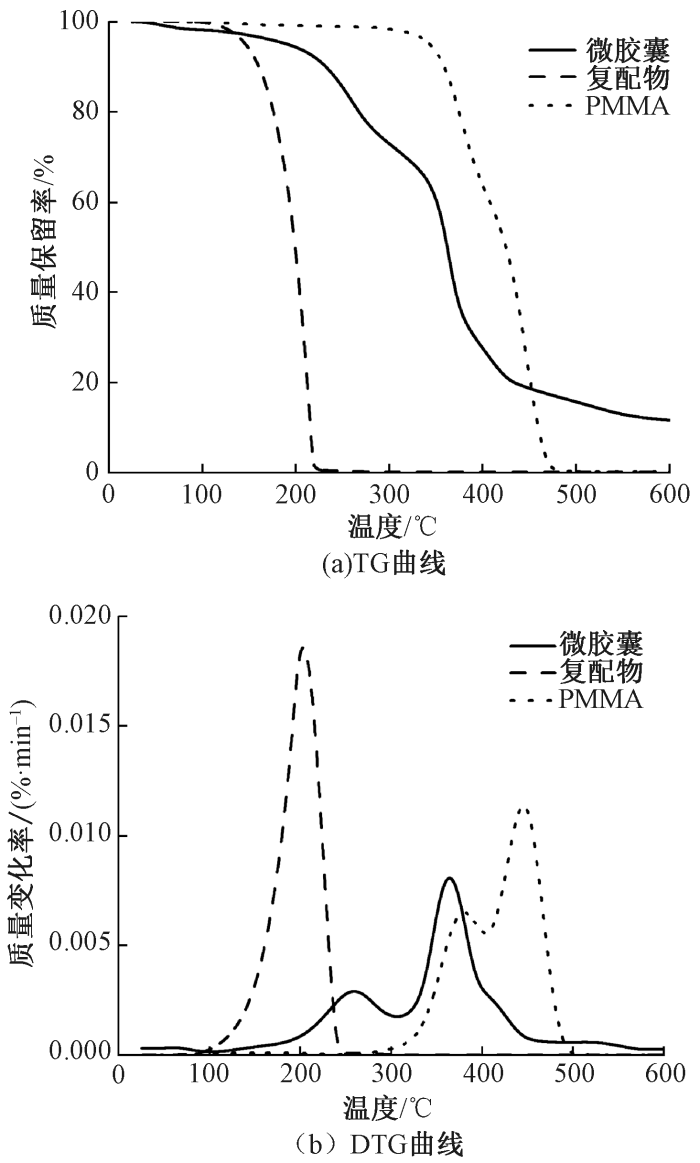
图5
温致变色微胶囊的TG和DTG曲线
Fig.5
TG (a) and DTG (b) curves of thermochromic mircrocapsules
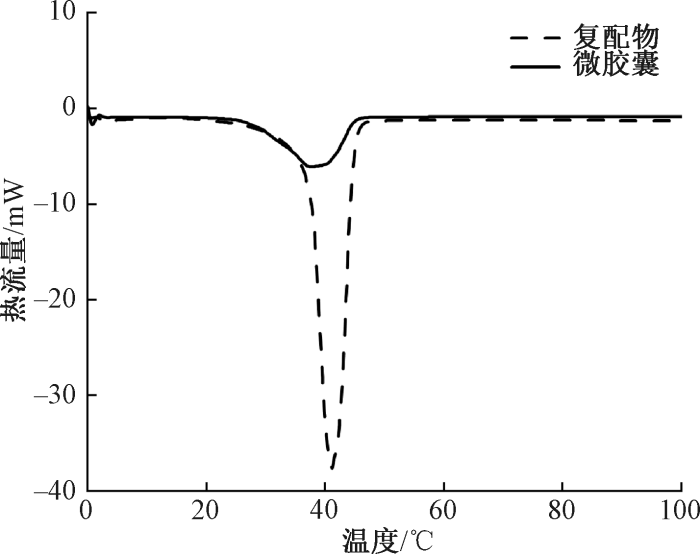
双组分温致变色复配物芯材和微胶囊的DSC熔融曲线如图6所示。可以看出,复配物芯材的玻璃化转变温度在41 ℃左右,而微胶囊的在37 ℃左右,说明PMMA壳材的加入略微降低芯材的玻璃化转变温度。
图6
2.4 温致变色织物性能分析
2.4.1 织物表观形貌分析
采用扫描电子显微镜对原涤纶/棉织物和温致变色涤纶/棉织物的表观形貌进行表征,结果如图7所示。原涤纶/棉织物纤维结构明显,且表面光滑,印花后的涤纶/棉织物表面粗糙,有大量微胶囊附着在织物表面,这说明温致变色微胶囊已成功附着在涤纶/棉织物表面。
图7

图7
涤纶/棉织物和温致变色织物的电镜照片
Fig.7
SEM images of polyester/cotton fabric (a) and thermochromic fabric (b)
2.4.2 织物颜色性能分析
选取复配色浆质量比为2∶1、5∶1和6∶1的温致变色织物,通过反射率曲线研究了多种温度条件下织物的颜色变化性能,结果如图8(a)所示,当温度从20 ℃升温至50 ℃时,温致变色织物的反射率曲线在490和600 nm处的2个特征峰的反射率值增加,织物颜色逐渐变浅。
图8

图8
2∶1、5∶1和6∶1复配色浆织物在不同温度下的反射率、K/S值和CIE色度图
Fig.8
Reflectance (a), K/S value (b) and CIE chromaticity diagram (c) of 2∶1, 5∶1 and 6∶1 compound color printed fabrics at different temperatures
图8(b)示出变色织物在不同温度下颜色深度的变化。可知,随温度升高颜色深度几乎没有差异,但随着温致变色色浆比例的增大,K/S值逐渐减小,织物颜色有明显变浅的趋势。
图8(c)示出印花织物的颜色在CIE1976色度图中的位置。可以看出,织物颜色的变化路径逐渐由绿色变为黄绿色,且颜色差异变化逐渐明显。
上述现象表明温致变色色浆占比增大使织物的色光在高温(50 ℃)和低温(20 ℃)条件产生更为突出的变化,但当达到一定比例时,这种颜色变化幅度逐渐趋于稳定。
2.4.3 织物变色循环性能分析
以复配色浆比例为5∶1的织物作为研究对象,表征其变色循环性能,结果如图9所示。织物在升温(50 ℃)和降温(20 ℃)的100次循环中展示出较好的可逆变色性能。织物在低温时都为绿色,升温后织物为黄绿色,K/S值基本保持不变,L*值、a*值、b*值在循环35次后出现一定程度的衰减,这是由于温致变色微胶囊在多次变色过程中,其表面包覆层因摩擦而受到破坏。
图9
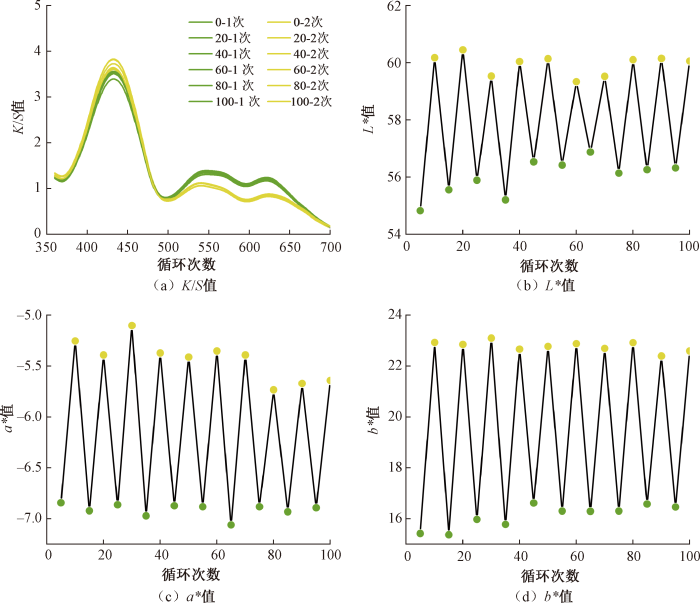
图9
温致变色织物在100次冷热循环下的测试值
Fig.9
Test data of thermochromic fabrics under 100 hot and cold cycles. (a) K/S values; (b) L* values; (c) a* values; (d) b* values
2.4.4 仿绿叶温致变色织物分析
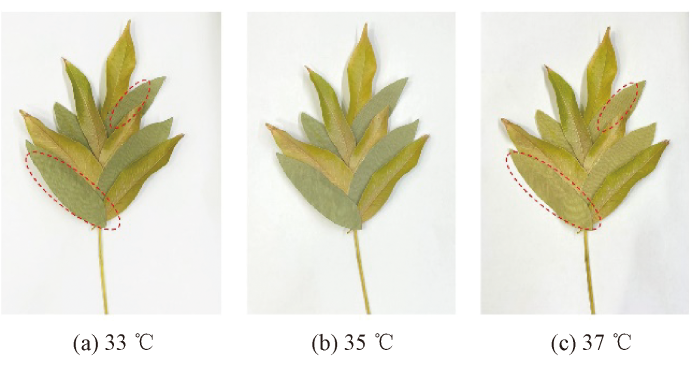
将温致变色复配色浆印制的涤纶/棉织物进行设计,与自然界中的树叶进行拼接,得到如图10所示的温致变化的颜色伪装织物。观察升温过程中不同温度下织物的颜色变化,可以看出:在35 ℃以下,色浆织物呈现绿色(春季);在环境温度到达37 ℃时,变为黄绿色(秋季),与树叶相融合;当温度再次低于35 ℃时,色浆织物的颜色恢复原状。因此本文制备的温致变色织物可以通过控制升温和降温过程,改变色浆织物的色相,从而实现在自然界中隐身的效果。
图10
对温致变色织物进行色牢度测试,其耐皂洗色牢度为3~4级,耐干摩擦、湿摩擦色牢度均达到4级,皂洗出现一定的褪色现象,但基本满足日常使用需求,综合性能较为良好。
3 结论
本文设计并合成了一种具有高灵敏度的新型荧烷染料,与相变材料(十四醇)混合制备的复配物可在2.5 ℃内实现颜色转变。以复配物为芯材,聚甲基丙烯酸甲酯为壳材,采用溶剂挥发法成功制备了具有典型核壳结构的微胶囊,粒径约为12 μm,表面光滑,热稳定性好。
基于此,将制备的温致变色微胶囊与普通分散染料共混,通过丝网印花将其应用于温致变色织物,响应温度为35~37 ℃,仍保持较窄的变色温度区间,且经100次变色循环测试后,仍呈现较好的性能,耐皂洗色牢度达3~4级,耐干摩擦、湿摩擦色牢度均达到4级。此外,随着温致变色微胶囊色浆与分散染料色浆比例的增加,织物在变色前后的颜色差异逐渐增大,从而更精准模拟了自然树叶的变色过程。
参考文献
Thermochromic and tunable emissivity properties of BCG/CaCl2/PEG-g-CDA composites for smart adaptive camouflage in visible and infrared wavebands
[J].DOI:10.1016/j.optmat.2018.06.061 URL [本文引用: 1]
Adaptive and adjustable mxene/reduced graphene oxide hybrid aerogel composites integrated with phase-change material and thermochromic coating for synchronous visible/infrared camouflages
[J].DOI:10.1021/acsnano.3c00573 URL [本文引用: 1]
仿植被可见光-近红外反射光谱特征的分散染料印花织物制备及其性能
[J].
Preparation and performance of disperse dye printed fabrics with characteristics of vegetation-like Vis-NIR reflectance spectrum
[J].
生物基锦纶56弱酸性染料仿绿色植被染色
[J].
Dyeing of bio-based polyamide 56 with weak acidic dyes for green vegetation imitation
A Camouflaged film imitating the chameleon skin with color-changing microfluidic systems based on the color information identification of background
[J].DOI:10.1007/s42235-021-00091-y [本文引用: 1]
仿生自主变色伪装材料的研究进展
[J].
Research progress on biomimetic autonomous color-changing camouflage materials
[J].
Thermal camouflage based on the phase-changing material GST
[J].
A color-changing biomimetic material closely resembling the spectral characteristics of vegetation foliage
[J].DOI:10.1002/smll.v20.10 URL [本文引用: 1]
针织物的感温变色涂层整理及性能研究
[J].
Research on thermochromic coating treatment and properties of knitted fabrics
[J].
Development of smart clothing for military applications using thermochromic colorants
[J].
The electrothermal color-changing fabric based on high-sensitivity thermochromic microcapsules
[J].
Preparation and thermochromic behavior of low-temperature thermochromic microcapsule temperature indicators
[J].
Ultrahigh-sensitivity thermochromic smart fabrics and flexible temperature sensors based on intramolecular proton-coupled electron transfer
[J].
Investigation of reversible self-thermochromism in microencapsulated fluoran-based materials
[J].DOI:10.1016/j.dyepig.2017.12.047 URL [本文引用: 1]

 京公网安备11010502044800号


