



碳基电磁屏蔽材料具有轻质、高化学稳定性、可调的导电性等优点,受到了广泛关注[3]。典型的碳基电磁屏蔽材料有炭黑、石墨烯、碳纳米管等[4]。例如,Song等[5]构建了碳纳米管/多层石墨烯边缘平面复合结构,所制全碳材料在X波段实现了66 dB的优异电磁屏蔽效能(EMI SE)。Fu等[6]则通过在2 800 ℃的超高温下制备轻质的单壁碳纳米管/石墨烯薄膜,形成了相互连接的多孔层状夹层结构,其EMI SE高达80 dB。尽管这些纳米碳材料在电磁屏蔽方面表现出了优异的性能,但其制备工艺复杂且成本较高,因此对于实际应用的普及依然面临挑战。另外,利用聚合物前驱体在高温条件下炭化得到碳材料是一种简便的制备碳基电磁屏蔽材料的方法。常用的聚合前驱体有聚丙烯腈、环氧树脂、三聚氰胺等[7]。例如,聚丙烯腈(腈纶,PAN)具有高残碳率,是一种应用广泛的制备碳纤维的前驱体,Naeem等[8]以废旧腈纶为前驱体通过单级炭化和物理活化制备了碳纤维织物,基于碳纤维及其改性的织物表现出优异的电磁屏蔽性能,在30 MHz至1.5 GHz频率范围内,电磁干扰屏蔽效能高达75.44 dB。另一方面,生物质材料因其来源广泛、可再生等优势,是一种流行的碳前驱体。例如,Li等[9]以丝瓜络作为碳前驱体,再涂炭化硅涂层改善力学性能,这种复合材料在厚度为2.5 mm时,具备68.4 dB的电磁屏蔽效能。
聚烯烃(如聚乙烯PE、聚丙烯PP等)作为年产量超1亿t的大宗塑料,具有高碳含量(>85%)、低成本(例如PE价格约1美元/kg)的特点,同时其废弃污染问题显著(占全球塑料废物的50%以上)[10],使其成为极具潜力的碳前驱体。将废旧聚烯烃材料转化为高附加值的碳基电磁屏蔽材料,不仅减少了废弃聚烯烃材料对环境的污染,而且赋予材料新的价值,但聚烯烃直接炭化时因线性分子链高温解聚,残碳率极低(<5%)。近年来,通过对聚烯烃基体进行改性处理,使其形成交联结构,显著提高了聚烯烃材料在高温炭化过程中的残碳率。常用的交联方法有过氧化物交联、辐射交联、硅烷交联等[11]。过氧化物交联法能快速交联不同形状系数的材料,因此适用范围广泛,但这种方法设备成本高[12]。辐射交联能提供稳定的交联效果[13],但成本高且穿透能力有限。相比之下,硅烷交联成本效益更高,所需附加设备最少,可有效增强聚烯烃基体力学性能,如Li等[14]利用硅烷交联法制备了超韧性高密度聚乙烯(HDPE)。然而硅烷交联工艺受限于湿气依赖性问题(固化阶段需通过水分渗透触发缩合反应),加工周期更长。在此背景下,研究者们开始探索利用发烟硫酸或者浓硫酸在高温下对聚烯烃材料进行磺化交联制备碳材料,并取得了较大进展。例如,Li等[15]通过商用聚乙烯(PE)在不同浓度浓硫酸中的磺化和炭化,制备了微孔碳材料;Robertson等[16]则通过磺化交联和热解步骤,将废弃口罩转化为多功能碳纤维材料,并保留了聚丙烯(PP)熔喷布的纤维结构;Smith等[17]通过磺化交联和热解将3D打印聚乙烯材料转化为碳材料,并研究了其力学性能的增强方法。但现有研究多聚焦于聚烯烃衍生碳材料的催化[18]、焦耳热[19]等应用,其在电磁屏蔽领域的系统研究仍较为匮乏,尤其缺乏对磺化交联机制-碳结构演化-屏蔽效能关联性的深入解析。
针对上述关键问题,本文以PE机织物为研究对象,系统研究了聚乙烯机织物的磺化及炭化工艺对其结构演变及电磁屏蔽性能的影响,重点分析磺化交联时间、炭化条件及织物厚度对电磁屏蔽效能的调控机制,并探讨炭化织物的电磁屏蔽机制。此项研究为PE纺织品的高值化再利用以及开发低成本、高性能电磁屏蔽材料提供了新的研究思路。
1 实验方法
1.1 实验材料
聚乙烯机织物(PE,重均分子量1 500 000 g/mol,湖北省嘉腾纺织有限公司);浓硫酸(98%)、丙酮(分析纯),均购自国药集团化学试剂有限公司;无水乙醇(优级纯,上海泰坦科技股份有限公司)。
1.2 PE织物的磺化交联与炭化
图1示出PE机织物炭化过程示意图和磺化反应机制。首先,将厚度为1 mm的PE机织物裁剪成尺寸为40 mm × 25 mm的矩形,并将其放入250 mL茄形烧瓶,浸泡于100 mL浓硫酸中。接着,在130 ℃的油浴中搅拌加热,进行磺化交联反应,磺化过程持续3、6或9 h。磺化后,将样品冷却至室温,取出并用去离子水及丙酮洗涤5次,以去除副产物及残余硫酸,然后在80 ℃下真空干燥12 h。干燥后的样品置于管式炉中,在氩气气氛下,以10 ℃/min的速率加热至400 ℃,然后以5 ℃/min的速率升温至800、900或1 000 ℃进行炭化,最后以10 ℃/min的速率降至室温。
图1
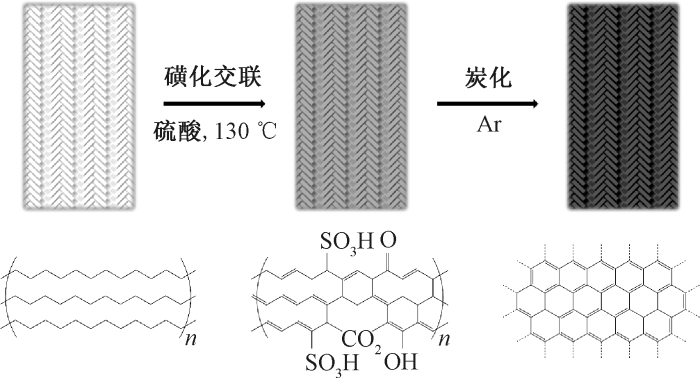
图1
聚乙烯机织物的炭化过程
Fig.1
Charring process and sulfonation reaction machnism of polyethylene woven fabric
1.3 测试与表征
1.3.1 形貌表征及碳收率计算
采用Regulus 8230型场发射扫描电子显微镜(日本日立公司)在5 kV加速电压下观察样品的微观形貌和元素分布。
将磺化交联织物的最终质量与起始质量进行比较,得到整个反应过程的质量增益。比较炭化后织物与初始织物的质量和尺寸变化来确定碳收率和尺寸收缩率。碳收率(Ym)通过下式计算:
式中:m0为样品的初始质量,g;mt为经过t温度炭化后的样品质量,g。
1.3.2 结构表征
使用D8 Advance型X射线衍射仪(德国布鲁克公司)进行X射线衍射(XRD)表征,X射线波长为154.06 pm,扫描范围为10°~50°,扫描速度为4(°)/min。采用inVia-reflex型拉曼光谱仪(英国雷尼绍公司)对不同炭化时间的样品结构进行分析,激发光波长为532 nm。
1.3.3 导电性与电磁屏蔽性能测试
根据SJ/T10314—1992《直流四探针电阻率测试仪通用技术条件》,采用MCP T370型四点探针法电阻仪(日本三菱化学公司)测定样品的电导率,同一样品取不同位置反复测量5次,结果取平均值。使用E5080B型矢量网络分析仪(德科技(中国)有限公司)测试样品的电磁屏蔽性能,样品尺寸为22.86 mm × 10.16 mm,测试采用波导法,测试频率为X波段(8.2~12.4 GHz)。Se值反映了屏蔽体对电磁波的阻挡能力,即电磁波在一定频率范围内被反射和衰减的程度。反射系数(R)、吸收系数(A)和透射系数(T)可以通过测量的散射参数(S)来计算,分析电磁屏蔽机制。其中,R、A、T可由散射系数(正反射S11、反透射S12、正透射S21、反反射S22)计算得到。
根据Schelkunoff理论,材料的Se值的计算式如下:
式中:SeT、SeA、SeR、SeM分别为电磁干扰总屏蔽效能、吸收屏蔽效能、反射屏蔽效能、多重反射屏蔽效能。当SeA>10时,SeM可忽略[20]。
2 结果与讨论
2.1 微观形貌和结构分析
图2

图2
磺化处理后PE织物的形貌
Fig.2
Morphologies of polyethylene fabrics after sulfonation.
(a) Original sample; (b)Sulfonating for 3 h; (c) Sulfonating for 6 h; (d) Sulfonating for 9 h
图3
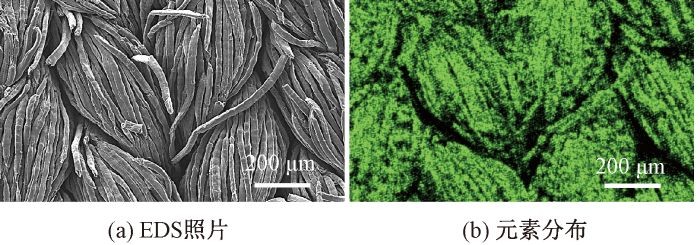
图3
磺化聚乙烯织物的EDS照片和元素分布
Fig.3
EDS image (a) and element distribution (b) of sulfonated polyethylene fabrics
图4
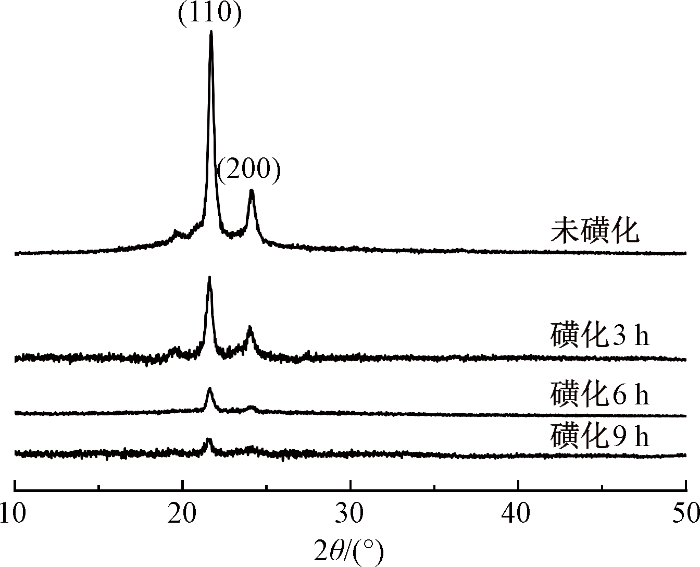
图5

图5
炭化PE织物质量与尺寸变化
Fig.5
Changes in mass and dimensions of charred PE fabrics.
(a) Carbon yield after treatment for different sulfonation durations and at different carbonization temperatures; (b) Macroscopic size changes of sample after charring
不同磺化时间处理的样品截面形貌如图6所示。磺化处理3 h的样品截面出现空心现象,结合XRD图谱与碳收率数据可知,短时间磺化未能使纤维进行充分的交联反应。由于聚乙烯纤维的磺化交联反应受溶剂硫酸的扩散控制,纤维内部的聚合物相较外部交联程度低,使得炭化过程中纤维内部出现较大程度的降解,导致空心结构[24]。经6 h磺化处理后的样品结构较为完整,虽有轻微的翘曲和弯曲现象,但整体形态接近原始编织结构,较3 h处理样品,纤维截面明显更加完整。进一步延长磺化时间至9 h后,样品的纤维截面几乎完全实心,然而纤维呈现出散乱的弯曲和翘曲现象。由此得出在长时间磺化过程中织物交联更加充分,但不能避免不规则形态的产生[25]。
图6
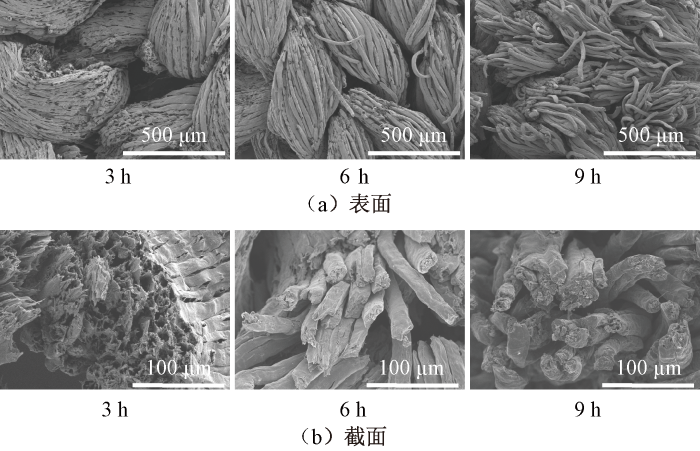
图6
不同磺化时间的炭化PE织物形貌
Fig.6
Morphologies of charred PE fabrics. (a) Surface; (b) Section
图7
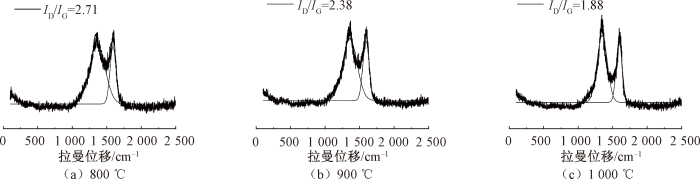
图7
不同炭化温度样品的拉曼谱图
Fig.7
Raman spectra of samples at different charring temperatures
进一步分析D峰半高宽(FWHM)的变化发现,其数值随温度升高呈现递减趋势,例如800 ℃时FWHM较宽,而1 000 ℃时明显收窄。这个现象归因于高温下含氧/硫官能团的脱除、碳-杂原子交联键的断裂以及涡轮层结构的形成,多环芳烃堆叠的无序度因此降低。相比之下,G峰的半高宽未呈现显著规律性变化,这与G峰同时来源于石墨微晶和局部有序碳链的双重贡献有关[28]。
2.2 导电性与屏蔽性能分析
图8
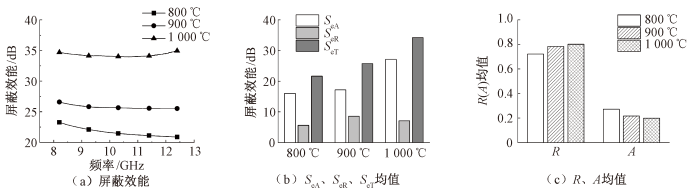
图8
不同炭化温度样品的电磁屏蔽性能
Fig.8
Electromagnetic shielding performances of samples at different charring temperatures. (a) Se values; (b) SeA, SeR and SeT values; (c) R and A values
相比于反射和吸收屏蔽效能,反射和吸收系数直接反映屏蔽体对电磁波的反射和吸收能力。如图8(c)所示,在800 ℃炭化时,R系数为0.72,A系数为0.27,材料导电性较低(36.2 S/m),相比更高温度炭化的样品,电磁波反射能力相对较弱。当温度升至900 ℃时,石墨化程度提高,导电路径完善,电导率有所提升(91.7 S/m),R系数增至0.78,A系数降至0.20,总屏蔽效能提升至26 dB。进一步提高炭化温度至1 000 ℃时,电导率提升至321.8 S/m,反射系数持续增长而吸收系数降低。这是由于材料表面与自由空间的阻抗不匹配程度增大,增强了表面反射。以上结果表明,炭化温度的改变对材料的电磁屏蔽机制有显著影响,不同炭化温度下碳纤维织物对电磁波的屏蔽以反射为主[30]。
磺化时间对电磁屏蔽性能也具有显著影响。由图9(b)可知,在1 000 ℃炭化条件下,随着磺化时间从3 h延长至9 h,样品总屏蔽效能呈现先升后降的趋势,分别为32、34和26 dB。根据碳收率数据以及SEM照片来看,经过6 h磺化处理的样品质量保留率较高,且织物编织结构保留较完整。这表明适当的磺化时间有助于改善织物结构完整性并提升屏蔽性能。然而,磺化9 h的样品其屏蔽效能显著下降,降至26 dB,这是由于过长的磺化时间引起过度交联,纤维膨胀、断裂,破坏织物的编织结构,进而影响导电路径,因此电磁屏蔽效果降低。
图9
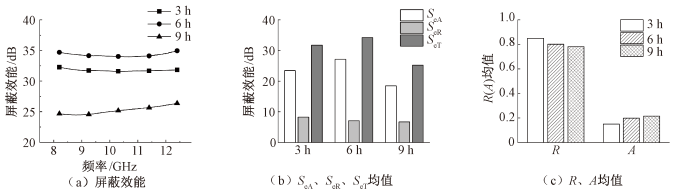
图9
不同磺化时间样品的电磁屏蔽性能
Fig.9
Electromagnetic shielding performance of samples with different sulfonation durations. (a) Se values; (b) SeA, SeR and SeT values; (c) R and A values
从图9(c)可知,磺化时间显著影响碳纤维织物的电磁屏蔽机制。当磺化时间为3 h时,碳纤维织物的电导率为237.3 S/m,R系数为0.85,A系数为0.15,材料电导率较高,反射损耗强,但内部交联不足,炭化后纤维呈空心结构,内部碳纤维对电磁波耗损能力减弱,因此其屏蔽效能低于6 h磺化的样品。延长磺化时间至6 h后,R系数降至0.80,A系数增至0.20,此时材料电导率也达到最高(321.8 S/m),这是由于PE的磺化交联程度提高,炭化后编织结构和碳纤维结构都得到最大程度的保留,形成连续的导电路径,屏蔽效能有所提升。磺化时间延长9 h后,电导率降至165.0 S/m,同时R系数降至0.78,这个现象归因于过度磺化导致的织物结构损伤(如图2所示),纤维间连接点断裂和编织结构破坏,降低了导电网络的连续性。从不同磺化时间处理的实验数据能够看出,磺化6 h为最佳条件,其平衡了碳纤维导电能力和导电路径完整性,展现了最优的屏蔽效能;不同磺化时间处理的碳纤维织物均展现出较高的导电性能,因此织物对电磁波的屏蔽机制以反射为主。
通过叠加1 mm厚度碳纤维织物层数来调控织物的厚度,并进一步研究了厚度对样品电磁屏蔽性能的影响,结果如图10所示。以在1 000 ℃炭化、磺化6 h样品为研究对象,随着样品厚度的增加,织物电磁屏蔽效能逐渐增加。当厚度由1 mm增大至3 mm时,织物在X波段的平均屏蔽效能从34 dB提高到87 dB。这表明,1 mm厚度的碳纤维织物可以屏蔽99.96%电磁波能量,而3 mm厚度则可以屏蔽99.999 999 8%电磁波能量。由图10(b)可以看出,吸收屏蔽效能几乎随织物厚度呈线性增长,而反射屏蔽效能基本不随厚度变化。这个现象可以通过西蒙形式理论解释[31],根据该理论,均匀非磁性导电材料的反射屏蔽效能与电导率呈正相关,但与厚度无关;而吸收屏蔽效能则与电导率和厚度均呈正相关。因此,碳纤维织物总屏蔽效能的增加主要归因于厚度增加导致的材料吸收损耗增大。
图10
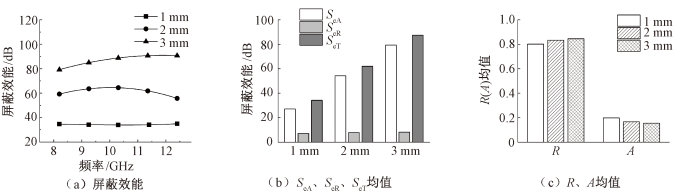
图10
不同厚度样品的电磁屏蔽性能
Fig.10
Electromagnetic shielding performance of samples with different thicknesses. (a) Se value; (b) SeA,SeR and SeT values; (c) R and A values
由于测得的吸收和反射屏蔽效能是基于进入材料内部的入射电磁波,而未考虑被前界面反射回去的部分,因此采用功率系数来揭示反射和吸收对电磁波屏蔽效能的实际贡献。从图10(c)可看出,不同厚度的碳纤维织物的反射系数均高于0.8,表明材料的电磁屏蔽机制以反射为主。
电磁干扰屏蔽机制主要通过材料对电磁波的反射、吸收及多重损耗的协同作用实现,而炭化工艺与结构调控对这些机制的效能具有关键影响。实验结果表明,随着炭化温度升高,材料电导率显著提升(如从800 ℃的36.2 S/m 增至1 000 ℃的321.8 S/m),这归因于高温促使非碳元素逸出与碳原子重排,形成更有序的石墨微晶结构及连续导电网络。高电导率增强了材料表面与自由空间的阻抗失配[32],使反射成为主导机制,即R系数随温度从0.72升至0.80,对应SeT从16 dB提升至34 dB。此时,未被反射的电磁波进入材料内部,其编织结构与纤维间界面提供了极化损耗与多重散射位点,尽管A系数因反射增强略有下降,但导电通路的完善为涡流损耗提供了高效路径,协同提升整体屏蔽性能[33]。磺化时间的调控则通过影响材料结构完整性作用于屏蔽机制:适度磺化(如6 h)可优化交联程度,使炭化后织物保持编织结构与连续导电路径,平衡导电能力与界面极化效应;过度磺化(如9 h)导致纤维膨胀断裂,破坏导电路径,使电导率下降(165 S/m)并降低屏蔽效能(26 dB)。材料厚度的增加通过延长电磁波传播路径强化吸收损耗,符合西蒙形式理论,吸收屏蔽效能随厚度线性增长(由34 dB增长至87 dB),而反射损耗因依赖电导率而非厚度保持稳定。尽管厚度增加提升了吸收贡献,但反射系数始终高于0.8,表明反射仍是核心机制,吸收损耗通过结构优化与路径延长起到补充增强作用。
综上,聚乙烯衍生碳纤维织物的高效屏蔽性能源于高导电网络主导的表面反射与多孔结构支撑的内部损耗:炭化温度与磺化时间优化导电网络完整性,厚度设计强化极化与散射效应。三者协同作用下,材料在轻质低成本优势下实现反射主导、吸收协同的高效电磁屏蔽机制,这与现有模型一致[34],为实际应用提供了定向优化的理论依据。
3 结论
本文通过对聚乙烯机织物的炭化工艺及其电磁屏蔽性能的系统研究,揭示了炭化温度、磺化时间及样品厚度对电磁屏蔽性能的影响。结果表明,随着炭化温度的升高,炭化织物的石墨化程度显著提升,导电性增强,电磁波的反射和吸收能力也随之提高;适当的磺化时间能够兼顾碳结构的完整性与最佳导电性能。具体而言,在1 000 ℃炭化温度和6 h磺化时间的实验条件下,样品的电磁屏蔽效能达到最优值,约为34 dB。此外,织物厚度的增加进一步增强了电磁波吸收能力,厚度为3 mm织物的电磁屏蔽效能显著提升至87 dB。基于炭化织物的高导电性,电磁屏蔽主要通过反射机制实现。本文研究为聚乙烯衍生碳织物在电磁屏蔽领域的应用提供了新的材料来源。未来研究可进一步探索聚烯烃衍生碳织物的力学性能调控和批量化制备方法,以满足现代社会对低成本高性能柔性电磁防护材料日益增长的需求。
参考文献
Electrochemically exfoliated graphite nanosheet films for electromagnetic interference shields
[J].DOI:10.1021/acsanm.1c01172 URL [本文引用: 1]
聚合物基电磁屏蔽复合材料的异质结构构建策略研究进展
[J].
Research progress on heterogeneous structure construction strategies of polymer-based electromagnetic shielding composites
[J].
Research progress on high-performance electromagnetic interference shielding materials with well-organized multilayered structures
[J].DOI:10.1016/j.mtphys.2024.101330 URL [本文引用: 1]
Carbon nanotube-multilayered graphene edge plane core-shell hybrid foams for ultrahigh-performance electro-magnetic-interference shielding
[J].DOI:10.1002/adma.v29.31 URL [本文引用: 1]
SWCNT-modulated folding-resistant sandwich-structured graphene film for high-performance electromagnetic interference shielding
[J].DOI:10.1016/j.carbon.2020.02.081 URL [本文引用: 1]
轻质碳基电磁屏蔽与吸波材料研究进展
[J].
DOI:10.19817/j.cnki.issn1006-3536.2023.11.008
[本文引用: 1]

随着科学技术的发展,电磁屏蔽与吸波材料在可穿戴、医疗和国防等领域的应用越来越广泛。碳基材料具有轻质、比表面积大、介电损耗强、导电性高等优点,已逐渐成为电磁波领域的研究热点。简述了电磁屏蔽和吸波材料的机理,从组成成分、合成方法、微观结构三方面总结了近年来国内外电磁屏蔽与吸波材料的研究进展,指出了目前轻质碳基电磁屏蔽与吸波材料存在的问题,面临的挑战和未来的发展前景。
Research progress on lightweight carbon-based electromagnetic shielding and absorbing materials
[J].
DOI:10.19817/j.cnki.issn1006-3536.2023.11.008
[本文引用: 1]
With the development of science and technology,electromagnetic shielding and absorbing materials are more and more widely used in wearable,medical and national defense fields.Carbon-based materials have gradually become a hot topic of research in electromagnetic wave field because of their lightweight,large specific surface area,strong dielectric loss,and high electrical conductivity.This article briefly described the mechanism of electromagnetic shielding and absorbing materials,and summarized the research progress of electromagnetic shielding and absorbing materials at home and abroad in recent years from three aspects:compositions,synthesis methods,and microstructures.Finally,the article pointed out the existing problems,challenges,and development prospects of current lightweight carbon-based electromagnetic shielding and absorbing materials.
Development of porous and electrically conductive activated carbon web for effective EMI shielding applications
[J].DOI:10.1016/j.carbon.2016.10.026 URL [本文引用: 1]
Strong and heat-resistant SiC-coated carbonized natural loofah sponge for electromagnetic interference shielding
[J].
Plastic waste: challenges and opportunities
[J].
Cross-linked polyolefins: opportunities for fostering circularity throughout the materials lifecycle
[J].
DOI:10.1021/acsapm.4c01959
PMID:39416717
[本文引用: 1]
Cross-linked polyolefins (XLPOs) constitute a significant portion of the plastics commercial market, with a market size of a similar order of magnitude to those of polystyrene and polyethylene terephthalate. However, few aspects of XLPO materials circularity have been examined relative to thermoplastic polyolefins. The cross-linking of polyolefins imparts superior performance properties, such as impact strength, chemical and electrical resistance, and thermal stability vs thermoplastic analogues, but it also makes the reprocessing of XLPOs to valuable products more challenging, as XLPOs cannot be molten. Thus, most XLPOs are incinerated or landfilled at the end of the first lifecycle, even though XLPO products are commonly collected as a relatively clean waste stream-providing a unique opportunity for valorization. In this review, we discuss approaches to improve XLPO circularity throughout the entire materials lifecycle by examining biobased feedstocks as alternative olefinic monomer sources and by assessing both traditional mechanical and advanced XLPO recycling methods based on industrial feasibility and potential product value. We also consider how advancing materials longevity can reduce environmental impacts and lifecycle costs and how recyclable-by-design strategies can enable better end-of-life opportunities for future generations of XLPO materials. Throughout this review, we highlight XLPO circularity routes that have the potential to balance the performance, circularity, and scalability necessary to impart economic and environmental viability at an industrial scale.© 2024 The Authors. Published by American Chemical Society.
形状记忆交联聚乙烯的制备及其光热、磁响应性能
[J].
Preparation of shape memory cross-linked polyethylene and its photothermal and magnetic response properties
[J].
Foaming behavior of radiation-crosslinked virgin and recycled low-density polyethylene
[J].DOI:10.1007/s10924-025-03509-4 [本文引用: 1]
Achieving super-tough high-density polyethylene with promising foamability using silane crosslinked polyolefin elastomer nanofibrils network
[J].DOI:10.1016/j.compscitech.2024.110576 URL [本文引用: 1]
Preparation of microporous carbon materials via in-depth sulfonation and stabilization of polyethylene
[J].
Multifunctional carbon fibers from chemical upcycling of mask waste
[J].
DOI:10.1021/acsomega.2c00711
PMID:35449951
[本文引用: 1]
Over the past years, disposable masks have been produced in unprecedented amounts due to the COVID-19 pandemic. Their increased use imposes significant strain on current waste management practices including landfilling and incineration. This results in large volumes of discarded masks entering the environment as pollutants, and alternative methods of waste management are required to mitigate the negative effects of mask pollution. While current recycling methods can supplement conventional waste management, the necessary processes result in a product with downgraded material properties and a loss of value. This work introduces a simple method to upcycle mask waste into multifunctional carbon fibers through simple steps of thermal stabilization and pyrolysis. The pre-existed fibrous structure of polypropylene masks can be directly converted into carbonaceous structures with high degrees of carbon yield, that are inherently sulfur-doped, and porous in nature. The mask-derived carbon product demonstrates potential use in multiple applications such as for Joule heating, oil adsorption, and the removal of organic pollutants from aqueous environments. We believe that this process can provide a useful alternative to conventional waste management by converting mask waste generated during the COVID-19 pandemic into a product with enhanced value.© 2022 The Authors. Published by American Chemical Society.
Enabling 3D printing of carbons by polyethylene precursors
[J].DOI:10.1557/s43579-024-00619-3 [本文引用: 1]
Vanadium redox flow batteries including carbon catalysts derived from low-density polyethylene and polyurethane
[J].DOI:10.1007/s11814-023-1576-y [本文引用: 1]
Upcycling of mixed polyolefin wastes to 3D structured carbon Joule heaters for decarbonized hydrogen production
[J].
DOI:10.1039/D4MH01755B
URL
[本文引用: 1]
This work presents an integrated approach to industrial decarbonization by converting mixed polyolefin waste into structured carbon with exceptional Joule heating properties, enabling efficient electrified hydrogen production via NH3 decomposition.
Electromagnetic interference shielding polymers and nanocomposites: a review
[J].
DOI:10.1080/15583724.2018.1546737
[本文引用: 1]
Intrinsically conducting polymers (ICP) and conductive fillers incorporated conductive polymer-based composites (CPC) greatly facilitate the research in electromagnetic interference (EMI) shielding because they not only provide excellent EMI shielding but also have advantages of electromagnetic wave absorption rather than reflection. In this review, the latest developments in ICP and CPC based EMI shielding materials are highlighted. In particular, existing methods for adjusting the morphological structure, electric and magnetic properties of EMI shielding materials are discussed along with the future opportunities and challenges in developing ICP and CPC for EMI shielding applications.
Production of polyethylene based carbon fibers
[J].
The chemical transformation of hydrocarbons to carbon using SO3 sources
[J].DOI:10.1016/j.carbon.2015.07.029 URL [本文引用: 1]
Pyrolysis pathways of sulfonated polyethylene, an alternative carbon fiber precursor
[J].
DOI:10.1021/ja3121845
PMID:23560686
[本文引用: 1]
Polyethylene is an emerging precursor material for the production of carbon fibers. Its sulfonated derivative yields ordered carbon when pyrolyzed under inert atmosphere. Here, we investigate its pyrolysis pathways by selecting n-heptane-4-sulfonic acid (H4S) as a model compound. Density functional theory and transition state theory were used to determine the rate constants of pyrolysis for H4S from 300 to 1000 K. Multiple reaction channels from two different mechanisms were explored: (1) internal five-centered elimination (Ei5) and (2) radical chain reaction. The pyrolysis of H4S was simulated with kinetic Monte Carlo (kMC) to obtain thermogravimetric (TGA) plots that compared favorably to experiment. We observed that at temperatures <550 K, the radical mechanism was dominant and yielded the trans-alkene, whereas cis-alkene was formed at higher temperatures from the internal elimination. The maximum rates of % mass loss became independent of initial ȮH radical concentration at 440-480 K. Experimentally, the maximum % mass loss occurred from 440 to 460 K (heating rate dependent). Activation energies derived from the kMC-simulated TGAs of H4S (26-29 kcal/mol) agreed with experiment for sulfonated polyethylene (~31 kcal/mol). The simulations revealed that in this region, decomposition of radical HOSȮ2 became competitive to α-H abstraction by HOSȮ2, making ȮH the carrying radical for the reaction chain. The maximum rate of % mass loss for internal elimination was observed at temperatures >600 K. Low-scale carbonization utilizes temperatures <620 K; thus, internal elimination will not be competitive. E(i)5 elimination has been studied for sulfoxides and sulfones, but this represents the first study of internal elimination in sulfonic acids.
Sulfonation-induced structural evolution of polyethylene fibers for enhanced carbonization performance
[J].DOI:10.1002/adma.v35.17 URL [本文引用: 1]
Investigating nanostructures in carbon fibres using Raman spectroscopy
[J].DOI:10.1016/j.carbon.2017.12.108 URL [本文引用: 1]
An efficient way to introduce hierarchical structure into biomass-based hydrothermal carbonaceous materials
[J].
Microstructure, electrical conductivity and mechanical properties of graphitization carbon foam derived from epoxy resin modified with coal tar pitch
[J].DOI:10.1007/s42823-023-00642-9 [本文引用: 1]
Effects of carbonization temperature and component ratio on electromagnetic interference shielding effectiveness of wood ceramics
[J].
DOI:10.3390/ma9070540
URL
[本文引用: 1]
Woodceramics were fabricated in a vacuum through carbonization of wood powder impregnated with phenol formaldehyde (PF) resin. The effects of carbonization temperature and mass ratio of wood/resin on electromagnetic interference (EMI) shielding effectiveness (SE) and morphology of woodceramics were explored. The PF resin made wood cell walls have the characteristics of glassy carbon. Wood axial tracheid and ray cells were filled with more glassy carbon by increasing addition of PF resin. Moreover, the increase of carbonization temperature was beneficial to improving SE. Woodceramics (mass ratio 1:1) obtained at 1000 °C presented a medium SE level between 30 MHz and 1.5 GHz.
Biomass-derived, highly conductive aqueous inks for superior electromagnetic interference shielding, joule heating, and strain sensing
[J].
Anisotropic MXene aerogels with a mechanically tunable ratio of electromagnetic wave reflection to absorption
[J].DOI:10.1002/adom.v7.10 URL [本文引用: 1]
Nitrogen-doped and Fe-filled CNTs/NiCo2O4 porous sponge with tunable microwave absorption perform-ance
[J].
DOI:10.1016/j.carbon.2019.07.077
[本文引用: 1]
Lightweight, highly efficient, thermal stable microwave absorption materials are highly desirable but challenging for electromagnetic protection. Impedance matching and electromagnetic loss are two crucial factors for the microwave absorption materials design. Here, we successfully designed and synthesized a lightweight (31.5 mg/cm(3)) and porous NiCo2O4@carbon nanotubes (CNTs) hybrid sponge (NiCo2O4@CNTs) based on N-doped and Fe-filled CNTs. The as-prepared NiCo2O4@CNTs shows high thermal stability (>500 degrees C) and excellent microwave absorption properties with a minimum reflection loss value of - 45.1 dB at 9.0 GHz for absorber thickness of 2.5 mm. Moreover, the maximum absorption peak frequency and effective microwave absorption region (<10 dB) can be controlled in the range of 4.0 -16.0 GHz by varying the thickness of the absorber. The highly efficient electromagnetic absorption performance of the sponge is mainly attributed to the high dipolar polarization, interfacial polarization loss and suitable impedance matching characteristic. These results indicate that the NiCo2O4@CNTs sponge can serve as the lightweight, highly efficient, and high temperature resistant microwave absorption materials. (C) 2019 Elsevier Ltd.

 京公网安备11010502044800号


