



目前,许多合成和天然高聚物被用作制备人工血管的原料[8-9],常用的有聚对苯二甲酸乙二醇酯和聚氨酯[10]。最先应用于临床合成血管材料的是涤纶材料,由于其在大血管的替换方面表现出优异的通畅率而被运用至今[11],但由聚对苯二甲酸乙二醇酯制备的人工血管有保形性差、强力低等缺点,限制了其在临床上的应用。聚氨酯材料具有良好的生物相容性[12-13]和弹性[14],但其易在血液中氧化分解,在植入人体前需进行改性处理,临床应用限制较大[15]。聚四氟乙烯(PTFE)具有良好的生物相容性,用其制备的产品在临床上具有广泛应用,如血管支架涂层[16]、假体[17]、分流导管等[18]。通过单向拉伸法制备的膨体聚四氟乙烯(ePTFE)管式纤维膜,以其特有的结点-纤维网状微观结构,能够产生大量的中空空间使人体组织细胞在其表面生长,成为制备人工血管的最佳材料,但是,采用单向拉伸工艺制备的ePTFE人工血管由于柔韧性和纵向弹性较差,在受到血液压力作用时无法及时膨胀或收缩[19-20],导致其在植入人体内部后易降低血液流速和诱发血栓等疾病[6]。
针对以上难题,本研究在单向拉伸法制备ePTFE管式纤维膜的基础上,采用二次加热和淬火工艺制备出内密外疏微孔结构和波浪状纤维结构ePTFE管式纤维膜。详细探讨了所制备样品的表面形貌、结晶度、拉伸强度、顺应性和生物学性能,同时进行了大型犬颈动脉置换手术。结果表明,所制备的样品在犬体内静脉置换6个月中未见炎症发生和血栓形成,为ePTFE管式纤维膜在人工血管中的应用提供了可行方案。
1 实验部分
1.1 实验材料
聚四氟乙烯(PTFE)分散树脂(苏威132F),美国苏威集团;润滑剂(白油),杭州米克化工仪器有限公司;无水乙醇,杭州高精化工有限公司;二甲基亚砜(DMSO)、噻唑蓝溶液(MTT,1 mg/mL),北京索莱宝科技有限公司;MEM培养基、胎小牛血清(FCS)、青霉素(10 000 IU/mL)、胰蛋白酶/EDTA溶液、磷酸盐缓冲液(PBS)、谷氨酰胺(0.2 mol/L)、链霉素(10 mg/mL),赛默飞世尔科技(中国)有限公司;苏木精染液(2 g/L)、伊红染液(10 g/L),北京百奥思科生物医学技术有限公司;高密度聚乙烯(100%),默克集团。
1.2 ePTFE人工血管的制备
采用单向拉伸法制备ePTFE管式纤维膜。首先,在15 ℃条件下,将经过830 μm筛网过滤后的聚四氟乙烯分散树脂和润滑剂按质量比为10∶2混合均匀,然后放入40 ℃电热恒温鼓风干燥箱中干燥24 h,再依次经过压坯、挤出、脱脂、纵向拉伸和热定形工艺,通过控制牵引轮和挤出速差获得拉伸倍数为4.5倍的一次定形ePTFE管式纤维膜,定形温度为360 ℃,定形时间为3 min。将一次定形ePTFE管式纤维膜分割成长度为1 m的样品,然后将其穿套在具有加热功能的不锈钢棒外,从两端往中间均匀压缩至原长的2/3,随后将不锈钢棒快速升温到300 ℃,保温5 min后将管式纤维膜快速取出并放入去离子水(温度15 ℃)中淬火,完全冷却后将样品在室温下再次纵向拉伸至0.95 m,静置放置24 h后用无水乙醇进行超声波清洗,获得二次定形具有内密外疏梯度孔结构的ePTFE人工血管。
1.3 测试与表征
若无特殊说明以下测试均在常温常压下进行,测试3次结果取平均值。
使用Sigma 300型扫描电子显微镜(德国卡尔蔡司公司)观察样品的表面形貌;使用D8 Discover型X射线衍射仪(威夏电子科技(杭州)有限公司)表征样品的晶体结构,通过Jade软件计算各样品的结晶度,扫描范围在3°~80°之间,扫描速度为2(°)/min;根据YY/T 0500—2021《心血管植入物 、血管假体、管状血管移植物和血管补片》,使用AGS-X 10 kN型高强万能试验机(日本岛津公司)测试ePTFE管式纤维膜的纵向、径向拉伸强度;根据YY/T 0500—2021,采用JX0500-C型血管动态顺应性测试仪(威夏电子科技(杭州)有限公司)测试样品的顺应性:同时截取相同长度的一次定形和二次定形样品,用直尺测量其自然松弛下的长度并拍照记录,然后将2种样品在相同拉力下拉伸至完全伸展,用直尺测量各自完全伸展下的长度并拍照记录;根据GB/T 16886.4—2022《医疗器械生物学评价 第4部分:与血液相互作用试验》、GB/T 16886.10—2017《医疗器械生物学评价 第10部分:刺激与皮肤致敏试验》、GB/T 16 886.11—2021《医疗器械生物学评价 第11部分:全身毒性试验》等标准对样品进行生物学性能检测。
本研究依据的动物实验伦理审批文件的批号为NN202412D28-01。选用符合动物实验标准(SPF级标准)的拉布拉多犬进行左右颈动脉置换实验,数量为3只(分别编号1#、2#、3#),将一次定形和二次定形的ePTFE样品随机置换同一只犬的左右颈动脉,2组样品保持一致,长度为5.00 cm、内径为5.70 mm、壁厚为0.75 mm。手术后每周使用多普勒超声波检查血管通畅性,6个月后处死实验犬取出样品进行病理分析。观察材料表面和管腔是否有血栓和内膜增生,使用苏木精和伊红染液对样品染色切片,在显微镜下观察并拍照记录。
2 结果与讨论
2.1 微观形貌
图1(a)示出一次定形的ePTFE样品的内外表面SEM照片。通过膨化拉伸法制备的ePTFE管式纤维膜内表面和外表面均呈现典型的“纤维-节点-纤维”排列形貌,同时内壁孔径大于外壁孔径。这主要是因为PTFE树脂被挤压时,在受热和剪切力的作用下,PTFE树脂相互聚集,晶片呈折叠链,纵向拉伸折叠链转变为伸直链,形成PTFE原纤,未发生转变的折叠链形成PTFE节点。在高剪切作用下,PTFE颗粒被拉伸、滑移、部分解缠结,并沿流动方向(挤出方向)发生取向。由于外壁剪切力更强,PTFE颗粒/初级原纤维的取向度更高,排列更紧密、规整,形成的网络结构在后续拉伸前就具有更高的预取向程度和更小的初始孔隙。在后续的纵向单向拉伸过程中,材料沿挤出方向被拉伸,由于初始结构已高度取向和致密,拉伸时分子链或原纤维进一步滑移、伸展空间相对较小,导致现有孔隙的细化、伸长,产生更小的微孔。而内壁剪切力相对较弱,PTFE颗粒/初级原纤维的取向度较低,排列相对松散、无序,致使形成的网络结构初始孔隙稍大,规整性较差。在后续拉伸时,薄弱点更易被拉开,形成更大的孔洞,无序结构也导致孔的形成更不均匀,易出现一些相对较大的孔。图1(b)经过二次加热处理的ePTFE样品的内外表面SEM照片。由图可知,膜内壁节点间距离明显缩短,外壁纤维呈现弯曲状,内壁孔径明显小于外壁。这主要是因为二次加热时内壁紧贴金属棒而外壁接触空气,加热时内壁温度要高于外壁,内壁发生软化粘连而外壁仍处于蓬松状态,这种转变归因于烧结过程中特定纤维的受控收缩。具体而言,允许部分纤维收缩有助于形成有序的晶体结构,而另一些纤维则因烧结过程中的力学作用被晶态固定在原位,从而形成内壁孔径小于外壁的状态。同时发现外表面纤维呈现波浪形状,主要是由于非晶态纤维构成的部分发生塑性变形并产生残余应力,导致其部分回缩至烧结长度。然而,许多其它纤维仍保持结构锁定状态。不同纤维间的塑性变形与弹性收缩程度差异,最终形成了独特的波浪状结构。
图1

图1
不同ePTFE样品的内外表面SEM照片
Fig.1
Inner and outer surface SEM images of different ePTFE samples. (a) Primary shaping; (b) Secondary shaping
2.2 结晶度
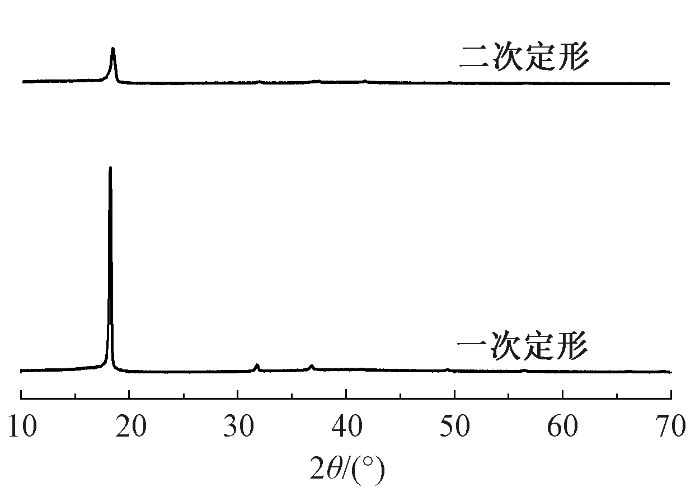
图2示出不同ePTFE样品的X射线衍射(XRD)图谱。其结晶度计算结果显示,一次定形的ePTFE样品的结晶度为(57.86±0.04)%,二次定形的ePTFE样品的结晶度为(48.97±0.05)%。经过二次定形处理后,样品结晶度明显降低,主要是因为300 ℃加热为PTFE分子链提供了足够的能量和活动能力,分子链试图重新排列,进入更稳定的晶格中,这个过程可能包括一些不完善晶体的逐渐完善。随后的水淬火是一个极其快速的冷却过程,能迅速将材料的温度从300 ℃降到室温,“冻结”了分子链的运动,分子链来不及进行充分的规整排列和形成大的晶体,就被强行固定在相对无序的状态。这导致非晶区比例增加,形成的晶体更小、更不完善,因此整体测得的结晶度反而下降。
图2
2.3 力学性能
为表征所制备的ePTFE管式纤维膜的力学性能,对不同样品进行了单轴拉伸实验。图3示出不同ePTFE样品的应力-应变曲线。从图可知,应力-应变呈现明显的非线性特征,包含低应力/高应变线性区和陡峭上升线性区。相比于一次定形的ePTFE样品,二次定形处理后ePTFE管式纤维膜径向(在0~5 MPa应力范围内应变从0%升至100%,)和纵向初始(脚趾区域)均具有低应力和高应变区域,这个区域源于纤维从波浪形构型恢复为直线形态的过程,该区域表现出弹性响应特性。随后的上升线性区则对应所有纤维完全拉直并发生塑性变形时的材料塑性变形过程。
图3
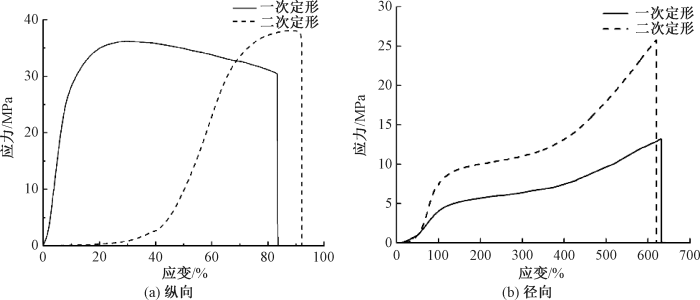
图3
不同ePTFE样品的应力-应变曲线
Fig.3
Stress-strain curves of different ePTFE samples. (a) Vertical; (b) Radial
表1示出不同ePTFE样品的断裂强度和断裂伸长率。由表可知,二次定形处理后ePTFE管式纤维膜的径向断裂强度明显提高,而纵向断裂强度变化较小。主要是因为二次加热为节点内松散无序的分子链提供了足够的能量和运动能力,链段得以松弛,并重新排列和形成新的、更有效的缠结网络。这个过程极大地优化了节点内部的分子结构,释放了内应力,相当于“修复”了节点的缺陷。同时快速淬火将这个新形成的、更强韧的节点结构冻结固定下来。当ePTFE样品被垂直方向拉伸时,外力需要破坏的不再是松散脆弱的原始节点,而是经过修复和强化后的新节点,因此,径向断裂强度显著提高。这种强度的提升源于节点区域非晶缠结网络的增强,足以抵消整体结晶度下降带来的任何负面影响。对于ePTFE样品纵向,在最初的拉伸定形过程中,纤维已被高度拉伸和取向,分子链几乎已伸展到极限,形成非常强韧的结构。其强度已接近PTFE分子链本征强度的极限,二次加热处理对已高度取向和结晶的纤维影响相对较小。同时分子链的活动可能主要发生在纤维表面或末端,或许能形成少量新的缠结,但对于整体强度已非常高的纤维来说,这种增强效应微不足道。
表1 不同ePTFE样品的拉伸断裂强度和断裂伸长率
Tab.1
| ePTFE样品 | 径向 | 纵向 | ||
|---|---|---|---|---|
| 断裂强度/MPa | 断裂伸长率/% | 断裂强度/MPa | 断裂伸长率/% | |
| 一次定形 | 13.15±0.10 | 605.78±1.05 | 36.18±0.18 | 83.64±0.85 |
| 二次定形 | 25.75±0.11 | 620.34±0.80 | 38.06±0.21 | 92.22±0.73 |
对于断裂伸长率而言,二次定形处理时的加热温度低于PTFE的熔点(327 ℃),在此温度下,PTFE处于高弹态,具有一定的黏弹性,但不足以使整个节点熔化,没有破坏或改变在最初拉伸定形过程中形成的稳定节点-纤维网络拓扑结构,网络骨架被完好地保留下来。同时,淬火导致结晶度下降,非晶区比例增加,这本来应该增加分子链的活动性和延展性,倾向于提高断裂伸长率,但在300 ℃加热时,分子链发生松弛和再缠结,形成了更多的物理交联点。这会约束分子链的相对滑移,倾向于降低断裂伸长率,使材料变得“更脆”。这2种在分子尺度上相反的作用(一方增塑,一方增强)在一定程度上相互抵消,因此,实体PTFE材料本身的断裂伸长率变化不大。
2.4 顺应性
为尽可能地模拟天然血管的生理功能,以确保血液流动顺畅、减少并发症,并实现长期通畅,要求人工血管应具有一定的顺应性,即人工血管径向尺寸随压力变化的能力。不同ePTFE样品的顺应性测试结果如表2和图4所示。从表2可看出,单向拉伸法制备的ePTFE管式纤维膜顺应性较差。主要是因为单向拉伸迫使PTFE的晶区和非晶区沿着拉伸方向取向、排列,并形成由微纤维连接的节点组成的多孔网状结构,高温定形使PTFE分子链段运动加剧,在节点处重新缠绕和“烧结”,使得径向结构进一步被固化和锁定,变得更加僵化,进一步削弱了其本就不佳的弹性回复能力。经过二次加热处理后,纤维呈现独特的波浪结构,这种波浪形纤维结构显著提升了材料的柔顺性。当施加拉伸应力时,纤维首先发生伸长,随后才完全参与整体拉伸过程,在宏观上体现出二次定形的ePTFE样品(见图4(b))能够在外力作用下伸展得更长。在材料弹性极限范围内,这些波浪形纤维发挥类弹簧作用,使材料能够产生弹性形变但不会永久形变,从而使其具有一定的顺应性。
表2 不同ePTFE样品的顺应性
Tab.2
| ePTFE样品 | 不同压力下径向顺应性 | 纵向顺应性 | ||
|---|---|---|---|---|
| 低压 (7~12 kPa) | 中压 (10.7~16.0 kPa) | 高压 (14.7~20.0 kPa) | ||
| 一次定形 | 0.11±0.01 | 0.11±0.01 | 0.12±0.01 | 0.51±0.01 |
| 二次定形 | 1.23±0.01 | 2.56±0.01 | 3.98±0.01 | 15.51±0.01 |
图4
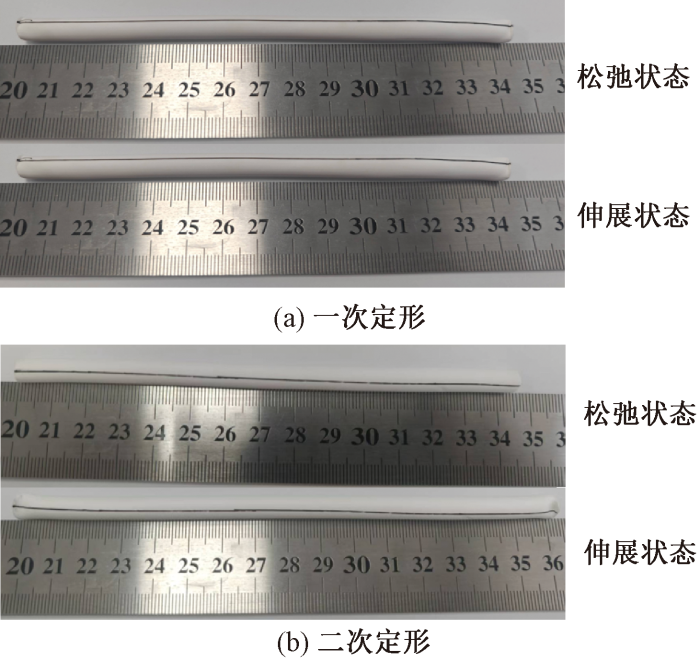
图4
不同样品在松弛和延伸状态下的对比
Fig.4
Comparison of different samples in relaxed and extended states. (a) Primary shaping; (b) Secondary shaping
2.5 体外细胞毒性及生物相容性
体外细胞毒性实验中的样品有:样品组为含不同质量分数的(25%、50%、75%、100%)ePTFE浸出液(分别编号为ePTFE-25、ePTFE-50,ePTFE-75和ePTFE-100),阴性对照组为高密度聚乙烯浸出液,阳性对照组为二甲基亚砜溶液(DMSO,10%)及空白组(纯MEM培养基)。图5示出不同实验组的细胞存活率测试结果。
图5
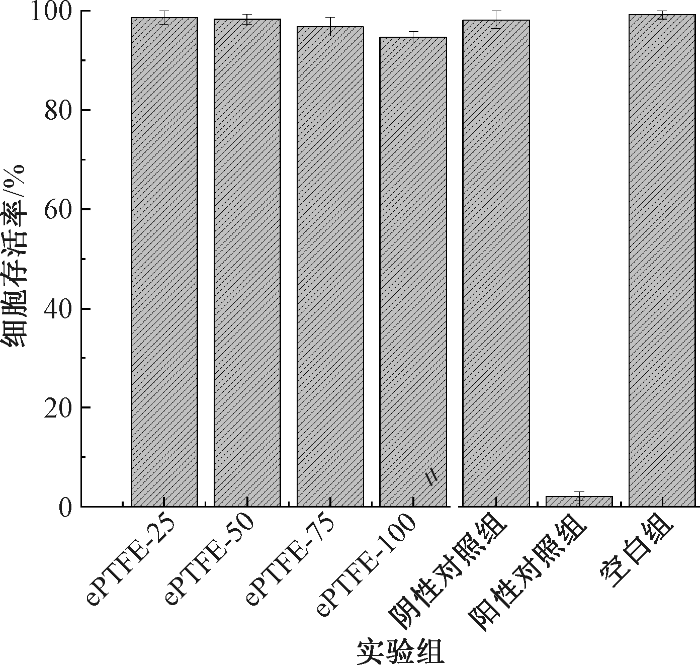
表3 生物学检测结果
Tab.3
| 检测项目 | 检测结果 | 检测依据 |
|---|---|---|
| 致敏性 | 0% | GB/T 16886.10—2024 |
| 皮内反应 | 无动物皮内反应 | GB/T 16886.23—2023 |
| 急性毒性 | 无毒性反应 | GB/T 16886.11—2021 |
| 溶血率 | 0%(<5%代表合格) | GB/T 16886.4—2022 |
2.6 动物植入性能
植入实验结果为一次定形的1#和3#样品在植入后2周内诱发血栓形成,2#样品在植入后3周内诱发血栓形成;二次定形的3个样品在整个植入实验期间均未见血栓形成。从植入实验结果(见图6(a))可看出,相比一次定形的ePTFE样品在3周内均诱发血栓形成,二次定形的ePTFE样品在6个月内未见血栓形成。从图6(c)可见,植入6个月后,2种样品表面均被组织包裹。主要是因为样品表面为微多孔结构,周围组织形成牢固的生物学固定,将人工血管与人体组织融为一体,从而避免发生移位或产生异物排斥包裹。不同样品的剖面与截面图显示,一次定形的ePTFE样品管腔内充满血栓,二次定形的ePTFE样品表面光滑未见血栓形成。同时进行染色做病理分析(见图6(b)、(d))。结果表明:
图6
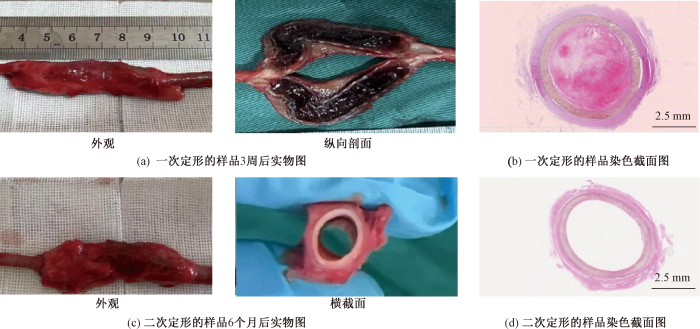
图6
犬颈动脉不同ePTFE样品置换结果
Fig.6
Results of different ePTFE samples replacement for canine carotid artery. (a)Actual view of primary shaped sample after implantation for 3 weeks; (b) Stained cross-section of primary shaped sample;(c)Actual view of secondary shaped sample after implantation for 6 months;(d) Stained cross-section of secondary shaped sample
一次定形的ePTFE样品血管结构清晰完整,血管外已被结缔组织层包裹,纤维细胞渗入人工血管壁内,材料内少量炎症因子及血细胞浸润,管腔内可见血栓形成;二次定形人工血管的结构清晰完整,血管外壁包裹有结缔组织层,且内皮细胞已渗入人工血管壁内,内膜生长致密,但尚未完全覆盖人工血管,材料没有出现平滑肌细胞分层和炎症现象。主要原因是:1)二次定形的ePTFE样品顺应性远高于一次定形的,这确保了血液流动顺畅、减少并发症;2)二次定形的ePTFE样品内壁相对光滑致密,表面能最大限度地减少血液流动的阻力(低湍流)和与血液成分(特别是血小板)的接触面积,从而有效抑制血栓的初始形成。
3 结论
在单向拉伸法制备ePTFE管式纤维膜的基础上,本研究通过二次加热和水淬火处理工艺制备出用于人工血管的具有高性能非对称孔道结构的ePTFE管式纤维膜。系统探讨了通过膨化拉伸及二次定形工艺制备的ePTFE管式纤维膜的多性能表现。结果表明,采用二次加热处理后,材料的结构和力学性能均显著优化。在结构方面,二次热处理对内壁贴附加热使节点间距缩短、孔径减小,外壁纤维呈波浪形排列,形成内密外疏的孔结构,该结构有利于后续组织长入和生物学固定。在力学性能上,二次热处理显著提高了径向断裂强度,主要是因为节点区域分子链重排与缠结网络增强,纵向因原纤维已高度取向,强度变化不大;同时,波浪形纤维赋予材料更高柔顺性和弹性,更接近天然血管的力学行为。生物学评价显示材料无显著细胞毒性,具有良好的细胞相容性;动物实验中二次定形的ePTFE样品在6个月内未见血栓形成,且可见内皮细胞长入及结缔组织包裹,其抗血栓性能和组织整合能力明显优于一次定形的样品。综上,二次热处理工艺可有效优化ePTFE管式纤维膜的综合性能,显示出作为人工血管应用的良好潜力。
参考文献
人造血管制备和性能研究的进展
[J].
Progress in the preparation and performance of artificial blood vessels
[J].
Bacterial synthesized cellulose: artificial blood vessels for microsurgery
[J].DOI:10.1016/S0079-6700(01)00021-1 URL [本文引用: 1]
New method for the isolation of endothelial cells from large vessels
[J].
DOI:10.1016/j.jcyt.2014.01.010
PMID:24831838
[本文引用: 1]

Numerous protocols for the isolation of bovine aortic endothelial cells have been described in the previous literature. However, these protocols prevent researchers from obtaining the pure population of endothelial cells. Thus, this study aimed to develop a new and economical method for the isolation of pure endothelial cells by introducing a new strategy to the enzymatic digestion method proposed by previous researchers.With the use of this method, the lumen of a bovine aorta was filled with wash medium and the outer surface of the sample was washed with alcohol for 30 seconds. Under a laminar flow hood, the inner surface of the sample was covered with filter paper. Collagenase type II was dripped onto the filter paper as a digestion enzyme. The digestion fluid was seeded in T25 flasks and fed with complete medium every 3 days.The isolated cells were characterized by markers such as CD31, von Willebrand factor, 1,1'-dioctadecyl-1,3,3,3',3'-tetramethylindocarbocyanine perchlorate acetylated low-density lipoprotein and angiogenesis behavior. The purity of endothelial cells was detected by flow cytometry to be of nearly 90% purity; these results were confirmed by immunostaining. Moreover, endothelial cells formed blood vessel-like tubes in a three-dimensional environment, which is specific dynamic behavior for endothelial cells.The new strategy presented in the current report enables isolation of a highly pure population of endothelial cells that can survive long-term culture without inducing an overgrowth of fibroblast cells.Copyright © 2014 International Society for Cellular Therapy. Published by Elsevier Inc. All rights reserved.
一种血液透析患者人造血管内瘘穿刺点轮换提示卡的设计与应用
[J].
Design and application of a prompt card for rotation of puncture points of artificial vascular fistula in hemodialysis patients
[J].
Critical appraisal of surgical revascularization for critical limb ischemia
[J].
Saphenous vein versus PTFE for above-knee femoropopliteal bypass. a review of the literature
[J].
DOI:10.1016/j.ejvs.2003.12.027
PMID:15015183
[本文引用: 2]
The autogenous saphenous vein is considered the best bypass graft material for arterial bypasses below the inguinal ligament. However, a synthetic graft or prosthesis is considered an acceptable alternative, especially when the distal anastomosis is situated above the knee. Some studies even suggest that patency rates for vein and synthetic grafts are comparable, whereas others indicate that a vein graft is superior to a prosthetic graft, even above the knee. To test the hypothesis that both vein grafts and synthetic prostheses are equally beneficial in the above-knee position, we performed a systematic review of available studies comparing the patency of saphenous vein and polytetrafluoroethylene (PTFE) as bypass material. English and German medical literature from 1966 to 2002 was searched using Medline, and 25 articles meeting our inclusion and exclusion criteria were selected. The patency of venous bypasses was superior to that of PTFE bypasses at all time intervals studied. After 2 years, the primary patency rate of venous bypasses was 81% as compared to 67% for PTFE bypasses, and after 5 years it was 69 and 49%, respectively. After 5 years, the secondary patency of PTFE bypasses reached 60%. When only randomized trials were considered, venous bypasses were again superior to PTFE bypasses at all intervals studied. After 2 years, the primary patency rate of venous and PTFE bypasses was 80 and 69%, respectively, and after 5 years it was 74 and 39%, respectively. Since both randomized and retrospective studies comparing venous with PTFE bypasses showed that vein grafts were 'better' than PTFE prostheses, the null hypothesis that there is no difference between the two types of graft material was rejected (p=0.008). We conclude from this systematic review that if a saphenous vein is available, a venous bypass should be chosen at all times, even if patients have an anticipated short life expectancy (<2 years). If the saphenous vein is absent or not suitable for bypass grafting, PTFE is a good alternative as bypass material.
基于纺织材料的人造血管制备及应用进展
[J].
Preparation and application progress of artificial blood vessels based on textile materials
[J].
A review of key challenges of electrospun scaffolds for tissue-engineering applications
[J].
DOI:10.1002/term.1978
PMID:25619820
[本文引用: 1]
Tissue engineering holds great promise to develop functional constructs resembling the structural organization of native tissues to improve or replace biological functions, with the ultimate goal of avoiding organ transplantation. In tissue engineering, cells are often seeded into artificial structures capable of supporting three-dimensional (3D) tissue formation. An optimal scaffold for tissue-engineering applications should mimic the mechanical and functional properties of the extracellular matrix (ECM) of those tissues to be regenerated. Amongst the various scaffolding techniques, electrospinning is an outstanding one which is capable of producing non-woven fibrous structures with dimensional constituents similar to those of ECM fibres. In recent years, electrospinning has gained widespread interest as a potential tissue-engineering scaffolding technique and has been discussed in detail in many studies. So why this review? Apart from their clear advantages and extensive use, electrospun scaffolds encounter some practical limitations, such as scarce cell infiltration and inadequate mechanical strength for load-bearing applications. A number of solutions have been offered by different research groups to overcome the above-mentioned limitations. In this review, we provide an overview of the limitations of electrospinning as a tissue-engineered scaffolding technique, with emphasis on possible resolutions of those issues. Copyright © 2015 John Wiley & Sons, Ltd.Copyright © 2015 John Wiley & Sons, Ltd.
静电纺丝制备小口径人造血管研究进展
[J].
Research progress in electrospinning preparation of small caliber artificial blood vessels
[J].
The role of coronary artery bypass surgery versus percutaneous intervention in patients with diabetes and coronary artery disease
[J].
DOI:S0033-0620(19)30101-X
PMID:31377224
[本文引用: 1]
Patients with diabetes mellitus (DM) often exhibit a complex coronary anatomy, making coronary revascularization challenging. Coronary artery bypass grafting surgery (CABG) is currently considered the preferred revascularization method in patients with DM and multivessel disease. Percutaneous coronary intervention (PCI) has advanced with new stent generations having been developed in the recent years, but they have not yet been adequately compared against CABG in the population with DM. Comorbidities, such as renal disease and heart failure, lead to worse prognosis following a revascularization procedure and require especial consideration when choosing between CABG versus PCI. The presence of significant left main disease may also impose additional challenges to coronary revascularization, particularly when accompanied by the involvement of multivessel disease. Most of the evidence regarding revascularization in patients with DM is compiled from studies enrolling patients with stable ischemic heart disease, and trials with patients in the acute coronary syndrome setting are lacking.Copyright © 2019. Published by Elsevier Inc.
可用于人造血管内层基底的电纺细菌纤维素/聚氨酯复合膜的制备与表征
[J].
Manufacturing and representation of electrospun BC/PU composite membrane for inner substrate of artificial blood vessels
[J].
The influence of elastomeric polyurethane type and ratio on the physicochemical properties of electrospun polyurethane/silk fibroin hybrid nanofibers as potential scaffolds for soft and hard tissue engineering
[J].DOI:10.1016/j.eurpolymj.2019.109294 URL [本文引用: 1]
VEGFR-2对膨体聚四氟乙烯重建肺动脉人造血管新内膜形成的影响
[J/OL].
Effect of VEGFR-2 on neointima formation of e-PTFE artificial blood vessels for reconstruction pulmonary artery
[J/OL].
Shape memory polyurethane: amorphous molecular mechanism during fixation and recovery
[J].DOI:10.1016/j.polymer.2020.122226 URL [本文引用: 1]
受软骨启发的抗剪切表面用于心血管介入治疗开发
[J].
Cartilage-inspired shear-resistant surfaces for development in cardiovascular interventions
[J].
Improved clinical outcome using polytetrafluoroethylene-coated stents for tips: results of a randomized study
[J].
DOI:10.1053/j.gastro.2003.11.016
PMID:14762784
[本文引用: 1]
A 50% dysfunction rate at 1 year is one of the main drawbacks of the transjugular intrahepatic portosystemic shunt procedure. Preliminary experimental and clinical studies suggest that the use of stents covered with polytetrafluoroethylene could tremendously decrease this risk.Eighty patients with cirrhosis and uncontrolled bleeding (n = 23), recurrent bleeding (n = 25), or refractory ascites (n = 32) were randomized to be treated by transjugular intrahepatic portosystemic shunts with either a polytetrafluoroethylene-covered stent (group 1; 39 patients) or a usual uncovered prosthesis (group 2; 41 patients). Follow-up Doppler ultrasound was scheduled at day 7, at 1 month, and then every 3 months for 2 years. Angiography and portosystemic pressure gradient measurements were performed 6, 12, and 24 months after the transjugular intrahepatic portosystemic shunt procedure and whenever dysfunction was suspected. Dysfunction was defined as a >50% reduction of the lumen of the shunt at angiography or a portosystemic pressure gradient >12 mm Hg.After a median follow-up of 300 days, 5 patients (13%) in group 1 and 18 (44%) in group 2 experienced shunt dysfunction (P < 0.001). Clinical relapse occurred in 3 patients (8%) in group 1 and 12 (29%) in group 2 (P < 0.05). Actuarial rates of encephalopathy were 21% in group 1 and 41% in group 2 at 1 year (not significant). Estimated probabilities of survival were 71% and 60% at 1 year and 65% and 41% at 2 years in groups 1 and 2, respectively (not significant).The use of polytetrafluoroethylene-covered prostheses improves transjugular intrahepatic portosystemic shunt patency and decreases the number of clinical relapses and reinterventions without increasing the risk of encephalopathy.
聚四氟乙烯(PTFE)人工血管移植内瘘的穿刺和护理
[J].
Polytetrafluoroethylene(PTFE)artificial vascular transplantation in the fistula puncture and care
[J].
E-PTFE ventricular shunt catheters
[J].The perfect polymer surface for implantation should resist the adhesion of bacteria while producing no reaction in surrounding tissues. Silicone elastomer is a common material used for medical implantation devices. This material is superior to most available for implantation because of its flexibility and low, but detectable, tissue reaction. We have evaluated a flexible, expanded polytetrafluoroethylene (e-PTFE) ventricular catheter for cerebrospinal fluid shunting and have found that although e-PTFE is safe for cerebral implantation, the porosity of the material allows tissue ingrowth that obstructs the lumen. Our limited clinical evaluation of 5-microns internodal distance e-PTFE revealed that this open-cell structure, allowing tissue ingrowth, apparently is a poor candidate to replace silicone elastomer in cerebrospinal fluid shunting devices. However, further investigation may provide a polymer superior to silicone elastomer to create a cerebrospinal fluid shunt.
Autologous vascularization: a method to enhance the antibacterial adhesion properties of ePTFE
[J].DOI:10.1016/j.jss.2018.11.051 URL [本文引用: 1]

 京公网安备11010502044800号


