



随着智能纺织品[7]的快速发展,织物电极凭借柔韧性、透气性及可与服装无缝集成等优势,逐渐成为新兴的研究热点。然而,针织电极在实际应用中仍面临电极-皮肤接触阻抗不稳定、运动伪影明显、缺乏系统性评估等问题。
1 实验部分
1.1 实验材料与仪器
实验材料:镀银锦纶纱(线密度11.1 tex,单位长度电阻12 Ω/cm,淄博泰林纺织有限公司);锦纶/氨纶包覆纱(线密度6.4 tex,江苏平美纱业有限公司);锦纶复丝纱(线密度11.1 tex,山东华纺纺纱有限公司);直径3.9 mm电极扣(东莞冠隆医疗科技有限公司);X-1型一次性电极片(杭州迅达无线电器材有限公司);75% 医用酒精(山东奕顺医疗科技有限公司);100 g装医用导电膏(苏州乐泰医疗科技有限公司);聚乙烯(PE)医用压敏胶带(金华景迪医疗用品有限公司);铂电极(10 mm×10 mm×0.1 mm,上海勒顿实业有限公司);R1060型Ag/AgCl凝胶电极(直径6 mm,高仕睿联光电科技有限公司);0.01 mol/L磷酸盐缓冲溶液(pH值为7.2~7.4,北京赛百盛生物科技有限公司)。
仪器:SWG041N2/E18电脑横机(日本岛精公司);HCAM系列便携式电子显微镜(ToupTek拓普光研公司);EMG002双通道肌肉电传感器配套DC3.5导联线(东莞谷诚电子科技有限公司);CHI660E电化学工作站(上海辰华仪器有限公司);3 kg哑铃(永康宇莱工贸有限公司)配合10~200 g砝码组(莆田巨衡电子科技有限公司)。
1.2 针织电极的设计及制备
本研究以肱二头肌作为表面肌电(sEMG)信号采集部位。该肌肉位于上臂前侧,形态近似梭形,平均宽度约为3 cm,是完成肘关节屈曲动作的主要肌群,在肌电研究中常作为代表性测试对象。实验招募一名健康成年男性受试者,年龄25岁,身体质量指数(BMI)为21.8 kg/m2,无上肢神经肌肉系统病史,实验前已签署知情同意书。
针对长期动态肌电监测对舒适性与稳定性的要求,结合人体工效学与针织工艺特点,设计了尺寸分别为2 cm×2 cm、3 cm×3 cm及4 cm×4 cm的方形针织电极,对应电极编号为2#、3#和4#(见图1(a))。
图1
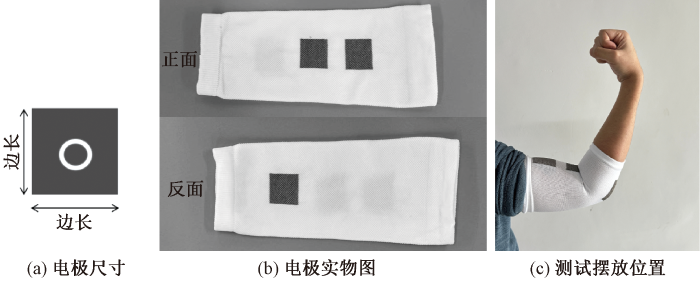
图1
针织电极的设计与测试
Fig.1
Design and testing of knitted electrodes. (a) Size schematic of electrode; (b) Physical photo of electrode; (c) Test position of knitted electrode
电极尺寸参考了肱二头肌平均宽度及相关文献,以确保在较小尺寸下仍能获得与Ag/AgCl凝胶电极(0#)相近的信号质量。电极采用针织结构,充分发挥其弹性好、透气性佳、贴合度高的特点,以兼顾动态佩戴时的舒适性与信号可靠性。在制备过程中,以镀银锦纶纱作为导电材料,锦纶/氨纶包覆纱作为基底材料,通过电脑横机配合局部提花技术,采用一体成形工艺完成电极织物的编织,电极实物图如图1(b)所示。该工艺可将导电纱线精确织入预设区域,形成稳定的电极结构,其中部的圆形区域为有效导电接触区,由高密度的镀银锦纶纱通过提花工艺集中编织而成,是与皮肤直接接触、采集生物电信号的功能核心;其周围的方形区域为支撑基底,主要起固定、集成与维持整体织物形态的作用。此结构在确保信号采集效能的同时,兼顾了面料整体的柔性与透气性。电极贴放遵循标准肌电导联设置:2个信号采集电极分别置于肱二头肌肌腹最高点及其下方2 cm处,参考电极则黏附于对侧肘部下方,具体位置如图1(c)所示,以降低共模干扰[10-11]。
该针织电极利用其线圈间的自然孔隙与弹性网状结构,在维持足够皮肤接触面积的同时,能有效缓解因身体运动引起的信号伪影。相比传统机织电极柔性不足,刺绣电极工艺一致性差等问题,本研究提出的针织电极为长期、动态条件下的肌电信号监测提供了一种具有潜力的解决方案。
1.3 测试与表征
1.3.1 表面形貌观察
采用便携式电子显微镜,对针织电极样品的正、反面微观形貌进行观察。
1.3.2 阻抗测试
图2
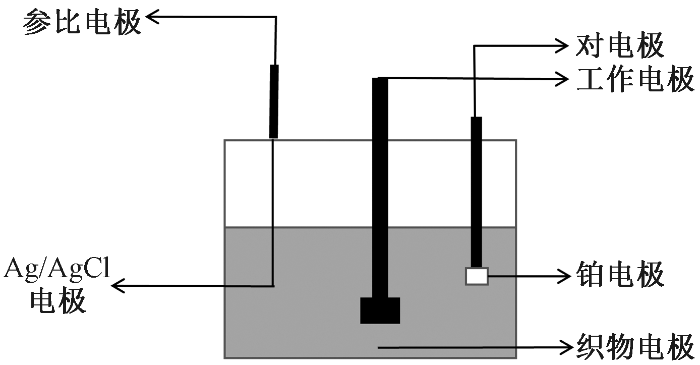
采用无创双电极法测量皮肤-电极接触阻抗。将2个3 cm×3 cm的针织电极以边缘间距2 cm黏附于前臂皮肤,通过电化学工作站在10~500 Hz频率范围内施加0.03 V电压,测定两电极间的总阻抗,该阻抗值为皮肤-电极接触阻抗与组织流体阻抗之和。为进一步探究实际应用中的影响因素,还分析了不同压力(0、0.98、1.96、2.94 N)及皮肤干湿状态对接触阻抗的影响。不同压力下皮肤-电极接触阻抗的测试方法为:将前臂平放在实验台上,将3 cm×3 cm的针织电极以边缘间距2 cm摆放,并分别在无压力(仅用医用胶带固定)、100 g砝码(对应0.98 N压力)、200 g砝码(对应1.96 N压力)和300 g砝码(对应2.94 N压力)条件下测量皮肤-电极接触阻抗。干湿皮肤状态下皮肤-电极接触阻抗的测试方法为:将前臂平放在实验台上,针织电极以边缘间距2 cm摆放,在医用胶带固定的情况下,分别测量干态和湿态皮肤的接触阻抗。干态皮肤不做任何处理,湿态皮肤采用75%医用酒精清洁。
1.3.3 肌电性能测试
选择健康成年志愿者作为受试对象,以3 kg哑铃为负荷,进行肌电信号采集实验。为确保信号可比性,将Ag/AgCl凝胶电极与针织电极放置于同一受试者肱二头肌的相同解剖位置。实验前采用76%医用酒精清洁局部皮肤,并在电极与皮肤间涂敷医用导电膏,以降低接触阻抗。
受试者于坐姿状态下进行单臂哑铃90°弯举动作:右臂自然下垂,以肘关节为轴心,缓慢屈肘至90°后再恢复至初始位置。在无负重条件下先重复该动作多次,以获取稳定的肌电信号基线;随后持3 kg哑铃执行相同动作,用于模拟负重状态下的肌肉收缩信号。该标准化流程有助于客观比较2类电极在不同负荷条件下的肌电信号质量。
实验通过方均根值(RRMS)、平均功率频率(fMPF)和信噪比(SSNR)等指标对降噪处理后的肌电信号进行评估。肌电RRMS作为时域指标,反映了肌电信号的有效值,表示肌肉在一定时间内放电的平均强度,用于直接衡量肌肉收缩时的能量输出,可通过MatLab计算得出。RRMS用于评估信号的幅度特征,计算公式为
式中:N为信号中样本的数量;xi为第i个样本的信号电压值, mV。
采用MatLab对肌电信号进行快速傅里叶变换(FFT)处理,得到频谱或者功率谱,然后再进行运算。fMPF用于评估信号的频率特征,计算公式为
式中,f为频率Hz;ρ(f)为频率f处的功率谱密度,mV2/Hz。
利用肌肉收缩状态下的肌电信号与松弛状态下的肌电信号计算SSNR,用于评估肌电信号质量,计算公式为
式中:Psignal为信号功率,mV2;Pnoise为噪声功率,mV2。
1.3.4 长期佩戴测试
受试者分别佩戴3#和0#电极,在行走(3 km/h)和慢跑(6 km/h)状态下,变换不同手势以激活肌肉,连续采集肌电信号,累计监测时间不低于40 h。通过分析信号幅度稳定性、信噪比变化及噪声水平,评价电极在长期使用中的性能表现。若电极在整个过程中信号无显著衰减且信噪比保持稳定,则认为其具备长期使用的可靠性。同时,还考察了连续佩戴7 d后肌电信号的质量变化及皮肤相容性。定期记录受试者佩戴部位皮肤状态,包括是否出现过敏、瘙痒、红斑等不良反应。
为模拟实际穿戴中的力学形变,参照GB/T 3923.2—2013《纺织品 织物拉伸性能 第2部分:断裂强力的测定(抓样法)》测试3#电极的拉伸循环性能。在耐水洗性方面,参照ISO 105-C06∶2010《纺织品 色牢度试验 第C06部分:耐家庭和商业洗涤的色牢度》规定的洗涤条件对3#电极进行模拟测试。
2 结果与讨论
2.1 针织电极的表面形貌分析
图3分别示出针织电极的正面和反面的电镜照片。可看出,电极表面呈现凹凸纹理,提花区域以几何图案分布,确保导电均匀稳定。织物整体柔软有弹性,提花纹理增强了表面层次与皮肤贴合度。
图3
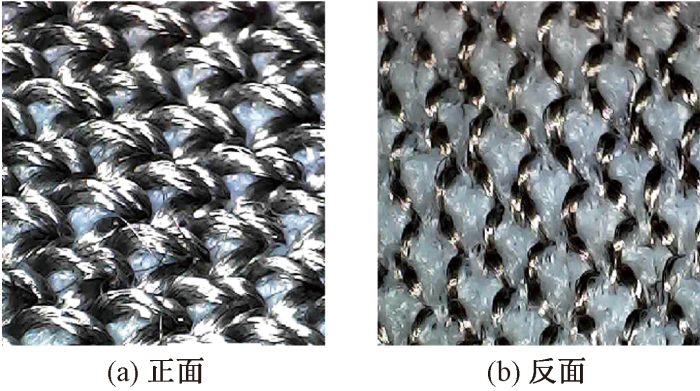
图3
针织电极的电镜照片(×30)
Fig.3
Electron micrographs of knitted electrode (×30). (a) Front; (b) Back
2.2 针织电极的阻抗性能分析
针织电极的交流阻抗的测试结果如图4所示。可看出,针织电极的阻抗值随频率增加而降低。在10 Hz时针织电极的阻抗为182.7 Ω,100 Hz时为125 Ω,500 Hz时降至99 Ω。这一变化趋势主要与电极-皮肤界面存在的双电层电容特性有关,低频下该电容的容抗较高,成为影响阻抗的主要因素;随频率升高,容抗迅速下降,总阻抗随之降低。该特性表明电极在低频区电导率较低,可能导致肌电信号中低频有效成分的采集灵敏度下降,并更易引入同频段环境噪声。
图4
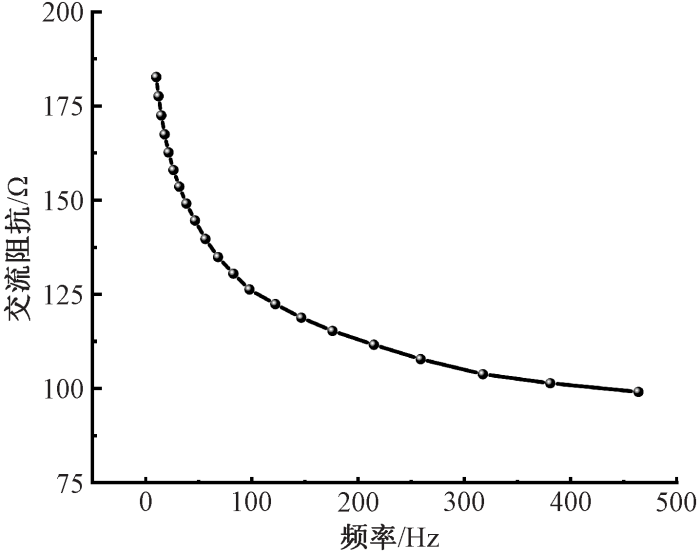
图5
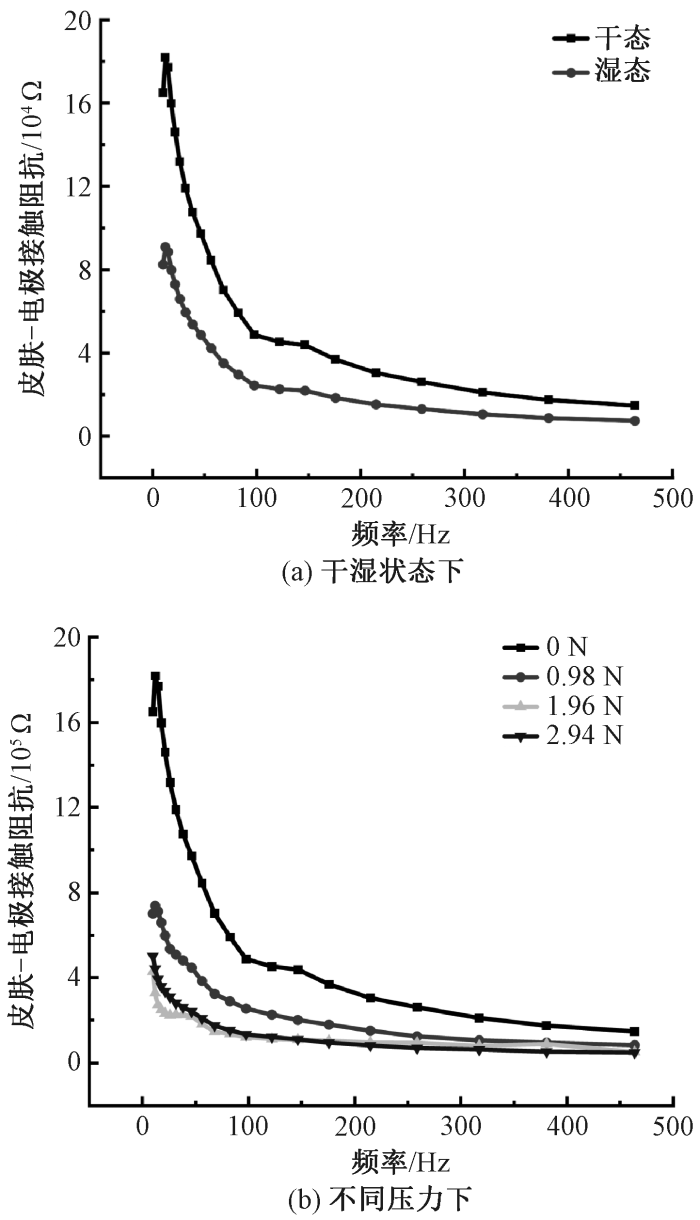
图5
针织电极在干湿状态和不同压力下的皮肤-电极接触阻抗
Fig.5
Skin-electrode contact impedance of knitted electrodes under skin dry and wet conditions (a) and under different pressures (b)
2.3 针织电极的肌电性能分析
不同负荷下针织电极的表面肌电(sEMG)测试结果如图6所示。可看出,不同负荷条件下的哑铃弯举测试中,所有尺寸的针织电极均表现出与Ag/AgCl凝胶电极相当的信号电压值,且信号幅值随电极尺寸和负荷的增加而增大。
图6
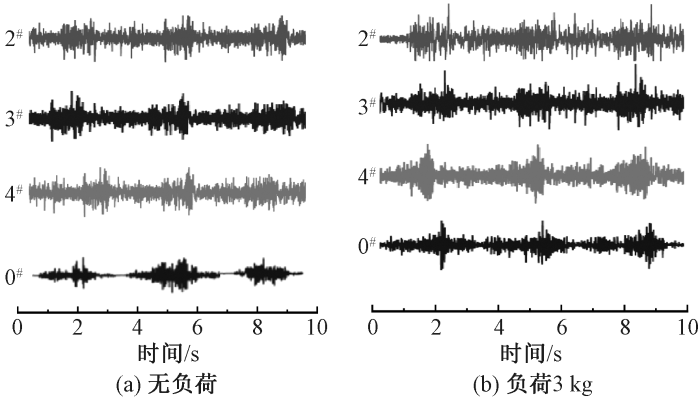
图6
不同负荷下电极的sEMG测试结果
Fig.6
sEMG test results of electrodes under different loads. (a) No load; (b) 3 kg loads
不同负荷下电极的SSNR测试结果如图7所示。可看出,3#电极的SSNR最优。实验数据表明,3#电极的RRMS和fMPF也是最优:其在90°弯举哑铃动作无负荷和3 kg负荷下的SSNR分别为20.1、24.5 dB,RRMS值分别为0.046、0.07 mV,fMPF值分别为182、173 Hz,最接近Ag/AgCl凝胶电极。
图7
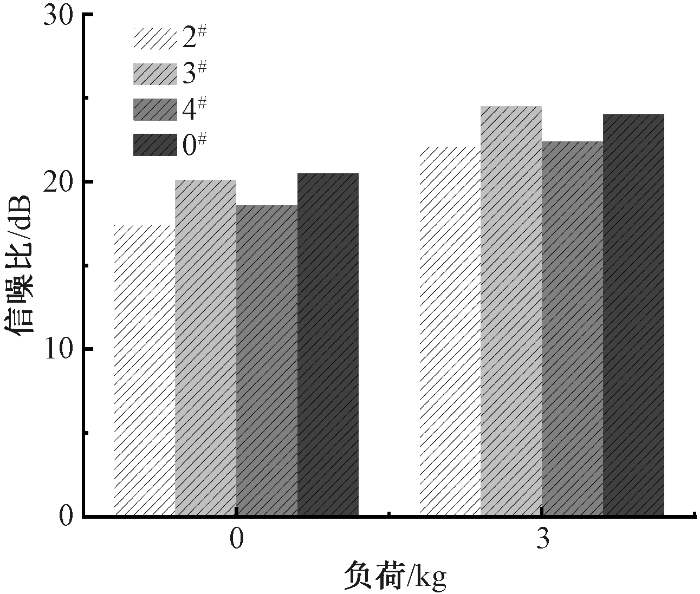
图7
不同负荷下电极的SSNR测试结果
Fig.7
SSNR test results for electrodes under different loads
不同负荷条件下在弯举哑铃的肌电性能测试中,所有尺寸的针织电极均表现出与Ag/AgCl凝胶电极相当的信号采集能力,验证了其通过柔性贴合实现有效皮肤接触的基本性能。信号电压值随电极尺寸和负荷增加而提升的现象,归因于物理采集面积的扩大和运动单元募集的生理机制。其中,3#电极展现出最优的综合性能,其3项指标SSNR、RRMS和fMPF值最接近Ag/AgCl凝胶电极,关键在于该尺寸在信号采集范围与信号质量之间达到最佳平衡,足够覆盖主要肌纤维以确保信号强度,又避免了过大尺寸导致的信号空间分辨率下降和噪声引入,从而在保持低阻抗的同时,实现了优异的抗干扰能力和信号稳定性。
2.4 针织电极的长期佩戴性能分析
肌电电极信号质量稳定性测试结果如图8所示。可看出,3#电极在40 h佩戴中信号质量稳定,而0#电极在38 h后SSNR出现明显下降。3#电极佩戴7 d的实验数据进一步表明,针织电极仍能维持稳定的信号采集性能,未发生显著衰退,同时其柔软透气特性显著提升了佩戴舒适度,未引起皮肤不良反应。针织电极在长期动态监测中表现出优于传统凝胶电极的可靠性和适用性。
图8
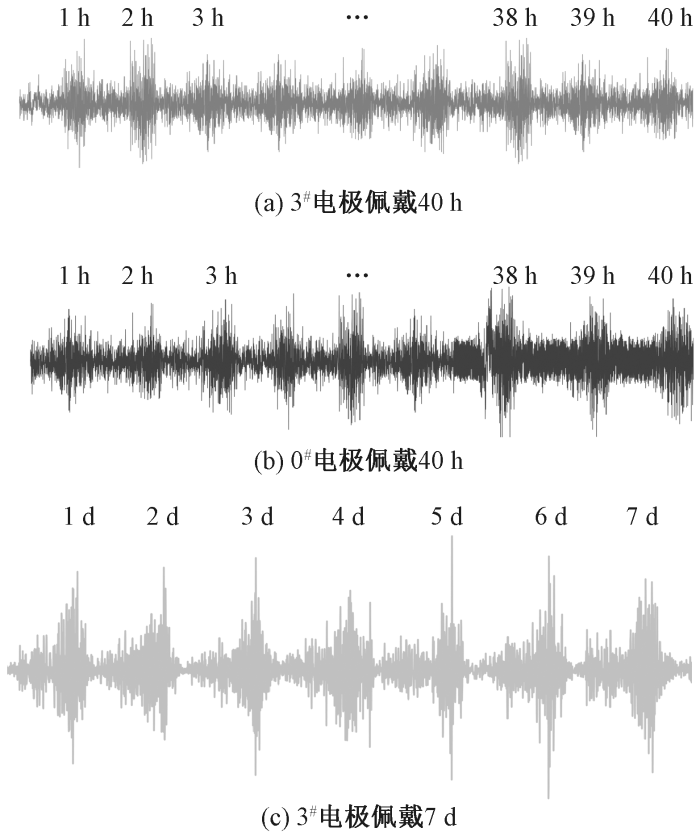
图8
表面肌电电极信号质量稳定性测试结果
Fig.8
sEMG signal quality stability test results of electrodes. (a) 3# electrode for 40 h; (b) 0# electrodes for 40 h; (c) 3# electrode for 7 d
图9示出3#电极的拉伸循环稳定性曲线。可看出:经历6 000次循环后,3#电极的电阻值因针织线圈结构性松弛而缓慢上升;继续拉伸至8 000次的过程中,电阻变化趋于平稳,表明材料具备良好的循环稳定性。
图9
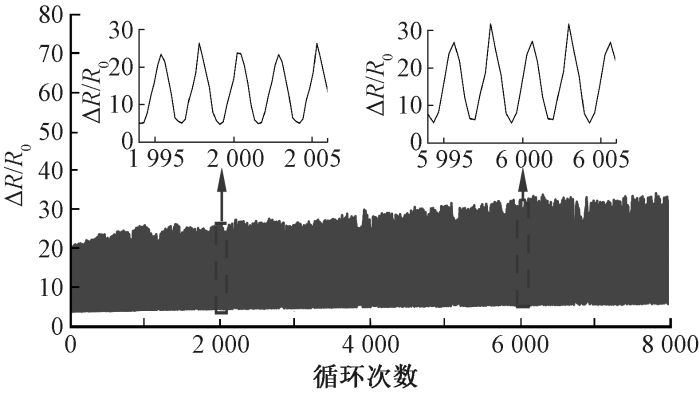
图10示出3#电极的模拟洗涤实验结果。可看出,经不同时长模拟洗涤后3#电极的电阻仅轻微波动,表明电极受洗涤影响较小,能满足日常清洁维护的基本要求。
图10
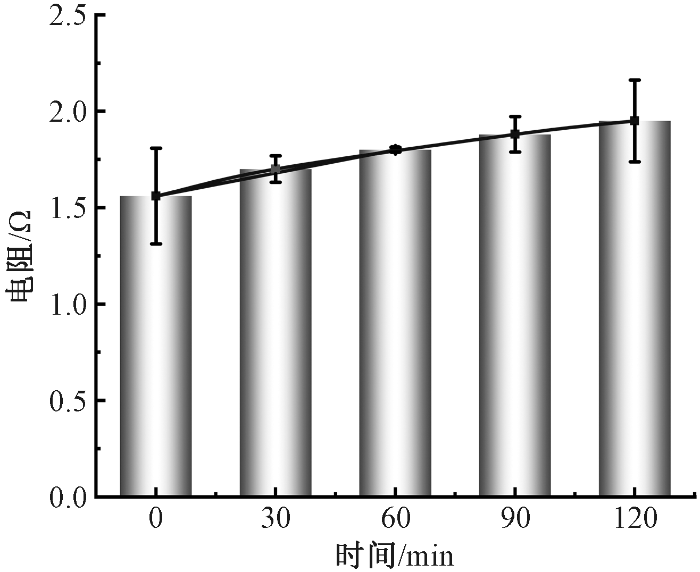
图10
3#电极在不同洗涤时间下的电阻变化图
Fig.10
Resistance change of 3# electrode for different washing time periods
综上所述,该电极材料具有良好的生物相容性,适用于长期佩戴[12]。
2.5 针织电极传感器的应用
2.5.1 肌肉疲劳监测
哑铃肱二头肌90°弯举是常见的肱二头肌训练动作,但不恰当的负荷选择或过度训练可能引发肌肉损伤。为预防此类损伤,通过实时监测肌肉负荷、疲劳程度及肌腱位移等指标,可为训练优化与损伤预防提供关键依据。在本研究肌肉疲劳监测系统中,当用户进行上肢运动时,针织电极会同步采集表面肌电信号,并将信号送入分析模块,分别通过RRMS和fMPF值分析评估肌肉负载水平和肌肉疲劳程度,从而综合输出肌肉的实时状态;基于该状态数据生成个性化反馈,一方面用于动态调整后续运动方案以优化训练效果,另一方面为损伤预防提供依据。
采用优选出的3#与0#电极进行对比,受试者负荷3 kg完成10次连续举重动作,肱二头肌sEMG信号变化情况如图11所示。由图可见,在3 kg负荷下90°弯举哑铃测试中,3#电极仍保持信号稳定,且sEMG信号强度高于Ag/AgCl凝胶电极,10次举哑铃肱二头肌的RRMS、 fMPF值变化显示,随着肌肉疲劳程度增加,肌电信号的RRMS值逐渐上升,fMPF值逐渐下降。3#电极的RRMS值从0.05 mV增至0.07 mV,fMPF值从196 Hz降至179 Hz,与0#电极变化趋势一致。
图11
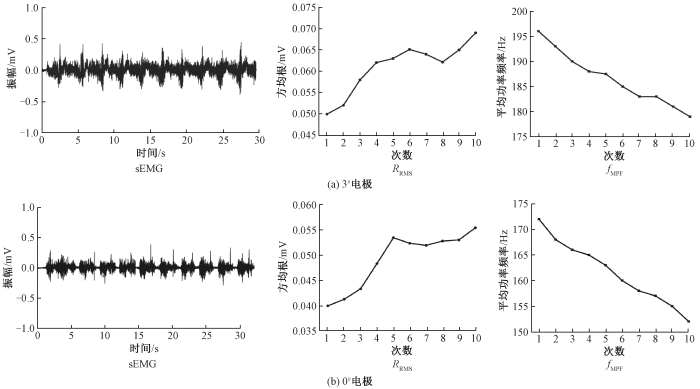
图11
使用3#和0#电极监测的负荷下10次举哑铃肱二头肌状态
Fig.11
10-lift dumbbell biceps status under load monitored using 3# and 0# electrodes
不同负荷(0、1、3 kg)下的实验结果进一步表明,针织电极能有效区分肌力水平,信号电压值与负荷呈正相关,如图12所示。
图12
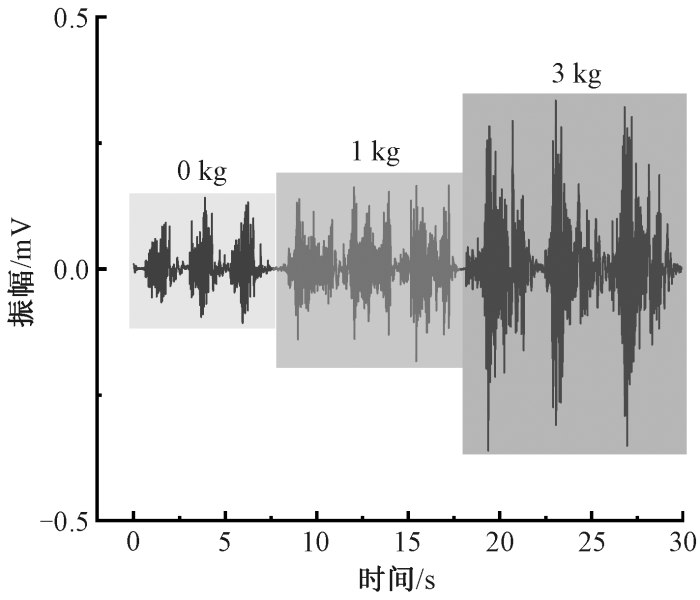
图12
不同负荷下肱二头肌sEMG信号电压值变化
Fig.12
Changes in sEMG signal voltage values of biceps brachii muscle under different loads
实验中所采用的3#电极因其在动态运动中与皮肤保持更稳定贴合,不仅信号强度优于传统凝胶电极,而且能一致、准确地捕捉到肌肉疲劳时,神经代偿机制推高RRMS值,而代谢因素拉低fMPF值的生理变化规律,有效验证了其在实时监测肌肉状态、区分不同负荷水平方面的可靠性,为运动训练中的疲劳评估与损伤预防提供了关键技术支撑。
2.5.2 肌电信号拟合性能
肌电信号采集后,采用10~300 Hz的带通滤波器对原始数据进行预处理。该频段范围依据表面肌电信号的生理特征设定:其有效能量主要分布于20~500 Hz;设置10 Hz高通截止可抑制运动伪影及低频漂移,300 Hz低通截止则用于消除高频环境噪声,从而在保留信号核心成分的同时提高信噪比。预处理后,使用Origin绘制肌电信号的时域对比图,通过同步采集行走(3 km/h)和慢跑(6 km/h)状态下,腓肠肌肌电信号对比针织电极与凝胶电极的性能。对采集的表面肌电信号的时域和频域分析表明,2种电极信号特征高度一致:行走状态下RRMS值相差0.006 4 mV,fMPF值相差9 Hz;慢跑状态下RRMS值相差0.005 mV,fMPF值相差5 Hz。针织电极能清晰区分不同运动强度,慢跑时RRMS值显著高于行走状态(如图13所示),证明其具备与凝胶电极相当的信号采集能力。
图13
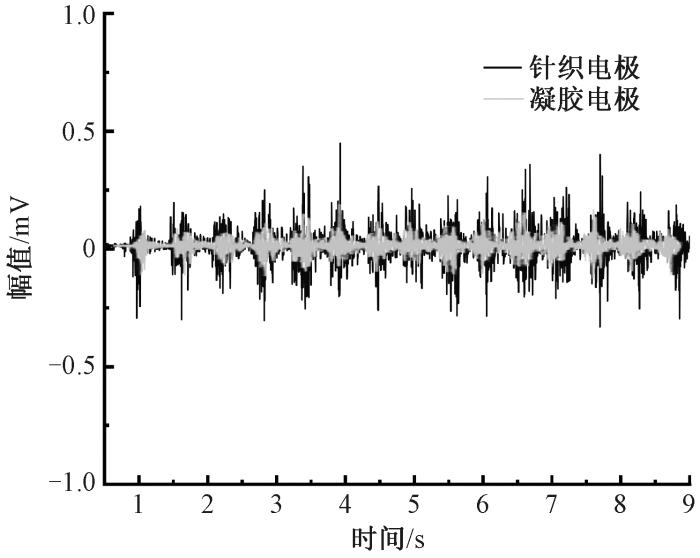
图13
针织电极与Ag/AgCl凝胶电极采集的sEMG信号时域对比
Fig.13
Time-domain comparison of sEMG signals acquired by knitted electrode and Ag/AgCl gel electrode
3 结论
本研究针对长期动态肌电监测对电极舒适性及稳定性的需求,采用局部提花针织工艺制备了3种不同尺寸(2 cm×2 cm、3 cm×3 cm、4 cm×4 cm)的镀银锦纶柔性电极。通过对比测试,明确了3 cm×3 cm电极具有最优的综合性能:其电化学阻抗与频率呈典型依赖关系,在10~500 Hz范围内信号质量与Ag/AgC1凝胶电极相当;在不同负荷下的弯举测试中,能有效监测肌肉疲劳状态,表现为方均根值上升、平均功率频率下降,其信号特征与Ag/AgCl凝胶电极一致,在3 kg负荷下其根方均值为0.07 mV,平均功率频率值为179 Hz。同时,该电极凭借针织结构赋予的弹性与透气性,在连续佩戴中表现出良好的皮肤相容性,并能有效抑制运动伪影。此外,拉伸循环与耐洗涤测试表明其具备可靠的机械耐久性与维护可行性。结果表明,该针织电极在动态肌电信号采集方面可替代传统凝胶电极,并为康复监测、运动科学等领域的可穿戴设备开发提供有效的技术方案。
参考文献
Bioinspired tunable helical fiber-shaped strain sensor with sensing controllability for the rehabilitation of hemiplegic patients
[J].
Surface electromyographic activities of submental and infrahyoid muscles: comparisons based on residue, penetration and aspiration
[J].
DOI:10.1111/joor.13934
PMID:39861954
[本文引用: 1]

Surface electromyography (sEMG) has been used in a wide range of studies conducted in the field of dysphagia.The main aim of this case-control study is to obtain how submental and infrahyoid sEMG signals differ based on residue, penetration and aspiration.A total of 100 participants (50 patients with suspected dysphagia and 50 healthy controls) were enrolled in the present study. Participants with suspected dysphagia underwent a detailed fibreoptic endoscopic evaluation of swallowing (FEES) to observe the efficiency and safety of swallowing using the Yale Pharyngeal Residue Severity Rating Scale (YPRSRS) and the Penetration-Aspiration Scale (PAS), respectively. Afterward, sEMG parameters, including submental muscle activity duration (SMM-AD), infrahyoid muscle activity duration (IM-AD), amplitude of submental muscles (A-SMM) and amplitude of infrahyoid muscles (A-IM) were obtained during three consecutive dry swallows from all study cohorts.There were significantly higher SMM-AD values in patients with a YPRSRS score of 1-2 and a YPRSRS score of 3-5 for residue in vallecula compared to the controls (p < 0.001 and p = 0.001, respectively). Both subgroups of patients with a YPRSRS score of 1-2 and a YPRSRS score of 3-5 for residue in piriforms showed significantly higher SMM-AD values compared to the controls (p < 0.001 and p = 0.048, respectively). The same prolongation of SMM-AD was also evident for the patients with airway invasion (penetration or aspiration) compared to the controls (p = 0.042 and p < 0.001, respectively). The other measured sEMG parameters (IM-AD, A-SMM and A-IM) did not differ significantly based on FEES outcomes (p > 0.05).Since the availability of instrumental swallowing assessment methods in clinical practice is quite challenging, specific sEMG parameters may be useful to predict possible residue, penetration, or aspiration events in patients with dysphagia. SMM-AD can be considered as a first-line assessment parameter for possible residue, penetration, and aspiration events before referring patients for further instrumental methods.© 2025 The Author(s). Journal of Oral Rehabilitation published by John Wiley & Sons Ltd.
A noise-tolerant dual multi-classifier system with fuzzy model applied to the sEMG-based control of a bionic upper limb prosthesis
[J].DOI:10.1016/j.bspc.2024.107441 URL [本文引用: 1]
长时连续稳定体表肌电监测织物干电极的研究进展
[J].
Research progress of fabric dry electrode for long time continuous and stable EMG monitoring on human skin
[J].
Sustainability and predictive accuracy evaluation of gel and embroidered electrodes for ECG monitoring
[J].DOI:10.1016/j.bspc.2024.106632 URL [本文引用: 1]
Virtual reality-based myoelectric prosthetic control training: effects of action observation and motor imagery with visual feedback of electromyographic signals
[J].
DOI:10.1097/PXR.0000000000000392
PMID:39692729
[本文引用: 1]
Conventional myoelectric prostheses (myo-prostheses) training involves repetitive grasping and manipulation training, which requires considerable training time. It is necessary to develop a short and efficient myo-prostheses training. This study aimed to verify the immediate and sustained effects of action observation and motor imagery (AOMI) using virtual reality (VR) on myo-prostheses control and clarify the effect of visual feedback of electromyogram (EMG) signals during AOMI using VR.We evaluated 24 healthy right-handed individuals wearing a myo-prostheses simulator in their dominant hands. We divided participants into 3 groups: VR video observation with EMG presentation during manipulation (VR+), VR video observation without EMG presentation (VR), and control group. We evaluated prosthetic control skills using the Grasp Force Adjustment Test (GFAT) and Bowknot task immediately before and after AOMI and 1 week later. In addition, we evaluated the level of immersion during AOMI.The rate of change in the GFAT 1 week after the intervention was significantly greater in the VR+ (P < 0.05, d = 1.32) and VR (P < 0.01, d = 2.34) groups than in the control group. Immersion was significantly higher in the VR+ and VR groups than in the control group. The condition and time required for GFAT had significant effects, although the post-hoc test showed no significant difference between VR+ and VR groups.AOMI using VR had sustained effects on motor learning of myo-prosthetic control despite EMG presentation. Therefore, AOMI, using VR, manipulates prostheses once learned, and it might be used for future training of myo-prosthetic control.Copyright © 2024 International Society for Prosthetics and Orthotics.
Enhanced sensitivity and versatile detection: dual-sized microsphere-type pressure sensors for soft robotics and wearable electronics
[J].
Motion analysis for the evaluation of dynamic spasticity during walking: a systematic scoping review
[J].DOI:10.1016/j.msard.2025.106273 URL [本文引用: 1]
Estimation of lower limb joint angles using sEMG signals and RGB-D camera
[J].DOI:10.3390/bioengineering11101026 URL [本文引用: 1]
The influence of distance between the electrode and noise reduction buffer amplifiers in ECG monitoring using knitted electrodes
[J].
Non-invasive detection of early-stage fatty liver disease via an on-skin impedance sensor and attention-based deep learning
[J].DOI:10.1002/advs.v11.31 URL [本文引用: 1]
Exploring pattern-specific components associated with hand gestures through different sEMG measures
[J].
DOI:10.1186/s12984-024-01526-3
PMID:39741272
[本文引用: 2]
For surface electromyography (sEMG) based human-machine interaction systems, accurately recognizing the users' gesture intent is crucial. However, due to the existence of subject-specific components in sEMG signals, subject-specific models may deteriorate when applied to new users. In this study, we hypothesize that in addition to subject-specific components, sEMG signals also contain pattern-specific components, which is independent of individuals and solely related to gesture patterns. Based on this hypothesis, we disentangled these two components from sEMG signals with an auto-encoder and applied the pattern-specific components to establish a general gesture recognition model in cross-subject scenarios. Furthermore, we compared the characteristics of the pattern-specific information contained in three categories of EMG measures: signal waveform, time-domain features, and frequency-domain features. Our hypothesis was validated on an open source database. Ultimately, the combination of time- and frequency-domain features achieved the best performance in gesture classification tasks, with a maximum accuracy of 84.3%. For individual feature, frequency-domain features performed the best and were proved most suitable for separating the two components. Additionally, we intuitively visualized the heatmaps of pattern-specific components based on the topological position of electrode arrays and explored their physiological interpretability by examining the correspondence between the heatmaps and muscle activation areas.© 2024. The Author(s).
A silver/silver chloride woven electrode with convex based on electrical impedance tomography
[J].DOI:10.1080/00405000.2020.1800926 URL [本文引用: 1]

 京公网安备11010502044800号


