



理想的个体热防护材料需兼具优异的热防护性能、舒适性、柔韧性、耐磨性、轻量化及湿热迁移能力[5]。然而,厚重或透气性不足的材料虽可提供良好隔热,却易导致热应激,加重人体生理负荷,从而降低作业效率与安全性。因此,平衡材料的热防护性能和热湿舒适性,对减少皮肤烧伤风险与缓解热应激至关重要。
本文系统梳理了近年来个体热防护材料的研究进展,重点围绕隔热与阻燃两大防护机制、材料体系构建、性能评价及应用场景等方面展开分析,并指出当前面临的技术挑战与未来发展趋势,以期为该领域内科研人员提供参考,推动其向智能化、多功能化与舒适一体化的方向创新发展。
1 个体热防护材料研究现状
热防护的核心在于对极端热流的主被动协同调控,其材料性能体现在两大关键性能上:一是“隔热”,旨在通过采用低导热材料与构筑多尺度结构,协同阻滞热传导、热对流和热辐射,从而延缓热流;二是“阻燃”,旨在通过化学机制中断燃烧反应,从而维持结构完整性。二者协同增效,共同实现对极端热危害的综合抵御。
1.1 隔热材料的传热调控
图1
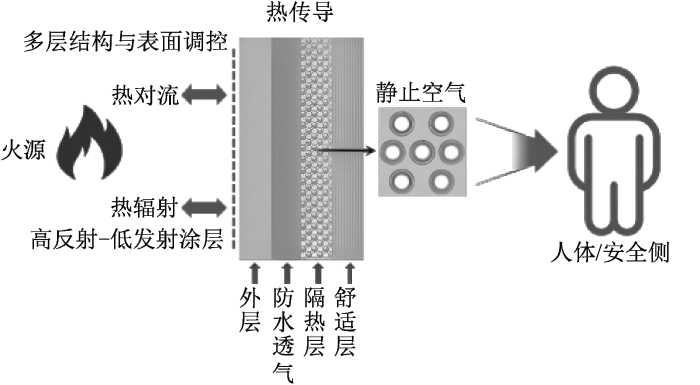
图1
个体热防护材料隔热机制示意图
Fig.1
Schematic diagram of heat insulation mechanism of individual thermal protection materials
1.1.1 热传导防护
热传导防护材料利用低导热的多尺度结构延缓热传导。该类材料大都采用本质阻燃纤维,结合机织、针织或非织造等成形工艺,在保障高效隔热的同时,确保了结构稳定性与长效服役性能。Alghamdi等[8]探讨了针刺工艺参数对碳纤维复合材料热传导性能的调控机制。研究表明,针刺工艺参数通过调控复合材料的孔隙形态与分布,从而影响有效热导率;增大针刺密度与孔径可促进复合材料在厚度方向导热;反之,则可增强纵向隔热性能。这为热传导路径的定向设计与性能可定制化提供了工艺依据,并有助于维持结构完整性。
1.1.2 热对流防护
热对流防护材料是指通过在织物表面涂覆致密的阻燃聚合物膜,有效阻挡高温气流、火焰和液体渗透,显著提升防护性能。但该技术会明显降低透气性,多用于抢险救援服等需近距离防火的装备。Liu等[9]基于植酸(PA)与三聚氰胺(MEL)的超分子自组装工艺获得高比热容膜材料,仅添加10%即可使复合薄膜极限氧指数达到31%,展现出显著的协同阻燃效应。其中,PA热解释放磷酸促进成炭,MEL分解释放氨气稀释可燃气体,二者协同形成致密稳定炭层,有效抑制火焰蔓延。该研究证明,通过表面涂覆构建此类阻隔层可显著提升热对流隔离效果。但该类材料受限于因透气性不足导致的湿热积聚问题。未来需进一步平衡阻隔与透气性能,推动材料向轻量化、动态热管理的方向发展。
1.1.3 热辐射防护
热辐射防护材料通过在织物表面构建高反射层,直接反射辐射热,避免依赖被动吸热,在冶金等强热辐射工业环境中应用优势显著,如真空镀铝织物和铝箔复合材料等。为有效平衡防护材料的热反射性能与柔韧性、透气性,Zhu等[10]通过涂层法在芳纶织物表面构建了由铝浆、膨胀型阻燃剂及丝素蛋白组成的复合功能涂层。该涂层在显著提高辐射反射率(平均>0.7)与热防护性能(TPP值为52.34 kW·s/m2)的同时,优化了水蒸气渗透性,实现了高效热防护、阻燃与穿着舒适性的协同。由此可知,反射型复合涂层的使用需兼顾防护与舒适性。未来可以结合动态热管理,开发展轻质柔韧且具备全热路径调控能力的材料。
1.2 阻燃材料的化学燃烧抑制
阻燃材料的核心目标是通过干扰或中断材料自身燃烧过程以提升其火灾安全性,其机制本质上是基于化学与物理化学过程:在气相中捕获自由基抑制火焰,在凝聚相中促进成炭以隔绝热量与氧气,从而延缓或中断燃烧(见图2)。阻燃性能是个体热防护材料在明火或极端热冲击下保持结构完整、避免二次引燃并维持防护功能的关键前提。
图2
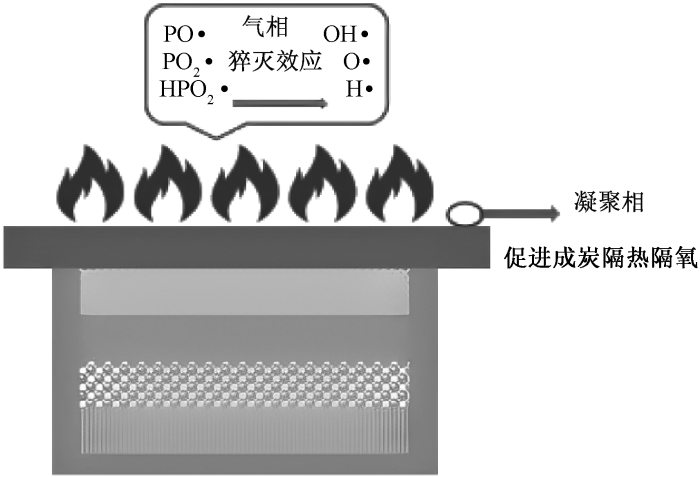
图2
个体热防护材料阻燃机制示意图
Fig.2
Schematic diagram of flame retardant mechanism of individual thermal protection materials
1.2.1 本质阻燃纤维材料
本质阻燃纤维无需添加阻燃剂,其分子结构中的芳环或芳香杂环赋予自身阻燃性,常见品种有芳纶、聚苯并咪唑纤维和聚酰亚胺纤维等。此类纤维具有高极限氧指数、不熔滴、耐高温、低烟低毒等特性,其阻燃性能优异、耐洗涤和耐磨损。
1.2.2 改性阻燃纤维材料
改性阻燃纤维通过共混、涂层或接枝共聚等技术将阻燃剂引入基体(如阻燃粘胶纤维、涤纶等)[13]。其在高温下可形成致密炭化层,有效隔绝氧气并抑制有毒烟雾,从而显著提升热防护性能。
共混技术工艺简便,但由于阻燃剂与纤维分子间缺乏稳定化学键,导致其耐久性、耐洗性不足。Yang等[14]通过改性三聚氰胺聚磷酸酯(MPP)与三聚氰胺氰尿酸酯(MCA)阻燃剂,增强其与基体的相容性,并借助干湿法纺丝工艺形成致密的纤维结构,可使材料展现出良好的耐洗性与吸湿性能。涂层法常用于混纺织物中纤维的阻燃整理,但易导致织物强力下降和手感硬化。Marcioni等[15]通过选用亲水性的壳聚糖和六偏磷酸钠,并结合能形成多孔结构的冷冻干燥工艺,在纤维素纤维表面构建了均匀的纳米涂层。这种涂层因其材料特性和结构特点,显著提升了织物的整体吸湿性能,实现了阻燃与舒适性的协同改进。接枝共聚技术通过化学键将阻燃剂与纤维大分子链或其支链结合,可显著提升纤维的阻燃性与耐久性,具备高效持久的阻燃效果。Zheng等[16]通过接枝共聚,显著改善了聚乳酸纤维基体与阻燃剂的界面相容性。该方法在提升极限氧指数(28.2%)的同时,克服了力学性能下降问题,实现了韧性、强度、耐热性及阻燃性的综合优化。
改性阻燃纤维虽在提升阻燃性能和成本控制方面具有优势,但仍存在耐久性低、影响织物手感与力学性能、环保性不足等问题。未来需开发绿色阻燃体系与结构功能一体化材料,以实现持久、环保且舒适的高性能阻燃目标。
1.3 新型个体热防护材料
新型个体热防护材料在保障核心防护性能的同时,更加重视人体穿着舒适性。新型材料主要包括相变调温材料、气凝胶材料、形状记忆及仿生结构材料等,其中一部分依靠自身材料特性实现防护;另一部分则通过结构设计,实现高效、轻质与智能的热防护效果。
在实际应用中,个体热防护材料基于多层复合与梯度结构设计,融合了隔热、阻隔及辐射反射等多重热防护机制,在保障安全的同时兼顾人体热湿舒适性。未来仍需在动态响应调节、轻量化与高效隔热协同等方面实现关键突破,以推动其向智能、舒适化方向发展,从而更好地应对多场景应用需求。
2 个体热防护材料性能评价
个体热防护材料主要用于消防、焊接、冶金、电力等高危行业防护服的制作,其核心功能是在热危害环境中为使用者提供安全撤离或关键操作的时间保障,并兼顾穿着舒适性。评价个体热防护材料性能优劣的核心在于其抵御外部热危害的能力,不同应用领域对热防护材料的功能要求和防护等级存在显著差异[28]。
针对不同应用场景下的个体热防护材料,我国制定并实施了一系列国家标准与行业标准,具体包括:GB 38453—2019《防护服装 隔热服》、XF 10—2014《消防员灭火防护服》、GB 8965.2—2022《防护服装 焊接服》、GB 8965.3—2022《防护服装 熔融金属飞溅防护服》以及GB 8965.4—2022《防护服装 防电弧服》。以上标准主要对个体热防护材料的阻燃性能、热稳定性能、热防护性能及隔热性能等核心指标提出了明确的技术要求。然而,当前个体防护材料的性能评价仍存在局限性,主要集中于静态测试场景,过度关注单一热防护指标及初始性能参数,忽视了材料在实际动态使用环境中的长期耐久性表现以及与人体工效学密切相关的舒适性能评估。具体问题可归纳为以下几个方面。
1)真实动态环境测试的缺乏。在现有标准测试中,热暴露环境多为稳态和单向。然而在实际作业中,作业人员常处于动态热环境,如热源移动或突发热浪冲击。同时,防护服在穿着过程中会受到机械与环境的双重应力,导致材料结构与性能发生变化,进而影响其隔热效果,而这一点尚未被纳入现行评价体系中。为更真实地评估个体防护材料在极端复杂环境下的性能,Psikuta等[29]利用3D人体扫描技术模拟了3种姿势下消防员衣服中空气层分布的差异,这些姿势反映了真实的作业暴露条件(爬行、握住软管和直立)。身体姿势的变化反映在集合的热阻力和蒸发阻力上,从而影响了实际应用时的潜在热性能。因此,在评估时应考虑身体姿势和外界作用力对防护服性能与功能的真实影响。
3)热舒适性评价的不足。当前热防护测试标准在评估服装内部热量与水汽散失所关联的热湿舒适性方面存在明显局限。厚重的隔热服易导致热应激,已成为威胁使用者健康的主要风险因素之一。尽管现行标准规定了透湿性测试,但这仅属于静态评价方法,难以真实反映人体在大量出汗及运动状态下服装系统的整体散热与排湿能力[32]。因此,建议引入能够模拟人体出汗状态的动态热板法测试,更科学地评估服装在实际使用中的散热与透湿性能。同时,可增设穿着者主观评价作为辅助指标,为产品开发阶段获取一线作业人员的实际穿着反馈提供系统化指导。
4)性能耐久性评价的不全面。当前标准仅要求在经过特定次数洗涤后,对热防护材料的各项性能进行评价,但未对多次洗涤与磨损后关键隔热性能的衰减率作出强制性规范。在实际使用场景中,防护服装常面临洗涤、机械摩擦、热暴露等多重老化因素的复合作用,而现行标准既未明确设定强制报废周期,也未提供相应的性能评估准则。此外,针对达到报废条件的服装,其回收处置方式与判定标准同样存在规范缺失。针对上述问题,有必要强制要求对洗涤前后服装的隔热性能等关键指标进行系统检测,同时建立明确的强制报废评估体系及规范化的回收处理路径。
综上,对个体热防护材料的性能评价需置于“人体-服装-环境”完整的系统中进行,应依据动态性能评估结果持续优化热防护材料的设计方案,既要确保材料在极端热暴露环境下提供可靠的热阻隔防护,又要通过结构创新与功能集成促进人体热湿平衡管理(包括散热、透气及透湿性能),从而在保障使用者生理舒适性的同时维持其作业效能。
3 个体热防护材料应用场景
3.1 应急消防
应急消防是热防护材料要求最为严苛的领域之一。消防员在灭火救援过程中面临火焰直烧、高温气体对流、强辐射热及高温蒸汽等多重热威胁。消防服材料需具备优异的阻燃性、耐热性与隔热性,以有效阻隔辐射与对流热传递,同时兼顾防水透湿性能,避免蒸汽烫伤,并满足防切割、防化学渗透等物化防护要求。此外,防护服还应轻便紧凑,以保证消防员救援灵活性[33]。
为提升作业安全,应急消防部门持续推进防护服材料研发与标准升级。现行标准要求防护服TPP值不低于1 467 kW·s/m2,并能够预测皮肤烧伤程度,为材料与结构设计提供依据[34]。现代消防服通常包含4层:外层为阻燃耐磨机织物,防水透气层用于阻隔液态水并排出水蒸气,隔热层多采用针刺毡或气凝胶材料,舒适层为阻燃针织物。Li等[35]开发出珍珠层模拟剪切硬化凝胶(SSG)-氢氧化镁(MH)涂层芳纶复合材料(SMK),通过真空辅助蒸发诱导交联法构建高度取向的层状结构。氢键与动态硼氧交联增强了界面作用,使其热辐射温度降低46%,抗拉强度提高40%。燃烧后的SMK复合材料在100 m/s冲击下仍保持形状完整,所制消防服在持续燃烧与冲击测试中表现出优异的热防护性和稳定性。
3.2 工业防护
工业用热防护服主要用于防护闪火爆燃、熔融金属飞溅、电弧、高温辐射热等多种热伤害。根据防护需求,可将其细分为焊接、熔融金属飞溅及电弧防护等不同类别[36]。
3.2.1 焊接防护
焊接作业[37]属于特殊工种,作业人员长期在电焊弧光照射、高温、焊渣飞溅、热辐射等条件下作业,易造成尘肺、电光性眼炎、一氧化碳中毒、放射性疾病、电光性皮炎及金属烟热等焊接职业病。焊接防护服可实现对飞溅电焊火花、高温金属熔滴和弧光辐射的有效防护。然而,目前市面上的焊接服在耐久性、稳定性和舒适性方面普遍表现不佳且难以兼顾。
李世雄等[38]通过优化织物组织与结构相,开发出一种高密度直贡缎纹织物。其正面采用光滑纱线形成长浮线沟槽结构,增强抗熔融金属冲击能力;背面以高强度耐高温纱线作为热屏障,即使在正面局部损伤时仍能有效阻隔热渗透,维持整体结构完整性。该设计显著提升了焊接服的防护性能,并兼顾防护耐久与舒适性。
3.2.2 熔融金属飞溅防护
金属冶炼作业环境中常伴随高温、强热辐射、熔融金属喷溅等多种危险因素。因而,要求熔融金属飞溅防护服具备高温金属液体飞溅到织物表面后迅速滑落的能力,以免高温液体将热量传递给人体[39]。目前主流使用的全棉阻燃织物隔热性不足,铝膜织物虽可隔热但透气性和舒适性较差。
刘婉婉等[40]基于微纳米结构表面的热量补偿机制,采用纳米SiO2与有机硅整理剂对羊毛混纺织物进行后整理,开发出具有优异熔融金属滑脱性能的防护面料。添加纳米SiO2后,织物TPP值从278.17 kW·s/m2增至294.63 kW·s/m2,最大热通量由80.00 W/m2降至49.10 W/m2。这归因于纳米SiO2增强了热阻与隔热性,同时表面微纳结构促进了熔融金属滑脱。该研究通过热量补偿与微纳结构设计,为熔融金属防护材料提供了主动滑脱与被动隔热相结合的创新思路。
3.2.3 电弧防护
防电弧材料是核电、特高压及新能源领域带电作业的关键防护装备,其核心功能在于抵御由电弧闪爆产生的瞬时极高热压和电离气体的冲击,通过个体热防护材料在人体与电弧热源之间构建一个隔热屏障,以阻挡、吸收和反射巨大的热能,保障从业人员生命安全[41]。
目前,芳纶及其混纺织物是电弧防护服的主流材料,但在高温燃烧时会产生有毒气体,危及作业人员健康。Ma等[42]通过分子动力学模拟和实验测试对比发现,聚酰亚胺的玻璃化转变温度(700 K)高于芳纶(540 K),表明其分子链结构更稳定,具有更优的刚性、耐热性和耐磨性;电弧测试中,聚酰亚胺织物在热防护性能、抗爆性能方面均优于芳纶,能够有效降低Ⅱ度烧伤风险,因此是一种更具潜力的高性能电弧防护材料。
3.3 其它领域
军事战训服是各军种必需装备,用于在战斗与训练中为士兵提供抵御火焰、热辐射等伤害的有效防护。该类防护服除需具备优良的热防护性能外,还应兼具轻量化、耐磨及吸湿透气等特性,以保障士兵在高强度行动中的热湿舒适性与机动性,确保作战与训练任务高效完成。针对军事战训服阻燃性与穿着舒适性之间的平衡问题,Smith等[43]开发了基于壳聚糖、PA和单宁酸(TA)的阻燃涂层,并将其应用于锦纶/棉混纺织物。该织物表现出良好的阻燃性能,质量增加率仅16.6%,燃烧后质量保留率达91%,峰值热释放率降低51%。这种新型涂层不仅实现了绿色环保的阻燃生产,还有效平衡了军事战训服在阻燃性与穿着舒适性之间的需求。
除此之外,在航空航天领域,热防护材料对保障宇航员安全具有至关重要的作用。该类材料主要应用于航天服最外层,需兼具高反射、多层隔热与抗超高速冲击性能。在赛车运动领域,热防护材料主要用于车手在碰撞和火灾中的个体防护。其大多采用多层高阻燃纤维结构,遇火迅速炭化膨胀以延缓热传递,同时注重轻量化、透气与物理防护,保障车手高温下的操作舒适性与安全。
4 个体热防护材料发展趋势与挑战
4.1 智能化
智能化热防护材料的核心在于赋予材料实时感知、动态响应与主动防护等智能功能,为应急救援和工业安全等领域提供更先进的解决方案。
Wang等[44]开发的基于羧化纤维素纳米纤维、氧化石墨烯和蒙脱土的三维多孔气凝胶,在极端条件下,该材料具备优异的透湿性、穿着舒适性和隔热性能(降温10 ℃),触发警报后可维持长达300 s的超长预警时间,并输出高达74 mA的持续电流。同时,在燃烧过程中平均热释放率降低36.92%,峰值CO2生成率下降51.61%,显著抑制燃烧过程中的热释放和有毒气体生成。这类智能材料为开发集预警、阻燃与热管理于一体的下一代个体防护装备提供了新思路。
4.2 多功能集成化
为应对复杂应用场景的需求,热防护材料需从单一功能向多功能集成方向发展。其核心是防护与舒适性能之间的有效平衡。例如,Xu等[45]受驼峰启发设计的分层结构(HHF),能在80 ℃高温下将皮肤温度与湿度分别降低20.6 ℃和13.6%。其次是整合生化防护功能。如Attia等[46]利用废棉、果皮衍生物等开发的纳米复合涂层,在阻燃的同时兼具防紫外线(UPF=90)和多重抗菌性能。再者是面向特定场景开发复合功能材料。例如,Chai等[47]基于聚四氟乙烯与碳纳米管开发的导电纺织材料,兼具高力学强度(17.3 MPa)、高电磁屏蔽效能(29 dB)及优异的防紫外线性能(UPF>3 000)和抗静电性能。可见,多功能集成化热防护材料已实现从功能叠加到结构一体化的升级,并在部分领域初步应用。
4.3 绿色可持续化
在环保意识提升的背景下,开发环境友好型个体热防护材料成为重要趋势。主要进展包括生物基阻燃纤维(如Lyocell与壳聚糖纤维)的应用,以及基于干湿、冻融循环等老化方法实现复合材料的回收与高值化再利用。Sadrolodabaee等[48]通过利用干湿和冻融循环的强制老化提升复合材料的性能,将从防护服中回收的切碎纤维浸入二元基体中,进行回收再利用。
通过梳理个体热防护材料的三大发展趋势与挑战:智能化材料正融合纳米与信息技术,实现感知、预警与动态热管理,但需在舒适性、系统稳定性及标准化测试上取得突破;多功能集成化材料从单一隔热走向热湿舒适、生化防护等多功能协同,需解决性能冲突、成本与产业化难题;绿色可持续化材料借助生物基纤维与回收技术发展,全生命周期绿色化是长期目标。总体而言,下一代个体热防护材料正朝着更智能、多功能集成、可持续的方向演进,其发展需跨学科协同创新以应对实际应用中的多重挑战。
5 结束语
个体热防护材料的研究已从传统纤维的性能优化,发展为多材料、多结构、多功能融合的复合体系。芳纶等高性能纤维仍是当前技术体系的核心基础,而气凝胶、相变材料及形状记忆材料等新型功能材料的引入,显著提升了热防护效率与动态热管理能力。未来研究应重点聚焦以下方向:一是发展具有智能响应特性的材料系统,构建多功能协同机制;二是推进覆膜材料的制备、使用到回收的全生命周期绿色可持续设计;三是结合人体-服装-环境系统,引入极端复杂环境下的人体生物学响应指标,完善防护服整体功能评价体系;四是在确保极端热防护有效性的基础上,着力突破材料在柔韧性、耐久性及成本等方面的瓶颈,最终实现热防护性能与穿着舒适度的动态平衡与协同优化。
参考文献
机织物的热传递与强热条件下热防护性能
[J].
DOI:10.13475/j.fzxb.20220506901
[本文引用: 1]

在高低温、热辐射和烈火场等强热物理场,要求服装具有隔热功能。为探究组织结构、热源强度对机织结构材料热防护性能的影响,采用有限元模拟方法,研究热源强度为0.8 kW/m<sup>2</sup>条件下,6种组织芳纶、涤纶机织结构材料的瞬态热传递过程特征,得到材料的温度云图和表面温度时变图,观察温度时变图,从隔热时间和隔热温度2个维度提出强热条件下评价织物热防护性能的5大指标。结果表明:热流沿纱线浮长传递,形成与浮长相关的上、下表面温度和温差;热流达到下表面的滞后时间越长,下表面的温升速度越慢,形成的温差越大,下表面形成的稳定温度越低,材料的防护效果越好,6种组织的隔热防护性能由低到高排序为:平纹、2上1下斜纹、3上1下斜纹、4上1下斜纹、5上1下斜纹、6上1下斜纹;在常规热源条件下,单层织物能够有效阻止热流滞后约 1.5 s,强热条件下,需增加防护厚度或叠加其它材料以提高隔热能力;辐射热防护性能测试表明,实验结果与模拟结果存在很好的一致性。
Heat transfer and thermal protection properties under strong thermal conditions of woven fabrics
[J].
DOI:10.13475/j.fzxb.20220506901
[本文引用: 1]
<p id="p00010"><strong>Objective</strong> Thermal protective clothing has attracted much attention because of its unique thermal insulation function and wide application prospects. However, it is difficult to describe the transient heat transfer process in the fabric by physical tests, and the preparation process of thermal protective fabric needs to rely on a large number of thermal protective performance tests. Therefore, the transient heat transfer process of different woven fabric is simulated by finite element method.</p> <p id="p00015"><strong>Method</strong> The transient heat transfer characteristics of six woven fabrics (plain weave, 2 1-6 1 twill) of aramid and polyester were studied by finite element simulation, and the temperature nephogram and surface temperature time varying diagram of the fabrics were obtained. From the two dimensions of heat insulation time and heat insulation temperature, five indicators for evaluating the thermal protection performance of fabrics under strong thermal conditions were proposed, namely, the lag time of temperature rise on the lower surface, temperature rise speed of lower surface, stable temperature of upper and lower surfaces, maximum temperature difference and stable temperature difference. The effects of yarn float and heat source intensity on the thermal protection performance of fabrics were studied.</p> <p id="p00020"><strong>Results</strong> The heat flow is transmitted along the yarn float, which causes the temperature of the yarn body on the surface of the fabric to rise, and the temperature of the yarn in the weaving area to rise faster, forming the upper and lower surface temperatures and temperature differences related to the yarn float (Fig. 3). The lag time, maximum temperature difference and stable temperature difference of the initial temperature rise of the lower surface of the six aramid and polyester fabrics from low to high all exist: plain,2 1,3 1,4 1,5 1,6 1 twill, showing a positive correlation with the fabric float (Fig. 5, Fig. 6), while the lower surface temperature rise speed and stable temperature show a negative correlation with the fabric float (Fig. 4, Fig. 6). Under the condition of conventional heat source intensity of 0.8 kW/m<sup>2</sup>, single-layer aramid and polyester fabrics can effectively prevent the heat flow lag of about 1.5 and 1.4 s, respectively (Fig. 6). When the heat transfer balance is reached, the upper surface temperature of aramid and polyester fibers is stabilized at about 318.33 and 317.13 K(45.18 and 43.98 ℃), respectively, the lower surface temperature is stabilized at about 306.53 and 307.63 K(33.38 and 34.48 ℃), respectively, and the upper and lower surface temperature difference is stabilized at about 11.8 and 9.5 K respectively. With the increase of heat source intensity, the lag time decreases gradually (Tab. 5). Under the heat source intensity of 4.0 kW/m<sup>2</sup>, the lower surface temperature of aramid and polyester fibers are stabilized at 345.26 and 350.47 K (about 72.11 and 77.32 ℃)(Tab. 6), respectively, which are 37 ℃ higher than the constant physiological temperature of human body.</p> <p id="p00025"><strong>Conclusion</strong> The yarn float will directly affect the heat transfer of the fabric. When other conditions are the same, the thermal insulation and protection performance of the six fabrics from low to high is: plain,2 1,3 1,4 1,5 1,6 1 twill. Under strong heat intensity, the single-layer fabric is not enough to delay the heat flow transmission, and the thermal insulation protection ability is limited. It is necessary to increase the protective thickness or add other materials to improve the thermal insulation ability. Through the RPP thermal protection performance test, the test results are in good agreement with the simulation results, and the research results provide guidance for the design of thermal insulation structures.</p>
Heat and mass transfer through thermal protective clothing: a review
[J].DOI:10.1016/j.ijthermalsci.2016.03.006 URL [本文引用: 1]
热防护服蓄热防护与放热危害双重特性的研究进展
[J].
Research progress in dual performance in heat-storage protection and heat-release hazard of thermal protective clothing
[J].
具有孔径梯度的热防护接结三层织物的制备与导湿性能研究
[J].
Study on the preparation of thermal protective bonded three-layer fabrics with aperture gradient and its moisture transfer performance
[J].
Characterization and modeling of thermal protective and thermo-physiological comfort performance of polymeric textile materials: a review
[J].
DOI:10.3390/ma14092397
URL
[本文引用: 1]
In 2017, more than 60,000 firefighters and oilfield-workers injuries and fatalities occurred while they were working under various thermal hazards such as flame, radiant heat, steam, etc., or due to their significant heat stress related discomfort. The majority of these burn injuries and fatalities results from an inadequate protection and comfort provided by firefighters’ and oilfield-workers’ fire protective polymeric textile materials used in their workwear. Hence, both the thermal protective and thermo-physiological comfort performance of fabrics used in workwear significantly contribute to limit firefighters’ and oilfield-workers’ skin burns and heat stress. Considering this, previous studies have focused on characterizing and developing empirical models to predict the protective and comfort performance based on physical properties of the fabrics. However, there are still some technical knowledge gaps in the existing literature related to this. This paper critically reviewed the literature on characterization and modeling of thermal protective and thermo-physiological comfort performance of fire protective textile fabric materials. The key issues in this field have been indicated in order to provide direction for the future research and advance this scientific field for better protection and comfort of the firefighters and oilfield-workers.
High-strength, thermal-stable ZrO2 aerogel from polyacetylacetonatozirconium
[J].DOI:10.1016/j.cplett.2018.11.025 URL [本文引用: 1]
Effect of needling parameters and manufacturing porosities on the effective thermal conductivity of a 3D carbon-carbon composite
[J].
DOI:10.3390/ma12223750
URL
[本文引用: 1]
Needle-punching is used as an alternative to expensive and sophisticated three-dimensional (3D) weaving processes to prepare a 3D composite. In this study, a 3D needled carbon–carbon (C/C) composite structure was examined using X-ray tomography and scanning electron microscopy (SEM). The effects of manufacturing porosities, needling diameter and needling density on the thermal conductivity of the composite were determined through multiscale finite-element modelling. The degradation of thermal conductivity caused by the manufacturing porosity was higher in the longitudinal direction than in the through-thickness direction. Moreover, it was found that the through-thickness thermal conductivity of the composites increased with increasing needling diameter and density.
Self-assembling macromolecular flame retardant polyvinyl alcohol films with phytic acid and melamine
[J].DOI:10.1002/vnl.v32.1 URL [本文引用: 1]
Preparation, thermal properties and permeabilities of aluminum-coated fabrics destined for thermal radiation protective clothing
[J].DOI:10.1002/fam.v44.6 URL [本文引用: 1]
芳纶纤维的发展现状及应用
[J].
Development status and application of aramid fiber
[J].
芳纶的合成与改性
[J].
Synthesis and modification of aramid
[J].
阻燃纤维改性方法及其高性能阻燃纤维开发的研究现状
[J].
Research status of modification methods of flame retardant fibers and high-performance flame retardant fibers development
[J].
Structure and properties of flame-retardant Lyocell fibers prepared by blending method
[J].DOI:10.1002/pen.v62.10 URL [本文引用: 1]
Layer-by-layer-coated cellulose fibers enable the production of porous, flame-retardant, and lightweight materials
[J].
Synergistic effect of stereo-complexation and interfacial compatibility in ammonium polyphosphate grafted polylactic acid fibers for simultaneously improved toughness and flame retardancy
[J].DOI:10.1016/j.ijbiomac.2024.129943 URL [本文引用: 1]
Flame-retardant phase change material (PCM) for thermal protective application in firefighting protective clothing
[J].DOI:10.1016/j.ijthermalsci.2022.108075 URL [本文引用: 1]
相变材料在热防护服上的应用研究进展
[J].
Application research progress in phase change materials for thermal protective clothing
[J].DOI:10.1177/004051757304300402 URL [本文引用: 1]
Multifunctional composite phase change materials: preparation, enhanced properties and applications
[J].DOI:10.1016/j.compositesa.2024.108331 URL [本文引用: 1]
Air-drying for rapid manufacture of flexible aramid nanofiber aerogel fibers with robust mechanical properties and thermal insulation in harsh environments
[J].DOI:10.1002/smll.v21.7 URL [本文引用: 1]
热防护用气凝胶材料的研究进展
[J].
Research progress of aerogel materials for thermal protection
[J].
气凝胶材料在消防服中的应用研究进展
[J].
Research progress on application of aerogel materials in firefighting clothing
[J].
Engineering aramid aerogel fibers with core-shell structure for high-performance thermal protective textiles
[J].DOI:10.1002/adfm.v35.47 URL [本文引用: 1]
Application of shape memory materials in protective clothing: a review
[J].DOI:10.1080/00405000.2018.1532783 URL [本文引用: 1]
Reconfigurable high-temperature thermal protection shape memory aerogel based on phthalonitrile resin with facile template method
[J].DOI:10.1016/j.carbon.2025.120378 URL [本文引用: 1]
STF-filled biomimetic variable stiffness hierarchic porous material with impact resistance, thermal insulation, and sensing
[J].DOI:10.1016/j.cej.2023.146939 URL [本文引用: 1]
Biomimetic, knittable aerogel fiber for thermal insulation textile
[J].
DOI:10.1126/science.adj8013
URL
[本文引用: 1]
Aerogels have been considered as an ideal material for thermal insulation. Unfortunately, their application in textiles is greatly limited by their fragility and poor processability. We overcame these issues by encapsulating the aerogel fiber with a stretchable layer, mimicking the core-shell structure of polar bear hair. Despite its high internal porosity over 90%, our fiber is stretchable up to 1000% strain, which is greatly improved compared with that of traditional aerogel fibers (~2% strain). In addition to its washability and dyeability, our fiber is mechanically robust, retaining its stable thermal insulation property after 10,000 stretching cycles (100% strain). A sweater knitted with our fiber was only one-fifth as thick as down, with similar performance. Our strategy for this fiber provides rich possibilities for developing multifunctional aerogel fibers and textiles.
国内外阻燃、热防护类纺织品标准对比与分析
[J].
Flame retardant, thermal protection textiles standards at home and abroad of contrast and analysis
[J].
Clothing air gaps in various postures in firefighters' work
[J].
DOI:10.1007/s00484-022-02391-2
PMID:36323952
[本文引用: 1]
Both the physical properties of the fabric materials used in clothing and the effective design of the clothing, primarily in terms of the air gap thickness, restrict the transmission of the thermal energy from the heat source to the firefighter's body. The air gap distribution over the body in real deployment conditions of firefighters will vary, and is likely to be different from the air gap distribution in standardised manikin tests in standing upright posture. In this study, we investigated differences in the distribution of air layers in firefighters' clothing in three postures reflecting realistic on-duty exposure conditions (crawling, hose-holding, and standing upright used in laboratory tests) using 3D body scanning technology. The body posture induced substantial changes in the air gap thickness on the upper body (chest and back) and lower body. These changes were reflected in both the thermal and evaporative resistance of the ensemble, and consequently, in their potential thermal performance in the field. Therefore, it is recommended to consider body postures during the evaluation of clothing protective performance. Secondly, the knowledge of local clothing properties in real-life exposure provides a true protection mapping and gives design inputs to improve the local protective properties of firefighters' clothing.© 2022. The Author(s).
服装热防护性能测评技术的发展过程及现状
[J].
Development and current status on performance test and evaluation of thermal protective clothing
[J].
基于燃烧假人的阻燃服装热防护性能
[J].
Thermal protective performance of flame retardant clothing based on a flame manikin
[J].
Evaluation method for thermal protection of firefighters' clothing in high-temperature and high-humidity condition: a review
[J].DOI:10.1108/IJCST-10-2015-0107 URL [本文引用: 1]
A mathematical model for heat transfer in fire fighting suits containing phase change materials
[J].DOI:10.1016/j.firesaf.2015.04.007 URL [本文引用: 1]
灭火防护服轻量化设计与表征
[J].
Research on lightweight of fire protection clothing
[J].
Bioinspired flame-retardant and impact-resistant aramid composites via nacre-mimetic self-assembly for firefighting applications (adv. mater. 42/2025)
[J].DOI:10.1002/adma.v37.42 URL [本文引用: 1]
热防护服装的分类应用及创新发展
[J].
Classification, application, and innovative development of thermal protective clothing
[J].
焊接防护面料的研究现状与开发方向
[J].
Development status and development direction of welding protective fabric
[J].
高密度焊接服面料织造技术实践与优化
[J].
Practice and optimization of weaving technology for high-density welded clothing fabrics
[J].
防熔融金属飞溅织物的防护机理及影响因素探讨
[J].
Discussion on protection principle and influence factor of molten metal splash protection fabric
[J].
熔融金属防护面料的开发
[J].
Development of molten metal protective fabrics
[J].
防电弧服产品认证概述及建议
[J].
Overview and suggestions of product certification for arc flash protective clothing
[J].
Comparative analysis of polyimide and aramid fabrics as arc protective materials
[J].
DOI:10.1177/00405175231158819
URL
[本文引用: 1]
Arc explosion accidents in live working seriously threaten the safety of power workers. At present, the mainstream arc protective clothing material is aramid and blends of aramid. However, aramid will produce toxic gas under high temperature combustion, which is harmful to the health of operators. Therefore, it is a special challenge to study fabrics that are friendly to the human body and have a highly protective performance to protect electrical workers. Polyimide is nontoxic and has excellent high temperature resistance, flame retardation, and mechanical properties. In this paper, polyimide was proposed to be used as an arc protective clothing material. In order to explore the feasibility of polyimide in the field of arc protection, molecular dynamics simulation was used to compare the heat resistance of polyimide and aramid in terms of bond order and glass transition temperature. Referring to ASTM F1959 and IEC 61482-1-1, an arc test apparatus was built to test the protective properties of materials. The protection failure mechanism was analyzed by comparing the safety protective performance of polyimide and aramid fabric under the arc. It was found that polyimide has better arc thermal protective performance and break open threshold. The simulation and test results show that polyimide can be used as a material for arc protective clothing to improve protective performance.
Bio-sourced intumescent nanocoating
[J].DOI:10.1002/adem.v25.4 URL [本文引用: 1]
Carboxylated cellulose nanofibers aerogels with enhanced flame retardancy and thermal insulation for intelligent fire warning systems
[J].DOI:10.1016/j.indcrop.2025.121703 URL [本文引用: 1]
Hump-inspired hierarchical fabric for personal thermal protection and thermal comfort management
[J].DOI:10.1002/adfm.v33.10 URL [本文引用: 1]
Rational strategy for construction of multifunctional coatings for achieving high fire safety, antibacterial, UV protection and electrical conductivity functions of textile fabrics
[J].DOI:10.1016/j.mtsust.2023.100450 URL [本文引用: 1]
Porous and conductive fiber woven textile for multi-functional protection, personal warmth, and intelligent motion/temperature perception
[J].DOI:10.1002/adfm.v35.10 URL [本文引用: 1]
Mechanical performance of aged cement-based matrices reinforced with recycled aramid textile nonwoven fabric: comparison with other FRCMs
[J].

 京公网安备11010502044800号


