



消防救援行动中的火灾环境具备严酷、复杂的特点:一方面会出现闪火等极端紧急事件,其热流密度可瞬时飙升至84 kW/m2;另一方面,消防员在常规救援作业中会持续暴露在5~12 kW/m2的热辐射环境中[1-2]。消防服是保障消防员在极端环境下安全作业的关键防护装备,对其热防护性能进行准确评估与优化设计,对于保障消防救援人员的人身安全、合理规划作业时长以及提升工作效能至关重要。采用传统实验与数值模拟方法开展的消防服相关研究,均依赖于边界条件与物性参数的合理设定。然而,简化火场复杂性会使传统方法遭遇精度瓶颈;在追求高保真火灾场景模拟的过程中,受限于工程周期与成本,传统方法难以高效指导消防服的优化设计。
2025年8月,国务院印发《关于深入实施“人工智能+”行动的意见》,明确指出“人工智能+”是信息技术革命的延续和深化[3]。人工智能(AI)领域的机器学习技术在新一轮科技革命中迅速发展。随着计算机算力的提升,数据驱动的研究方法已在高分子材料、生物医药等领域得到广泛应用。在消防服热防护性能预测与智能逆向设计研究中,该方法同样展现出显著的应用潜力。依托高质量实证数据集[4]和大规模数值模拟数据集[5],数据驱动方法可通过数据挖掘、特征重要性分析等手段,在无需构建复杂物理模型的情况下从数据中挖掘潜在规律[6],为消防服的智能设计开发提供了新方案。消防服研究正在从以经验、理论、计算为核心向以数据驱动为特征转变。
目前,基于数据驱动的消防服研究仍面临诸多挑战,本文旨在梳理传统物理实验、一维数值模型与三维计算流体力学(CFD)传热模拟的研究进展,总结数据驱动的机器学习算法在消防服领域的实践探索及关键问题,并对未来融合多源数据、引入物理信息约束的智能化消防服设计发展方向提出设想。
1 物理驱动的性能评估
1.1 物理实验方法
全尺度假人系统从服装系统层面评估消防服局部与整体的热防护性能。针对火灾现场的极端热环境,目前主要存在燃烧假人和辐射假人2类模拟测试系统。其中,燃烧假人系统用于模拟热流密度84 kW/m2的瞬时闪火环境,定量分析人体穿着消防服时,皮肤烧伤分布、消防服形变等因素的综合作用[17-18]。辐射假人则用于模拟持续性热辐射环境导致的人体烧伤;相较于早期为暖体假人配置独立辐射热源的技术[19],现行系统通过集成增强型冷却装置、耐高温外壳以及自动化数据处理软件,显著提升了测试效率和精度。典型的辐射假人系统如美国北卡罗来纳州立大学的RadManTM可模拟5~21 kW/m2的热流密度,东华大学的热辐射假人Andi则适用于5 kW/m2以下的低热辐射环境研究,但能够更加准确地模拟人体热生理调节的影响。为关联不同尺度的测试结果,有研究[20]引入最大衰减因子作为关联指标,使得基于台式设备和假人测试的热防护性能结果具有可比性。全尺度假人实验能综合评估服装结构、合身度等设计因素和人体产热、出汗与行走等穿着效果对热防护性能的影响,但无法复现人体的动态生理调节,所支持的运动姿势和热流密度范围,也限制了实验方案的设置。
实战演练在受控火场中再现动态热流、烟雾及高强度活动的多因素耦合效应[21],基于人体的直接反馈评估消防员所需和可用安全作业时间[22],并建立物理暴露与主观感受的直接关联。此类研究指出消防员的烧伤高发区主要为肩、臂、关节弯曲处及受装备压迫部位[23],裸露皮肤的短时无损伤热暴露阈值约为2.3 kW/m2,而12 kW/m2的热流密度可能对人体造成致命伤害[24]。但演练环境难以标准化和复现,且成本高昂。气候舱实验在实验室模拟环境中进行,侧重于量化特定因素对人体生理及耐受极限的影响。研究发现,多数穿着热防护服的受试者可承受热流密度为2.0 kW/m2的热辐射3 min,而2.5 kW/m2及以上的暴露则应完全避免[25],此外,即便是低水平热辐射也会显著加剧中等强度运动下人体的热生理负荷与主观疲劳感[26],环境温度分布[27]和消防服的合身度[28]也对热生理具有显著影响。随着人工智能领域技术的发展,这些实证数据能校准高精度预测模型,以更安全和高效的方式实现消防服的性能预测与智能设计。
1.2 数值模型方法
图1
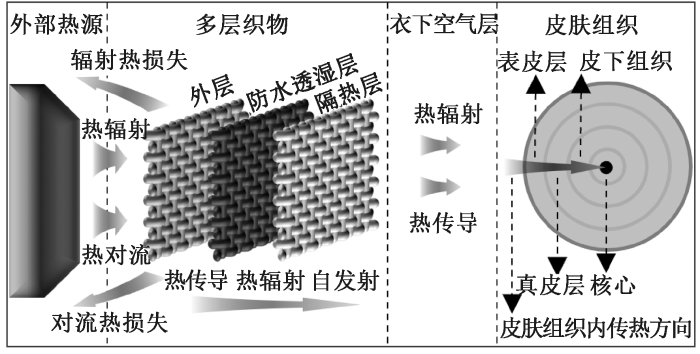
在数值模型的计算中,热源通常被简化为恒定的热通量或特定温度的100%辐射热源。对织物系统的建模从早期基于傅里叶定律的干态单层织物传热模型[30],发展到考虑多层织物层间热传导与热辐射的理论模型[31-32],再到集成水分蒸发、吸收、扩散乃至非线性润湿和剧烈相变的热湿耦合模型[33-34],其模拟的物理机制日益复杂。对衣下空气层的建模也从厚度固定的静态层假设[35],发展出用正弦函数描述匀速运动引发的空气层周期性变化[36-37],现已演进出能够反映消防员非匀速运动和姿态变化的传热模型[38]。对皮肤组织的损伤评估也从Pennes经典生物传热方程发展到更适用于模拟闪火等短时高热流场景的双相滞后生物传热模型[39]与考虑消防员年龄和身体部位生理差异的个体化模型[40]。但目前多数模型忽略了材料在高温下的热解炭化,即假设服装热物理性质为恒定值[41],这可能导致消防服热防护性能的预测结果偏高。
基于数值模型的计算流体动力学(CFD)方法补充了对复杂几何曲面和流体运动的模拟,通过热场云图、皮肤烧伤分布图等可视化手段直观呈现热防护效果[42],其人体和服装的几何模型从简化的同心圆柱体[43]发展到基于真实扫描数据、逆向工程与简化算法的三维人体着装模型[44],对于衣下空气层与服装合体性的模拟也逐渐完善[45]。现已应用于石化火炬[46]、油罐火灾[47]、强风火灾[48]等救援场景的仿真,通过对比火灾热流场与着装人体能承受的热流密度阈值,计算消防员的安全热暴露距离。此外,也有研究者利用激光雷达技术收集植被、火焰及地形的实时数据[49-50],采用内嵌三维火灾模型的专用软件工具[51]预测消防员的安全距离,但由于对火灾场景的简化,其预测准确度还有待验证。
2 数据驱动的性能预测
2.1 机器学习算法
图2
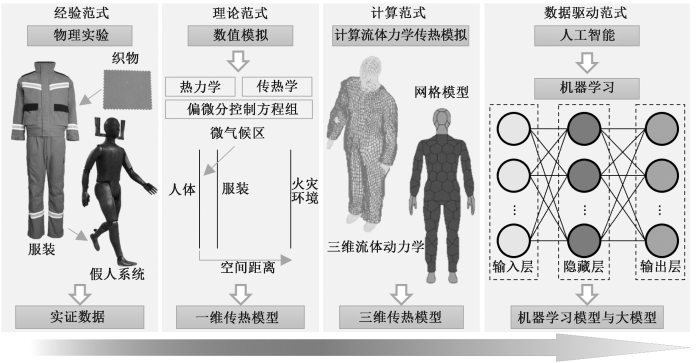
图2
消防服性能评估及优化设计的研究范式
Fig.2
Research paradigms for performance evaluation and optimization design of firefighter protective clothing
在机器学习算法中,将数据实例的属性称为“特征”,经筛选后的特征将作为机器学习模型的输入。早期研究如朱根娣等[54]探索了径向基函数在预测消防服热防护性能中的应用,但未考量织物特征。随后,Udayraja等[55]构建的人工神经网络模型则将单层热防护织物的性能作为关键输入特征。Mandal等[56]进一步将特征维度扩展至多层织物系统,并首次将汗液等人体热湿耦合作用相关因素加入输入特征。Rajput等[5]将与火灾环境下消防服系统热湿传递相关的物理参数扩充至23个,验证了高维多源特征对提升预测精度的有效性。如表1所示,当前研究所选的输入特征涵盖火灾环境参数、织物物理性能及人体生理指标三大维度。其中,织物厚度、密度、面密度、热阻、湿阻以及环境热流密度等输入特征受到普遍关注。输出响应主要为皮肤烧伤时间等消防服性能量化指标,但由于火灾环境中人体生理参数的获取具有极大的挑战性,此类高价值特征的使用仍相对匮乏。
表1 火灾环境消防服性能机器学习算法对比分析
Tab.1
| 文献 | 算法 | 输入特征 | 输出响应 | 模型效能 |
|---|---|---|---|---|
| [54] | 径向基函数神经网络 | 环境热流密度,热暴露时间;消防服TPP值 | 皮肤Ⅱ级烧伤时间 | RE<9.3% |
| [55] | 人工神经网络 | 环境热流密度;单层织物组成成分、 经纬密、厚度; 衣下空气层厚度 | 皮肤Ⅱ级烧伤时间 | RE<3.565 8%; σ<0.047 8 |
| [56] | 人工神经网络 | 环境热流密度;多层织物组成成分、 面密度、厚度、热阻、透气性、 湿阻、液体扩散速度 | 织物热防护性综合指标 | R2=0.99; RMSE=0.71 |
| 热生理舒适性综合指标 | R2=0.94; RMSE=1.53 | |||
| [57] | 多层感知机 神经网络 | 织物结构、线密度、经纬密、面密度、 厚度、极限氧指数、湿阻 | EN 367标准/ISO 6942 标准下升温12 ℃/ 24 ℃各自所需时间 | MAPE<6.87%; r>0.83 |
| [4] | 人工神经网络 | 织物组成成分、结构、经纬密、面密度、 厚度、透气性、热阻、湿阻、 湿润程度;是否存在衣下空气层 | 热传递性能指标 | r=0.54; RMSE=4.37 |
| 总热损失 | r=0.33; RMSE=293.03 | |||
| [5] | 人工神经网络 | 多层织物厚度、经纬密、导热系数、比热容; 固体纤维体积分数、回潮率、湿润程度、液体 扩散系数;衣下空气层厚度;基于上述物理参 数量纲分析得到17个无量纲参数 | 皮肤Ⅱ级烧伤时间 | RE<10%; RMS<0.001; R2=0.972 3 |
注:RE为相对误差;σ为预测误差分散度;R2为决定系数;RMSE为均方根误差;MAPE为平均绝对百分比误差;r为Pearson相关系数;RMS为均方误差。
2.2 数据集构建与特征工程
未来研究可将经实验验证的高保真数值模拟和CFD传热模拟共同作为数据增广手段,构建覆盖数据、文本、图像的多工况训练样本,扩充样本规模,为数据驱动模型提供更充分的泛化依据。
2.3 物理可解释性
2.4 模型效能
尽管当前模型预测与物理实验间还存在一定偏差,但现有研究中机器学习算法的整体性能已初步验证了该方法的可行性与先进性。为真正推动模型从实验室标准测试走向复杂火场环境应用,未来的研究需建立更严格的交叉验证与评估体系以更客观地评价模型的泛化性能。
3 数据驱动的智能逆向设计
传统消防服的设计依赖于物理实验的试错和调整以优化性能,随着数值模型和数据驱动模型的发展,研究者可以在虚拟环境中高效地对服装性能进行评估,属于织物系统热湿传递正问题的求解。在正问题的基础上,数据驱动的机器学习算法拓展出一种更加主动的消防服逆向设计方法,即:使用搜索算法,逆向获取满足特定防护性能要求的最优织物参数,这种纺织材料的智能逆向设计方法,在数学上被称为参数决定反问题[61]。
在中性热环境或低温环境下设计的反问题往往以满足特定热舒适性为指标[62],然而在火灾环境下,消防服很难完全满足人体的舒适性要求,同时,保证消防员的人身安全是救援任务中更为重要的目标。因此,火灾环境织物参数决定反问题通常被构建为在保证不发生二级皮肤烧伤的前提下,寻求最大化安全工作时间所对应的织物参数组合[63-64]。这既包括对于单个织物参数的最优值求解的单参数决定反问题[65],也包括寻求多个关键物理量最优组合的多参数同时决定反问题[66]。例如,在多层消防服的结构设计中,可以通过智能逆向算法,在限定总重量的前提下,精准计算出外层、防水透气层与隔热层三者之间的最优厚度配比;或者针对外层材料开发,逆向推导PBI与Kevlar等高性能纤维的最佳混纺比例,以实现热稳定性与力学强度的最佳平衡。对于单个热防护性能目标,可能存在多种解决方案,通过对多组候选方案进行排序与筛选,可应对一对多映射关系的非唯一性,并确定最优设计;也可能不存在解决方案[67],此时如果允许目标少量变化可能会大大提高模型的实用性,并允许找到可能的解决方案。
随着技术快速迭代,人工智能的应用形态不断拓展。大语言模型、AI智能体等高交互性的生成式技术亦开始在材料设计领域显现潜力。已有研究[68]将材料参数视为自然语言训练大模型,使其具有根据自然语义进行推理与逆向设计运算的能力。AI赋能的消防服性能预测与逆向设计方案可以参考软体机器人领域[69],从多模态信息融合、物理信息约束增强、实时响应策略3个方面开展。综合运用经验证的数值模拟技术,获取大样本仿真数据对模型进行预训练,利用高质量物理实验数据对模型进行微调,实现多模态信息的融合,使模型在实验室数据样本和实战演练数据样本上具备更好的表达;向机器学习算法模型引入描述热质传递的偏微分方程作为约束,确保模型能做出符合物理直觉的热防护性能预测和根据热防护目标输出满足需求的消防服具体物理参数;耦合生成式技术,构建火灾场景数字孪生系统与消防服智能设计平台,向着多模态融合与全流程智能化的方向深度演进。
4 结束语
消防服热防护性能的预测和设计方法正经历着从物理实验、数值模拟向数据驱动、智能化方向演进的过程。针对消防员实战演练数据采集风险大、成本高,物理实验难以完全复现复杂动态工况的问题,未来消防服智能设计可整合经验证的高保真数值模型或CFD传热数值模拟,生成多工况的虚拟训练数据,从根本上扩充数据集,为数据驱动模型提供物理信息约束。
现有消防服设计模式缺乏面向特定防护目标的全流程智能化的逆向设计能力。未来研究可构建由先验知识约束、数据驱动的个性化逆向设计平台。利用AI智能体理解自然语言描述的设计需求,自主调用仿真工具进行性能预测与方案迭代,高效探索能满足特定场景与个体需求的消防服设计方案,推动消防服设计范式从正向预测向全流程智能化逆向设计发展。
数据驱动模型在构建消防员数字孪生系统方面应用价值较高,但存在物理可解释性不足的风险。未来研究可通过构建由物理信息约束的消防员数字孪生系统,提升仿真模拟的可靠性,为消防服的研发提供高可信度的虚拟测试。结合VR/AR等沉浸式体验技术,也有望为消防员提供无风险的实战演练,持续推动消防服设计向更加精准、智能、实用的方向发展,为消防服的智能化研发与消防员安全保障体系的构建提供关键科学支撑。
参考文献
Protecting fire fighters exposed in room fires: comparison of results of bench scale test for thermal protection and conditions during room flashover
[J].DOI:10.1007/BF01039637 URL [本文引用: 1]
Fire fighting and its influence on the body
[J].Working conditions for fire fighters can be described according to the environment temperature and the incident radiant heat flux. Measurements for this study in buildings for fire fighting training have shown that fire fighters are typically exposed to radiant heat fluxes of between 5 and 10 kWm(-2) during this kind of exercise. The heat load can nevertheless be much higher. In one case, 42 kWm(-2) was measured. The temperatures reached between 100 and 190 degrees C at 1 m above ground, going up to 278 degrees C in one case. Human trials have been performed with 17 fire fighters. After exercises (about 15 min) in a heated room, the mean core temperature of the fire fighters rose by 0.6 degrees C with a surrounding temperature of 31 degrees C and 1.0 degrees C with 38 degrees C. The sweat production varied from 0.7 to 2.1 lh(-1); 16% to 45% of sweat remained in the clothing layers. During the exercises in the training buildings, a mean of 48 degrees C has been measured between fire fighters' clothing and workwear. These conditions lead to an increase of the relative humidity in all the jackets up to 100%. When the fire fighters came out of the fire, the humidity remained at this level in the PVC coated jackets while it was in some cases strongly reduced in breathable jackets.
国务院关于深入实施“人工智能+”行动的意见
[EB/OL].
Opinions of The State Council on Deepening the Implementation of the ″Artificial Intelligence Plus″ Action
[EB/OL].
Using artificial neural network modeling to analyze the thermal protective and thermo-physiological comfort performance of textile fabrics used in oilfield workers' clothing
[J].
DOI:10.3390/ijerph18136991
URL
[本文引用: 4]

Most of the fatalities and injuries of oilfield workers result from inadequate protection and comfort by their clothing under various work hazards and ambient environments. Both the thermal protective performance and thermo-physiological comfort performance of textile fabrics used in clothing significantly contribute to the mitigation of workers’ skin burns and heat-stress-related deaths. This study aimed to apply the ANN modeling approach to analyze clothing performance considering the wearers’ sweat moisture and the microclimate air gap that is generated in between their body and clothing. Firstly, thermal protective and thermo-physiological comfort performance of fire protective textiles used in oilfield workers’ clothing were characterized. Different fabric properties (e.g., thickness, weight, fabric count), thermal protective performance, and thermo-physiological comfort performance were measured. The key fabric property that affects thermal protective and thermo-physiological performance was identified as thickness by statistical analysis. The ANN modeling approach could be successfully implemented to analyze the performance of fabrics in order to predict the performance more conveniently based on the fabric properties. It is expected that the developed models could inform on-duty oilfield workers about protective and thermo-physiological comfort performance and provide them with occupational health and safety.
Performance prediction of flame-retardant clothing using correlations and artificial neural networks: optimizing firefighter safety
[J].DOI:10.1016/j.icheatmasstransfer.2024.108324 URL [本文引用: 5]
Modeling for predicting the thermal protective and thermo-physiological comfort performance of fabrics used in firefighters' clothing
[J].
DOI:10.1177/0040517518803779
URL
[本文引用: 1]
\n Standardized test methods are available for measuring the thermal protective as well as thermo-physiological comfort Performance of fabrics used in firefighters' clothing. However, these tests are usually fabric destructive in nature, time consuming, and/or expensive to carry out on a regular basis. Hence, the availability of empirical models could be useful for conveniently predicting the thermal protective and thermo-physiological comfort performances from the fabric properties. The aim of this study is to develop individual models for predicting thermal protective and thermo-physiological comfort performances of fabrics. For this, different single- and multi-layered fabrics that are commercially used to manufacture firefighters' protective clothing were selected, and the fundamental properties of these fabrics (weight, thickness, thermal resistance, air-permeability, evaporative resistance, and water spreading speed) were measured using the standard test methods developed by the International Organization for Standardization (ISO) or the American Association of Textile Chemists and Colorists. The thermal protective performance of these fabrics was measured by the ISO 9151:2016 test method under 80 kW/m\n 2\n flame exposure. The thermo-physiological comfort performance of fabrics was determined by the ISO 18640-1:2018 test method and a statistical model. Thereafter, the key fabric properties affecting the thermal protective and thermo-physiological comfort performances of fabrics were determined statistically. It has been found that thermal and evaporative resistances are the key fabric properties to affect the thermal protective performance, whereas the fabric weight, evaporative resistance, and water spreading speed are the key properties to affect the thermo-physiological comfort performance. By employing these key fabric properties, Multiple Linear Regression and Artificial Neural Network (ANN) models were developed for predicting the thermal protective and thermo-physiological comfort performances. Through a comparison of the predicting performance parameters of these models, it has been found that ANN models can more accurately predict the performances of fabrics. These models can be implemented in the textile industry and academia for effectively and conveniently predicting the thermal protective and thermo-physiological comfort performances only by utilizing the key fabric properties.\n
Paradigm shift in materials science driven by artificial intelligence: methods, platforms, and frontiers of applications
[J].
Characterization and modeling of thermal protective fabrics under Molotov cocktail exposure
[J].
Studies of thermal injury: I. the conduction of heat to and through skin and the temperatures attained therein. a theoretical and an experimental investigation
[J].
Development of a test device to characterize thermal protective performance of fabrics against hot steam and thermal radiation
[J].DOI:10.1088/0957-0233/27/12/125904 URL [本文引用: 1]
Developing a test device to analyze heat transfer through firefighter protective clothing
[J].DOI:10.1016/j.ijthermalsci.2018.12.031 URL [本文引用: 1]
Influences of moisture management performance and continuous sweat rate on heat transfer through firefighting clothing under radiant exposure
[J].DOI:10.1016/j.ijthermalsci.2023.108401 URL [本文引用: 1]
Developing a test device to analyze heat transfer combined with radiant exposure and continuous liquid sweating through thermal protective clothing
[J].
开放/封闭空气层对阻燃织物热防护性能的影响
[J].
DOI:10.13475/j.fzxb.20200303105
[本文引用: 1]
为探究衣下空气层间的传热方式对阻燃织物外观性能和阻燃织物系统传热机制的影响,基于热防护性能(TPP) 实验装置,构建开放式和封闭式空气层以模拟实际着装时“服装-人体皮肤”的空间关系。利用彩色图像处理方法对比热暴露前后的织物外观和热收缩情况,从能量传递、TPP值和二级烧伤时间角度评估“织物-空气层”系统的传热特性和热防护性能。结果表明:空气层的介入会降低热传递效率,进而提升阻燃织物的热防护性能,但会加速织物老化,加剧织物热收缩;当打开空气层与周围环境热量交换的通路时,空气层间热量的流动路径变复杂,且织物的热防护性能进一步提升。
Effect of open/closed air layer on thermal protective performance of flame-resistant fabrics
[J].
DOI:10.13475/j.fzxb.20200303105
[本文引用: 1]
To investigate the effects of heat transfer modes on appearance and thermal protective performance of thermal protective clothing with an air layer, the thermal protective performance (TPP) tester was established to simulate the actual spatial relationship between the human skin and garment with an open or closed air layer. Color image processing was used to evaluate the shrinkage of the fabrics before and after the heat exposure. The heat transfer and thermal protective performance of the “fabric-air layer” system were evaluated from the perspectives of energy transfer, TPP value and second degree burn time. Experimental results reveal that the presence of air layer decreases the heat transfer efficiency and improves the thermal protective performance of the flame-resistant fabrics. However, it also accelerates the aging and thermal shrinkage of the fabrics. When the heat exchange path between the air layer and the surrounding environment is opened, the fluid flow of heat within the air space becomes much sophisticated, and the thermal protective performance of fabric is further improved.
织物热防护性能测试方法比较
[J].
Comparisons among thermal protection performance test methods for fabrics
[J].
闪火中防护服装的形变及其影响因素
[J].防火服在火焰中的收缩形变会影响其热防护性能并制约人体的肢体运动。本文提出用捺印的方法,通过燃烧假人闪火燃烧试验研究防火服各部位形变量的分布规律,探究形变差异的原因及影响因素,对比分析服装形变与假人皮肤表面烧伤程度的关系。结果显示,燃烧试验后防火服在四肢和背部发生了显著收缩形变,热流量、衣下空气层等是主要影响因素。着装姿势越复杂、闪火持续时间越长,服装越宽松,服装面料的面密度越大,服装形变越显著。服装形变显著的对应部位衣下皮肤的烧伤也越严重。
Shrinkage of fire-fighting suit during flash fire exposure
[J].The shrinkage of fire protective clothing may affect its thermal performance and block body movement. In this paper, by using an instrumented mannequin, flame-test for complete garments is applied to simulate the fire situation. Seals marked on the garment are used to measure the shrinkage distribution of garments during flash fire exposure. The reasons for the shrinkage and its factors are studied. The relationship between shrinkage and the burn injury of manikin skin is preliminarily analyzed. Results show that the sleeves, trousers and the back of the clothing shrink significantly. The variation of the shrinkage results from the heat flux, air gap and other factors. The shrinkage extent is influenced by wearing posture, fire duration, construction size, and fabric density. As a whole, burn injury will be more serious where the shrink is more significant.
“火灾环境-防护服-人体” CFD传热模拟及皮肤烧伤分布预测
[J].
Simulating heat transfer from the fire environment to protective clothing and the human body using CFD and predicting skin burn distribution
[J].
Heat gain from thermal radiation through protective clothing with different insulation, reflectivity and vapour permeability
[J].The heat transferred through protective clothing under long wave radiation compared to a reference condition without radiant stress was determined in thermal manikin experiments. The influence of clothing insulation and reflectivity, and the interaction with wind and wet underclothing were considered. Garments with different outer materials and colours and additionally an aluminised reflective suit were combined with different number and types of dry and pre-wetted underwear layers. Under radiant stress, whole body heat loss decreased, i.e., heat gain occurred compared to the reference. This heat gain increased with radiation intensity, and decreased with air velocity and clothing insulation. Except for the reflective outer layer that showed only minimal heat gain over the whole range of radiation intensities, the influence of the outer garments' material and colour was small with dry clothing. Wetting the underclothing for simulating sweat accumulation, however, caused differing effects with higher heat gain in less permeable garments.
Determination of the thermal protective performance of clothing during bench-scale fire test and flame engulfment test: evidence from a new index
[J].DOI:10.1177/0734904115581620 URL [本文引用: 1]
Characterizing a firefighter's immediate thermal environment in live-fire training scenarios
[J].DOI:10.1007/s10694-015-0555-1 URL [本文引用: 1]
Design a safe firefighting time (SFT) for major fire disaster emergency response
[J].DOI:10.1016/j.ijdrr.2023.103606 URL [本文引用: 1]
Thermal Capacity of Fire Fighter Protective Clothing
[R].
Relationship between pain and tissue damage due to thermal radiation
[J].
The protective performance of process operators' protective clothing and exposure limits under low thermal radiation conditions
[J].DOI:10.3390/biology11081222 URL [本文引用: 1]
Responses of human perception and skin temperature to directed thermal radiation in hot environments
[J].DOI:10.1016/j.buildenv.2021.107857 URL [本文引用: 1]
A multi-segmented human bioheat model for asymmetric high temperature environments
[J].DOI:10.3390/ijerph192215259 URL [本文引用: 1]
Thermo-physiological impact of different firefighting protective clothing ensembles in a hot environment
[J].
DOI:10.1177/0040517516688629
URL
[本文引用: 1]
It is currently unclear how the assembly of different fabric layers of personal protective clothing (PPC) contributes to differences in thermal comfort among garments. Therefore, we used two different approaches to investigate the effect of PPC on body heat dissipation: a technical characterization of textiles (using sweating Torso methodology) and thermo-physiological wearing trials. We hypothesized that the technical characterization provides a similar outcome compared to the wearing trials and, thus, proves to have high thermo-physiological relevance.
Numerical simulations of heat and moisture transport in thermal protective clothing under flash fire conditions
[J].A numerical model of heat and moisture transport in thermal protective clothing during exposure to a flash fire was introduced. The model was developed with the assumption that textiles are treated as porous media. The numerical model predictions were compared with experimental data from different fabric systems and configurations. Additionally, with the introduction of a skin model, the parameters that affect the performance of thermal protective clothing were investigated.
Heat transfer model of flame resistant fabrics during cooling after exposure to fire
[J].DOI:10.1007/s10694-005-3733-8 URL [本文引用: 1]
An improved model to analyze radiative heat transfer in flame-resistant fabrics exposed to low-level radiation
[J].
DOI:10.1177/0040517516660892
URL
[本文引用: 1]
An improved heat transfer model, based on the two-flux model, in a multilayer flame-resistant fabric system with an air gap was proposed. The developed model considered the thermal radiation by absorbing, transmitting, emitting and reflecting in porous fabrics. The predicted results of the new model were compared with the previous Beer’s law model and the experimental results, and were found to be in good agreement with the experimental ones. The aim of this study is to investigate the mechanism of radiant heat transfer in the multilayer fabric system and the effects of the optical properties of flame-resistant fabric on heat transfer in the fabric system. The numerical results demonstrated that the self-emission in multilayer fabric system increases not only the rate of thermal energy transferred to human skin during thermal exposure, but also the rate of thermal energy transmitting to the ambience during cooling. The fabric’s optical properties have a complex influence on the transmitted and stored energy in multilayer protective clothing. The finding obtained in this study can provide references for the improvement of the thermal protective performance of flame-resistant fabrics.
Study of heat transfer through multilayer clothing assemblies: a theoretical prediction
[J].DOI:10.1515/aut-2011-110205 URL [本文引用: 1]
Sudden water exposure on geared firefighters may cause unexpected burns in post-fire periods
[J].DOI:10.1016/j.tsep.2024.102452 URL [本文引用: 1]
Modeling heat and moisture transport in firefighter protective clothing during flash fire exposure
[J].
Numerical study of the air gap between fire-protective clothing and the skin
[J].
DOI:10.1177/1528083713483784
URL
[本文引用: 1]
The analysis of the air gap between fire-protective clothing and the skin plays a crucial role in evaluating the protective performance of the clothing. However, the more accurate the analysis of the air gap, the more complex the air-gap model. This article introduces a novel air-gap model that stands halfway in terms of accuracy and complexity between other two models that already exist in the literature. A comparison between the performances of fire-protective clothing predicted by using the three air-gap models is discussed in this article. Different parameters that affect heat transfer within the air gap and hence the protective performance of the clothing were studied to assess the novel air-gap model compared with the other two models. Despite its simplicity, the novel air-gap model predicted the performance of fire-protective clothing as accurately as the most realistic model.
Influence of the fabric properties on the protective performance of flame resistant clothing during the body movement
[J].DOI:10.1007/s10694-018-0802-3 [本文引用: 1]
An extended model for analyzing the heat transfer in the skin-microenvironment-fabric system during firefighting
[J].
DOI:10.3390/ma16020487
URL
[本文引用: 1]
This study proposed an extended multi–layer heat transfer model to simulate skin burns of firefighters during firefighting. The proposed model takes into account the effect of fabric movement frequencies, fabric movement amplitudes and human body movement speeds on the heat transfer between the skin and the heat source under low–level radiative exposure. The simulation performance was validated against the simulations in the published literature in terms of the heat transfer in the multi–layer fabric system, skin temperature and skin burns. The results indicated that the fabric periodic movement caused by human body movement decreased the time to skin burns and the skin temperature increased with increasing fabric movement amplitude. During firefighting, the time to 2nd degree burn was 33.3–35.2% shorter at medium human body movement speed than at low and high movement speeds. Furthermore, at low movement speeds, the time to 2nd degree burn was negatively associated with fabric movement amplitude, whereas it was delayed by 12.9–29.8% at the fabric movement amplitude of 2.5 mm at medium and high human body movement speeds. This research provides foundational knowledge for the development of a new generation of firefighters’ protective clothing (FPC) and the assessment of skin burns in firefighters.
Prediction of safe zone for firefighters exposed to purely radiant heat source: a numerical analysis
[J].DOI:10.1016/j.ijthermalsci.2023.108302 URL [本文引用: 1]
Heat transfer analysis and second degree burn prediction in human skin exposed to flame and radiant heat using dual phase lag phenomenon
[J].DOI:10.1016/j.ijheatmasstransfer.2014.07.073 URL [本文引用: 1]
Investigating the protective performance of turnout gears for firefighters under diverse exposure conditions: effect of age and body segments
[J].DOI:10.1016/j.tsep.2024.102543 URL [本文引用: 1]
A three-dimensional conjugate heat transfer model for thermal protective clothing
[J].DOI:10.1016/j.ijthermalsci.2018.04.005 URL [本文引用: 1]
计算流体力学在服装传热性能评价中的应用
[J].
DOI:10.19398/j.att.202103026
[本文引用: 1]
为突破传统实验手段与一维数学模型的局限,一些研究者提出基于计算流体力学模拟人体-服装-环境系统的热量流动与传递过程,通过计算皮肤温度、传热系数等参数的方式评价服装的传热性能。文章概述了仿真方法解决服装传热问题的流程,揭示服装及人体几何模型建立、计算模型与边界条件设定的关键;从着装人体、服装结构、防护服装功能角度回顾了传热问题的国内外研究进展;总结了常用人体热生理模型的特征,介绍了热调节-CFD耦合系统在服装传热性能评价中的应用。现有模拟方法依然存在难以完全还原纺织材料、衣下空间分布、人体热反应等真实特性的问题,建议将动网格、用户自定义函数、数值模型耦合系统等作为深入研究方向,提高仿真评价的准确性。
Application of CFD in heat and flow transfer performance evaluation for clothing
[J].
DOI:10.19398/j.att.202103026
[本文引用: 1]
To break down the limitations of traditional experimental means and one-dimensional mathematical models, some researchers proposed to simulate the process of heat and flow transfer in human-clothing-environment system based on computational fluid dynamics. Through the calculation of skin temperature, heat transfer coefficient and other parameters, the heat transfer properties of clothing can be evaluated. This paper summarizes the procedure of simulation to solve clothing heat transfer issues, reveals key points on establishing geometries of clothing and human body, calculating models and setting boundary conditions; reviews the progress of heat transfer research at home and abroad from the perspectives of human body, clothing structure, and protective clothing functions; concludes the characteristics of common human thermal physiological models, and introduces how to construct thermal regulation-CFD coupling system in the evaluation. It is found that existing simulation methods are still difficult to completely restore the real characteristics of textile materials, clothing space distribution, and human thermal reaction. Finally, this paper proposes recommendations of conduct in-depth research on dynamic grids, user-defined functions, and numerical model coupling systems so as to enhance the accuracy of simulation evaluation.
Assessment of airflow and microclimate for the running wear jacket with slits using CFD simulation
[J].DOI:10.1186/s40691-014-0025-2 URL [本文引用: 1]
基于CFD的闪火环境中消防服传热机制模拟
[J].
Heat transfer mechanism of the firefighter's clothing exposed to the flash fire based on computational fluid dynamics
[J].
Heat transfer modeling within the microclimate between 3D human body and clothing: effects of ventilation openings and fire intensity
[J].
DOI:10.1108/IJCST-12-2019-0191
URL
[本文引用: 1]
The purpose of this study is to determine the effect of ventilation openings and fire intensity on heat transfer and fluid flow within the microclimate between 3D human body and clothing.
高架火炬事故状态火焰热辐射危险性分析
[J].
Flame heat radiation hazard analysis of elevated flare under accident condition
[J].
油罐火灾中消防员安全施救距离
[J].
Safe distance of fire fighters in oil tank fire extinguishing
[J].
强风条件下大型储罐火灾的热辐射灾害影响
[J].
Thermal radiation disasters with the large-sized oil tanks fire usually caused by the strong winds
[J].
Safe separation distance score: a new metric for evaluating wildland firefighter safety zones using lidar
[J].DOI:10.1080/13658816.2016.1270453 URL [本文引用: 1]
Identification of firefighter safety zones using lidar
[J].
DIMZAL: a software tool to compute acceptable safety distance
[J].DOI:10.4236/ojf.2017.71002 URL [本文引用: 1]
Predicting the mechanical strength of fire protective fabrics after thermal aging using machine learning
[J].
A novel protocol to characterize the thermal protective performance of fabrics in hot-water exposure
[J].
DOI:10.1177/1528083715580522
URL
[本文引用: 1]
This study aims to introduce a novel protocol to characterize the thermal protective performance of fabrics used in firefighters’ clothing under hot-water exposure. For this, new and improved test methods were developed to evaluate the performance of a set of fabrics under exposure to hot-water splash and hot-water immersion with compression. The thermal energy transmission through the fabrics tested was thoroughly investigated, and the physical properties that affect the performance of fabrics were statistically identified. It has been found that mainly mass (hot-water) transfer occurs through fabrics in a hot-water splash; whereas, both conductive heat and mass transfer predominate in a hot-water immersion with compression. The compression applied in the exposure of hot-water immersion changes the physical properties of fabrics, thereby reducing fabrics’ performance. The structural configuration and physical properties (e.g., air permeability, thickness) of fabrics are crucial to their heat and mass transfer and therefore to overall fabric performance. This study’s findings may contribute to developing new fabric testing standards, as well as improved thermal protective clothing to provide better occupational safety and health for firefighters.
基于人工神经网络的消防服热防护性能检测数据预测
[J].
Test data prediction of thermal protective performance of fire protective clothing based on artificial neural network
[J].
Development of correlations and artificial neural network models to predict second-degree burn time for thermal-protective fabrics
[J].
Modeling for predicting the thermal protective and thermo-physiological comfort performance of fabrics used in firefighters' clothing
[J].
DOI:10.1177/0040517518803779
URL
[本文引用: 4]
\n Standardized test methods are available for measuring the thermal protective as well as thermo-physiological comfort Performance of fabrics used in firefighters' clothing. However, these tests are usually fabric destructive in nature, time consuming, and/or expensive to carry out on a regular basis. Hence, the availability of empirical models could be useful for conveniently predicting the thermal protective and thermo-physiological comfort performances from the fabric properties. The aim of this study is to develop individual models for predicting thermal protective and thermo-physiological comfort performances of fabrics. For this, different single- and multi-layered fabrics that are commercially used to manufacture firefighters' protective clothing were selected, and the fundamental properties of these fabrics (weight, thickness, thermal resistance, air-permeability, evaporative resistance, and water spreading speed) were measured using the standard test methods developed by the International Organization for Standardization (ISO) or the American Association of Textile Chemists and Colorists. The thermal protective performance of these fabrics was measured by the ISO 9151:2016 test method under 80 kW/m\n 2\n flame exposure. The thermo-physiological comfort performance of fabrics was determined by the ISO 18640-1:2018 test method and a statistical model. Thereafter, the key fabric properties affecting the thermal protective and thermo-physiological comfort performances of fabrics were determined statistically. It has been found that thermal and evaporative resistances are the key fabric properties to affect the thermal protective performance, whereas the fabric weight, evaporative resistance, and water spreading speed are the key properties to affect the thermo-physiological comfort performance. By employing these key fabric properties, Multiple Linear Regression and Artificial Neural Network (ANN) models were developed for predicting the thermal protective and thermo-physiological comfort performances. Through a comparison of the predicting performance parameters of these models, it has been found that ANN models can more accurately predict the performances of fabrics. These models can be implemented in the textile industry and academia for effectively and conveniently predicting the thermal protective and thermo-physiological comfort performances only by utilizing the key fabric properties.\n
Neural network based thermal protective performance predictionof three-layered fabrics for firefighter clothing
[J].DOI:10.35530/IT URL [本文引用: 2]
On physically similar systems; illustrations of the use of dimensional equations
[J].DOI:10.1103/PhysRev.4.345 URL [本文引用: 1]
Random forest based thermal comfort prediction from gender-specific physiological parameters using wearable sensing technology
[J].DOI:10.1016/j.enbuild.2018.02.035 URL [本文引用: 1]
Personal comfort models: predicting individuals' thermal preference using occupant heating and cooling behavior and machine learning
[J].DOI:10.1016/j.buildenv.2017.12.011 URL [本文引用: 2]
纺织材料设计反问题的贝叶斯统计推断方法
[J].
Bayesian statistical inference method for inverse problems of textile material design
[J].
低温环境下纺织材料类型设计反问题
[J].本文提出了基于热湿传递稳态模型的低温环境下纺织材料类型设计反问题,即根据人体所处环境温度-湿度值,依据人体服装舒适性指标,已知材料微观结构与厚度,决定材料的类型。根据正则化思想将类型设计反问题的求解归结为一个函数极小化问题。利用非线性常微分方程的正演算法与函数极小化问题的一维Hooke-Jeeves搜索,构造了反问题正则化解的迭代算法。数值模拟验证了算法的有效性和反问题提法的合理性。
Inverse problem of textile material design at low temperature
[J].Based on the model of steady-state heat and moisture transfer through textiles, we put forward an inverse problem of type design for textile materials under low temperature, that is to say, according to the environment’s temperature and humidity people live in and the comfort index of clothing, given the textile microcosmic structure and thickness of the material, we determine the type of the material. According to the idea of regularization method, the inverse problem of type design can be formulated into a function minimization problem. Combining the finite difference algorithm for nonlinear ordinary differential equation with direct search method of one-dimensional minimization problems, we construct an iterative algorithm for the regularized solution of the inverse problem. Numerical Simulation shows the effectiveness of the algorithm.
基于蒙特卡罗算法的高温作业防护服优化设计
[J].
Optimal design of high-temperature operation protective clothing based on Monte Carlo algorithm
[J].
Crystal structure generation with autoregressive large language modeling
[J].
DOI:10.1038/s41467-024-54639-7
[本文引用: 1]
The generation of plausible crystal structures is often the first step in predicting the structure and properties of a material from its chemical composition. However, most current methods for crystal structure prediction are computationally expensive, slowing the pace of innovation. Seeding structure prediction algorithms with quality generated candidates can overcome a major bottleneck. Here, we introduce CrystaLLM, a methodology for the versatile generation of crystal structures, based on the autoregressive large language modeling (LLM) of the Crystallographic Information File (CIF) format. Trained on millions of CIF files, CrystaLLM focuses on modeling crystal structures through text. CrystaLLM can produce plausible crystal structures for a wide range of inorganic compounds unseen in training, as demonstrated by ab initio simulations. Our approach challenges conventional representations of crystals, and demonstrates the potential of LLMs for learning effective models of crystal chemistry, which will lead to accelerated discovery and innovation in materials science.

 京公网安备11010502044800号


