



摩擦电纺织品(Tex-TENG)依据摩擦电-静电耦合机制,能够将人体日常运动(如脉搏、呼吸、关节屈伸、嗓音振动等)产生的机械能转化为电能,并可同步输出与生理状态高度相关的电信号,实现能量供应和信号采集的一体化[7-8]。与传统可穿戴设备相比,Tex-TENG将机械能直接转化为电能,具有自驱动传感的优势,无需外部电源或定期充电,理论寿命仅取决于材料疲劳寿命,在反复接触循环及多次洗涤后仍能保持良好的输出性能,具有较好的耐久性[9-10]。Tex-TENG具有良好的柔韧性,能够集成到衣物或配件中,且与传统电池相比其质量轻、体积小,提高了穿戴的舒适性[11]。此外,Tex-TENG对机械刺激响应灵敏,能够快速响应微小的形变或运动,高效收集人体运动产生的机械能,并能准确监测人体生理信号,适应多种应用场景[12-13]。现有纺织技术如静电纺丝[14]、湿法纺丝[15]、包覆纺纱[16]和无缝针织[17]等均可应用于制备Tex-TENG,且制备工艺成熟,具有从实验室样品到产业化的放大潜力[18]。
1 基础原理与材料-结构体系
1.1 摩擦电-静电感应耦合机制
摩擦电-静电感应耦合机制是TENG的核心工作原理[24]。当2种不同材料的表面相互接触时,由于材料对电子的束缚能力不同,电子会在2种材料间发生转移。摩擦电负性强的材料表面会携带负电荷,而另一材料表面则携带等量的正电荷。当摩擦电层发生相对运动(如分离或滑动)时,带电的摩擦层在其附近的导电电极上感应出相反极性的电荷。这种感应电荷在电极间形成电势差,驱动电子在外部电路中流动,从而产生电流[25-26]。基于电子云相互作用的势阱模型解释了微观层面的摩擦带电现象,如图1(a)所示。在2种介电材料接触前,由于势阱的捕获作用,电子不会发生转移;当2种材料接触时,电子云发生重叠,电子就有可能从一种材料跃迁到另一种材料;分离后,转移的部分电子在表面势垒的作用下被保留下来[27-28]。
图1
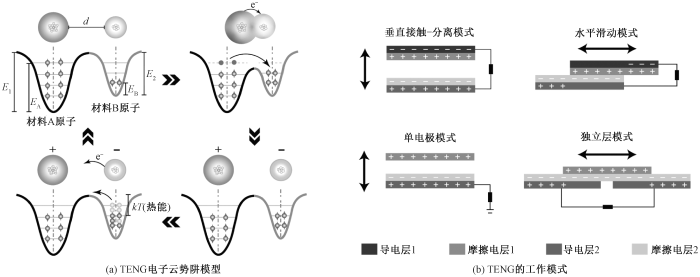
图1
TENG的电子云势阱模型及其4种工作模式
Fig.1
Electron-cloud-potential-well model (a) and four working modes (b) of TENG
1.2 材料-结构设计
Tex-TENG的核心结构设计围绕材料选择、多级结构构建和可穿戴集成展开。在摩擦电材料方面,根据接触起电序列理论,当2种摩擦电材料在摩擦电序列中的位置相距越远时,界面电荷转移量越大,输出性能显著增强[31-32],据此可将摩擦电材料分为摩擦正电性材料和摩擦负电性材料,正负极性材料的优化配对则是关键,即是摩擦正电性材料(如锦纶、纤维素、壳聚糖)与负电性材料(如聚四氟乙烯、聚偏氟乙烯、天然橡胶)依据接触起电序列形成高效电荷转移对。此外,研究人员还通过材料改性策略提升织物表面电荷密度和结构耐久性,例如MXene掺杂热塑性聚氨酯(TPU)[33]、云母填料增强TPU[34]、离子注入改性[35]等。同时,还使用生物相容性材料制备Tex-TENG拓展其在医疗健康领域的应用[36]。
图2
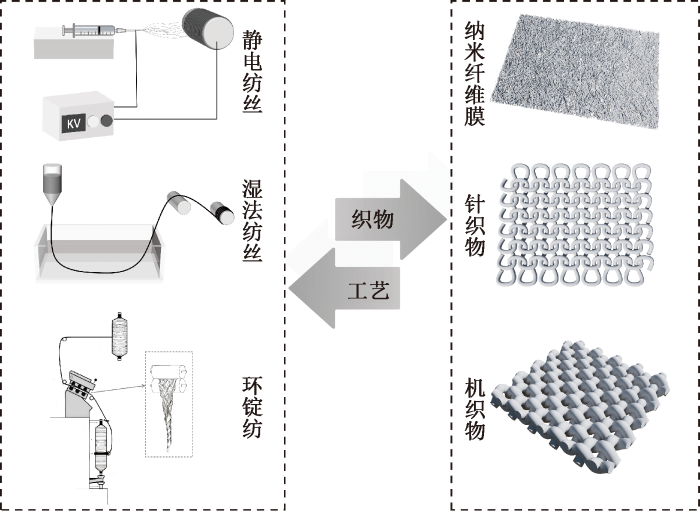
表1示出制备工艺对Tex-TENG性能的影响及织物舒适性与国标对比结果。Wang等[45]通过摩擦纺与浸涂法制备同轴结构摩擦电纱线PPSN,其针织面料输出93 V电压,可驱动44个发光二极管(LED),且具有2 630.78 mm/s的透气率和1 900 g/(m2·24 h)的透湿率、耐磨可洗。Li等[46]采用三维编织技术制得双电极3D-FTENG,交叉结构功率密度达200.93 mW/m2,经50 000次循环和20次洗涤性能稳定。湿法纺丝工艺侧重通过优化纱线结构提升综合性能。Ning等[15]通过一步同轴湿纺法规模化制备液态金属/聚氨酯(LM/PU)芯鞘结构摩擦电纤维,直径仅0.18 mm,拉伸率达232%,通过数字刺绣和平纹编织实现大面积集成,所制得的T-TENG透气率达1 290 mm/s,且在5次洗涤后电输出不变,经100 000次循环输出稳定。在集成策略上,研究者们多将摩擦层与储能单元结合形成自充电系统[53],结合机器学习算法实现运动姿态识别或健康预警,最终在物联网框架下构建以人体为中心的自驱动能量-信息闭环系统。
表1 制备工艺对Tex-TENG性能的影响及织物舒适性与国标对比结果
Tab.1
| 文献 编号 | 研究采用工艺 | 电学性能 | 织物舒适性 | 与国标对比 | 织物舒适性国标 |
|---|---|---|---|---|---|
| [15] | 湿法纺丝、数字刺绣、平纹编织 | 经100 000次循环输出稳定;5次洗涤后电输出不变 | 透气率1 290 mm/s | 具有远超标准的透气性 | 透气率≥180 mm/s, GB/T 21295—2007 《服装理化性能的技术要求》 4.14条[50]; 透湿率 ≥2 200 g/(m2·24 h), GB/T 21295—2024 《服装理化性能的 技术要求》 5.2条[51] |
| [45] | 同轴摩擦纺纱、连续浸涂、针织 | 5 cm×5 cm PPSN针织物:4 Hz、40 N下开路电压93 V,短路电流0.45 μA,9 GΩ负载下功率密度69.61 mW/m2;15 000次按压循环性能无衰减,10次水洗后性能保留80% | 透气率2 630.78 mm/s;透湿率1 900 g/(m2·24 h);接触角142°疏水 | 具有远超标准的透气性;基本符合标准的透湿性 | |
| [47] | 共轭静电纺、环丝纺、针织 | 高电压输出:3.5 cm内17.5 V;耐磨性:4 500次磨损周期;2.5 cm×2.5 cm针织物可点亮22个LED | 透气率147.3 mm/s; 透湿率3 470 g/(m2·24 h) | 具有远超标准的透湿率 | |
| [48] | 静电纺丝 | 旋转速度调节表面电位(35~110 V) | 透气率100 mm/s;透光性>60% | 基本符合标准的透气性 | |
| [49] | 核壳纱线、机织 | 10 000次工作循环后电荷保持率基本不变;机洗20次后结构与性能基本保持不变 | 透气率621 mm/s; 透湿率211 g/(m2·h) | 具有远超标准的透气性 | |
| [50] | 核壳结构纱线、摩擦纺纱 | 1 000次弯曲/扭曲后导电性能稳定;经过2 400次接触分离和20次洗涤后输出电压基本不变 | 透气率387.37 mm/s;30次机洗后抗冲击、电磁屏蔽性能无显著衰减 | 具有远超标准的透气性 |
2 在生命健康领域的关键应用
图3
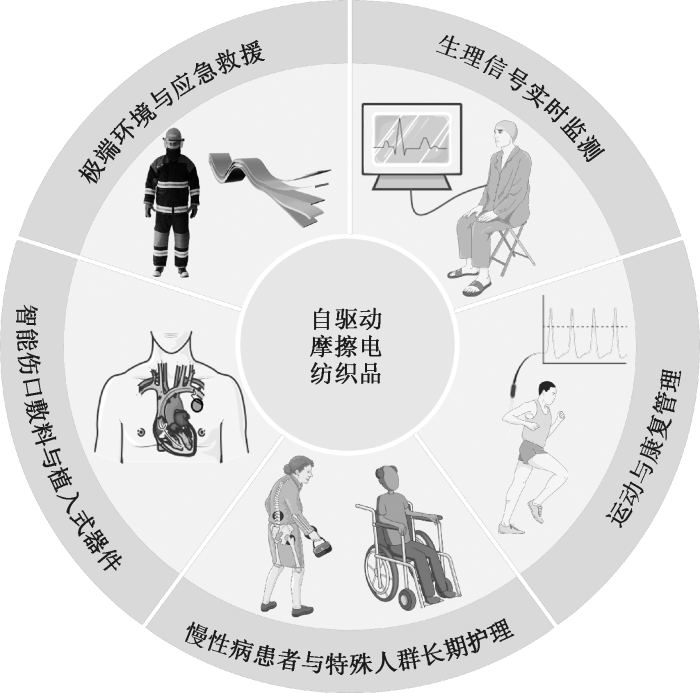
图3
Tex-TENG在医疗健康领域的应用
Fig.3
Tex-TENG applications in medical and healthcare fields
2.1 生理信号实时监测
在临床诊断中,对心率、脉搏和血压等生理信号实现实时连续监测对于相关疾病的预防和诊断至关重要。Tex-TENG能够通过摩擦电效应将人体的机械运动转换为电信号,从而实现对生理信号的实时监测。Sohel等[55]将氧化钼(α-MoO3)和金属有机框架(MOF-525)复合到硅橡胶中制备了纳米复合材料(silicone/α-MoO3/MOF-525),作为负摩擦电材料层与导电织物结合得到了具有高灵敏度、功率密度和超高拉伸性的TENG。基于该TENG器件开发的自供电可穿戴生物运动传感器,能够用于呼吸和脉搏监测,并可通过手机应用实时监测生理信号,为生物医学应用提供关键数据。基于纳米纤维膜本身的物理拦截和静电吸附特性,Yi等[56]利用锦纶66/甲壳散季铵盐(PA66/H)多尺度纳米纤维膜(正摩擦层)和PVDF-HFP纳米纤维膜(负摩擦层)组成能够同时实现过滤空气和呼吸监测的TENG口罩。基于物理拦截和静电吸附的协同效应显著提升了纤维膜捕获空气污染物的能力,使TENG口罩在PM0.3过滤效率上超过99%,同时当使用者佩戴TENG口罩时,呼吸运动(呼气和吸气)驱动纤维膜周期性接触和分离,TENG口罩通过捕捉人体呼吸信号并将其转换为电信号,实现实时健康监测。此外,TENG口罩将呼吸运动的机械能转化为电能,实现自供能,无需外部电源即可稳定运行。Tex-TENG在生理信号实时监测中的应用具有显著优势和重要意义,其自供能特性消除了对外部电源的依赖,提高了设备的便携性。Kang等[57]通过改变玻璃纤维增强的乙烯基-硫醇功能化硅氧烷混合材料(GFR-VTHs)中的苯基含量来调控极性,然后以金涂层的GFR-VTH薄膜作为摩擦电组件、氧化铟锡(ITO)涂层的柔性PET作为对电极组件,组装成TENG。在体温监测系统中,通过周期性按压TENG产生交流电。交流电经过整流器转换为直流电,为电容器充电。当电容器电压达到3 V时,即可为体温计供电,实现体温的实时监测。TENG织物的高灵敏度和长期稳定性使其能够准确检测心率、血压等关键生理信号,为疾病早期诊断和长期健康管理提供了有力支持。
2.2 运动与康复管理
Tex-TENG的柔韧性和可穿戴性使其能够集成到日常服装中,实时监测运动时的生理信号,为运动员或康复者提供详细准确的运动数据,同时能将人体运动的机械能转化为电能,实现自供能,为运动监测设备、康复辅助器具等提供稳定持久的能源支持。Chen等[58]利用超疏水细菌纤维素纤维制备了一种织物基TENG(SF-TENG),并将SF-TENG编织进运动裤中用于检测运动信号,构建了运动健康监测系统。这种运动健康监测系统能够准确检测不同运动状态下的运动信号,并在复杂环境下能够保持稳定性能。Parashar等[59]报道了一种机器学习驱动的摩擦电自供能鞋垫系统,用于步态辅助的运动康复闭环管理。以锦纶66纳米纤维和水滴状微结构聚四氟乙烯(PTFE)构建接触-分离式TENG传感器阵列,并将4枚传感器嵌入鞋垫,实现足底压力与步态相位的监测。这种鞋垫将摩擦电织物、人工智能(AI)与个体化康复方案结合,为低负荷、无电池的运动康复评估与训练反馈提供了新方法。Wang等[60]设计了一种多层纳米纱线摩擦纳米发电机(MNY-TENG)。MNY-TENG可贴附于人体不同部位,监测人体不同部位的细微运动变化,并可集成到羽毛球拍中监测击球动作并识别不同击球方式。此外,MNY-TENG被集成到智能穿戴臂带中,结合Brunnstrom运动恢复阶段方法,通过机器学习模型准确识别6种康复动作,为偏瘫患者康复训练提供辅助与反馈。这些案例为TENG在可穿戴电子设备、运动监测以及康复工程领域的应用提供了新的设计思路和实践案例,推动了智能纺织品与康复技术的融合发展。
2.3 慢性病与特殊人群长期护理
面对人口老龄化加速与慢性病患者年轻化的趋势,长期、有效的健康监测与管理需求激增,尤其对慢病患者及特殊照护人群(如高龄、失能者)至关重要。传统监测手段往往难以满足其长期、舒适、动态的健康数据捕捉需求。开发能够无缝融入日常、提供持续生理信息的新型监测技术,是实现主动健康管理与提升生命质量的重要突破口。目前,研究人员通过开发Tex-TENG实现对慢性病患者[61]和特殊人群的新型监测[62]。例如,Wang等[63]开发了基于纳米纤维同轴纱线(NCY)的高性能摩擦电纳米发电机纺织品,其通过制备导电黏合剂增强的PVDF/PA66双材料NCY,显著提升了纺织品的灵敏度与稳定性;在可穿戴医疗监测领域的应用,特别是利用高灵敏度平纹织物制成智能鞋垫,实现对糖尿病足患者步态的实时监测;同时,该技术可灵活制成绞纱、编织纱和罗纹织物,应用于吞咽、手指弯曲、肘部活动等多种关节运动的追踪。Shen等[64]开发了可大规模生产的仿生毛绒针织摩擦电织物(SJPF-TENG),利用成熟纬编技术批量制备了具有高密度的毛绒织物,显著提升了输出功率(峰值密度达1.4 W/m2),在智能家居与健康监护应用方面,集成该织物的智能地毯和3像素×3像素键盘阵列,实现了通过触摸或滑动控制家电开关;智能字母书写板可识别手指轨迹;柔性轮椅方向控制器则为老年人提供了便捷操控;此外,该织物还能点亮1 392个LED并为微型电子设备供电,展示了其在舒适可穿戴设备及智能家居系统中的广泛应用潜力。
2.4 智能伤口敷料与植入式器件
伤口愈合状态的精准监测与植入式器件的长期可靠供能,是临床护理与健康管理的核心挑战。传统方法难以实时、无创评估感染风险或组织修复进程,而植入设备的电池寿命更制约其持续监测与治疗能力。智能伤口敷料与自供能植入器件的出现,为解决这些难题、实现主动式健康干预提供了变革性契机。Ouyang等[65]开发了一种基于ZIF-8摩擦纳米发电机(TENG)的智能绷带系统,通过将载药沸石咪唑酯骨架(ZIF-8/GS)与静电纺聚己内酯(PCL)纤维结合作为TENG摩擦层,其核心应用是利用药物释放过程中TENG电信号的变化,实时监测绷带内残留药物浓度,并通过红黄绿三色指示灯直观显示药物状态,该系统能指导医护人员精准更换绷带,减少频繁操作导致的二次损伤、交叉感染和药物浪费,显著促进慢性伤口愈合。Jeong等[66]开发了基于植入式摩擦纳米发电机的共生心脏起搏器(SPM),通过采集心脏跳动的机械能,即单次心跳产能0.495 μJ能量驱动起搏单元,成功在大型动物(猪)体内实现完全自供能的心脏起搏与窦性心律失常实时纠正,输出能量为0.377 μJ,超过人类起搏阈值,并通过无线被动触发机制控制电脉冲释放3 V/(0.5 ms),该技术避免了电池更换手术,为永久性植入式医疗电子设备提供了自供能解决方案。融合摩擦电自驱动技术的智能伤口系统与植入器件[67],有望突破能源束缚,实现无感化、长期化的生理信号采集与闭环治疗,显著提升护理效能与患者体验。
2.5 极端环境与应急救援
地震、火灾、极地科考等极端环境及突发事件中,救援者与受困者面临多重威胁。如何在通信中断、补给困难的极端场景下,进行快速响应与精准施救的应急救援活动尤为重要。对救援人员生理状态的实时监控及受困者关键信息的无源获取,是保障救援力量、提升生还率的关键。摩擦电自驱动技术为解决设备在严苛条件下的持续工作难题,实现自主化、智能化的生命信息感知提供了突破方向。Liu等[68]通过静电纺丝构筑了基于芳纶纳米纤维(PMIA)和碳纳米纤维(CNF)的复合摩擦纳米发电机(PMIA/CNF-TENG),其兼具超高温/强酸强碱耐受性和无重金属特性,可实时感知高风险环境:在火场中肘部弯曲电压可提升136.7%,手写输入信号增强900%,以识别高温;在接触不同液体时输出电压遵循NaOH > HNO3 > H2SO4 > H2O的规律,实现化学品溅射预警;再结合无线传输系统,发现其在消防服和化工防护装备中具有自供能运动监测与即时风险感知的应用潜力。Li等[69]开发了具有双网络结构的二氧化硅/芳纶纳米纤维(ANF)复合气凝胶纤维,结合了ANF的优异力学性能和二氧化硅气凝胶的高比表面积与卓越阻燃性,实现了3.4 MPa的高断裂强度、0.033 W/(m·K)的超低导热系数,具有95%孔隙率以及在-196 ℃至高于1 100 ℃的极端环境下的结构稳定性。其作为摩擦纳米发电机的阻燃柔性摩擦层,燃烧5 s后仍能保持94%以上的发电性能,可用于消防服等极端环境防护装备,显著提升了自供能可穿戴设备在火灾中的安全性与可靠性。
3 结束语
现代医疗对人体健康的精准、实时且长期监测需求迫切,人们也期待通过便携舒适的可穿戴设备实现健康监测,摩擦电纺织品(Tex-TENG)由此应运而生。该技术基于摩擦电-静电感应耦合机制,将人体运动机械能转化为电能,可自驱动并实时动态监测生命体征,为疾病早诊早治提供依据,是健康医疗领域极具潜力的创新手段。Tex-TENG自供电特性摆脱了传统电池束缚,良好的柔韧性与可拉伸性既提升穿着舒适度,又能精准捕捉微弱生理信号。其性能则依托材料-结构协同设计。选材改性可提升电荷密度与耐久性,多级结构设计能增加材料接触面积、提高电荷转移量。同时,Tex-TENG在健康监测领域应用潜力广泛,可监测心率、呼吸等生理信号以支撑个性化医疗,还能集成于日常服装为运动员、康复者提供运动监测数据,也可应用于糖尿病足慢病管理、伤口智能护理等场景,甚至能为心脏起搏器等植入式医疗设备自供能,此外在极端环境和应急救援中,也能为使用者提供自供能应急电源与风险感知支持。
当前Tex-TENG虽已实现健康监测、预警与康复等功能,却仍面临诸多技术挑战:器件在复杂生理环境中易性能衰减,材料的生物相容性、可降解性等性能待优化,且高输出性与柔性、透气性等特性存在矛盾;纱线/织物结构易出现层间剥离、电荷泄漏等问题,大规模生产一致性差;器件供电特性与生物传感器需求失配,电源管理体系亟待完善。针对这些问题,研究者从多维度提出解决策略:如材料上掺杂MXene、石墨烯等兼顾多方面性能,结构上构建特殊结构或依托数字编织/打印实现均匀生产,集成系统上将织物与微型储能、无线模块等共形集成,并嵌入人工智能(AI)算法处理生理信号。另外,Tex-TENG虽已从实验室走向工厂规模化生产,但还面临着产业化落地和标准化建设的关键瓶颈:在产业化方面,生产稳定性、效率及相关材料成本进一步制约其市场化;在标准化方面,其缺乏完整评价框架,电学输出性能超出现有柔性传感器标准范围,且测试无统一规范,产品质量评判难以统一。为此,未来研究需推进材料-工艺-设备协同优化,同时建立专属行业标准,推动其从实验室成果走向市场化。综上,Tex-TENG在健康医疗领域潜力巨大,可通过长期收集生理数据助力个性化健康管理,其监测与传输功能能优化远程医疗资源分配,还可与电刺激疗法等结合丰富临床方案,有望重塑医疗健康监测与治疗格局,提升全民健康水平。
参考文献
Principles, applications, and challenges of E-skin: a mini-review
[J].DOI:10.1016/j.cej.2025.166936 URL [本文引用: 1]
Wearable ultrasound technology in health monitoring and therapy: technological innovations, differentiated applications, and future directions
[J].
DOI:10.1021/acssensors.5c01767
PMID:40762041
[本文引用: 1]

Ultrasound technology plays a pivotal role in health monitoring and management by virtue of its noninvasiveness, real-time imaging capability, and deep tissue penetration. As the frontier in ultrasound imaging and therapeutic applications, wearable ultrasound overcomes the limitations of conventional ultrasound devices, which are bulky and require operation by a professional. These advantages broaden its potential for use in mobile health monitoring and personalized therapy. This Perspective systematically summarizes the latest developments in wearable ultrasound devices, with a particular focus on technological innovations in different ultrasound transducer materials and other designs related to miniaturization and flexibility. We provide a comprehensive overview of their diverse roles in both diagnosis and therapy, including multimodal tissue imaging, targeted drug delivery, wound healing, and neuromodulation. Furthermore, the synergistic benefits of ultrasound-based communication and energy supply are explored, which improve physiological monitoring and therapeutic efficacy. We identify the key technical challenges and potential solutions to them through an in-depth comparison of the working mechanism and performance of ultrasound technology in different applications. Finally, we offer a perspective on future directions of research on wearable ultrasound technology along the dimensions of safety, clinical reliability, portability, multifunctionality, and efficiency.
Electrotherapy and health monitoring with piezoelectric and triboelectric technologies
[J].DOI:10.1016/j.biomaterials.2025.123425 URL [本文引用: 1]
Advances in health rehabilitation devices based on triboelectric nanogenerators
[J].DOI:10.1016/j.nanoen.2023.108787 URL [本文引用: 1]
All-printed chip-less wearable neuromorphic system for multimodal physicochemical health monitoring
[J].DOI:10.1038/s41467-025-60854-7 [本文引用: 1]
自供电可穿戴智能纺织品研究进展
[J].
Research progress of self-powered smart wearable textiles
[J].
Efficient energy harvesting using triboelectric nanogenerators (TENGs): integration with technologies, wearable applications, and future trends
[J].DOI:10.1016/j.rser.2025.115662 URL [本文引用: 1]
TENG-boosted smart sports with energy autonomy and digital intelligence
[J].
DOI:10.1007/s40820-025-01778-1
PMID:40397052
[本文引用: 1]
Technological advancements have profoundly transformed the sports domain, ushering it into the digital era. Services leveraging big data in intelligent sports-encompassing performance analytics, training statistical evaluations and metrics-have become indispensable. These tools are vital in aiding athletes with their daily training regimens and in devising sophisticated competition strategies, proving crucial in the pursuit of victory. Despite their potential, wearable electronic devices used for motion monitoring are subject to several limitations, including prohibitive cost, extensive energy usage, incompatibility with individual spatial structures, and flawed data analysis methodologies. Triboelectric nanogenerators (TENGs) have become instrumental in the development of self-powered devices/systems owing to their remarkable capacity to harnessing ambient high-entropy energy from the environment. This paper provides a thorough review of the advancements and emerging trends in TENG-based intelligent sports, focusing on physiological data monitoring, sports training performance, event refereeing assistance, and sports injury prevention and rehabilitation. Excluding the potential influence of sports psychological factors, this review provides a detailed discourse on present challenges and prospects for boosting smart sports with energy autonomy and digital intelligence. This study presents innovative insights and motivations for propelling the evolution of intelligent sports toward a more sustainable and efficient future for humanity.© 2025. The Author(s).
MXene supported by cotton fabric as electrode layer of triboelectric nanogenerators for flexible sensors
[J].DOI:10.1016/j.nanoen.2022.107973 URL [本文引用: 1]
Naturally crosslinked biocompatible carbonaceous liquid metal aqueous ink printing wearable electronics for multi-sensing and energy harvesting
[J].
DOI:10.1007/s40820-024-01362-z
PMID:38466478
[本文引用: 1]
Achieving flexible electronics with comfort and durability comparable to traditional textiles is one of the ultimate pursuits of smart wearables. Ink printing is desirable for e-textile development using a simple and inexpensive process. However, fabricating high-performance atop textiles with good dispersity, stability, biocompatibility, and wearability for high-resolution, large-scale manufacturing, and practical applications has remained challenging. Here, water-based multi-walled carbon nanotubes (MWCNTs)-decorated liquid metal (LM) inks are proposed with carbonaceous gallium-indium micro-nanostructure. With the assistance of biopolymers, the sodium alginate-encapsulated LM droplets contain high carboxyl groups which non-covalently crosslink with silk sericin-mediated MWCNTs. E-textile can be prepared subsequently via printing technique and natural waterproof triboelectric coating, enabling good flexibility, hydrophilicity, breathability, wearability, biocompatibility, conductivity, stability, and excellent versatility, without any artificial chemicals. The obtained e-textile can be used in various applications with designable patterns and circuits. Multi-sensing applications of recognizing complex human motions, breathing, phonation, and pressure distribution are demonstrated with repeatable and reliable signals. Self-powered and energy-harvesting capabilities are also presented by driving electronic devices and lighting LEDs. As proof of concept, this work provides new opportunities in a scalable and sustainable way to develop novel wearable electronics and smart clothing for future commercial applications.© 2024. The Author(s).
Enhancing fabric TENG performance through optimized compression mechanics in smart IoT carpets, for energy harvesting and movement sensing
[J].DOI:10.1016/j.nanoen.2024.110568 URL [本文引用: 1]
Recent progress of electrospun nanofiber-based composite materials for monitoring physical, physiological, and body fluid signals
[J].
DOI:10.1007/s40820-025-01804-2
PMID:40531267
[本文引用: 1]
Flexible electronic skin (E-skin) sensors offer innovative solutions for detecting human body signals, enabling human-machine interactions and advancing the development of intelligent robotics. Electrospun nanofibers are particularly well-suited for E-skin applications due to their exceptional mechanical properties, tunable breathability, and lightweight nature. Nanofiber-based composite materials consist of three-dimensional structures that integrate one-dimensional polymer nanofibers with other functional materials, enabling efficient signal conversion and positioning them as an ideal platform for next-generation intelligent electronics. Here, this review begins with an overview of electrospinning technology, including far-field electrospinning, near-field electrospinning, and melt electrospinning. It also discusses the diverse morphologies of electrospun nanofibers, such as core-shell, porous, hollow, bead, Janus, and ribbon structure, as well as strategies for incorporating functional materials to enhance nanofiber performance. Following this, the article provides a detailed introduction to electrospun nanofiber-based composite materials (i.e., nanofiber/hydrogel, nanofiber/aerogel, nanofiber/metal), emphasizing their recent advancements in monitoring physical, physiological, body fluid, and multi-signal in human signal detection. Meanwhile, the review explores the development of multimodal sensors capable of responding to diverse stimuli, focusing on innovative strategies for decoupling multiple signals and their state-of-the-art advancements. Finally, current challenges are analyzed, while future prospects for electrospun nanofiber-based composite sensors are outlined. This review aims to advance the design and application of next-generation flexible electronics, fostering breakthroughs in multifunctional sensing and health monitoring technologies.© 2025. The Author(s).
Fabric-reinforced functional insoles with superior durability and antifracture properties for energy harvesting and AI-empowered motion monitoring
[J].DOI:10.1002/adfm.v35.10 URL [本文引用: 1]
Development and applications of electrospun nanofiber-based triboelectric nanogenerators
[J].DOI:10.1016/j.nanoen.2023.108444 URL [本文引用: 1]
Scalable one-step wet-spinning of triboelectric fibers for large-area power and sensing textiles
[J].DOI:10.1007/s12274-022-5273-7 [本文引用: 3]
A review on the progress in core-spun yarns (CSYs) based textile TENGs for real-time energy generation, capture and sensing
[J].DOI:10.1002/advs.v10.29 URL [本文引用: 1]
Seamlessly knitted stretchable comfortable textile triboelectric nanogenerators for E-textile power sources
[J].DOI:10.1016/j.nanoen.2020.105327 URL [本文引用: 1]
The potential of electrospinning to enable the realization of energy-autonomous wearable sensing systems
[J].
DOI:10.1021/acsnano.3c09077
PMID:38230863
[本文引用: 1]
The market for wearable electronic devices is experiencing significant growth and increasing potential for the future. Researchers worldwide are actively working to improve these devices, particularly in developing wearable electronics with balanced functionality and wearability for commercialization. Electrospinning, a technology that creates nano/microfiber-based membranes with high surface area, porosity, and favorable mechanical properties for human and applications using a broad range of materials, is proving to be a promising approach. Wearable electronic devices can use mechanical, thermal, evaporative and solar energy harvesting technologies to generate power for future energy needs, providing more options than traditional sources. This review offers a comprehensive analysis of how electrospinning technology can be used in energy-autonomous wearable wireless sensing systems. It provides an overview of the electrospinning technology, fundamental mechanisms, and applications in energy scavenging, human physiological signal sensing, energy storage, and antenna for data transmission. The review discusses combining wearable electronic technology and textile engineering to create superior wearable devices and increase future collaboration opportunities. Additionally, the challenges related to conducting appropriate testing for market-ready products using these devices are also discussed.
基于接触起电效应的新型机电转化纤维性能提升策略
[J].
Strategies for enhancing performance of novel mechano-electric conversion fibers based on contact electrification effect
[J].
A flame-retardant and conductive fabric-based triboelectric nanogenerator: application in fire alarm and emergency evacuation
[J].
DOI:10.1016/j.jcis.2023.12.043
PMID:38104404
[本文引用: 1]
The fabrics commonly used in architectural decorative materials pose significant fire hazards due to their flammability and rapid fire spread. Moreover, the traditional fire-alarm systems may fail to function properly in complex fire environments owing to power supply disruptions. In this study, we developed a low-cost and eco-friendly flame-retardant conductive fabric-based triboelectric nanogenerator (FCF-TENG) by integrating flame-retardant conductive nylon fabric and polytetrafluoroethylene soaked cotton fabric. This nanogenerator exhibits excellent flame-retardant properties and remarkable energy-harvesting capabilities. The nylon fabric, treated with layer-by-layer self-assembly method, possesses outstanding self-extinguishing capability and melt-dripping resistance. Additionally, the electrical performance of FCF-TENG significantly improves, with a 10-fold boost in conductivity, and the open-circuit voltage increases by 84% to 92 V. Besides, by incorporating the rectifier circuit, the FCF-TENG is capable of completely charging a 1 μF capacitor within 30 s. Furthermore, the FCF-TENG was successfully applied as a self-powered sensor in the fire-alarm system and served as a safety exit indicator for evacuees and fire rescue. This work presents an effective and innovative application of multifunctional smart textiles for energy harvesting and self-powered sensing.Copyright © 2023 Elsevier Inc. All rights reserved.
Woven fabric triboelectric nanogenerators for human-computer interaction and physical health monitoring
[J].DOI:10.1007/s12274-024-6410-2 [本文引用: 1]
Carbon allotropes/fabrics-based triboelectric nanogenerators: current progress and future perspectives
[J].DOI:10.1016/j.mser.2025.101049 URL [本文引用: 1]
Wearable broadband MoS2 photodetector for dual heart rate and UV detection powered by PDMS-MXene TENG
[J].DOI:10.1016/j.cej.2024.155953 URL [本文引用: 1]
纳米发电机与微纳能源收集
[J].
Nanogenerators and micro/nano energy harvesting
[J].
Hydrogel-based triboelectric nanogenerators: current progress and future perspectives
[J].DOI:10.1002/adfm.v35.50 URL [本文引用: 1]
Biomass-derived carbonaceous materials for triboelectric nanogenerators: a state-of-the-art review
[J].DOI:10.1016/j.jechem.2025.07.008 URL [本文引用: 1]
Toward a new era of sustainable energy: advanced triboelectric nanogenerator for harvesting high entropy energy
[J].
Triboelectric nanogenerators from fundamentals to applications
[J].DOI:10.1016/j.nanoen.2025.110825 URL [本文引用: 1]
TENG-based self-powered device: the heart of life
[J].DOI:10.1016/j.nanoen.2023.109080 URL [本文引用: 1]
Material selection and performance optimization strategies for a wearable friction nanogenerator (W-TENG)
[J].
DOI:10.1039/D3TA04710E
URL
[本文引用: 1]
This review summarizes the research progress of wearable friction nanogenerators (W-TENG). Its perspective comprehensively covers the friction layer, the electrodes, and strategies for improving the triboelectric output of the W-TENG.
Selection rules of triboelectric materials for direct-current triboelectric nanogenerator
[J].
DOI:10.1038/s41467-021-25046-z
PMID:34344892
[本文引用: 1]
The rapid development of Internet of Things and artificial intelligence brings increasing attention on the harvesting of distributed energy by using triboelectric nanogenerator (TENG), especially the direct current TENG (DC-TENG). It is essential to select appropriate triboelectric materials for obtaining a high performance TENG. In this work, we provide a set of rules for selecting the triboelectric materials for DC-TENG based on several basic parameters, including surface charge density, friction coefficient, polarization, utilization rate of charges, and stability. On the basis of the selection rules, polyvinyl chloride, used widely in industry rather than in TENG, is selected as the triboelectric layer. Its effective charge density can reach up to ~8.80 mC m in a microstructure-designed DC-TENG, which is a new record for all kinds of TENGs. This work can offer a basic guideline for the triboelectric materials selection and promote the practical applications of DC-TENG.© 2021. The Author(s).
新型机电转化纤维材料与自供能可穿戴技术
[J].
Novel mechano-electric conversion fiber materials and self-powered wearable technologies
[J].
A triboelectric nanogenerator based on MXene/TPU composite films with excellent stretchability for self-powered flexible sensing
[J].DOI:10.1016/j.nanoen.2024.109999 URL [本文引用: 1]
High-performance triboelectric nanogenerators based on TPU/mica nanofiber with enhanced tribo-positivity
[J].DOI:10.1016/j.nanoen.2023.108629 URL [本文引用: 1]
Improving and quantifying surface charge density via charge injection enabled by air breakdown
[J].DOI:10.1002/adfm.v32.35 URL [本文引用: 1]
Antibacterial triboelectric nanogenerator for mite removal and intelligent human monitoring
[J].DOI:10.1002/admt.v8.16 URL [本文引用: 1]
Versatile core-sheath yarn for sustainable biomechanical energy harvesting and real-time human-interactive sensing
[J].DOI:10.1002/aenm.v8.23 URL [本文引用: 1]
Scalable fabrication of core-sheath nanofiber yarns via Nanotwist spinning for high-performance energy-harvesting E-nanofiber fabrics
[J].
Research progress of fabrics with different geometric structures for triboelectric nanogenerators in flexible and wearable electronics
[J].
DOI:10.1007/s42765-023-00334-z
[本文引用: 1]
<div class="mag_zhaiyao_sec"><p id="Par5" class="mag_zhaiyao_p">Widespread reliance on fossil fuels, and the resulting imbalance between energy supply and demand have emerged as significant obstacles to achieving sustainable development. Triboelectric nanogenerators (TENGs) offer a viable solution to this problem. Among the various materials used in TENGs, fabrics with geometric structures have attracted considerable interest because of their advantageous properties, such as their light weight, breathable structures, favorable softness, and excellent breathability. This review provides a comprehensive introduction to fabric geometric (fabric structure with yarn as the basic unit, including woven fabrics formed by warp and weft yarns and knitted fabrics formed by yarn coils, etc.) TENGs, including their definition, working principle, and mechanisms, and explores the recent progress in TENGs based on one-, two-, and three-dimensional structures, classifying them into woven and knitted fabrics according to the fabrication method. We summarize the advantages and disadvantages of TENGs with different dimensions. Considering the intrinsically limited conductivity of the fiber and fabric, progress in improving the comprehensive output performance of TENGs via combination with other conductive materials and surface modification is discussed. Finally, this review concludes with a discussion of the challenges, opportunities, and potential applications related to TENGs based on fabric geometric structures. This study is expected to provide readers with new strategies and conceptual ideas to improve the performance of TENGs constructed with fabrics, particularly through the optimization of their structures.</p></div><div id="ASec2" class="mag_zhaiyao_sec"><strong class="mag_zhaiyao_title">Graphical Abstract </strong><p id="Par6" class="mag_zhaiyao_p"></p></div>
Biomass-derived multifunctional 3D film framed by carbonized loofah toward flexible strain sensors and triboelectric nanogenerators
[J].DOI:10.1016/j.nanoen.2022.108129 URL [本文引用: 1]
3-D woven triboelectric nanogenerators with integrated friction, spacer, and electrode layers for wearable energy harvesting and mechanical sensing
[J].DOI:10.1016/j.nanoen.2024.110622 URL [本文引用: 1]
High-speed sirospun conductive yarn for stretchable embedded knitted circuit and self-powered wearable device
[J].DOI:10.1007/s42765-022-00203-1 [本文引用: 1]
Direct 3D-printed triboactive polymer layers on stretchable conductive fabric for high-performance T-TENGs
[J].DOI:10.1016/j.nanoen.2025.111218 URL [本文引用: 1]
Highly conductive PEDOT: PSS: Ag nanowire-based nanofibers for transparent flexible electronics
[J].
Scale manufacturing of braided coaxial triboelectric yarns for flexible wearable smart electronics for energy harvesting, motion sensing and human-computer interaction
[J].DOI:10.1016/j.cej.2025.165881 URL [本文引用: 2]
Toward 3D double-electrode textile triboelectric nanogenerators for wearable biomechanical energy harvesting and sensing
[J].DOI:10.1016/j.cej.2022.137491 URL [本文引用: 1]
A nano-micro structure engendered abrasion resistant, superhydrophobic, wearable triboelectric yarn for self-powered sensing
[J].DOI:10.1016/j.nanoen.2022.107769 URL [本文引用: 1]
Tribonano shield-scalable manufacturing anti-smog multi-level structured nanofiber air filter with co-enhanced purification performance towards self-powered window screen
[J].DOI:10.1016/j.nanoen.2023.109230 URL [本文引用: 1]
A multifunctional power textile based on interfacial electrostatic breakdown
[J].DOI:10.1002/adfm.v35.52 URL [本文引用: 1]
Cross-scale regulation of coaxial twisted core-sheath composite yarn for constructing permeable intelligent fabric with multiple protection and perception
[J].DOI:10.1002/adfm.v35.32 URL [本文引用: 2]
降温服的研究现状及应用前景
[J].
Research status and application prospects of cooling clothing
[J].
老年人跌倒伤害防护智能服装的研究现状与发展方向
[J].
Research status and development of intelligent fall injury protection clothing for the elderly
[J].
Self-charging power textiles integrating energy harvesting triboelectric nanogenerators with energy storage batteries/supercapacitors
[J].DOI:10.1088/1674-4926/42/10/101601 [本文引用: 1]
面向个性化健康医疗的智能纺织品研究进展
[J].
Advances in smart textiles oriented to personalized healthcare
[J].
DOI:10.1177/004051757504500309
URL
[本文引用: 1]
Cellulose formed complexes of limited stability with a di-secondary diamine, symmetrical dimethylethylenediamine, and with a diamine containing primary and tertiary amine groups, unsymmetrical dimethylethylenediamine. Pretreat ment of the cellulose with liquid ammonia was required for complex formation. X-ray diffractometer tracings were obtained of the complexes. More stable complexes were formed between cellulose and each of two diamines, N-methyl- ethylenediamine and N-methyl-1,3-propanediamine, both of which contain primary and secondary amine groups. Pre treatment with liquid ammonia was not required for formation of these complexes. Unit cell determinations were made of the latter complexes. A di-tertiary diamine, N,N,N',N'-tetramethylethylenediamine, did not form a complex with cellulose even when the cellulose was preswollen with liquid ammonia. A complex formed with cellulose and diethyl enetriamine confirmed the results of previous workers who found that crosslinkage of the cellulose chains occurs through primary and secondary amine groups when the complex is washed with carbon tetrachloride after vacuum distillation. However, if the complex is not washed, the terminal primary amine groups bond with the cellulosic hydroxyl groups with greater distention of the 101 interplanar spacing of the complex. Nitrogen content of the complexes corresponded to a 1:1 ratio of diamine molecules to anhydroglucose units. Thermal studies were made of the more stable complexes.
Metal-organic framework and molybdenum oxide doped highly negative hybridized triboelectric material for self-powered and continuous monitoring of biosignals
[J].DOI:10.1016/j.cej.2023.144989 URL [本文引用: 1]
Multi-scale nanofiber filter-based TENG for sustainable enhanced PM0.3 filtration and self-powered respiratory monitoring
[J].
Polarity control of siloxane composite films for triboelectric nanogenerator based self-powered body temperature monitoring
[J].DOI:10.1016/j.nanoen.2024.109742 URL [本文引用: 1]
Fabric-based TENG woven with bio-fabricated superhydrophobic bacterial cellulose fiber for energy harvesting and motion detection
[J].DOI:10.1002/adfm.v33.45 URL [本文引用: 1]
Machine learning-driven gait-assisted self-powered wearable sensing: a triboelectric nanogenerator-based advanced healthcare monitoring
[J].
DOI:10.1039/D4TA07496C
URL
[本文引用: 1]
A self-powered TENG-based machine learning-driven insole wearable sensing system for gait-assisted healthcare is designed to classify flat foot conditions, identify users, and monitor rehabilitation and athletic exercises accurately.
Multilayer nanofiber yarns via electrospinning-assisted continuous fabrication for body motion monitoring and intelligent rehabilitation
[J].DOI:10.1016/j.nanoen.2025.111287 URL [本文引用: 1]
Large-scale and washable smart textiles based on triboelectric nanogenerator arrays for self-powered sleeping monitoring
[J].DOI:10.1002/adfm.v28.1 URL [本文引用: 1]
Large-scale smart carpet for self-powered fall detection
[J].DOI:10.1002/admt.v5.2 URL [本文引用: 1]
Scalable and ultra-sensitive nanofibers coaxial yarn-woven triboelectric nanogenerator textile sensors for real-time gait analysis
[J].DOI:10.1002/advs.v11.28 URL [本文引用: 1]
Mass-production of biomimetic fur knitted triboelectric fabric for smart home and healthcare
[J].DOI:10.1016/j.nanoen.2024.109510 URL [本文引用: 1]
Symbiotic cardiac pacemaker
[J].
DOI:10.1038/s41467-019-09851-1
PMID:31015519
[本文引用: 1]
Self-powered implantable medical electronic devices that harvest biomechanical energy from cardiac motion, respiratory movement and blood flow are part of a paradigm shift that is on the horizon. Here, we demonstrate a fully implanted symbiotic pacemaker based on an implantable triboelectric nanogenerator, which achieves energy harvesting and storage as well as cardiac pacing on a large-animal scale. The symbiotic pacemaker successfully corrects sinus arrhythmia and prevents deterioration. The open circuit voltage of an implantable triboelectric nanogenerator reaches up to 65.2 V. The energy harvested from each cardiac motion cycle is 0.495 μJ, which is higher than the required endocardial pacing threshold energy (0.377 μJ). Implantable triboelectric nanogenerators for implantable medical devices offer advantages of excellent output performance, high power density, and good durability, and are expected to find application in fields of treatment and diagnosis as in vivo symbiotic bioelectronics.
Accelerated wound healing with an ionic patch assisted by a triboelectric nanogenerator
[J].DOI:10.1016/j.nanoen.2020.105463 URL [本文引用: 1]
Fire/acid/alkali-resistant aramid/carbon nanofiber triboelectric nanogenerator for self-powered biomotion and risk perception in fire and chemical environments
[J].
DOI:10.1007/s42765-023-00288-2
[本文引用: 1]
<div class="mag_zhaiyao_sec"><p id="Par8" class="mag_zhaiyao_p">Casualties are frequent in high-risk environments, particularly in high-risk chemical and high-temperature fire environments, due to improper protection or accidents. While wearable sensors can offer real-time biomechanical monitoring in fire and chemical environments, they cause discomfort, contain toxic heavy metals, and lack resistance to fire and acid/alkali. Herein, a facile approach to fabricating metal-free fire/acid/alkali-resistant poly(m-phenylene isophthalamide) fiber and carbon nanofiber composite triboelectric nanogenerator (PMIA/CNF-TENG) was demonstrated. The PMIA/CNF-TENG shows the advantages of textile construction including flexibility, waterproofing, and moisture permeability. It also exhibits unique functions, such as ultrahigh fire/temperature resistance, strong acid and alkali protection, the ability to monitor human signals in real time with self-power, handwritten input for danger signals, and sudden risk perception. The PMIA/CNF-TENG possessed an open-circuit voltage (V<sub>OC</sub>) retention rate of 96.8% even at 250 °C, thereby showing considerably higher thermal stability than conventional flame-retardant TENGs. When moved from room temperature to a simulated fire environment, the biomotion-generated V<sub>OC</sub> increased by 136.7% for bending the elbow and by over 900% for hand input, indicating good fire-sensing capability. In addition, output signal strength by solid–liquid contact depended on the solution type and corresponded to the laws—NaOH > HNO<sub>3</sub> > H<sub>2</sub>SO<sub>4</sub> > H<sub>2</sub>O, indicating potential applications in chemical splash detection and active acid–alkali liquid identification. Moreover, the PMIA/CNF-TENG could be built into wireless intelligent sensing systems to achieve remote biomotion and risk perception.</p></div><div id="ASec2" class="mag_zhaiyao_sec"><strong class="mag_zhaiyao_title">Graphical Abstract </strong><p id="Par9" class="mag_zhaiyao_p"></p></div>
Smart bandage based on a ZIF-8 triboelectric nanogenerator for in situ real-time monitoring of drug concentration
[J].
Mechanically robust and thermal insulating silica/aramid nanofiber composite aerogel fibers with dual networks for fire-resistant and flexible triboelectric nanogenerators
[J].DOI:10.1002/adfm.v34.52 URL [本文引用: 1]

 京公网安备11010502044800号


