



2012年,王中林课题组提出了摩擦纳米发电机(TENG概念),其能将日常人体活动产生的随机、不规则的机械能转换为电能,为自供能传感和连续健康监测提供了全新的技术手段。作为新兴的能量收集和信息感知技术,TENG凭借材料和结构的多样性,在自供能技术领域受到广泛关注。尤其基于纺织材料和工艺构建的纺织基TENG,凭借优异的柔韧性、高灵敏度和自供能特性,以及与人体力学行为的良好适配性所带来的穿戴舒适性,在可穿戴健康监测方面展现出显著优势与广阔应用前景[3-4]。更为重要的是,多样化的材料选择与灵活的结构设计,不仅赋予了纺织基TENG实现人体多生理参数协同监测的能力,而且其制造工艺与传统纺织技术具有高度的兼容性,展现出良好的规模化生产与产业化应用前景[5-6]。纺织基TENG的优势不仅为解决可穿戴监测设备的续航和用户体验瓶颈提供了可行的技术路径,也可为未来健康监测搭建理想可穿戴平台,从而在多模态、连续的健康监测中发挥核心作用。
本文系统梳理与评述纺织基TENG在智能健康监测领域的研究进展与应用现状,并对未来可能的研究方向与面临的挑战进行展望,以期为该领域的科研人员与工程技术人员提供有价值的参考与启示。
1 摩擦纳米发电机工作原理与模式
1.1 工作原理
TENG的工作机制是基于摩擦起电与静电感应效应的耦合[7]。摩擦起电是指2种电负性不同的材料相互摩擦时,因电子得失能力的差异,电子从一个材料表面转移到另一种材料表面,从而使一材料表面带正电荷,另一材料表面带等量负电荷的现象[8]。用电子云模型[9]可从微观层面阐释该过程。纺织基TENG的工作机制如图1所示。可知:当2个原子接触前,其外围电子云相互独立;在外力驱动下发生接触时,原子间距离减小,电子云产生重叠,致使界面处的电子势垒降低,从而引发电子跃迁。静电感应是指当上述摩擦带电的材料分离后,其所携带的静电荷会形成一个电场。若此时有导体靠近该电场,导体内部的自由电荷会在电场力作用下重新分布,与外部电荷同性的电荷被排斥至远端,而异性电荷则被吸引至近端。
图1
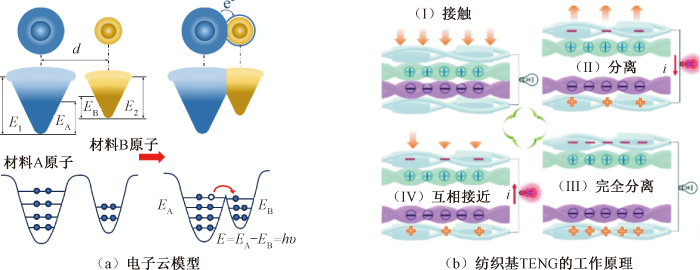
图1
纺织基TENG的工作机制
Fig.1
Working mechanism of textile-based TENG. (a)Electron cloud model; (b) Working principle of textile-based TENG
1.2 工作模式
图2
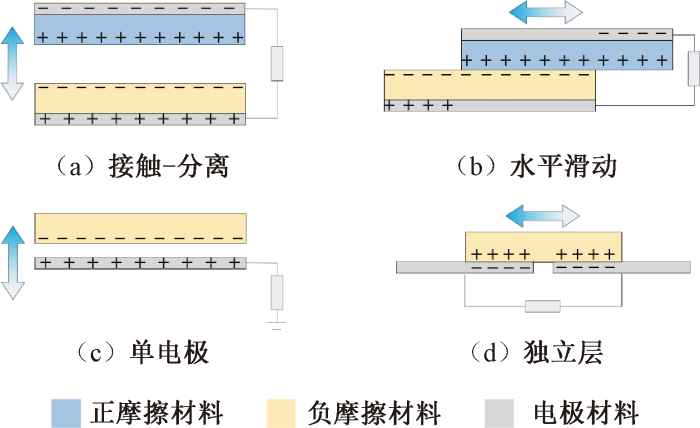
图2
TENG的4种基本工作模式
Fig.2
Four basic working modes of TENG. (a) Contact-separation mode; (b) Lateral-sliding mode; (c) Single-electrode mode; (d) Independant mode
1.2.1 接触-分离模式
接触-分离模式中2片摩擦层接触与分离产生电能。接触时发生电荷转移,分离时电极感应出相反电荷,形成电势差并驱动电子流动,形成电流,实现机械能向电能转换。在外力驱动下,摩擦层周期性地完成接触与分离过程,输出交流电信号。
1.2.2 水平滑动模式
水平滑动模式中,能量转换是通过外力驱动2片紧密接触摩擦层的相对滑移来实现。随着摩擦层周期性滑移与复位,表面电荷分布发生动态变化,进而使电极间的感应电势周期性变化,驱动外电路中自由电子往复流动并输出交流电信号。
1.2.3 单电极模式
单电极模式中,通过保留一侧工作电极并以大地或远端接地体作为参考电极来工作。在外力驱动下,摩擦层与该工作电极发生周期性接触与分离,导致工作电极相对于参考电极的电势随之变化,从而驱动自由电子在工作电极与参考体之间往复流动并产生交流输出。
1.2.4 独立层模式
独立层模式中,由1片移动摩擦层与两侧对称布置的电极构成。当外力驱动摩擦层在2个电极之间往复运动时,摩擦层与电极之间产生的电荷分布呈现空间非对称性,从而在2个电极之间建立起电势差,促使自由电子在外电路中流动并产生电流。
2 纺织基TENG的设计与制备
2.1 材料选择
摩擦电材料的选择对纺织基TENG的输出性能起决定性作用。常以摩擦电序列表(见图3)作为材料匹配的主要依据,该序列表反映了材料得失电子的能力。一般认为,在接触条件与表面状态相近的情况下,摩擦电序列中相距较远、极性差较大的材料配对更有利于界面电荷的转移,从而获得较高的输出性能。因此,在器件设计中应优先选取序列两端差异显著的材料配对,以最大化摩擦电荷生成与能量转换效率[14]。电极作为TENG中静电感应的载体,其电学性能直接影响能量采集效率。若电极材料载流子迁移率或自由载流子浓度较低,器件将在电荷传输过程中遭遇较大能量损耗,从而降低输出功率[15]。常见电极材料可分为金属类、碳基材料与导电聚合物3大类,各自具有不同的导电性、柔韧性与穿着舒适性[16-17]。实现高效能量采集同时保证穿戴舒适性的关键在于对摩擦电材料与电极材料的合理匹配与协同设计,以满足实际可穿戴应用的多维需求。
图3
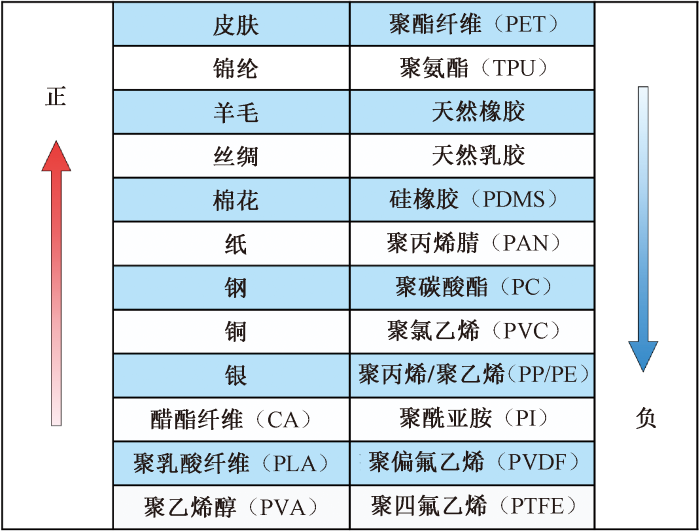
图3
纺织基TENG常用摩擦材料的摩擦电序列表
Fig.3
Triboelectric series of commonly used friction materials for textile-based TENGs
2.2 摩擦电纤维/纱线的制备
功能纤维与纱线作为构建纺织基TENG的基本单元,其结构设计与制备工艺直接影响器件的能量输出与传感性能。纤维/纱线基TENG通常在线性构型中合理布置导电层与摩擦层构成典型的“芯-鞘”结构,实现机械能-电能转换。纤维/纱线基TENG既可作为独立的发电单元工作,也可经由纺织加工制备成摩擦电织物,进一步扩展为大面积、柔性的能量收集与传感系统。纤维/纱线基TENG的制备方法与工艺路线各有特点,为设计功能多样、性能可调的纤维/纱线基TENG提供了丰富的技术路径。
2.2.1 涂覆法
图4
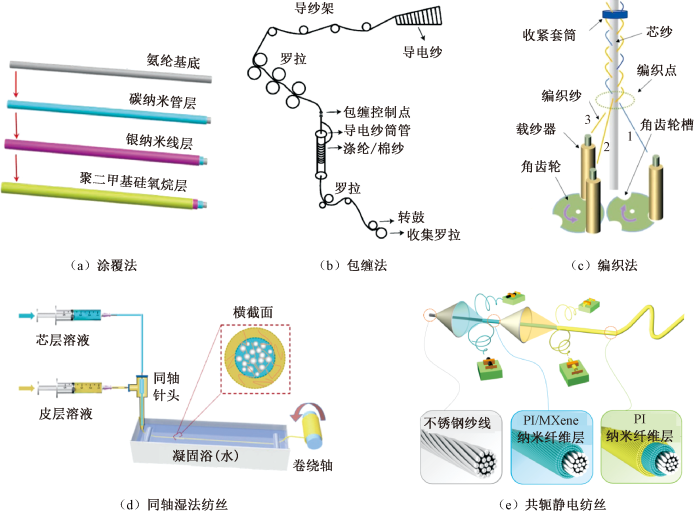
图4
摩擦电纤维/纱线的制备方法
Fig.4
Preparation methods of triboelectric fibers/yarns. (a) Coating method; (b) Wrapping method; (c) Braiding method; (d) Coaxial wet-spinning method; (e) Conjugate electrospinning
2.2.2 包缠法
2.2.3 编织法
编织法是将多股纤维或纱线按预设规律进行交叉缠绕或交错排列,从而形成具有中空或包覆结构复合纱线的成形方法。该方法不仅能赋予纱线优异的力学性能与柔韧性,还能实现结构上的功能集成。Chen等[20]以乳胶橡胶为芯层,聚酰胺(PA)纱与涂银PA导电纱交替编织构成外层,借助高速螺旋编织技术制备了基于仿生双螺旋编织结构的超拉伸纱线TENG,如图4(c)所示。该纱线最大拉伸应变可达500%,且无需依赖外部摩擦材料或复杂多层结构,仅依靠自身平行纱线在拉伸-释放过程中的接触-分离即可实现能量转换,展现出优异的可拉伸性与能量转换效率。此外,该方法可依托成熟的高速编织机实现大规模、低成本的连续化生产,为柔性可穿戴能源器件的开发提供切实可行的工艺路径。
2.2.4 同轴湿法纺丝法
湿法纺丝是一种通过将聚合物溶液挤入凝固浴中,使其固化成形制备纤维的工艺。同轴湿法纺丝则在传统工艺基础上,利用同轴喷丝头使芯层与皮层纺丝液同时挤出,随后固化形成具有皮-芯结构的复合纤维。Ning等[21]采用该技术制备了以液态金属(LM)为芯、聚氨酯(PU)为皮的摩擦电纤维,如图4(d)所示。该研究选用的液态金属兼具高流动性与优异导电性,使其在拉伸、弯曲甚至挤压等形变条件下仍能维持导电通路的连续性,从而有效解决了传统刚性金属材料与聚合物基体间常见的界面相容性差、弹性模量不匹配等问题。该方法能够实现摩擦电纤维的连续化生产,并可通过数码缝纫直接将其嵌入织物中,为柔性可穿戴能源纺织品的工业化应用奠定了基础。
2.2.5 共轭静电纺丝法
共轭静电纺丝技术是将2组纺丝装置分别接入正、负极性高压电源,使纺丝过程中产生的纤维分别带上正负电荷,这些带电纤维在电场作用下相互吸引、缠绕,并最终共同沉积于收集装置,形成具有皮-芯结构的纳米纤维束[24]。Yan等[22]采用连续两步共轭静电纺丝法制备出具有多级结构的摩擦电包芯纱,如图4(e)所示。该纱线以不锈钢芯纱为电极、聚酰亚胺(PI)/MXene纳米纤维作为电荷捕获中间层、PI纳米纤维为最外层的摩擦层。中间电荷捕获层的引入能够有效抑制摩擦电荷在实际使用过程中的衰减现象。由此纱线编织的TENG织物在400 ℃高温条件下仍能保持稳定的电输出,成功应用于消防防护服,实现了生理参数监测与应急求救信号的发送功能。这种方法不仅能够直接获得摩擦电纱线,而且得益于纳米纤维固有的高比表面积和多孔特性,可显著增大摩擦接触面积,从而有效提升器件的电输出性能[25]。
面向未来,研究工作可致力于综合各工艺路线的独特优势,积极探索多种技术的融合创新与关键界面的工程优化,以期构建出兼具优异电学性能和可规模化生产的纤维/纱线基TENG制备体系。
2.3 摩擦电织物的制备
摩擦电织物是通过将功能纤维或纱线利用纺织加工技术组装成具有特定结构的织物。该方法不仅能显著扩大摩擦界面有效接触面积,提升电荷转移效率与电输出性能,还可充分保留织物固有的柔软性、透气性及穿戴舒适性,同时与现有纺织工艺体系高度兼容。凭借灵活的结构设计与规模化生产潜力,摩擦电织物在可穿戴能源领域展现出重要的应用前景。根据织造工艺不同,摩擦电织物主要可分为机织物与针织物两类[26]。
2.3.1 机织物
机织物由经纱与纬纱在织机上按一定规律相互交织而成,其基本组织结构包括平纹、斜纹和缎纹3类。Miao等[27]以棉纱为经纱、聚四氟乙烯(PTFE)长丝包裹导电芯纱的摩擦电纱线为纬纱,以设定的间隔周期性嵌入棉纱基机织物中,并分别采用平纹、斜纹、缎纹3种组织结构进行织造(如图5(a)所示),制备了摩擦电织物。在其所研究的参数范围内,斜纹结构织物表现出较高的输出性能,缎纹次之,平纹相对较低,反映了织物结构与形貌等整体特征对输出性能有影响。同时,该工作还发现电输出性能随摩擦电纱线间距增大而提升,这主要归因于间距增大可减弱相邻摩擦电纱线间的电场干扰。Bakhtiyari等[28]使用羊毛织物与聚酯(PET)织物制备了多层结构机织TENG,其结构如图5(b)所示,该研究并着重探讨了织物有效摩擦接触面积及表面粗糙度对机织TENG电输出性能的影响,并发现摩擦接触面积与表面粗糙度均与电输出性能呈正相关。从而,提出了可用于计算机预测织物实际接触面积的理论模型,强调了织物图案设计和表面特性在优化摩擦电装置性能方面的重要性,为后续摩擦电织物的结构优化与性能预测提供了理论参考。
图5
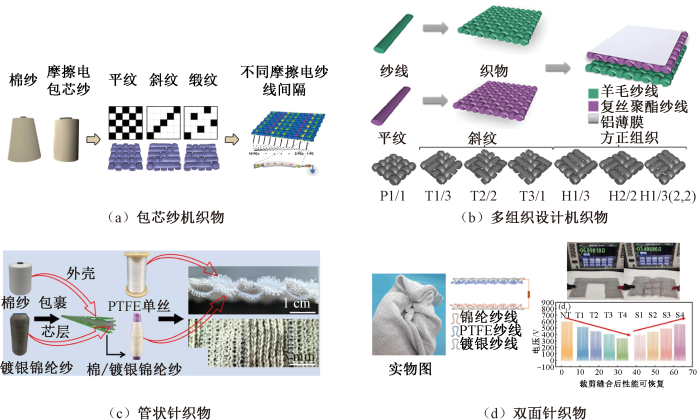
图5
摩擦电织物
Fig.5
Triboelectric fabrics. (a) Core-spun yarn woven fabric; (b) Woven fabrics with various structures; (c) Tubular knitted fabric; (d) Double-faced knitted fabric
2.3.2 针织物
针织物由线圈相互串套而成,按工艺可分为经编和纬编2种。针织物通常具备优异的柔韧性与可拉伸性,能够更好地贴合人体关节及不规则体表。同时,线圈结构形成的多孔网络赋予其良好的透气与透湿性能,从而有效提升穿着舒适度。在输出性能方面,相较于机织物,针织结构通常具有更高的表面粗糙度与更大的有效摩擦面积,这一结构特性有助于提升其电输出性能[29]。Yin等[30]设计了一种具有非对称结构的管状针织摩擦电织物,其一侧为镀银锦纶/棉织物,另一侧为PTFE织物,如图5(c)所示。所设计的管状空气层结构为TENG提供了垂直响应的空间,使其可在横向拉伸与垂直按压2种模式下工作,为监测人体活动过程中的多维度复杂变形信号提供了有效解决方案。然而,实现稳定可靠的多维信号感知不仅要求高效的发电机制,还需器件在实际穿戴条件下具备足够的耐久性与形态适应性。为此,Yan等[31]通过针织技术用PTFE纱线与镀银纱线制备了双面摩擦电织物,其正面为PTFE摩擦层,背面为导电电极。该织物采用一体化成形设计,使其能像普通面料一样被任意裁剪和缝合,并集成于服装中。经过多次裁剪该器件的电学性能仍可保持初始值的85%以上,且在缝合后性能可逐步恢复(如图5(d)所示)。该摩擦电织物显示出良好的耐受物理损伤能力与形状可定制潜力,为纺织基TENG走向产业化提供了兼具结构可靠性与形态灵活性的实用范例。
3 健康监测应用
纺织基TENG以纺织品为载体,结合自供能与传感功能,为实现人体生理信息的无感、长期监测提供了理想平台。该类器件适用于运动状态、睡眠质量等多种与健康相关信号的持续采集,通过对这些数据的动态记录与分析,使用者能够及时了解自身健康状况,辅助养成良好生活习惯,同时还可在某些疾病的早期预防与发现方面发挥积极作用,因此在个人健康管理中具有重要意义。
3.1 生理信号监测
呼吸、脉搏等基础生理指标是评估人体健康状况的重要参数,在生命体征监测与疾病预警中具有重要意义。纺织基TENG具备高灵敏度和优异柔韧性,可准确感知微弱的生理力学信号,同时相较于传统医疗设备,其成本低、使用灵活,因此在长期、动态的生理信号监测方面展现出广阔前景。
呼吸作为核心生命体征之一,直接反映呼吸与循环系统功能状态,其异常变化常提示潜在呼吸系统疾病或身体疲劳。Ning等[32]将PTFE/Ag复合纤维与锦纶/Ag复合纤维交替螺旋缠绕在可拉伸纱线基底上设计了一种可响应微小形变的摩擦电单元。该纤维TENG被集成于胸带应用于呼吸监测时,纱线随呼吸动作发生拉伸与回复,可引起PTFE与锦纶之间的周期性接触-分离,从而产生电信号。该传感器灵敏度高,可检测低于1%的拉伸应变,能够准确捕捉胸腹部在呼吸过程中的起伏变化,并有效区分不同的呼吸模式。基于该结构设计的智能报警系统,可在呼吸暂停持续6 s以上时报警,实现有效安全监护。
在脉搏监测方面,连续、精准地采集脉搏信号对心血管疾病的早期发现与干预至关重要。然而,在体表准确捕捉与识别脉搏引发的微弱力学信号方面仍存在一定的挑战。在此背景下,纺织基TENG逐渐成为可穿戴脉搏监测产品的理想解决方案。Fan等[33]以涤纶包覆不锈钢导电纱和锦纶纱为原料开发了全织物型摩擦电传感针织物。该织物有效增大了摩擦作用面积,从而提升了传感器的灵敏度与信号输出能力。在脉搏搏动引起的微压力作用下,导电纱与锦纶之间发生周期性的接触-分离,从而输出电信号,能够准确捕获脉搏波形中的关键特征点。该织物具备柔性、可穿戴、可水洗等优势。其可集成于颈部、手腕、指尖及脚踝等多个体表部位,实现多点位、长周期的脉搏信号采集,为心血管健康的无创评估与分析提供了可靠的技术支持。
3.2 运动与行为监测
运动模式与姿态特征是评估人体功能状态的重要指标,其监测结果可广泛应用于日常健康评估、康复训练指导与运动表现分析[34]。将自供能摩擦电传感单元嵌入鞋垫或袜类产品形成的智能足部纺织品,能够实现长期运动行为监测。Gao等[35]以硅胶-棉织物复合结构为基底,采用双L背靠结构构成接触-分离式摩擦电单元,制备了摩擦电鞋垫。足底压力使摩擦层周期性接触分离,产生电信号实现运动监测。其交替多层涂层设计增强了结构稳定性,在经过60 000次循环测试和10次洗涤后,仍能保持高度一致的性能,结合机器学习方法可实现对7种不同运动模式的准确识别。Zu等[36]则采用编织工艺制备出PA/银/PU复合纱线基TENG,并进一步通过针织加工制得可紧密贴合足部的摩擦电智能袜,该袜在维持良好透气性与穿着舒适度的同时,通过压力感知稳定实现了对人体运动信号的捕捉与分类识别。
在持续监测过程中,纺织基TENG不仅限于识别基本运动,还可进一步检测与识别不良行为并予以反馈纠正,完成从“被动监测”向“感知-干预”的转型。Jiang等[37]将导电银纤维与锦纶以双罗纹结构加工后得到柔性针织TENG,并将其嵌入背心后可实现自供能无感人体坐姿监测。当使用者处于不同坐姿时,背部、肩部等部位的面料发生拉伸或压缩,引起锦纶与导电纤维之间的接触-分离产生电信号,通过分析这些信号特征实现姿态识别并为用户提供实时反馈。可有助于使用者纠正不良坐姿,预防脊柱疾病与近视等健康问题。
3.3 睡眠监测
良好的睡眠对维持身心健康具有重要意义,高质量睡眠有助于体力恢复、情绪稳定与免疫功能提升。当前市场上主流睡眠监测设备如智能手环,在数据准确性、佩戴舒适性等方面仍有优化空间。相较而言,纺织基TENG兼具优异柔性、透气性与传感功能,能在保持使用舒适度的同时提供持续监测能力。Lin等[38]构建了基于压敏TENG阵列的可水洗床单。该床单采用3层结构:上下2层为垂直排布的导电纤维,中间夹有波浪形PET薄膜。当受到人体压迫时,波浪结构形变引起接触面积变化,产生电信号。通过对压力变化的感知可实时监测睡眠者的体位、身体姿态及压力分布,从而对睡眠质量做出评估,并可在检测到跌落风险时主动报警,保障睡眠安全。Zhu等[39]则提出自供能摩擦电眼罩,其摩擦电功能层由PTFE与锦纶织物构成。当使用者在睡眠中发生眼动或眨眼等行为时,会引起内部摩擦层发生微小接触-分离,从而产生实时变化的电信号。通过对这些信号进行分析,该系统能够有效辨识眼球活动状态,区分不同睡眠阶段,从而为睡眠质量评估提供依据。
3.4 医疗康复与培训监测
纺织基TENG在医疗领域的应用亦延伸至康复训练与长期健康监护。Dong等[40]开发了基于多壁碳纳米管的集热电-摩擦电功能为一体的智能纱线,并将其制成针织物。该织物能够快速响应温度变化,感知温差,可用于断指再植术后血管危象实时监测与报警。当再植指与正常指温差异常时,系统能及时发出警报。同时,织物还能通过检测手指弯曲角度对应的摩擦电信号,评估断指再植术后手指功能恢复程度。Lin等[41]开发了基于芯鞘结构的微弯曲敏感摩擦电纤维,其以乙烯-醋酸乙烯酯(EVA)中空纤维为骨架,通过共轭静电纺丝在其表面缠绕热塑性聚氨酯纳米纤维作为摩擦正极,并在芯层注入离子凝胶作为电极,再以纬编工艺集成于织物中。当纤维弯曲时,其纳米纤维屈曲结构会改变摩擦界面间的接触分离距离,通过静电感应引发电信号,从而实现了微小形变转换为电信号。将其缝制于护具或手环中,可捕捉肌肉收缩引起的微变形,实现握力、腕部肌肉力量等康复指标评估。该电子纺织品兼具高透气性和可水洗性,适合长期佩戴,为康复进度追踪与训练安全预警提供支持。
纺织基TENG在医疗体系的应用中,除疾病诊断与康复监测外,还可助力医疗教育与技能培训。Lan等[42]以银纳米线导电纤维为芯材、弹性硅橡胶为鞘层,制备出可水洗、高伸缩性且具备规模化潜力的纤维基TENG。经等离子体处理后,界面结合强度可显著提升,器件展现出优异的机械稳定性。其工作模式为单电极模式,外部材料与硅橡胶鞘层摩擦后分离,硅橡胶因强电负性而携带负电荷,并通过静电感应驱动内部银纳米线电极中的电子定向流动,输出电信号。将其集成于智能手套中,可用于心肺复苏培训,通过电压信号实时反映按压深度、频率、垂直度、中断时间及胸廓回弹情况,为操作者提供实时反馈,有效改善了传统培训设备笨重且响应滞后的问题。
尽管纺织基TENG在健康监测领域已取得多项研究成果,为智慧健康管理体系的构建提供了技术支撑,但在实际推广中仍需重视数据格式的兼容性,严格遵循用户隐私与数据安全规范,并持续优化材料的生物相容性与服役耐久性,以推动其向实用化与产业化迈进。
4 结束语
近年来,智能可穿戴技术发展迅猛,纺织基TENG凭借自供能传感特性以及优异的可穿戴性能,已成为健康监测领域的研究热点。本文系统综述了纺织基TENG在智能健康监测中的研究进展,并介绍了TENG的工作原理和4种典型工作模式;随后重点论述了纺织基TENG的材料体系及包括涂覆法、包缠纱法、湿法纺丝、静电纺丝等多种纤维/纱线基TENG的构建方法,以及机织物和针织物2类结构化织物TENG的实现路径;最后展示了该技术在生理信号监测、运动与步态监测、睡眠分析、医疗术后康复与培训等多种典型场景中的应用实践,充分展示了其在持续、无感、多功能健康监测方面的巨大潜力。
尽管纺织基TENG技术在柔性可穿戴领域展现出巨大潜力,但其从实验室走向产业化仍面临若干技术瓶颈:1)纤维或纱线形态的摩擦电材料有效摩擦接触面积较小,电输出性能有待进一步提升;2)摩擦电器件与整流或储能器件集成时会增加体积,削弱穿戴舒适性优势;3)摩擦材料在反复使用过程中会引发材料疲劳、界面损伤及性能衰减,对其耐久性提出了更高的要求;4)纺织基TENG的产业化面临标准化和大规模生产的挑战。现有制备方法大多处于实验室阶段,尽管相关的静电纺丝等制备技术在生产效率上已有提升,但在生产工艺、成本控制、质量管理和性能测试方面缺乏统一标准,与纺织工业大规模、连续化生产的要求仍存在差距。
为推动纺织基TENG技术的实用化进程,未来研究应聚焦于以下方向:开发具有高电荷亲和力、优异力学强度及环境稳定性的新型摩擦电材料;探索与现有成熟纺织工艺兼容的低成本制造技术,以实现高性能器件的规模化、标准化生产,并建立完善的标准体系,涵盖产品定义与设计、生产工艺及质量检测等,确保大规模生产的一致性和产品的可靠性,从而加速产业化进程。加强同材料科学、微纳能源管理、人工智能、柔性电子及生物医学等领域的深度交叉融合,构建集能量收集、信号感知、信息处理与无线传输于一体的智能化系统,从而真正释放其在持续、无扰健康监测中的全部潜力。随着研究的持续深入,纺织基TENG有望实现从实验室创新到实用化、产业化跨越,成为推动智慧医疗与智能穿戴领域发展的核心动力。
参考文献
Digital health for aging populations
[J].
DOI:10.1038/s41591-023-02391-8
PMID:37464029
[本文引用: 1]

Growing life expectancy poses important societal challenges, placing an increasing burden on ever more strained health systems. Digital technologies offer tremendous potential for shifting from traditional medical routines to remote medicine and transforming our ability to manage health and independence in aging populations. In this Perspective, we summarize the current progress toward, and challenges and future opportunities of, harnessing digital technologies for effective geriatric care. Special attention is given to the role of wearables in assisting older adults to monitor their health and maintain independence at home. Challenges to the widespread future use of digital technologies in this population will be discussed, along with a vision for how such technologies will shape the future of healthy aging.© 2023. Springer Nature America, Inc.
主动健康数据采集设备在医疗健康领域的应用现状
[J].
Current status of active health data collection devices applied in healthcare field
[J].
Frictional nanogenerators (TENGs) in medical health monitoring: a progress review
[J].
DOI:10.1063/5.0263452
URL
[本文引用: 1]
Triboelectric nanogenerators (TENGs), as a revolutionary energy-harvesting technology, have garnered widespread attention in the scientific community for their efficient conversion of mechanical energy into electrical energy. This article first outlines the five working modes of TENGs: vertical contact-separation mode, horizontal sliding mode, single-electrode mode, independent layer mode, and free-standing rotating mode, and elaborates on their working principles in detail. Subsequently, this article delves into the application examples of TENGs in wearable health monitoring devices, implantable medical devices, and environmental health monitoring, fully demonstrating the vast potential of TENG technology in medical health monitoring. In addition, this article analyzes the advantages of TENG technology, including its self-powered characteristics, high sensitivity, and good biocompatibility, while also pointing out the challenges that it faces, such as improving long-term stability, enhancing energy conversion efficiency, and environmental adaptability. This review aims to explore the progress of TENG technology in medical health monitoring, analyze its advantages and challenges, and look forward to future development directions. Through a systematic analysis of existing literature, this article will provide researchers and developers with in-depth insights into guiding future research and product development.
Recent progress in the fabrication and processing of triboelectric yarns
[J].DOI:10.1002/cnl2.v2.1 URL [本文引用: 1]
Wearable triboelectric sensors enabled gait analysis and waist motion capture for IoT-based smart healthcare applications
[J].DOI:10.1002/advs.v9.4 URL [本文引用: 1]
Recent progress of functional fiber and textile triboelectric nanogenerators: towards electricity power generation and intelligent sensing
[J].
DOI:10.1007/s42765-021-00077-9
[本文引用: 1]
<div class="mag_zhaiyao_sec"><p id="Par1" class="mag_zhaiyao_p">Rapid development in wearable electronics has brought huge convenience to human life and gradually penetrated into various indispensable fields, such as health monitoring, medical assistance, smart sports, object tracking and smart home, etc. However, the suitable energy supply system for these wearable electronics remains an important issue to address. Fiber and textile triboelectric nanogenerators (f/t-TENGs), capable of converting biomechanical energy into electricity, have promising features to act as a mobile sustainable power source for wearable electronics or directly serve as an intelligent self-powered sensing solution. Compared with the low-output piezoelectric nanogenerators, hard-to-wear electromagnetic generators and other bulk TENGs, the fiber/textile TENG may be the best type of wearable human mechanical energy harvester at present. Herein, this review comprehensively introduces the recent progress of smart fibers and textiles with a highlight on triboelectric nanogenerators, including the general materials and structures of fiber/textile shaped electronics, various fiber and textile devices for triboelectric/triboelectric-integrated energy harvesting and self-powered smart sensing systems. Moreover, the advance of f/t-TENGs with multifunctionality and large-scale textile processing techniques is summarized as well. Finally, the challenges and perspectives of f/t-TENGs for future improvement, large-scale production and emerging applications are thoroughly discussed as well.</p></div> <div id="ASec2" class="mag_zhaiyao_sec"><strong class="mag_zhaiyao_title">Graphic abstract </strong></div>
Flexible triboelectric generator
[J].DOI:10.1016/j.nanoen.2012.01.004 URL [本文引用: 1]
摩擦起电机理、调控与应用研究的现状及展望
[J].
A review on the study of contact electrification: mechanism, control and application
[J].
On the origin of contact-electrification
[J].
DOI:10.1016/j.mattod.2019.05.016
[本文引用: 1]
Although contact electrification (triboelectrification) (CE) has been documented since 2600 years ago, its scientific understanding remains inconclusive, unclear, and un-unified. This paper reviews the updated progress for studying the fundamental mechanism of CE using Kelvin probe force microscopy for solid-solid cases. Our conclusion is that electron transfer is the dominant mechanism for CE between solid-solid pairs. Electron transfer occurs only when the interatomic distance between the two materials is shorter than the normal bonding length (typically similar to 0.2 nm) in the region of repulsive forces. A strong electron cloud overlap (or wave function overlap) between the two atoms/molecules in the repulsive region leads to electron transition between the atoms/molecules, owing to the reduced interatomic potential barrier. The role played by contact/friction force is to induce strong overlap between the electron clouds (or wave function in physics, bonding in chemistry). The electrostatic charges on the surfaces can be released from the surface by electron thermionic emission and/or photon excitation, so these electrostatic charges may not remain on the surface if sample temperature is higher than similar to 300-400 degrees C. The electron transfer model could be extended to liquid-solid, liquid-gas and even liquid-liquid cases. As for the liquid-solid case, molecules in the liquid would have electron cloud overlap with the atoms on the solid surface at the very first contact with a virginal solid surface, and electron transfer is required in order to create the first layer of electrostatic charges on the solid surface. This step only occurs for the very first contact of the liquid with the solid. Then, ion transfer is the second step and is the dominant process thereafter, which is a redistribution of the ions in solution considering electrostatic interactions with the charged solid surface. This is proposed as a two-step formation process of the electric double layer (EDL) at the liquid-solid interface. Charge transfer in the liquid-gas case is believed to be due to electron transfer once a gas molecule strikes the liquid surface to induce the overlapping electron cloud under pressure. In general, electron transfer due to the overlapping electron cloud under mechanical force/pressure is proposed as the dominant mechanism for initiating CE between solids, liquids and gases. This study provides not only the first systematic understanding about the physics of CE, but also demonstrates that the triboelectric nanogenerator (TENG) is an effective method for studying the nature of CE between any materials.
自供电纺织基柔性应变传感器研究进展
[J].
Research progress of self-powered textile-based flexible stress sensors
[J].
Recent advances in self-powered electronic skin based on triboelectric nanogenerators
[J].DOI:10.3390/en17030638 URL [本文引用: 1]
Recent progress on textile-based triboelectric nanogenerators
[J].
DOI:10.1016/j.nanoen.2018.10.036
[本文引用: 1]
Triboelectric nanogenerators (TENG) are one of the most promising candidates for powering wearable and portable devices. Example TENGs have demonstrated flexibility, light weight, biocompatibility, versatility and good performance. Textiles are a potential substrate onto, or into, which wearable technology is increasingly being incorporated but supplying power remains an enduring challenge. TENGs are a potential textile based mechanical energy harvesting power supply and there has been an increasing effort to combine TENGs with fabrics. A significant challenge exists in the integration without losing the performance of the TENG or the original properties (appearance, breathability, washability, and durability) and feel of the textile. Various approaches towards the realisation of textile-based TENGs (T-TENGs) have been demonstrated. Depending on its structure, T-TENGs can be divided into two main types, fabric-based TENG and fibre-based TENG. The fabric-based TENG is composed of conventional and/or modified fabrics, which serve as a substrate and/or a triboelectric material. The fibre-based TENG is fabricated as a single fibre or a collection of interlaced fibres. This paper provides an up to date review of the progress in the research of T-TENGs. The paper covers the basic operating principles, possible operation modes, textile manufacturing methods, material selections, T-TENG fabrication process, surface modification and structural designs. Issues, such as standardised measurement parameters, the challenges and limitations of T-TENG are discussed.
面向个性化健康医疗的智能纺织品研究进展
[J].
Research progress on self-powered wearable smart textiles
[J].
DOI:10.1177/004051757504500309
URL
[本文引用: 1]
Cellulose formed complexes of limited stability with a di-secondary diamine, symmetrical dimethylethylenediamine, and with a diamine containing primary and tertiary amine groups, unsymmetrical dimethylethylenediamine. Pretreat ment of the cellulose with liquid ammonia was required for complex formation. X-ray diffractometer tracings were obtained of the complexes. More stable complexes were formed between cellulose and each of two diamines, N-methyl- ethylenediamine and N-methyl-1,3-propanediamine, both of which contain primary and secondary amine groups. Pre treatment with liquid ammonia was not required for formation of these complexes. Unit cell determinations were made of the latter complexes. A di-tertiary diamine, N,N,N',N'-tetramethylethylenediamine, did not form a complex with cellulose even when the cellulose was preswollen with liquid ammonia. A complex formed with cellulose and diethyl enetriamine confirmed the results of previous workers who found that crosslinkage of the cellulose chains occurs through primary and secondary amine groups when the complex is washed with carbon tetrachloride after vacuum distillation. However, if the complex is not washed, the terminal primary amine groups bond with the cellulosic hydroxyl groups with greater distention of the 101 interplanar spacing of the complex. Nitrogen content of the complexes corresponded to a 1:1 ratio of diamine molecules to anhydroglucose units. Thermal studies were made of the more stable complexes.
Fiber/fabric-based piezoelectric and triboelectric nanogenerators for flexible/stretchable and wearable electronics and artificial intelligence
[J].DOI:10.1002/adma.v32.5 URL [本文引用: 1]
Flexible and stretchable fiber-shaped triboelectric nanogenerators for biomechanical monitoring and human-interactive sensing
[J].DOI:10.1002/adfm.v31.4 URL [本文引用: 2]
自供电可穿戴智能纺织品研究进展
[J].
Research progress of self-powered smart wearable textiles
[J].
Large-scale fabrication of core-shell triboelectric braided fibers and power textiles for energy harvesting and plantar pressure monitoring
[J].DOI:10.1002/eom2.v4.4 URL [本文引用: 1]
包缠复合纱摩擦纳米发电机的制备及其电学性能
[J].
Preparation and electrical properties of triboelectric nanogenerator based on wrapped composite yarn
[J].
Bionic double-helix braided ultra-stretchable energy-harvesting yarns for power and wearable electronics
[J].DOI:10.1016/j.nanoen.2025.110832 URL [本文引用: 1]
Scalable one-step wet-spinning of triboelectric fibers for large-area power and sensing textiles
[J].DOI:10.1007/s12274-022-5273-7 [本文引用: 1]
Thermally robust hierarchical nanofiber triboelectric yarns for efficient energy harvesting in firefighting E-textiles
[J].DOI:10.1016/j.cej.2024.156188 URL [本文引用: 2]
Highly wearable, breathable, and washable sensing textile for human motion and pulse monitoring
[J].
静电纺纳米纤维在生物医用领域的应用研究
[J].
Application study on electrospun nanofiber in biomedical field
[J].
Advanced electrospun fiber-based triboelectric nanogenerators: from diversified designs to customized applications
[J].DOI:10.1016/j.cej.2024.158636 URL [本文引用: 1]
Asymmetric-elastic-structure fabric-based triboelectric nanogenerators for wearable energy harvesting and human motion sensing
[J].DOI:10.1016/j.cej.2023.143079 URL [本文引用: 1]
Woven fabric triboelectric nanogenerators for human-computer interaction and physical health monitoring
[J].DOI:10.1007/s12274-024-6410-2 [本文引用: 1]
Yarn-to-yarn surface area and roughness as structural engineering tools for optimizing the electrical output of triboelectric nanogenerators: geometrical and experimental verification
[J].DOI:10.1002/admt.v10.7 URL [本文引用: 1]
Influence of the fabric topology on the performance of a textile-based triboelectric nanogenerator for self-powered monitoring
[J].DOI:10.1021/acsapm.2c01820 URL [本文引用: 1]
Integrated Janus meta-fabric via an interlock stitch knitted structure for marginal physiological signal monitoring
[J].DOI:10.1021/acsaelm.4c01969 URL [本文引用: 1]
High-performance textile-based triboelectric nanogenerators with damage insensitivity and shape tailorability
[J].DOI:10.1016/j.nanoen.2024.109675 URL [本文引用: 1]
Helical fiber strain sensors based on triboelectric nanogenerators for self-powered human respiratory monitoring
[J].DOI:10.1021/acsnano.1c09792 URL [本文引用: 1]
Machine-knitted washable sensor array textile for precise epidermal physiological signal monitoring
[J].
DOI:10.1126/sciadv.aay2840
URL
[本文引用: 1]
A triboelectric all-textile sensor with high pressure sensitivity and comfort was been developed for health monitoring.
Plantar pressure-based insole gait monitoring techniques for diseases monitoring and analysis: a review
[J].DOI:10.1002/admt.v7.1 URL [本文引用: 1]
Fabric-reinforced functional insoles with superior durability and antifracture properties for energy harvesting and AI-empowered motion monitoring
[J].DOI:10.1002/adfm.v35.10 URL [本文引用: 1]
Scale production of a stretchable fiber triboelectric nanogenerator in customizable textile for human motion recognition
[J].
Knitted self-powered sensing textiles for machine learning-assisted sitting posture monitoring and correction
[J].DOI:10.1007/s12274-022-4409-0 [本文引用: 1]
Large-scale and washable smart textiles based on triboelectric nanogenerator arrays for self-powered sleeping monitoring
[J].DOI:10.1002/adfm.v28.1 URL [本文引用: 1]
Triboelectric patch based on Maxwell displacement current for human energy harvesting and eye movement monitoring
[J].
DOI:10.1021/acsnano.2c01199
PMID:35920687
[本文引用: 1]
The forthcoming wearable health care devices garner considerable attention because of their potential for monitoring, treatment, and protection applications. Herein, a self-powered triboelectric patch was developed using polytetrafluoroethylene rubbed with nylon fabric. The triboelectric patch can maintain a stable electrostatic field, due to the excess electrification on the surface of the triboelectric layer. The designed triboelectric nanogenerator (TENG) output watt density can reach about 485 mW/m with added resistance of 11 kΩ. Additionally, the performance of the triboelectric patch allowed eye movement monitoring. The maximum voltage could reach 80 V at the vertical distance of 20 mm between the frictional layer and collector. The triboelectric patch not only can power a digital watch for potential wearable applications but also can be integrated to monitor eye movements during sleep. This work proposed a mechanism for human movement energy harvesting, which may be used for self-powered smart wearable health equipment and Maxwell displacement current wireless sensors.
Hybrid thermoelectric-triboelectric smart knitted fabric for real-time monitoring of vascular crisis and postoperative recovery of severed fingers
[J].
Triboelectric micro-flexure-sensitive fiber electronics
[J].
DOI:10.1038/s41467-024-46516-0
PMID:38490979
[本文引用: 1]
Developing fiber electronics presents a practical approach for establishing multi-node distributed networks within the human body, particularly concerning triboelectric fibers. However, realizing fiber electronics for monitoring micro-physiological activities remains challenging due to the intrinsic variability and subtle amplitude of physiological signals, which differ among individuals and scenarios. Here, we propose a technical approach based on a dynamic stability model of sheath-core fibers, integrating a micro-flexure-sensitive fiber enabled by nanofiber buckling and an ion conduction mechanism. This scheme enhances the accuracy of the signal transmission process, resulting in improved sensitivity (detectable signal at ultra-low curvature of 0.1 mm; flexure factor >21.8% within a bending range of 10°.) and robustness of fiber under micro flexure. In addition, we also developed a scalable manufacturing process and ensured compatibility with modern weaving techniques. By combining precise micro-curvature detection, micro-flexure-sensitive fibers unlock their full potential for various subtle physiological diagnoses, particularly in monitoring fiber upper limb muscle strength for rehabilitation and training.© 2024. The Author(s).
Scalable, stretchable and washable triboelectric fibers for self-powering human-machine interaction and cardiopulmonary resuscitation training
[J].DOI:10.1016/j.nanoen.2022.107737 URL [本文引用: 1]

 京公网安备11010502044800号


