



THPS废水的处理难点集中体现在3个层面。其一,THPS亲水性极强且其中磷原子被羟甲基严密包裹,混凝沉淀对其几乎无效[3-4]。其二,THPS本身具有广谱杀菌性,进入生化系统后会抑制活性污泥微生物活性,导致传统厌氧/好氧工艺难以有效运行[5]。其三,废水中往往同时伴有高浓度氨氮,多污染物协同去除的需求进一步增加了处理工艺的设计难度[6];因此,设置以有机磷形态转化为核心目标的强力预处理单元是处理该类废水的关键前提。高级氧化技术(AOPs)能够产生·OH、SO4·-等强氧化活性物种,将稳定的有机磷转化为易于沉淀的形态,是实现这一预处理目标的重要技术路径[7-8]。目前,臭氧(O3)氧化[9]、活化过硫酸盐氧化[10]、类Fenton氧化[11]及K2FeO4氧化[12]等AOPs均在难降解有机废水处理中展现出应用潜力,但针对THPS阻燃整理废水这一特定水质背景,系统比较预处理效能并引入成本与减排维度进行综合评价的研究仍较少,难以为企业工艺选型提供直接决策依据。
在“十五五”绿色低碳转型的政策导向下,纺织废水治理正由末端达标排放向全过程低碳化治理转型。据此,本研究以阻燃整理工序产生的有机磷废水为研究对象,系统考察5种典型AOPs对有机磷形态转化及碳、磷、氮多污染物的协同去除效能,结合后续化学沉淀评价各组合工艺的处理效果,并引入能耗与成本核算及减排潜力评价,以期为纺织行业阻燃整理废水的低碳化工艺选型提供科学依据。
1 实验部分
1.1 废水来源与水质特征
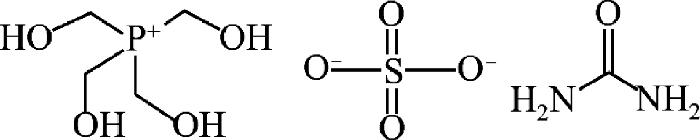
本研究实验用废水取自某纺织企业窗帘布染整车间的阻燃整理工序。该工序采用四羟甲基硫酸磷-尿素初缩体(THPS-尿素)对织物进行持久性阻燃处理。整理剂结构式如图1所示。阻燃整理工序具体流程为:将织物浸轧阻燃整理液后经氨熏处理,使THPS与尿素在纤维内部原位交联固化,再经水洗去除残余整理剂,最终烘干成品。水洗过程中,未完全固化的THPS-尿素整理剂及大量氨熏残留物进入废水,使该废水呈高磷与高氮特征。
图1
废水初始pH值为3.33,总磷(TP)质量浓度为82.04 mg/L,磷酸盐(PO43-)质量浓度为10.52 mg/L,氨氮(NH3-N)质量浓度为302.99 mg/L,总氮(TN)质量浓度为358.75 mg/L,总有机碳(TOC)质量浓度为467.90 mg/L,化学需氧量(COD)为1 176 mg/L。
1.2 试剂与仪器
试剂:过硫酸钾(K2S2O8, PS)、七水合硫酸亚铁(FeSO4·7H2O)、过氧化钙(CaO2)、高铁酸钾(K2FeO4)、氯化钙(CaCl2)、氯化镁(MgCl2)、氢氧化钠(NaOH)、盐酸(HCl)、氢氧化钾(KOH),均为分析纯,国药集团化学试剂有限公司。
仪器:LAB2B型臭氧发生器瑞士奥宗尼亚公司;ICS-1100型离子色谱,美国赛默飞世尔公司;Multi N/C 3100 TOC型总有机碳测定仪,德国耶拿公司;LH-S700型紫外-可见分光光度计,北京连华永兴科技发展有限公司。
1.3 有机磷废水的高级氧化预处理
所有实验均在室温条件下进行,单次处理水样体积为100 mL,反应结束后水样过0.45 μm滤膜,测量TP、
1.4 化学沉淀
将经5种AOPs预处理后的水样进行化学沉淀:加入9.0 mmol/L CaCl2和21.0 mmol/L MgCl2,以300 r/min搅拌10 min,调节pH值至11,静置10 min,取上清液测量TP、
1.5 水质指标测定与计算方法
参照GB/T 11893—1989《水质 总磷的测定 钼酸铵分光光度法》测定TP质量浓度;采用离子色谱法测定
式中:C0为污染物初始质量浓度,mg/L;Ct为某时刻体系中污染物的剩余质量浓度,mg/L。
废水中污染物削减量X的计算公式为
1.6 能耗与成本核算方法
运行成本(元/m3)以单位处理水量为核算基准。电耗根据臭氧发生器运行功率与处理时间计算耗电量,结合当地电价折算为电费,以kW·h/m3表示;药剂成本根据各工艺最佳工况下的药剂投加量与市售单价计算,折算为每立方米废水的药剂费用。2项合计为各工艺的综合运行成本。
1.7 综合评价方法
以TP去除效果、TOC去除效果、NH3-N形态转化效果、TN去除效果、综合运行成本和操作可行性(含污泥产量)为评价维度,采用相对排名赋分法对5种氧化-沉淀组合工艺进行综合评价。各维度按工艺表现优劣依次赋予1~5分(5分最优),权重相同。运行成本和污泥产量以低为优,赋分方向与处理效果类指标保持一致。结果以雷达图形式呈现。
2 结果与讨论
2.1 5种AOPs体系对有机磷转化的影响
图2示出5种AOPs在较优工况下
图2
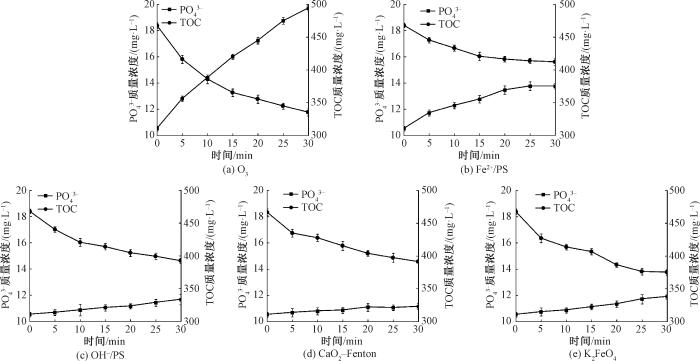
图2
不同高级氧化体系中PO43-与TOC质量浓度随反应时间的变化曲线
Fig.2
Curves of PO43- and TOC mass concentration over reaction time in different advanced oxidation systems
2.2 氧化阶段多指标去除效果对比
2.2.1 O3氧化
图3示出不同O3投加量时O3氧化体系对各污染物去除效果的影响。随O3质量浓度升至10 mg/L,NH3-N质量浓度由约300 mg/L降至250 mg/L,但TN质量浓度基本不变,表明NH3-N主要被氧化转化为其它含氮形态而非气态氮逸出。TP质量浓度始终维持在82.0~82.1 mg/L,O3对磷的形态转化与总量去除均无显著贡献。TOC去除率达34.0%,在4项指标中响应最为显著,反映出O3对THPS有机碳骨架具有较强的氧化降解能力。
图3
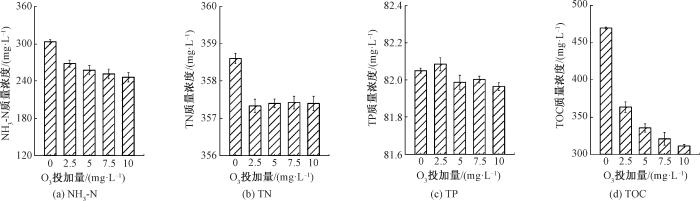
图3
不同O3投加量对废水中NH3-N、TN、TP和TOC去除效果的影响
Fig.3
Influence of different O3 dosages on removal effect of NH3-N, TN, TP and TOC in wastewater
2.2.2 碱活化PS
图4
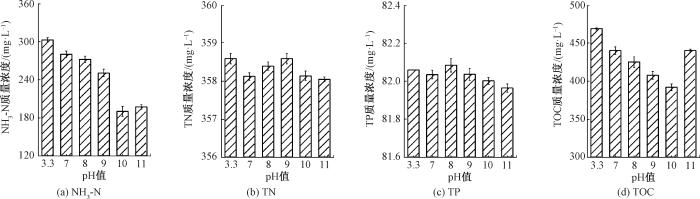
图4
不同pH值碱活化PS对废水中NH3-N、TN、TP和TOC去除效果的影响
Fig.4
Influence of alkali-activated PS on removal effect of NH3-N, TN, TP and TOC in wastewater at different pH value
2.2.3 Fe2+活化PS
图5示出不同Fe2+投加量时Fe2+/PS氧化体系对各污染物去除效果的影响。NH3-N质量浓度在Fe2+为0.01 mmol/L时降至约272 mg/L,随后随Fe2+投加量增加,质量浓度回升至285 mg/L,TN质量浓度变化趋势与之同步但幅度更小(356~358 mg/L)。这与过量Fe2+猝灭SO4·-(Fe2+ + SO4·- → Fe3+ + SO42-)导致有效自由基质量浓度下降有关[16]。TOC同样在Fe2+为0.1 mmol/L时去除效果最佳(417 mg/L),过量后质量浓度回升至468 mg/L,进一步印证了自由基猝灭效应。TP质量浓度稳定在81.8~82.0 mg/L,氧化阶段对TP无直接去除作用。综合来看,Fe2+最佳投加量为0.1 mmol/L。
图5
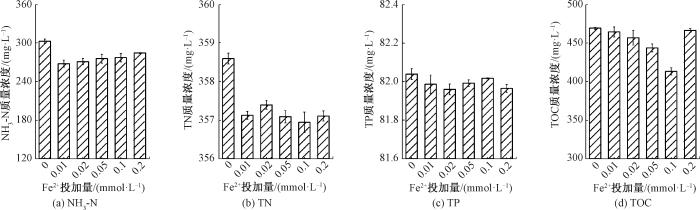
图5
不同Fe2+投加量对废水中NH3-N、TN、TP和TOC去除效果的影响
Fig.5
Influence of different Fe2+ dosages on removal effect of NH3-N, TN, TP and TOC in wastewater
2.2.4 CaO2类Fenton
图6示出不同CaO2投加量时CaO2-Fenton氧化体系对各污染物去除效果的影响。NH3-N质量浓度在299~301 mg/L小幅波动,TN质量浓度仅在CaO2最低投加量时略有下降,二者整体变化幅度极小,表明CaO2-Fenton体系对含氮污染物无显著直接去除能力。TP质量浓度始终维持在82.0~82.1 mg/L之间,结合2.1节中PO43-质量浓度增量极为有限的结果,可以判断氧化阶段Ca2+与PO43-的原位络合沉淀效应微弱,有机磷的深度去除将依赖后续化学沉淀步骤实现。TOC质量浓度随CaO2投加量增加持续下降,由约470 mg/L降至8 mmol/L时的405 mg/L,去除率为13.8%,且未出现其它体系中常见的回升拐点。这与CaO2独特的缓慢释氧机制密切相关[17],其在水中逐步水解释放H2O2,再与体系中Fe2+持续反应生成·OH[18],氧化能力随投加量线性累积而非骤然衰减,因此不存在过量猝灭效应,TOC去除效果随CaO2浓度单调递增。这一特性使CaO2-Fenton体系在氧化稳定性方面优于Fe2+/PS等依赖瞬时自由基爆发的体系。
图6
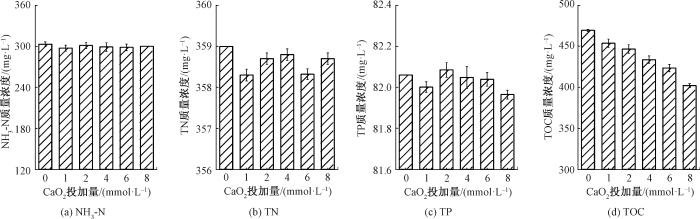
图6
不同CaO2投加量对废水中NH3-N、TN、TP和TOC去除效果的影响
Fig.6
Influence of different CaO2 dosages on removal effect of NH3-N, TN, TP and TOC in wastewater
2.2.5 K2FeO4氧化
图7示出不同K2FeO4投加量时K2FeO4氧化体系对各污染物去除效果的影响。随K2FeO4投加量升至0.2 mmol/L,NH3-N质量浓度由约300 mg/L急剧降至120 mg/L(降幅60%),但TN质量浓度几乎不变,与前述氨氮形态转化一致。同一投加量下,TOC质量浓度由约470 mg/L降至340 mg/L(去除率约27%),去除效果最为显著,反映出低浓度K2FeO4对有机物具有较强的直接氧化能力。投加量超过0.2 mmol/L后,NH3-N与TOC去除效果均小幅减弱并趋于平稳,这与过量K2FeO4发生自分解(4
图7
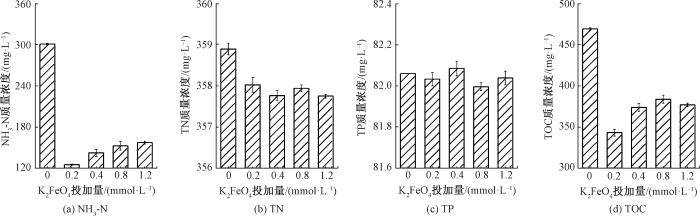
图7
不同K2FeO4投加量对废水中NH3-N、TN、TP和TOC去除效果的影响
Fig.7
Influence of different K2FeO4 dosages on removal effect of NH3-N, TN, TP and TOC in wastewater
2.3 氧化-沉淀工艺的协同效应
图8示出各AOPs在最佳工况下氧化与沉淀阶段的污染物去除贡献对比,图中P指仅沉淀、O指预氧化、O-P指氧化-沉淀。以仅沉淀处理(TP去除率为15.08%)作为基准对照,经AOPs预处理后各工艺TP总去除率均大幅提升,且沉淀阶段贡献远超氧化阶段。各体系氧化阶段水相PO43-增量有限,表明AOPs并非依赖将有机磷完全矿化为PO43-,而是通过部分断裂C—P键生成含磷酸基团的有机中间体,后者与Ca2+、Mg2+的络合沉淀能力显著强于原始THPS,在碱性沉淀条件下可快速形成稳定络合物沉降,形成预氧化活化-络合沉淀的协同除磷机制。
图8
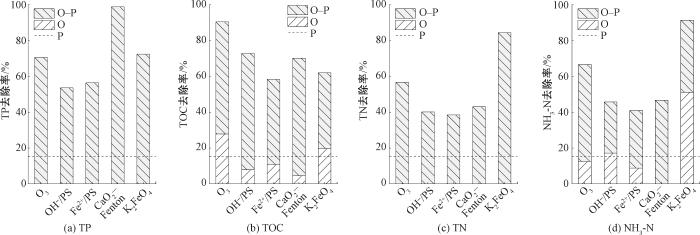
图8
不同氧化-沉淀组合工艺对TP、TOC、NH3-N和TN的去除效果
Fig.8
Removal effect of TP, TOC, NH3-N and TN by different oxidation-precipitation combined processes
CaO2-Fenton氧化-沉淀工艺对TP去除率最高(98.72%)。THPS中磷原子被羟甲基严密包裹,与Ca2+、Mg2+配位能力较弱,仅沉淀处理的工艺中,TP去除率仅为15.08%。CaO2-Fenton氧化-沉淀通过·OH适度断裂C—P键,
将有机磷转化为含磷酸基团的部分氧化中间体,磷酸根基团的氧原子孤对电子得以暴露,与Ca2+、Mg2+的配位能力显著增强;同时CaO2原位释放的Ca2+与外加Ca2+、Mg2+协同,在pH=11条件下与含磷中间体形成稳定络合沉淀,实现高效除磷。K2FeO4氧化-沉淀时的TP去除率(72.33%)次之,产生的Fe(III)絮体兼具吸附共沉淀功能。O3产生最高水相PO43-增量,但TP去除率(70.52%)低于前二者。游离PO43-易受共存离子竞争干扰,沉淀效率存在上限,而含磷酸基团的有机中间体分子量较大,可通过多点螯合与絮凝共沉淀实现更高效去除。这表明部分氧化路径的络合沉淀效率优于深度矿化路径;OH-/PS和Fe2+/PS氧化-沉淀工艺对TP去除率在53%~57%之间,活化程度相对有限。
TOC去除方面,O3氧化-沉淀工艺去除率最高(90.39%),这与O3对有机碳骨架的强氧化分解能力有关,OH-/PS和CaO2-Fenton氧化-沉淀工艺次之,Fe2+/PS和K2FeO4相对较低。含氮污染物去除方面,K2FeO4氧化-沉淀工艺表现最为突出,NH3-N与TN的总去除率在5种工艺中最高,这与Fe(VI)的强氧化性及还原产物Fe(III)絮体的协同作用有关[20]。其它工艺对含氮污染物的去除效果相对有限,表明该类废水的深度脱氮仍需依赖后续专项处理工艺。
2.4 能耗和成本与减污降碳协同评估
2.4.1 运行成本分析
各工艺运行成本及单位污染物去除成本见表1。综合运行成本以OH-/PS氧化-沉淀工艺最低,O3氧化-沉淀工艺因引入电耗成本最高。在单位污染物去除成本方面,CaO2-Fenton氧化-沉淀工艺除磷性价比最优,OH-/PS氧化-沉淀工艺的TOC去除成本最低。综合来看,若以除磷为优先目标,CaO2-Fenton氧化-沉淀工艺具有明显的成本优势,其单位除磷成本仅为71.3元/g,在5种工艺中最低;若以有机物去除为优先目标,OH-/PS氧化-沉淀工艺性价比最高。
表1 各预氧化-沉淀工艺的处理成本
Tab.1
| 氧化-沉淀 工艺 | 电耗①/ (kW·h· m-3) | 氧化药剂 成本/ (元·m-3) | 沉淀药 剂成本/ (元· m-3) | 综合 成本/ (元· m-3) | 污泥 产量 | 操作 复杂 度 |
|---|---|---|---|---|---|---|
| O3 | 10 | 0.50(O2) | 3.80 | 12.30 | 低 | 中 |
| OH-/PS | — | 0.13 | 3.80 | 3.93 | 低 | 低 |
| Fe2+/PS | — | 0.56 | 3.80 | 4.36 | 中 | 中 |
| CaO2- Fenton | — | 1.98 | 3.80 | 5.78 | 高 | 低 |
| K2FeO4 | — | 1.77 | 3.80 | 5.57 | 中 | 低 |
注:①表示各工艺均使用磁力搅拌器搅拌,但实验室小试条件下电耗不具代表性,故不计入成本核算。O3电耗参考工程应用文献[
2.4.2 减污降碳协同评估
在降碳方面,5种组合工艺中仅O3工艺存在较大的直接电耗碳排放,按华东电网排放因子(0.525 7 kgCO2·kW/h)计算,O3工艺直接碳排放为5.26 kgCO2/m3。其它4种组合工艺无直接电耗,碳排放主要来源于药剂生产的隐含碳,以药剂投加量作为相对比较依据:OH-/PS体系的药剂投加量最少,隐含碳最低;CaO2-Fenton和K2FeO4体系的药剂用量相对较高,隐含碳居中。
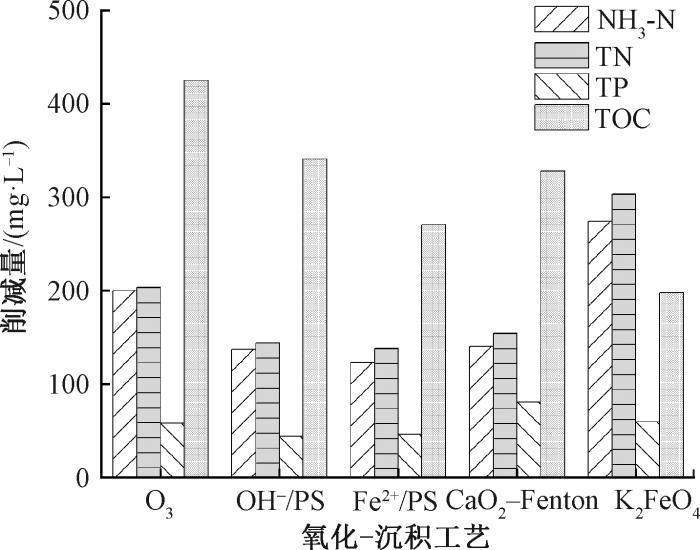
在减污方面,各组合工艺对TP、TOC的削减量差异显著(见图9)。CaO2-Fenton氧化-沉积工艺中,对TP的减量最大(81.03 mg/L),在O3氧化-沉淀工艺中,对TOC的削减量最高(424.9 mg/L)。结合降碳,无直接电耗的药剂体系在单位碳排放条件下可实现更高的减污效益,减污降碳协同优势更为突出;在O3氧化-沉淀工艺中,对TOC去除效果最佳,但其较高的直接碳排放削弱了减污降碳的协同效益。
图9
此外,AOPS预处理大幅降低了废水中有机磷和TOC质量浓度,可显著减轻后续生化处理系统的有机负荷,降低曝气能耗和污泥处理成本,产生间接降碳效益。O3和OH-/PS氧化-沉淀工艺在这一维度具有明显优势。CaO2-Fenton体系产生的含磷污泥理论上可作为低品位磷肥回用,实现磷资源的循环利用,强化减污降碳的协同效益。
2.4.3 各氧化工艺多角度评估
从TP去除效果、TOC去除效果、NH3-N形态转化效果、TN去除效果、运行成本、污泥产量及操作可行性7个维度对5种组合工艺进行综合评估,结果如图10所示。CaO2-Fenton氧化-沉淀工艺在TP去除方面得分最高,操作可行性较优,但污泥产量大、运行成本居中,适用于以除磷为核心目标的场景。O3氧化-沉淀工艺TOC去除效果最突出、污泥产量低,但运行成本最高,适用于以有机物深度去除为主的场景。OH-/PS氧化-沉淀工艺运行成本最低,但TP去除能力相对较弱,适用于对低碳运行要求较高的场景。Fe2+/PS氧化-沉淀工艺各维度表现均衡但无突出优势,综合得分居中。K2FeO4氧化-沉淀工艺在TP去除和操作可行性方面表现较好,NH3-N形态转化效果在5种工艺中最优,需严格控制氨氮排放时推荐。综合来看,各工艺在不同维度各具优劣,实际工程中应据出水水质目标灵活选择。
图10
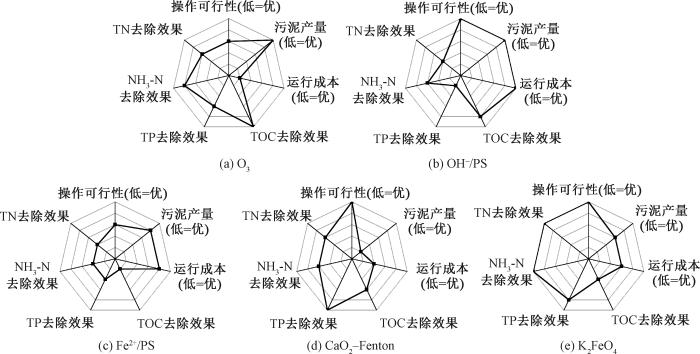
图10
不同氧化-沉淀组合工艺的污染物削减效能与运行成本评价
Fig.10
Pollutant removal performances and operational cost evaluations of different oxidation-precipitation combined processes
3 结论
以THPS阻燃整理废水为研究对象,系统考察了5种典型高级氧化技术(AOPs)与化学沉淀组合工艺的处理效能,并引入成本与减排维度进行综合评价,主要得出以下结论。
1)AOPs的核心作用在于部分断裂有机磷C—P键,生成含磷酸基团的有机中间体,形成预氧化活化-络合沉淀的协同除磷机制,但深度脱氮仍需依赖后续专项处理工艺。
2)CaO2类Fenton氧化-沉淀工艺对TP的去除率最高(98.72%),每克磷的处理成本最低(71.3元/g),综合性价比最优;O3氧化-沉淀工艺对TOC的去除率最优(90.39%);K2FeO4氧化-沉淀工艺氨氮(NH3-N)形态转化效果最突出;碱活化PS综合运行成本最低(3.93元/m3)。
3)无直接电耗的药剂体系降碳协同效益优于O3体系。以除磷为优先目标推荐CaO2-Fenton氧化-沉淀体系,以低碳运行和有机物去除为优先目标推荐碱活化PS体系,需控制NH3-N排放时推荐K2FeO4体系。
参考文献
原位水解生成的羟基氧化铁凝聚吸附除磷效能与机制
[J].
Effectiveness and mechanism of the in situ formed iron hydroxide(FeOxHy) towards the removal of phosphate by coagulation and adsorption
[J].
基于高级氧化技术降解水中OPPs的研究进展
[J].
Research progress on degradation of organophosphorus pesticides in water based on advanced oxidation technology
[J].
络合沉淀结合混凝法去除浮选废水中有机磷
[J].
Dephosphorization of flotation wastewater containing organophosphor using complex precipitation method
[J].
臭氧联合混凝沉淀法去除浮选废水中有机磷
[J].
Dephosphorization of flotation wastewater containing organic phosphorus using ozone-coagulation sedimentation method
[J].
Effects of tetrakis(hydroxymethyl)phosphonium sulfate pretreatment on characteristics of sewage sludge
[J].DOI:10.1016/j.jes.2018.09.013 URL [本文引用: 1]
When the smoke disappears: dealing with extinguishing chemicals in firefighting wastewater
[J].
DOI:10.2166/wst.2014.081
PMID:24759534
[本文引用: 1]

Water is not enough. Nowadays, numerous chemicals are used for fire extinction. After use, however, these may unintentionally enter sewerage systems. In order to safely treat firefighting wastewater (FFWW), knowledge of the potential effects of these chemicals on biological treatment processes is essential. This study characterized and mimicked the composition of FFWW containing two powders, three foams and one foam degrader. Nitrogen (162-370 mg NH4(+)-N L(-1)) and phosphorus (173-320 mg PO4(3-)-P L(-1)) concentrations exceeded discharge limits, whereas chemical and biological oxygen demand, suspended solids and detergent concentrations remained sufficiently low. Adequate nutrient removal could be obtained through FeCl3 addition and nitrification/denitrification with acetate as substrate. In batch tests, residual nitrifying activities of 84, 81, 89, 95 and 93% were observed in the presence of powders, foams, foam degrader, synthetic and real FFWW, respectively. All categories showed higher denitrification rates than the control. Although the powders at first seemed to inhibit anammox activity at 82%, after pH correction anammox was fully feasible, allowing nitrogen removal through oxygen-limited nitrification/denitrification (OLAND). Detailed cost calculations indicated that OLAND could save 11% of capital and 68% of operational costs compared to nitrification/denitrification, identifying OLAND as the most recommendable process for nitrogen removal from firefighting wastewaters.
牦牛绒均相高级氧化脱色技术及机制
[J].
Yak wool decolorization using homogeneous advanced oxidation technology and its mechanism
[J].
基于还原-氧化体系的活性染料染色棉织物剥色
[J].
DOI:10.13475/j.fzxb.20231202601
[本文引用: 1]
为解决传统剥色工艺复杂、剥色时间长、剥色过程能耗大等问题,设计并采用二氧化硫脲与过硫酸钠联合组成的还原-氧化剥色体系对活性蓝KN-R染色棉织物进行剥色,分析了剥色液中剥色剂质量浓度、碱剂质量浓度、剥色时间以及温度对剥色效果和棉织物强力的影响,探究了剥色剂对染色棉织物进行剥色的剥色机制。得到的二氧化硫脲体系最佳剥色工艺条件为:二氧化硫脲质量浓度2 g/L,氢氧化钠质量浓度6 g/L,剥色时间20 min,剥色温度60 ℃。过硫酸钠体系最佳剥色工艺条件为:过硫酸钠质量浓度6 g/L,氢氧化钠浓度质量4 g/L,剥色时间20 min,剥色温度60 ℃。在最佳剥色工艺条件下对活性蓝KN-R染色棉织物剥色率达到96.05%,强力保留率也维持在90%以上。相比于传统剥色工艺,二氧化硫脲-过硫酸钠剥色体系对染色棉织物进行剥色的剥色率较高,织物强力损伤较小,所需剥色剂用量少,剥色时间短,剥色温度低,是一种高效、节能的剥色方法。
Color stripping performance of cotton fabrics dyed with reactive dyes based on reduction-oxidation system
[J].
DOI:10.13475/j.fzxb.20231202601
[本文引用: 1]
<p id="p00005"><strong>Objective</strong> The annual production of waste textiles is enormous, and the existing treatment routes such as chemical incineration and physical landfill are commonly employed to deal with waste textiles. These methods not only severely pollute the environment but also result in significant resource waste. Therefore, recycling waste textiles is crucial for conserving resources and reducing pollution. Color stripping is a prerequisite for recycling the colored waste textiles. However, conventional color stripping processes are characterized by high energy consumption, low efficiency, and operational complexity. This research aims to develop an environmentally friendly color stripping process that is both low in energy consumption and easy to operate as an alternative to the conventional color stripping methods. </p> <p id="p00113"><strong>Method</strong> A reduction-oxidation stripping system, employing thiourea dioxide (TD) as the reducing agent and sodium persulfate (Na<sub>2</sub>S<sub>2</sub>O<sub>8</sub>) as the oxidizing agent, was used to strip the dyed cotton fabrics colored with Reactive Blue KN-R. The influences of stripping agent concentration, alkali concentration, stripping time, and temperature on the color stripping rate and the strength retention rate of the fabric were investigated. After stripping, the <i>K/S</i> values of the fabrics were measured using spectrophotometers to determine the color stripping rate. The strength retention rate was measured using an electronic fabric strength tester. All samples were measured three to five times to obtain an average value. </p> <p id="p00112"><strong>Results</strong> In the reductive color stripping process, the concentration of NaOH significantly affected the removal of dye molecules. When the concentration of NaOH was increased from 1 g/L to 6 g/L, the stripping rate increased from 73.09% to 86.95%. Excessive dosage of TD resulted in slight decreases in both color stripping rate and strength retention rate, indicating that excessive TD concentration is not conducive to colorant removal. The color stripping rate increased with time but showed minimal improvement beyond 20 min. Higher temperatures improved the color stripping rate but also caused a notable decrease in strength retention rate. When the temperature of the stripping system reached 70 ℃, after stripping for 20 minutes, the fabric strength retention rate dropped below 90%. In the oxidative stripping process, the stripping rate was higher than 90.00% with the dosage of NaOH being more than 1 g/L. A gradually increasing tendency was also obtained as the concentration of the oxidant Na<sub>2</sub>S<sub>2</sub>O<sub>8</sub> being increased from 1 g/L to 6 g/L. Similarly, the color stripping rate was increased within 20 minutes and stabilized afterward. Higher temperature also increased the color stripping rate but damaged the cotton fabrics, reducing the strength retention rate. After TD reduction stripping and Na<sub>2</sub>S<sub>2</sub>O<sub>8</sub> oxidation stripping, the fabric color changed from blue to purple and eventually to white. Additionally, the sequential reduction-oxidation stripping system effectively stripped fabrics dyed with other reactive dyes. For fabrics dyed with Reactive Red M-3BE, Reactive Red X-3B, Reactive Blue KN-G, and Reactive Blue M-BE, the initial reductive color stripping rates were 91%, 93%, 64%, and 78%, respectively. The subsequent oxidative stripping further improved the rates to 97%, 98%, 83%, and 96%, respectively.</p> <p id="p00111"><strong>Conclusion</strong> The sequential stripping system of TD reduction and Na<sub>2</sub>S<sub>2</sub>O<sub>8</sub> oxidation can serve as an alternative to conventional color stripping methods. For the cotton fabrics dyed with Reactive Blue KN-R, the stripping rate can reach 96% under low-temperature conditions, while the strength retention rate remains above 90%. The optimized TD reductive stripping process includes a thiourea dioxide concentration of 2 g/L, NaOH concentration of 6 g/L, stripping time of 20 minutes, and stripping temperature of 60 ℃. The optimized Na<sub>2</sub>S<sub>2</sub>O<sub>8</sub> oxidative stripping process includes a sodium persulfate concentration of 6 g/L, NaOH concentration of 4 g/L, stripping time of 20 minutes, and stripping temperature of 60 ℃. Compared to traditional color stripping processes, the new method causes less fabric damage, uses fewer stripping agents, requires shorter stripping times, and operates at lower temperatures. Moreover, the sequential reduction-oxidation stripping system is applicable to a wide range of reactive dyes.</p>
乙烯砜型活性染料染色废液的臭氧处理及循环利用
[J].
Dyeing of cotton fabric with reactive dyes and ozonated spent dyebath water
[J].
铁基双金属活化过硫酸盐降解有机废水研究进展
[J].
DOI:10.16796/j.cnki.1000-3770.2025.07.004
[本文引用: 1]
基于自由基和非自由基途径的高级氧化技术等替代化学处理技术在水处理中越来越受到重视,特别是基于铁的双金属类芬顿反应和基于硫酸根自由基的高级氧化工艺在处理有机污染物中得到了广泛的应用。包括铁在内的过渡金属在有机污染环境的修复中被广泛用作过硫酸盐活化剂,铁与其他金属形成双金属结构可以调节催化剂的电子结构和活性位点,因此铁基双金属催化剂通常表现出更高的稳定性、催化活性、回收利用性。根据国内外研究现状,综述了近年来铁基双金属催化剂的制备方法、活化机理以及降解应用,讨论了影响铁基双金属催化剂稳定性及其活化过硫酸盐体系降解率的主要因素,最后对该体系降解有机废水的发展趋势和研究方向作出了展望。
Progress on the degradation of organic wastewater by iron-based bimetallic activated persulfate
[J].
DOI:10.16796/j.cnki.1000-3770.2025.07.004
[本文引用: 1]
Alternative chemical treatment methods, including radical- and non-radical-based advanced oxidation processes, have drawn increasing attention in water treatment. In particular, the Fenton-like bimetallic reaction centered on iron and sulfate radical-based oxidation are widely applied to remove organic contaminants. Transition metals, including iron, serve as common persulfate activators in remediating organic pollution, and forming bimetallic complexes between iron and other metals fine-tunes the catalyst's electronic structure and active sites. Consequently, iron-based bimetallic catalysts frequently exhibit enhanced stability, catalytic potency, and recyclability. Drawing on current domestic and international research, this paper reviews recent developments in the fabrication, activation mechanism, and applications of iron-supported bimetallic catalysts for pollutant degradation. Key factors affecting the catalyst's stability and the activation efficiency of peroxodisulfate-based systems are also discussed, along with possible future directions for organic wastewater treatment using these catalysts.
退浆废水预氧化-絮凝一体化处理及资源化技术
[J].
Integrated treatment and resource recovery technology of desizing wastewater through pre-oxidation and flocculation
[J].
Removal of organoarsenic with ferrate and ferrate resultant nanoparticles: oxidation and adsorption
[J].DOI:10.1021/acs.est.8b01718 URL [本文引用: 1]
Catalytic versus pure ozonation: insights from real wastewater treatment performance
[J].DOI:10.1021/acs.est.5c15666 URL [本文引用: 1]
Impact of phosphate on ferrate oxidation of organic compounds: an underestimated oxidant
[J].DOI:10.1021/acs.est.8b04655 URL [本文引用: 1]
The role of sulfate radicals and pH in the decomposition of persulfate in aqueous medium: a step towards prediction
[J].DOI:10.1016/j.ceja.2022.100331 URL [本文引用: 1]
聚合多巴胺功能化非织造布增强Fe2+活化过硫酸盐降解酸性红B
[J].
Enhanced degradation of acid red B by Fe2+ activated persulfate with polydopamine functionalized nonwovens cloth
[J].
缓释氧剂的制备及其在黑臭水体治理方面的应用研究
[J].
DOI:10.16606/j.cnki.issn0253-4320.2018.12.037
[本文引用: 1]
采用聚乙烯醇(PVA)为包埋剂,制备了以火山渣为填充剂、过氧化钙(CaO<sub>2</sub>)为氧源的缓释氧剂,旨在为黑臭水体治理提供一种高效可行的方式。通过清水实验和黑臭水体实验,研究了缓释氧剂的释氧性能及其在污染物去除方面的作用。结果表明,相较粉末状过氧化钙,缓释氧剂的释氧得到有效控制,且对pH的影响相对减弱。在2 L的黑臭水体中投加6.08 g缓释氧剂后,DO峰值达5.16 mg/L,且19 d内仍维持在2 mg/L以上,COD由145.99 mg/L降至28.6 mg/L,总磷去除率达95%以上。表明缓释氧剂能显著改善黑臭水体上覆水的溶氧状态,且对COD和总磷的去除有积极的促进作用。
Preparation of slow oxygen-releasing agent and application in treatment of urban black odorous water
[J].
DOI:10.16606/j.cnki.issn0253-4320.2018.12.037
[本文引用: 1]
A slow oxygen-releasing agent is prepared by using polyvinyl alcohol (PVA) as an embedding agent,scoria as a filling agent and CaO<sub>2</sub> as an oxygen source,aiming at providing an efficient and feasible way to treat black and odorous water.The oxygen-releasing performance of slow oxygen-releasing agent and its role in the removal of pollutants are evaluated through experiments on clear water and black odorous water,respectively.It is indicated that the oxygen release rate of slow oxygen-releasing agent is controlled effectively compared with powdered calcium peroxide,and the effect on pH value weakens relatively.After adding 6.08 g of slow oxygen-release agent into 2 L of black odorous water,the highest concentration of dissolved oxygen reaches 5.16 mg·L<sup>-1</sup> and maintains above 2 mg·L<sup>-1</sup> in 19 days,the concentration of <i>COD</i> decreases from 145.99 mg·L<sup>-1</sup> to 28.6 mg·L<sup>-1</sup> and the maximum removal rate of total phosphorus exceeds 95%.It indicates that this slow oxygen-releasing agent can significantly improve the dissolved oxygen state of the overlying water in the black odorous water and promote the removals of <i>COD</i> and total phosphorus.
Properties of calcium peroxide for release of hydrogen peroxide and oxygen: a kinetics study
[J].DOI:10.1016/j.cej.2016.05.123 URL [本文引用: 1]
高铁酸盐体系中高价铁氧中间体对双酚A的降解研究
[J].
DOI:10.16606/j.cnki.issn0253-4320.2024.04.031
[本文引用: 1]
以典型内分泌干扰物双酚A(BPA)为目标污染物,研究了高铁酸钾[Fe(Ⅵ)]对其的去除效果及机理。通过高效液相色谱仪、离子色谱仪等手段考察了pH、Fe(Ⅵ)投加量和共存离子等因素对BPA去除效果的影响。结果表明,在pH为8.0、Fe(Ⅵ)与BPA浓度比为30:1时,反应10 min后BPA的降解率达到81.5%。Cl<sup>-</sup>、SO<sup>2-</sup><sub>4</sub>、NO<sup>-</sup><sub>3</sub>、HCO<sup>-</sup><sub>3</sub>等共存阴离子未影响 Fe(Ⅵ)体系的氧化能力,但Ca<sup>2+</sup>和Mg<sup>2+</sup>因加速了Fe(Ⅵ)自分解而抑制了BPA降解。通过淬灭实验对体系中的活性氧物种进行识别,Fe(Ⅵ)及其高价铁氧中间体Fe(Ⅴ)/Fe(Ⅳ)在氧化BPA中起主导作用。在实际水体(自来水、市政二级出水和地下水)中,Fe(Ⅵ)氧化体系对BPA的降解未受到明显影响,证实其具有较高的环境适应性。
Oxidation degradation of bisphenol A by high-valent iron oxide intermediates in ferrate system
[J].
DOI:10.16606/j.cnki.issn0253-4320.2024.04.031
[本文引用: 1]
The removal effect and mechanism of potassium ferrate (Fe(Ⅵ)) on bisphenol A (BPA),a typical endocrine disruptor chemical substance,are studied.The effects of pH value,Fe(Ⅵ) dosage,and coexisting ions on the removal efficiency of BPA are investigated through using high-performance liquid chromatography (HPLC),ion chromatography,and other measurements.The results show that the degradation rate of BPA reaches 81.5% after 10 minutes of reaction at a pH of 8.0 and a Fe(Ⅵ) to BPA concentration ratio of 30:1.The co-existed anions including Cl<sup>-</sup>,SO<sup>2-</sup><sub>4</sub>,NO<sup>-</sup><sub>3</sub> and HCO<sup>-</sup><sub>3</sub> exert negligible effect on the oxidation ability of Fe(Ⅵ) system,while Ca<sup>2+</sup> and Mg<sup>2+</sup> both accelerate the self-decomposition of Fe(Ⅵ) and therefore suppress the degradation of BPA.The reactive oxygen species in the system are identified through quenching experiments,and Fe(Ⅵ) and its intermediate high valence product Fe(Ⅴ)/Fe(Ⅳ) play a dominant role in the oxidation of BPA.In some real water bodies (tap water,municipal secondary effluent,and groundwater),no obvious negative effects on degradation of BPA by Fe(Ⅵ) oxidation system have been observed,indicating a high adaptability.
Remarkable efficiency of phosphate removal: ferrate(VI)-induced in situ sorption on core-shell nanoparticles
[J].
DOI:S0043-1354(16)30525-5
PMID:27438903
[本文引用: 1]
Despite the importance of phosphorus as a nutrient for humans and its role in ecological sustainability, its high abundance, resulting in large part from human activities, causes eutrophication that negatively affects the environment and public health. Here, we present the use of ferrate(VI) as an alternative agent for removing phosphorus from aqueous media. We address the mechanism of phosphate removal as a function of the Fe/P mass ratio and the pH value of the solution. The isoelectric point of γ-Fe2O3 nanoparticles, formed as dominant Fe(VI) decomposition products, was identified to play a crucial role in predicting their efficiency in removing of phosphates. Importantly, it was found that the removal efficiency dramatically changes if Fe(VI) is added before (ex-situ conditions) or after (in-situ conditions) the introduction of phosphates into water. Removal under in-situ conditions showed remarkable sorption capacity of 143.4 mg P per gram of ferric precipitates due to better accessibility of active surface sites on in-situ formed ferric oxides/oxyhydroxides. At pH = 6.0-7.0, complete removal of phosphates was observed at a relatively low Fe/P mass ratio (5:1). The results show that phosphates are removed from water solely by sorption on the surface of γ-Fe2O3/γ-FeOOH core/shell nanoparticles. The advantages of Fe(VI) utilization include its environmentally friendly nature, the possibility of easy separation of the final product from water by a magnetic field or by natural settling, and the capacity for successful phosphate elimination at pH values near the neutral range and at low Fe/P mass ratios.Copyright © 2016 Elsevier Ltd. All rights reserved.
A2O+MBR+臭氧催化氧化用于化工园区污水厂升级改造
[J].
Application of A2O/MBR/catalytic ozonation in upgrading and reconstruction of waste water treatment plant in chemical industrial park
[J].

 京公网安备11010502044800号


