



本文以大麻脱胶废水为研究对象,探究其固沙可行性。优化大麻多糖的固沙应用参数,分析多胶质组分对固沙效果的影响,明确多糖分子量与固沙性能的关系,旨在为大麻产业的绿色可持续发展提供技术支撑。
1 实验部分
1.1 实验材料与仪器
实验材料:大麻脱胶废水,由江西恩达麻世纪科技股份有限公司提供,pH值9,总盐质量浓度4 000 mg/L,COD值6 500 mg/L,废水中主要金属离子为钠离子(浓度3.18×103 mg/kg),未检出汞、镉、锌、铜、铅和硒。沙粒,平均粒径0.25 mm,取自内蒙古自治区乌海市沙地。PVA固沙剂(分析纯,重均分子量140 ku)、木质素固沙剂(纯度98%,重均分子量2 ku),购自默克化学试剂有限公司。葡聚糖(生化试剂),重均分子量分别为1、5、50、500 ku,购自美国Sigma公司。柠条种子,由内蒙古林业科学院提供。苯酚、硫酸、考马斯亮蓝G-250、四硼酸钠、间羟基联苯、3,5-二硝基水杨酸(DNS),均为分析纯,购自国药集团化学试剂有限公司。
实验仪器:BGZ-76型烘箱,博迅有限公司;TU-1810S型紫外分光光度计,北京普析通用仪器有限责任公司;Waters 2695型高效液相色谱仪,美国Waters公司;TYD-1型土壤硬度计,台州仪器有限公司;Nexus 670型傅里叶变换红外光谱仪,美国Thermo Nicolet公司;EM-30 Plus型扫描显微镜,韩国Coxem公司;ZEISS Gemini SEM 300型场发射扫描电子显微镜,德国卡尔蔡司公司;ESCALAB 250Xi型X射线光电子能谱仪,美国赛默飞世尔科技公司。
1.2 大麻脱胶废水的固沙实验方法
1.2.1 结壳成形实验及固沙工艺参数优化
将一定质量浓度的固沙剂按设计喷洒量均匀喷施于沙粒表面;先在80 ℃烘箱内干燥8 h,再于20 ℃烘箱中干燥16 h。重复上述干燥步骤4次后在温度20 ℃、相对湿度50% 环境中静置4 h,形成稳定完整的沙胶结壳。后续所有实验组、对照组样品均统一采用本流程制备。
以结壳硬度1~2 kg/cm2、结壳厚度2~3 cm为目标,优化固沙剂喷洒量和多糖质量浓度。固定多糖质量浓度为6 g/L,在喷洒量2.5~14 kg/m2范围内进行优化;在确定最优喷洒量基础上,于多糖质量浓度1~12 g/L区间内确定最佳施用浓度。
1.2.2 PVA及木质素与大麻多糖固沙效果对比
统一采用5 kg/m2喷洒量,以硬度1~2 kg/cm2为控制标准,分别调控并优化PVA、木质素的质量浓度。达到同等结壳硬度时,对比大麻多糖、PVA及木质素三者的浓度差异。
1.2.3 胶质组分对多糖固沙性能的影响
固定脱胶废水的喷洒量5 kg/m2,分别设置其多糖质量浓度为2、5、8 g/L,在0~2 g/L质量浓度范围内改变木质素、果胶和蛋白质添加量,探究3类胶质组分对多糖固沙性能的影响。
1.2.4 适宜固沙的多糖分子量范围筛选
选择重均分子量为1~500 ku的葡聚糖标准品为模拟试样,采用优化后的喷洒量5 kg/m2和多糖质量浓度5 g/L制备结壳,以结壳硬度为评价指标,确定适配固沙应用的多糖重均分子量范围。
1.3 测试与表征
1.3.1 胶质浓度测试
采用紫外分光光度计测定大麻脱胶废水中各类胶质浓度,具体方法如下:室温下多糖在硫酸介质中与苯酚反应30 min后生成橙黄色化合物[17],于490 nm波长处测定吸光度并计算其浓度。多糖标准曲线在0.008~0.036 mg/mL质量浓度范围内线性良好;室温下蛋白质与考马斯亮蓝结合后呈现青色[18],静置10 min后在595 nm波长处测定吸光度并计算其浓度。蛋白质标准曲线在0.01~0.1 mg/mL质量浓度范围内线性良好;果胶在100 ℃含四硼酸钠的硫酸溶液中反应6 min后冷却至室温,再与间羟基联苯反应生成粉红色衍生物[19],在528 nm波长处测定吸光度。果胶标准曲线在质量浓度0.01~0.2 mg/mL范围内线性良好;室温下,DNS试剂中的木质素在0.08~1.2 mg/mL质量浓度范围内与530 nm波长处的吸光度值呈良好线性关系[20],据此计算木质素浓度。
1.3.2 胶质分子量测试
采用凝胶液相色谱法测试多糖、果胶、木质素和蛋白质的重均分子量。多糖、果胶、木质素的测试使用示差折光检测器,选择0.1 mol/L硝酸钠流动相。使用UltrahydrogelTMLinear 300 mm×7.8 mm色谱柱,柱温为40 ℃,流速为0.5 mL/min。采用Dextran标准品校准标准曲线。蛋白质的测试使用紫外检测器,选择乙腈/水(40/60)流动相。使用TSKgel 2000 SWxl 300 mm×7.8 mm色谱柱,柱温为30 ℃,流速为0.5 mL/min。采用已知重均分子量的细胞色素C、抑肽酶、杆菌肽及乙氨酸校准标准曲线。
1.3.3 结壳硬度和结壳厚度测试
采用土壤硬度计在结壳样的中心位置测试其结壳硬度;结壳厚度用游标卡尺测试。每个数据测试5次,结果以平均值±标准差的形式计值。
1.3.4 化学结构表征
采用傅里叶变换红外光谱仪测试多糖结壳的红外光谱,采用衰减全反射模式,使用金刚石晶体。每个样品扫描64次,波数范围为4 000~650 cm-1,分辨率为2 cm-1。
1.3.5 结壳密度测试
在结壳厚度方向不同位置处截取5 mm×5 mm×2 mm(长×宽×高)的固沙样品,测试其质量和体积,用其质量(含胶质)与体积的比值计算结壳密度。
1.3.6 结壳内胶质含量测试
测试前,分别取结皮层、结壳中层及结壳底层的沙粒聚集体,按质量比1∶10浸没于去离子水中,室温下采用800 r/min磁力搅拌2 h。先用孔径为150 μm的不锈钢筛网过滤去除沙粒,再用孔径为0.45 μm的微孔滤膜过滤并收集滤液。参照1.3.1节的比色法测定滤液中各类胶质的浓度,再通过浓度与溶液体积的乘积,计算得到每克沙粒聚集体中各类胶质的含量。
1.3.7 元素组成表征
采用场发射扫描电镜的能量色散X射线光谱分析模式对沙粒表面进行扫描(400倍),采集Ca、C元素的面分布图,观察2种元素分布的一致性。
1.3.8 元素价态表征
采用X射线光电子能谱仪先做全谱扫描,再采集Ca 2p精细谱。用Avantage软件校准后分析Ca 2p峰位置变化,并对Ca 2p精细谱进行分峰拟合。
1.3.9 结壳保水性测试
模拟荒漠夏季地表昼夜温度变化,选取25、80 ℃这2个特征温度,进行8 h保水性能测试。按优化工艺制备多糖结壳,分别在2种温度下恒温干燥 8 h,以烘干后与烘干前结壳内水分质量的比值计算结壳的水分保留率,水分质量精确至0.000 1 g;同步测试 PVA、木质素结壳的保水性,进行横向对比分析。每个样品测试5次,结果以平均值±标准差的形式计值。
1.3.10 结壳的种子发芽测试
将柠条种子以400 粒/m2的播种密度均匀埋于沙壤(初始含水率0.1%)下(1±0.1) cm处,按优化工艺喷施固沙剂。设定培养条件:温度25 ℃、相对湿度50%、光照强度1 000 lx。恒温培养7 d 后统计发芽率(发芽种子数与埋入总种子数之比),对比不同固沙材料对种子萌发作用的差异。
1.3.11 表观形貌观察
采用扫描电子显微镜观察结壳内沙粒结合体的堆砌紧密程度及多糖聚合物薄膜的表面形态。将结壳表面在9 mA电流下溅射镀金120 s后,在15 kV电压下观察。
1.3.12 结壳总盐含量计算
首先切取一定面积的沙胶结壳,称取结壳干态质量;然后按下式计算结壳总盐含量:
式中:C为结壳总盐含量,g/kg;C1为固沙剂溶液的多糖质量浓度,mg/L;C0为脱胶废水的多糖质量浓度,mg/L;Cs为脱胶废水的总盐质量浓度,mg/L;S为结壳面积,m2;R为单位面积的固沙剂喷洒量,kg/m2;D为固沙剂溶液的密度,g/cm3;G为结壳干态质量,kg。
1.3.13 统计分析
所有实验数据均独立重复测试不少于5次,结果以平均值±标准差表示。采用SPSS Statistics 25软件进行单因素方差分析,比较组间统计学差异。图中统计学显著性标记:*表示p<0.05,**表示p<0.01,***表示p<0.001。
2 结果与讨论
2.1 大麻脱胶废水的胶质组成
图1示出大麻脱胶废水中多糖、果胶、木质素及蛋白质4种胶质的重均分子量Mw和质量浓度。由图可见,脱胶废水中多糖重均分子量最高,达到822 ku,依次高于果胶、木质素与蛋白质;4种胶质中多糖质量浓度最高,为9.1 g/L。其它3种组分质量浓度大小排序依次为木质素、果胶、蛋白质。4类胶质主要依靠氢键作用黏结沙粒,其重均分子量与质量浓度是决定结壳硬度的核心因素。综上可知,大麻脱胶废水中的多糖组分是沙胶结壳成型的关键物质。
图1
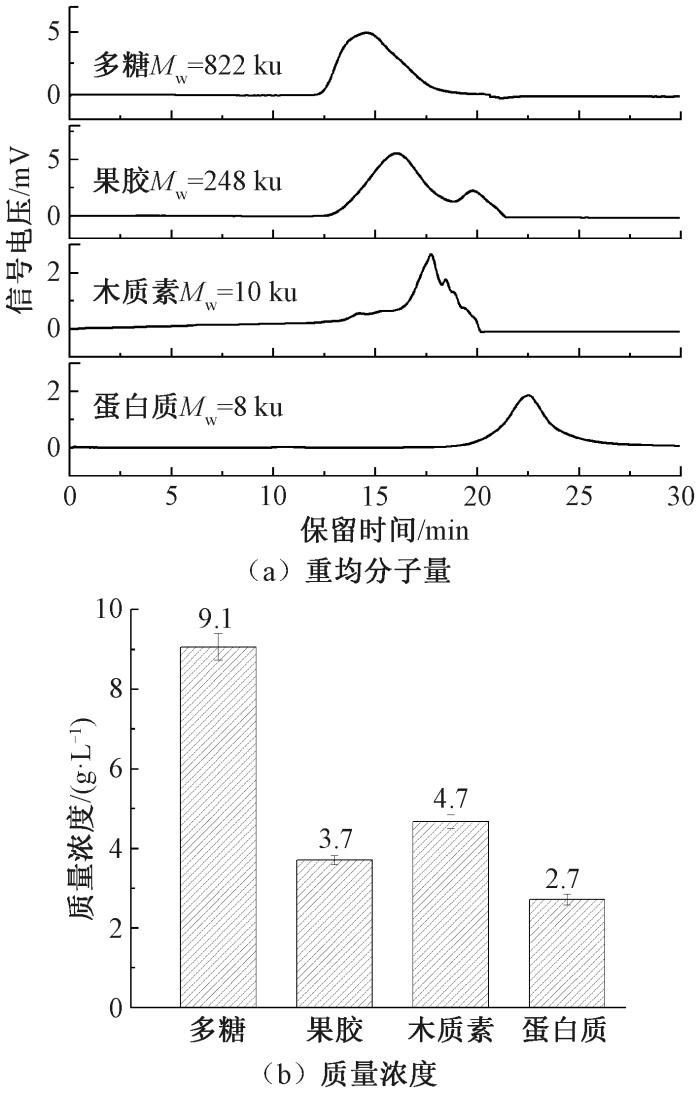
图1
大麻脱胶废水中4种胶质组分的重均分子量和质量浓度
Fig.1
Weight-average molecular weights (a) and mass concentrations (b) of four gum components in hemp degumming wastewater
2.2 多糖固沙剂应用参数优化
图2示出多糖质量浓度恒定6 g/L条件下固沙剂喷洒量对结壳硬度和厚度的影响规律。可以看出,在固沙剂喷洒量2.5~7 kg/m2范围内,结壳硬度与厚度均呈快速升高趋势。该区间内,渗入沙层的多糖沿厚度方向快速扩散渗透,有效黏结的沙粒数量快速增加,使结壳硬度和厚度同步提升。当喷洒量超过7 kg/m2后,结壳硬度和厚度的增长速率明显放缓。此时新增多糖主要填充于沙粒孔隙之间,对沙粒界面的黏结贡献趋于饱和,因此结壳硬度和厚度的增幅变缓。以结壳硬度1~2 kg/cm2为优化目标,适宜的固沙剂喷洒量确定为5 kg/m2。此时,形成结壳的厚度约2.2 cm,在2~3 cm的理想取值范围内。
图2
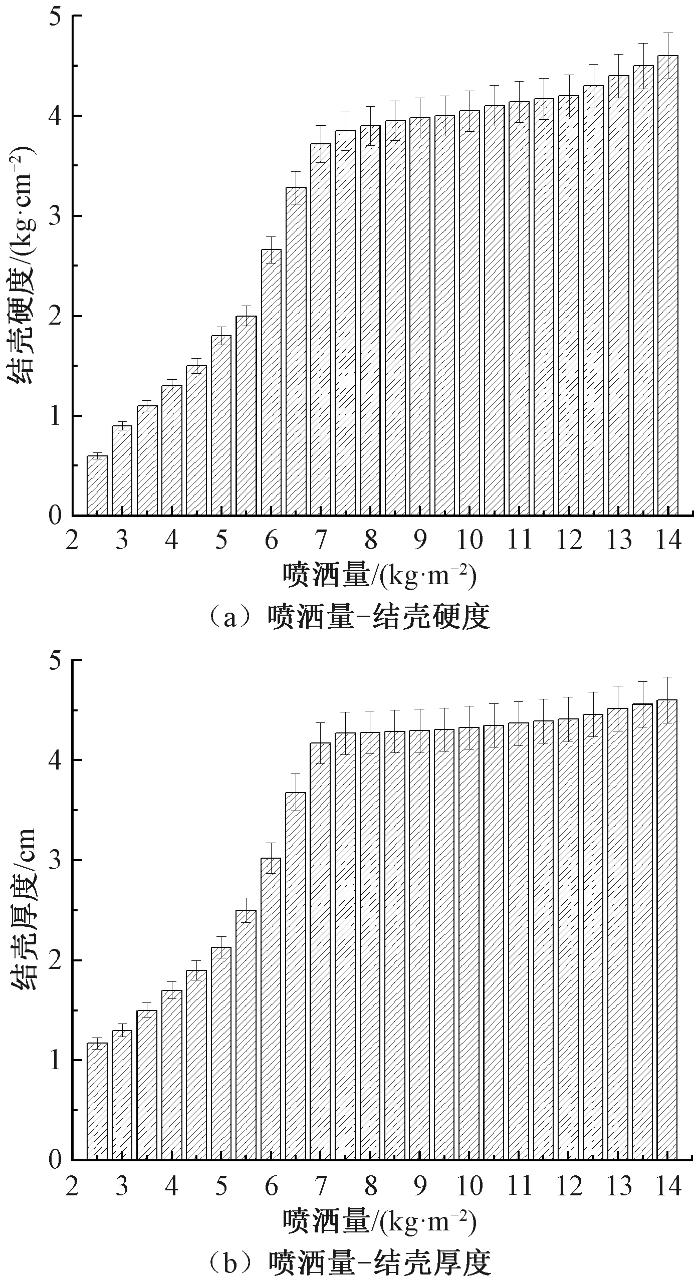
图2
固沙剂喷洒量对结壳硬度和厚度的影响
Fig.2
Influences of spraying rate on crust hardness and crust thickness.(a) Spraying rate-crust hardness; (b) Spraying rate-crust thickness
图3示出喷洒量恒定为5 kg/m2条件下多糖质量浓度对结壳硬度与厚度的影响。在多糖质量浓度1~5 g/L区间内,结壳硬度增长较为平缓,而结壳厚度呈迅速上升趋势。这一现象表明,低浓度条件下多糖在沙层内的渗透速度较快。但是,由于多糖总量不足,多糖大分子表面羟基与沙粒表面羟基之间形成的氢键数量有限,表现为结壳硬度增长缓慢。当多糖质量浓度超5 g/L后,结壳硬度呈现持续快速升高趋势,这是因为多糖总量的增加有效强化了多糖大分子与沙粒表面的氢键连接,显著提升了黏结效果。以获得1~2 kg/cm2的理想结壳硬度为目标,适宜的多糖质量浓度确定为5 g/L。
图3
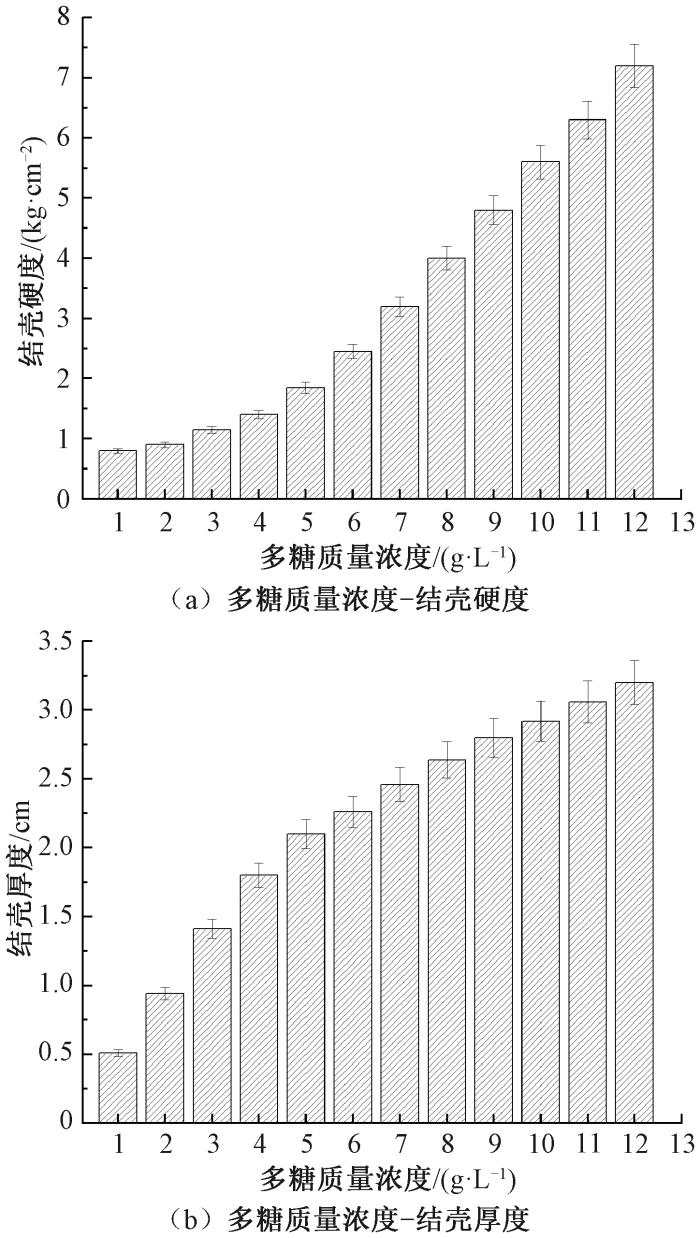
图3
多糖质量浓度对结壳硬度和厚度的影响
Fig.3
Influences of polysaccharide mass concentration on crust hardness and crust thickness. (a) Polysaccharide mass concentration-crust hardness; (b) Polysaccharide mass concentration-crust thickness
为比较大麻多糖、PVA及木质素的固沙性能差异,将喷洒量恒定在5 kg/m2。在此条件下,制备硬度1.85 kg/cm2的结壳需大麻多糖质量浓度达5 g/L,较同等条件下PVA所需浓度高出52%,较木质素所需浓度则降低85%。这3种固沙材料对沙粒的黏结作用均依靠分子链上羟基形成氢键实现。相较于PVA,大麻多糖的支链丰富、大分子链规整度低,与沙粒间构建氢键网络的能力偏弱;而相比于木质素,多糖大分子链线性更优、羟基官能团含量更高,其氢键缔合及黏结沙粒的能力更强。
2.3 多胶质组合固沙效果
图4示出大麻脱胶废水中其它3种组分对多糖固沙效果的影响。整体而言,提高果胶、蛋白质及木质素的质量浓度,均可提升多糖结壳的硬度。其中,果胶的提升效果最为显著,其次为蛋白质,木质素作用最弱。在结壳成型过程中,果胶、蛋白质及木质素大分子上的羟基或酰胺基均可与沙粒表面羟基形成氢键[21],进而提升结壳硬度。在这3种胶质组分中,果胶的协同增强效果最突出,原因在于果胶分子除可通过羟基构建氢键外,其含有的COO-还能与沙粒表面Ca2+形成配位键[22-23],对沙粒的黏结作用更强。木质素所含羟基为酚羟基,虽可参与氢键缔合,但分子呈非线性空间结构,形成氢键的空间位阻较大,与沙粒构建氢键的能力弱于果胶与蛋白质,因此对多糖结壳的增强贡献最低。
图4
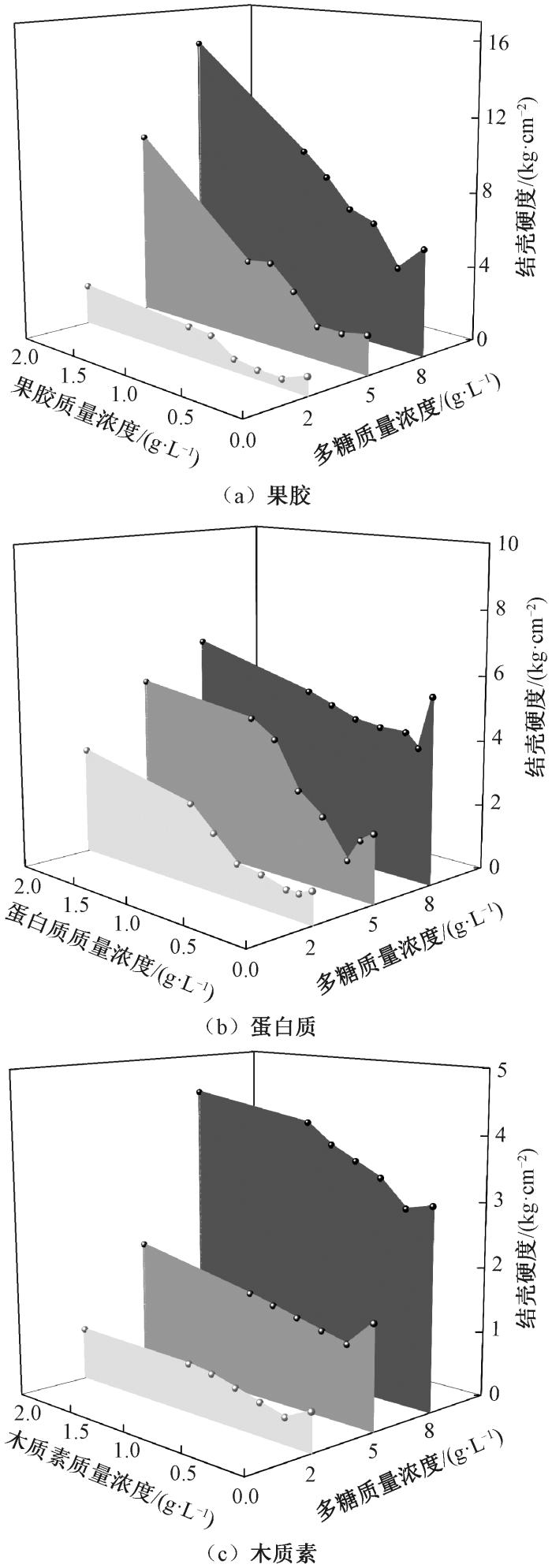
图4
果胶、蛋白质和木质素对多糖固沙的影响
Fig.4
Influences of pectin (a), protein (b), and lignin (c) on polysaccharide-based sand fixation
图5
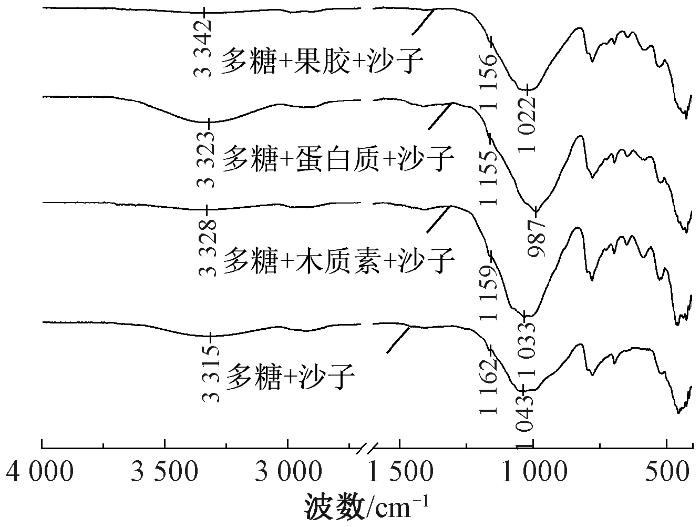
图6
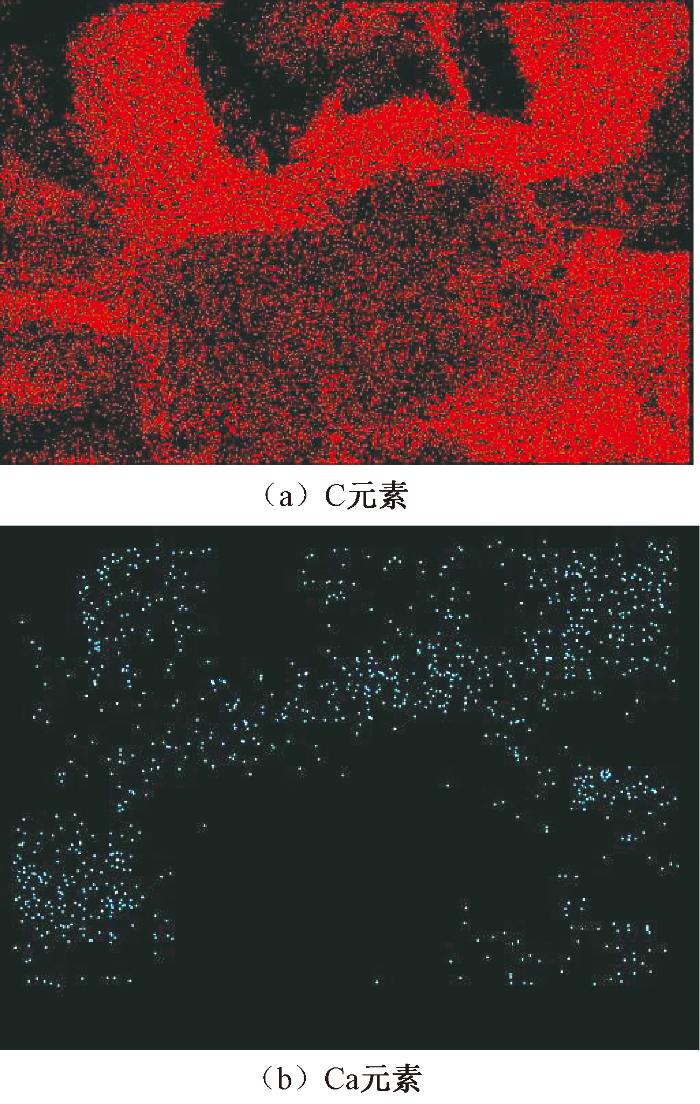
图6
多糖与果胶协同固沙后结壳表面C和Ca的分布
Fig.6
Distribution of C element (a)and Ca element (b) on crust surface after synergistic sand fixation by polysaccharides and pectin
图7
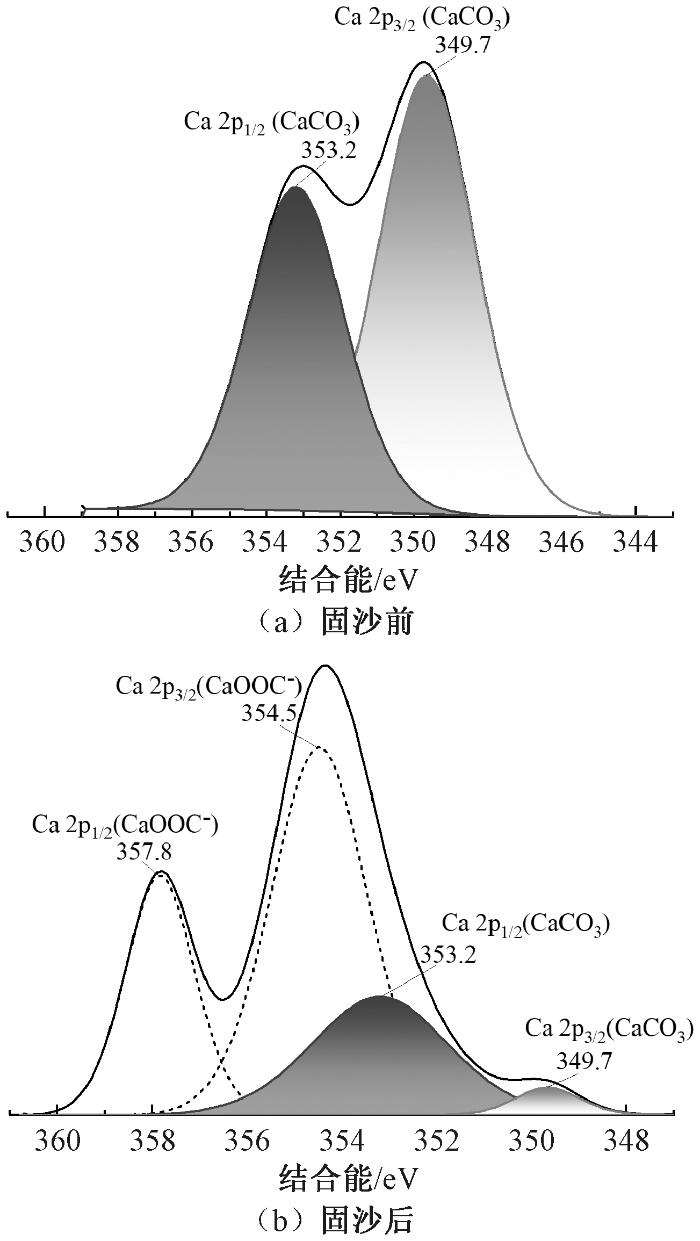
图7
多糖与果胶协同固沙前后沙粒表面Ca 2p的精细谱
Fig.7
High-resolution Ca 2p spectra of sand grain surfaces before (a) and after (b) synergistic sand fixation by polysaccharide and pectin
2.4 沙胶结壳的结构
2.4.1 结壳密度
图8示出多糖结壳不同层面沙粒集合体的微观形态。由图可见,沿结壳厚度方向自上而下,沙粒聚集体的内部结构由致密逐步趋于疏松。单因素方差分析结果表明,结壳不同分层位置对其密度具有显著影响(F(2, 12)=9.75, p=0.003)。事后Tukey HSD检验表明,结皮层密度为(2.1±0.2) g/cm3,显著高于结壳中层(1.7±0.1) g/cm3(p=0.003)和结壳底层(1.2±0.1) g/cm3(p=0.001);且中层与底层间密度也存在显著差异(p=0.003)。
图8
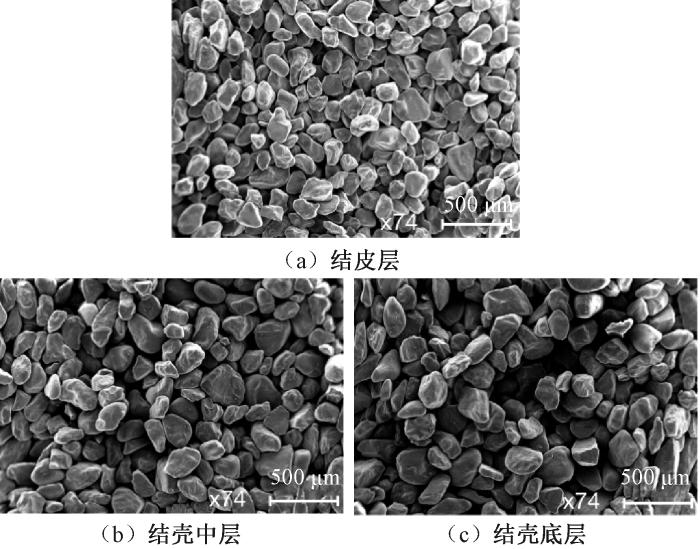
图8
多糖结壳内结皮层、结壳中层及结壳底层沙粒集合体的形态
Fig.8
Morphologies of sand aggregates in top layer (a), middle layer (b), and bottom layer (c) of polysaccharide crust
2.4.2 结壳内的胶质分布
图9示出结壳厚度方向不同分层位置处多糖、木质素、果胶及蛋白质的含量。其中结皮层多糖含量高达(9.6±0.5) mg/g,显著高于结壳中层(4.6±0.3) mg/g和结壳底层(1.4±0.4) mg/g;木质素、果胶与蛋白质均呈现相同的纵向分布规律。该变化规律与前述结壳密度沿厚度自上而下递减的特征相吻合,说明胶质含量是决定结壳密度的关键因素。一方面,胶质含量越高,对沙粒间孔隙的填充越充分;另一方面,胶质组分越多,与沙粒表面形成氢键的位点越多,对沙粒的黏结固化作用越强。
图9
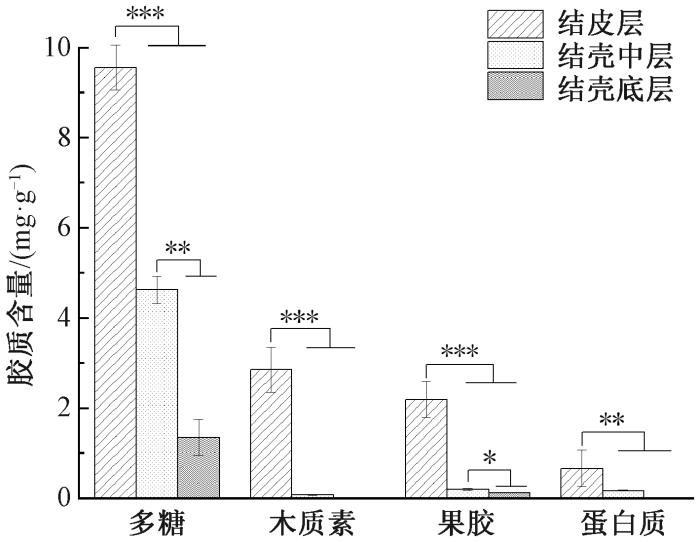
表1示出结壳不同分层处多糖的重均分子量与黏度的变化规律。可以看出,结皮层多糖的重均分子量达(254±21) ku,显著高于结壳中层(161±11) ku和结壳底层(46±4) ku。这种自上而下重均分子量递减的分布特征与多糖溶液黏度密切相关。高分子量多糖溶液黏度大,在沙层中流动渗透阻力高,易滞留富集于结皮层;低分子量多糖黏度低、流动性好,可进一步下渗至结壳底层。多糖重均分子量的纵向梯度分布,也进一步造成了结壳硬度沿厚度方向存在差异。
表1 结壳内多糖的重均分子量及多糖溶液黏度
Tab.1
| 结壳位置 | 重均分子量/ku | 黏度/(mPa·s) |
|---|---|---|
| 结皮层 | 254±21a | 3.6±0.2A |
| 结壳中层 | 161±11b | 3.2±0.2B |
| 结壳底层 | 46±4c | 2.7±0.1C |
注:不同小写字母表示各层的分子量存在显著差异;不同大写字母表示各层的黏度存在显著差异(p<0.05,Tukey检验)。
图10示出葡聚糖分子量对结壳硬度的影响。随着葡聚糖重均分子量从1 ku增至500 ku,结壳硬度从0.4 kg/cm2快速升至1.7 kg/cm2。为将结壳硬度维持在1~2 kg/cm2的理想区间,大麻多糖的重均分子量宜控制在50~500 ku范围内。
图10
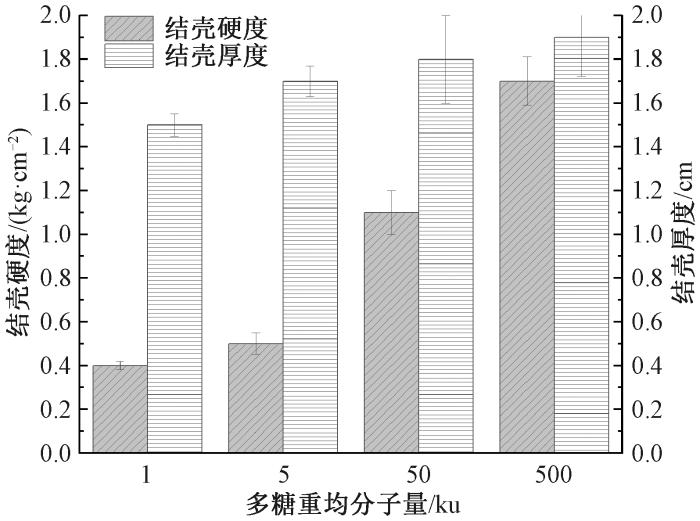
图10
多糖重均分子量对结壳硬度和厚度的影响
Fig.10
Influence of weight-average molecular weight of polysaccharides on crust hardness and thickness
2.5 结壳的保水性及其对种子发芽的影响
图11(a)示出大麻多糖、PVA及木质素3种固沙剂形成结壳的水分保留率和种子发芽率,以纯水固沙样作参照。由图可知,大麻多糖、PVA、木质素形成的3种结壳在25 ℃条件下的水分保留率分别为80.5%、78.7%和78.4%,均显著高于其在80 ℃条件下的对应值(30.3%、27.6%、18.1%)。与PVA和木质素相比,大麻多糖的结壳表现出更优异的保水性能,其原因在于多糖大分子含有丰富的羟基,可与水分子形成氢键,有效抑制结壳内水分的挥发。PVA大分子同样富含羟基,但分子结构更规整,分子间氢键结合能力更强,一定程度上削弱了其与水分子的氢键作用,因此保水性弱于大麻多糖;木质素大分子与水分子形成氢键的能力较弱,故其水分保留率也最低。需指出的是,这3种固沙剂结壳的保水性均显著优于纯水对照样,证实了高分子材料在固沙应用中可有效提升保水效果。
图11
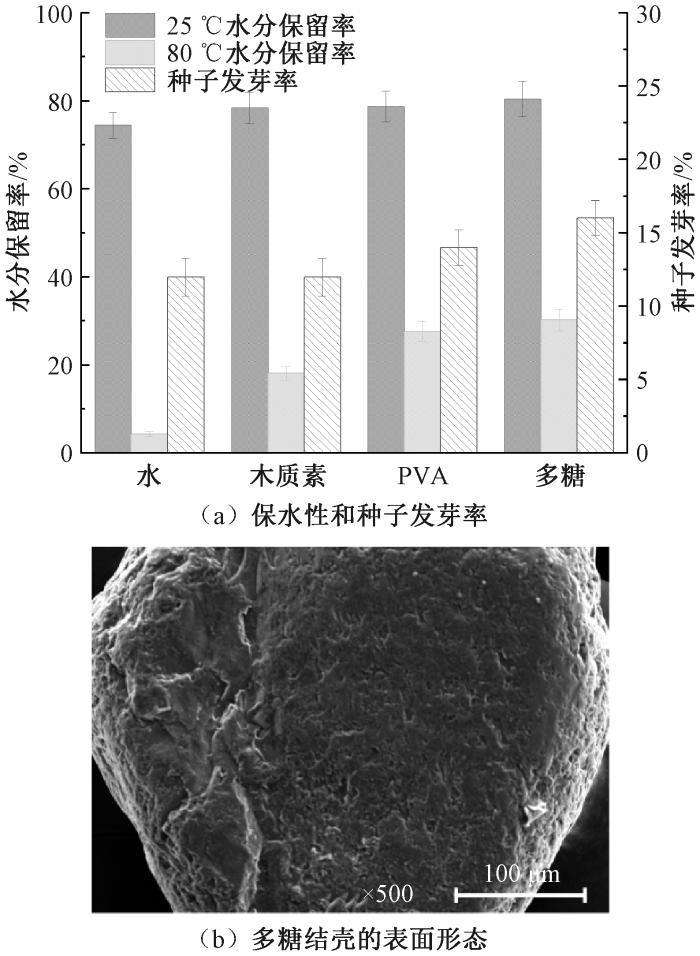
图11
多糖结壳的保水性和种子发芽率及表面形态
Fig.11
Water retention capacity and seed germination rate (a), and surface morphology (b) of polysaccharide crust
2.6 土壤盐碱化风险
本研究所用大麻脱胶废水总盐质量浓度约4 000 mg/L。在喷洒量5 kg/m2、多糖质量浓度5 g/L的固沙工艺条件下,按照1.3.12节的方法计算得到结壳的总盐含量为0.45 g/kg。依据HJ 964—2018《环境影响评价技术导则 土壤环境(试行)》分级判定,属于未盐化土壤范畴。同时,结壳中残留的盐分以硫酸钠为主,相较于苏打盐和氯化物,植物对硫酸钠的耐受程度更高。综上可知,采用大麻脱胶废水进行固沙应用,不会带来明显的土壤盐碱化及生态安全风险。
3 结论
1)大麻脱胶废水中多糖的重均分子量和质量浓度均显著高于木质素、果胶和蛋白质等组分,是决定沙胶结壳成型的关键物质。结壳内各胶质组分的含量和多糖分子量自上而下均呈递减分布,结壳密度也随之降低。适合固沙的多糖分子量宜控制在50~500 ku。
2)增大固沙剂喷洒量和多糖质量浓度均可提升结壳硬度。以结壳硬度1~2 kg/cm2为优化目标,确定适宜喷洒量为5 kg/m2、多糖质量浓度为5 g/L。在制备同等硬度结壳的目标下,所需大麻多糖浓度较PVA高52%,较木质素低85%。
3)提高固沙剂中果胶、蛋白质和木质素的浓度均可提升多糖结壳的硬度。其中果胶的增强效果最为突出,这归因于氢键与配位键的协同作用;但在0~0.2 g/L的低质量浓度区间,3类胶质均对多糖固沙产生抑制作用。
4)大麻多糖结壳的水分保留率可达30.3%,优于PVA结壳27.6%和木质素结壳18.1%,更利于提升种子萌发效果。
本研究在野外风蚀实验、耐老化、废水批次波动等方面未开展系统性实验,后续研究应关注固沙剂的长期生态影响。
参考文献
A novel approach to cost-effective utilization of flax polysaccharides: sand fixation
[J].DOI:10.1016/j.ijbiomac.2025.146925 URL [本文引用: 1]
不同醇及助剂对大麻有机溶剂脱胶效果的影响
[J].
DOI:10.13475/j.fzxb.20210801406
[本文引用: 1]

为解决传统化学脱胶污染大、损伤纤维等弊端以及生物脱胶成本高、耗时长等问题,使用高沸点醇类有机溶剂对大麻麻皮进行脱胶处理,提高脱胶选择性,确保反应安全环保;同时针对脱胶后大麻纤维残胶率及物理力学性能不足的问题,引入碱性钠盐助剂辅助脱胶。研究了4种不同醇类(乙二醇、1,2-丙二醇、丙三醇和1,4-丁二醇)和3种不同碱性钠盐助剂(碳酸钠、碳酸氢钠及硅酸钠)对大麻麻皮脱胶效果的影响,对脱胶后纤维的各项性能进行了对比。结果表明:经乙二醇脱胶的大麻纤维性能在4种醇类中最好,木质素去除效果最佳,纤维残胶率为8.67%,断裂强度偏低,为3.92 cN/dtex;3种碱性钠盐助剂中,碳酸钠辅助乙二醇脱胶的大麻纤维残胶率为7.71%,断裂强度为4.84 cN/dtex,符合大麻精麻的国家标准。
Effects of different alcohols and additives on organic solvent degumming for hemp fibers
[J].
DOI:10.13475/j.fzxb.20210801406
[本文引用: 1]
In order to overcome the disadvantages of traditional chemical degumming, such as serious pollution and fiber damage, as well as the high cost and time-consuming biological degumming process, hemp bast was degummed with high boiling point alcohol organic solvent to improve degumming selectivity and ensure safety and environmental protection. To solve the problem of insufficient residual glue rate and physical and mechanical properties of hemp fiber after degumming, alkaline sodium salt additives were added to organic solvents to assist degumming. The effects of four different alcohols (ethylene glycol, 1,2-propanediol, glycerol and 1,4-butanediol) and three different alkaline sodium salt (sodium carbonate, sodium bicarbonate and sodium silicate) additives on the degumming effect of hemp bast were studied, and the chemical and physical properties of degummed fiber were compared. The results showed that among the four alcohols, the performance of hemp fiber degummed by ethylene glycol was the best, the lignin removal effect was the best, the residual rubber rate of fiber was 8.67%, but the breaking strength was low, which was 3.92 cN/dtex. Among the three basic sodium salt additives, the residual gum rate of hemp fiber degummed by sodium carbonate assisted ethylene glycol is 7.71%, and the breaking strength is 4.84 cN/dtex, which meets the national standard of refined hemp.
大麻纤维的芬顿法脱胶及其性能
[J].
Degumming of hemp fibers using Fenton method and fiber properties
[J].
大麻纤维高温-酶联合脱胶技术
[J].
Hemp retting by the combined action of high temperature boiling and enzymes
[J].
精细化工业大麻纤维的制备及其性能研究
[J].
Preparation and research of refined industrial hemp fiber
[J].
一步沉淀法测定大麻纤维果胶与水溶物含量
[J].
Determining the content of pectin and water-soluble substance in hemp fiber by one-step
[J].
Structural and physico-chemical characterization of industrial hemp hurd: impacts of chemical pretreatments and mechanical refining
[J].DOI:10.1016/j.indcrop.2021.113818 URL [本文引用: 1]
Evaluation of value adding components from postharvest biomass of Thai medicinal cannabis var. Hang Kra Rog Phu Phan
[J].DOI:10.1016/j.jarmap.2024.100593 URL [本文引用: 1]
荒漠化治理中应用的有机高分子材料
[J].
Organic polymer materials applied in desertification control
[J].
Preparation and sand-fixing property of a novel and eco-friendly organic-inorganic composite
[J].DOI:10.1080/03602559.2014.974271 URL
Runoff and soil loss characteristics on sandy soil slope with new chemical sand-fixing agent under simulated rainfall
[J].DOI:10.1007/s12665-023-10943-x [本文引用: 1]
不同喷洒浓度沙蒿胶固沙效果试验
[J].
Sand fixation experiment of Artemisia sphaerocephala Krasch. gum with different concentrations
[J].
Robinia pseudoacacia sand stabilizer: its sand fixation effects and mechanical properties
[J].DOI:10.3389/fenvs.2024.1304830 URL [本文引用: 1]
Fabrication of multi-functional biodegradable liquid mulch utilizing xyloglucan derived from tamarind waste for agricultural application
[J].DOI:10.1016/j.ijbiomac.2023.128627 URL [本文引用: 1]
高分子材料在化学固沙中的应用
[J].我国是世界上受荒漠化影响最严重的国家之一,土地荒漠化每年造成的直接经济损失上百亿元,严重制约着经济的可持续发展。化学固沙技术是荒漠化治理的一种重要途径,其优点是成本低,施工简便,见效快。高分子材料是化学固沙的主要原料。综述了石油产品类、合成高分子类、生物质资源类固沙剂,以及高吸水树脂保水剂在沙漠治理中的应用。
Application of polymer materials to chemical sand fixation
[J].Desertification that causes tens of billion yuan of economical loss annually,which restricts regional continual development severely has been a nationwide problem. Chemical sand fixation is an important method of desertification control due to its low cost, efficiency and suppleness,for which polymer is the main material. The applications of several kinds of sand fixation agents including petrochemical, synthetic polymer, biomass, and superabsorbent polymer for the desertification control were summarized.
The effects of sand-fixing agents and trichoderma longibrachiatum on soil quality and alfalfa growth in wind-sand soil
[J].DOI:10.3390/agriculture15232468 URL [本文引用: 1]
苯酚硫酸法测定总糖含量的试验原理验证及拓展应用
[J].
Experimental principle verification and application of phenol-sulfuric acid method for determination of total polysaccharide content
[J].
改良考马斯亮蓝试剂法测定壳聚糖及其衍生物中蛋白质含量
[J].
Determination of protein content in chitosan and its derivatives by modified coomassie brilliant blue reagent method
[J].
天然植物人参中糖醛酸含量测定方法的建立
[J].
Establishment of a method for determining the content of uronic acid in the natural plant ginseng
[J].
分光光度法测定生物质水解液中糠醛、酸溶木质素、还原糖的含量
[J].
Furfural, acid-soluble lignin and reducing sugar content in biomass hydrolysate by spectrophotometric method
[J].
化学固沙剂固沙作用机理研究
[J].
A study of sand-fixation mechanism of chemical sand-fixation agent
[J].
How accurate is the egg-box model in describing the binding of calcium to polygalacturonate a molecular dynamics simulation study
[J].DOI:10.1021/acs.jpcb.2c05374 URL [本文引用: 1]
Egg-box model-based gelation of alginate and pectin: a review
[J].DOI:10.1016/j.carbpol.2020.116389 URL [本文引用: 1]
Degradation of flax polysaccharides with purified endo-polygalacturonase
[J].DOI:10.1016/0144-8617(90)90081-3 URL [本文引用: 1]
Characteristic of the interaction mechanism between soy protein isolate and functional polysaccharide with different charge characteristics and exploration of the foaming properties
[J].DOI:10.1016/j.foodhyd.2023.109615 URL [本文引用: 1]
Enhancement of interface between lignocellulosic fibers and polypropylene matrix via the structure alteration of lignin at elevated temperatures
[J].DOI:10.3390/ma13235428 URL [本文引用: 1]
Solution properties of pectin polysaccharides: II. conformation and molecular size of high galacturonic acid content isolated pectin chains
[J].DOI:10.1016/0144-8617(91)90098-W URL [本文引用: 1]

 京公网安备11010502044800号


