



Hiremath等[14]在纺织级PAN基复合长丝中实现了 C-CNF的均匀分散,并通过在丙烯腈表面接枝C-CNF提高其在PAN纤维基体中的分散性。结果表明,与对照组相比,加入3.2%功能化C-CNF并经牵伸处理后的复合纤维,其拉伸强度和弹性模量均提高了3倍以上。Chang等[15]将纤维素纳米晶(CNC)分散于PAN中,发现CNC的引入显著改善了 PAN 纤维的综合性能,且环化反应和交联反应的活化能分别降低了17.5% 和19%。Krishnaswamy等[16]探讨了聚酰胺6/SA复合材料的制备及其对气凝胶结构完整性的影响,发现当填料含量为0.04%时,气凝胶在复合材料中的结构完整性能够得到较好保持。Sedighi等[17]分别以 0.4%、1%和2%的质量分数成功制备了填充SA的聚酯复合纤维,结果表明该纤维具有实心截面、表面粗糙及疏水等特性。
自2003年以来,有研究围绕PAN基共聚物的可熔融改性开展了系统研究,并成功实现了可熔融PAN基共聚物的批量制备[18-
1 实验部分
1.1 实验材料与仪器
亲水性SiO2气凝胶(SA),天津朗盛高新材料科技有限公司;氨水(NH4OH)、乙烯基三乙氧基硅烷(VTES)、4-丙烯酰氧基二苯甲酮(ABP)、羧基化纤维素纳米纤维(C-CNF,4~10 nm,6% 分散液)以及过硫酸铵((NH4)2S2O8),上海麦克林生化科技股份有限公司;无水乙醇(C2H5OH),天津丰川化学试剂科技有限公司;丙烯腈(AN)、丙烯酸甲酯(MA)、亚硫酸氢钠(NaHSO3)、正十二烷基硫醇(RSH)和十二烷基硫酸钠(SDS),天津美鼎科技有限公司;N,N-二甲基甲酰胺(DMF)、溴化锂(LiBr),上海阿拉丁生化科技股份有限公司;乳化剂(OP-10)、无水硫酸镁(MgSO4),北京宇晟化工有限公司。
WIGGENS D-500D数显均质乳化机(维根技术北京有限公司);BFDUV-X2K240紫外光固化机(深圳市博飞达科技有限公司);JC-QM-4行星式球磨机(青岛聚创华业分析仪器有限公司)HTGD-20双螺杆挤出机(广州市哈尔技术有限公司);Autosorb-iQ-C全自动物理化学吸附仪(美国康塔仪器公司);Mastersizer2000激光粒度分析仪(英国马尔文公司);Tensor 37傅里叶变换红外光谱仪(赛默飞世尔科技);DRL-III导热系数测试仪(湖南振华分析仪器有限公司);Waters 1525凝胶渗透色谱仪(沃特世公司);XNR-400C型熔体流动速率仪(承德市纵驰检测仪器有限公司);D8 DISCOVER X射线衍射仪(布鲁克科技有限公司);TGA Q5000 热重分析仪、DSC200F3差示扫描量热仪(德国耐驰制造有限公司);S4800扫描电子显微镜(HITACHI公司);LLY-11B单纤维强力仪(山东省纺科院科技有限公司)。
1.2 PAN/C-CNF聚合物的制备
将适量去离子水、乳化剂OP-10、SDS以及RSH混合后充分乳化,加入到三口烧瓶中并通10 min N2。量取一定量AN和MA单体倒入三口烧瓶,加入占单体总质量0.1%的C-CNF分散液,在60 ℃下反应。反应结束后将无水硫酸镁溶于水中,再将所得乳液倒入其中进行破乳,随后经静置、过滤、洗涤和干燥后得到PAN/C-CNF聚合物。
1.3 SA-PAN的制备
称取15 g SA,用无水乙醇充分浸润后分散于1 000 mL水中,加入50 g VTES,水解 3 h;随后加入 15 mL 氨水,在 40 ℃下搅拌反应 4 h 后终止反应,经离心洗涤并真空干燥72 h,制得SA-VTES[21]。将AN、ABP、无水乙醇和水按照质量比35∶3∶60∶2加入烧杯中混合均匀,配制改性溶液。将SA-VTES先用无水乙醇浸润后加入改性溶液中,使用数显均质乳化机快速分散,再继续搅拌2 h 使其混合均匀,随后在紫外光固化机中反应2 h。反应完成后,经离心洗涤并真空干燥72 h得到SA-PAN。
1.4 熔融纺丝PAN基隔热纤维的制备
将含不同比例SA-PAN的PAN/C-CNF混合物置于行星式球磨机中混合均匀,再经螺杆挤出机挤出造粒得到纺丝原料。随后将纺丝原料加入双螺杆纺丝机中进行熔融纺丝。挤出机转速为50 r/min,纤维收集速度为300 r/min,螺杆5个温区的温度分别设定为160、180、185、190和195 ℃。之后在热辊上对纤维进行热牵伸,牵伸温度为110~120 ℃。最终制得SA-PAN 质量分数分别为1%、3%、5%和7% 的 PAN/C-CNF/SA-PAN纤维,分别记为PCS1%、PCS3%、PCS5% 和 PCS7% 纤维。采用上述相同方法,进一步制得熔融纺丝PAN纤维和PAN/C-CNF 纤维,分别记为PAN纤维和PC纤维。
1.5 表征与测试
1.5.1 孔径和粒径测试
采用全自动物理化学吸附仪在N2条件下进行孔径吸附-脱附测试,表征SA孔结构特性。测试前取适量SA样品,在120 ℃真空脱气处理6 h消除吸附水与残留小分子。以N2为吸附介质,低温采集吸附-脱附等温线。基于BET理论计算比表面积,借助BJH模型解析孔径分布、总孔容及平均孔径;采用激光粒度分析仪测试SA的粒径分布。测试前取少量SA分散于无水乙醇中,超声波分散10 min实现充分分散,以无水乙醇为分散介质,设置折射率参数完成测试,获取样品粒径尺寸与分布曲线。
1.5.2 隔热性能测试
采用导热系数测试仪在室温环境下表征纤维织物的导热性能。为方便测试,将纤维编织成尺寸为5 cm×5 cm的方形织物试样,测试时取2块完全一致的织物分别置于探头上下两侧包裹传感探头,保证接触紧密;每组平行测试3次,记录并计算样品平均热导率,热扩散系数由导热系数测试仪同步测得。
1.5.3 化学结构表征
采用傅里叶变换红外光谱仪(FT-IR)分别对SA、聚合物及纤维样品进行化学结构表征。测试波数范围为4 000~400 cm-1,光谱分辨率设置为4 cm-1。其中,聚合物及气凝胶粉体采用压片法制样测试;纤维织物采用衰减全反射法(ATR)直接测试,无需压片处理。
1.5.4 聚合物分子量测试
在室温下将聚合物样品溶于的DMF中,以溴化锂作为洗脱剂,通过尺寸排阻色谱法测定合成聚合物的重均分子量(Mw)、数均分子量(Mn)及分子量分布指数(PDI)。
1.5.5 聚合物晶体结构表征
采用X射线衍射仪(XRD)分别对SA与纤维样品进行物相结构表征。测试辐射源为Cu Kα射线,设置管电压为40 kV、管电流为40 mA,扫描速率为5 (°)/min,2θ扫描区间为5°~45°。通过所得衍射图谱分析气凝胶的无定形特征及纤维的结晶结构变化。
1.5.6 熔体流动测试
参照GB/T 3682.1—2018《塑料 热塑性塑料熔体质量流动速率(MFR)和熔体体积流动速率(MVR)的测定 第1部分:标准方法》,采用熔体流动速率仪测试不同SA添加量PAN复合材料的熔体流动速率。测试温度为210℃,加载砝码总质量为2.16 kg。将干燥后的样品颗粒装入料筒并恒温熔融,稳定后在恒定载荷挤压下挤出熔体,截取并称量10 min内挤出的熔体质量,计算得到样品熔体流动速率,用以评价不同SA添加量PAN复合材料的熔融加工流动性。
1.5.7 微观形貌表征
采用场发射扫描电子显微镜观察SA、聚合物及纤维的微观形貌,使用配套EDS能谱仪对纤维表面开展元素面扫,分析SiO2填料在PAN基体中的分散均匀性。SA及聚合物粉末直接粘贴于导电胶上待测。纤维样品分为2组,一组剪刀裁切观察表面形貌,另一组经液氮冷冻脆断获取平整横截面,所有样品均真空喷金消除荷电效应,设置低加速电压分别采集气凝胶和聚合物颗粒、纤维表面、纤维脆断面微观图像。
1.5.8 热稳定性测试
采用热重分析仪在N2氛围下测试样品的热稳定性。测试前,将样品充分干燥,取适量样品置于热重分析坩埚中。测试温度范围为室温至800 ℃,升温速率为 10 ℃/min。测试过程中记录样品质量随温度升高的变化,获得TG曲线和DTG曲线。通过分析样品的初始质量损失温度、主要热分解温度区间、最大质量损失速率温度及800 ℃下残炭率,评价C-CNF和SA-PAN对PAN基纤维热稳定性及耐高温性能的影响。采用差示扫描量热仪表征PAN基纤维的热转变性能。测试全程通入N2保护,样品以10 ℃/min的升温速率从20 ℃升温至230 ℃,恒温10 min以消除内部热历史,随后以10 ℃/min的降温速率冷却至20 ℃,获得纤维的熔融和结晶热学特征参数。
1.5.9 力学性能测试
为了增强纤维的力学强度,对不同样品纤维进行不同倍率的热牵伸(最后一个热辊速率与初始热辊速率的比值即为牵伸倍数),3个热辊温度分别为90、100、110 ℃。采用单纤维强力仪测试纤维的力学性能。测试前,选取表面较完整且无明显缺陷的单根纤维作为测试样品。测试时,将单根纤维固定于强力仪上下夹具之间,夹持距离设定为10 mm,拉伸速度设定为10 mm/min。启动仪器后对纤维进行拉伸,直至纤维断裂,记录断裂强度和断裂伸长率。每组样品至少测试10次,去除明显异常值后取平均值,用于评价C-CNF和SA-PAN添加量对PAN基隔热纤维力学性能的影响。
2 结果与讨论
2.1 改性SiO2气凝胶的结构与性能
图1(a)、(b)分别示出SA和SA-PAN的BET吸附-脱附曲线。SA的比表面积、孔体积和孔径分别为171.271 m2/g、0.442 cm3/g、2.519 nm;SA-PAN的分别为 127.475 m2/g、0.316 cm3/g、2.195 nm。与SA相比,SA-PAN的比表面积、孔体积和孔径均有所下降。通常情况下,较小的孔径和较高的孔隙率有利于材料隔热性能的提升[22]。图1(c)表明,原始SA的平均粒径为28.416 μm,主要分布在0~25 μm范围内,且分布较为均匀;SA-VTES的平均粒径降至 12.177 μm,粒径分布仍保持均匀;SA-PAN的平均粒径进一步减至6.079 μm,且粒径分布更加集中,这有利于其在熔融加工制备复合隔热纤维过程中实现更均匀的分散。
图1
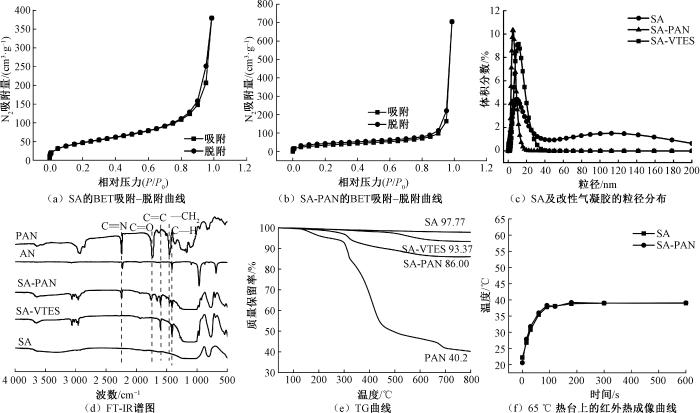
图1
SA及改性气凝胶的结构与热性能
Fig.1
Structural and thermal properties of SA and modified aerogels. (a) BET adsorption-desorption isotherms of SA; (b) BET adsorption-desorption isotherms of SA-PAN; (c) Particle size distribution of SA and modified aerogels; (d) FT-IR spectra; (e) TG curves; (f) Infrared thermal imaging curves recorded on hot stage at 65 ℃
由图1(d)可知,SA-VTES在1 410和1 600 cm-1处分别出现了烯烃的特征吸收峰,对应于C—H面内弯曲振动和C══C键伸缩振动;在约3 000 cm-1处出现了烯烃(══C—H)的伸缩振动峰。SA-PAN在1 450 cm-1处出现与PAN相同的—CH2弯曲振动峰,并在2 240 cm-1处出现了PAN的特征吸收峰,该峰归属于C≡N氰基的伸缩振动[23]。图1(e)显示,SA在800 ℃下的质量损失率为2.23%,表现出良好的耐高温性能。SA-VTES的质量损失率为 6.63%,较SA提高了4.40%。SA-PAN的质量损失率为 14.00%,分别较SA-VTES和SA提高了7.37%和 11.77%,且其质量损失曲线与PAN相似。这表明PAN 已成功接枝到SA-PAN中,接枝率为20.4%;同时,材料仍保持了SA优异的耐高温性和较高的热稳定性。
由图1(f)可知,SA的表面温度在90 s内由室温逐渐升高至约38 ℃,在随后90 s内缓慢升至39 ℃,之后基本保持稳定。改性后SA-PAN也表现出相似的温度变化趋势,说明SA-PAN具有良好的隔热性能。SA和SA-PAN的热学性能数据测试结果:SA、SA-PAN的热导率分别为0.045 1、0.055 2 W/(m·K),二者均处于较低水平,且改性后SA-PAN的热导率仅增加了0.010 1 W/(m·K)。其热扩散系数由0.196 1 mm2/s增至0.219 9 mm2/s,进一步表明其仍具有良好的隔热性能。
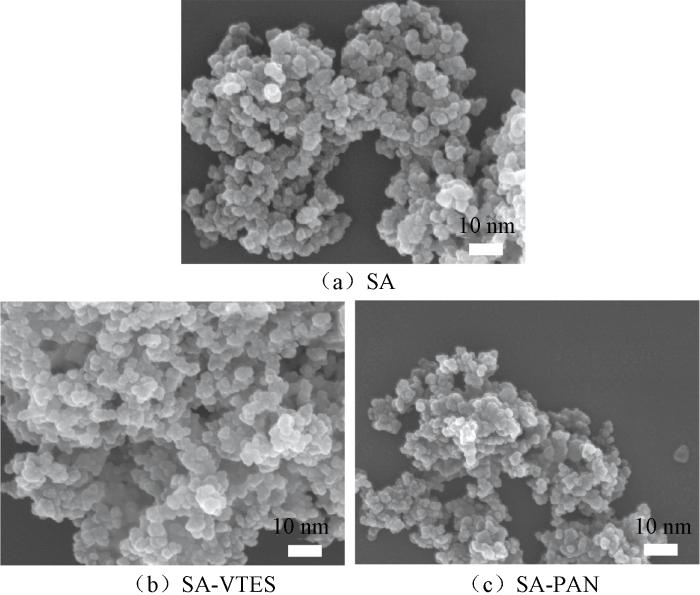
图2示出SA、SA-VTES和SA-PAN的SEM照片,SA、SA-VTES和SA-PAN均呈椭圆状形貌,且粒径分布较为均匀。改性后SA-VTES和SA-PAN的形貌与SA基本相似,粒径差异也不明显,说明接枝改性过程对SA的形貌影响较小。
图2
2.2 PAN/C-CNF 聚合物的结构与性能分析
图3示出可熔融 PAN 和 PAN/C-CNF 聚合物的FT-IR谱图,在C-CNF的FT-IR谱图中,1 650 cm-1处出现了C══O的伸缩振动峰,3 300~3 500 cm-1之间出现了—OH的伸缩振动峰,说明其表面富含羟基[24]。在PAN和PAN/C-CNF的FT-IR谱图中,2 930 cm-1处对应—CH的伸缩振动峰,1 450 cm-1 处对应—CH2的弯曲振动峰,2 244 cm-1处的特征吸收峰为PAN的特征峰,归属于C≡N的伸缩振动;1 731 cm-1处的C══O伸缩振动峰则为丙烯酸甲酯共聚单元的特征峰。此外,在PAN/C-CNF聚合物中的光谱图还观察到1 650 cm-1以及3300~3 500 cm-1范围内的特征峰,证实C-CNF已成功分散于PAN聚合物中,并形成了良好的氢键作用[25]。
图3
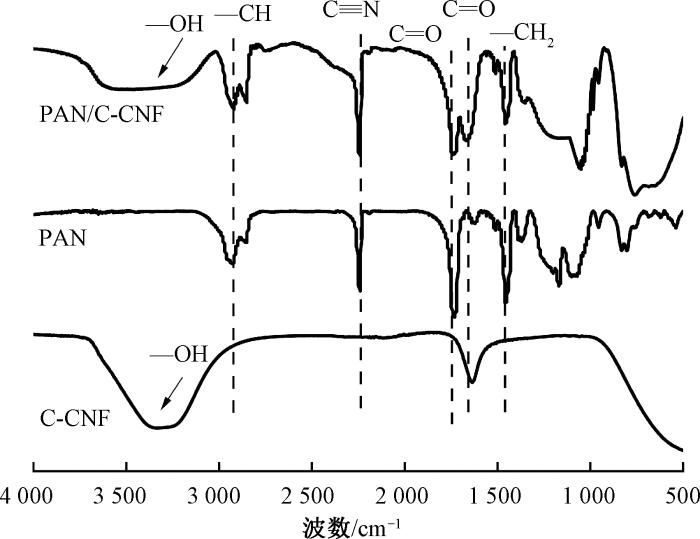
图3
C-CNF、可熔融 PAN 和 PAN/C-CNF聚合物的FT-IR谱图
Fig.3
FT-IR spectra of C-CNF,meltable PAN and PAN/C-CNF polymers
图4示出可熔融PAN和PAN/C-CNF聚合物的SEM照片。由图可知,PAN和PAN/C-CNF聚合物的粒径分布均较为均匀,其微观形貌均呈典型的六边形结构;C-CNF的加入并未显著改变PAN的形貌。
图4
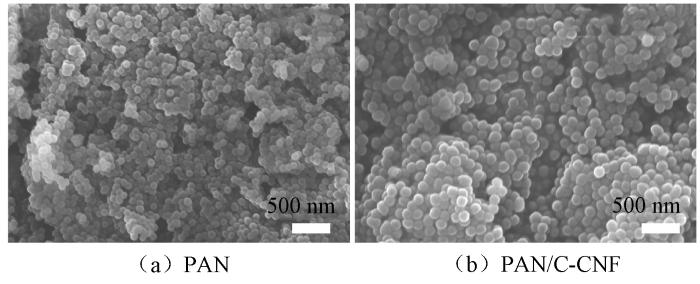
图4
可熔融 PAN 和 PAN/C-CNF 聚合物的SEM照片
Fig.4
SEM images of meltable PAN and PAN/C-CNF polymers
表1示出可熔融 PAN 和 PAN/C-CNF 聚合物的分子量及熔体流动速率,PAN和PAN/C-CNF聚合物的数均分子量(Mn)分别约为25和28 ku,重均分子量(Mw)分别约为45和42 ku。二者的熔体流动速率均约为4.5 g/(10 min),表明其具有良好的可熔融加工性能。
表1 可熔融 PAN 和 PAN/C-CNF聚合物的分子量及熔体流动速率
Tab.1
| 样品 | Mn/ku | Mw/ku | PDI | 熔体流动速率/ (g·(10 min)-1) |
|---|---|---|---|---|
| PAN | 25 | 45 | 1.792 | 4.5 |
| PAN/C-CNF | 28 | 42 | 1.493 | 4.6 |
2.3 隔热纤维的结构与热学性能分析
图5示出熔融纺 PAN 基纤维的 FT-IR、XRD、DSC 和 TG 分析结果。由图可知,不同组分纤维的红外光谱差异并不显著,主要特征峰包括2 930 cm-1处的—CH 伸缩振动峰、1 450 cm-1处的—CH2弯曲振动峰、2 244 cm-1处的C≡N伸缩振动峰以及1 731 cm-1处的C══O伸缩振动峰。与 PAN 聚合物不同的是,2 240~2 000 cm-1范围内出现的多个吸收峰,主要是由于熔融加工后C≡N基团与相邻基团之间发生相互作用,吸收峰因此发生偏移。由于C-CNF和 SA-PAN的添加量较低,且受到熔融加工过程的影响,其特征峰被PAN基体掩盖,因此纤维的化学结构未发生明显变化。
图5
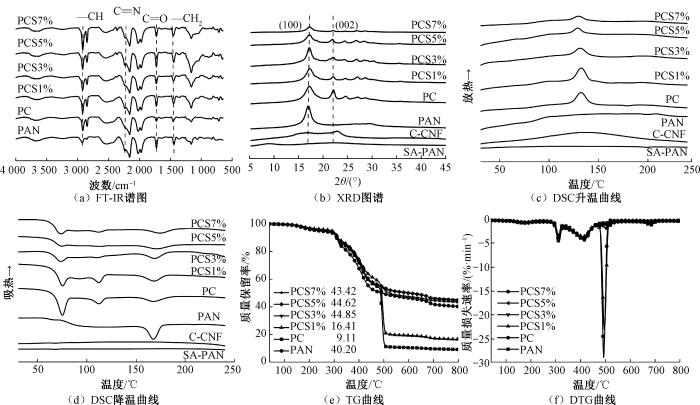
图5
不同 PCS 添加量对熔融纺 PAN 基纤维性能的影响
Fig.5
Influences of PCS contents on properties of PAN-based fibers. (a) FT-IR spectra; (b) XRD patterns; (c) DSC heating curves; (d) DSC cooling curves; (e) TG curves; (f) DTG curves
图5(b)表明所有熔融纺PAN基纤维均呈现典型的六方晶体结构,在2θ=17° 和2θ=30°处出现特征峰,其中宽而平缓的漫反射峰对应于PAN共聚物的无定形低有序区[26]。此外,C-CNF 的引入使纤维在2θ=22°~23°处出现额外的结晶峰,证实其作为异相成核剂发挥了作用,能够促进纤维的多重结晶,说明C-CNF与PAN之间具有良好的相互作用[27-28]。随着SA-PAN添加量的增加(含量从PCS1%增加到PCS7%),纤维结晶度由38.2% 逐渐降至22.0%,表明随着SA-PAN 的加入降低了纤维的结晶度。XRD图谱表明,PAN纤维(100)晶峰尖锐,结晶度高、取向单一、无定形区少,分子链运动受限,纤维刚性大。PC纤维(100)晶峰减弱、(002)晶峰增强,2θ=20°附近出现明显无定形宽化弥散峰,结晶度降低、取向分散,分子链形变能力更强,柔性与断裂伸长率更优。
由图5(c)、(d)可知,熔融纺PAN基纤维在约100 ℃处出现玻璃化转变温度(Tg)。在升温过程中,PAN纤维在90 ℃左右出现较宽的吸热峰,这与水分失重有关。可以看出,C-CNF在约130 ℃处存在1个较宽的吸热峰,而在加入C-CNF 后,PAN基纤维也在130 ℃处出现吸热峰,表明 PAN 基体与C-CNF之间形成了较强的相互作用。SA-PAN的加入使该峰强度逐渐减弱,这与结晶度下降的趋势一致。在降温过程中,PAN纤维在 170 ℃ 处出现明显的放热峰。C-CNF的引入使 PAN基纤维在70 ℃和110 ℃处出现额外的放热峰,进一步证实了其异相成核作用。随着SA-PAN添加量的增加,结晶放热峰的强度逐渐减弱,这与 XRD分析结果一致。
从图5(e)、(f)可见,PAN纤维存在3个明显的失重阶段[29]。第1阶段发生在90~130 ℃,主要归因于水分蒸发;第2阶段为更为显著的失重阶段,发生在280~430 ℃,主要是由于PAN基纤维发生环化和热分解,以及部分分子链分解所致。可以看出,C-CNF的加入使PAN基纤维的热分解温度提高到了约320 ℃。在480 ℃ 之后,PAN纤维的分解与炭化过程趋于平衡,仅发生轻微失重,进一步升高温度对其结构影响较小。然而,PC纤维在 480 ℃之后出现了明显而快速的失重现象,其高温下的分解和炭化过程更为剧烈,这与C-CNF的引入有关。C-CNF的纳米尺寸效应增强了PAN基纤维的结构孔隙性,使其在高温下更易发生分解,从而降低了残炭率。在加入1%和3% SA-PAN 后,PAN基纤维的残炭率分别由9.11%提高至16.41%和44.85%。同时,PAN基纤维的残炭率在高温下趋于稳定,变化不再明显,这表明SA-PAN的引入显著提升了PAN 基纤维的热稳定性和残炭率。
2.4 熔融纺 PAN 基隔热纤维的形貌分析
图6
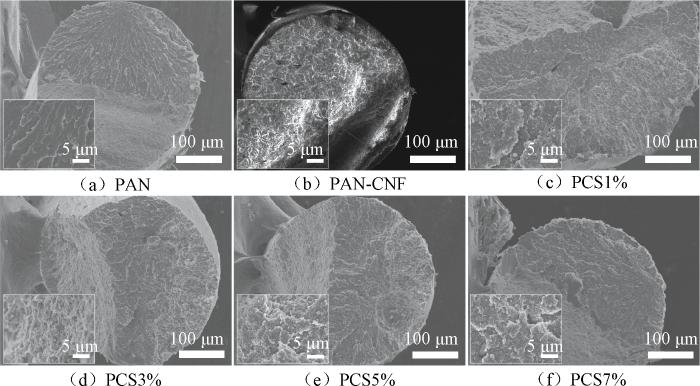
图6
不同 PAN 基纤维截面的SEM照片
Fig.6
SEM image of sections of different PAN-based fibers
如图7所示,SA填料分布较为均匀,但填料添加比例增加至5%和7%后,PAN 基纤维中的SA已出现明显团聚。由此可见,SA-PAN的引入改变了纤维内部相结构和截面形貌,诱导形成了更多微孔。由图还可看到,PAN纤维和PC纤维表面相对光滑,外观较均匀;而加入SA-PAN后,PAN基纤维表面变得粗糙,并出现明显沟槽。随着SA-PAN添加量的增加,纤维表面粗糙度进一步增大。可以看到,当 SA-PAN添加量为1%、3% 和5%时,PAN 基纤维表面仍基本保持纤维应有的平整性;而当SA-PAN添加量增加至7%时,纤维表面粗糙度显著上升,沟槽现象更加严重,导致纤维牵伸困难、脆性增强,从而使其性能明显下降。
图7
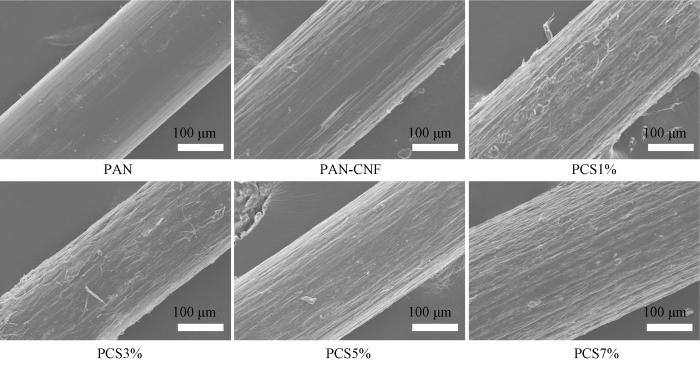
图7
不同纤维样品表面SEM照片
Fig.7
SEM images of fibers surface of different fiber samples
2.5 隔热纤维的力学性能与隔热性能分析
由于性能差异,不同组成纤维可承受的牵伸倍数不同,对不同样品纤维进行力学性能的测试,结果如图8所示。从图中可以看出,熔融纺PAN基纤维的力学性能随着牵伸倍数的增大而提高,牵伸后纤维的拉伸强度显著增加;但当牵伸倍数达到极限后,若继续提高牵伸倍数,纤维的力学性能反而下降。
图8
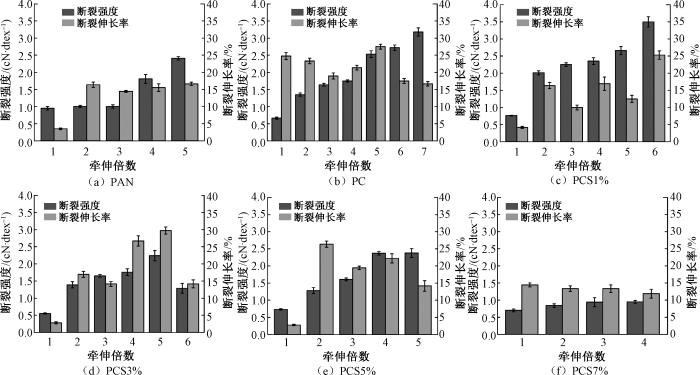
图8
不同牵伸倍数下熔融纺 PAN 基纤维的断裂强度和断裂伸长率
Fig.8
Tensile strength and elongation at break of melt-spun PAN-based fibers at different drafting multiples
PAN纤维的最佳断裂强度为2.41 cN/dtex,PC纤维的为3.18 cN/dtex。与PAN 纤维相比,含0.1% C-CNF的PC纤维断裂强度提高了32.0%,且原丝断裂伸长率显著提高,与XRD分析结果一致,这表明 PAN基体与C-CNF之间形成了较强的相互作用,从而显著提升了熔融纺PAN基纤维的强度和柔韧性。PCS1% 纤维的最佳断裂强度为3.50 cN/dtex,较 PAN纤维提高了45.2%,说明少量SA-PAN的加入能够改善PAN基纤维的力学性能。这是因为PC纤维本身具有较好的柔韧性,而作为填料的SA-PAN仍具有一定的硬度和刚性,少量加入可对PAN基纤维的力学性能产生一定增强作用,同时 SA-PAN与PAN/C-CNF之间形成了较好的界面结合。受 SA-PAN 硬度和刚性的影响,随着SA-PAN 添加量的增加,纤维脆性逐渐增大,且由于SA-PAN在PAN基纤维中逐渐出现团聚的影响,力学性能逐步下降[30];但当SA-PAN添加量为5%时,纤维断裂强度仍可保持在约2.38 cN/dtex的较好水平,而当添加量达到7%时,其力学性能则下降至较差水平。
表2示出不同样品的热学性能。由表可知,PAN纤维和PC纤维的热导率分别为0.101 9、0.119 9 W/(m·K)。PC纤维的热导率的轻微升高,主要是由于C-CNF具有较高比表面积,从而在一定程度上提高了材料的热传导能力。加入1% SA-PAN后,PAN基纤维的热导率降低了29.4%;随着SA-PAN 添加量的增加,PCS纤维的热导率分别降低了 32.7%、37.2%和44.8%。此外,纤维的热扩散系数也随着SA-PAN添加量的增加而降低,结合SEM分析,SA-PAN的引入一方面可降低复合体系中固相热传导能力,另一方面也改变了纤维内部相结构和截面形貌,诱导形成更多微孔,使得熔融纺丝PAN基纤维的隔热性能显著提升。
表2 不同样品的热学性能
Tab.2
| 样品 | 热导率/(W·m-1·K-1) | 热扩散系数/(mm2·s-1) |
|---|---|---|
| PAN | 0.101 9 | 0.405 6 |
| PC | 0.119 9 | 0.477 2 |
| PCS1% | 0.084 6 | 0.357 1 |
| PCS3% | 0.080 7 | 0.350 8 |
| PCS5% | 0.075 3 | 0.339 4 |
| PCS7% | 0.066 2 | 0.263 6 |
3 结论
本文成功将聚丙烯腈(PAN)接枝到SiO2气凝胶(SA)表面,制备得到接枝率为20.4% 的SA-PAN填料。在乳液聚合阶段原位加入0.1%的羧基纤维素纳米纤维(C-CNF),制备了可熔融加工的 PAN/C-CNF聚合物,并将其与不同比例的SA-PAN 进行共混,随后通过熔融纺丝法成功制备出兼具优异隔热性能和力学性能的PAN基纤维。C-CNF 的引入显著改善了纤维的柔韧性和拉伸强度。纤维断裂强度提高了32%,由2.41 cN/dtex提升至3.18 cN/dtex。SA-PAN的加入有效降低了纤维热导率,并提升了其热稳定性和残炭率。纤维热导率由0.119 9 W/(m·K)降至0.075 3 W/(m·K),降幅为37.2%;当分别加入1%和3% SA-PAN 时,PAN基隔热纤维的残炭率由 9.11% 分别提高至16.41%和44.85%。此外,少量SA-PAN的加入还能够改善纤维的力学性能。当加入1% SA-PAN 时,PAN基纤维的断裂强度提高至3.50 cN/dtex;但随着SA-PAN添加量进一步增加,纤维的力学性能有所下降。需指出的是,当SA-PAN添加量为5%时,纤维断裂强度仍可保持在2.38 cN/dtex的较好水平。
参考文献
Polyacrylonitrile-based nanocomposite fibers: a review of current developments
[J].
A review: polyacrylonitrile as high-performance piezoelectric materials
[J].DOI:10.1016/j.nanoen.2023.108987 URL [本文引用: 1]
Melt-spinnable polyacrylonitrile: an alternative carbon fiber precursor
[J].
DOI:10.3390/polym14235222
URL
[本文引用: 1]

The review summarizes recent advances in the production of carbon fiber precursors based on melt-spun acrylonitrile copolymers. Approaches to decrease the melting point of polyacrylonitrile and acrylonitrile copolymers are analyzed, including copolymerization with inert comonomers, plasticization by various solvents and additives, among them the eco-friendly ways to use the carbon dioxide and ionic liquids. The methods for preliminary modification of precursors that provides the thermal oxidative stabilization of the fibers without their melting and the reduction in the stabilization duration without the loss of the mechanical characteristics of the fibers are discussed. Special attention is paid to different ways of crosslinking by irradiation with different sources. Examples of the carbon fibers preparation from melt-processable acrylonitrile copolymers are considered in detail. A patent search was carried out and the information on the methods for producing carbon fibers from precursors based on melt-spun acrylonitrile copolymers are summarized.
Transparent thermal insulation silica aerogels
[J].
DOI:10.1039/d0na00655f
PMID:36133881
[本文引用: 1]
Silica aerogels have received much attention due to their unique nanoporous networks, which consist of nanoscale connective silica particles and high-volume nanoscale pores. This lightweight superinsulation solid materials are synthesized by a 'sol-gel' process involving precursor preparation, gelation, aging and drying. By controlling their synthesis and processing, silica aerogels demonstrate good thermal and acoustic insulation, mechanical strength and optical transparency. In recent years, incorporating transparent and thermal insulation silica aerogels in energy-saving windows is of great interest for both scientific and technological applications. This review introduces the basic principles of thermal and optical properties of silica aerogels and highlights their tunability synthetic and processing control. In addition, the use of silica aerogels in transparent thermal insulation windows is discussed.This journal is © The Royal Society of Chemistry.
Hierarchical cellular structured ceramic nanofibrous aerogels with temperature-invariant superelasticity for thermal insulation
[J].
Vibration isolation performance of silica aerogel blankets and boards, fumed silica, polymer aerogel and nanofoams
[J].DOI:10.1016/j.conbuildmat.2024.137429 URL [本文引用: 1]
Hydrophobic silica aerogels by silylation
[J].DOI:10.1016/j.jnoncrysol.2016.01.016 URL [本文引用: 1]
Dye adsorption performance of nanocellulose beads with different carboxyl group content
[J].DOI:10.1007/s10570-022-04964-1 [本文引用: 1]
Highly smooth, robust, degradable and cost-effective modified lignin-nanocellulose green composite substrates for flexible and green electronics
[J].DOI:10.1016/j.compositesb.2022.109803 URL
A simple approach to prepare carboxycellulose nanofibers from untreated biomass
[J].
DOI:10.1021/acs.biomac.7b00544
PMID:28644013
[本文引用: 1]
A simple approach was developed to prepare carboxycellulose nanofibers directly from untreated biomass using nitric acid or nitric acid-sodium nitrite mixtures. Experiments indicated that this approach greatly reduced the need for multichemicals, and offered significant benefits in lowering the consumption of water and electric energy, when compared with conventional multiple-step processes at bench scale (e.g., TEMPO oxidation). Additionally, the effluent produced by this approach could be efficaciously neutralized using base to produce nitrogen-rich salts as fertilizers. TEM measurements of resulting nanofibers from different biomasses, possessed dimensions in the range of 190-370 and 4-5 nm, having PDI = 0.29-0.38. These nanofibers exhibited lower crystallinity than untreated jute fibers as determined by TEM diffraction, WAXD and C CPMAS NMR (e.g., WAXD crystallinity index was ∼35% for nanofibers vs 62% for jute). Nanofibers with low crystallinity were found to be effective for removal of heavy metal ions for drinking water purification.
Composite electrospun membranes based on polyacrylonitrile and cellulose nanofibrils: relevant properties for their use as active filter layers
[J].DOI:10.1016/j.seppur.2023.123358 URL [本文引用: 1]
Synthesis of carboxyl cellulose nanocrystals/copper nanohybrids to endow waterborne polyurethane film with improved mechanical and antibacterial properties
[J].DOI:10.1007/s10924-023-02772-7
Influence of nanocellulose structure on paper reinforcement
[J].DOI:10.3390/molecules27154696 URL [本文引用: 1]
Polyacrylonitrile nanocomposite fibers from acrylonitrile-grafted carbon nanofibers
[J].DOI:10.1016/j.compositesb.2017.07.031 URL [本文引用: 1]
Stabilization study of polyacrylonitrile/cellulose nanocrystals composite fibers
[J].DOI:10.1021/acsapm.9b00057 URL [本文引用: 1]
Effect of extrusion and compression moulding on the thermal properties of nylon-6/silica aerogel composites
[J].
DOI:10.1177/0892705717729198
URL
[本文引用: 1]
The article presents the effect of a lower extrusion speed and compression moulding processes on the thermal properties of polyamide 6 (PA-6)/aerogel composite. Scanning electron and optical microscope images showed that although most of the aerogel was destroyed during extrusion at 65 r/min, extrusion at 5 r/min showed a better retention of the aerogel structure. However, when subjected to moulding in a compression press, both composites extruded at different speeds suffered significant damage. Nevertheless, the extruded samples did show a lower thermal conductivity compared to the virgin polymer. Further, it was observed that the sample extruded at 5 r/min had a lower damage coefficient value with an overall loss of around 33% to the aerogel structure when compared to the material extruded at 65 r/min, which endured a structural loss of 41% to the aerogel in it.
The influence of silica aerogels on physical, mechanical, and morphological properties of melt-spun POY and DTY polyester yarns
[J].DOI:10.1016/j.polymertesting.2022.107628 URL [本文引用: 1]
Various comonomers in acrylonitrile based copolymers: effects on thermal behaviour
[J].
Fabrication, structures and properties of acrylonitrile/vinyl acetate copolymers and copolymers containing microencapsulated phase change materials
[J].DOI:10.1007/s13233-009-0122-z URL
Effects of copolymerization temperatures on structure and properties of melt-spinnable acrylonitrile-methyl acrylate copolymers and fibers
[J].DOI:10.1007/s13233-010-1115-7 URL [本文引用: 1]
Modification of graphene oxide and its effect on properties of natural rubber/graphene oxide nanocomposites
[J].
DOI:10.3762/bjnano.15.16
PMID:38352717
[本文引用: 1]
Modification of graphene oxide (GO) by vinyltriethoxysilane (VTES) was investigated to study the effect of silanized GO on radical graft copolymerization of GO onto deproteinized natural rubber (DPNR). The modified GO, GO-VTES (a and b), was characterized by X-ray diffraction (XRD), Fourier-transform infrared spectroscopy, contact angle, thermal gravimetric analysis, and scanning electron microscopy. The XRD results showed the appearance of an amorphous region of silica particles at a diffraction angle of 22°. The formation of silica was investigated by Si NMR, and it was found that the hydrolysis and condensation of VTES proceed more completely in basic conditions than in acidic conditions. The silica content of GO-VTES(b) was 43%, which is higher than that of GO-VTES(a) (8%). Morphology of silica was observed by SEM. The DPNR/GO-VTES nanocomposites prepared with the same amount of GO, GO-VTES(a), and GO-VTES(b) were characterized with tensile tests and dynamic mechanical tests. The stress at break of DPNR/GO-VTES(a) and DPNR/GO-VTES(b) was 5.2 MPa and 4.3 MPa, respectively, which were lower than that of DPNR/GO. However, it exhibited higher stress at small strains and higher storage modulus than DPNR/GO.Copyright © 2024, Thuong et al.
Multiple assembly strategies for silica aerogel-fiber combinations: a review
[J].
Facile fabrication of controllable zinc oxide nanorod clusters on polyacrylonitrile nanofibers via repeatedly alternating immersion method
[J].DOI:10.1007/s11051-016-3678-5 URL [本文引用: 1]
Accelerating the stabilization of polyacrylonitrile fibers by UV irradiation
[J].DOI:10.1016/j.jiec.2019.01.012 URL [本文引用: 1]
High-performance cellulose nanofibers/carbon nanotubes composite for constructing multifunctional sensors and wearable electronics
[J].
DOI:10.1007/s42765-024-00388-7
[本文引用: 1]
The green preparation of highly dispersed carbon nanotube (CNT) conductive inks remains a critical challenge in the field of flexible electronics. Herein, a waterborne CNT dispersion approach mediated by carboxylated cellulose nanofibers (C-CNFs) was proposed. CNFs, special biomass materials with excellent nanostructures and abundant active surface groups, are used as green dispersants. During the dispersion process, benefiting from chemical charge and dimensional matching, C-CNF/CNT wicking-driven stable composite structures (CCNTs) were co-assembled via hydrogen bonding, electrostatic stabilization and π–π stacking between the interfaces, generating controlled orientational structures and promoting stable dispersion and conductivity of CNTs, which were demonstrated via molecular dynamics simulations combined with a variety of physicochemical characterization methods. The dispersion concentration of CNTs in a CCNT slurry can reach 80 wt%, and the obtained CCNT slurry has a low zeta potential (less than − 60 mV) and good stability. Due to the film-forming properties of CNFs and in-plane oriented self-assembly of CCNT, the composite self-supporting films were fabricated with high electrical conductivity (67 S cm−1) and mechanical performance (tensile strength of 153 MPa). In addition, the resulting biobased CCNT ink is compatible with a variety of printing processes and adaptable to various substrates. Moreover, this ink can be used to construct multifunctional advanced sensors with electrochemical, electrothermal, and deformation/piezoresistive responses, which demonstrate excellent performance in monitoring human health.
Structure of sp2-carbon fiber prepared by high-temperature thermomechanical treatment of polyacrylonitrile fiber: a Raman and X-ray diffraction study
[J].DOI:10.1007/s11172-018-2171-y [本文引用: 1]
Cellulose nanocrystals as nucleating agents for the strain induced crystallization in natural rubber
[J].
DOI:10.1039/d2sm01291j
PMID:36349700
[本文引用: 1]
Vulcanized natural rubber (NR)/cellulose nanocrystals (CNC) composites with a CNC content of up to 5 wt% using physical blending and dicumyl peroxide crosslinking were prepared. The tensile properties were investigated at slow and high strain rates. The slow strain rate tests revealed an increase of the elastic modulus concomitant with a decrease of strain at the crystallization onset while increasing the CNC fraction. The high strain rate tests performed near adiabatic conditions demonstrated the ability of the CNC to improve the elastocaloric properties of the NR matrix, with an increase of 30% and 15% of heating and cooling capacities, respectively, in the presence of 3 wt% CNC. Such results were ascribed to (i) a higher thermoelastic effect, due to strain amplification in the NR matrix in the presence of CNC and (ii) a nucleating effect of the CNC on strain induced crystallization. This series of materials can be proposed as a promising eco-friendly alternative to conventional carbon black filled rubber as potential green elastocaloric materials (heating pump, cooling machines).
Lignin-coated cellulose nanocrystals as promising nucleating agent for poly(lactic acid)
[J].DOI:10.1007/s10973-016-5657-6 URL [本文引用: 1]
Characterization and mechanism analysis of flexible UV irradiated PAN-based carbon fiber membranes prepared
[J].DOI:10.1007/s12221-023-00384-5 [本文引用: 1]
Fabrication and characterization of silica aerogel blanket as an excellent thermal insulating material
[J].DOI:10.1007/s12034-023-03102-2 [本文引用: 1]

 京公网安备11010502044800号


