



基于此,本文从纺织品全生命周期视角出发,系统梳理AI赋能纺织产业减污降碳的技术现状与创新路径,以期为纺织产业绿色低碳转型提供理论支撑与实践参考。
1 AI赋能纺织产业减污降碳研究进展
近年来,AI技术在纺织产业的应用已向全生命周期减污降碳延伸,“双碳”目标进一步推动了AI与纺织绿色发展的融合研究[6]。
1.1 设计阶段
设计阶段是源头环节,现有研究主要从3个方面展开。
3)智能交互产品设计。多模态感知、强化学习与生成对抗网络等技术被引入纺织产品交互设计,推动产品从传统功能型向智能交互型转变,以实时采集的用户行为数据优化产品设计决策[11]。
设计阶段3类技术路径各有侧重,生成式AI(GAN、扩散模型)输出速度快、创意成本低,但结果可控性弱、对大规模标注数据依赖度高,不适合精准工艺决策;IDSS与DGM在材料性能预测上精度更高、可解释性更强,但需构建专业领域数据库,初期部署成本较高;多模态感知与强化学习在交互产品设计上潜力突出,但工程化门槛高、训练周期长。
1.2 生产阶段
纺织生产阶段是全产业链能耗与污染排放最集中的环节,印染加工过程中产生的CO2排放量占印染行业总量的70%以上[12]。目前,AI在质量检测、工艺控制、生产流程3个方向的应用形成了较为系统的积累。
生产阶段AI技术的减碳效能与数据质量和模型复杂度密切相关。例如CNN在质量检测上精度高、实时性强,但依赖海量标注样本,标注成本高;机器学习(ANN、GA、RF)则在工艺控制中可解释性相对较好,数据需求量适中,适合工艺知识积累较深的传统印染企业,部署门槛低于深度学习。
1.3 流通阶段
流通阶段的供应链协同效率与物流碳排放水平,直接影响纺织产业全链条的减碳成效。
此阶段AI技术的减碳效能依赖于供应链数据的开放程度。需求预测算法(RF、DT、ANN)部署成本相对可控,核心约束在于历史销售数据的质量与上下游相关方的共享意愿,数据壁垒问题突出;三维虚拟试穿技术硬件与建模成本较高,短期内主要适用于高客单价品类和头部平台,但其对退货率的压降在减少逆向物流碳排放方面发挥了独特优势。
1.4 消费阶段
消费阶段对纺织业碳排放的影响日益凸显[24],现有研究主要从物理耐久性(生产端驱动)和情感耐久性(消费端驱动)2个维度切入。
比较2种类型,物理耐久性依赖传感器硬件与材料研发的协同,技术链条长、落地成本高,但减碳效果可量化;情感耐久性以软件推荐算法为核心,边际成本低、易规模化,但减碳效果难归因,且高度依赖用户行为数据,数据合规成本存在争议,算法推荐的“信息茧房”效应也可能导致过度消费反而增加碳排放。
1.5 回收再生阶段
回收再生阶段是纺织品全生命周期中技术难度最大、AI参与工作较多的过程。
2)再生利用技术。在再生工艺参数优化方面,化学法再生是高值化利用的核心路径[32],AI的引入可对醇解反应中多参数组合进行智能优化,提升反应效率和产品纯度;在再生产品质量评估方面,AI辅助的绿色溶剂筛选与高效催化剂开发是突破多品类纤维分类回收技术壁垒的核心方向。
回收再生阶段AI技术应用的核心差异体现在识别精度、处理速度与设备成本3个维度。NIR结合深度学习在纤维成分识别中准确率最高,但光谱设备价格昂贵、维护要求高,且对深色和混纺织物的识别稳定性仍有待提升;化学法再生的AI参数优化应用潜力大,但工程化成本高,对催化剂和溶剂体系的专业要求制约了中小回收企业的可及性;回收网络优化的算法门槛不高,主要障碍在于回收量预测所需的数据来源分散,以及各区域运营主体的协同意愿不足。
深度融合数字技术正是推动纺织产业从多维度实现绿色创新的核心驱动[36],数字化技术、智能制造和环保染色技术等新质生产力要素的综合作用,能够助力行业实现从传统制造向高附加值、智能化、绿色化现代产业的跨越[37]。综观现有研究,仍存在3方面不足之处。一是缺乏全生命周期系统性分析。从研究范式看,工程技术类研究偏重局部性能优化,环境管理类研究侧重末端效应评估;从产业结构看,纺织价值链主体高度分散,跨阶段数据的采集与贯通在现实中面临较高的协调成本;从数据标准看,不同阶段的碳排放核算边界与功能单位定义不统一,导致跨阶段效益比较缺乏共同基准。二是数据贯通与系统协同机制存在瓶颈。在技术层面,行业数据格式与接口标准高度碎片化,各类设备、平台与管理系统之间的数据互通成本高昂,“数据孤岛”问题突出;在利益层面,核心工艺数据与客户数据的权属争议缺乏明确的法律界定和市场化解决机制,商业壁垒难以依靠单一技术手段突破;在能力层面,中小纺织企业数字化基础薄弱,数据采集与处理能力的差距使规模化协同在短期内难以实现;三是AI技术自身存在局限性。当前研究普遍聚焦于AI的技术潜力,而对其在纺织应用场景中的内在局限性关注不足。其一,算法“黑箱”问题在可解释性要求较高的工艺优化场景中构成实质性障碍,目前可解释AI(XAI)框架的引入是较为可行的应对方向,但相关研究在纺织领域较少。其二,模型泛化能力受限于训练数据的代表性,纺织生产中设备型号、原料批次、气候环境等变量多样,特定企业环境中训练的模型往往难以跨厂迁移,制约了规模化应用。其三,AI系统自身的训练与推理过程存在不可忽视的算力能耗,目前暂未系统测算并将这一“AI碳成本”纳入全生命周期的净减排效益核算。
上述3方面不足表明,推动AI赋能纺织产业深度减碳,不能仅依赖单点技术突破,还需在数据标准建设、跨主体协同机制和AI模型可信度提升3个层面协同推进。
2 全生命周期减污降碳的路径
依据已有研究数据,对AI赋能下纺织品全生命周期各阶段碳减排潜力进行测算。设基准年单位产品(以1件标准棉质服装为例,约重0.3 kg)生命周期碳排放为15 kg CO2e(含原料种植/化纤生产约5.5 kg、纺纱织造约1.5 kg、印染整理约4.0 kg、运输流通约1.0 kg、消费使用约1.5 kg、废弃处置约1.5 kg),各阶段AI介入后减排潜力估算如下:
过剩生产率降低20%~30%[38],折算碳减排1.10~1.65 kg CO2e/件;印染碳排放可降低15%~20%,0.6~0.8 kg CO2e/件;坯布废品率降低约20%[14],按纺纱织造阶段(1.5 kg)折算碳减排约0.3 kg CO2e/件;智能调度可使运输碳排放降低10%~15%[10],折算0.1~0.15 kg CO2e/件;服装穿用次数每增加1倍,碳排放减少44%[6],减排约0.66 kg CO2e/件;废旧纺织品单独回收碳排放(221.31 kg/t)较混入回收碳排放(343.97 kg/t)下降约35%[39],可减排0.53 kg CO2 e/件。综合各阶段,在AI充分赋能的情景下,单件服装生命周期碳排放由约15 kg CO2e降至10.9~11.7 kg CO2e,全链条减排潜力达22%~27%。
基于此,提出AI赋能纺织产业全链条减污降碳的具体路径,如图1所示。
图1
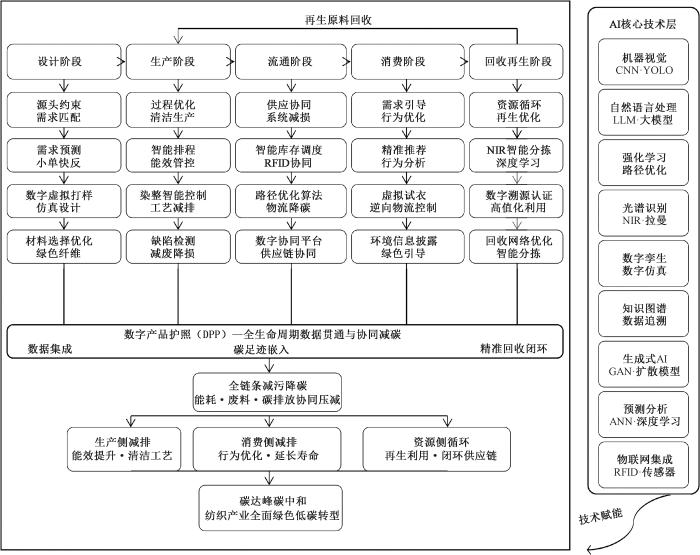
图1
AI赋能纺织全生命周期减污降碳技术路径
Fig.1
AI-Enabled technical pathways for pollution reduction and carbon mitigation across textile life cycle
2.1 源头约束与需求匹配设计阶段
设计阶段是纺织品全生命周期减污降碳的起点。产品全生命周期中约80%的资源环境影响取决于设计阶段的决策[40],AI在设计阶段的应用主要通过3大路径发挥作用。
1)消费数据驱动的需求预测与“小单快反”模式。传统“批量生产、集中销售、尾货处理”的线性模式造成大量库存积压与资源浪费。AI驱动的需求预测技术通过整合历史销售数据、社交媒体趋势、搜索热词及实时消费者信号,显著提升预测准确率,为“小批量、快测试、快反应”的生产模式提供数据基础。以SHEIN为代表的快时尚平台通过机器学习模型识别潜在流行趋势,以极小批量(通常仅召集50~100件)进行试产,依据销售反馈决定是否追加。该模式使库存周转率大幅提升,库存压力降低20%~30%[38],有效减少因滞销库存被填埋或焚烧而产生的碳排放。
2)数字仿真设计与虚拟打样技术。传统实物打样每轮打样均涉及材料消耗、运输碳排放与生产能耗。数字仿真与虚拟打样技术以三维建模、物理仿真引擎与机器学习算法,从源头大幅削减实物样品的物料消耗[10]。例如:耐克(Nike)通过将AI驱动的虚拟打样系统整合进产品开发流程,降低样品阶段的原材料消耗与物流碳排放;Style3D等国内平台的AI多模态生成模型满足基础设计需求外,还能精准捕捉市场趋势,与“小单快反”模式形成协同,推动设计端与流通端的跨阶段减碳效应。
2.2 过程优化与清洁生产阶段
AI在生产阶段的减污降碳作用机制可归纳为3个层次:生产排程优化减少无效能耗、染整工艺智能控制降低化学品与能源消耗、深度学习缺陷检测减少面料废品率。
2.3 供应链协同与系统减损流通阶段
AI在流通阶段可通过信息的实时整合与协同优化,系统性消除供应链各环节的“摩擦性浪费”,实现从订单到交付全链条的减损与降碳。
1)射频识别(RFID)与AI协同的智能库存调度。通过对门店库存的实时感知与跨门店、跨仓储节点的智能调拨,可消除传统库存管理的信息滞后问题[48]。例如:Inditex在全球门店部署RFID标签,通过AI分析门店销售速度、区域需求差异与季节性趋势,动态调整补货计划与跨区调拨策略,库存盘点准确率提升至98%以上,补货速度提升30%。
2.4 需求引导与行为优化机制消费阶段
生产阶段的减碳作用于物质流的转化效率,而消费阶段的减碳则作用于需求流的引导与行为模式的优化。
2)虚拟试衣技术与逆向物流控制。三维虚拟试衣技术通过AI驱动的体型扫描、参数化建模与虚拟试穿模拟,在购买前提供高度仿真的穿着效果预览,降低因信息不对称带来的产品失配风险[10]。Zalando的AI尺码推荐系统使相关产品的退货率降低10%以上。
2.5 资源循环与再生优化机制回收再生阶段
废旧纺织品成分复杂、混纺比例高,传统回收体系严重制约了再生纤维的品质与规模[27]。AI在回收再生阶段通过智能分拣、数字追溯与回收网络的优化实现减污降碳。
1)NIR与深度学习融合的纤维分拣技术。NIR技术通过检测纤维对近红外光的吸收特征,快速获取材料的化学组成信息,再由DL对光谱特征进行高精度解析,实现对棉、涤纶、锦纶等不同纤维成分的精准识别与分类。Tomra将高精度NIR、可见光(VIS)光谱传感技术与深度学习算法集成于全自动分拣设备,实现对棉、涤纶及混纺材料的高精度区分。分拣精度的提升直接影响再生纤维的品质,而高品质的再生纤维正是推动废旧纺织品从末端处置向高值循环转型的技术起点。
2.6 全生命周期协同机制数字产品护照
数字产品护照(DPP)为每件产品配置贯通全生命周期的数字身份档案,将材料成分、生产工艺、碳足迹、维修记录与回收处置信息整合于统一数据载体,实现全流程数据贯通[55]。DPP不仅是欧盟绿色贸易规则的重要组成部分,更是AI赋能纺织全生命周期协同减碳的制度与技术抓手。
1)与纺织印染工艺的技术衔接。DPP在生产阶段可将印染工艺参数与环境排放数据进行标准化数字记录,形成可跨主体传递的工艺环境档案。技术路径上,印染工序中AI优化系统的输入参数与输出结果可通过IoT接口实时写入DPP数据层;区块链技术对上述数据进行存证;AI辅助的生命周期评估(LCA)工具基于DPP中的多维数据,自动化地生成实时动态的产品碳足迹报告,替代传统人工LCA的高成本与低时效[35]。当产品碳足迹数据以标准化方式向供应链下游开放时,碳减排的压力与激励机制将从终端品牌向上游供应商延伸,形成贯通全供应链的碳约束传导效应。
2)基于产品数据的纺织回收工艺发展。DPP可为废弃纺织品智能分拣系统提供先验材料成分信息,提升回收工艺效率与再生纤维品质。产品设计阶段写入DPP的纤维成分、染料类型与整理剂信息,可在回收端通过扫描产品标识直接读取,辅助NIR光谱分拣系统预先设定识别模型参数,减少光谱特征的误判概率;化学法再生工艺可根据DPP中的聚合物牌号与染色信息,预设最优的反应温度、催化剂浓度与溶剂配比,从而提升反应效率与产品纯度。再生原料经AI辅助的质量检测后,检测结果同步上链至DPP,为再生材料提供可追溯的质量认证。2026年3月,国家先进功能纤维创新中心与国际合作伙伴Aware平台联合发布首版再生涤纶全链路数字化产品护照,实现从订单、原料到成品的全流程数据透明追溯,为产品贴上“绿色身份证”,标志着DPP在我国纺织行业的落地应用取得实质性突破。
3)全流程数据贯通与生命周期信息集成。DPP技术实现依赖于跨阶段、跨主体的数据采集与整合。在技术路径上,DPP通过集成标识、物联网、区块链、可信数据空间等,构建覆盖数据采集、标识、存证与核验的全链路闭环;AI在该系统中可承担数据筛选、信息标准化与跨系统互操作的技术支撑角色,将来源各异、格式不一的多元数据转化为可比较、可分析的结构化信息[35]。
3 结束语
我国纺织产业在设计、生产、流通、消费与回收再生各环节均蕴含着巨大的减污降碳潜力,人工智能(AI)已初步形成覆盖纺织品全生命周期的技术赋能体系。在设计阶段,AI驱动的需求预测与虚拟打样从源头削减了物料浪费与“预测性过剩”;在生产环节,智能排程、染整工艺控制与深度学习缺陷检测显著降低了能耗、化学品消耗与废料率;在流通阶段,射频识别(RFID)智能调度与运输路径优化系统性消除了供应链中的“摩擦性浪费”;在消费环节,AI通过精准推荐与虚拟试衣驱动了生产端及消费端根源性减碳;在回收再生阶段,近红外NIR光谱与深度学习融合的智能分拣技术结合数字追溯体系,正在推动废旧纺织品从“末端处置”向“高值循环”转型。以数字产品护照(DPP)为载体的全生命周期数据贯通机制,则为AI赋能全链条协同减碳提供了转型路径。
未来AI赋能纺织减污降碳的研究需在以下4个方向实现突破。一是可解释AI(XAI)在纺织工艺优化中的应用,重点探索如何将沙谱利值(SHAP值)、注意力机制等可解释性工具加入染整工艺模型,在保持预测准确度的同时提升工程师的可干预性。二是探索基于联邦学习的隐私保护型跨企业数据协同机制,在不共享原始数据的前提下实现跨企业、跨阶段的联建,从而打破数据孤岛。三是DPP数据标准与全球互认机制研究,实现跨主体数据可信传递与碳足迹动态核算的技术规范。四是多目标协同优化的AI统筹决策系统,探索多目标强化学习(RL)与帕累托最优在纺织工艺优化中的应用,建立兼顾碳排放最小化、化学需氧量排放最低化、能源效率最大化与产品质量最优化等多重目标的AI统筹决策系统。综上,AI赋能纺织产业减污降碳已进入规模化应用的关键期,需在不同方向实现交叉突破,才能进一步推动我国纺织产业真正迈向全生命周期减污降碳。
参考文献
90%纺织企业设定气候目标,从纤维到成衣碳足迹核算待突破
[EB/OL]. (
90% of textile enterprises set climate goals, carbon footprint accounting from fiber to garment awaits breakthrough
[EB/OL]. (
我国纺织行业单位产值能耗近20年下降超65% 再生纤维年使用量突破300万吨
[EB/OL]. (
Energy consumption per unit output value of China's textile industry has dropped by more than 65% in the past two decades, annual use of recycled fiber exceeds 3 million tons
[EB/OL]. (
废旧纺织品回收量持续增长背后:纺织行业迎来线性经济转向循环经济变革
[EB/OL]. (
Behind the continuous growth of waste textile recycling: the textile industry ushers in a transformation from linear economy to circular economy
[EB/OL]. (
GeSI: 到2030年,ICT技术助力全球二氧化碳当量排放减少20%
[EB/OL]. (
GeSI:ICT technologies will help reduce global CO2 equivalent emissions by 20% by 2030
[EB/OL]. (
“智”造有“数” 企业扩“路”——工业企业加力布局智能制造
[EB/OL]. (
Intelligent manufacturing with data drives enterprises' expansion-industrial enterprises accelerate deployment of smart manufacturing
[EB/OL]. (
双碳目标下纺织产业的绿色创新与发展
[J].
Green innovation and development of textile industry under dual carbon goals
[J].
人工智能技术在纺织服装图案设计领域的应用
[J].
Application of AI technology in textile and apparel pattern design
[J].
An application of generative AI for knitted textile design in fashion
[J].DOI:10.1080/14606925.2024.2303236 URL [本文引用: 1]
A data-driven intelligent decision support system that combines predictive and prescriptive analytics for the design of new textile fabrics
[J].DOI:10.1007/s00521-023-08596-9 [本文引用: 1]
人工智能技术在减少纺织服装行业碳排放中的发展与应用
[J].
Development and application of artificial intelligence technology in reducing carbon emissions in the textile and apparel industry
[J].
人工智能驱动的纺织产品交互创新机制与设计模式研究
[J].
Research on the interactive innovation mechanism and design patterns of textile products driven by artificial intelligence
[J].
纺织印染行业的碳排放情况和碳减排技术
[J].
Carbon emission situation and carbon emission reduction technology in textile printing and dyeing industry
[J].
Deep learning applications in textile industry: a systematic review of current status and delineating future research agenda
[J].DOI:10.1007/s11831-025-10366-w [本文引用: 1]
Artificial intelligence driving innovation in textile defect detection
[J].
DOI:10.3390/textiles5020012
URL
[本文引用: 2]

The cornerstone of textile manufacturing lies in quality control, with the early detection of defects being crucial to ensuring product quality and sustaining a competitive edge. Traditional inspection methods, which predominantly depend on manual processes, are limited by human error and scalability challenges. Recent advancements in artificial intelligence (AI)—encompassing computer vision, image processing, and machine learning—have transformed defect detection, delivering improved accuracy, speed, and reliability. This article critically examines the evolution of defect detection methods in the textile industry, transitioning from traditional manual inspections to AI-driven automated systems. It delves into the types of defects occurring at various production stages, assesses the strengths and weaknesses of conventional and automated approaches, and underscores the pivotal role of deep learning models, especially Convolutional Neural Networks (CNNs), in achieving high precision in defect identification. Additionally, the integration of cutting-edge technologies, such as high-resolution cameras and real-time monitoring systems, into quality control processes is explored, highlighting their contributions to sustainability and cost-effectiveness. By addressing the challenges and opportunities these advancements present, this study serves as a comprehensive resource for researchers and industry professionals seeking to harness AI in optimizing textile production and quality assurance amidst the ongoing digital transformation.
人工智能在纺织印染行业中的应用研究进展
[J].
Research progress in applications of artificial intelligence in dyeing and finishing industry
[J].
Integration of artificial intelligence and augmented reality for assisted detection of textile defects
[J].
人工智能在纺织行业生产领域的应用
[J].
AI applications in the textile industry production
[J].
人工智能驱动下纺织机械自动化的技术创新与发展趋势研究
[J].
Research on technological innovation and development trends of textile machinery automation driven by artificial intelligence
[J].
AI在纺织检测实验室质量管理体系中的应用
[J].
Application of AI in the quality management system of textile testing laboratories
[J].
Effectiveness of AI technologies in reducing textile waste in the fashion industry
[J].
DOI:10.1177/00405175251357582
URL
[本文引用: 4]
Currently, artificial intelligence (AI) technology offers opportunities to address serious challenges in waste management in the fashion industry. This study systematically reviewed and analyzed literature on AI applications in textile waste management from 2014 to 2024. We aimed to review the intervention effects of AI technologies on textile waste across stages of the fashion industry lifecycle and explore AI’s role in promoting circular supply chains (CSCs). The results show that AI plays a prominent role in four key areas: Enhanced intelligent analysis of market dynamics, optimizing consumer experience-oriented durability design, collaboratively optimizing production processes and inventory management, and advancement of intelligent waste management. Convolutional neural networks are the most widely used AI technology due to their strength in image recognition. However, AI technologies also face limitations such as high data requirements. Future research should attempt to promote improvements in policies, enterprise, and technologies to unleash greater potential for AI in CSCs.
Effects of 3D virtual 'try-on' on online sales and customers' purchasing experiences
[J].DOI:10.1109/Access.6287639 URL [本文引用: 1]
Role of artificial intelligence and augmented reality in fashion industry from consumer perspective: sustainability through waste and return mitigation
[J].DOI:10.1016/j.engappai.2024.108114 URL [本文引用: 1]
绿色消费驱动下纺织产业绿色转型机制研究
[J/OL].
Research on green transformation mechanism of textile industry driven by green consumption
[J/OL].
Artificial intelligence enabled biodegradable all-textile sensor for smart monitoring and recognition
[J].DOI:10.1016/j.nanoen.2024.110118 URL [本文引用: 1]
Emerging AI technologies inspiring the next generation of e-textiles
[J].DOI:10.1109/ACCESS.2023.3282184 URL [本文引用: 1]
废旧纺织品高效分拣、解聚与高值再生技术进展
[J/OL].
Progress in efficient sorting, depolymerization and high-value regeneration technologies for waste textiles
[J/OL].
Advancing circular economy practices using AI-powered colour classification of textile fabrics: overview and roadmap
[J].
DOI:10.3390/textiles5040053
URL
[本文引用: 1]
Classification is a crucial task for reintroducing end-of-life fabrics as raw materials in a circular process, thus reducing reliance on dyeing processes. In this context, this review explores the evolution of automated and semi-automated colour classification methods, emphasizing the transition from deterministic techniques to advanced methods, with a focus on machine learning, deep learning, and particularly Convolutional Neural Networks (CNNs), and Recurrent Neural Networks (RNNs). These technologies show potential for improving accuracy and efficiency. The results highlight the need for enriched datasets, deeper AI integration into industrial processes, and alignment with circular economy objectives to enhance sustainability without compromising industrial performance. Tested against a case study, the different architectures confirmed the state-of-the-art statements demonstrating that they are effective in classification, with better performance reached by CNN-based methods, which outperforms other methods in most colour families, with an average accuracy of 86.1%, indicating its adaptability for this task. The adoption of the proposed AI-based colour-classification roadmap could be effective in reducing dyeing operations, lower costs, and improve sorting efficiency for textile SMEs.
A systematic literature review: AI-enabled textile waste sorting
[J].DOI:10.3390/su17104264 URL [本文引用: 1]
基于专利视角的人工智能技术在纺织检测领域的应用
[J].
The application of artificial intelligence technology in the textile inspection field from patent perspective
[J].
废旧纺织品循环经济的监督检验体系研究进展
[J].
Research progress of supervision and inspection system for recycling waste textiles
[J].
废旧纺织品回收与资源化再生利用技术进展
[J].
Technology progress in recycling and reuse of waste textiles
[J].
废旧纺织品循环利用产业发展空间及促进机制
[J].
Development space and promotion mechanism of waste textile recycling industry
[J].
生活源废旧纺织品高值化回收再利用体系的构建研究
[J].
Research on constructing high-value recycling systems for municipal textile wastes
[J].DOI:10.1177/004051757204200101 URL [本文引用: 2]
废旧纺织品服装回收再利用环境影响评价综述
[J].
DOI:10.19398/j.att.202206029
[本文引用: 3]
为研究废旧纺织品服装回收再利用环境影响评价的相关问题,采用CiteSpace可视化文献分析工具,对废旧纺织品服装回收再利用环境影响评价的中英文文献进行计量分析,并讨论了废旧纺织品服装回收再利用的环境影响评价结果、再生循环的环境效益计算与分摊方法、环境影响结果综合评价等问题。结果表明:采用不同的回收工艺处理同种废旧纺织品,或将废旧纺织品再生成不同的产品,造成的环境影响具有显著差异;废旧纺织品服装再生循环的环境效益可通过扩展系统边界法进行量化,纳入再生原料的替换率和质量可提高计算精度,并可避免环境效益的主观性评价;废旧纺织品服装再生循环的环境效益在前后两个生命周期进行合理分摊,可避免环境效益的重复计算;环境影响的综合评价可实现不同再生方式环境影响的客观比较。
Review on environmental impact assessment of waste textiles and clothing recycling
[J].
DOI:10.19398/j.att.202206029
[本文引用: 3]
In order to study the environmental impact assessment of waste textiles and clothing recycling, this paper adopts CiteSpace visual literature analysis tool to conduct bibliometric analysis on the Chinese and English literature on the environmental impact assessment of waste textiles and clothing recycling, and discusses the environmental impact results of waste textiles and clothing recycling, the environmental benefit calculation of recycling, the method of environmental impact sharing, and comprehensive evaluation of environmental impact. The results show that the environmental impact is significantly different when the same waste textile is treated by different recycling processes or the waste textile is regenerated into different products. The environmental benefits of the recycling of waste textiles and clothing can be obtained through the system expansion method. Including replacement rate and quality of recycled raw materials can improve the calculation accuracy and avoid subjective evaluation of environmental benefits. The environmental benefits of the recycling of waste textiles and clothing can be reasonably shared between the two life cycles, which can benefit multiple parties and avoid double-counting of environmental benefits. The comprehensive assessment of environmental impact can be characterized by value method, scoring method and geometric area method, so as to compare the overall environmental impact of different regeneration methods.
数字技术赋能纺织产业绿色创新与发展的探讨
[J].
Discussion on green innovation and development of textile industry enabled by digital technology
[J].
新质生产力驱动下纺织行业的创新发展与转型研究
[J].
Research on innovation development and transformation of textile industry driven by new quality productive forces
[J].
新年新衣24小时AI快反,库存压力骤降30%
[EB/OL]. (
New year new clothes: 24-hour AI quick response reduces inventory pressure by 30%
[EB/OL]. (2026-02-14)[
基于垃圾分类的废旧纺织品的单独回收对深圳市生活垃圾处理的碳足迹影响分析
[J].
Effects of separate recycling of household waste textile on carbon footprint of domestic waste treatment in Shenzhen based on garbage classification
[J].
数字化绿色化协同转型发展报告(2024)
[EB/OL]. (
Report on coordinated digital and green transformation development (2024)
[EB/OL]. (
2025新时奢·智享未来报告
[EB/OL]. (
2025 new era luxury·smart future report
[EB/OL]. (2025-03-13)[
长期践行可持续发展战略,阿迪达斯荣膺2025年度财联社致远奖“环境友好(E)先锋企业奖”
[EB/OL]. (
Long-term practice of sustainable development strategy, Adidas wins the 'Environmentally Friendly (E) Pioneer Enterprise Award' of 2025 Cailianshe Zhiyuan Award
[EB/OL]. (
申洲针织(安徽)时尚服装智能制造项目在望江开工
[EB/OL]. (
Shenzhou knitting (Anhui) fashionable garment intelligent manufacturing project starts in Wangjiang
[EB/OL]. (
中国自主研发的染色新技术装备获国家科技进步一等奖
[EB/OL]. (
China's self-developed new dyeing technology and equipment wins first prize of National Science and Technology Progress Award
[EB/OL]. (
人工智能在纺织品检测领域的应用
[J].
Application of artificial intelligence in textile testing
[J].
年检测布匹预计3亿米星辰视觉大模型AI验布机助力泉州产业焕新
[EB/OL]. (
Annual fabric inspection expected to reach 300 million meters - Xingchen visual large model AI fabric inspector helps Quanzhou industry renovation
[EB/OL]. (2024-06-24)[
广州番禺纺织业创新智能验布机纺织品瑕疵检测准确率达97%
[EB/OL]. (
Innovative intelligent fabric inspector in Panyu, Guangzhou achieves 97% accuracy in textile defect detection
[EB/OL]. (
纺织工业智能发展现状与展望
[J].
Current status and prospect of intelligent development in textile industry
[J].
全年减碳超50万吨京东物流绿色供应链带动低碳转型
[EB/OL]. (
Annual carbon reduction exceeds 500,000 tons - JD Logistics green supply chain drives low-carbon transformation
[EB/OL]. (
国务院关于修改《快递暂行条例》的决定
[EB/OL]. (
Decision of the State Council on amending the Interim Regulations on Express Delivery
[EB/OL]. (
服装可持续消费行为的研究现状及困境分析
[J].
Research on status and dilemma of sustainable clothing consumption behavior
[J].
阿里巴巴发布2024年ESG报告持续推进减碳与数字化普惠
[EB/OL]. (
Alibaba releases 2024 ESG report, continues to promote carbon reduction and digital inclusion
[EB/OL]. (
纺织服装行业可持续发展标签分析
[J].
Analysis of sustainability labelling in the textile and fashion industry
[J].
绿色消费政策体系及对服装绿色消费的启示
[J].
Green consumption policy system and its enlightenment to clothing green consumption
[J].
欧盟纺织产业链上的绿色循环及废旧纺织品处理关键问题
[J].
Circular economy in European Union textile industry chain and key issues of waste textiles treatment
[J].
我国废旧纺织品回收利用发展现状及趋势
[J].
The current situation and development trend of recycling and utilization of the textile waste in China
[J].
杭州临平:新国标第四代绿色数智分拣中心投运
[EB/OL]. (
Hangzhou Linping: new national standard fourth-generation green digital intelligent sorting center put into operation
[EB/OL]. (

 京公网安备11010502044800号
