纺织学报 ›› 2024, Vol. 45 ›› Issue (11): 162-169.doi: 10.13475/j.fzxb.20240100901
杜蕾1,2, 王士杰1,2, 蒋之铭1,2( ), 朱平1,2
DU Lei1,2, WANG Shijie1,2, JIANG Zhiming1,2(), ZHU Ping1,2
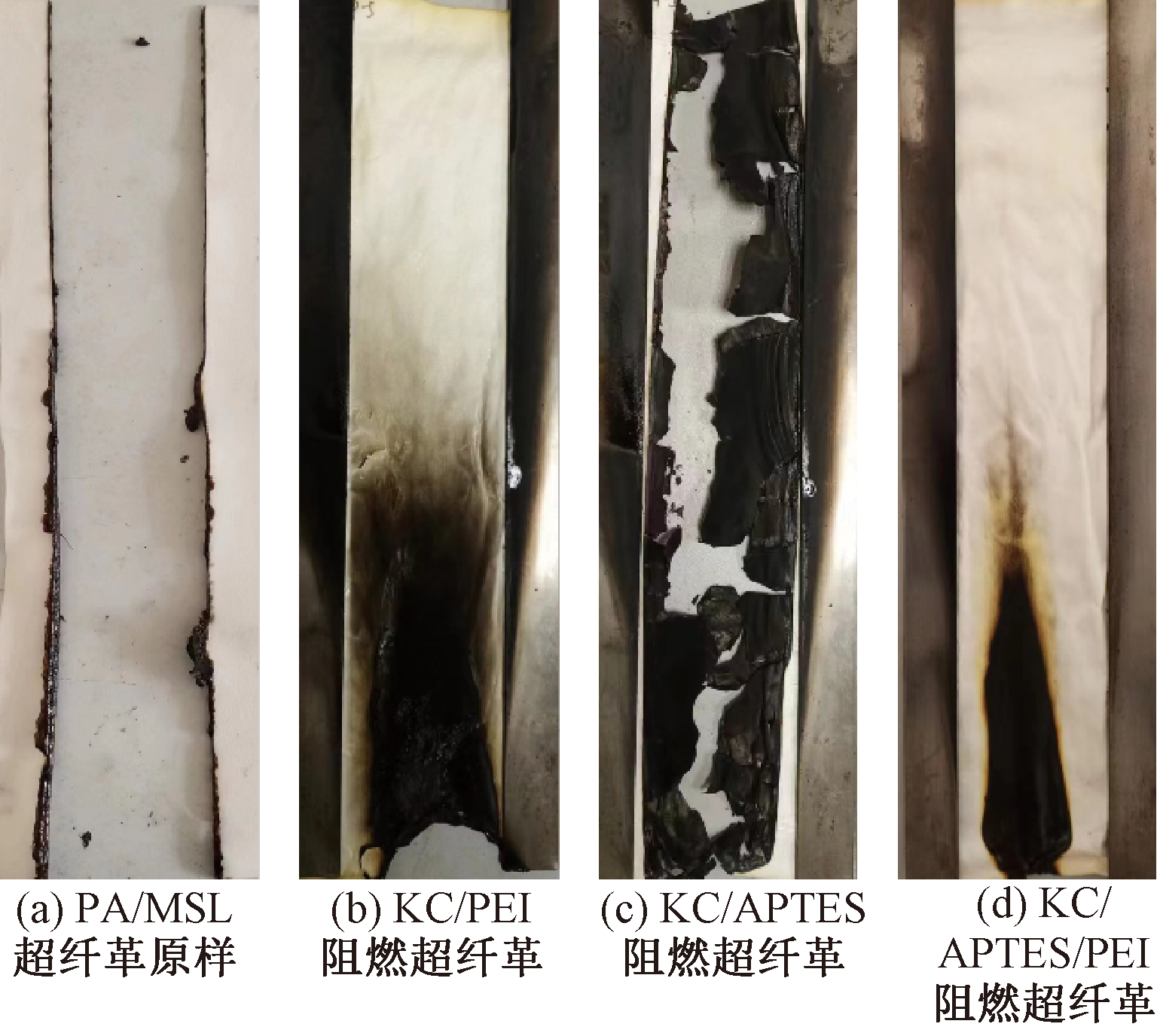
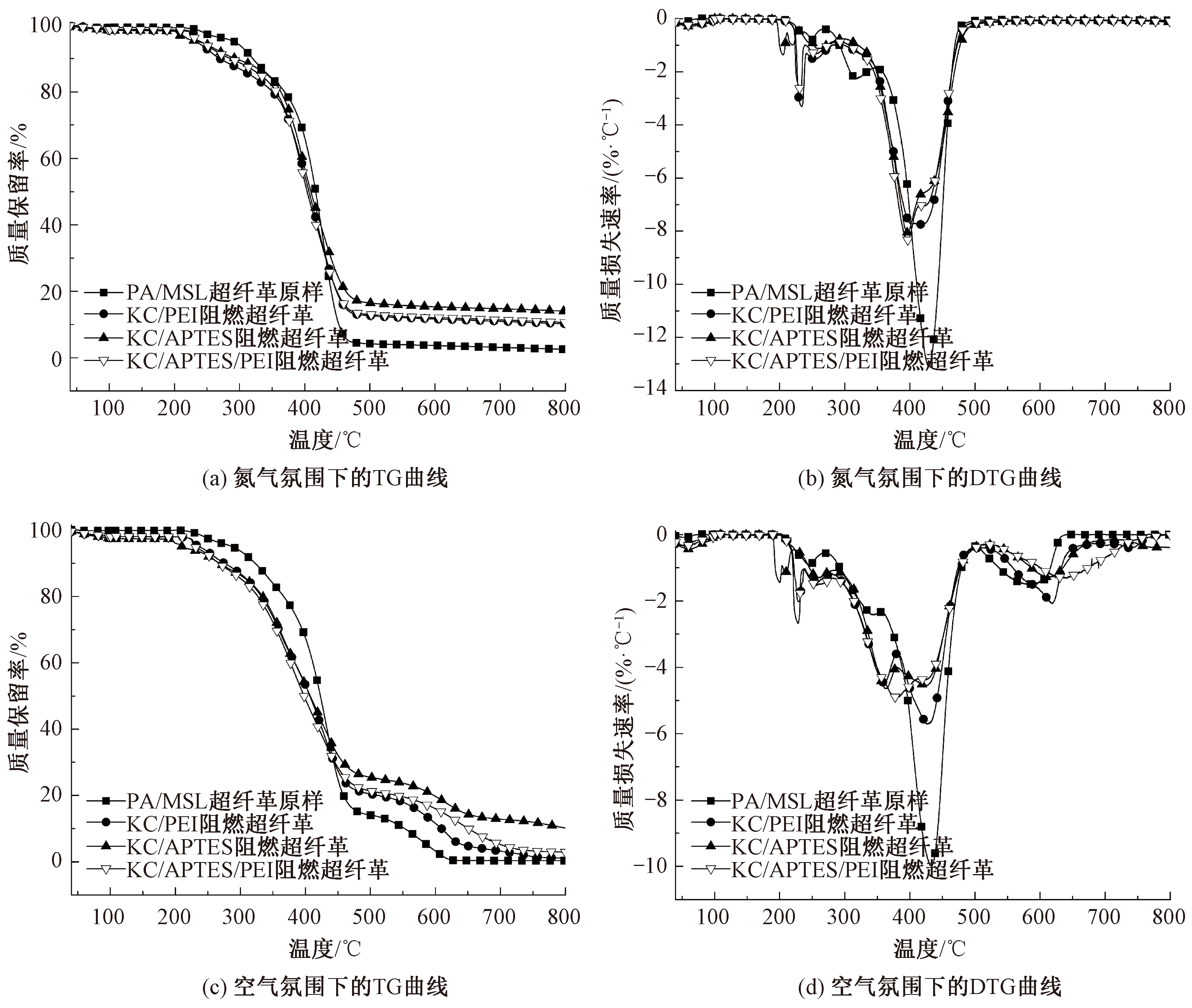
摘要: 超细纤维合成革(MSL)凭借其优异的透气、耐磨、耐用等特性,广泛应用于家居内饰、高铁、汽车及航空航天等领域,但其易燃和熔滴问题严重威胁人身财产安全,极大限制了其在特定领域中的应用。为解决此问题,采用层层自组装技术,以生物多糖卡拉胶(KC)为阴离子电解质,分别与阳离子电解质聚乙烯亚胺(PEI)、3-氨丙基三乙氧基硅烷(APTES)及其混合物相结合,通过构建无卤无磷体系制备了阻燃聚酰胺超细纤维合成革(PA/MSL)。结果表明:APTES的引入可显著提升超细纤维合成革的成炭能力,有效解决了超细纤维合成革的融滴问题,与PA/MSL原样和KC/PEI体系相比,由KC/APTES体系制备的超细纤维合成革的极限氧指数为26.0%,无熔滴产生,在800 ℃氮气和空气气氛下的残炭量分别为14.2%和10.3%;此外,KC/APTES/PEI三元体系能赋予超细纤维合成革优异的阻燃性能,当KC/APTES/PEI涂层负载量为34.1%时,超细纤维合成革的极限氧指数提升至37%,且可在垂直燃烧测试中实现自熄,无熔滴产生。
中图分类号:
| [1] | 王亚停, 赵家琪, 王碧佳, 等. 超细纤维合成革的染色与功能整理研究进展[J]. 纺织学报, 2020, 41(7): 188-196. |
| WANG Yating, ZHAO Jiaqi, WANG Bijia, et al. Research progress on dyeing and functional finishing of microfiber synthetic leather[J]. Journal of Textile Research, 2020, 41(7): 188-196. | |
| [2] | 郭玉花, 邵文全, 滕立军, 等. APP/Sb2O3 复合阻燃剂对聚乙烯性能的影响[J]. 现代塑料加工应用, 2009, 21(5): 48-51. |
| GUO Yuhua, SHAO Wenquan, TENG Lijun, et al. Effect of APP/Sb2O3 composite flame retardant on the properties of polyethylene[J]. Modern Plastics Processing Application, 2009, 21(5): 48-51. | |
| [3] | 李梅英, 张玉洲, 陈明磊, 等. 不同阻燃剂在超细纤维合成革皮基中的应用研究[J]. 皮革与化工, 2018, 35(1): 11-13, 28. |
| LI Meiying, ZHANG Yuzhou, CHEN Minglei, et al. The application research of different flame retardants in microfiber synthetic leather base[J]. Leather and Chemical Industry, 2018, 35(1): 11-13, 28. | |
| [4] | 李梅英, 张玉洲, 刘杰, 等. 溴锑阻燃体系在超细纤维合成革革基中的应用[J]. 中国皮革, 2018, 47(3): 33-37. |
| LI Meiying, ZHANG Yuzhou, LIU Jie, et al. Application of bromine-antimony flame retardant system in microfiber synthetic leather base[J]. Leather in China, 2018, 47(3): 33-37. | |
| [5] | ZHANG Dongqiao, ZENG Jia, LIU Weifeng, et al. Pristine lignin as a flame retardant in flexible PU foam[J]. Green Chemistry, 2021, 23: 5972-5980. |
| [6] | WEN Huirao, ZAI Yinhu, HUA Xiuxu, et al. Flame retardant flexible polyurethane foams with highly efficient melamine salt[J]. Industrial & Engineering Chemistry Research, 2017, 56(25): 7112-7119. |
| [7] | ZHENG Tao, XIA Wenning, GUO Jing, et al. Modified magnesium hydroxide encapsulated by melamine cyanurate in flame-retardant polyamide-6[J]. Journal of Polymer Research, 2020. DOI: 10.1007/s10965-020-02229-8. |
| [8] | JIN Wenjie, HE Weilin, GU Liang, et al. An eco-friendly and intumescent P/N/S-containing flame retardant coating for polyamide 6 fabric[J]. European Polymer Journal, 2022. DOI: 10.1016/j.eurpolymj.2022.111610. |
| [9] | ZHAO Haibo, WANG Yuzhong. Design and synthesis of PET-based copolyesters with flame-retardant and antidripping performance[J]. Macromolecular Rapid Communications, 2017. DOI: 10.1002/marc.201700451. |
| [10] | WANG Qianzhan, LIU Chang, XU Yingjun, et al. Highly efficient flame retardation of polyester fabrics via novel DOPO-modified sol-gel coatings[J]. Polymer, 2021. DOI: 10.1016/j.polymer.2021.123761. |
| [11] | LU Shaolin, FENG Yechang, ZHANG Peikun, et al. Preparation of flame-retardant polyurethane and its applications in the leather industry[J]. Polymers, 2021. DOI: 10.3390/polym13111730. |
| [12] | VISAKH P M, SEMKIN A O, REZAEV I A, et al. Review on soft polyurethane flame retardant[J]. Construction and Building Materials, 2019, DOI: 10.1016/j.conbuildmat.2019.116673. |
| [13] | KE Huimin, ZHU Ripeng, MA Jinghong, et al. Preparation and properties of halogen-free flame retardant polyurethane for superfine fiber leather[J]. Materials Science Forum, 2020, 993: 669-677. |
| [14] | WANG Yulu, JIN Liqing. Preparation and characterization of self-colored waterborne polyurethane and its application in eco-friendly manufacturing of microfiber synthetic leather base[J]. Polymers, 2018. DOI:10.3390/polym10030289. |
| [15] | WANG Meiting, YIN Guangzhong, YANG Yuan, et al. Bio-based flame retardants to polymers: a review[J]. Advanced Industrial and Engineering Polymer Research, 2023, 6(2): 132-155. |
| [16] |
LIU Wei, SHI Rui, ZHANG Zejiang, et al. Coordination driven layer-by-layer deposition technology used for fabrication of flame retardant polyamide 66 fabric[J]. Polymers for Advanced Technologies, 2021, 32(8): 3232-3241.
doi: 10.1002/pat.5335 |
| [17] | QIU Xiaoqing, LI Zhiwei, LI Xiaohong, et al. Flame retardant coatings prepared using layer by layer assembly: a review[J]. Chemical Engineering Journal, 2018, 334: 108-122. |
| [18] |
LI Shanshan, DING Fang, LIN Xinghuan, et al. Layer-by-layer self-assembly of organic-inorganic hybrid intumescent flame retardant on cotton fabrics[J]. Fibers and Polymers, 2019, 20(3): 538-544.
doi: 10.1007/s12221-019-8914-z |
| [19] | DENG Shibi, LIAO Wang, YANG Junchi, et al. Flame-retardant and smoke-suppressed silicone foams with chitosan-based nanocoatings[J]. Industrial & Engineering Chemistry Research, 2016, 55(27): 7239-7248. |
| [20] | 孙珂, 徐子涵, 张贺. 生物质阻燃材料发展现状与趋势[J]. 绿色科技, 2018 (18):217-219. |
| SUN Ke, XU Zihan, ZHANG He. Development status and trend of biomass flame retardant materials[J]. Green Science and Technology, 2018 (18):217-219. | |
| [21] | PAN Haifeng, WANG Wei, SHEN Qi, et al. Fabrication of flame retardant coating on cotton fabric by alternate assembly of exfoliated layered double hydroxides and alginate[J]. RSC Advances, 2016, 6(113): 111950-111958. |
| [22] |
WU Qian, LIU Chun, TANG Longcheng, et al. Stable electrically conductive, highly flame-retardant foam composites generated from reduced graphene oxide and silicone resin coatings[J]. Soft Matter, 2021, 17(1): 68-82.
doi: 10.1039/d0sm01540g pmid: 33147311 |
| [23] | XIAO Chaobo, LIU Hongjuan, LU Yongshang, et al. Blend films from sodium alginate and gelatin solu-tions[J]. Journal of Macromolecular Science, Part A, 2001, 38(3): 317-328. |
| [24] | RAHMAN M Z, KUNDU C K, WANG X, et al. Bio-inspired and dual interaction-based layer-by-layer assembled coatings for superior flame retardancy and hydrophilicity of polyamide 6.6 textiles[J]. European Polymer Journal, 2021. DOI: 10.1016/j.eurpolymj.2021.110320. |
| [25] | ROBLES E, CSOKA L, LABIDI J. Effect of reaction conditions on the surface modification of cellulose nanofibrils with aminopropyl triethoxysilane[J]. Coatings, 2018. DOI: 10.3390/coatings8040139. |
| [26] | ZHANG Shenghe, CHU Fukai, XU Zhoumei, et al. The improvement of fire safety performance of flexible polyurethane foam by highly-efficient P-N-S elemental hybrid synergistic flame retardant[J]. Journal of Colloid and Interface Science, 2022, 606: 768-783. |
| [27] | NIE Shibin, HU Yuan, SONG Lei, et al. Synergistic effect between a char forming agent (CFA) and microencapsulated ammonium polyphosphate on the thermal and flame retardant properties of poly-propylene[J]. Polymers for Advanced Technologies, 2008, 19(8):1077-1083. |
| [28] | ZHOU Li, LIANG Zongsheng, LI Rong, et al. Flame-retardant treatment of cotton fabric with organophosphorus derivative containing nitrogen and silicon[J]. Journal of Thermal Analysis and Calorimetry, 2016, 128(2): 653-660. |
| [29] | HE Jiajia, JIANG Lin, SUN Jinhua, et al. Thermal degradation study of pure rigid polyurethane in oxidative and non-oxidative atmospheres[J]. Journal of Analytical and Applied Pyrolysis, 2016, 120: 269-283. |
| [30] | FENG Caimin, LIANG Minyi, JIANG Jiali, et al. Preparation and characterization of oligomeric char forming agent and its effect on the thermal degradation and flame retardant properties of LDPE with ammonium polyphosphate[J]. Journal of Analytical and Applied Pyrolysis, 2016, 119: 75-86. |
| [31] | WANG Shibo, WANG Siheng, SHEN Minggui, et al. Bio-based phosphorus siloxane-containing polyurethane foam with flame-retardant and smoke suppressant performances[J]. ACS Sustainable Chemistry & Engineering, 2021, 9(25): 8623-8634. |
| [32] | ZHOU Shun, SONG Lei, WANG Zhengzhou, et al. Flame retardation and char formation mechanism of intumescent flame retarded polypropylene composites containing melamine phosphate and pentaerythritol phosphate[J]. Polymer Degradation and Stability, 2008, 93(10): 1799-1806. |
| [33] | 滕海伟. 生物基阻燃剂的制备及其阻燃水性环氧树脂的性能研究[D]. 沈阳: 沈阳化工大学, 2019: 1-39. |
| TENG Haiwei. Preparation of bio-based flame retardants and their properties of flame retardant aqueous epoxy resins[D]. Shenyang: Shenyang University of Chemical Technology, 2019:1-39. | |
| [34] | 赵佩. 不同交联剂对胶原蛋白接枝改性超细纤维合成革基布的研究[D]. 西安: 陕西科技大学, 2017: 1-62. |
| ZHAO Pei. Study on graft modification of microfiber synthetic leather substrate by collagen with different crosslinking agents[D]. Xi'an: Shaanxi University of Science and Technology, 2017: 1-62. |
| [1] | 许秋歌, 郭寻, 朵永超, 吴若楠, 钱晓明, 宋兵, 符浩, 赵宝宝. 高收缩聚酯/聚酰胺6中空橘瓣型纺黏针刺非织造布的制备及其性能[J]. 纺织学报, 2024, 45(12): 41-49. |
| [2] | 黄田田, 宋媛珠, 赵斌. 单宁酸基阻燃多功能涂层及表面整理Lyocell织物[J]. 纺织学报, 2024, 45(12): 152-158. |
| [3] | 关玉, 王冬, 郭一凡, 付少海. MoS2/MXene阻燃气敏棉织物的制备及其性能[J]. 纺织学报, 2024, 45(12): 159-165. |
| [4] | 邴琳涵, 王锐, 吴雨航, 刘博同, 黄寒江, 魏建斐. 聚对苯二甲酸乙二醇酯基碳点热解法制备及其在阻燃改性中的应用[J]. 纺织学报, 2024, 45(10): 1-8. |
| [5] | 肖宁宁, 陈智杰, 欧阳裕福, 孟金贵, 孙阳艺, 戚栋明. 超细纤维合成革用阻燃水性聚氨酯的制备及其性能[J]. 纺织学报, 2024, 45(09): 113-120. |
| [6] | 刘慧, 李平, 朱平, 刘云. γ-脲基丙基三乙氧基硅烷/苯基膦酸阻燃抗菌棉织物的制备及其性能[J]. 纺织学报, 2024, 45(08): 205-214. |
| [7] | 黄连香, 王祥荣, 侯学妮, 钱琴芳. 茜草色素对生物基聚酰胺56的染色性能[J]. 纺织学报, 2024, 45(07): 94-103. |
| [8] | 徐豫松, 周杰, 甘佳怡, 张涛, 张先明. 含磷氮水性聚氨酯的制备及其在涤纶织物阻燃整理中应用[J]. 纺织学报, 2024, 45(07): 112-120. |
| [9] | 李旭, 刘祥吉, 靳鑫, 杨承昊, 董朝红. 耐久高效磷/氮协同阻燃剂的制备及其在棉织物上的应用[J]. 纺织学报, 2024, 45(07): 121-129. |
| [10] | 吴雨航, 魏建斐, 顾伟文, 王玉萍, 张安莹, 王锐. 共聚阻燃改性聚对苯二甲酸乙二醇酯的制备及其性能[J]. 纺织学报, 2024, 45(06): 1-10. |
| [11] | 程献伟, 刘亚文, 关晋平, 陈瑞. 生物质植酸改性聚氨酯涂层锦纶6织物的制备及其阻燃性能[J]. 纺织学报, 2024, 45(06): 120-126. |
| [12] | 何芳, 郭嫣, 韩朝旭, 刘铭燊, 杨瑞瑞. 汽车座椅用织物的复合工艺及其性能[J]. 纺织学报, 2024, 45(05): 79-84. |
| [13] | 丁倩, 吴俊霖, 江慧, 汪军. 阻燃腈纶/酚醛树脂纤维织物的制备及其性能[J]. 纺织学报, 2024, 45(04): 83-88. |
| [14] | 刘懿德, 李凯, 姚久勇, 成芳芳, 夏延致. 纤维素水凝胶纤维的制备及其阻燃传感性能[J]. 纺织学报, 2024, 45(04): 1-7. |
| [15] | 王晓萌, 李婷婷, 许炳铨, 林佳弘, 楼静文. 耐用多功能光热阻燃织物的制备及应用[J]. 纺织学报, 2024, 45(04): 120-125. |
|
||
 京公网安备11010502044800号