纺织学报 ›› 2024, Vol. 45 ›› Issue (12): 234-242.doi: 10.13475/j.fzxb.20240102302
刘燕萍1, 郭佩瑶1, 吴莹1,2,3( )
)
LIU Yanping1, GUO Peiyao1, WU Ying1,2,3()
摘要:
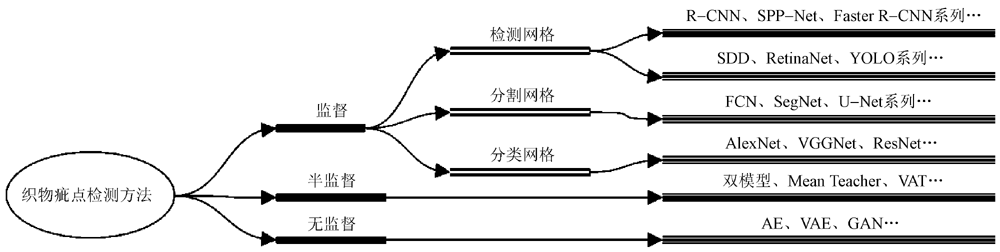
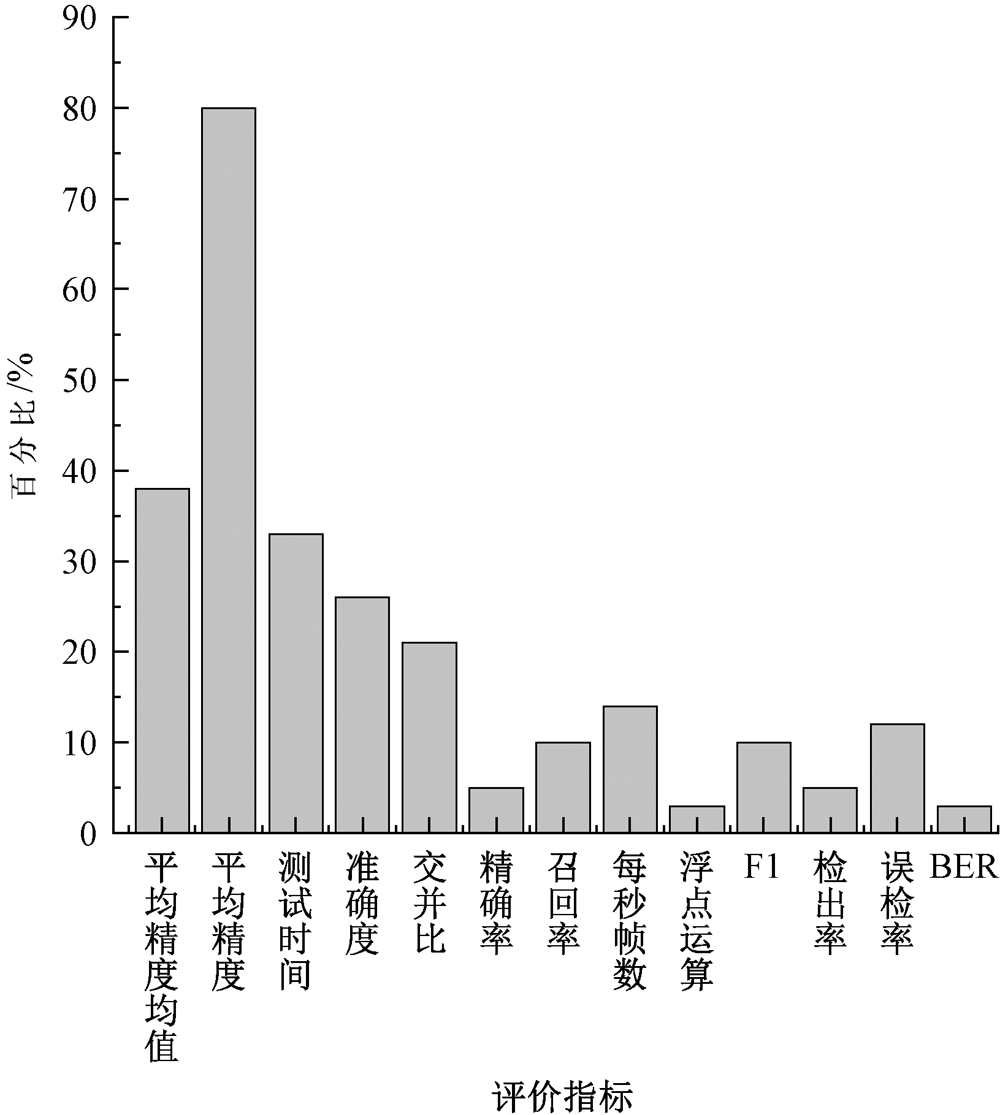
为提高深度学习技术在疵点检测中的应用效率,推动纺织行业质量控制自动化与智能化发展。首先,对现有公开的疵点数据集进行整理,剖析织物疵点数据的现状及困境。其次,从监督学习、半监督学习和无监督学习三方面梳理了面向织物疵点检测的深度学习技术原理,对比各自的优缺点及适用场景。此外,对疵点检测领域常用的速度和精度评价指标进行了总结。最后,基于背景、检测方法及评价指标等多个维度,对深度学习各类网络在疵点检测任务中的实验结果进行了对比分析。结果表明,数据集质量是影响算法性能的关键因素。认为未来研究重点将是生成有织物纹理特性的高质量疵点,可自动标注的监督学习算法,以及提升无监督和半监督学习算法的检测性能。
中图分类号:
| [1] | CHAN C H, PANG G K H. Fabric defect detection by fourier analysis[J]. IEEE Transactions on Industry Applications, 2000, 36(5): 1267-1276. |
| [2] | DI L, LONG H B, LIANG J Z. Fabric defect detection based on illumination correction and visual salient features[J]. Sensors(Basel), 2020. DOI: 10.3390/s20185147. |
| [3] | BUMRUNGKUN P. Defect detection in textile fabrics with snake active contour and support vector ma-chines[C]// 11th International Conference on Computer and Electrical Engineering (ICCEE).Tokyo: IOP Publishing Ltd, 2018(1195): 1742-6596. |
| [4] | WU Y, ZHOU J, AKANKWASA N T, et al. Fabric texture representation using the stable learned discrete cosine transform dictionary[J]. Textile Research Journal, 2019, 89(3): 294-310. |
| [5] | ZOU Z X, CHEN K Y, SHI Z W, et al. Object detection in 20 years: a survey[J]. Proceedings of the IEEE, 2023, 111(3): 257-276. |
| [6] | 王斌, 李敏, 雷承霖, 等. 基于深度学习的织物疵点检测研究进展[J]. 纺织学报, 2023, 44(1): 219-227. |
| WANG Bin, LI Min, LEI Chenglin, et al. Advances in deep learning-based fabric defect detection[J]. Journal of Textile Research, 2023, 44(1): 219-227. | |
| [7] | 程旭, 宋晨, 史金钢, 等. 基于深度学习的通用目标检测研究综述[J]. 电子学报, 2021, 49(7): 1428-1438. |
| CHENG Xu, SONG Chen, SHI Jingang, et al. A review of deep learning-based generalized target detection[J]. Acta Automation Sinica, 2021, 49(7): 1428-1438. | |
| [8] | ZHANG H W. Yarn-dyed fabric defect detection with yolov2 based on deep convolution neural net-works[C]// ZHANG L J, LI P F, GU D. IEEE 7th Data Driven Control and Learning Systems Confe-rence (DDCLS). Enshi: IEEE, 2018: 170-174. |
| [9] | JING J F, ZHUO D, ZHANG H H, et al. Fabric defect detection using the improved yolov3 model[J]. Journal of Engineered Fibers and Fabrics, 2020. DOI: 10.1177/1558925020908268. |
| [10] | ZHOU J, JING J F, ZHANG H H, et al. Real-time fabric defect detection algorithm based on s-yolov3 model[J]. Laser & Optoelectronics Progress, 2020. DOI: 10.3788/LOP57.161001. |
| [11] | DLAMINI S, KAO C Y, SU S L, et al. Development of a real-time machine vision system for functional textile fabric defect detection using a deep yolov4 model[J]. Textile Research Journal, 2022, 92(5/6): 675-690. |
| [12] | LUO X, NI Q, TAO R, et al. A light weight detector based on attention mechanism for fabric defect detec-tion[J]. IEEE Access, 2023(11): 33554-33569. |
| [13] | LIU Z F. Fabric defects detection based on ssd[C]// LIU S L, LI C L, DING S, et al. 2nd International Conference on Graphics and Signal Proceed-sing (ICGSP).Sydney: [s.n.]2018: 74-78. |
| [14] | XIE H S, ZHANG Y F, WU Z S. An improved fabric defect detection method based on ssd[J]. Aatcc Journal of Research, 2021(8): 182-191. |
| [15] | QIN Y J. Focus generator with score classification on fabric defect detection[C]// CHEN M, QI L, SUN Y.31st IEEE International Conference on Tools with Artificial Intelligence (ICTAI).Portland, OR: IEEE, 2019: 1708-1714. |
| [16] | LI F. Bag of tricks for fabric defect detection based on cascade R-CNN[J]. Textile Research Journal, 2021, 91(5/6): 599-612. |
| [17] | LI H H. Integrating deformable convolution and pyramid network in cascade R-CNN for fabric defect detec-tion[C]// ZHANG H, LIU L, ZHONG H, et al. IEEE International Conference on Systems, Man, and Cybernetics (SMC).Toronto: IEEE, 2020: 3029-3036. |
| [18] | HASHIMOTO Y, WATANABE Y, TAKANO H, et al. High diagnostic yield using advanced artificial intelligence in cytology of pancreatic cancer by eus-fna[J]. Gastroenterology, 2019, 156(6): S115-S115. |
| [19] | ZHAO J, ZHOU S, ZHENG Q, et al. Fabric defect detection based on transfer learning and improved faster R-CNN[J]. Journal of Engineered Fibers and Fabrics, 2022. DOI: 10.1177/15589250221086647. |
| [20] | CHEN M Q, YU L J, ZHI C, et al. Improved faster R-CNN for fabric defect detection based on gabor filter with genetic algorithm optimization[J]. Computers in Industry, 2022. DOI: 10.1016/j.compind.2021.103551. |
| [21] | HE D F, WEN J J, LAI Z H. Textile fabric defect detection based on improved faster R-CNN[J]. Aatcc Journal of Research, 2021, 8(SUPPL 1): 83-91. |
| [22] | KAHRAMAN Y, DURMUSOGLU A. Deep learning-based fabric defect detection: a review[J]. Textile Research Journal, 2023, 93(5/6): 1485-1503. |
| [23] | LIU Z F. Fabric defect detection based on faster R-CNN[C]// LIU X H, LI C L, LI B C, et al. 9th International Conference on Graphic and Image Processing (ICGIP). Qingdao: ICGIP, 2017: 10615. |
| [24] | 安萌, 郑飂默, 王诗宇, 等. 一种改进faster R-CNN的面料疵点检测方法[J]. 小型微型计算机系统, 2021, 42(5): 1029-1033. |
| AN Meng, ZHENG Liaomo, WANG Shiyu, et al. An improved faster R-CNN method for fabric defect detection[J]. Journal of Chinese Computer Systems, 2021, 42(5): 1029-1033. | |
| [25] | 晏琳, 景军锋, 李鹏飞. Faster rcnn模型在坯布疵点检测中的应用[J]. 棉纺织技术, 2019, 47(2): 24-27. |
| YAN Lin, JING Junfeng, LI Pengfei. Application of Faster RCNN model in blank fabric defect detec-tion[J]. Cotton Textile Technology, 2019, 47(2): 24-27. | |
| [26] | WU J, LE J, XIAO Z T, et al. Automatic fabric defect detection using a wide-and-light network[J]. Applied Intelligence, 2021, 51(7): 4945-4961. |
| [27] | 路浩, 陈原. 基于机器视觉的碳纤维预浸料表面缺陷检测方法[J]. 纺织学报, 2020, 41(4): 51-57. |
| LU Hao, CHEN Yuan. Surface defect detection method of carbon fiber prepreg based on machine vision[J]. Journal of Textile Research, 2020, 41(4): 51-57. | |
| [28] | 张丽瑶, 王志鹏, 徐功平. 基于SSD的织物疵点检测的研究[J]. 电子设计工程, 2020, 28(6): 40-44. |
| ZHANG Liyao, WANG Zhipeng, XU Gongping. Research on SSD-based fabric defect detection[J]. Electronic Design Engineering, 2020, 28(6): 40-44. | |
| [29] | ZHAO H Q, ZHANG T S. Fabric surface defect detection using se-ssdnet[J]. Symmetry-Basel, 2022. DOI: 10.3390/sym14112373. |
| [30] | ZHANG Y. Steel defect detection based on modified retinanet[C]// GAO Y, SHEN L Y. 26th International Conference on Pattern Recognition/8th International Workshop on Image Mining-Theory and Applica-tions (IMTA). Montreal: IEEE, 2022: 3572-3579. |
| [31] | LIANG H, YANG J L, SHAO M W. Fe-retinanet: small target detection with parallel multi-scale feature enhancement[J]. Symmetry-Basel, 2021. DOI: 10.3390/sym13060950. |
| [32] | CHENG X, YU J B. Retinanet with difference channel attention and adaptively spatial feature fusion for steel surface defect detection[J]. IEEE Transactions on Instrumentation and Measurement, 2021. DOI: 10.1109/TIM.2020.3040485. |
| [33] | LONG J, SHELHAMER E, DARRELL T. Fully convolutional networks for semantic segmentation[J]. IEEE Transactions on Pattern Analysis Machine Intelligence, 2017, 39 (4): 640-651. |
| [34] | ZHANG T S, MA H R. Clothnet: sensitive semantic segmentation network for fabric defect detection[J]. Textile Research Journal, 2023, 93(1/2): 103-115. |
| [35] | 马浩然, 张团善, 王峰, 等. 基于语义生成与语义分割的机织物疵点检测方法[J]. 轻工机械, 2023, 41(1): 66-73. |
| MA Haoran, ZHANG Tuanshan, WANG Feng, et al. A defect detection method for woven fabrics based on semantic generation and semantic segmentation[J]. Light Industry Machinery, 2023, 41(1): 66-73. | |
| [36] | ZHOU Z Y, YANG X F, JI J F, et al. Classifying fabric defects with evolving inception v3 by improved l2,1-norm regularized extreme learning machine[J]. Textile Research Journal, 2023, 93(3/4): 936-956. |
| [37] | SABEENIAN R S, PAUL E, PRAKASH C. Fabric defect detection and classification using modified vgg network[J]. Journal of The Textile Institute, 2023, 114(7): 1032-1040. |
| [38] | CELIK H I, DULGER L C, OZTAS B, et al. A novel industrial application of cnn approach: real time fabric inspection and defect classification on circular knitting machine[J]. Tekstil Ve Konfeksiyon, 2022, 32(4): 344-352. |
| [39] | 李学良, 杜玉红, 任维佳, 等. 基于近红外光谱和残差神经网络的异性纤维分类识别[J]. 纺织学报, 2023, 44(5): 84-92. |
| LI Xueliang, DU Yuhong, REN Weijia, et al. Classification and identification of anisotropic fibers based on near-infrared spectroscopy and residual neural network[J]. Journal of Textile Research, 2023, 44(5): 84-92. | |
| [40] | ZHAO X Q, ZHANG M, ZHANG J J. Ensemble learning-based cnn for textile fabric defects classifica-tion[J]. International Journal of Clothing Science and Technology, 2021, 33(4): 664-678. |
| [41] | 贾小军, 叶利华, 邓洪涛, 等. 基于卷积神经网络的蓝印花布纹样基元分类[J]. 纺织学报, 2020, 41(1): 110-117. |
| JIA Xiaojun, YE Lihua, DENG Hongtao, et al. Convolutional neural network-based primitive classification of blue printed fabric pattern[J]. Journal of Textile Research, 2020, 41(1): 110-117. | |
| [42] | LAINE S, AILA T. Temporal ensembling for semi-supervised learning[J]. arXiv, 2016. DOI: 10.48550/arXiv.1610.02242. |
| [43] | TARVAINEN A. Mean teachers are better role models: Weight-averaged consistency targets improve semi-supervised deep learning results[C]// VALPOLA H. 31st Annual Conference on Neural Information Processing Systems (NIPS). Long Beach, CA: Curran Associates Inc, 2017. DOI: 10.48550/arXiv.1703.01780. |
| [44] | MIYATO T, MAEDA S I, KOYAMA M, et al. Virtual adversarial training: a regularization method for supervised and semi-supervised learning[J]. IEEE Transactions on Pattern Analysis and Machine Intelligence, 2019, 41(8): 1979-1993. |
| [45] | CHEN J M, YANG M, LING J. Attention-based label consistency for semi-supervised deep learning based image classification[J]. Neurocomputing, 2021(453): 731-741. |
| [46] | SHAO L H, ZHANG E H, MA Q R, et al. Pixel-wise semisupervised fabric defect detection method combined with multitask mean teacher[J]. IEEE Transactions on Instrumentation and Measurement, 2022. DOI: 10.1109/TIM.2022.3162286. |
| [47] | WEI C, LIANG J Z, LIU H, et al. Multi-stage unsupervised fabric defect detection based on dcgan[J]. Visual Computer, 2022, 39(12): 6655-6671. |
| [48] | HE X J, CHANG Z W, ZHANG L H, et al. A survey of defect detection applications based on generative adversarial networks[J]. IEEE Access, 2022(10): 113493-113512. |
| [49] | WEI W, DENG D X, ZENG L, et al. Real-time implementation of fabric defect detection based on variational automatic encoder with structure simi-larity[J]. Journal of Real-Time Image Processing, 2021, 18(3): 807-823. |
| [50] | OLIMOV B. Unsupervised deep learning-based end-to-end network for anomaly detection and localiza-tion[C]// SUBRAMANIAN B, KIM J.13th Interna-tional Conference on Ubiquitous and Future Networks (ICUFN). Barcelona: IEEE, 2022: 444-449. |
| [51] | TANG C W, FENG X X, WEN H T, et al. Semantic segmentation network for surface defect detection of automobile wheel hub fusing high-resolution feature and multi-scale feature[J]. Applied Sciences-Basel, 2021. DOI: 10.3390/app112210508. |
| [52] | 顾梅花, 刘杰, 李立瑶, 等. 结合特征学习与注意力机制的服装图像分割[J]. 纺织学报, 2022, 43(11): 163-171. |
| GU Meihua, LIU Jie, LI Liyao, et al. Combining feature learning and attention mechanism for garment image segmentation[J]. Journal of Textile Research, 2022, 43(11): 163-171. | |
| [53] | CHENG L, YI J Z, CHEN A B, et al. Fabric defect detection based on separate convolutional unet[J]. Multimedia Tools and Applications, 2023, 82(2): 3101-3122. |
| [54] | JEYARAJ P R, NADAR E R S. Effective textile quality processing and an accurate inspection system using the advanced deep learning technique[J]. Textile Research Journal, 2020, 90(9/10): 971-980. |
| [1] | 蔡丽玲, 王梅, 邵一兵, 陈炜, 曹华卿, 季晓芬. 基于改进堆叠生成对抗网络的传统汉服智能定制推荐[J]. 纺织学报, 2024, 45(12): 180-188. |
| [2] | 李杨, 张永超, 彭来湖, 胡旭东, 袁嫣红. 基于改进甲壳虫全域搜索算法的机织物疵点检测[J]. 纺织学报, 2024, 45(10): 89-94. |
| [3] | 陆寅雯, 侯珏, 杨阳, 顾冰菲, 张宏伟, 刘正. 基于姿态嵌入机制和多尺度注意力的单张着装图像视频合成[J]. 纺织学报, 2024, 45(07): 165-172. |
| [4] | 朱凌云, 王晨宇, 赵悦莹. 基于多度量多模型图像投票的织物表面瑕疵检测方法[J]. 纺织学报, 2024, 45(06): 89-97. |
| [5] | 顾梅花, 花玮, 董晓晓, 张晓丹. 基于上下文提取与注意力融合的遮挡服装图像分割[J]. 纺织学报, 2024, 45(05): 155-164. |
| [6] | 文嘉琪, 李新荣, 冯文倩, 李瀚森. 印花面料的边缘轮廓快速提取方法[J]. 纺织学报, 2024, 45(05): 165-173. |
| [7] | 扶才志, 曹鸿艳, 廖文皓, 李忠健, 黄琪翔, 蒲三成. 基于多视角图像的纱线条干均匀度测量方法[J]. 纺织学报, 2024, 45(03): 49-57. |
| [8] | 陆伟健, 屠佳佳, 王俊茹, 韩思捷, 史伟民. 基于改进残差网络的空纱筒识别模型[J]. 纺织学报, 2024, 45(01): 194-202. |
| [9] | 池盼盼, 梅琛楠, 王焰, 肖红, 钟跃崎. 基于边缘填充的单兵迷彩伪装小目标检测[J]. 纺织学报, 2024, 45(01): 112-119. |
| [10] | 杨宏脉, 张效栋, 闫宁, 朱琳琳, 李娜娜. 一种高鲁棒性经编机上断纱在线检测算法[J]. 纺织学报, 2023, 44(05): 139-146. |
| [11] | 顾冰菲, 张健, 徐凯忆, 赵崧灵, 叶凡, 侯珏. 复杂背景下人体轮廓及其参数提取[J]. 纺织学报, 2023, 44(03): 168-175. |
| [12] | 李杨, 彭来湖, 李建强, 刘建廷, 郑秋扬, 胡旭东. 基于深度信念网络的织物疵点检测[J]. 纺织学报, 2023, 44(02): 143-150. |
| [13] | 陈佳, 杨聪聪, 刘军平, 何儒汉, 梁金星. 手绘草图到服装图像的跨域生成[J]. 纺织学报, 2023, 44(01): 171-178. |
| [14] | 王斌, 李敏, 雷承霖, 何儒汉. 基于深度学习的织物疵点检测研究进展[J]. 纺织学报, 2023, 44(01): 219-227. |
| [15] | 安亦锦, 薛文良, 丁亦, 张顺连. 基于图像处理的纺织品耐摩擦色牢度评级[J]. 纺织学报, 2022, 43(12): 131-137. |
|
||
 京公网安备11010502044800号