纺织学报 ›› 2026, Vol. 47 ›› Issue (07): 160-168.doi: 10.13475/j.fzxb.20251104601
苑洁1,2,3, 朱芸嘉2, 许昌亮4, 娄琳1,2,3( )
)
YUAN Jie1,2,3, ZHU Yunjia2, XU Changliang4, LOU Lin1,2,3()
摘要:
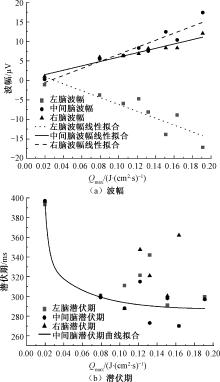
针对织物接触冷暖感在人体大脑神经电生理学上的感知表征问题,采用事件相关电位技术,招募健康受试者,分别施加不同接触冷感强度的织物刺激,并同步采集大脑皮层体觉功能脑区的脑电信号。通过离线分析提取刺激后诱发的特征神经电位成分,重点考察不同冷感强度对体觉功能脑区的影响规律。研究结果显示:当人体一侧受到织物接触冷感刺激时,在300 ms左右出现的P300电位的激活反应最大,且在触觉刺激的对侧和中间脑区呈现正激活反应,而在同侧呈现负激活反应。对侧及中间脑区的P300电位波幅、同侧脑区的P300电位波幅分别与接触冷感值呈高度正相关和高度负相关的线性关系。但是,由于感知后效的影响,P300电位的潜伏期并非随接触冷感值的增加而线性缩短,而是左右脑以不规则波动速度缩短,中间脑区则相对稳定,以单指数衰减速度缩短。本研究揭示了织物接触冷感在大脑中枢加工中的时空动态特征及其偏侧化神经机制,为智能织物设计与热舒适评价提供了神经科学依据。
中图分类号:
| [1] |
ASHTON K, ZINSZER B D, CICHY R M, et al. Time-resolved multivariate pattern analysis of infant EEG data: a practical tutorial[J]. Developmental Cognitive Neuroscience, 2022, 54: 101094.
doi: 10.1016/j.dcn.2022.101094 |
| [2] |
MIRAGLIA F, PAPPALETTERA C, DI IENNO S, et al. The effects of directional and non-directional stimuli during a visuomotor task and their correlation with reaction time: an ERP study[J]. Sensors, 2023, 23(6): 3143.
doi: 10.3390/s23063143 |
| [3] | CHEN S, HUANG Q, YANG C Z, et al. Study of event-related potentials by withdrawal friction on the fingertip[J]. Skin Research and Technology, 2023, 29: e13232. |
| [4] | 苑洁, 翟淑娜, 娄琳, 等. 基于事件相关电位技术的织物舒适度研究进展[J]. 纺织学报, 2023, 44(6): 225-231. |
|
YUAN Jie, ZHAI Shu'na, LOU Lin, et al. Research progress in fabric comfort based on event-related potential technique[J]. Journal of Textile Research, 2023, 44(6): 225-231.
doi: 10.1177/004051757404400315 |
|
| [5] | 唐玮, 张梅梅, 杨雷, 等. 粗糙表面的摩擦触觉感知研究[J]. 摩擦学学报, 2022, 42(4): 764-774. |
| TANG Wei, ZHANG Meimei, YANG Lei, et al. Tactile perception of rough surface using friction and electroencephalography methods[J]. Tribology, 2022, 42(4): 764-774. | |
| [6] | CHEN S, GE S R. Experimental research on the tactile perception from fingertip skin friction[J]. Wear, 2017, 376: 305-314. |
| [7] | 陈思, 葛世荣, 时晓露, 等. 摩擦诱发的事件相关电位认知成分特征研究[J]. 摩擦学学报(中英文), 2015, 35(5): 538-542. |
| CHEN Si, GE Shirong, SHI Xiaolu, et al. Perception component of event related potentials evoked by friction[J]. Tribology, 2015, 35(5): 538-542. | |
| [8] | 刘陶峰, 李一员, 李炜, 等. 确定性纹理表面特征高度对皮肤摩擦感知的影响[J]. 西南交通大学学报, 2020, 55(2): 372-378. |
| LIU Taofeng, LI Yiyuan, LI Wei, et al. Influence of surface feature height of deterministic texture on tactile perception of fingertip[J]. Journal of Southwest Jiaotong University, 2020, 55(2): 372-378. | |
| [9] | 夏羽. 基于神经电生理学的丝织物触感评价和认知研究[D]. 苏州: 苏州大学, 2017: 28-32. |
| XIA Yu. Tactile evaluation and cognitive study of silk fabrics based on neurophysiology[D]. Suzhou: Soochow University, 2017: 28-32. | |
| [10] |
LIU Y, WANG W J, XU W G, et al. Quantifying the generation process of multi-level tactile sensations via ERP component investigation[J]. International Journal of Neural Systems, 2021, 31(12): 2150049.
doi: 10.1142/S0129065721500490 |
| [11] |
MENA C I, LANG K D, GHERRI E. Electrophysiological correlates of attentional selection in tactile search tasks: the impact of singleton distractors on target selection[J]. Psychophysiology, 2020, 57(9): e13592.
doi: 10.1111/psyp.v57.9 |
| [12] |
RIGATO S, BREMNER A J, GILLMEISTER H, et al. Interpersonal representations of touch in somatosensory cortex are modulated by perspective[J]. Biological Psychology, 2019, 146: 107719.
doi: 10.1016/j.biopsycho.2019.107719 |
| [13] | 张岳兰, 陈春云, 王浩, 等. 纺织品瞬间接触冷暖感测试研究与探讨[J]. 上海纺织科技, 2024, 52(7): 60-63. |
| ZHANG Yuelan, CHEN Chunyun, WANG Hao, et al. Research and discussion on instantaneous contact cold and warm sensation of textiles[J]. Shanghai Textile Science & Technology, 2024, 52(7): 60-63. | |
| [14] | 王永华, 姜利利. 凉感纺织品的检测方法和评价方案分析[J]. 中国纤检, 2024(7): 54-57. |
| WANG Yonghua, JIANG Lili. Testing methods and evaluation scheme of cool-feeling textiles[J]. China Fiber Inspection, 2024(7): 54-57. | |
| [15] | DELORME A, MULLEN T, KOTHE C, et al. EEGLAB, SIFT, NFT, BCILAB, and ERICA: new tools for advanced EEG processing[J]. Computational Intelligence and Neuroscience, 2011, 2011(1): 130714. |
| [16] |
DELORME A, MAKEIG S. EEGLAB: an open source toolbox for analysis of single-trial EEG dynamics including independent component analysis[J]. Journal of Neuroscience Methods, 2004, 134(1): 9-21.
doi: 10.1016/j.jneumeth.2003.10.009 pmid: 15102499 |
| [17] |
BODE S, FEUERRIEGEL D, BENNETT D, et al. The decision decoding ToolBOX (DDTBOX): a multivariate pattern analysis toolbox for event-related potentials[J]. Neuroinformatics, 2019, 17(1): 27-42.
doi: 10.1007/s12021-018-9375-z |
| [18] | 程学梅, 崔园. 用EEGLAB分析脑电信号[J]. 计算机与数字工程, 2014, 42(10): 1967-1970. |
| CHENG Xuemei, CUI Yuan. EEGLAB analysis of EEG signals[J]. Computer & Digital Engineering, 2014, 42(10): 1967-1970. | |
| [19] |
KNYAZEV G G. Comparison of spatial and temporal independent component analyses of electroencephalographic data: a simulation study[J]. Clinical Neurophysiology, 2013, 124(8): 1557-1569.
doi: 10.1016/j.clinph.2013.02.011 pmid: 23535453 |
| [20] |
ELMAGD ELKHOLY O, ABDELDAYEM H, BADAWY A. Brain electrical activity mapping in the diagnosis of attention-deficit hyperactivity disorder[J]. Egyptian Journal of Psychiatry, 2020, 41(1): 7.
doi: 10.4103/ejpsy.ejpsy_18_19 |
| [21] | 孟花, 冯爱芬. 织物结构和性能对接触冷暖感的影响[J]. 毛纺科技, 2020, 48(8): 38-41. |
| MENG Hua, FENG Aifen. Influence of fabric structure and fabric correlation on contacting cool and warm feeling[J]. Wool Textile Journal, 2020, 48(8): 38-41. | |
| [22] |
ENAX-KRUMOVA E, ATTAL N, BOUHASSIRA D, et al. Contralateral sensory and pain perception changes in patients with unilateral neuropathy[J]. Neurology, 2021, 97(4): 389-402.
doi: 10.1212/WNL.0000000000012238 |
| [23] |
PANG Y H, LIM S H. Fine margin between crossed sensory and contralateral sensory loss: a case report[J]. Journal of Clinical Neuroscience, 2018, 56: 188-191.
doi: S0967-5868(18)30441-7 pmid: 29937417 |
| [24] |
LI X M, CAI H J, LI F C, et al. Physical exercise on cortical brain activity in patients with mild cognitive impairment: a meta-analysis[J]. Medicine, 2024, 103(35): e39452.
doi: 10.1097/MD.0000000000039452 |
| [25] | CHEN X, XIU H Q, HOU Y F, et al. High-frequency repetitive transcranial magnetic stimulation on overall cognition in patients with poststroke cognitive impairment: a systematic review and meta-analysis[J]. American Journal of Physical Medicine & Rehabilitation, 2024, 103(5): 418-427. |
| [26] |
翟淑娜, 苑洁, 娄琳. 事件相关电位技术在织物触觉舒适度评价中的研究进展[J]. 现代纺织技术, 2023, 31(1): 73-81.
doi: 10.19398/j.att.202203070 |
|
ZHAI Shuna, YUAN Jie, LOU Lin. Research progress of ERPs technology in fabric tactile comfort evaluation[J]. Advanced Textile Technology, 2023, 31(1): 73-81.
doi: 10.19398/j.att.202203070 |
|
| [27] | 徐沛韬, 魏伟, 赵雨晴, 等. 卒中后认知障碍患者认知功能的事件相关电位研究[J]. 康复学报, 2024, 34(3): 217-224, 232. |
|
XU Peitao, WEI Wei, ZHAO Yuqing, et al. Event-related potential study of cognitive functions in patients with post-stroke cognitive impairment[J]. Rehabilitation Medicine, 2024, 34(3): 217-224, 232.
doi: 10.3724/SP.J.1329.2024.03010 |
|
| [28] |
LEUTHOLD H, SOMMER W. Postperceptual effects and P300 latency[J]. Psychophysiology, 1998, 35(1): 34-46.
pmid: 9499704 |
| [29] |
YE C X, GUO L J, WANG N, et al. Perceptual encoding benefit of visual memorability on visual memory formation[J]. Cognition, 2024, 248: 105810.
doi: 10.1016/j.cognition.2024.105810 |
| [30] |
LAZAR-KURZ Z, AZIZ J, MCKEARNEY K J, et al. Age-related changes to electroencephalographic markers of visuomotor error processing and learning in prism adaptation[J]. Neuropsychologia, 2023, 184: 108546.
doi: 10.1016/j.neuropsychologia.2023.108546 |
| [31] |
SIRCAR S, GAUTAM S, TANDON O P. Post-task P3-changes following a brief, rigorous visual task indicate individual differences in the task-specific ability[J]. Indian journal of physiology and pharmacology, 2004, 48(3): 311-320.
pmid: 15648403 |
| [32] |
SCHAPKIN S A, FALKENSTEIN M, MARKS A, et al. Noise aftereffects and brain processes: mediating role of achievement motivation[J]. Journal of Psychophysiology, 2007, 21(1): 1-8.
doi: 10.1027/0269-8803.21.1.1 |
| [1] | 苑洁, 翟淑娜, 娄琳, 王其才, 雷雨田. 基于事件相关电位技术的织物舒适度研究进展[J]. 纺织学报, 2023, 44(06): 225-231. |
| [2] | 苑洁, 娄琳, 王其才. 织物触觉舒适度大脑感知技术研究进展[J]. 纺织学报, 2022, 43(09): 211-217. |
| [3] | 苑洁 于伟东 陈克敏. 基于功能磁共振的织物接触压舒适度脑感知研究进展[J]. 纺织学报, 2017, 38(10): 146-152. |
| [4] | 吕佳, 陈东生. 情绪的事件相关电位在服装设计中的应用[J]. 纺织学报, 2012, 33(2): 151-156. |
| [5] | 张如全;周双喜;;陶荣;林建勇. 基于单片机织物动态热传递性能测试装置[J]. 纺织学报, 2011, 32(3): 122-126. |
|
||
 京公网安备11010502044800号