纺织学报 ›› 2024, Vol. 45 ›› Issue (12): 41-49.doi: 10.13475/j.fzxb.20230800601
许秋歌1, 郭寻1, 朵永超1, 吴若楠1, 钱晓明1( ), 宋兵2, 符浩1,3, 赵宝宝4
XU Qiuge1, GUO Xun1, DUO Yongchao1, WU Ruonan1, QIAN Xiaoming1(), SONG Bing2, FU Hao1,3, ZHAO Baobao4
摘要:
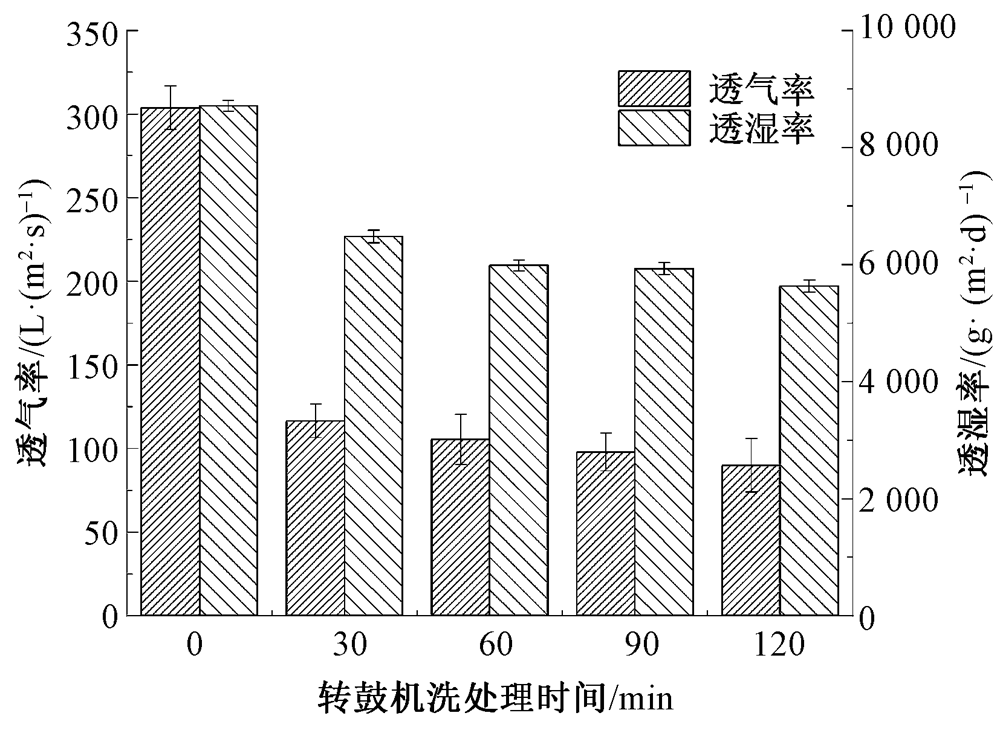
为解决高收缩聚酯(HSPET)/聚酰胺6(PA6)中空橘瓣型双组分纺黏长丝铺网针刺后存在纤维开纤裂离效果差的问题,对HSPET/PA6针刺布采用干热处理、水热处理、超声波处理和转鼓机洗处理4种物理开纤方式进行分析,并研究了转鼓机洗处理温度和时间对HSPET/PA6针刺布性能的影响。结果表明:HSPET/PA6针刺布的开纤率为18.9%,干热处理后的HSPET/PA6针刺布开纤率并未改变;经水热处理、超声波处理及转鼓机洗处理后的HSPET/PA6针刺布开纤率分别为24.0%、32.6%、75.5%,转鼓机洗能有效提高HSPET/PA6针刺布的开纤率;在最佳转鼓机洗处理温度60 ℃下,随着转鼓机洗处理时间的延长,开纤率逐渐提高,HSPET/PA6针刺布的柔软度及力学性能随着开纤率的提高逐渐得到改善,而HSPET/PA6针刺布的透气透湿性能逐渐下降。
中图分类号:
| [1] | 卢志敏, 钱晓明. 桔瓣型双组分纺黏水刺超纤技术及其应用[J]. 棉纺织技术, 2011, 39(7): 65-68. |
| LU Zhimin, QIAN Xiaoming. Technology and application of segmented pie bicomponent spunbonded & spunlaced microfiber[J]. Cotton Textile Technology, 2011, 39(7): 65-68. | |
| [2] | 张宇静, 童珈珈, 叶翔宇, 等. 双组分超细纺黏水刺非织造材料发展现状与展望[J]. 丝绸, 2022, 59(7): 29-39. |
| ZHANG Yujing, TONG Jiajia, YE Xiangyu, et al. Research progress and prospect on bicomponent spunbond hydroentangled nonwovens[J]. Journal of Silk, 2022, 59(7): 29-39. | |
| [3] | DURANY A, ANANTHARAMAIAH N, POURDEYHIMI B. High surface area nonwovens via fibrillating spunbonded nonwovens comprising islands-in-the-sea bicomponent filaments: structure-process-property relationships[J]. Journal of Materials Science, 2009, 44(21): 5926-5934. |
| [4] | 梁肖肖, 钱晓明, 王俊南, 等. 中空橘瓣型PET/PA6双组分纺黏纤维生产工艺研究[J]. 合成纤维工业, 2016, 39(1): 27-30. |
| LIANG Xiaoxiao, QIAN Xiaoming, WANG Junnan, et al. Production process of hollow segmented-pie PET/PA6 bicomponent spunbond fiber[J]. China Synthetic Fiber Industry, 2016, 39(1): 27-30. | |
| [5] | 赵德方, 毛加冲, 黄芽, 等. PP/PA6中空橘瓣型复合超细纤维的制备及性能研究[J]. 丝绸, 2022, 59(6): 44-49. |
| ZHAO Defang, MAO Jiachong, HUANG Ya, et al. Study on preparation and properties of PP/PA6 hollow segmented-pie composite superfine fiber[J]. Journal of Silk, 2022, 59(6): 44-49. | |
| [6] | PRAHSARN C, MATSUBARA A, MOTOMURA S, et al. Development of bicomponent spunbond nonwoven webs consisting of ultra-fine splitted fibers[J]. International Polymer Processing, 2008, 23(2): 178-182. |
| [7] | LU Z M, QIAN X M. Combination technology of spunbond & spunlace[J]. Advanced Materials Research, 2011, 331: 241-244. |
| [8] | ZHANG H, QIAN X M, ZHEN Q, et al. Research on structure characteristics and filtration performances of PET-PA6 hollow segmented-pie bicomponent spunbond nonwovens fibrillated by hydro entangle method[J]. Journal of Industrial Textiles, 2015, 45(1): 48-65. |
| [9] | 左文君, 靳向煜. 分裂型超细纤维水刺非织造布力学性能研究[J]. 产业用纺织品, 2012, 30(7): 9-15. |
| ZUO Wenjun, JIN Xiangyu. Study on mechanical properties of splitted superfine fiber spunlaced nonwovens[J]. Technical Textiles, 2012, 30(7): 9-15. | |
| [10] | 卢志敏, 钱晓明. 橘瓣型双组分纺黏非织造布的开纤技术探讨[J]. 产业用纺织品, 2011, 29(3): 23-26. |
| LU Zhimin, QIAN Xiaoming. Discussion on the splitting technology of segmented pie bicomponent spunbonded nonwovens[J]. Technical Textiles, 2011, 29(3): 23-26. | |
| [11] | 卢延蔚, 钱晓明, 张恒. 橘瓣型双组分非织造材料的开纤技术及过滤性能[J]. 合成纤维工业, 2014, 37(2): 64-67. |
| LU Yanwei, QIAN Xiaoming, ZHANG Heng. Splitting technology and filtration performance of segmented pie bicomponent nonwovens[J]. China Synthetic Fiber Industry, 2014, 37(2): 64-67. | |
| [12] | HOLLOWELL K B, ANANTHARAMAIAH N, POURDEYHIMI B. Hybrid mixed media nonwovens composed of macrofibers and microfibers[J]. Journal of the Textile Institute, 2013, 104(9): 972-979. |
| [13] | 朵永超, 钱晓明, 郭寻, 等. 中空桔瓣型高收缩聚酯/聚酰胺6超细纤维非织造布的制备及其性能[J]. 纺织学报, 2022, 43(2): 98-104. |
| DUO Yongchao, QIAN Xiaoming, GUO Xun, et al. Preparation and properties of hollow pie-segmented high shrinkage polyester/polyamide 6 microfiber non-wovens[J]. Journal of Textile Research, 2022, 43(2): 98-104. | |
| [14] | ZHAO B B, QIAN X M, QIAO Y, et al. The application of hollow segmented pie bicomponent spunbond hydro-entangled microfiber nonwovens for microfiber synthetic leather apparel[J]. AATCC Journal of Research, 2019, 6(3): 45-49. |
| [15] | DUO Y C, QIAN X M, ZHAO B B, et al. Preparation and properties of fluffy high-shrinkage polyester/polyamide 6 hollow segmented pie microfiber non-wovens[J]. Textile Research Journal, 2022, 92(17/18): 3221-3233. |
| [16] | 王晓斌, 姚金波. 双组分熔喷非织造布开纤方法及开纤效果评价方法探讨[J]. 产业用纺织品, 2008, 26(11): 21-24. |
| WANG Xiaobin, YAO Jinbo. Discussion on slitting fiber on manufacture bicomponent meltblown nonwovens and evaluation method of splitting effect[J]. Technical Textiles, 2008, 26(11): 21-24. | |
| [17] | 于宾, 焦晓宁. 高收缩聚酯纤维及其在非织造材料中的应用[J]. 产业用纺织品, 2012, 30(11): 39-43. |
| YU Bin, JIAO Xiaoning. High-shrinkage polyester fiber and its application on nonwovens[J]. Technical Textiles, 2012, 30(11): 39-43. | |
| [18] | 殷保璞, 靳向煜. 超细纤维水刺非织造布的纤维裂离机理及性能[J]. 东华大学学报(自然科学版), 2003, 29(3): 55-58. |
| YIN Baopu, JIN Xiangyu. Principle of fiber being splited and performance of microfiber spunlaced nonwoven[J]. Journal of Donghua University (Nature Science), 2003, 29(3): 55-58. | |
| [19] | 秦晓, 王秋美. 超细纤维的开纤剥离[J]. 山东纺织科技, 2005(4): 39-41. |
| QIN Xiao, WANG Qiumei. The peeling technique in processing ultra-fine fiber stripping of microfiber[J]. Shandong Textile Science and Technology, 2005(4): 39-41. | |
| [20] | 杨建建, 李文林, 王伟建. 超声波技术在石油工业危险废物处置中的应用研究综述[J]. 北部湾大学学报, 2023, 38(2): 33-40. |
| YANG Jianjian, LI Wenlin, WANG Weijian. On the application of ultrasonic technology in disposal of petroleum industry hazardous wastes[J]. Journal of Beibu Gulf University, 2023, 38(2): 33-40. | |
| [21] | 戴东风. 哪些因素影响滚筒洗衣机的洗净度[J]. 大众用电, 2002(7): 38-39. |
| DAI Dongfeng. What factors affect the washability of drum washing machines[J]. Popular Electricity, 2002(7): 38-39. | |
| [22] | 薛元, 王潮霞, 曹艳, 等. 超细涤/锦复合丝剥离机理与工艺研究[J]. 纺织学报, 1998, 19(4): 196-199. |
| XUE Yuan, WANG Chaoxia, CAO Yan, et al. Study on splitting mechanism and process of polyester/polyamide composite superfine fiber filament[J]. Journal of Textile Research, 1998, 19(4): 196-199. | |
| [23] | 刘凡, 钱晓明, 赵宝宝, 等. 柔软处理对涤纶/锦纶6中空桔瓣型超细纤维非织造布性能的影响[J]. 纺织学报, 2018, 39(3): 114-119. |
| LIU Fan, QIAN Xiaoming, ZHAO Baobao, et al. Influence of softening treatment on properties of polyester/polyamide 6 hollow segmented-pie ultrafine fiber nonwovens[J]. Journal of Textile Research, 2018, 39(3): 114-119. |
| [1] | 章红豆, 陈芳, 楚祥婷, 陆惠文, 刘新金, 苏旭中. 基于示踪纤维法测试的化纤条内纤维弯钩[J]. 纺织学报, 2024, 45(12): 74-79. |
| [2] | 彭博, 吴宇洁, 张悦, 李妙龙, 孟祥, 李伟, 鲁育豪. 低取代度淀粉烷基羧酸单酯的烷基链长对涤纶上浆性能的影响[J]. 纺织学报, 2024, 45(10): 122-127. |
| [3] | 韩画宇, 杨文龙, 王甫, 胡柳, 胡毅. 苯并[a]吩恶嗪基功能染料制备及其在改性涤纶织物上的应用[J]. 纺织学报, 2024, 45(10): 128-136. |
| [4] | 何雨静, 康建平, 赵坤伟, 何勇, 李佳逸, 谭昕. 袋式除尘用聚苯硫醚纤维的研究进展与展望[J]. 纺织学报, 2024, 45(10): 232-240. |
| [5] | 刘文龙, 李好义, 何东洋, 李长金, 张杨, 马秀清, 李满意, 杨卫民. 低密度聚乙烯熔喷工艺及其非织造布性能[J]. 纺织学报, 2024, 45(10): 31-38. |
| [6] | 肖宁宁, 陈智杰, 欧阳裕福, 孟金贵, 孙阳艺, 戚栋明. 超细纤维合成革用阻燃水性聚氨酯的制备及其性能[J]. 纺织学报, 2024, 45(09): 113-120. |
| [7] | 朵永超, 宋兵, 张如全, 许秋歌, 钱晓明. 熔融双组分超细纤维成纤技术研究进展[J]. 纺织学报, 2024, 45(08): 54-64. |
| [8] | 杨瑞华, 邵秋, 王翔. 再循环棉及涤纶短纤维的成纱性能与面料特征[J]. 纺织学报, 2024, 45(08): 127-133. |
| [9] | 葛美彤, 董智佳, 丛洪莲, 丁玉琴. 凹凸点阵双面织物的结构与湿热管理评价[J]. 纺织学报, 2024, 45(07): 47-54. |
| [10] | 黄连香, 王祥荣, 侯学妮, 钱琴芳. 茜草色素对生物基聚酰胺56的染色性能[J]. 纺织学报, 2024, 45(07): 94-103. |
| [11] | 徐豫松, 周杰, 甘佳怡, 张涛, 张先明. 含磷氮水性聚氨酯的制备及其在涤纶织物阻燃整理中应用[J]. 纺织学报, 2024, 45(07): 112-120. |
| [12] | 李文雅, 周剑, 廖昙倩, 董真真. 薄鞘高包覆涤纶/棉包芯纱的结构控制及其工艺[J]. 纺织学报, 2024, 45(06): 46-52. |
| [13] | 李倩倩, 郭晓玲, 崔文豪, 许宇真, 王林峰. 汽车座椅用抗菌涤纶针织物制备及其性能[J]. 纺织学报, 2024, 45(06): 127-133. |
| [14] | 方雪明, 董智佳, 丛洪莲, 丁玉琴. 单面纬编织物变化孔隙率结构设计与透气导湿性能评价[J]. 纺织学报, 2024, 45(05): 51-59. |
| [15] | 胡自强, 骆晓蕾, 魏璐琳, 刘琳. 植酸/壳聚糖对涤纶/棉混纺织物的协同阻燃整理[J]. 纺织学报, 2024, 45(04): 126-135. |
|
||
 京公网安备11010502044800号