纺织学报 ›› 2025, Vol. 46 ›› Issue (05): 1-9.doi: 10.13475/j.fzxb.20241203701
• 特约专栏: 智能纤维与织物器件 • 下一篇
于梦菲1, 高文丽1, 任婧1, 曹雷涛1, 彭若铉1, 凌盛杰1,2( )
)
YU Mengfei1, GAO Wenli1, REN Jing1, CAO Leitao1, PENG Ruoxuan1, LING Shengjie1,2()
摘要:
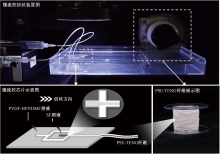
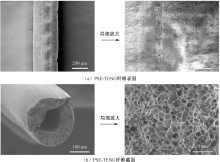
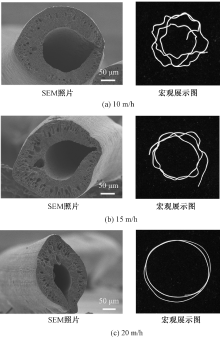
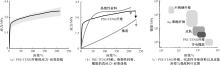
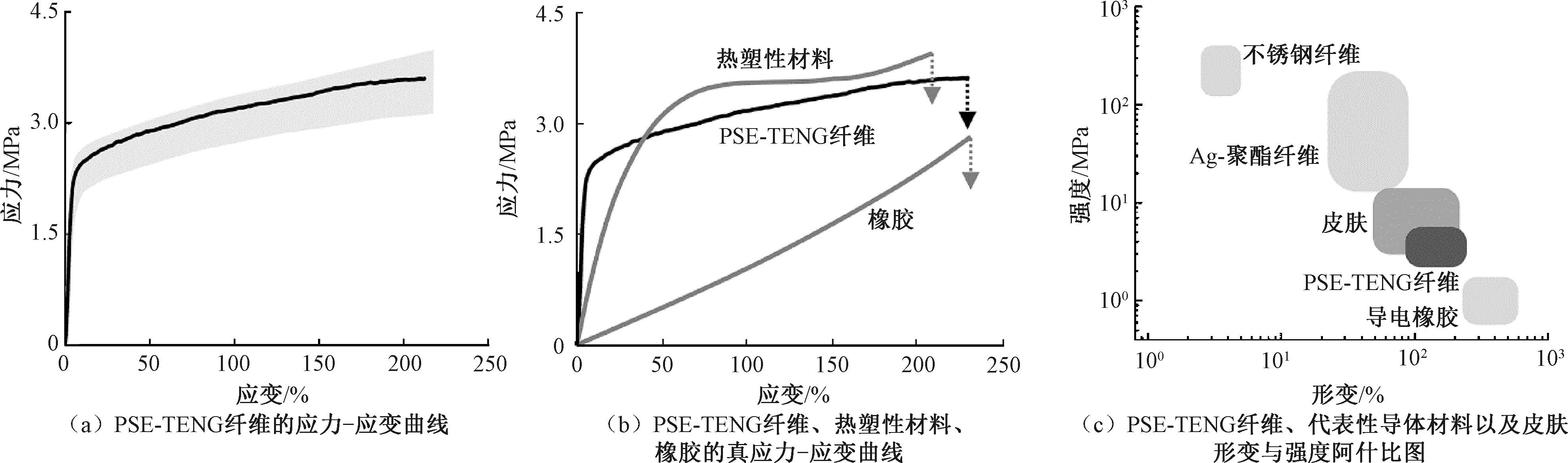
针对具有皮芯结构的摩擦纳米发电机用纤维传统制备工艺复杂的难题,采用微流控纺丝技术,以高介电常数聚偏氟乙烯-六氟丙烯(PVDF-HFP)为皮层材料,丝素蛋白-1-乙基-3-甲基咪唑醋酸盐(EMImAC)离子液体(SE)溶液为导电芯层材料,一步法制备了单电极聚偏氟乙烯-六氟丙烯-丝素蛋白离子液体(PSE)摩擦纳米发电机用纤维(PSE-TENG纤维)。分别借助扫描电子显微镜、万用材料力学测量仪对PSE-TENG纤维的形貌、结构、力学性能进行了表征。使用疲劳测试机进行运动模拟,采用示波器对PSE-TENG纤维的电输出性能进行信号采集。探讨了纺丝参数对PSE-TENG纤维结构的影响,评估了PSE-TENG纤维的力学性能,并探究了PSE-TENG纤维在不同机械运动条件下的输出性能和长期使用稳定性。研究发现:PSE-TENG纤维具有稳定的皮芯结构,拉伸断裂强度为(3.32±0.19)MPa,拉伸断裂应变为(176.83±27.14)%;在不同频率的机械运动下,PSE-TENG纤维的电压信号峰值与频率呈正相关;在超过2万次接触-分离运动后,PSE-TENG纤维仍可稳定输出信号。所制备的PSE-TENG纤维具有优异的能量转换效率和力学稳定性,能够为可穿戴技术提供稳定且高效的自供能解决方案。
中图分类号:
| [1] | HE Junyuan, CAO Leiqing, CUI Jiaojiao, et al. Flexible energy storage devices to power the future[J]. Advanced Materials, 2024. DOI: 10.1002/adma.202306090. |
| [2] | ZHOU Yuankai, SHEN Maoliang, CUI Xin, et al. Triboelectric nanogenerator based self-powered sensor for artificial intelligence[J]. Nano Energy, 2021. DOI: 10.1016/j.nanoen.2021.105887. |
| [3] | LI Zhe, ZHENG Qiang, WANG Zhonglin, et al. Nanogenerator-based self-powered sensors for wearable and implantable electronics[J]. Research, 2020. DOI: 10.34133/2020/8710686. |
| [4] | CHEN Jun, WANG Zhonglin. Reviving vibration energy harvesting and self-powered sensing by a triboelectric nanogenerator[J]. Joule, 2017, 1(3): 480-521. |
| [5] | ALIYANA Akshaya Kumar, STYLIOS George. A review on the progress in core-spun yarns (CSYs) based textile TENGs for real-time energy generation, capture and sensing[J]. Advanced Science, 2023. DOI: 10.1002/advs.202304232. |
| [6] | FU Chiyu, TANG Wenyang, MIAO Ying, et al. Large-scalable fabrication of liquid metal-based double helix core-spun yarns for capacitive sensing, energy harvesting, and thermal management[J]. Nano Energy, 2023. DOI: 10.1016/j.nanoen.2022.108078. |
| [7] | 马丽芸, 吴荣辉, 刘赛, 等. 包缠复合纱摩擦纳米发电机的制备及其电学性能[J]. 纺织学报, 2021, 42(1): 53-58. |
| MA Liyun, WU Ronghui, LIU Sai, et al. Preparation and electrical properties of triboelectric nanogenerator based on wrapped composite yarn[J]. Journal of Textile Research, 2021, 42(1): 53-58. | |
| [8] | ZHENG Lijing, ZHU Miaomiao, WU Baohu, et al. Conductance-stable liquid metal sheath-core microfibers for stretchy smart fabrics and self-powered sensing[J]. Science Advances, 2021. DOI: 10.1126/sciadv.abg4041. |
| [9] | YANG Yujue, XU Bingang, GAO Yuanyuan, et al. Conductive composite fiber with customizable functionalities for energy harvesting and electronic textiles[J]. ACS Applied Materials & Interfaces, 2021, 13(42): 49927-49935. |
| [10] |
KANG Edward, JEONG Gi Seok, CHOI Yoonyoung, et al. Digitally tunable physicochemical coding of material composition and topography in continuous micro-fibres[J]. Nature Materials, 2011, 10: 877-883.
doi: 10.1038/nmat3108 pmid: 21892177 |
| [11] |
WU Ronghui, KIM Taesung. Review of microfluidic approaches for fabricating intelligent fiber devices: importance of shape characteristics[J]. Lab on a Chip, 2021, 21(7): 1217-1240.
doi: 10.1039/d0lc01208d pmid: 33710187 |
| [12] | YU Yunru, GUO Jiahui, SUN Lingyu, et al. Microfluidic generation of microsprings with ionic liquid encapsulation for flexible electronics[J]. Research-China, 2019. DOI: 10.34133/2019/6906275. |
| [13] | DU Xiangyun, LI Qiang, WU Guan, et al. Multifunctional micro/nanoscale fibers based on microfluidic spinning technology[J]. Advanced Materials, 2019. DOI: 10.1002/adma.201903733. |
| [14] | HU Xili, TIAN Mingwei, PAN Ning, et al. Structure-tunable graphene oxide fibers via microfluidic spinning route for multifunctional textiles[J]. Carbon, 2019, 152, 106-113. |
| [15] |
DONG Kai, WANG Yicheng, DENG Jianan, et al. A highly stretchable and washable all-yarn-based self-charging knitting power textile composed of fiber triboelectric nanogenerators and supercapacitors[J]. ACS Nano, 2017, 11(9): 9490-9499.
doi: 10.1021/acsnano.7b05317 pmid: 28901749 |
| [16] |
XIONG Jiaqing, LEE Pooi See. Progress on wearable triboelectric nanogenerators in shapes of fiber, yarn, and textile[J]. Science and Technology of Advanced Materials, 2019, 20(1): 837-857.
doi: 10.1080/14686996.2019.1650396 pmid: 31497178 |
| [17] | SHI Lin, JIN Hao, DONG Shurong, et al. High-performance triboelectric nanogenerator based on electrospun PVDF-graphene nanosheet composite nanofibers for energy harvesting[J]. Nano Energy, 2021. DOI: 10.1016/j.nanoen.2020.105599. |
| [18] |
JIN Long, XIAO Xiao, DENG Weili, et al. Manipulating relative permittivity for high-performance wearable triboelectric nanogenerators[J]. Nano Letters, 2020, 20(9): 6404-6411.
doi: 10.1021/acs.nanolett.0c01987 pmid: 32584050 |
| [19] | SAXENA Pooja, SHUKLA Prashant. A comprehensive review on fundamental properties and applications of poly(vinylidene fluoride) (PVDF)[J]. Advanced Composites and Hybrid Materials, 2021, 4: 8-26. |
| [20] |
YE Chao, YANG Shuo, REN Jin, et al. Electroassisted core-spun triboelectric nanogenerator fabrics for intellisense and artificial intelligence perception[J]. ACS Nano, 2022, 16(3): 4415-4425.
doi: 10.1021/acsnano.1c10680 pmid: 35238534 |
| [21] | CAO Xinyi, YE Chao, CAO Leitao, et al. Biomimetic spun silk ionotronic fibers for intelligent discrimination of motions and tactile stimuli[J]. Advanced Materials, 2023. DOI: 10.1002/adma.202300447. |
| [22] | WU Chuang, ALMUAALEMI Haithm Yahya Mohammed, SOHAN A S M Muhtasim, et al. Effect of flow velocity on laminar flow in microfluidic chips[J]. Micromachines (Basel), 2023. DOI: 10.3390/mi14071277. |
| [23] |
VATANKHAH-VARNOSFADERANI Mohammad, KEITH Andrew N, CONG Yidan, et al. Chameleon-like elastomers with molecularly encoded strain-adaptive stiffening and coloration[J]. Science, 2018, 359(6383): 1509-1513.
doi: 10.1126/science.aar5308 |
| [24] | VATANKHAH-VARNOSFADERANI Mohammad, Daniel William F M, EVERHART Matthew H, et al. Mimicking biological stress-strain behaviour with synthetic elastomers[J]. Nature, 2017, 549: 497-501. |
| [25] | XING Xiaowei, ZHANG Xiaoyu, TASIN Md Arif Saleh, et al. Interlaced amphiphobic nanofibers for smart waterproof and breathable membranes with instant waterproofness monitoring ability[J]. ACS Applied Polymer Materials, 2024, 6 (12), 7301-7310. |
| [26] |
KIM Weon Guk, KIM Do Wan, TCHO Il Woong, et al. Triboelectric nanogenerator: structure, mechanism, and applications[J]. ACS Nano, 2021, 15(1): 258-287.
doi: 10.1021/acsnano.0c09803 pmid: 33427457 |
| [27] | JIANG Yang, DONG Kai, LI Xin, et al. Stretchable, washable, and ultrathin triboelectric nanogenerators as skin-like highly sensitive self-powered haptic sensors[J]. Advanced Functional Materials, 2020. DOI: 10.1002/adfm.202005584. |
| [28] | WANG Zhonglin. On Maxwell's displacement current for energy and sensors: the origin of nanogenerators[J]. Materials Today, 2017, 20(2): 74-82. |
| [1] | 陈枭, 赵继忠, 董凯. 基于接触起电效应的新型机电转化纤维性能提升策略[J]. 纺织学报, 2025, 46(05): 41-48. |
| [2] | 闫静, 王亚倩, 刘晶晶, 李好义, 杨卫民, 康卫民, 庄旭品, 程博闻. 熔融静电纺长丝纱的制备及其在摩擦纳米发电机中的应用[J]. 纺织学报, 2025, 46(05): 23-29. |
| [3] | 刘烨, 王俊胜, 金星. 消防员个人防护装备用智能纺织品研究进展[J]. 纺织学报, 2025, 46(05): 105-115. |
| [4] | 李兴兴, 李琴, 岳甜甜, 刘宇清. 微纳米纤维素材料的微流控制备技术研究进展[J]. 纺织学报, 2022, 43(04): 180-186. |
| [5] | 李枫, 杨嘉豪, 赖耿昌, 王建南, 许建梅. 高分子聚合物栓塞微球的研究进展[J]. 纺织学报, 2021, 42(10): 180-189. |
| [6] | 马丽芸, 吴荣辉, 刘赛, 张玉泽, 汪军. 包缠复合纱摩擦纳米发电机的制备及其电学性能[J]. 纺织学报, 2021, 42(01): 53-58. |
| [7] | 李辉 王娇娜 赵树宇 李从举. 柔性全编织摩擦纳米发电织物的制备[J]. 纺织学报, 2018, 39(09): 34-38. |
| [8] | 项晓飞;潘志娟;刘红波. 静电纺聚酰胺6纳米纤维纱的形态和力学性能[J]. 纺织学报, 2009, 30(10): 10-14. |
|
||
 京公网安备11010502044800号