纺织学报 ›› 2026, Vol. 47 ›› Issue (04): 235-245.doi: 10.13475/j.fzxb.20250504002
项雪雪1, 彭雨粲2, 陆哲雨1, 王富军1, 王璐1, 高晶1( )
)
XIANG Xuexue1, PENG Yucan2, LU Zheyu1, WANG Fujun1, WANG Lu1, GAO Jing1()
摘要:
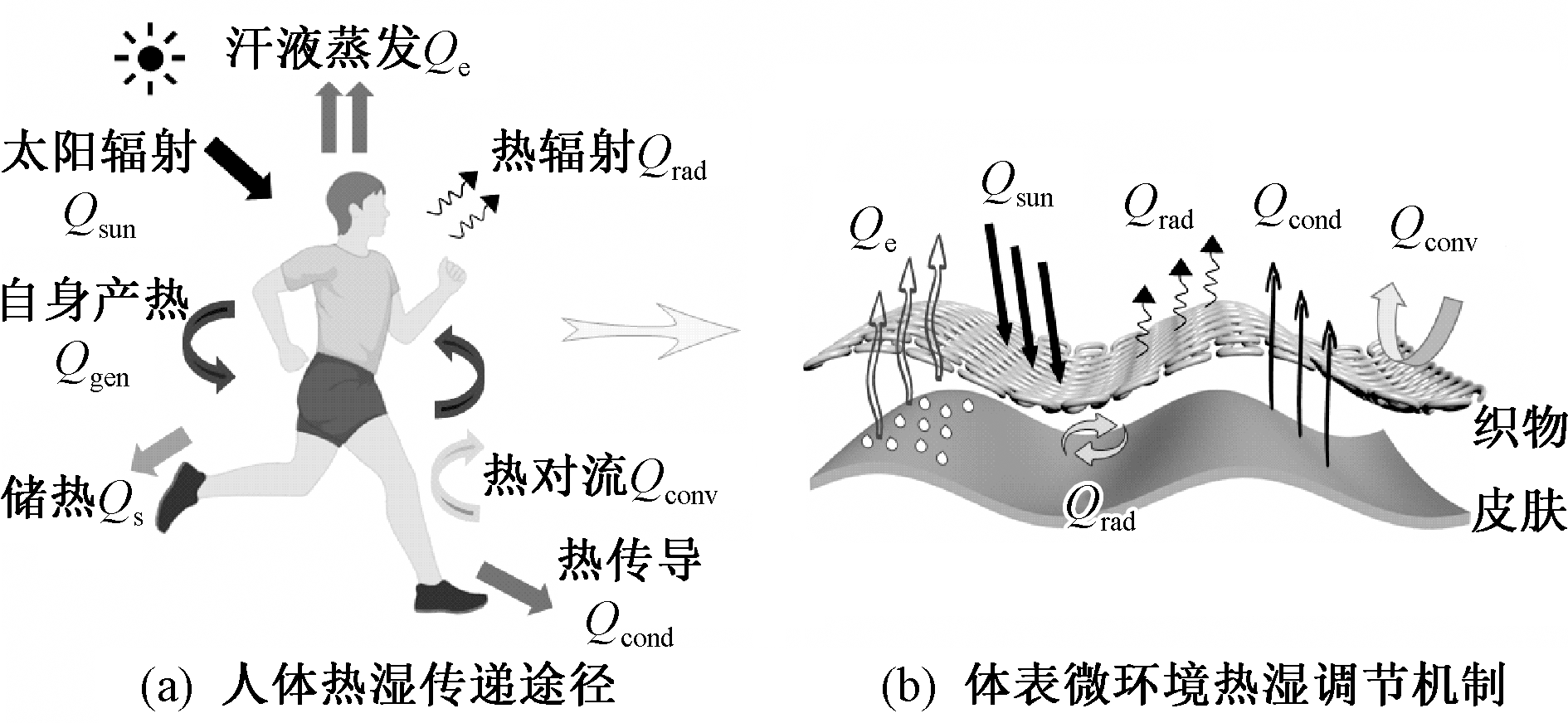
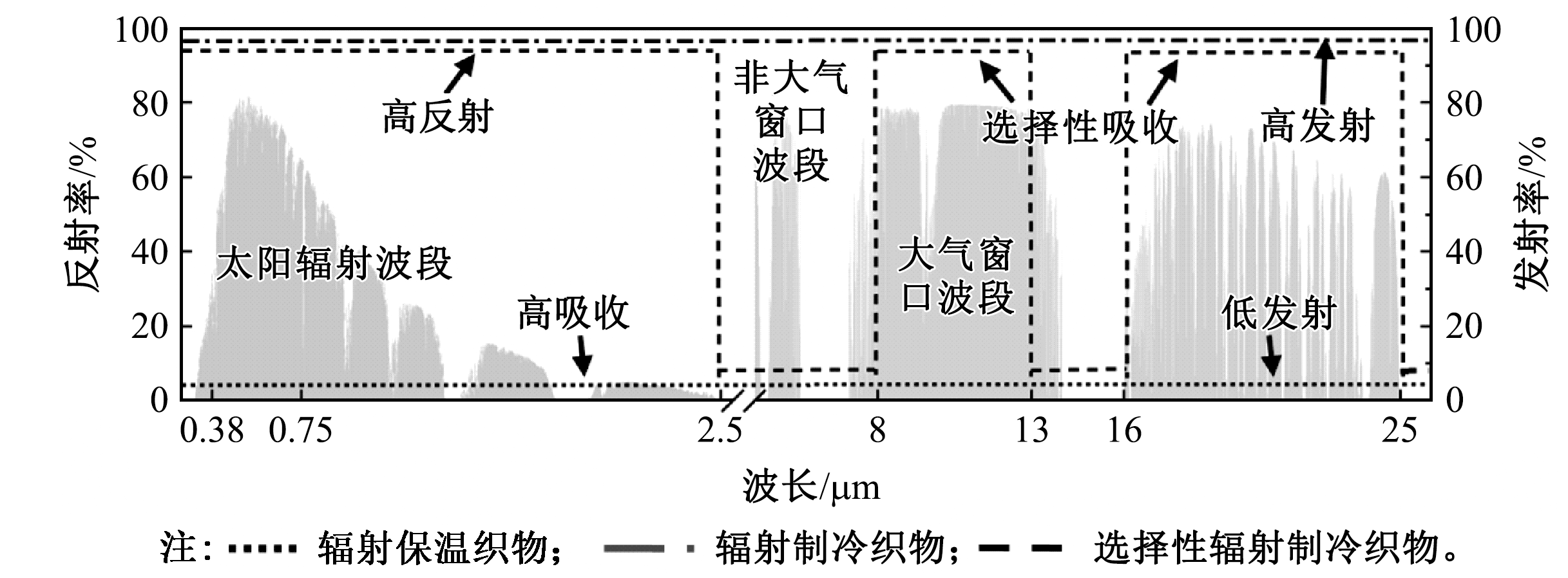
随着气候变化和人体健康需求的提升,体表微环境的热湿调节成为了当前研究的热点。热湿管理织物作为调控人体与外界环境热湿交换的重要媒介,已成为提升人体热湿舒适性和提供健康保护的创新解决方案。系统回顾了近年来热湿管理织物的研究进展,分析了人体热湿调节机制及织物在热湿管理中的作用,重点分析了导热调控、辐射调控、水分管理、相变储能和能量转化调温等五大技术方向,分别总结了不同类别织物的核心调控机制、制备方法及其相关研究进展。最后指出了目前热湿管理织物在规模化制备、智能化、功能化、应用性和长期稳定性等方面的挑战,展望了在多功能集成、智能响应及绿色可持续性方面的创新方向和发展趋势。
中图分类号:
| [1] |
SAJJAD U, HAMID K, TAUSEEF-UR-REHMAN, et al. Personal thermal management - A review on strategies, progress, and prospects[J]. International Communications in Heat and Mass Transfer, 2022, 130: 105739.
doi: 10.1016/j.icheatmasstransfer.2021.105739 |
| [2] |
BIARDEAU L T, DAVIS L W, GERTLER P, et al. Heat exposure and global air conditioning[J]. Nature Sustainability, 2020, 3(1): 25-28.
doi: 10.1038/s41893-019-0441-9 |
| [3] | JESSOE K, MOORE F C. The energy costs of climate change[J]. Nature, 2021(598): 262-263. |
| [4] | 雷敏. 人体-织物-环境系统辐射制冷与蒸发制冷的数值模拟研究[D]. 上海: 东华大学, 2024: 1-4. |
| LEI Min. Numerical research on radiative cooling and evaporative cooling in skin-clothing-environment system[D]. Shanghai: Donghua University, 2024: 1-4. | |
| [5] |
程宁波, 缪东洋, 王先锋, 等. 用于个人热湿舒适管理的功能纺织品研究进展[J]. 纺织学报, 2022, 43(10): 200-208.
doi: 10.13475/j.fzxb.20210401609 |
|
CHENG Ningbo, MIAO Dongyang, WANG Xianfeng, et al. Review in functional textiles for personal thermal and moisture comfort management[J]. Journal of Textile Research, 2022, 43(10): 200-208.
doi: 10.13475/j.fzxb.20210401609 |
|
| [6] |
PENG Y C, CUI Y. Advanced textiles for personal thermal management and energy[J]. Joule, 2020, 4(4): 724-742.
doi: 10.1016/j.joule.2020.02.011 |
| [7] |
XUE S D, HUANG G H, CHEN Q, et al. Personal thermal management by radiative cooling and heating[J]. Nano-Micro Letters, 2024, 16(1): 153.
doi: 10.1007/s40820-024-01360-1 pmid: 38478150 |
| [8] |
TABOR J, CHATTERJEE K, GHOSH T K. Smart textile-based personal thermal comfort systems: current status and potential solutions[J]. Advanced Materials Technologies, 2020, 5(5): 1901155.
doi: 10.1002/admt.v5.5 |
| [9] | PENG Y C, CUI Y. Thermal management with innovative fibers and textiles: manipulating heat transport, storage and conversion[J]. National Science Review, 2024, 11(10): nwae295. |
| [10] |
SUN Z, YU H T, FENG Y Y, et al. Application and development of smart thermally conductive fiber materials[J]. Nanomaterials, 2024, 14(2): 154.
doi: 10.3390/nano14020154 |
| [11] |
LI P, WANG Z Q, QI Y X, et al. Bidirectionally promoting assembly order for ultrastiff and highly thermally conductive graphene fibres[J]. Nature Communications, 2024, 15: 409.
doi: 10.1038/s41467-024-44692-7 pmid: 38195741 |
| [12] |
CHEN Y Z, CHEN J L, ZHANG Y M, et al. Flexible fiber membrane based on carbon nanotube and polyurethane with high thermal conductivity[J]. Nanomaterials, 2021, 11(10): 2504.
doi: 10.3390/nano11102504 |
| [13] |
SUN Z, YU H T, CHEN C, et al. Core-sheath smart polymer fiber composites with high elasticity and thermal conductivity[J]. Composites Science and Technology, 2024, 252: 110610.
doi: 10.1016/j.compscitech.2024.110610 |
| [14] |
GAO T T, YANG Z, CHEN C J, et al. Three-dimensional printed thermal regulation textiles[J]. ACS Nano, 2017, 11(11): 11513-11520.
doi: 10.1021/acsnano.7b06295 pmid: 29072903 |
| [15] |
CHEN W, WU J T, CAO Y S, et al. Highly thermal conductivity polymer composites reinforced by BNNS/UHMWPE fabric for reliable electronic thermal protection and management[J]. Composites Communications, 2024, 49: 101991.
doi: 10.1016/j.coco.2024.101991 |
| [16] |
ZHANG B J, LIU Y, LI X L, et al. Closed-cell ZrO2/SiC-based composite nanofibers with efficient electromagnetic wave absorption and thermal insulation properties[J]. Journal of Alloys and Compounds, 2022, 927: 167036.
doi: 10.1016/j.jallcom.2022.167036 |
| [17] |
LIN L, LI Z Y, MAO H Y, et al. Optically active polyurethane/silica aerogel coated cotton fabrics for thermal protection[J]. Frontiers in Materials, 2021, 8: 681678.
doi: 10.3389/fmats.2021.681678 |
| [18] |
WEI B L, WANG H L, TIAN M W, et al. The graphene-polyurethane foam-coated fabric with excellent photo-thermal property[J]. Materials Letters, 2023, 333: 133566.
doi: 10.1016/j.matlet.2022.133566 |
| [19] |
WANG S, LIU C, WANG F, et al. Recent advances in ultrafine fibrous materials for effective warmth retention[J]. Advanced Fiber Materials, 2023, 5(3): 847-867.
doi: 10.1007/s42765-022-00209-9 |
| [20] |
YU Y, XU C J, HU Z X, et al. Industrial scale sea-island melt-spun continuous ultrafine fibers for highly comfortable insulated aerogel felt clothing[J]. Advanced Materials, 2024, 36(52): 2414731.
doi: 10.1002/adma.v36.52 |
| [21] |
WU M R, SHAO Z Y, ZHAO N F, et al. Biomimetic, knittable aerogel fiber for thermal insulation textile[J]. Science, 2023, 382(6677): 1379-1383.
doi: 10.1126/science.adj8013 pmid: 38127754 |
| [22] |
YANG Y C, WANG H Y, YAN H Y, et al. Modeling and influence on effective thermal conductivity of woven fabrics based on structure parameters[J]. International Journal of Clothing Science and Technology, 2023, 35(6): 938-951.
doi: 10.1108/IJCST-12-2021-0180 |
| [23] | 丁雪婷, 王建萍, 潘婷, 等. 仿蜻蜓翅膀结构的冬季针织面料研发及其性能[J]. 纺织学报, 2023, 44(9): 75-83. |
|
DING Xueting, WANG Jianping, PAN Ting, et al. Development and performance of dragonfly wing structure like winter knitted fabrics[J]. Journal of Textile Research, 2023, 44(9): 75-83.
doi: 10.1177/004051757404400113 |
|
| [24] |
TENG F, TU L X, WANG X, et al. Ultralight air-filled hollow yarn fabrics for efficient thermal insulation and its heat and mass transfer mechanism[J]. Composites Part A: Applied Science and Manufacturing, 2024, 185: 108281.
doi: 10.1016/j.compositesa.2024.108281 |
| [25] | LIU H K, XIAO Y N, SHEN Y, et al. Self-adaptive rapid thermal conductive fabrics based on hygroscopic shrinkage response for personal cooling and drying[J]. ACS Applied Materials & Interfaces, 2024, 16(6): 7917-7926. |
| [26] |
XIAO Y X, CAI R, XIANG S F, et al. A Janus textile mimics leaf stoma for dynamic thermal regulation through a shape memory coating[J]. Chemical Engineering Journal, 2024, 496: 153770.
doi: 10.1016/j.cej.2024.153770 |
| [27] |
ZHANG X H, GU Y H, CHAO X J, et al. All-weather 3D self-folding fabric for adaptive personal thermoregulation[J]. Nano-Micro Letters, 2025, 17(1): 290.
doi: 10.1007/s40820-025-01812-2 pmid: 40500485 |
| [28] |
WANG C H, CHEN H, WANG F Q. Passive daytime radiative cooling materials toward real-world applications[J]. Progress in Materials Science, 2024, 144: 101276.
doi: 10.1016/j.pmatsci.2024.101276 |
| [29] |
HSU P C, SONG A Y, CATRYSSE P B, et al. Radiative human body cooling by nanoporous polyethylene textile[J]. Science, 2016, 353(6303): 1019-1023.
doi: 10.1126/science.aaf5471 |
| [30] |
CHEN Z P, ZHANG Q, DING L P, et al. An infrared-transparent textile with high drawing processed Nylon 6 nanofibers[J]. Nature Communications, 2025, 16: 2009.
doi: 10.1038/s41467-025-57366-9 |
| [31] |
ZENG S N, PIAN S J, SU M Y, et al. Hierarchical-morphology metafabric for scalable passive daytime radiative cooling[J]. Science, 2021, 373(6555): 692-696.
doi: 10.1126/science.abi5484 pmid: 34353954 |
| [32] |
YU H J, LU J Q, YAN J, et al. Selective emission fabric for indoor and outdoor passive radiative cooling in personal thermal management[J]. Nano-Micro Letters, 2025, 17(1): 192.
doi: 10.1007/s40820-025-01713-4 pmid: 40102320 |
| [33] |
WU R H, SUI C X, CHEN T H, et al. Spectrally engineered textile for radiative cooling against urban heat islands[J]. Science, 2024, 384(6701): 1203-1212.
doi: 10.1126/science.adl0653 pmid: 38870306 |
| [34] |
HSU P C, LIU X G, LIU C, et al. Personal thermal management by metallic nanowire-coated textile[J]. Nano Letters, 2015, 15(1): 365-371.
doi: 10.1021/nl5036572 |
| [35] |
CAI L L, SONG A Y, WU P L, et al. Warming up human body by nanoporous metallized polyethylene textile[J]. Nature Communications, 2017, 8: 496.
doi: 10.1038/s41467-017-00614-4 pmid: 28928427 |
| [36] |
HU R J, HOU L L, LIU J C, et al. Bioinspired hollow porous fibers with low emissivity and conductivity aluminum platelet skin for thermal insulation[J]. Journal of Materials Chemistry A, 2023, 11(4): 1704-1711.
doi: 10.1039/D2TA08558E |
| [37] |
CHENG N B, WANG Z H, LIN Y Y, et al. Breathable dual-mode leather-like nanotextile for efficient daytime radiative cooling and heating[J]. Advanced Materials, 2024, 36(33): 2403223.
doi: 10.1002/adma.v36.33 |
| [38] |
CHOW L, ZHANG Q, HUANG X C, et al. Army ant nest inspired adaptive textile for smart thermal regulation and healthcare monitoring[J]. Advanced Materials, 2025, 37(9): 2406798.
doi: 10.1002/adma.v37.9 |
| [39] |
LAN C T, MENG J, PAN C X, et al. Hierarchical porous dual-mode thermal management fabrics achieved by regulating solar and body radiations[J]. Materials Horizons, 2024, 11(7): 1760-1768.
doi: 10.1039/D3MH01938A |
| [40] |
LI X S, LIU M L, CHEN K, et al. Adaptive fabric with emissivity regulation for thermal management of humans[J]. Nanophotonics, 2024, 13(17): 3067-3075.
doi: 10.1515/nanoph-2023-0930 pmid: 39634940 |
| [41] | ZHU K X, YAO H Z, SONG J J, et al. Temperature-adaptive dual-modal photonic textiles for thermal management[J]. Science Advances, 2024, 10(41): eadr2062. |
| [42] | HOU L L, LIU X F, GE X R, et al. Designing of anisotropic gradient surfaces for directional liquid transport: fundamentals, construction, and applications[J]. Innovation, 2023, 4(6): 100508. |
| [43] |
FAN C H, ZHANG Y X, LONG Z W, et al. Dynamically tunable subambient daytime radiative cooling metafabric with Janus wettability[J]. Advanced Functional Materials, 2023, 33(29): 2300794.
doi: 10.1002/adfm.v33.29 |
| [44] |
ZHANG Q, WANG M Y, CHEN T, et al. Sweat gland-like fabric for personal thermal-wet comfort management[J]. Advanced Functional Materials, 2026, 36(6): 2409807.
doi: 10.1002/adfm.v36.6 |
| [45] |
ZHANG L, GUO Y W, MO R L, et al. Hierarchical weaving metafabric for unidirectional water transportation and evaporative cooling[J]. Advanced Functional Materials, 2023, 33(51): 2307590.
doi: 10.1002/adfm.v33.51 |
| [46] |
PENG Y C, LI W, LIU B F, et al. Integrated cooling (i-Cool) textile of heat conduction and sweat transportation for personal perspiration management[J]. Nature Communications, 2021, 12: 6122.
doi: 10.1038/s41467-021-26384-8 pmid: 34675199 |
| [47] |
DING C F, LIN Y Y, CHENG N B, et al. Dual-cooling textile enables vertical heat dissipation and sweat evaporation for thermal and moisture regulation[J]. Advanced Functional Materials, 2024, 34(34): 2400987.
doi: 10.1002/adfm.v34.34 |
| [48] |
LI X Y, JI Y T, FAN Z Z, et al. Asymmetrical emissivity and wettability in stitching treble weave metafabric for synchronous personal thermal-moisture management[J]. Small, 2023, 19(29): 2300297.
doi: 10.1002/smll.v19.29 |
| [49] | PU Y, FAN J T. Thermoresponsive skin-like fabric for personal comfort and protection[J]. ACS Applied Materials & Interfaces, 2024, 16(8): 10960-10968. |
| [50] |
LIN Y Y, CHENG N B, MENG N, et al. A patterned knitted fabric with reversible gating stability for dynamic moisture management of human body[J]. Advanced Functional Materials, 2023, 33(44): 2304109.
doi: 10.1002/adfm.v33.44 |
| [51] |
LI S, SHAO K, WU X C, et al. Self-contained moisture management and evaporative cooling through 1D to 3D hygroscopic all-polymer composites[J]. Advanced Functional Materials, 2024, 34(9): 2310020.
doi: 10.1002/adfm.v34.9 |
| [52] |
FREEMAN T B, FOSTER K E O, TROXLER C J, et al. Advanced materials and additive manufacturing for phase change thermal energy storage and management: a review[J]. Advanced Energy Materials, 2023, 13(24): 2204208.
doi: 10.1002/aenm.v13.24 |
| [53] |
XU F D, ZHANG T, XU Z G, et al. Solid-solid phase change fibers with enhanced energy storage density for temperature management[J]. Journal of Energy Storage, 2024, 79: 110190.
doi: 10.1016/j.est.2023.110190 |
| [54] |
ZHU Z J, BASHIR A, WU X H, et al. Highly integrated phase change and radiative cooling fiber membrane for adaptive personal thermal regulation[J]. Advanced Functional Materials, 2025, 35(9): 2416111.
doi: 10.1002/adfm.v35.9 |
| [55] |
SAMANTA A, NECHYPORCHUK O, BORDES R. Wet spinning of strong cellulosic fibres with incorporation of phase change material capsules stabilized by cellulose nanocrystals[J]. Carbohydrate Polymers, 2023, 312: 120734.
doi: 10.1016/j.carbpol.2023.120734 |
| [56] |
CHEN S N, CHEN Z Y, HU Z X, et al. Soft-hard complex microsphere strategy to construct high-temperature form-stable phase change material for melt-spun temperature-regulating fibers[J]. Chemical Engineering Journal, 2023, 476: 146833.
doi: 10.1016/j.cej.2023.146833 |
| [57] |
AHN Y H, DEWITT S J A, MCGUIRE S, et al. Incorporation of phase change materials into fibers for sustainable thermal energy storage[J]. Industrial & Engineering Chemistry Research, 2021, 60(8): 3374-3384.
doi: 10.1021/acs.iecr.0c06140 |
| [58] |
DE CASTRO P F, MINKO S, VINOKUROV V, et al. Long-term autonomic thermoregulating fabrics based on microencapsulated phase change materials[J]. ACS Applied Energy Materials, 2021, 4(11): 12789-12797.
doi: 10.1021/acsaem.1c02170 pmid: 35128339 |
| [59] |
XU R, XIA X M, WANG W, et al. Infrared camouflage fabric prepared by paraffin phase change microcapsule with Good thermal insulting properties[J]. Colloids and Surfaces A: Physicochemical and Engineering Aspects, 2020, 591: 124519.
doi: 10.1016/j.colsurfa.2020.124519 |
| [60] |
CHANG J, SHI L, ZHANG M, et al. Tailor-made white photothermal fabrics: a bridge between pragmatism and aesthetic[J]. Advanced Materials, 2023, 35(41): 2209215.
doi: 10.1002/adma.v35.41 |
| [61] |
DAI H M, GAO J L, JIA C, et al. High-performance electrothermal fabrics enabled by lignin-derived carbon nanotube yarns[J]. Chemical Engineering Journal, 2024, 482: 149157.
doi: 10.1016/j.cej.2024.149157 |
| [62] |
WANG X F, LEI Z W, MA X D, et al. A lightweight MXene-coated nonwoven fabric with excellent flame retardancy, EMI shielding, and electrothermal/photothermal conversion for wearable heater[J]. Chemical Engineering Journal, 2022, 430: 132605.
doi: 10.1016/j.cej.2021.132605 |
| [63] | JING Y Y, LUO J, HAN X, et al. Scalable manufacturing of a durable, tailorable, and recyclable multifunctional woven thermoelectric textile system[J]. Energy & Environmental Science, 2023, 16(10): 4334-4344. |
| [64] | LIU J Z, JIANG W K, ZHUO S, et al. Large-area radiation-modulated thermoelectric fabrics for high-performance thermal management and electricity generation[J]. Science Advances, 2025, 11: eadr2158. |
| [1] | 李树豪, 张星慧, 许静娴, 卢业虎. 基于手部冷敏感度的防护手套分区设计[J]. 纺织学报, 2025, 46(12): 188-197. |
| [2] | 朱元成, 何永红, 熊伟国. 个体降温服装技术研究进展[J]. 纺织学报, 2025, 46(09): 268-277. |
| [3] | 廖昙倩, 李文雅, 杨晓宇, 赵静娜, 张骁骅. 碳纳米管/聚乙二醇复合相变纤维的制备及其热性能[J]. 纺织学报, 2025, 46(03): 9-16. |
| [4] | 顾舒婷, 陈晨依, 许静娴. 面向老年人局部差异热需求的加热被褥设计[J]. 纺织学报, 2024, 45(09): 175-182. |
| [5] | 丁小蝶, 唐虹, 高强, 张成蛟. 上躯干皮肤温度冷热变化与热量调节区划分[J]. 纺织学报, 2024, 45(05): 147-154. |
| [6] | 柯莹, 林磊, 郑晴, 王宏付. 电加热服加热区域分布对人体热舒适感的影响[J]. 纺织学报, 2024, 45(04): 188-194. |
| [7] | 孙浪涛, 杨宇珊. 调温抗菌微胶囊的制备及其在棉织物上的应用[J]. 纺织学报, 2024, 45(02): 171-178. |
| [8] | 刘广菊, 苏云, 田苗, 李俊. 电加热鞋帮二维瞬态传热模型及其实验验证[J]. 纺织学报, 2023, 44(10): 127-133. |
| [9] | 聂思萱, 尹虎, 聂亚东. 半导体制冷服设计方法研究进展[J]. 纺织学报, 2023, 44(10): 223-231. |
| [10] | 王中昱, 苏云, 王云仪. 机器学习建立的个体热舒适模型及其在服装领域的应用展望[J]. 纺织学报, 2023, 44(05): 228-236. |
| [11] | 张昭华, 陈雪, 倪军, 杨玉桐, 邹一凡. 冷环境下局部电加热对人体热反应的影响[J]. 纺织学报, 2023, 44(03): 187-194. |
| [12] | 郑晴, 严芳英, 柯莹, 王鸿博. 基于睡袋温标模型的被子舒适温度测定与可行性验证[J]. 纺织学报, 2023, 44(02): 151-158. |
| [13] | 程宁波, 缪东洋, 王先锋, 王朝晖, 丁彬, 俞建勇. 用于个人热湿舒适管理的功能纺织品研究进展[J]. 纺织学报, 2022, 43(10): 200-208. |
| [14] | 江舒, 李俊. 婴儿被服热舒适性研究进展[J]. 纺织学报, 2022, 43(08): 189-196. |
| [15] | 吴国珊, 刘何清, 吴世先, 游波, 宋小鹏. 不同环境下个体通风服的制冷量[J]. 纺织学报, 2021, 42(10): 139-145. |
|
||
 京公网安备11010502044800号