纺织学报 ›› 2025, Vol. 46 ›› Issue (03): 9-16.doi: 10.13475/j.fzxb.20240304501
廖昙倩1,2, 李文雅1( ), 杨晓宇3, 赵静娜2, 张骁骅4
LIAO Tanqian1,2, LI Wenya1(), YANG Xiaoyu3, ZHAO Jingna2, ZHANG Xiaohua4
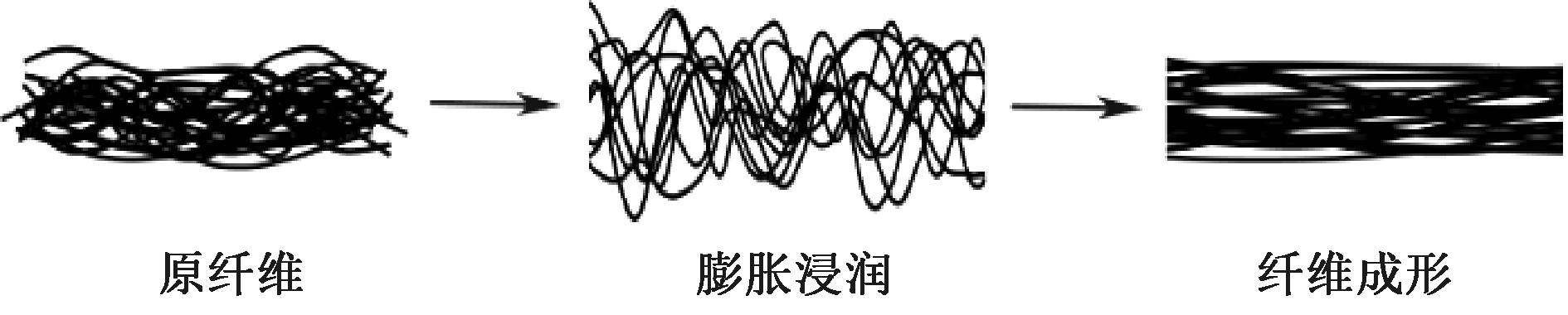
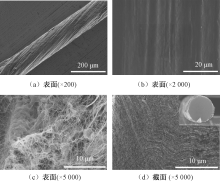
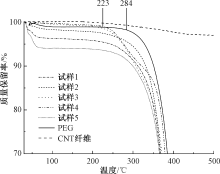
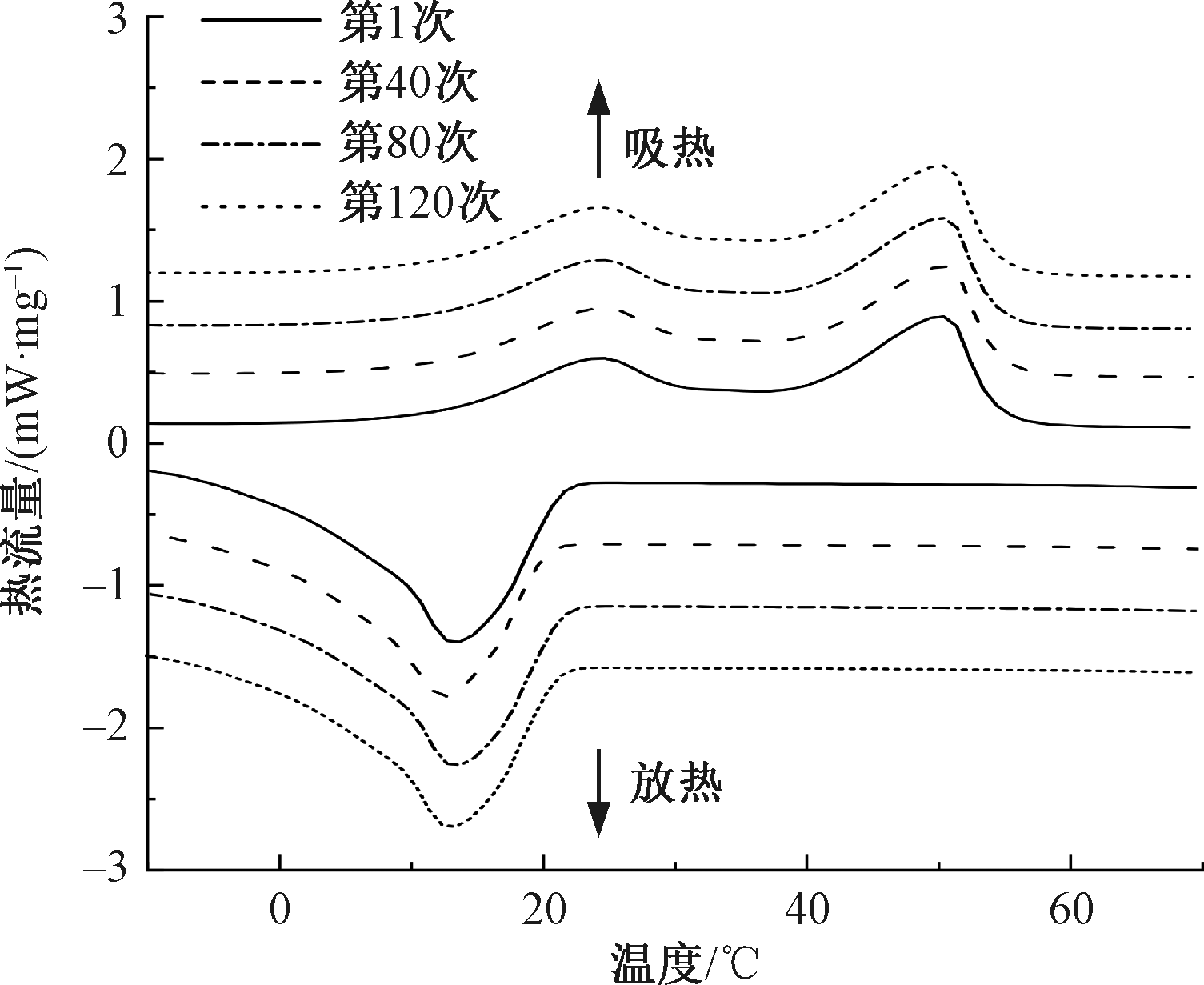
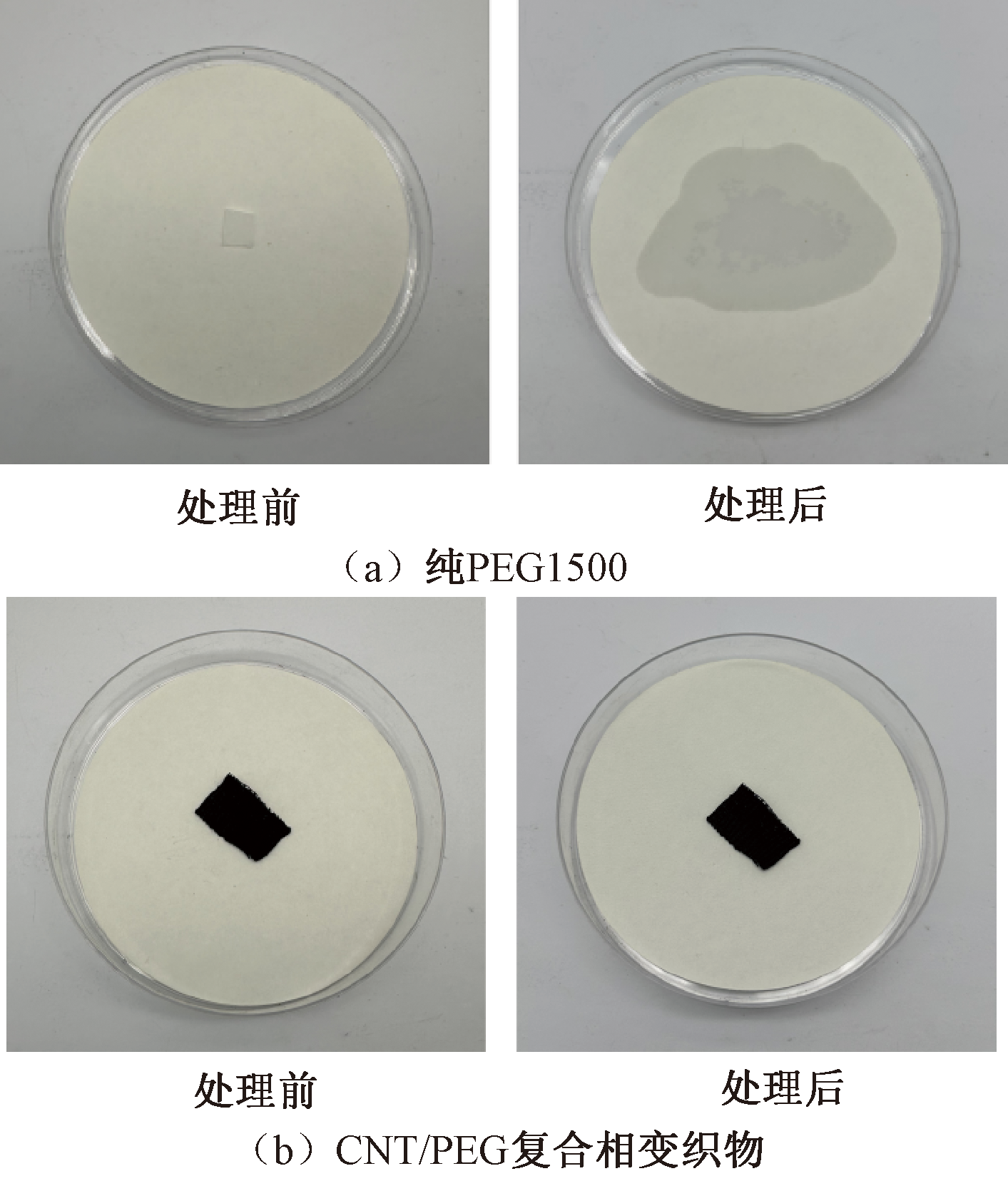
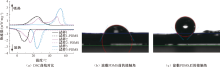
摘要: 为解决有机相变材料导热性能、力学性能、热稳定性差等问题,利用一维连续的宏观碳纳米管(CNT)纤维作为增强骨架,采用电化学析氢膨胀技术原位浸润聚乙二醇(PEG)制备了CNT/PEG复合相变纤维,并对其结构和热力学性能进行分析。结果表明:CNT/PEG复合相变纤维表面光滑、结构均匀,PEG负载量达94%以上;CNT的网络结构还促进了不同分子质量PEG的协同结晶,复合相变纤维的相变温度可在9.2~24.7 ℃范围内进行调控,相变焓最高达168.2 J/g,在120次热循环后仍具有优异的稳定性;得益于CNT出色的光吸收能力,复合相变纤维的光热转换效率达63.5%;复合相变纤维呈现出优异的力学和电学性能,断裂强度最高可达412 MPa,断裂伸长率可达17.0%,电阻值稳定;使用高透明疏水性材料对复合相变纤维进行封装,解决了PEG在空气中的吸湿问题,且不影响复合相变纤维的光热特性。
中图分类号:
| [1] | LEE J, LIN K Y A, JUNG S, et al. Hybrid renewable energy systems involving thermochemical conversion process for waste-to-energy strategy[J]. Chemical Engineering Journal, 2023. DOI: 10.1016/j.cej.2022.139218. |
| [2] | LAWAG R A, ALI H M. Phase change materials for thermal management and energy storage: a review[J]. Journal of Energy Storage, 2022. DOI: 10.1016/j.est.2022.105602. |
| [3] |
陈家东, 佘静, 李发兵, 等. 相变纤维制备及其应用研究进展[J]. 化工新型材料, 2023, 51(4):51-57.
doi: 10.19817/j.cnki.issn1006-3536.2023.04.009 |
|
CHEN Jiadong, SHE Jing, LI Fabing, et al. Research progress on preparation and application of phase change fiber[J]. New Chemical Materials, 2023, 51(4): 51-57.
doi: 10.19817/j.cnki.issn1006-3536.2023.04.009 |
|
| [4] | LUO D J, XIANG L, SUN X, et al. Phase-change smart lines based on paraffin-expanded graphite/polypropylene hollow fiber membrane composite phase change materials for heat storage[J]. Energy, 2020. DOI: 10.1016/j.energy.2020.117252. |
| [5] | XIANG L, LUO D J, YANG J K, et al. Construction and design of paraffin/PVDF hollow fiber linear-phase change energy storage materials[J]. Energy & Fuels. 2019, 33(11):11584-11591. |
| [6] | QUAN Z Z, XU Y Q, RONG H, et al. Preparation of oil-in-water core-sheath nanofibers through emulsion electrospinning for phase change temperature regul-ation[J]. Polymer, 2022. DOI: 10.1016/j.polymer.2022.125252. |
| [7] | NIU Z X, QI S Y, SHUA IB S S A, et al. Flexible, stimuli-responsive and self-cleaning phase change fiber for thermal energy storage and smart textiles[J]. Composites Part B: Engineering, 2021. DOI: 10.1016/j.compositesb.2021.109431. |
| [8] |
BAO Y Q, L J, LIU Z W, et al. Bending stiffness-directed fabricating of kevlar aerogel-confined organic phase-change fibers[J]. ACS Nano, 2021, 15 (9):15180-15190.
doi: 10.1021/acsnano.1c05693 pmid: 34423639 |
| [9] | TON G X, LI N Q, ZENG M, et al. Organic phase change materials confined in carbon-based materials for thermal properties enhancement: recent advancement and challenges[J]. Renewable and Sustainable Energy Reviews, 2019, 108:398-422. |
| [10] | SHWNG N, ZHU C Y, RAO Z H. Solution combustion synthesized copper foams for enhancing the thermal transfer properties of phase change material[J]. Journal of Alloys and Compounds, 2021. DOI: 10.1016/j.jallcom.2021.159458. |
| [11] | MALEKI M, AHAMADI P T, M H, et al. Photo-thermal conversion structure by infiltration of paraffin in three dimensionally interconnected porous polystyrene-carbon nanotubes (PS-CNT) polyHIPE foam[J]. Solar Energy Materials and Solar Cells, 2019, 191:266-274. |
| [12] | CHEN X, GAO H Y, YANG M, et al. Highly graphitized 3D network carbon for shape-stabilized composite PCMs with superior thermal energy harvesting[J]. Nano Energy, 2018, 49:86-94. |
| [13] | LI M, MU B Y. Effect of different dimensional carbon materials on the properties and application of phase change materials: a review[J]. Applied Energy, 2019, 242:695-715. |
| [14] | HE M Z, YANG L, LIN W Y, et al. Preparation, thermal characterization and examination of phase change materials (PCMs) enhanced by carbon-based nanoparticles for solar thermal energy storage[J]. Journal of Energy Storage, 2019. DOI: 10.1016/j.est.2019.100874. |
| [15] | SHENG N, RAO Z H, ZHU C Y, et al. Honeycomb carbon fibers strengthened composite phase change materials for superior thermal energy storage[J]. Applied Thermal Engineering, 2019. DOI: /10.1016/j.applthermaleng.2019.114493. |
| [16] | LI G, HONG G, DONG D, et al. Multiresponsive graphene-aerogel-directed phase-change smart fibers[J]. Adv Mater, 2018. DOI: 10.1002/adma.201801754. |
| [17] | WANG F, ZHAO S M, JIANG Q Y, et al. Advanced functional carbon nanotube fibers from preparation to application[J]. Cell Reports Physical Science, 2022. DOI: 10.1016/j.xcrp.2022.100989. |
| [18] | QIU L, GUO P, YANG X Q, et al. Electro curing of oriented bismaleimide between aligned carbon nanotubes for high mechanical and thermal performances[J]. Carbon, 2019, 145:650-657. |
| [19] | LI Y, SUN K, KOU Y, et al. One-step synthesis of graphene-based composite phase change materials with high solar-thermal conversion efficiency[J]. Chemical Engineering Journal, 2022. DOI: 10.1016/j.cej.2021.132439. |
| [20] | LI G, HONG G, DONG D, et al. Multiresponsive graphene-aerogel-directed phase-change smart fibers[J]. Advanced Materials, 2018. DOI: 10.1002/adma.201801754. |
| [1] | 刘霞, 吴改红, 闫子豪, 王彩柳. 智能相变调温聚乳酸纤维膜的制备及其性能[J]. 纺织学报, 2024, 45(12): 18-24. |
| [2] | 孙浪涛, 杨宇珊. 调温抗菌微胶囊的制备及其在棉织物上的应用[J]. 纺织学报, 2024, 45(02): 171-178. |
| [3] | 葛灿, 雍楠, 杜恒, 吴天宇, 方剑. 开放热管理式三维织物基光热海水淡化系统[J]. 纺织学报, 2024, 45(02): 153-161. |
| [4] | 潘露琪, 任李培, 肖杏芳, 徐卫林, 张骞. 纤维基界面光热蒸发器表面除盐的研究进展[J]. 纺织学报, 2023, 44(11): 225-231. |
| [5] | 娄辉清, 上媛媛, 曹先仲, 徐蓓蕾. 碳氮化钛/粘胶纤维束集合体太阳能界面水蒸发器的制备及其性能[J]. 纺织学报, 2023, 44(10): 9-15. |
| [6] | 李璟孜, 娄蒙蒙, 黄世燕, 李方. 基于光热利用的金属有机骨架/石墨烯复合膜对印染废水的再生处理[J]. 纺织学报, 2023, 44(09): 116-123. |
| [7] | 狄纯秋, 郭静, 管福成, 相玉龙, 单继成. 双金属离子交联海藻酸盐复合相变纤维的制备与性能[J]. 纺织学报, 2023, 44(05): 54-62. |
| [8] | 张少月, 岳江昱, 杨家乐, 柴晓帅, 冯增国, 张爱英. 环境友好聚己内酯基复合相变纤维膜的制备及其性能[J]. 纺织学报, 2023, 44(03): 11-18. |
| [9] | 娄辉清, 朱斐超, 李磊磊, 丁会龙, 普丹丹, 王相飞. 碳纳米管/Ni/聚苯胺纤维状超级电容器的制备及其电化学性能[J]. 纺织学报, 2022, 43(11): 35-40. |
| [10] | 聂文琪, 孙江东, 许帅, 郑贤宏, 徐珍珍. 柔性纺织纤维基超级电容器研究进展[J]. 纺织学报, 2022, 43(07): 200-206. |
| [11] | 丁倩, 邓炳耀, 李昊轩. 全纤维光驱动界面蒸发系统在海水淡化工程中的应用研究进展[J]. 纺织学报, 2022, 43(01): 36-42. |
| [12] | 葛灿, 张传雄, 方剑. 界面光热转换水蒸发系统用纤维材料的研究进展[J]. 纺织学报, 2021, 42(12): 166-173. |
| [13] | 曹元鸣, 郑蜜, 李一飞, 翟旺宜, 李丽艳, 常朱宁子, 郑敏. 二硫化钼/聚氨酯复合纤维膜的制备及其光热转换性能[J]. 纺织学报, 2021, 42(09): 46-51. |
| [14] | 陈亚丽, 赵国猛, 任李培, 潘露琪, 陈贝, 肖杏芳, 徐卫林. 芳纶织物基界面光热蒸发材料的制备及其性能[J]. 纺织学报, 2021, 42(08): 115-121. |
| [15] | 成悦, 安琪, 李大伟, 付译鋆, 张伟, 张瑜. SiO2原位掺杂聚偏氟乙烯纳米纤维膜的制备及其性能[J]. 纺织学报, 2021, 42(03): 71-76. |
|
||
 京公网安备11010502044800号