纺织学报 ›› 2026, Vol. 47 ›› Issue (05): 263-272.doi: 10.13475/j.fzxb.20250602102
刘荣芳1,2,3, 李新荣1,2,3( ), 李理1,2,3, 袁程栩1,2,3
LIU Rongfang1,2,3, LI Xinrong1,2,3(), LI Li1,2,3, YUAN Chengxu1,2,3
摘要:
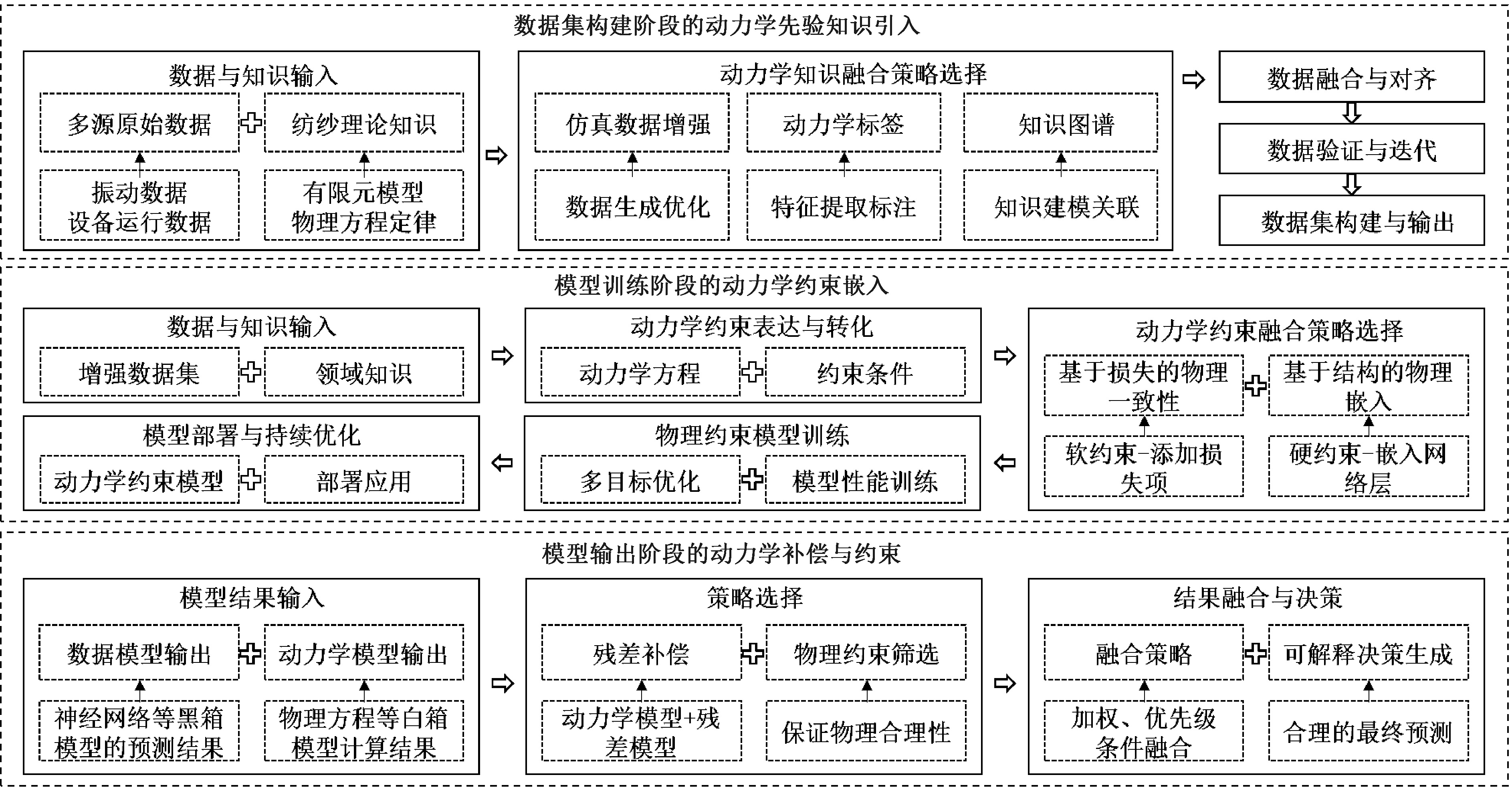
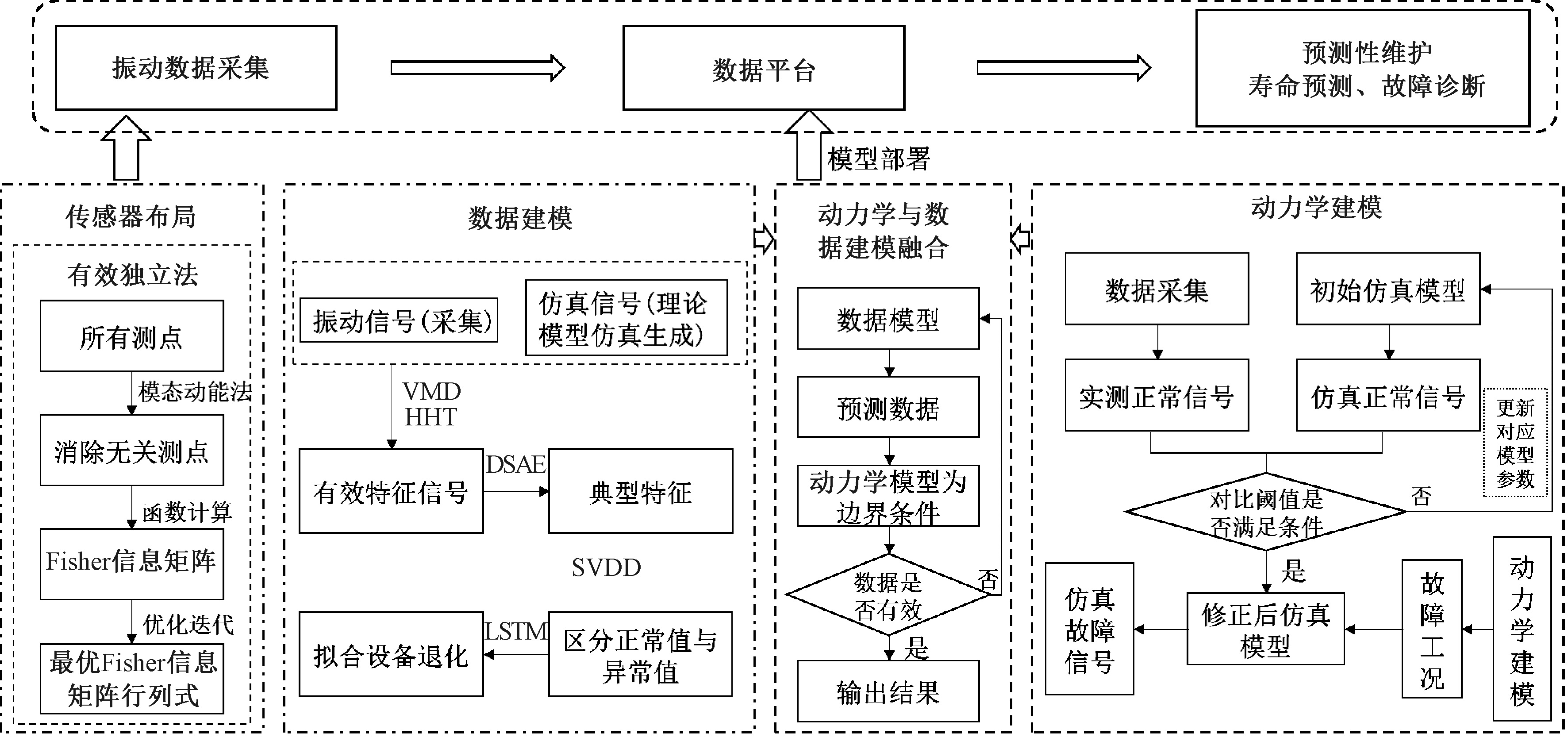
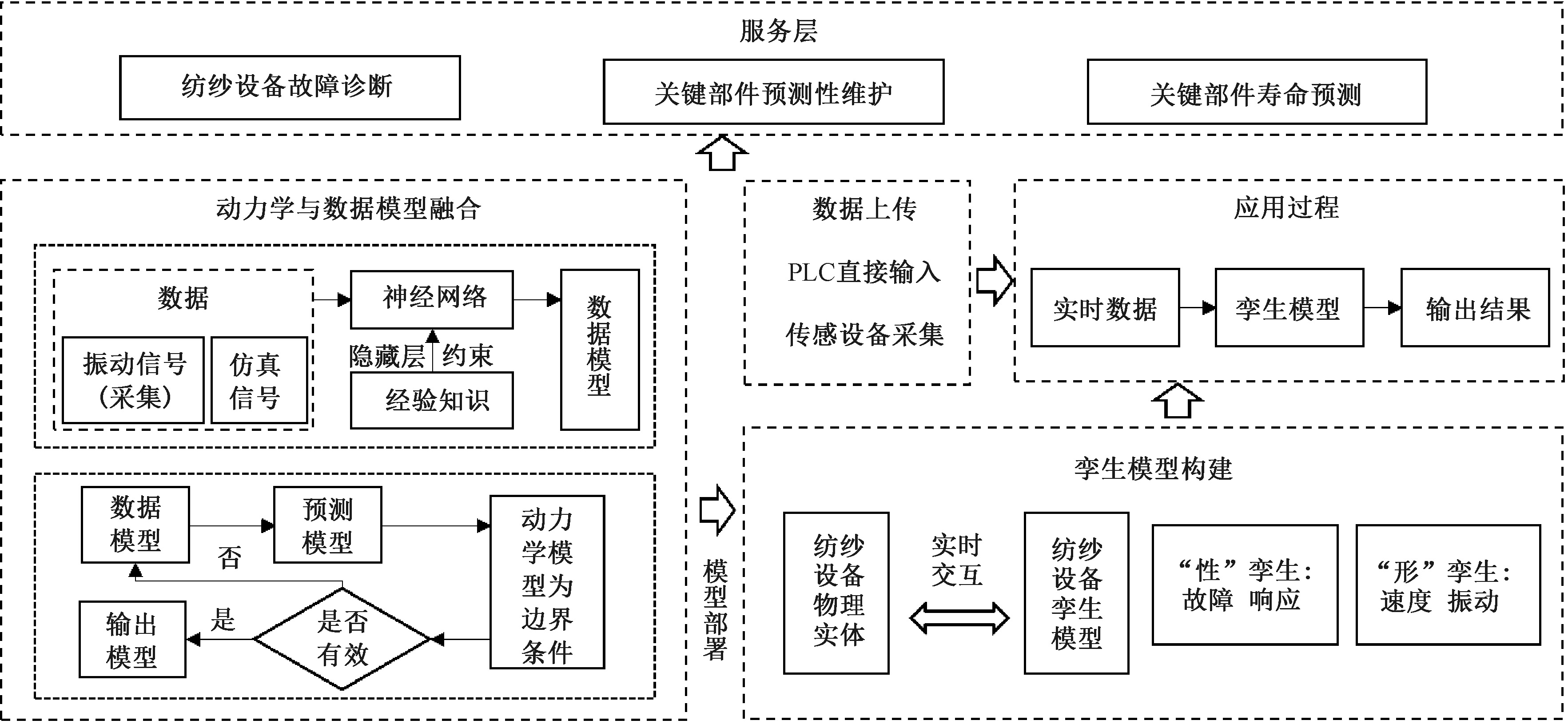
纺纱机械的振动严重限制其进一步向高速、高质方向的发展,为解决当前纺纱机械振动存在的问题,从纺纱机械振动研究现状、其它领域的振动研究方法以及未来研究方向3个方面进行了综述。首先,阐明了传统动力学与数据建模各自的局限以及融合需求;其次,从数据集构建阶段、模型训练阶段以及模型输出阶段等不同环节梳理了融合方法在其它领域中的应用实践,在此基础上提出面向纺纱机械振动研究的动力学与数据建模融合整体架构,并探讨结合数字孪生技术的融合架构;随后系统讨论不同融合策略的性能差异并分析其在不同设备与工况下的适用性;最后,总结了融合方法对纺纱机械智能化发展的意义,并展望其在小样本预测、复杂工况适应以及数字孪生集成等方面的未来发展趋势。研究为纺纱机械振动研究提供了新的思路,也为纺织服装行业设备研发设计提供了理论支持。
中图分类号:
| [1] | 殷强, 王正光, 吴秀全, 等. 纺纱行业数字化转型中的标准化探索与实践[J]. 信息技术与标准化, 2023(5): 28-33. |
| YIN Qiang, WANG Zhengguang, WU Xiuquan, et al. Exploration and practice of standardization in digital transformation of spinning industry[J]. Information Technology & Standardization, 2023(5): 28-33. | |
| [2] | 任家智. 国产棉纺精梳机的创新发展与展望[J]. 棉纺织技术, 2023, 51(10): 25-32. |
| REN Jiazhi. Innovative development and prospect of domestic cotton comber[J]. Cotton Textile Technology, 2023, 51(10): 25-32. | |
| [3] | 莫帅, 冯战勇, 党合玉, 等. 高速纺纱锭子弹性管减振机制与振动特性[J]. 纺织学报, 2020, 41(3): 148-153. |
| MO Shuai, FENG Zhanyong, DANG Heyu, et al. Vibration damping mechanism and vibration characteristics of spindle tubes[J]. Journal of Textile Research, 2020, 41(3): 148-153. | |
| [4] | 畅博彦, 韩芳孝, 周杨, 等. 面向精梳任务的高速变胞机构冲击动力学研究[J]. 机械工程学报, 2024, 60(7): 54-65. |
| CHANG Boyan, HAN Fangxiao, ZHOU Yang, et al. Impact dynamics of high-speed metamorphic mechanism for comber[J]. Journal of Mechanical Engineering, 2024, 60(7): 54-65. | |
| [5] |
刘金儒, 李新荣, 王浩, 等. 棉精梳机分离罗拉混合驱动系统优化[J]. 纺织学报, 2023, 44(11): 190-198.
doi: 10.13475/j.fzxb.20220601201 |
|
LIU Jinru, LI Xinrong, WANG Hao, et al. Optimization of detaching roller hybrid drive system for cotton comber[J]. Journal of Textile Research, 2023, 44(11): 190-198.
doi: 10.13475/j.fzxb.20220601201 |
|
| [6] |
SHEN C, CHEN B, YU L Q, et al. Machine learning based anomaly detection and diagnosis method of spinning equipment driven by spectrogram data[J]. The Journal of the Textile Institute, 2022, 113(10): 2090-2099.
doi: 10.1080/00405000.2021.1966182 |
| [7] | 陈宇航, 李正平, 肖雷. 基于细纱机罗拉轴承故障诊断[J]. 棉纺织技术, 2023, 51(1): 16-21. |
| CHEN Yuhang, LI Zhengping, XIAO Lei. Fault diagnosis of roller bearing in spinning frame based on FFT-1D-CNN[J]. Cotton Textile Technology, 2023, 51(1): 16-21. | |
| [8] |
GHANMI H, GHITH A, BENAMEUR T. Ring yarn quality prediction using hybrid artificial neural network: fuzzy expert system model[J]. International Journal of Clothing Science and Technology, 2015, 27(6): 940-956.
doi: 10.1108/IJCST-01-2015-0015 |
| [9] |
GAO T H, ZHU H P, WU J, et al. Hybrid physics data-driven model-based fusion framework for machining tool wear prediction[J]. The International Journal of Advanced Manufacturing Technology, 2024, 132(3): 1481-1496.
doi: 10.1007/s00170-024-13365-6 |
| [10] |
GU Q W, DENG Z H, LV L S, et al. Prediction research for surface topography of internal grinding based on mechanism and data model[J]. The International Journal of Advanced Manufacturing Technology, 2021, 113(3): 821-836.
doi: 10.1007/s00170-021-06604-7 |
| [11] |
XUE R J, ZHANG P S, HUANG Z G, et al. Digital twin-driven fault diagnosis for CNC machine tool[J]. The International Journal of Advanced Manufacturing Technology, 2024, 131(11): 5457-5470.
doi: 10.1007/s00170-022-09978-4 |
| [12] |
VISHNU V S, VARGHESE K G, GURUMOORTHY B. A data-driven digital twin framework for key performance indicators in CNC machining processes[J]. International Journal of Computer Integrated Manufacturing, 2023, 36(12): 1823-1841.
doi: 10.1080/0951192X.2023.2177741 |
| [13] |
CHIA J W Y, VERHAGEN W J C, SILVA J M, et al. A review and outlook of airframe digital twins for structural prognostics and health management in the aviation industry[J]. Journal of Manufacturing Systems, 2024, 77: 398-417.
doi: 10.1016/j.jmsy.2024.09.024 |
| [14] |
WANG J J, LI Y L, GAO R X, et al. Hybrid physics-based and data-driven models for smart manufacturing: modelling, simulation, and explainability[J]. Journal of Manufacturing Systems, 2022, 63: 381-391.
doi: 10.1016/j.jmsy.2022.04.004 |
| [15] | REN L L, MA H B, ZHOU W, et al. A condition monitoring method of hydraulic gear pumps based on multilevel mechanism-data fusion[J]. International Journal of Aerospace Engineering, 2024, 2024(1): 5587168. |
| [16] |
TANG K, LI S S, TANG J T, et al. Fusing structural information with knowledge enhanced text representation for knowledge graph completion[J]. Data Mining and Knowledge Discovery, 2024, 38(3): 1316-1333.
doi: 10.1007/s10618-023-00998-6 |
| [17] |
WANG C, CHEN X X, QIANG X, et al. Recent advances in mechanism/data-driven fault diagnosis of complex engineering systems with uncertainties[J]. AIMS Mathematics, 2024, 9(11): 29736-29772.
doi: 10.3934/math.20241441 |
| [18] |
LIU C Y, GRYLLIAS K. Simulation-driven domain adaptation for rolling element bearing fault diagnosis[J]. IEEE Transactions on Industrial Informatics, 2022, 18(9): 5760-5770.
doi: 10.1109/TII.2021.3103412 |
| [19] |
MU G Q, LIU C L, CHEN J. Integrating physical knowledge for generative-based zero-shot learning models in process fault diagnosis[J]. Reliability Engineering & System Safety, 2025, 258: 110852.
doi: 10.1016/j.ress.2025.110852 |
| [20] |
LIU X Y, HUANG H Z, XIANG J W. A personalized diagnosis method to detect faults in a bearing based on acceleration sensors and an FEM simulation driving support vector machine[J]. Sensors, 2020, 20(2):420-433.
doi: 10.3390/s20020420 |
| [21] |
ZHANG C, QIN F F, ZHAO W T, et al. Research on rolling bearing fault diagnosis based on digital twin data and improved ConvNext[J]. Sensors, 2023, 23(11): 5334-5356.
doi: 10.3390/s23115334 |
| [22] | 朱永怀, 杨聪彬, 刘志峰, 等. 一种机理与数据融合驱动的小样本滚动轴承故障诊断方法: CN118886291A[P]. 2024-11-01. |
| ZHU Yonghuai, YANG Congbin, LIU Zhifeng, et al. A mechanism-data fusion driven fault diagnosis method for rolling bearings under small-sample conditions, CN118886291A[P]. 2024-11-01. | |
| [23] |
WANG N Z, ZHANG D X, CHANG H B, et al. Deep learning of subsurface flow via theory-guided neural network[J]. Journal of Hydrology, 2020, 584: 124700.
doi: 10.1016/j.jhydrol.2020.124700 |
| [24] | 刘晶, 高立超, 孙跃华, 等. 基于知识和数据融合驱动的设备故障诊断方法[J]. 郑州大学学报(理学版), 2022, 54(2): 39-46. |
| LIU Jing, GAO Lichao, SUN Yuehua, et al. Fault diagnosis method for equipment driven by knowledge and data fusion[J]. Journal of Zhengzhou University (Natural Science Edition), 2022, 54(2): 39-46. | |
| [25] |
GUO B L, WANG Y N, PAN W F, et al. Fault diagnosis method for hydro-power plants with Bi-LSTM knowledge graph aided by attention scheme[J]. Journal of Vibroengineering, 2023, 25(8): 1629-1641.
doi: 10.21595/jve |
| [26] |
CHEN Y J, ZHOU M, ZHANG M Z, et al. Knowledge-graph-driven fault diagnosis methods for intelligent production lines[J]. Sensors, 2025, 25(13): 3912-3943.
doi: 10.3390/s25133912 |
| [27] | 刘鹏展, 贾国欣, 任家智. 精梳机钳板机构的振动分析[J]. 纺织学报, 2015, 36(9): 108-113. |
| LIU Pengzhan, JIA Guoxin, REN Jiazhi. Simulation and vibration of combing nipper mechanism[J]. Journal of Textile Research, 2015, 36(9): 108-113. | |
| [28] |
GUO Y, CHENG Z Y, ZHANG J D, et al. A review on adversarial-based deep transfer learning mechanical fault diagnosis[J]. Journal of Big Data, 2024, 11(1): 151.
doi: 10.1186/s40537-024-01006-4 |
| [29] |
RAISSI M, PERDIKARIS P, KARNIADAKIS G E. Physics-informed neural networks: a deep learning framework for solving forward and inverse problems involving nonlinear partial differential equations[J]. Journal of Computational Physics, 2019, 378: 686-707.
doi: 10.1016/j.jcp.2018.10.045 |
| [30] | SHEN C P, APPLING A P, GENTINE P, et al. Differentiable modelling to unify machine learning and physical models for geosciences[J]. Nature Reviews Earth & Environment, 2023, 4(8): 552-567. |
| [31] |
CHEN Y T, HUANG D, ZHANG D X, et al. Theory-guided hard constraint projection (HCP): a knowledge-based data-driven scientific machine learning method[J]. Journal of Computational Physics, 2021, 445: 110624.
doi: 10.1016/j.jcp.2021.110624 |
| [32] |
ASLAMI P, ARYAL T, RAI A, et al. Power system frequency dynamics modeling, state estimation, and control using neural ordinary differential equations (NODEs) and soft actor-critic (SAC) machine learning approaches[J]. ACM SIGAPP Applied Computing Review, 2024, 24(1): 24-39.
doi: 10.1145/3663652.3663655 |
| [33] |
LAI Z L, MYLONAS C, NAGARAJAIAH S, et al. Structural identification with physics-informed neural ordinary differential equations[J]. Journal of Sound and Vibration, 2021, 508: 116196.
doi: 10.1016/j.jsv.2021.116196 |
| [34] |
ROEHRL M A, RUNKLER T A, BRANDTSTETTER V, et al. Modeling system dynamics with physics-informed neural networks based on Lagrangian mechanics[J]. IFAC-PapersOnLine, 2020, 53(2):9195-9200.
doi: 10.1016/j.ifacol.2020.12.2182 |
| [35] |
REN P, RAO C P, LIU Y, et al. PhyCRNet: physics-informed convolutional-recurrent network for solving spatiotemporal PDEs[J]. Computer Methods in Applied Mechanics and Engineering, 2022, 389: 114399.
doi: 10.1016/j.cma.2021.114399 |
| [36] |
MANIKKAN S, SRINIVASAN B. Transfer physics informed neural network: a new framework for distributed physics informed neural networks via parameter sharing[J]. Engineering with Computers, 2023, 39(4): 2961-2988.
doi: 10.1007/s00366-022-01703-9 |
| [37] |
HUANG B, WANG J H. Applications of physics-informed neural networks in power systems: a review[J]. IEEE Transactions on Power Systems, 2023, 38(1): 572-588.
doi: 10.1109/TPWRS.2022.3162473 |
| [38] |
SUN L N, GAO H, PAN S W, et al. Surrogate modeling for fluid flows based on physics-constrained deep learning without simulation data[J]. Computer Methods in Applied Mechanics and Engineering, 2020, 361: 112732.
doi: 10.1016/j.cma.2019.112732 |
| [39] |
YUAN L, NI Y Q, DENG X Y, et al. A-PINN: auxiliary physics informed neural networks for forward and inverse problems of nonlinear integro-differential equations[J]. Journal of Computational Physics, 2022, 462: 111260.
doi: 10.1016/j.jcp.2022.111260 |
| [40] |
CHAO Q, HU Y, LIU C L. Physics informed neural networks for detecting the wear of friction pairs in axial piston pumps[J]. Reliability Engineering & System Safety, 2025, 261: 111144.
doi: 10.1016/j.ress.2025.111144 |
| [41] | 赵春花, 汤文成. 精梳机钳板机构参激振动稳定性分析[J]. 东南大学学报(自然科学版), 2010, 40(1): 101-105. |
| ZHAO Chunhua, TANG Wencheng. Dynamic stability analysis of nipper mechanism on comber[J]. Journal of Southeast University (Natural Science Edition), 2010, 40(1): 101-105. | |
| [42] |
陈冲, 朱啸宇, 王芳, 等. 物理引导的深度学习研究综述: 进展、挑战和展望[J]. 计算机科学与探索, 2025, 19(2): 277-294.
doi: 10.3778/j.issn.1673-9418.2407056 |
| CHEN Chong, ZHU Xiaoyu, WANG Fang, et al. Comprehensive review of physics-guided deep learning: advancements, challenges, and perspectives[J]. Journal of Frontiers of Computer Science and Technology, 2025, 19(2): 277-294. | |
| [43] |
LUO J Y, JIAN B L. Establishment of low-cost and stable prediction models applied for thermal displacements in three axes[J]. IEEE Sensors Journal, 2022, 22(17): 17031-17042.
doi: 10.1109/JSEN.2022.3192547 |
| [44] |
WANG Z W, LIANG B Y, GUO J J, et al. Fault diagnosis based on residual-knowledge-data jointly driven method for chillers[J]. Engineering Applications of Artificial Intelligence, 2023, 125: 106768.
doi: 10.1016/j.engappai.2023.106768 |
| [45] |
LIU W M, HAN B, ZHENG A Y, et al. Fault diagnosis for reducers based on a digital twin[J]. Sensors, 2024, 24(8): 2575-2596.
doi: 10.3390/s24082575 |
| [46] |
LI Z M, SONG Q H, GONG J X, et al. Self-sensing sliding mode control of workpiece chatter based on accurate prediction of machining vibration[J]. Journal of Sound and Vibration, 2025, 600: 118887.
doi: 10.1016/j.jsv.2024.118887 |
| [47] |
VODYAHO A, DELHIBABU R, IGNATOV D I, et al. Run time dynamic digital twins and dynamic digital twins networks[J]. Future Generation Computer Systems, 2025, 172: 107823.
doi: 10.1016/j.future.2025.107823 |
| [48] | 夏景演, 黄如意, 陈祝云, 等. 孪生数据与特征增强融合驱动的装备小样本诊断方法[J]. 中国科学(技术科学), 2023, 53(7): 1202-1213. |
|
XIA Jingyan, HUANG Ruyi, CHEN Zhuyun, et al. Intelligent fault diagnosis method using small fault samples driven by digital data and feature enhancement[J]. SCIENTIA SINICA Technologica, 2023, 53(7): 1202-1213.
doi: 10.1360/SST-2023-0018 |
|
| [49] |
TAO F, LI Y L, WEI Y P, et al. Data-model fusion methods and applications toward smart manufacturing and digital engineering[J]. Engineering, 2025, 55: 36-50.
doi: 10.1016/j.eng.2024.12.034 |
| [50] |
李新荣, 韩鹏辉, 李瑞芬, 等. 数字孪生在纺纱领域应用的关键技术解析[J]. 纺织学报, 2023, 44(10): 214-222.
doi: 10.13475/j.fzxb.20220509002 |
|
LI Xinrong, HAN Penghui, LI Ruifen, et al. Review and analysis on key technology of digital twin in spinning field[J]. Journal of Textile Research, 2023, 44(10): 214-222.
doi: 10.13475/j.fzxb.20220509002 |
|
| [51] | 陈京威, 罗维平. PHM技术在纺织机械设备管理中的应用[J]. 武汉纺织大学学报, 2022, 35(1): 10-14. |
| CHEN Jingwei, LUO Weiping. The application of PHM technology in textile machinery and equipment management[J]. Journal of Wuhan Textile University, 2022, 35(1): 10-14. | |
| [52] |
GUO Y H, WANG N B, SHAO S Q, et al. A review on hybrid physics and data-driven modeling methods applied in air source heat pump systems for energy efficiency improvement[J]. Renewable and Sustainable Energy Reviews, 2024, 204: 114804.
doi: 10.1016/j.rser.2024.114804 |
| [53] |
ZHANG H Y, JIANG S L, GAO D F, et al. A review of physics-based, data-driven, and hybrid models for tool wear monitoring[J]. Machines, 2024, 12(12): 833-895.
doi: 10.3390/machines12120833 |
| [54] |
WU Y D, SICARD B, GADSDEN S A. Physics-informed machine learning: a comprehensive review on applications in anomaly detection and condition monitoring[J]. Expert Systems with Applications, 2024, 255: 124678.
doi: 10.1016/j.eswa.2024.124678 |
| [1] | 蒋静, 彭来湖, 史伟民, 袁豪伟. 基于奇异值分解算法的非接触纱线张力测量[J]. 纺织学报, 2024, 45(09): 204-211. |
| [2] | 戴宁, 梁汇江, 胡旭东, 陆哲昊, 徐开心, 袁嫣红, 屠佳佳, 曾志发. 纬编针织机编织过程中三角振动响应特性[J]. 纺织学报, 2023, 44(10): 181-187. |
| [3] | 李杨, 彭来湖, 刘建廷, 胡旭东, 郑秋扬. 基于横向振动频率的轴向运动纱线张力测量[J]. 纺织学报, 2023, 44(06): 72-77. |
| [4] | 纪越, 潘东, 马杰东, 宋丽梅, 董九志. 基于机器视觉的弦振动纱线张力非接触检测系统[J]. 纺织学报, 2023, 44(05): 198-204. |
| [5] | 陈志昊, 包文杰, 李富才, 静波, 黄朝林, 孙建文. 基于快速自适应经验模态分解的高速经编机振动分析[J]. 纺织学报, 2023, 44(04): 204-211. |
| [6] | 袁汝旺, 车一骋. 变速引纬规律驱动下剑带变长度非线性振动建模及其响应[J]. 纺织学报, 2022, 43(11): 172-178. |
| [7] | 李杨, 胡旭东, 彭来湖, 郑秋扬. 基于哈密顿原理轴向运动纱线的振动特性研究[J]. 纺织学报, 2022, 43(02): 202-207. |
| [8] | 戴宁, 彭来湖, 胡旭东, 钟垚森, 戚栋明. 基于轴向运动悬臂梁理论的无缝内衣机织针横向振动特性[J]. 纺织学报, 2021, 42(02): 193-20. |
| [9] | 戴宁, 彭来湖, 胡旭东, 崔英, 钟垚森, 王越峰. 纬编针织机织针自由状态下固有频率测试方法[J]. 纺织学报, 2020, 41(11): 150-155. |
| [10] | 苏柳元, 孟婥, 王亚诚, 葛晓逸, 张玉井. 多弹性支承-轴向运动导纱梳栉的振动模型[J]. 纺织学报, 2020, 41(02): 136-142. |
| [11] | 徐洋 程福荣 盛晓伟 孙志军 余智祺. 纱线束横向动态振动特性仿真与实验[J]. 纺织学报, 2018, 39(05): 113-118. |
| [12] | 周香琴 杨胜皎 王琴龙 蒋辉 唐存满. 剑杆织机惯性载荷变化规律及提速试验[J]. 纺织学报, 2017, 38(08): 144-149. |
| [13] | 金玉珍 胡小冬 林培锋 胡旭东. 喷气织机打纬机构及墙板的振动特性[J]. 纺织学报, 2016, 37(07): 131-136. |
| [14] | 李留涛 贾国欣 任家智. 精梳机分离罗拉传动机构的平衡优化[J]. 纺织学报, 2015, 36(08): 133-138. |
| [15] | 张琦 夏风林 刘念 李怀宇 李萍 孙黎明. 经编机梳栉的横移振动分析[J]. 纺织学报, 2013, 34(7): 121-125. |
|
||
 京公网安备11010502044800号