纺织学报 ›› 2026, Vol. 47 ›› Issue (05): 273-282.doi: 10.13475/j.fzxb.20250908802
胡浙人1,2, 俞乐1,2, 金楠洋3, 罗金明4, 孔培振1,2, 余德游1,2( )
)
HU Zheren1,2, YU Le1,2, JIN Nanyang3, LUO Jinming4, KONG Peizhen1,2, YU Deyou1,2()
摘要:
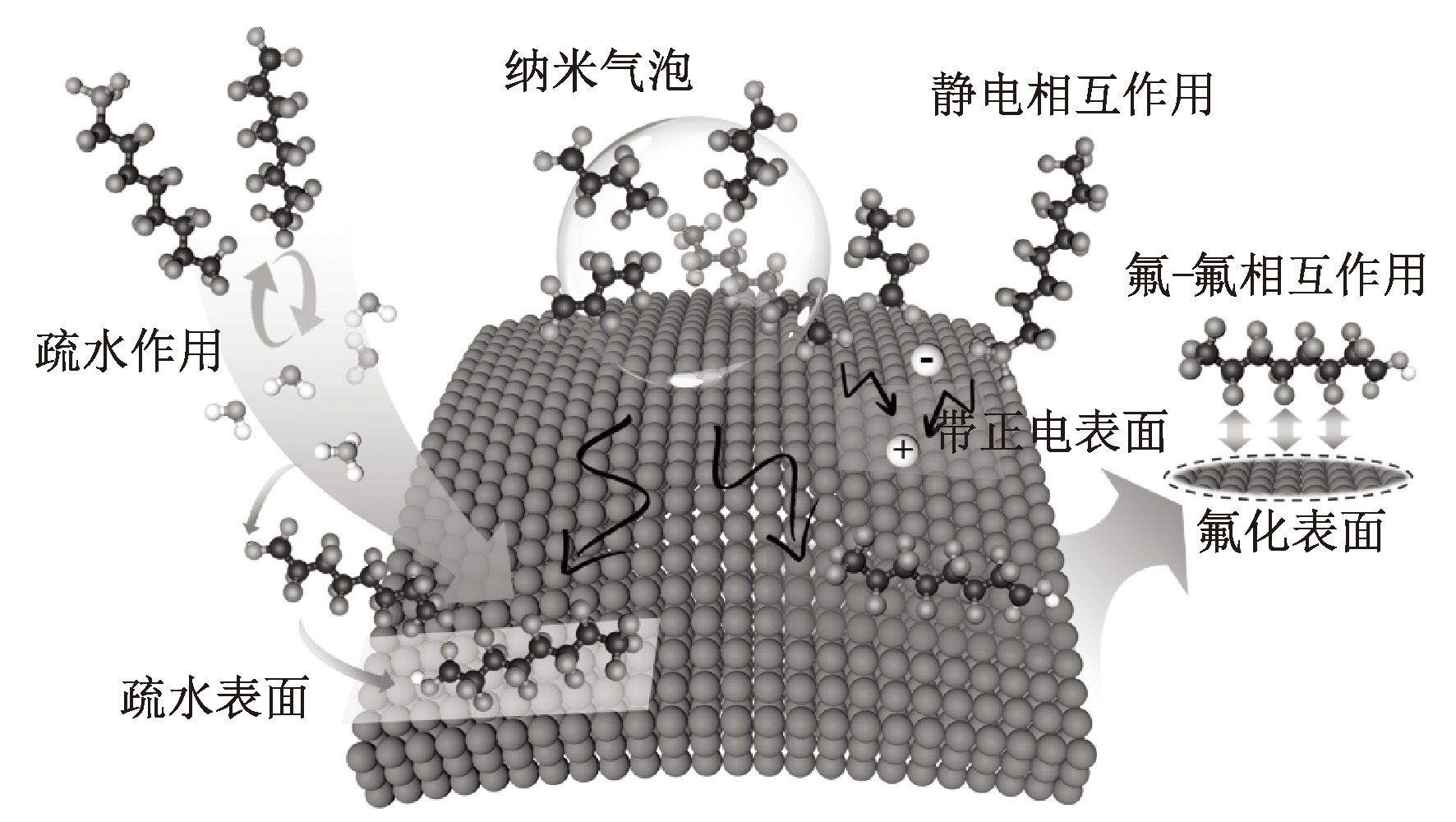
针对印染废水中全氟及多氟烷基物质(PFASs)毒性高、去除难等问题,系统解析了PFASs在印染废水中的赋存形态、浓度分布及迁移转化特征,综述了活性炭、离子交换树脂、金属有机框架、共价有机框架、氟化聚合物等典型吸附材料对PFASs的吸附特性及其应用局限性;重点剖析了疏水作用、静电作用和氟-氟相互作用等在PFASs吸附去除过程中的主导机制;系统考察了印染废水复杂水质条件(如pH值、共存无机盐、溶解性有机质等)对PFASs吸附去除的影响规律,提出了基于PFASs分子结构特征(如碳链长度、官能团类型)定向设计靶向吸附结构的创新策略,为推动高效高选择性吸附技术发展、实现印染废水中PFASs的深度去除提供理论支撑与技术指引。
中图分类号:
| [1] | COUSINS I T, DEWITT J C, GLÜGE J, et al. The high persistence of PFAS is sufficient for their management as a chemical class[J]. Environmental Science Processes & Impacts, 2020, 22(12): 2307-2312. |
| [2] |
LANGBERG H A, ARP H P H, BREEDVELD G D, et al. Paper product production identified as the main source of per- and poly-fluoroalkyl substances (PFAS) in a Norwegian lake: source and historic emission tracking[J]. Environmental Pollution, 2021, 273: 116259.
doi: 10.1016/j.envpol.2020.116259 |
| [3] | GLÜGE J, SCHERINGER M, COUSINS I T, et al. An overview of the uses of per- and poly-fluoroalkyl substances (PFAS)[J]. Environmental Science: Processes & Impacts, 2020, 22(12): 2345-2373. |
| [4] |
VU C T, WU T T. Recent progress in adsorptive removal of per- and poly-fluoroalkyl substances (PFAS) from water/wastewater[J]. Critical Reviews in Environmental Science and Technology, 2022, 52(1): 90-129.
doi: 10.1080/10643389.2020.1816125 |
| [5] | WOODWARD R. OECD reform[M]// The Organization for Economic Co-operation and Development (OECD). London: Routledge, 2022: 122-140. |
| [6] | TAJDINI B, VATANKHAH H, PEZOULAS E R, et al. Adsorbability of a wide range of per- and polyfluoroalkyl substances on granular activated carbon, ion exchange resin, and surface modified clay[J]. Water Research, 2025, 268(Pt B): 122774. |
| [7] |
魏宏远, 姚金波, 王红霞, 等. 全氟和多氟烷基物质对健康与环境的影响及其在纺织领域应用研究进展[J]. 纺织学报, 2024, 45(12): 243-252.
doi: 10.13475/j.fzxb.20240101102 |
|
WEI Hongyuan, YAO Jinbo, WANG Hongxia, et al. Influence of perfluoroalkyl and polyfluoroalkyl substances on human health and environment and research progress in field of textiles[J]. Journal of Textile Research, 2024, 45(12): 243-252.
doi: 10.13475/j.fzxb.20240101102 |
|
| [8] |
JIA Y Q, SHAN C, FU W Y, et al. Occurrences and fates of per- and poly-fluoralkyl substances in textile dyeing wastewater along full-scale treatment processes[J]. Water Research, 2023, 242: 120289.
doi: 10.1016/j.watres.2023.120289 |
| [9] |
NZERIBE B N, CRIMI M, MEDEDOVIC THAGARD S, et al. Physico-chemical processes for the treatment of per- and poly-fluoroalkyl substances (PFAS): a review[J]. Critical Reviews in Environmental Science and Technology, 2019, 49(10): 866-915.
doi: 10.1080/10643389.2018.1542916 |
| [10] |
APPLEMAN T D, HIGGINS C P, QUIÑONES O, et al. Treatment of poly- and perfluoroalkyl substances in U.S. full-scale water treatment systems[J]. Water Research, 2014, 51: 246-255.
doi: 10.1016/j.watres.2013.10.067 pmid: 24275109 |
| [11] |
ZHANG Z M, SARKAR D, BISWAS J K, et al. Biodegradation of per- and poly-fluoroalkyl substances (PFAS): a review[J]. Bioresource Technology, 2022, 344: 126223.
doi: 10.1016/j.biortech.2021.126223 |
| [12] |
PARK M, WU S M, LOPEZ I J, et al. Adsorption of perfluoroalkyl substances (PFAS) in groundwater by granular activated carbons: roles of hydrophobicity of PFAS and carbon characteristics[J]. Water Research, 2020, 170: 115364.
doi: 10.1016/j.watres.2019.115364 |
| [13] |
ZAGGIA A, CONTE L, FALLETTI L, et al. Use of strong anion exchange resins for the removal of perfluoroalkylated substances from contaminated drinking water in batch and continuous pilot plants[J]. Water Research, 2016, 91: 137-146.
doi: 10.1016/j.watres.2015.12.039 |
| [14] |
XIAO S, LIU T, HU L X, et al. Non-target and target screening and risk assessment of per- and poly-fluoroalkyl substances in textile wastewater and receiving river[J]. Science of the Total Environment, 2024, 927: 171876.
doi: 10.1016/j.scitotenv.2024.171876 |
| [15] |
SONG X W, VESTERGREN R, SHI Y L, et al. Emissions, transport, and fate of emerging per- and poly-fluoroalkyl substances from one of the major fluoropolymer manufacturing facilities in China[J]. Environmental Science & Technology, 2018, 52(17): 9694-9703.
doi: 10.1021/acs.est.7b06657 |
| [16] |
TANG B, PENG C, ZHOU D J, et al. Distribution, partitioning behaviors, and source identification of legacy and emerging per- and poly-fluorinated alkyl substances in the Pearl River Estuary, South China[J]. Water Research, 2025, 285: 124143.
doi: 10.1016/j.watres.2025.124143 |
| [17] |
WANG N, LIU J X, BUCK R C, et al. 6∶2 Fluorotelomer sulfonate aerobic biotransformation in activated sludge of waste water treatment plants[J]. Chemosphere, 2011, 82(6): 853-858.
doi: 10.1016/j.chemosphere.2010.11.003 |
| [18] | 李向楠, 王凌波, 包海花, 等. 全氟化合物在城镇污水处理厂及其受纳水体的赋存特征[J]. 环境工程学报, 2025, 19(11): 2768-2778. |
| LI Xiangnan, WANG Lingbo, BAO Haihua, et al. Occurrence characteristics of per- and poly-fluoroalkyl substances(PFASs)in municipal wastewater treatment plants and their receiving waters in a northern city[J]. Chinese Journal of Environmental Engineering, 2025, 19(11): 2768-2778. | |
| [19] |
HANSEN M C, BØRRESEN M H, SCHLABACH M, et al. Sorption of perfluorinated compounds from contaminated water to activated carbon[J]. Journal of Soils and Sediments, 2010, 10(2): 179-185.
doi: 10.1007/s11368-009-0172-z |
| [20] |
MCCLEAF P, ENGLUND S, ÖSTLUND A, et al. Removal efficiency of multiple poly- and per-fluoroalkyl substances (PFASs) in drinking water using granular activated carbon (GAC) and anion exchange (AE) column tests[J]. Water Research, 2017, 120: 77-87.
doi: 10.1016/j.watres.2017.04.057 |
| [21] | HASSAN M, LIU Y J, NAIDU R, et al. Adsorption of perfluorooctane sulfonate (PFOS) onto metal oxides modified biochar[J]. Environmental Technology & Innovation, 2020, 19: 100816. |
| [22] |
LIU Z Z, PAN C G, PENG F J, et al. Rapid adsorptive removal of emerging and legacy per- and poly-fluoroalkyl substances (PFASs) from water using zinc chloride-modified litchi seed-derived biochar[J]. Bioresource Technology, 2024, 408: 131157.
doi: 10.1016/j.biortech.2024.131157 |
| [23] |
HUANG X, HUANG J H, WANG K Y, et al. Comparison of perfluoroalkyl substance adsorption performance by inorganic and organic silicon modified activated carbon[J]. Water Research, 2024, 260: 121919.
doi: 10.1016/j.watres.2024.121919 |
| [24] |
GAGLIANO E, SGROI M, FALCIGLIA P P, et al. Removal of poly- and per-fluoroalkyl substances (PFAS) from water by adsorption: role of PFAS chain length, effect of organic matter and challenges in adsorbent regeneration[J]. Water Research, 2020, 171: 115381.
doi: 10.1016/j.watres.2019.115381 |
| [25] |
DIXIT F, DUTTA R, BARBEAU B, et al. PFAS removal by ion exchange resins: a review[J]. Chemosphere, 2021, 272: 129777.
doi: 10.1016/j.chemosphere.2021.129777 |
| [26] |
HUANG J J, FU K X, FANG Z Y, et al. Enhanced selective removal of PFAS at trace level using quaternized cellulose-functionalized polymer resin: performance and mechanism[J]. Water Research, 2025, 272: 122937.
doi: 10.1016/j.watres.2024.122937 |
| [27] |
ELLIS A C, BOYER T H, STRATHMANN T J. Regeneration of conventional and emerging PFAS-selective anion exchange resins used to treat PFAS-contaminated waters[J]. Separation and Purification Technology, 2025, 355: 129789.
doi: 10.1016/j.seppur.2024.129789 |
| [28] |
KIM H H, KOSTER VAN GROOS P G, ZHAO Y W, et al. Removal of PFAS by hydrotalcite: adsorption mechanisms, effect of adsorbent aging, and thermal regeneration[J]. Water Research, 2024, 260: 121925.
doi: 10.1016/j.watres.2024.121925 |
| [29] |
SUN Y X, QUAN K J, HE J, et al. Regulation and synthesis of metal-organic frameworks through mixed-ligand strategy: a pathway to enhance adsorption of perfluoroalkyl acids[J]. Chemical Engineering Journal, 2024, 495: 153621.
doi: 10.1016/j.cej.2024.153621 |
| [30] | 易皓, 余仪, 柳泽伟, 等. Ni-MOFs对水中全氟烷基醚磺酸盐的吸附性能及机理[J]. 环境工程学报, 2023, 17(9): 2861-2871. |
| YI Hao, YU Yi, LIU Zewei, et al. Adsorption performance and mechanisms of Ni-MOFs towards chlorinated polyfluoroalkyl ether sulfonic acid in aqueous phase[J]. Chinese Journal of Environmental Engineering, 2023, 17(9): 2861-2871. | |
| [31] |
JERY A E, PECHO R D C, TANIA CHURAMPI ARELLANO M, et al. Transforming waste into value: eco-friendly synthesis of MOFs for sustainable PFOA remediation[J]. Sustainability, 2023, 15(13): 10617.
doi: 10.3390/su151310617 |
| [32] |
PALA J, LE T, KASULA M, et al. Systematic investigation of PFOS adsorption from water by metal organic frameworks, activated carbon, metal organic framework@activated carbon, and functionalized metal organic frameworks[J]. Separation and Purification Technology, 2023, 309: 123025.
doi: 10.1016/j.seppur.2022.123025 |
| [33] |
WANG W, ZHOU S X, JIANG X Z, et al. Fluorinated quaternary ammonium covalent organic frameworks for selective and efficient removal of typical per- and poly-fluoroalkyl substances[J]. Chemical Engineering Journal, 2023, 474: 145629.
doi: 10.1016/j.cej.2023.145629 |
| [34] |
HUANG J L, SHI Y R, HUANG G Z, et al. Facile synthesis of a fluorinated-squaramide covalent organic framework for the highly efficient and broad-spectrum removal of per- and poly-fluoroalkyl pollutants[J]. Angewandte Chemie (International Ed in English), 2022, 61(31): e202206749.
doi: 10.1002/anie.v61.31 |
| [35] |
WANG W, JIA Y, ZHOU S X, et al. Removal of typical PFAS from water by covalent organic frameworks with different pore sizes[J]. Journal of Hazardous Materials, 2023, 460: 132522.
doi: 10.1016/j.jhazmat.2023.132522 |
| [36] |
HUANG J L, SHI Y R, XU J Q, et al. Hollow covalent organic framework with ″shell-confined″ environment for the effective removal of anionic per- and poly-fluoroalkyl substances[J]. Advanced Functional Materials, 2022, 32(39): 2203171.
doi: 10.1002/adfm.v32.39 |
| [37] |
YANG Z J, ZHU Y T, TAN X, et al. Fluoropolymer sorbent for efficient and selective capturing of per- and poly-fluorinated compounds[J]. Nature Communications, 2024, 15: 8269.
doi: 10.1038/s41467-024-52690-y |
| [38] |
TAN X, DEWAPRIYA P, PRASAD P, et al. Efficient removal of perfluorinated chemicals from contaminated water sources using magnetic fluorinated polymer sorbents[J]. Angewandte Chemie International Edition, 2022, 61(49): e202213071.
doi: 10.1002/anie.v61.49 |
| [39] |
CHANG P H, JIANG W T, LI Z H. Removal of perfluorooctanoic acid from water using calcined hydrotalcite: a mechanistic study[J]. Journal of Hazardous Materials, 2019, 368: 487-495.
doi: 10.1016/j.jhazmat.2019.01.084 |
| [40] |
ZHANG M R, YAZAYDIN A O. The effect of perfluoroalkyl chain length and the type of acid group on PFAS adsorption from water[J]. Chemical Engineering Journal, 2024, 499: 155851.
doi: 10.1016/j.cej.2024.155851 |
| [41] |
XIAO F, CHEN Z, WEI Z X, et al. Hydrophobic interaction: a promising driving force for the biomedical applications of nucleic acids[J]. Advanced Science, 2020, 7(16): 2001048.
doi: 10.1002/advs.v7.16 |
| [42] |
WILLEMSEN J A R, BOURG I C. Molecular dynamics simulation of the adsorption of per- and poly-fluoroalkyl substances (PFASs) on smectite clay[J]. Journal of Colloid and Interface Science, 2021, 585: 337-346.
doi: 10.1016/j.jcis.2020.11.071 |
| [43] |
GOSS K U. The pKa values of PFOA and other highly fluorinated carboxylic acids[J]. Environmental Science & Technology, 2008, 42(2): 456-458.
doi: 10.1021/es702192c |
| [44] |
GAO Y X, DENG S B, DU Z W, et al. Adsorptive removal of emerging polyfluoroalky substances F-53B and PFOS by anion-exchange resin: a comparative study[J]. Journal of Hazardous Materials, 2017, 323: 550-557.
doi: S0304-3894(16)30410-1 pmid: 27184593 |
| [45] |
DU Z W, DENG S B, BEI Y, et al. Adsorption behavior and mechanism of perfluorinated compounds on various adsorbents: a review[J]. Journal of Hazardous Materials, 2014, 274: 443-454.
doi: 10.1016/j.jhazmat.2014.04.038 |
| [46] | 黄鑫, 石宝友. 活性炭吸附去除氟表面活性剂的研究进展[J]. 环境科学学报, 2023, 43(12): 169-177. |
| HUANG Xin, SHI Baoyou. Removal of fluorinated surfactants by activated carbon: a review[J]. Acta Scientiae Circumstantiae, 2023, 43(12): 169-177. | |
| [47] |
TAN X, SAWCZYK M, CHANG Y X, et al. Revealing the molecular-level interactions between cationic fluorinated polymer sorbents and the major PFAS pollutant PFOA[J]. Macromolecules, 2022, 55(3): 1077-1087.
doi: 10.1021/acs.macromol.1c02435 |
| [48] | FU K X, HUANG J J, LUO F, et al. Understanding the selective removal of perfluoroalkyl and polyfluoroalkyl substances via fluorine-fluorine interactions: a critical review[J]. Environmental Science & Technology, 2024, 58(38): 16669-16689. |
| [49] |
ZHANG Z X, CHEN K X, AMEDURI B, et al. Fluoropolymer nanoparticles synthesized via reversible-deactivation radical polymerizations and their applications[J]. Chemical Reviews, 2023, 123(22): 12431-12470.
doi: 10.1021/acs.chemrev.3c00350 |
| [50] |
HIGGINS C P, LUTHY R G. Sorption of perfluorinated surfactants on sediments[J]. Environmental Science & Technology, 2006, 40(23): 7251-7256.
doi: 10.1021/es061000n |
| [51] |
XIAO X, ULRICH B A, CHEN B L, et al. Sorption of poly- and per-fluoroalkyl substances (PFASs) relevant to aqueous film-forming foam (AFFF)-impacted groundwater by biochars and activated carbon[J]. Environmental Science & Technology, 2017, 51(11): 6342-6351.
doi: 10.1021/acs.est.7b00970 |
| [52] |
WANG F, SHIH K. Adsorption of perfluoro-octanesulfonate (PFOS) and perfluorooctanoate (PFOA) on alumina: influence of solution pH and cations[J]. Water Research, 2011, 45(9): 2925-2930.
doi: 10.1016/j.watres.2011.03.007 |
| [53] |
LEUNG S C E, WANNINAYAKE D, CHEN D C, et al. Physicochemical properties and interactions of perfluoroalkyl substances (PFAS): challenges and opportunities in sensing and remediation[J]. Science of the Total Environment, 2023, 905: 166764.
doi: 10.1016/j.scitotenv.2023.166764 |
| [54] |
WU C Y, KLEMES M J, TRANG B, et al. Exploring the factors that influence the adsorption of anionic PFAS on conventional and emerging adsorbents in aquatic matrices[J]. Water Research, 2020, 182: 115950.
doi: 10.1016/j.watres.2020.115950 |
| [55] |
LIU L F, LI D Y, LI C L, et al. Metal nanoparticles by doping carbon nanotubes improved the sorption of perfluorooctanoic acid[J]. Journal of Hazardous Materials, 2018, 351: 206-214.
doi: S0304-3894(18)30145-6 pmid: 29550554 |
| [56] |
LEI X B, YAO L G, LIAN Q Y, et al. Enhanced adsorption of perfluorooctanoate (PFOA) onto low oxygen content ordered mesoporous carbon (OMC): adsorption behaviors and mechanisms[J]. Journal of Hazardous Materials, 2022, 421: 126810.
doi: 10.1016/j.jhazmat.2021.126810 |
| [57] |
WILLIAMS C F, AGASSI M, LETEY J, et al. Facilitated transport of napropamide by dissolved organic matter through soil columns[J]. Soil Science Society of America Journal, 2000, 64(2): 590-594.
doi: 10.2136/sssaj2000.642590x |
| [58] |
ESCHAUZIER C, BEERENDONK E, SCHOLTE-VEENENDAAL P, et al. Impact of treatment processes on the removal of perfluoroalkyl acids from the drinking water production chain[J]. Environmental Science & Technology, 2012, 46(3): 1708-1715.
doi: 10.1021/es201662b |
| [59] |
XIA X H, DAI Z N, RABEARISOA A H, et al. Comparing humic substance and protein compound effects on the bioaccumulation of perfluoroalkyl substances by Daphnia Magna in water[J]. Chemosphere, 2015, 119: 978-986.
doi: S0045-6535(14)01101-1 pmid: 25303657 |
| [1] | 郭正, 张贺凯, 宋云飞, 朱怡雷, 李佳颍, 郑佳悦, 王明环. 聚苯乙烯/ZIF-67纳米纤维的制备及其高级氧化降解应用[J]. 纺织学报, 2026, 47(04): 52-60. |
| [2] | 岳献阳, 王少博, 黄鑫, 王艳芝, 李冲冲, 张晓晓. 黄麻织物基磁性含氮多孔碳对Cr(VI)的吸附性能[J]. 纺织学报, 2026, 47(02): 255-263. |
| [3] | 凌磊, 陈凯, 高俊, 武丁胜, 汪邓兵, 张春, 凤权. 聚丙烯腈/共价有机框架复合纳米纤维膜的制备及其对Cr(Ⅵ)的吸附性能[J]. 纺织学报, 2026, 47(01): 54-62. |
| [4] | 刘劲扬, 李成才, 朱海霖, 郭玉海, 姜学梁. 非对称结构聚四氟乙烯中空管式纤维膜的制备及油水分离性能[J]. 纺织学报, 2025, 46(12): 11-18. |
| [5] | 谢围围, 朱庆鹏, 宋娇娇, 陈志明. 磁性固定化漆酶的制备及其对染料的高效降解[J]. 纺织学报, 2025, 46(12): 163-170. |
| [6] | 季巧, 于清源, 周爱晖, 马博谋, 徐进, 袁久刚. 细菌纤维素及其复合材料的应用研究进展[J]. 纺织学报, 2025, 46(12): 243-250. |
| [7] | 高俊, 凌磊, 陈缘, 武丁胜, 林韩蕾, 李振宇, 凤权. 氨基功能化聚丙烯腈纳米纤维膜的制备及其对Cr(Ⅵ)的吸附性能[J]. 纺织学报, 2025, 46(12): 57-65. |
| [8] | 刘东方, 任李培, 徐卫林, 肖杏芳. 灯心草负载活性炭材料的制备及其对染料吸附性能[J]. 纺织学报, 2025, 46(10): 159-166. |
| [9] | 王泓力, 张辉, 刘建宇, 尉海泽, 张雅宁, 王丽丽, 许学潮. 棉基生物炭-ZIF-L(Zn)-壳聚糖/聚丙烯复合膜的制备及其吸附-光催化性能[J]. 纺织学报, 2025, 46(09): 84-93. |
| [10] | 左卓帆, 卢凯亮, 李倩雯, 张维. 基于铝镁合金阳极的靛蓝染色废水电絮凝处理效能优化[J]. 纺织学报, 2025, 46(09): 197-204. |
| [11] | 项文龙, 杨静冉, 肖晓珍. 铁钴双金属有机框架/稻谷壳复合材料的制备及其染料脱色性能[J]. 纺织学报, 2025, 46(06): 178-186. |
| [12] | 邱月, 杨询, 李昊, 李海东, 吴国忠, 张彩丹. 聚琥珀酰亚胺纳米纤维膜改性及其染料吸附性能[J]. 纺织学报, 2025, 46(06): 88-95. |
| [13] | 王薇, 高建南, 裴笑涵, 陆鑫, 孙银银, 吴建兵. 纤维素/甲基三甲氧基硅烷气凝胶的制备及其油水分离效能[J]. 纺织学报, 2025, 46(05): 135-142. |
| [14] | 金汝诗, 陈万明, 刘国金, 刘承海, 戚栋明, 翟世民. 生物炭在印染废水处理中的应用研究进展[J]. 纺织学报, 2025, 46(04): 235-243. |
| [15] | 李逢春, 孙辉, 于斌, 谢有秀, 张德伟. 共价有机框架材料/粘胶水刺非织造布的制备及其染料吸附性能[J]. 纺织学报, 2025, 46(02): 170-179. |
|
||
 京公网安备11010502044800号