纺织学报 ›› 2026, Vol. 47 ›› Issue (07): 219-227.doi: 10.13475/j.fzxb.20251201301

• 服装工程 • 上一篇    下一篇

基于二维人体图像的服装尺寸提取方法

谢雅丽1, 李小辉1,2()   

  1. 1 东华大学 服装与艺术设计学院, 上海 200051
    2 东华大学现代服装设计与技术教育部重点实验室, 上海 200051
  • 收稿日期:2025-12-04 修回日期:2026-05-14 出版日期:2026-07-15 发布日期:2026-07-29
  • 通讯作者: 李小辉(1982—),男,副教授。主要研究方向为数字化服装结构设计。E-mail:lxh@dhu.edu.cn
  • 作者简介:谢雅丽(2002—),女,硕士生。主要研究方向为服装数字化。

Clothing size extraction based on two-dimensional human body images

XIE Yali1, LI Xiaohui1,2()   

  1. 1 College of Fashion and Art Design, Donghua University, Shanghai 200051, China
    2 Key Laboratory of Clothing Design and Technology, Ministry of Education, Donghua University, Shanghai 200051, China
  • Received:2025-12-04 Revised:2026-05-14 Published:2026-07-15 Online:2026-07-29

摘要:

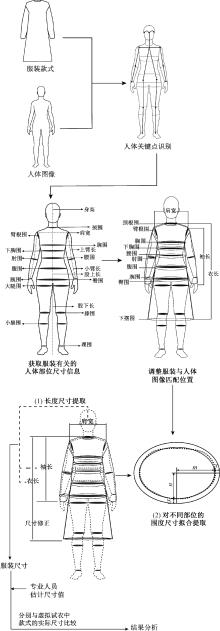
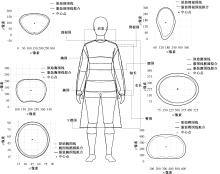
针对服装生产中人工提取尺寸效率偏低、三维扫描成本较高的问题,提出一种基于二维人体图像的服装规格尺寸提取方法。以二维人体图像为基准,选取19个人体关键尺寸参数,构建包含曲率修正、视角修正及松量动态分配的多因子修正模型,并采用差异化拟合策略,实现服装细节尺寸的量化。选取宽松长裙、卫衣、短袖衫、直筒裙、A字裙、衬衫裙6类代表性日常服装款式,将本文方法提取结果与人工估值及真实值进行对比。结果显示,本文方法的平均百分误差为3.02%,平均相对误差为2.23 cm,均低于人工估值的8.78%和6.28 cm,其中,衣长、袖长等线性尺寸误差小于1 cm,结构规整的服装围度误差均在3%以内。本文方法在较低成本下提供了可靠的尺寸提取方案,可为服装行业数字化转型提供实用化参考方案。

关键词: 服装尺寸提取, 尺寸量化, 参数化模型, 拟合优化, 误差修正

Abstract:

Objective An intelligent method is proposed for extracting clothing specification dimensions from two-dimensional (2-D) human body images, aiming to provide efficient and low-cost technical support for the intelligent production of apparel.

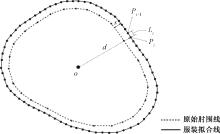
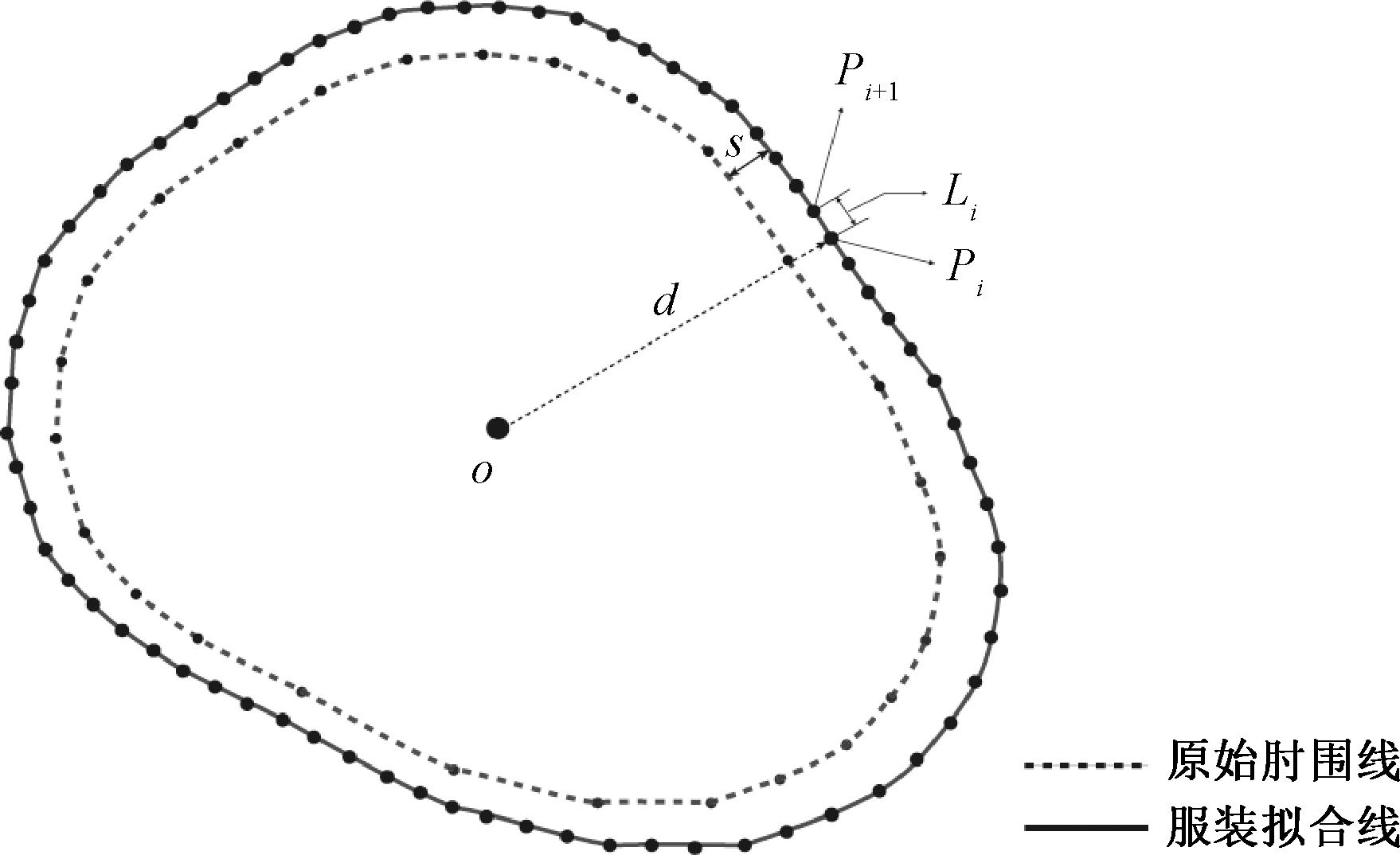
Method The proposed method uses 2D body images as input, and selects 19 key anthropometric parameters as the foundational data. In order to address the complexities of clothing sizing arising from human body curvature, imaging perspective, fabric properties, and style variations, a comprehensive multi-factor correction model is developed. This model systematically integrates three core correction mechanisms, which are the curvature compensation for converting chord lengths to chord lengths along body contours, perspective adjustment for compensating dimensional distortions caused by camera angles, and dynamic ease allocation that considers both garment style and specific body regions. Furthermore, a differentiated fitting strategy is employed to accurately quantify clothing dimensions across various body sections. For body areas with relatively uniform cross-sections, such as the waist and certain parts of the limbs, an elliptical fitting method is utilized. This approach models the body section as an ellipse, and the clothing dimension is derived by uniformly adding the design ease to its semi-major and semi-minor axes before calculating the adjusted perimeter. For irregular or non-uniform body sections, such as the armhole, chest, and hip areas, a feature-adaptive fitting method based on radial expansion is adopted.

Results This technique extends the original body contour points outward along radial vectors from a central point, with the extension magnitude modulated by a dynamic coefficient to allow for non-uniform ease distribution, thereby more accurately capturing the clothing's shape around complex anatomies. The experimental validation involved selecting representative daily clothing styles. The study focused on key measurement areas pertinent to each garment type: bust, waist, shoulder width, sleeve length, and garment length for tops; waist, hip, and length for bottoms; and a combination of these for dresses. In order to rigorously evaluate the method's performance, its results were compared against both physical measurements (treated as ground truth) and estimates made by ten experienced industry professionals (pattern makers, buyers, retail consultants) using a triple-blind assessment protocol. The primary metrics for comparison were the mean absolute percentage error (MAPE) and the mean relative error (MRE).Results demonstrated a significant enhancement in estimation accuracy compared to manual methods. The proposed method achieved an overall MAPE of 3.02% and an MRE of 2.23 cm across all tested clothing and measured dimensions. In contrast, the manual estimation by experts yielded a notably higher MAPE of 8.78% and an MRE of 6.28 cm. A detailed analysis revealed that the method performs exceptionally well for garments with regular, structured silhouettes, where errors for linear dimensions like garment length and sleeve length were often below 1 cm (approximately 1% error). Accuracy remained high for symmetrical lower-body garments in dimensions like hip circumference and inseam length. However, as anticipated, larger errors were observed for circumference measurements (e.g., waist, underbust) in loose-fitting garments like sweatshirts and relaxed dresses, primarily due to fabric drape, folds, and blurred contours in the 2-D images.

Conclusion A novel, image-based framework is prosposed for intelligent clothing size extraction that effectively marries the convenience of 2-D image processing with the incorporation of 3-D body morphological information through parametric modeling and correction factors. It successfully mitigates the subjectivity, inefficiency, and higher error rates inherent in manual estimation while avoiding the high cost, operational complexity, and computational demands associated with mainstream 3-D scanning solutions. The proposed method offers a practical, cost-effective tool for applications such as automated pattern making, personalized size recommendation, and smart manufacturing workflows, thereby contributing to enhanced precision, efficiency, and digital transformation within the apparel industry. Future work will involve expanding the clothing style dataset for training and integrating the framework with advanced deep learning models to further generalize and optimize its performance.

Key words: clothing dimension extraction, size quantification, parametric modeling, region-adaptive fitting, error-correction framework

中图分类号: 

  • TS941.19

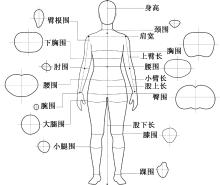
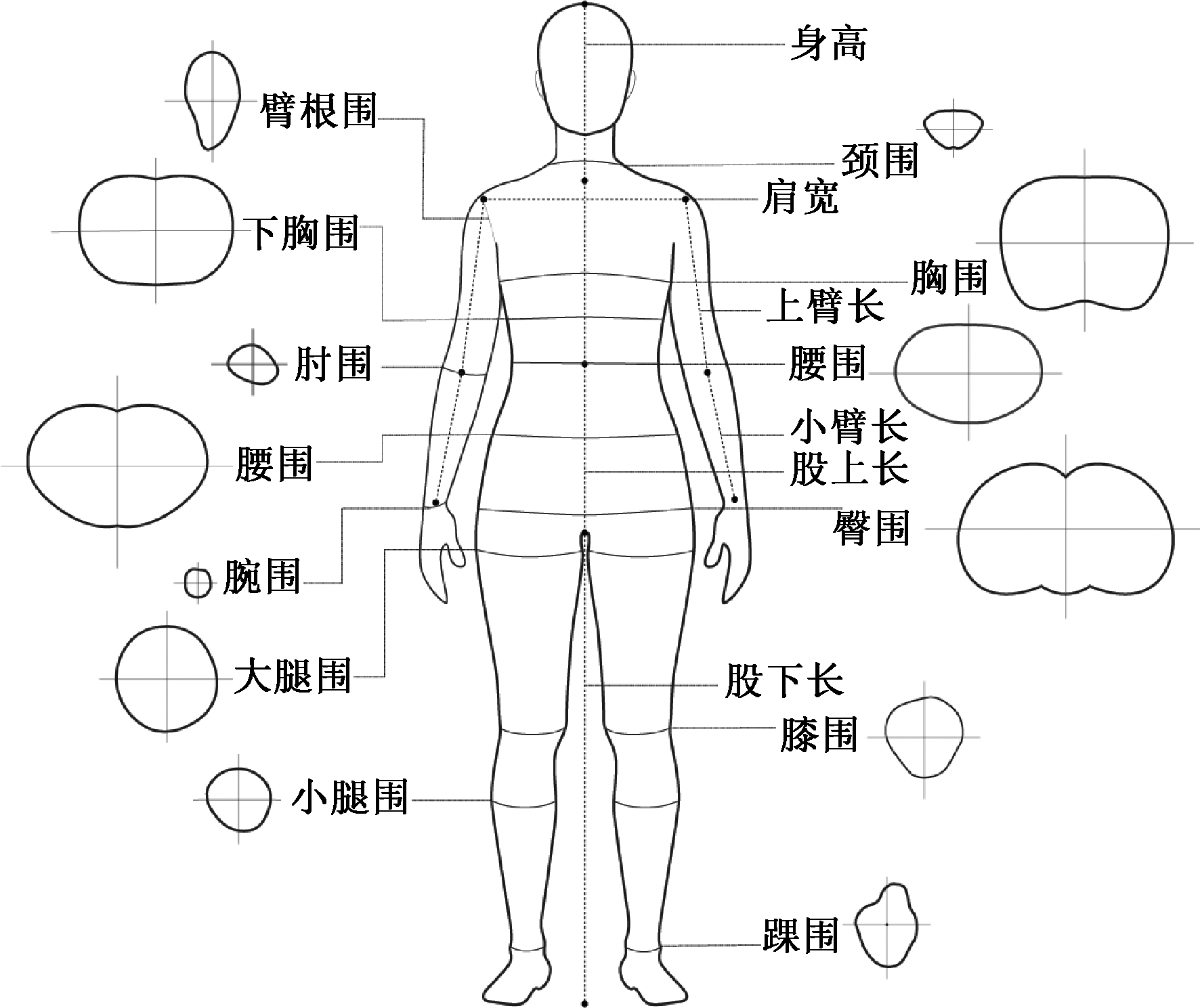
图1

人体尺寸参数图"

表1

多因子修正系数表"

参数 名称 含义
Tc 曲率修正系数 弧长/弦长比值,用于水平测量中曲线补偿,围度测量中设为1
Tv 视角修正系数 视角系数,反映拍摄角度对松量的影响
Ta 拟合修正系数 拟合结果与观测松量之间的误差补偿
Tf 面料修正系数 表征面料弹性、厚度等物理属性对尺寸的影响
Ts 款式修正系数 表征不同服装结构设计所造成的整体尺寸偏移

表2

人体各部位弦长弦高信息"

部位 前弦高/cm 后弦高/cm
肩部 0.00 0.45
腰围 8.85 7.87
下胸围 7.57 9.48
臀围 8.89 12.86
腹围 12.41 10.11
大腿围 8.95 9.29
膝围 5.82 5.23
小腿围 5.44 5.00
踝围 4.03 3.45
颈根围 4.00 4.83

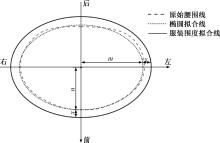
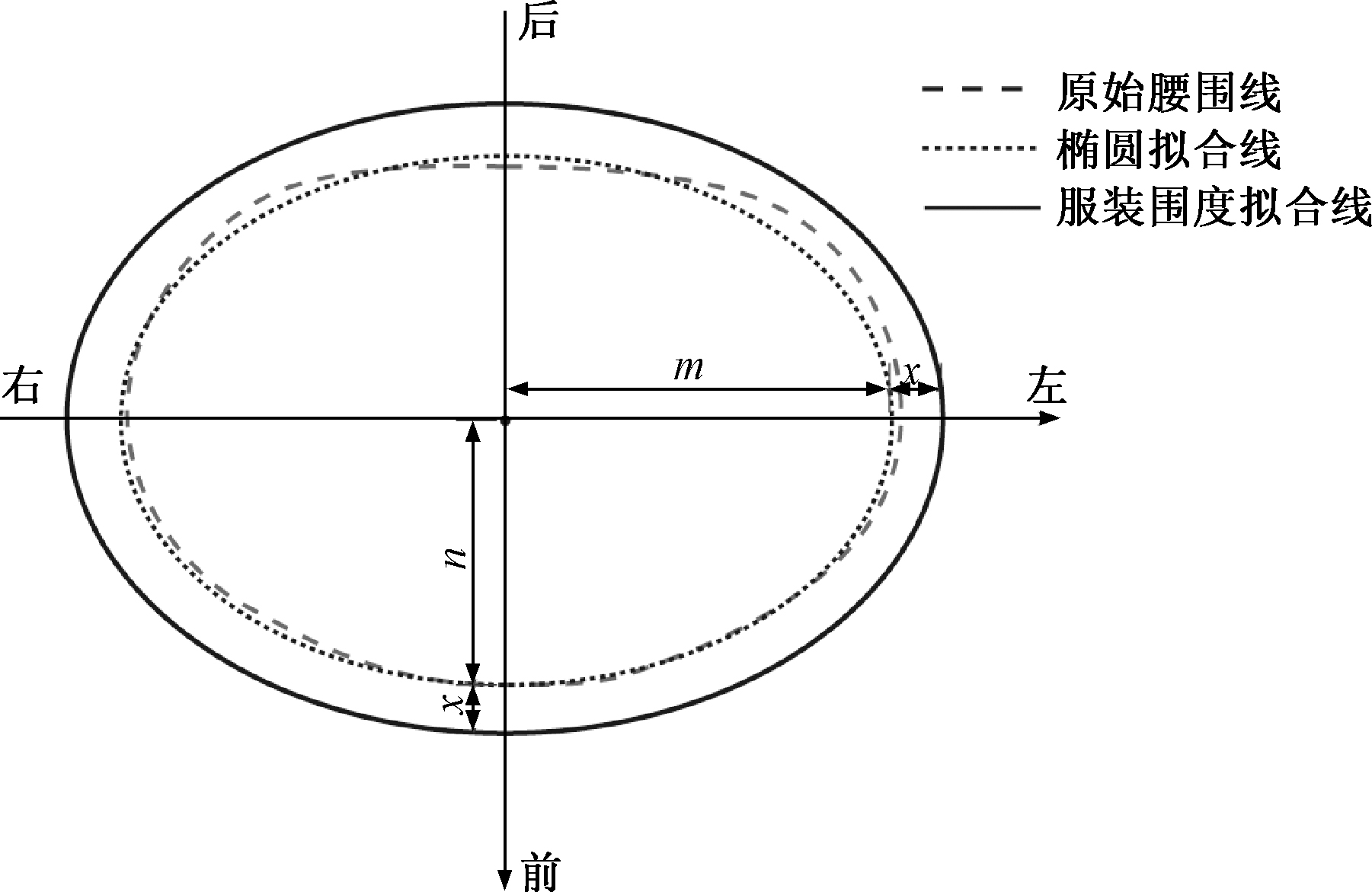
图2

椭圆拟合"

图3

特征拟合"

图4

服装尺寸提取流程"

图5

款式a关键尺寸拟合结果"

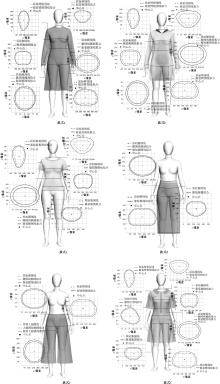
图6

6种服装款式尺寸拟合结果"

表3

款式a尺寸提取"

名称 本方法
提取值/cm
人工估计值/
cm
真实值/
cm
本文方法
MAPE/%
本文方法
MRE/cm
人工估值MAPE/
%
人工估值MRE/
cm
衣长 94.49 104.48 94.74 0.26 0.25 10.28 9.74
袖长 55.92 52.42 56.86 1.65 0.94 7.81 4.44
肩宽 33.37 36.82 33.48 0.33 0.11 9.98 3.34
颈根围 37.90 38.16 36.47 3.92 1.43 4.63 1.69
胸围 86.39 103.50 91.28 5.36 4.89 13.39 12.22
腰围 87.35 97.28 91.89 4.94 4.54 5.87 5.39
臀围 98.92 117.88 98.44 0.49 0.48 19.75 19.44
摆围 115.25 130.72 109.89 4.88 5.36 18.96 20.83
臂根围 53.56 54.98 51.86 3.28 1.70 6.02 3.12
腕围 27.24 28.62 26.76 1.79 0.48 6.95 1.86
误差均值 2.69 2.27 10.36 8.21

表4

各试样款式实验结果"

款式 本文方法
MAPE/%
本文方法
MRE/cm
人工估值
MAPE/%
人工估值
MRE/cm
a 2.69 2.27 10.36 8.21
b 2.61 1.65 8.96 5.33
c 2.99 1.91 8.10 4.94
d 4.55 3.47 10.24 7.65
e 2.96 2.48 8.67 7.27
f 1.73 1.40 5.00 3.99
误差均值 3.02 2.23 8.78 6.28
[1] 杨秀月, 马妮妮, 周双喜. 服装用人体测量的尺寸定义与方法研究[J]. 纺织检测与标准, 2019, 5(5): 32-36.
YANG Xiuyue, MA Nini, ZHOU Shuangxi. Study on the definition and method of clothing anthropometric measurement[J]. Textile Testing and Standard, 2019, 5(5): 32-36.
[2] WANG C C L, WANG Y, YUEN M M F. Feature based 3D garment design through 2D sketches[J]. Computer-Aided Design, 2003, 35(7): 659-672.
doi: 10.1016/S0010-4485(02)00091-X
[3] PAULAUSKAITE-TARASEVICIENE A, NOREIKA E, PURTOKAS R, et al. An intelligent solution for automatic garment measurement using image recognition technologies[J]. Applied Sciences, 2022, 12(9): 4470.
doi: 10.3390/app12094470
[4] CAO L, JIANG Y, JIANG M. Automatic measurement of garment dimensions using machine vision[C]// 2010 International Conference on Computer Application and System Modeling (ICCASM 2010). Taiyuan, China: IEEE, 2010: 30-33.
[5] 林嘉琪, 邓咏梅. 基于改进Canny算法的契丹男子袍服形制提取与复原[J/OL]. 服装学报,1-11[2026-05-15].https://doi.org/10.20205/j.cnki.2096-1928.20250318.001.
LIN Jiaqi, DENG Yongmei. Extraction and restoration of khitan men's robe shape based on improved canny algorithm[J/OL]. Journal of Clothing Research, 1-11[2026-05-15].https://doi.org/10.20205/j.cnki.2096-1928.20250318.001.
[6] Ge L, Xiaohui L. A vision-based approach to mapping flexible objects for garment development[J]. Textile Research Journal, 2023, 93(11-12):2833-2848.DOI:10.1177/00405175221149212.
[7] 李梦, 陈敏之. 基于YOLOv8的女裤结构特征识别方法[J]. 浙江理工大学学报(自然科学), 2025, 50(4): 507-514.
LI Meng, CHEN Minzhi. A structural feature recognition method of women's pants based on YOLOv8[J]. Journal of Zhejiang Sci-Tech University (Natural Sciences), 2025, 50(4): 507-514.
[8] 王永垒, 刘建军, 蔡春明. 数字化技术在成衣立体裁剪中的应用[J]. 染整技术, 2025, 47(4): 92-95.
WANG Yonglei, LIU Jianjun, CAI Chunming. Application of digital technology in garment draping[J]. Textile Dyeing and Finishing Journal, 2025, 47(4): 92-95.
[9] 雷鸽, 李小辉. 数字化服装结构设计技术的研究进展[J]. 纺织学报, 2022, 43(4): 203-209.
LEI Ge, LI Xiaohui. Review of digital pattern-making technology in garment production[J]. Journal of Textile Research, 2022, 43(4): 203-209.
[10] KIM S, MOON H, OH J, et al. Automatic measurements of garment sizes using computer vision deep learning models and point cloud data[J]. Applied Sciences, 2022, 12(10): 5286.
doi: 10.3390/app12105286
[11] QI S, XIN X, QIN G, et al. Advancements in three-dimensional body scanning technology for apparel applications[C]//Zhejiang Sci-Tech University,Textile Bioengineering and Informatics Society,The University of Manchester,State Key Laboratory of Bio-based Fiber Materials,Zhejiang Provincial lnnovation Center of Advanced Textile Techonology.Textile Bioengineering and Informatics Symposium Proceedings 2025.Xinjiang University, 2025:872-880.
[12] 洪岩, 袁琳, 李梦雪, 等. 产品生命周期视域下人工智能技术在服装产业中的应用进展[J]. 丝绸, 2024, 61(12):1-22.
HONG Yan, YUAN Lin, LI Mengxue, et al. Progress in the application of artificial intelligence technology in the garment industry from the perspective of product life cycle[J]. Journal of Silk, 2024, 61(12):1-22.
[13] TEYEME Y, MALENGIER B, TESFAYE T, et al. A review of contemporary techniques for measuring ergonomic wear comfort of protective and sport clothing[J]. Autex Research Journal, 2021, 21(1): 32-44.
doi: 10.2478/aut-2019-0076
[14] 夏明, 张理想, 许霄. 扫描人体外包围计算与上衣原型应用分析[J]. 丝绸, 2023, 60(1): 78-87.
XIA Ming, ZHANG Lixiang, XU Xiao. Scanning human body outer circumference calculation and upper prototype application analysis[J]. Journal of Silk, 2023, 60(1): 78-87.
[15] MUSONI P, MELZI S, CASTELLANI U. Capturing and modeling real cloth deformations for virtual garment design[C]// European Conference on Computer Vision.Springer, Cham:springer, 2025.DOI:10.1007/978-3-031-91569-7_20.
[16] 何源, 金立. 基于解析的数字人纹理生成[C]// 第44届中国控制会议论文集. 广州: 中国自动化学会, 2025: 574-579.
HE Yuan, JIN Li. Texture generation for digital humans based on parsing[C]// Proceedings of the 44th Chinese Control Conference. Guangzhou: Chinese Association of Automation, 2025: 574-579.
[17] 肖君睿. 基于虚拟试衣的合体裤穿着活动舒适性评价[D]. 上海: 东华大学, 2022:31-33.
XIAO Junrui. Evalution of the comfort of ability of fitted pants based on virtual fitting[D]. Shanghai: Donghua University, 2022:31-33.
[18] 赵子萌. 交互数字手的重建方法研究[D]. 南京: 东南大学,2024:25-28.
ZHAO Zimeng. Research on Reconstruction Methods of Interactive Digital Hands[D]. Nanjing: Southeast University, 2024: 25-28.
[19] 雷亮, 陈毅, 刘学涵, 等. 基于改进YOLOv8n-Pose的人体关键点检测算法[J]. 重庆科技大学学报(自然科学版), 2025, 27(1): 83-89.
LEI Liang, CHEN Yi, LIU Xuehan, et al. Human key point detection algorithm based on improved YOLOv8n-Pose[J]. Journal of Chongqing University of Science and Technology (Natural Science Edition), 2025, 27(1): 83-89.
[20] 鲍陈, 缪永伟, 孙瑜亮, 等. 基于散乱点云的三维人体自动测量[J]. 纺织学报, 2019, 40(1): 120-129.
BAO Chen, MIAO Yongwei, SUN Yuliang, et al. Automatic measurement of three-dimensional human body based on scattered point cloud[J]. Journal of Textile Research, 2019, 40(1): 120-129.
[1] 娄少红. 基于AutoCAD参数化功能的A型裙样板自动化生成[J]. 纺织学报, 2020, 41(01): 131-138.
Viewed
Full text


Abstract

Cited

  Shared   
  Discussed   
No Suggested Reading articles found!