Journal of Textile Research ›› 2025, Vol. 46 ›› Issue (05): 151-158.doi: 10.13475/j.fzxb.20240500601

• Textile Engineering • Previous Articles     Next Articles

Color prediction method of triple-weft fabric with full-color compound structure

ZHANG Aidan1,2(), WANG Qian1   

  1. 1. College of Textile Science and Engineering(International Institute of Silk), Zhejiang Sci-Tech University, Hangzhou, Zhejiang 310018, China
    2. Silk and Fashion Culture Research Center of Zhejiang Province, Zhejiang Sci-Tech University,Hangzhou, Zhejiang 310018, China
  • Received:2024-05-06 Revised:2025-01-14 Online:2025-05-15 Published:2025-06-18

Abstract:

Objective In order to solve the problem that the existing color prediction methods for woven fabrics cannot meet the color prediction requirements of jacquard fabrics with high warp and weft density, a color prediction method is proposed, which can not only reflect the characteristics of the interwoven structure of the fabric, but would also take into consideration of the deformation of the yarn and the shaded relationship formed by the microscopic three-dimensional structure of the fabric.
Method Through the color separation of the color fabric images, four types of characteristic patterns were utilized to reflect each color weft, warp, shadows on the fabric surface, and the textures of the yarn materials were obtained, respectively. Based on calculating the area ratio of four characteristic patterns, the color reassignment was carried out, and then the color prediction model of the fabric was constructed by the Lab proportional addition method. The predicted and the measured values of fabric samples were calculated for brightness difference, red-green difference and yellow-blue difference, respectively, and then the ridge regression algorithm was adopted to correct the deviation of the three sets of data on color difference. The processed color difference value was taken as the dependent variable, the area rate of the four characteristic patterns was taken as the independent variable, and the linear regression model between the two was re-established to complete the optimization of the prediction model.
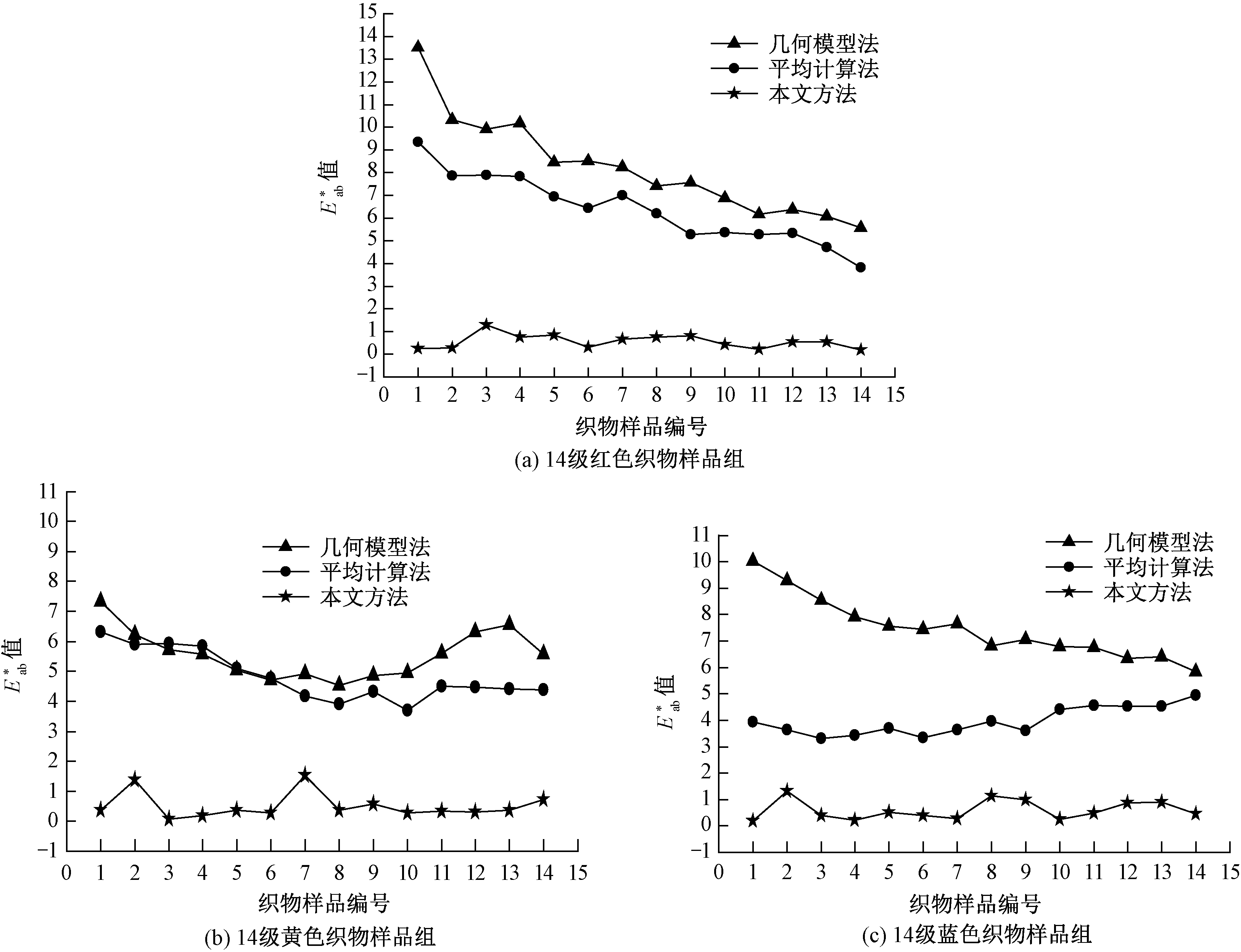
Results Three groups of red, yellow and blue gradient-changing fabric samples based full-color compound structure with triple-weft were designed and woven, and all 14 fabric samples prepared were measured by spectrophotometer to collect color data as the basis for testing and evaluating the prediction model. The color prediction accuracy of the basic prediction model and the optimized model was compared and analyzed, and it was found that the mean of the total color difference between the optimized predicted value and the measured value was decreased from 2.01, 2.28 and 2.49 to 0.56, 0.52 and 0.60, respectively, which proved that the optimization method had a significant improvement effect. The predicted value and the measured value were analyzed by item fitting, and the prediction accuracy of L value was found the most stable among the three parameters, while a value and b value were determined according to the specific situation. The red group had the smallest difference in a value, followed by L value and b value. A significant difference existed in a value in the yellow group, while there was a small difference in L value and b value. The fit degree of a value and L value in the blue group was better, and the difference in b value was significant. By comparing the above experiment results with the color values of the three color wefts, it was found that the prediction model was sensitive to the quantity of color components of the fabric samples, and the higher the quantity of a certain color component, the more accurate the prediction. Consequently, the color prediction data of the proposed method, the geometric model method and the image color averaging calculation method are analyzed and compared. The results showed that the proposed method was the most accurate in prediction for all of the fabric sample groups, followed by the color averaging method, while the worst was the geometric model method. Compared with the other two methods, the mean total color difference of the proposed color prediction method is reduced by 92.09% and 89.35%, respectively, demonstrating higher color prediction accuracy.
Conclusion The prediction model proposed establishes a clear correspondence with the fabric research object in terms of interweaving structural characteristics and yarn color. By overcoming the problem that the geometric model method cannot reflect the yarn deformation, and the low correlation between the color average calculation method and the structural characteristics of woven fabrics, this paper provides a reliable method for the color prediction of fabrics with high warp and weft density, and provides a new idea for the design and research of color prediction models.

Key words: full-color compound structure with triple-weft, color prediction, color gradient woven fabric, color fabric image, woven fabric design, color deviation

CLC Number: 

  • TS146

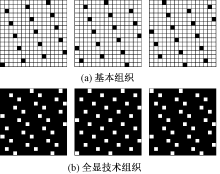
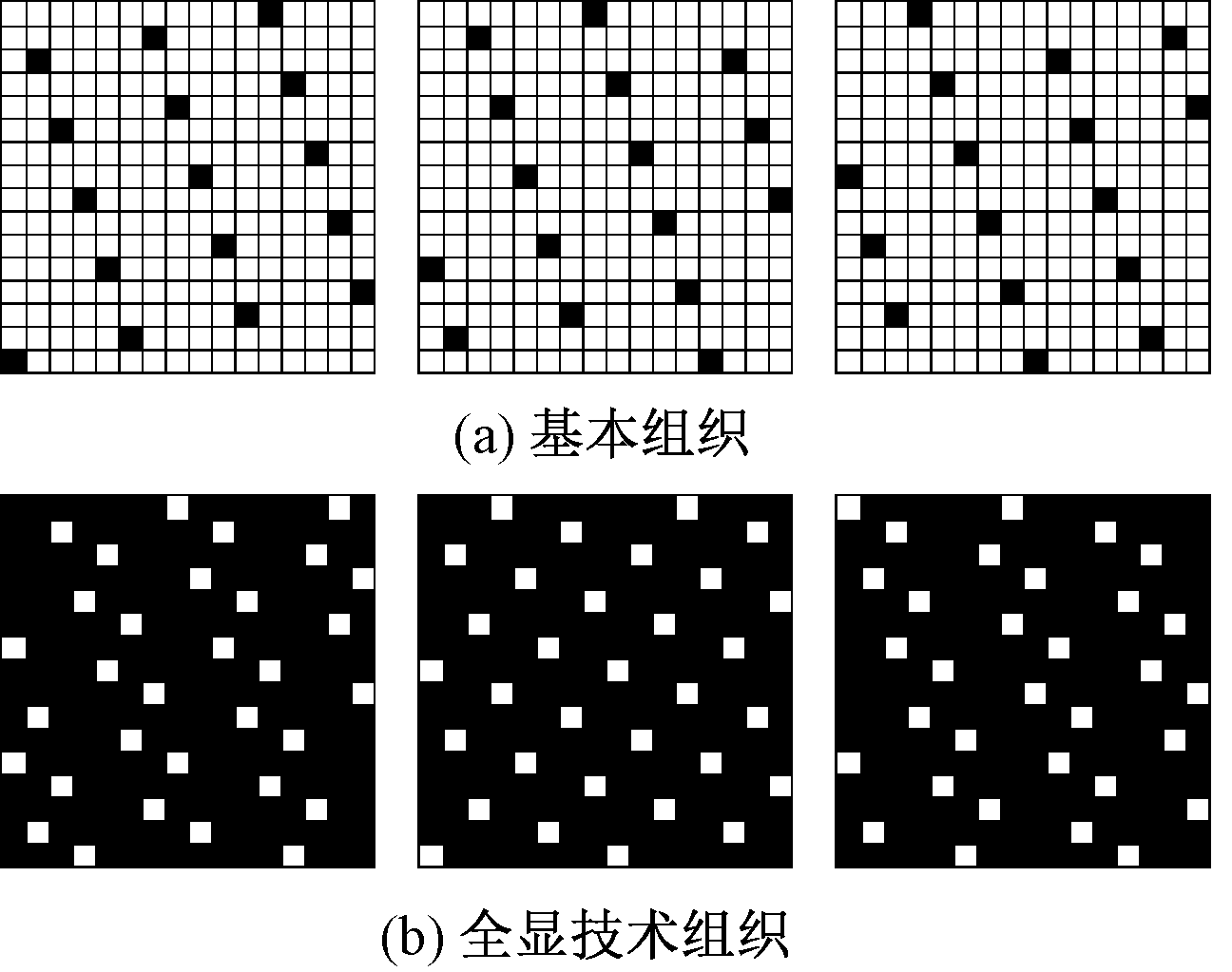
Fig.1

Basic weaves (a) and full-color technique weaves (b)"

Fig.2

Combination weaves with one weft gradual changing based on triple-weft combination full-color structure"

Tab.1

Yarn color value of fabric samples"

纱线种类 L a b
白经(W) 91.16 -1.31 2.55
红纬(R) 37.50 55.69 29.17
黄纬(Y) 79.17 7.24 62.60
蓝纬(B) 51.91 -12.31 -17.48

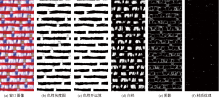
Fig.3

Feature image extraction diagrams of fabric images with red weft gradient changing. (a)Selected window image;(b)Gray image of color weft; (c)Open operational image of color weft;(d)White warp;(e)Shaded area; (f)Material texture"

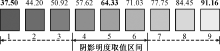
Fig.4

Method of lightness for shaded areas"

Tab.2

Mean values of color difference between values predicted by four optimized models and measured from fabric samples"

算法 织物颜色组
红色组 黄色组 蓝色组
偏最小二乘回归 0.63 0.70 0.71
岭回归 0.56 0.52 0.60
套索回归 0.60 0.88 0.71
逐步回归 0.97 0.78 0.90

Tab.3

Color difference comparison of color values predicted by basic and optimized models between those measured from fabric samples"

样品
编号
基础模型预测值 优化模型预测值 织物实测值 基础模型
Δ E a b *
优化模型
Δ E a b *
L a b L a b L a b
R-01 62.37 20.32 14.04 60.87 21.03 12.45 60.93 20.93 12.65 2.09 0.24
R-02 64.93 17.61 12.10 64.03 17.65 10.41 64.16 17.81 10.20 2.06 0.29
R-03 66.15 16.84 11.58 65.93 15.83 9.04 65.27 16.64 9.78 2.01 1.28
R-04 66.21 16.77 11.71 65.80 16.10 9.45 65.85 15.71 8.83 3.09 0.74
R-05 67.70 13.73 10.76 68.29 12.35 7.90 67.70 12.87 8.21 2.69 0.84
R-06 68.58 12.72 9.73 68.80 12.13 7.82 68.58 12.14 7.61 2.19 0.30
R-07 68.93 12.33 9.39 69.23 11.81 7.52 69.71 11.39 7.33 2.40 0.66
R-08 70.16 12.27 10.62 70.47 10.77 8.15 71.05 10.32 8.26 3.19 0.74
R-09 70.33 9.97 8.76 70.94 9.02 6.95 71.59 8.55 6.81 2.72 0.81
R-10 72.13 7.89 8.38 72.76 7.35 6.99 72.90 7.10 6.68 2.02 0.43
R-11 74.16 5.67 6.45 74.32 5.65 6.41 74.28 5.45 6.49 0.25 0.22
R-12 74.79 5.22 6.79 75.27 4.83 6.27 74.96 5.30 6.25 0.58 0.56
R-13 75.60 3.06 6.19 76.28 3.36 6.10 75.89 3.73 6.22 0.73 0.55
R-14 76.73 0.98 3.25 77.46 2.52 4.33 77.58 2.47 4.46 2.10 0.19
色差均值 2.01 0.56

Tab.4

Independent sample T-test results"

试样
编号
L a b
F P F P F P
1# 0.29 0.59 0.04 0.85 1.57 0.22
2# 0.00 0.98 2.81 0.11 0.01 0.93
3# 0.06 0.81 0.01 0.92 2.55 0.12

Fig.5

Color difference distribution of color predicted values for three different methods. (a) Red fabric sample group with 14 series; (b) Yellow fabric sample group with 14 series; (c) Blue fabric sample group with 14 series"

[1] 张爱丹, 周赳. 全显技术组织对三纬组合织物结构混色规律的影响[J]. 纺织学报, 2018, 39(10):44-49.
doi: 10.13475/j.fzxb.20171010706
ZHANG Aidan, ZHOU Jiu. Influence of full-color weave on color mixing law of compound fabric structure with triple-weft[J]. Journal of Textile Research, 2018, 39(10): 44-49.
doi: 10.13475/j.fzxb.20171010706
[2] 周赳, 吴文正. 数码提花织物的组合全显色结构设计[J]. 纺织学报, 2007, 28(6):59-63.
ZHOU Jiu, WU Wenzheng. All-coloring compound construction of digital jacquard fabric[J]. Journal of Textile Research, 2007, 28(6): 59-63.
[3] 周赳, 胡伊丽. 等经浮长的三纬组合全显结构设计与应用[J]. 纺织学报, 2023, 44(6):78-84.
ZHOU Jiu, HU Yili. Design and application of equal float length on full-color weave in triple-weft jacquard fabric structures[J]. Journal of Textile Research, 2023, 44(6): 78-84.
[4] MATHUR K. Color prediction model for jacquard tapestry woven fabrics[D]. Raleigh: North Carolina State University, 2007: 110-139.
[5] 罗来丽, 胡丁亭, 唐澜倩, 等. 基于全显色结构的三组纬提花织物混色特征研究[J]. 丝绸, 2011, 48(10):28-32.
LUO Laili, HU Dingting, TANG Lanqian, et al. Research on color mixture characteristics of triple-weft jacquard fabric with full-colors structure[J]. Journal of Silk, 2011, 48(10): 28-32.
[6] 郑雯洁, 张爱丹. 基于图像光影重构的缎纹影光织物明度预测方法[J]. 纺织学报, 2022, 43(5):97-103.
ZHENG Wenjie, ZHANG Aidan. Lightness prediction method for shaded satin fabrics based on image reconstruction of light and shadow[J]. Journal of Textile Research, 2022, 43(5): 97-103.
[7] 陈子晗. 织物结构设计与织物色彩关系的研究与应用[D]. 上海: 东华大学, 2015:23-35.
CHEN Zihan. Research and application of the relationship between fabric structure and fabric color[D]. Shanghai: Donghua University, 2015:23-35.
[8] HOERLR W. Ridge regression: a historical context[J]. Technometrics, 2020, 62(4):420-425.
[9] 张爱丹. 奇数层组合全显织物结构的构成原理及其呈色规律研究[D]. 杭州: 浙江理工大学, 2018:66-86.
ZHANG Aidan. The construction principle and colour rendering law of the full-colour fabric structure with odd-layer weave combination[D]. Hangzhou: Zhejiang Sci-Tech University, 2018:66-86.
[10] 章斐燕, 金亦佳, 李启正, 等. 空间并置混色色织物颜色预测方法的比较[J]. 丝绸, 2014, 51(11):22-27.
ZHANG Feiyan, JIN Yijia, LI Qizheng, et al. Comparation of color prediction methods of yarn-dyed fabrics with spatial juxtaposition[J]. Journal of Silk, 2014, 51(11): 22-27.
[1] YANG Liu, LI Yujia, YU Yan, MA Lei, ZHANG Ruiyun. Color prediction of fiber-colored fabrics based on Neugebauer equation [J]. Journal of Textile Research, 2024, 45(01): 83-89.
[2] YANG Liu, LI Yujia, ZHANG Xin, HE Wenjing, TONG Shenghao, MA Lei, ZHANG Yi, ZHANG Ruiyun. Effect of tightness of colored knitted fabrics on color prediction [J]. Journal of Textile Research, 2022, 43(05): 104-108.
[3] . Hierarchical multi-hive bee colony algorithm for fashion color prediction [J]. JOURNAL OF TEXTILE RESEARCH, 2018, 39(03): 137-142.
[4] . Model for predicting color mixing of dope-dyed polyester interwoven fabrics [J]. JOURNAL OF TEXTILE RESEARCH, 2017, 38(07): 56-62.
Viewed
Full text


Abstract

Cited

  Shared   
  Discussed   
No Suggested Reading articles found!