Journal of Textile Research ›› 2025, Vol. 46 ›› Issue (11): 1-8.doi: 10.13475/j.fzxb.20250500801

• Fiber Materials •     Next Articles

Preparation of thermochromic fiber membrane and its temperature-sensing performance

LIANG Zhi1,2, JI Kangrui1,2, LI Zhangcheng1,2, HE Yu1,2, WANG Can1,2, HOU Chong1,2,3()   

  1. 1. State Key Laboratory of New Textile Materials and Advanced Processing, Huazhong University of Science and Technology, Wuhan,Hubei 430074, China
    2. School of Optical and Electronic Information, Huazhong University of Science and Technology,Wuhan, Hubei 430074, China
    3. Research Institute of Huazhong University of Science and Technology in Shenzhen,Shenzhen, Guangdong 518057, China
  • Received:2025-05-08 Revised:2025-07-17 Online:2025-11-15 Published:2025-11-15
  • Contact: HOU Chong E-mail:chong@hust.edu.cn

Abstract:

Objective The thermochromic flexible temperature sensor, visible to the naked eye, effectively addresses the issues of limited flexibility, additional power requirements, and intricate structures associated with conventional rigid temperature sensors. To advance the field of wearable temperature sensing, developing a thermochromic flexible temperature sensor with superior stretchability and multi-color integration is of significant importance. This study aims to investigate the fabrication and temperature-sensing properties of thermochromic fiber membranes produced via solution blow spinning.
Method Two types of thermochromic microcapsules were employed, with one transitioning from colorless to blue at 22 ℃ and the other transforming from colorless to pink at 35 ℃. The microcapsules were blended with a styrene-ethylene-butene-styrene (SEBS) block copolymer via a solution-based approach to prepare the spinning solution. The spinning solution was subsequently blown through a high-pressure nozzle using a solution blow spinning technique, yielding thermochromic fiber membranes. The mechanical properties, spectral and chromatic characteristics, response time, hydrophobicity, and moisture permeability of the thermochromic fiber membranes were systematically tested and analyzed. To verify their temperature-sensing performance, the thermochromic fiber membrane was applied to a standard fabric for visualized temperature detection in ambient conditions.
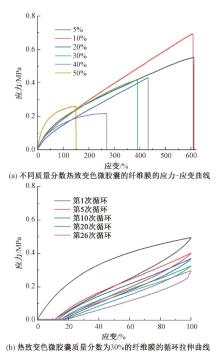
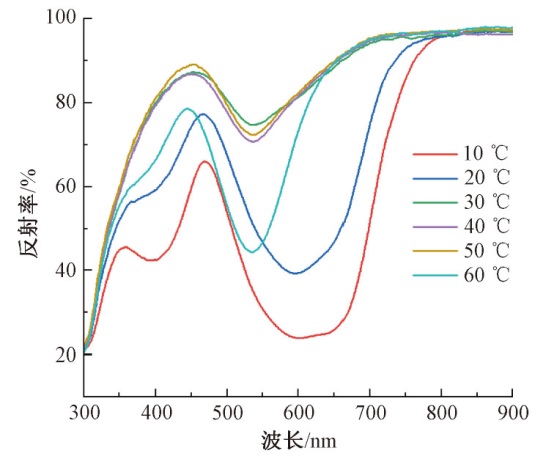
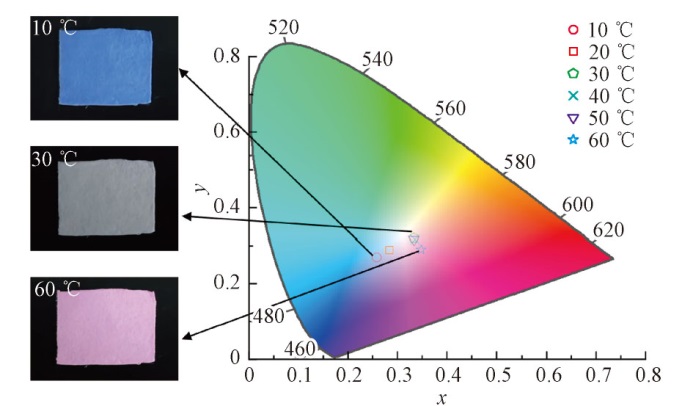
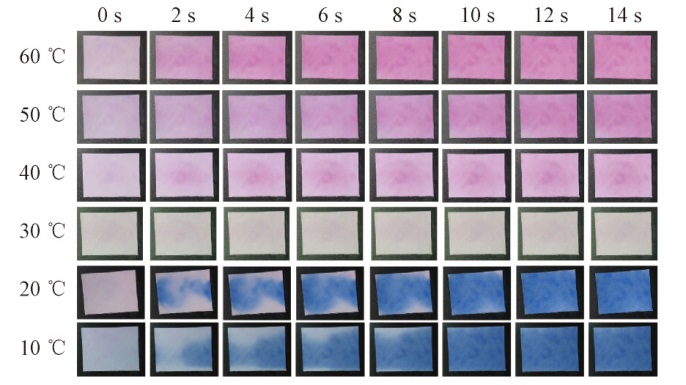
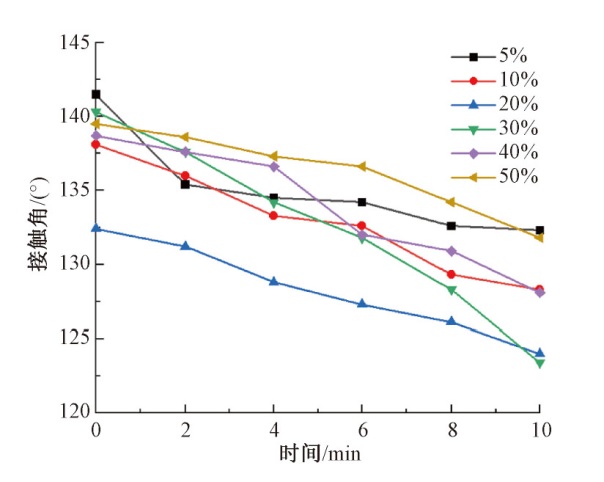
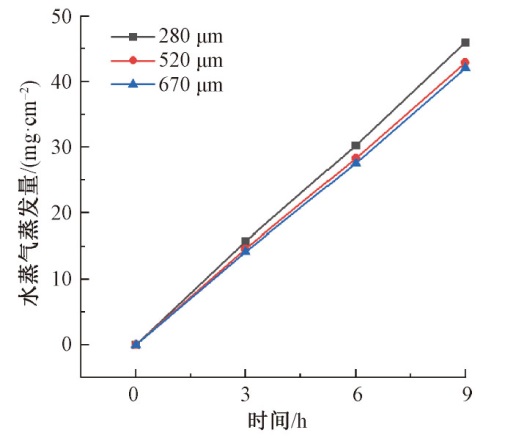
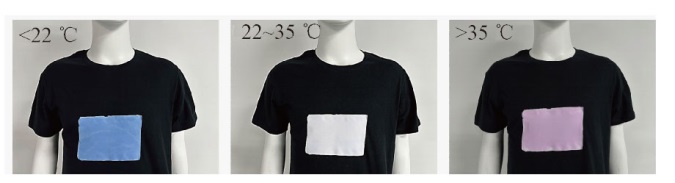
Results Scanning electron microscope characterization demonstrated that the blended spinning solution of SEBS and thermochromic microcapsules formed a fiber cross-mesh structure under high-pressure airflow conditions. This structural arrangement led to the degradation of fiber formation and the progressive aggregation of thermochromic microcapsules with increasing content. With the mass fraction of thermochromic microcapsules increasing from 5% to 10%, 20%, 30%, 40%, and 50%, the maximum strain of the thermochromic fiber membranes decreased sequentially from 611% to 608%, 432%, 390%, 269%, and 149%. Upon being stretched to 100% of its original length, the fiber membrane containing 30% thermochromic microcapsules withstood 26 stretching cycles prior to fracturing. Spectrum and chromaticity analyses revealed that the prepared thermochromic fiber membrane displayed a blue color at temperatures below 22 ℃, a white appearance at temperatures between 22 ℃ and 35 ℃, and a pink hue at temperatures above 35 ℃. Specifically, the fiber membrane with 30% thermochromic microcapsules underwent a color transition from white to blue within 10 s at 10 ℃, while the shift from white to pink at 60 ℃ similarly required 10 s to stabilize. The thermochromic fiber membranes exhibited excellent hydrophobicity, achieving an initial maximum water contact angle of 141.5°, which remained above 120° even after 10 min of water exposure. Following a 9-hour moisture permeability test, the water vapor permeability of the fiber membrane containing 30% thermochromic microcapsules with a thickness of 280 μm was measured at 5.08 mg/(cm2·h). Spraying thermochromic fibers onto the glass surface facilitates visualized water temperature sensing, which is crucial for ensuring safe drinking practices. By integrating the thermochromic fiber membrane with conventional fabric, intelligent wearable textiles can be developed, enabling visual sensing of environmental temperature through its temperature-color response relationship.
Conclusion The thermochromic fiber membranes enable visualized temperature sensing by exhibiting distinct color transitions across multiple temperature intervals, thereby overcoming the limitations of conventional thermochromic membranes, which are typically restricted to single-color changes and narrow temperature ranges. Experimental results demonstrate that these thermochromic fiber membranes possess excellent stretchability and hydrophobicity, underscoring their potential for applications in wearable temperature sensing. The smart wearable fabric fabricated using these thermochromic fiber membranes enables visualized temperature detection without the need for additional power input. Moreover, these membranes are facile to fabricate, lightweight, and can be seamlessly integrated with conventional fabrics, thereby significantly reducing the costs associated with practical applications.

Key words: thermochromic fiber membrane, temperature sensing, solution blow spinning, styrene-ethylene-butene-styrene block copolymer, flexible temperature sensor, thermochromic microcapsule, intelligent wearable textiles

CLC Number: 

  • TQ 317.9

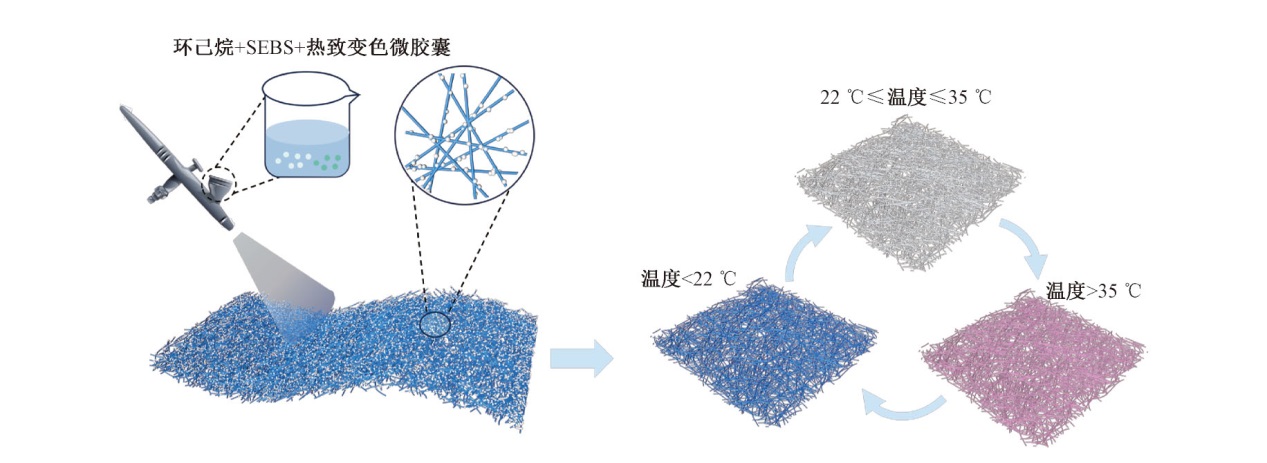
Fig.1

Preparation process of thermochromic fiber membranes and relationship between temperature and color response"

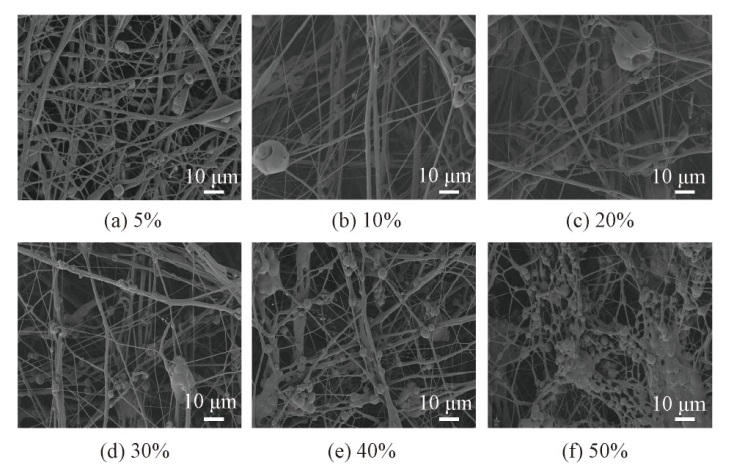
Fig.2

SEM images of surface morphologies of thermochromic fiber membranes containing thermochromic microcapsules of different mass fractions"

Fig.3

Mechanical properties of thermochromic fiber membranes.(a) Stress-strain curves of thermochromic fiber membranes with different mass fractions of thermochromic microcapsules;(b) Cyclic tensile test of thermochromic fiber membranes with 30% mass fraction of thermochromic microcapsules"

Fig.4

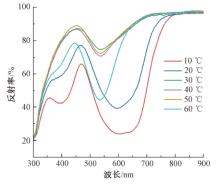
Reflectance spectra of thermochromic fiber membranes at different temperatures"

Fig.5

CIE 1931 chromaticity map coordinates of thermochromic fiber membranes at different temperatures"

Fig.6

Response time of thermochromic fiber membranes"

Fig.7

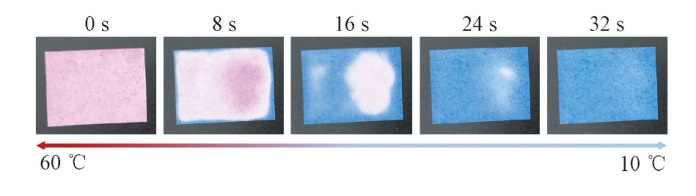
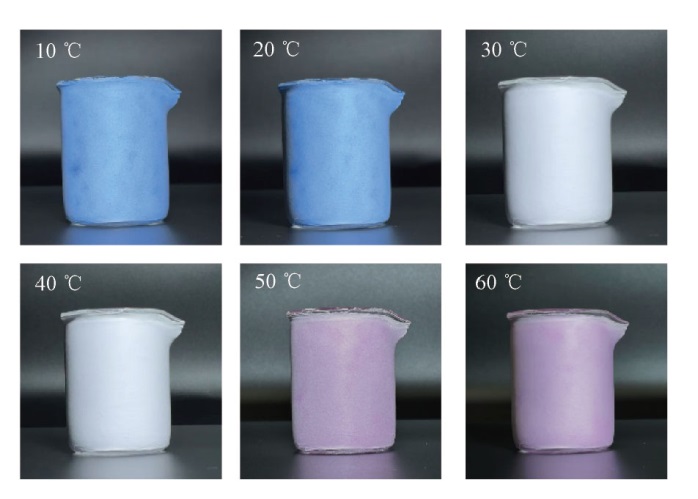
Color-changing process of thermochromic fiber membranes from high temperature to low temperature"

Fig.8

Hydrophobicities of thermochromic fiber membranes"

Fig.9

Moisture permeabilities of thermochromic fiber membranes"

Fig.10

Temperature sensing performance of thermochromic fiber membranes attached to cup"

Fig.11

Ambient temperature sensing performance of thermochromic fiber membranes attached to fabric"

[1] MADHVAPATHY S R, BURY M I, WANG L W, et al. Miniaturized implantable temperature sensors for the long-term monitoring of chronic intestinal inflammation[J]. Nature Biomedical Engineering, 2024, 8(8): 1040-1052.
doi: 10.1038/s41551-024-01183-w
[2] LU Y F, ZHANG H J, ZHAO Y, et al. Robust fiber-shaped flexible temperature sensors for safety monitoring with ultrahigh sensitivity[J]. Advanced Materials, 2024, 36(18): 2310613.
doi: 10.1002/adma.v36.18
[3] XIAO H Y, LI S B, HE Z D, et al. Dual mode strain-temperature sensor with high stimuli discriminability and resolution for smart wearables[J]. Advanced Functional Materials, 2023, 33(16): 2214907.
doi: 10.1002/adfm.v33.16
[4] CAI J Y, DU M J, LI Z L. Flexible temperature sensors constructed with fiber materials[J]. Advanced Materials Technologies, 2022, 7(7): 2101182.
doi: 10.1002/admt.v7.7
[5] LIU L, DOU Y Y, WANG J H, et al. Recent advances in flexible temperature sensors: materials, mechanism, fabrication, and applications[J]. Advanced Science, 2024, 11(36): 2405003.
doi: 10.1002/advs.v11.36
[6] LIU G, LV Z Y, BATOOL S, et al. Biocompatible material-based flexible biosensors: from materials design to wearable/implantable devices and integrated sensing systems[J]. Small, 2023, 19(27): 2207879.
doi: 10.1002/smll.v19.27
[7] ARMAN KUZUBASOGLU B, KURSUN BAHADIR S. Flexible temperature sensors: a review[J]. Sensors and Actuators A: Physical, 2020, 315: 112282.
doi: 10.1016/j.sna.2020.112282
[8] CHEN T D, YANG Q J, FANG C Q, et al. Advanced design for stimuli-reversible chromic wearables with customizable functionalities[J]. Advanced Materials, 2025, 37(6): 2413665.
doi: 10.1002/adma.v37.6
[9] HA H, SURYAPRABHA T, CHOI C, et al. Recent research trends in textile-based temperature sensors: a mini review[J]. Nanotechnology, 2023, 34(42): 422001.
doi: 10.1088/1361-6528/ace913
[10] ZHAN L Y, XU W X, HU Z X, et al. Full-color ″off-on″ thermochromic fluorescent fibers for customizable smart wearable displays in personal health monitoring[J]. Small, 2024, 20(29): 2310762.
doi: 10.1002/smll.v20.29
[11] LIU S L, ZHANG W T, HE J Z, et al. Fabrication techniques and sensing mechanisms of textile-based strain sensors: from spatial 1D and 2D perspectives[J]. Advanced Fiber Materials, 2024, 6(1): 36-67.
doi: 10.1007/s42765-023-00338-9
[12] 吕晓双, 刘丽萍, 俞建勇, 等. 纤维基自供能电子皮肤的构建及其应用性能研究进展[J]. 纺织学报, 2022, 43(10): 183-191.
doi: 10.13475/j.fzxb.20220404509
LÜ Xiaoshuang, LIU Liping, YU Jianyong, et al. Fabrication and application research progress of fiber-based self-powered electronic skins[J]. Journal of Textile Research, 2022, 43(10): 183-191.
doi: 10.13475/j.fzxb.20220404509
[13] LIM T, SEO H S, YANG J, et al. Reversible thermochromic fibers with excellent elasticity and hydrophobicity for wearable temperature sensors[J]. RSC Advances, 2024, 14(9): 6156-6164.
doi: 10.1039/d3ra06432h pmid: 38375008
[14] KIM D H, BAE J, LEE J, et al. Porous nanofiber membrane: rational platform for highly sensitive thermochromic sensor[J]. Advanced Functional Materials, 2022, 32(24): 2200463.
doi: 10.1002/adfm.v32.24
[15] LI P, SUN Z H, WANG R, et al. Flexible thermochromic fabrics enabling dynamic colored display[J]. Frontiers of Optoelectronics, 2022, 15(1): 40.
doi: 10.1007/s12200-022-00042-3
[16] GE F Q, PENG J, TAN J L, et al. Color tunable photo-thermochromic elastic fiber for flexible wearable heater[J]. Advanced Composites and Hybrid Materials, 2024, 7(5): 173.
doi: 10.1007/s42114-024-00994-4
[17] ZHANG L P, YANG Y T, WANG J X, et al. A portable, sprayable, highly malleable, elastic, and hydrophobic antibacterial fibrous wound dressing for infected wound healing[J]. Advanced Fiber Materials, 2025, 7(2): 528-540.
doi: 10.1007/s42765-024-00500-x
[18] QU Y P, NGUYEN-DANG T, PAGE A G, et al. Superelastic multimaterial electronic and photonic fibers and devices via thermal drawing[J]. Advanced Materials, 2018, 30(27): 1707251.
doi: 10.1002/adma.v30.27
[19] LI D, LIU X, LI W, et al. Scalable and hierarchically designed polymer film as a selective thermal emitter for high-performance all-day radiative cooling[J]. Nature Nanotechnology, 2020, 16(2): 153-158.
doi: 10.1038/s41565-020-00800-4
[20] WU X K, LI J L, XIE F, et al. A dual-selective thermal emitter with enhanced subambient radiative cooling performance[J]. Nature Communications, 2024, 15: 815.
doi: 10.1038/s41467-024-45095-4 pmid: 38280849
[21] LIU B Y, WU J W, XUE C H, et al. Bioinspired superhydrophobic all-In-one coating for adaptive thermoregulation[J]. Advanced Materials, 2024, 36(31): 2400745.
doi: 10.1002/adma.v36.31
[1] FANG Lei, LIU Xiuming, JIA Jiaojiao, LIN Zhihao, REN Yanfei, HOU Kaiwen, GONG Jixian, HU Yanling. Fabrication of high molecular weight chitosan core-shell nanofibers [J]. Journal of Textile Research, 2024, 45(09): 1-9.
[2] WANG Nan, SUN Hui, YU Bin, XU Lei, ZHU Xiangxiang. Preparation and sensing performances of flexible temperature sensor prepared from melt-blown nonwoven materials [J]. Journal of Textile Research, 2024, 45(05): 138-146.
[3] FANG Jian, REN Song, ZHANG Chuanxiong, CHEN Qian, XIA Guangbo, GE Can. Electroactive fibrous materials for intelligent wearable textiles [J]. Journal of Textile Research, 2021, 42(09): 1-9.
Viewed
Full text


Abstract

Cited

  Shared   
  Discussed   
No Suggested Reading articles found!