Journal of Textile Research ›› 2025, Vol. 46 ›› Issue (07): 144-153.doi: 10.13475/j.fzxb.20241105601

• Dyeing and Finishing Engineering • Previous Articles     Next Articles

Color transfer method for fabric patterns based on trending colors

WANG Jianhui1, ZHANG Huaxiong1(), JIN Yao1, LIU Zhi2   

  1. 1 School of Computer Science and Technology, Zhejiang Sci-Tech University, Hangzhou, Zhejiang 310018, China
    2 Hangzhou Wanshili Silk Culture Co., Ltd., Hangzhou, Zhejiang 310009, China
  • Received:2024-11-25 Revised:2025-03-06 Online:2025-07-15 Published:2025-08-14
  • Contact: ZHANG Huaxiong E-mail:zhxhz@zstu.edu.cn

Abstract:

Objective In order to solve problems of the inefficiencies, high costs, and limited variety in conventional handmade fabric pattern color designs, which are worsened by the frequent shifts in seasonal fashion colors, an efficient, intelligent color-transfer method for fabric patterns is introduced, based on the latest fashion color trends. By closely following fashion color trends, it aims to keep textile and apparel products visually appealing and appealing to consumers. Ultimately, this approach can minimize waste from color-related obsolescence and help the industry quickly adapt to market changes.

Method A comprehensive and trend-responsive color palette was developed by integrating fashion color trends, color theory principles, and the unique color attributes of fabric patterns. Using the K-means clustering algorithm, a dataset of fabric patterns incorporating popular color palettes was established. In order to refine the color transfer model, an edge-preserving loss function and a color perception loss function were introduced. This enhanced the ability of the model to capture intricate texture details while maintaining color authenticity. Additionally, salt-and-pepper noise during the model training phase was incorporated to enhance the overall robustness of the model.

Results A well-designed survey with 40 participants was conducted to compare two different color palettes in detail. One palette incorporated complex features of fabric patterns, while the other served as a control without these elements. Participants were asked to select their preferred palette based on various factors such as overall fabric design, pattern complexity, and color harmony. This evaluation, based on a diverse set of 90 test samples, ensured the comprehensiveness of the assessment. The results showed that the palette incorporating fabric pattern features received overwhelming positive feedback, with 2 425 votes (67.36% of the total), significantly outperforming the conventional palette and highlighting the strong appeal of fabric-inspired designs. Furthermore, the proposed color transfer model demonstrated excellent performance metrics. Specifically, it achieved a structural similarity index (s) of 0.911, indicating high visual fidelity between the original and transferred images. Additionally, the peak signal-to-noise ratio (p) reached 29.714, further confirming the model's ability to maintain image quality during the color transfer process. Compared to other conventional color transfer methods that perform well.It outperformed Neural Preset (p=28.295,s=0.894) and AdaIN (s=0.857), These results validate its strengths in maintaining color authenticity and structural fidelity for floral pattern adaptation.

In order to verify the contributions of the introduced salt-and-pepper noise, edge loss, and color perception loss to optimizing the color transfer model, ablation experiments were conducted. Compared to the baseline (p=27.596, s=0.806), introducing color perception loss alone (p=28.621, s=0.892) improved color accuracy by 3.7% in p and 10.7% in s, demonstrating superior sensitivity to subtle hue variations. Edge loss achieved an SSIM of 0.844 (4.7% gain), effectively preserving structural details, while salt-and-pepper noise enhanced robustness with a 0.9% p increase (27.835). The integrated model combining all components achieved optimal performance (p=29.714, s=0.911). The results indicated that the introduction of the color perception loss function significantly improved the model's sensitivity to subtle color changes, resulting in more precise and accurate matching of target fashion colors. Thirdly, the edge-preserving loss function played a crucial role in mitigating edge blurring and detail loss during the color transfer process, ensuring that the resulting patterns maintained clear outlines and rich details. Finally, incorporating salt-and-pepper noise during the training phase enhanced the model's robustness to fluctuations in image quality, simulating real-world disturbances that may occur during image transmission or storage. This enhancement allowed the model to accurately distinguish between true structures and noise, ultimately generating more stable and visually appealing images.

Conclusion The proposed fabric pattern color transfer method based on popular colors significantly improves design efficiency and enriches the diversity of fabric patterns while effectively reducing production costs through intelligent means. The feasibility and effectiveness of this method have been verified through empirical experiments. The proposed color transfer method provides an efficient solution for the intelligent design of fabric patterns, accelerating the digital transformation of the textile and apparel industry. Furthermore, by applying the color transfer technology to the fusion design of popular colors and fabric patterns, it not only meet the market's demand for diversification and personalization but also further respond to the initiative of sustainable development. This approach helps reduce dependence on new materials, aligns with the principles of a circular economy, and provides a more sustainable solution for the textile industry. Ultimately, the research lays the foundation for achieving textile designs that are both environmentally friendly and aesthetically pleasing, making a positive contribution to promoting a sustainable, innovative, and vibrant fashion industry.

Key words: color transfer, generative adversarial network, fabric pattern, fabric pattern design, fashion color

CLC Number: 

  • TP399

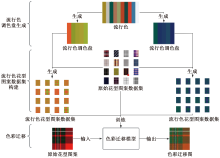
Fig.1

Overall framework of proposed method"

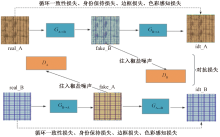
Fig.2

Color transfer model structure"

Fig.3

Fashion colors"

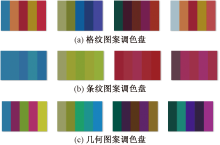
Fig.4

Fashion color palette. (a) Plaid color palette; (b)Stripe color palette; (c)Geometric color palette"

Tab.1

Voting results for different palettes"

方法 是否考虑
花型图案特征
得票情况
得票数 得票率/%
本文方法 2 425 67.36
对比方法 1 175 32.64

Fig.5

Example patterns from original pattern dataset. (a)Plaid pattern;(b)Stripe pattern;(c)Geometric pattern"

Fig.6

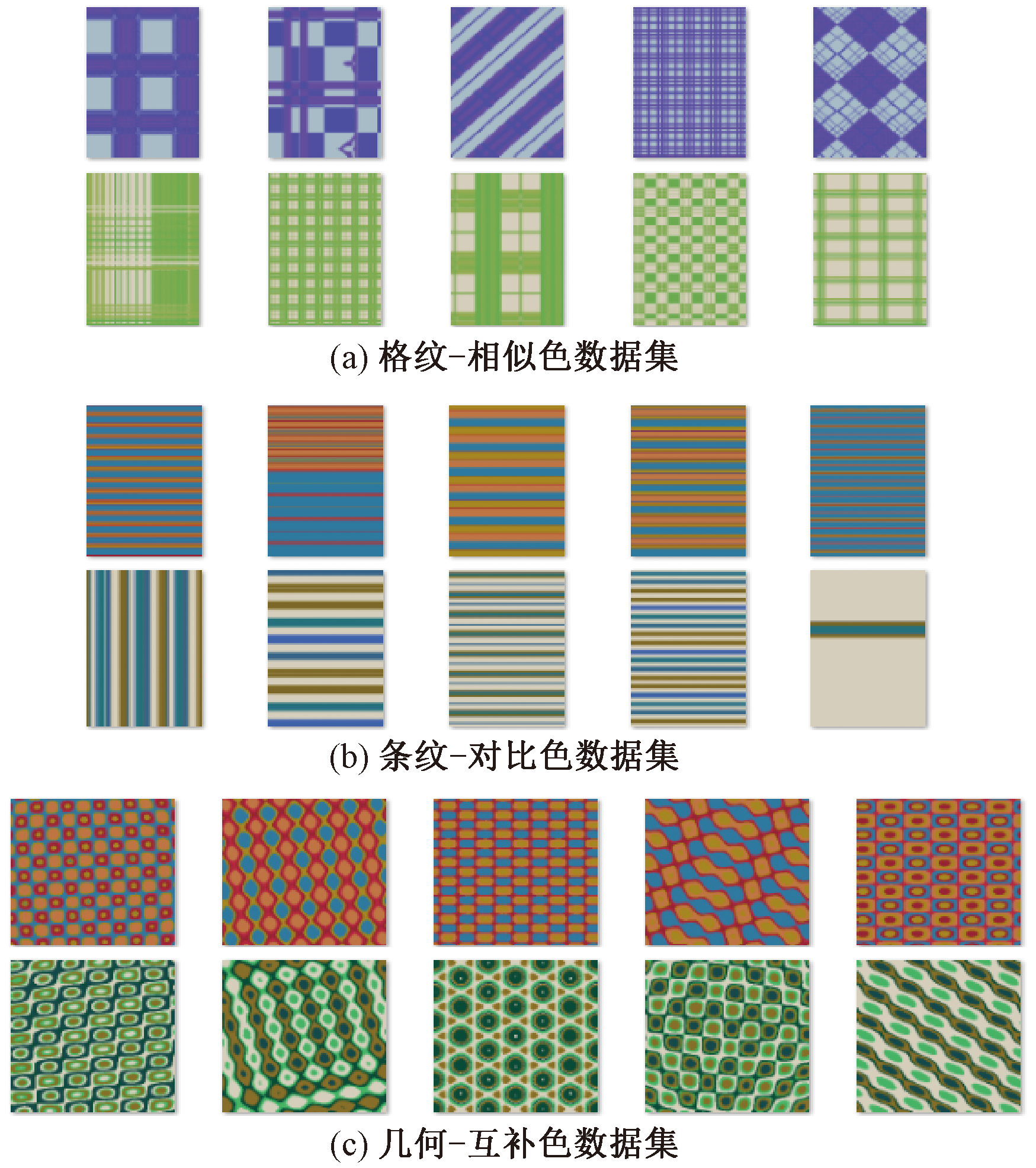
Example patterns from trendy color pattern dataset. (a)Plaid-similar color dataset; (b)Stripe-contrast color dataset; (c)Geometric-complementary color dataset"

Fig.7

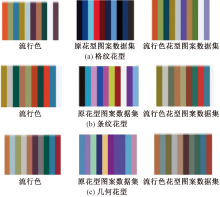
Main color extraction results from pattern datasets. (a)Plaid pattern; (b)Stripe pattern; (c)Geometric pattern"

Fig.8

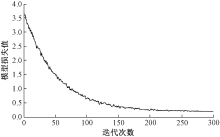
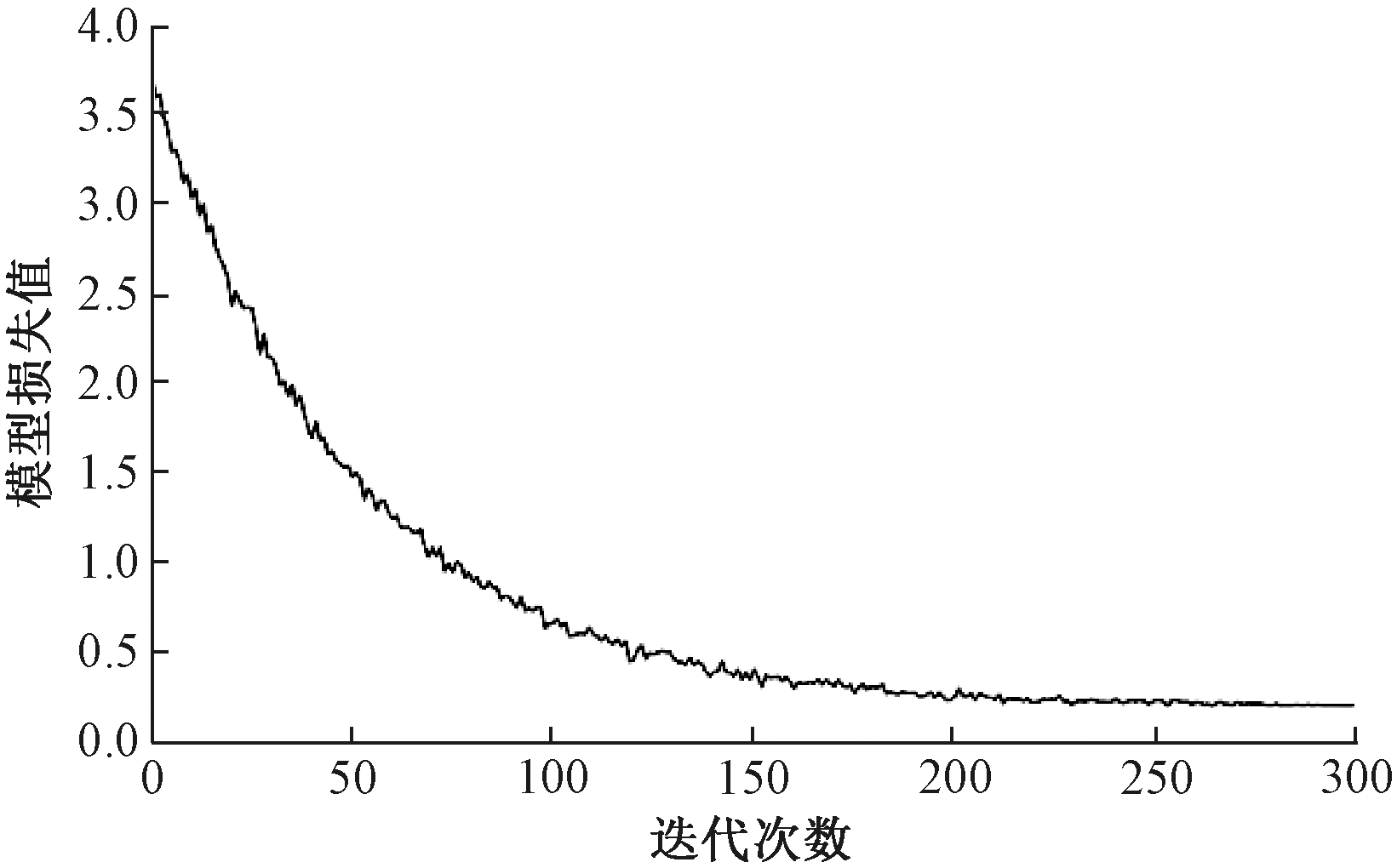
Model training loss curve"

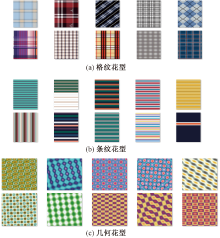
Fig.9

Pattern designs after color transfer. (a)Plaid pattern; (b) Stripe pattern; (c)Geometric pattern"

Fig.10

Color transfer results by different methods. (a)Original image; (b)Fashion colors; (c)Gatys; (d)AdaIN; (e)CAMS; (f)Neural Preset; (g)CycleGAN; (h)Proposed method"

Fig.11

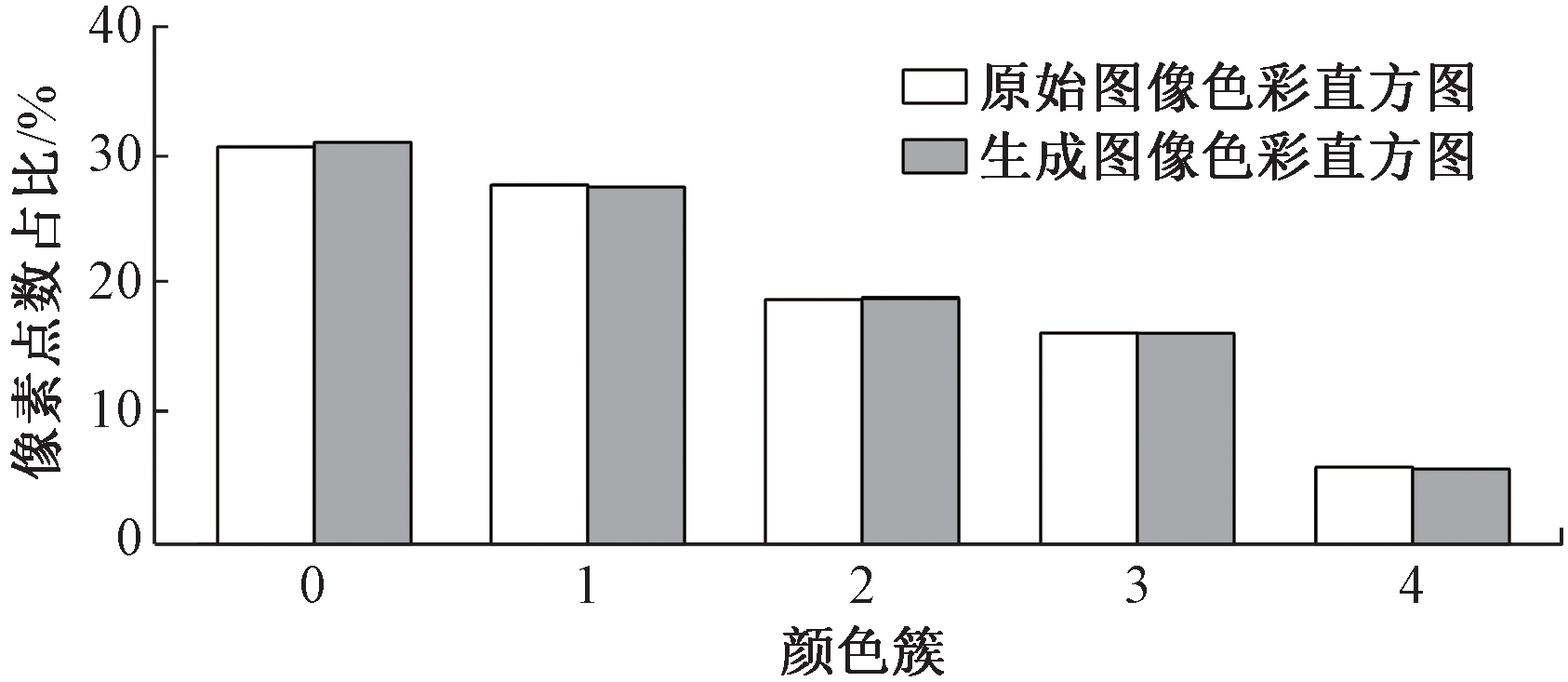
Comparison of color histograms before and after color transfer"

Tab.2

Evaluation metrics for color transfer images using different methods"

方法 峰值信噪比 结构相似性指数
Gatys 27.857 0.739
AdaIN 27.811 0.857
CAMS 27.743 0.611
Neural Preset 28.295 0.894
CycleGAN 27.596 0.806
本文方法 29.714 0.911

Tab.3

Contribution of each module to transfer experiment"

实验
编号
椒盐
噪声
边缘保持
损失
色彩感知
损失
峰值信
噪比
结构
相似性指数
a × × × 27.596 0.806
b × × 27.835 0.828
c × × 28.913 0.844
d × × 28.621 0.892
[1] 贺显伟. 色彩经济时代纺织品创新设计中的色彩策略[J]. 现代纺织技术, 2022, 30(2): 113-117.
doi: 10.19398/j.att.202106053
HE Xianwei. Color strategies in textile innovation design in the age of color economics[J]. Modern Textile Technology, 2022, 30(2): 113-117.
[2] WAN S H, XIA Y, QI L Y, et al. Automated colorization of a grayscale image with seed points propagation[J]. IEEE Transactions on Multimedia, 2020, 22(7): 1756-1768.
[3] GATYS L A, ECKER A S, BETHGE M. A neural algorithm of artistic style[C]// Proceedings of the 16th International Conference on Computer Vision. Venice: IEEE, 2016: 2295-2303.
[4] HUANG X, BELONGIE S. Arbitrary style transfer in real-time with adaptive instance normalization[C]// 2017 IEEE International Conference on Computer Vision. Venice: IEEE, 2017: 1510-1519.
[5] AFIFI M, ABUOLAIM A, HUSSIEIN M, et al. CAMS: Color-aware multi-style transfer[EB/OL]. (2021-06-23)[2023-11-08]. https://arxiv.org/abs/2106.13920.
[6] KE Z H, LIU Y H, ZHU L, et al. Neural preset for color style transfer[C]// 2023 IEEE/CVF Conference on Computer Vision and Pattern Recognition. Vancouver: IEEE, 2023: 14173-14182.
[7] ZHU J Y, PARK T, ISOLA P, et al. Unpaired image-to-image translation using cycle-consistent adversarial networks[C]// 2017 IEEE International Conference on Computer Vision. Venice: IEEE, 2017: 2242-2251.
[8] 徐明慧. 民族服饰色彩解析与纹样自动配色方法研究[D]. 杭州: 浙江理工大学, 2022: 90-99.
XU Minghui. Research on color analysis and automatic color matching of ethnic clothing patterns[D]. Hangzhou: Zhejiang Sci-Tech University, 2022: 90-99.
[9] 任艳博, 蒋超, 王教庆, 等. 基于聚类算法和色彩网络的蝴蝶色彩分析及应用[J]. 纺织学报, 2021, 42(5): 103-108.
REN Yanbo, JIANG Chao, WANG Jiaoqing, et al. Butterfly color analysis and application based on clustering algorithm and color network[J]. Journal of Textile Research, 2021, 42(5): 103-108.
[10] 庄冰冰, 向军, 张宁, 等. 便携式织物图像颜色测量系统开发[J]. 纺织学报, 2024, 45(10): 208-215.
doi: 10.13475/j.fzxb.20231105501
ZHUANG Bingbing, XIANG Jun, ZHANG Ning, et al. Development of a portable fabric image color measurement system[J]. Journal of Textile Research, 2024, 45(10): 208-215.
doi: 10.13475/j.fzxb.20231105501
[11] BALLESTER C, BUGEAU A, CARRILLO H, et al. Influence of color spaces for deep learning image colorization[EB/OL].(2022-04-06)[2024-06-20]. https://arxiv.org/abs/2204.02850.
[12] 邱笑迎. 基于颜色特征的面料花型图案检索算法[J]. 计算机时代, 2023(9): 92-95.
QIU Xiaoying. Fabric pattern retrieval algorithm based on color features[J]. Computer Era, 2023(9): 92-95.
[13] ZHU X, LIU J. Improving robustness of deep learning models with salt-and-pepper noise augmentation[C]// 2019 IEEE/CVF Conference on Computer Vision and Pattern Recognition. Long Beach: IEEE, 2019: 1234-1243.
[14] 王可铮, 徐玉芬, 周尚波. 结合对比感知损失和融合注意力的图像去雾模型[J]. 计算机工程, 2023, 49(8): 207-214.
doi: 10.19678/j.issn.1000-3428.0065255
WANG Kezheng, XU Yufen, ZHOU Shangbo. Image dehazing model combining contrast perception loss and fusion attention[J]. Computer Engineering, 2023, 49(8): 207-214.
doi: 10.19678/j.issn.1000-3428.0065255
[1] CAI Liling, WANG Mei, SHAO Yibing, CHEN Wei, CAO Huaqing, JI Xiaofen. Intelligent customization recommendation for traditional Hanfu based on improved stack-generative adversarial network [J]. Journal of Textile Research, 2024, 45(12): 180-188.
[2] LU Yinwen, HOU Jue, YANG Yang, GU Bingfei, ZHANG Hongwei, LIU Zheng. Single dress image video synthesis based on pose embedding and multi-scale attention [J]. Journal of Textile Research, 2024, 45(07): 165-172.
[3] YANG Chenhui, CHEN Mengdi, GUAN Yan, XIAO Hong. Design and realization of optical fiber fabric based on grating animation pattern synthesis [J]. Journal of Textile Research, 2024, 45(07): 40-46.
[4] ZHAO Wenhao, XIANG Jun, ZHANG Ning, PAN Ruru. Research on fabric pattern retrieval based on SURF and VLAD feature coding [J]. Journal of Textile Research, 2023, 44(08): 110-117.
[5] LIU Yuye, WANG Ping. High-precision intelligent algorithm for virtual fitting based on texture feature learning [J]. Journal of Textile Research, 2023, 44(05): 177-183.
[6] CHEN Jia, YANG Congcong, LIU Junping, HE Ruhan, LIANG Jinxing. Cross-domain generation for transferring hand-drawn sketches to garment images [J]. Journal of Textile Research, 2023, 44(01): 171-178.
[7] JIA Jing, CAO Jingwen, XU Pinghua, LIN Ruibing, SUN Xiaowan. Automatic coloration of clothing pattern based on color parsing of Peking Opera masks [J]. Journal of Textile Research, 2022, 43(12): 160-166.
[8] YANG Zhengyan, XUE Wenliang, ZHANG Chuanxiong, DING Yi, MA Yanxue. Recommendations for user's bottoms matching based on generative adversarial networks [J]. Journal of Textile Research, 2021, 42(07): 164-168.
[9] YUAN Li, XIONG Ying, GU Qian, WANG Danshu, HUO Da, LIU Junping. Characteristics and factorial study of color transfer between dyed fiber and colored spun yarns [J]. Journal of Textile Research, 2021, 42(05): 122-129.
[10] WANG Hui, SUN Jie, DING Xiaojun, LONG Ying, ZOU Fengyuan. Comparison of feature extracting and matching methods for fabric patterns [J]. Journal of Textile Research, 2020, 41(04): 45-50.
[11] . Selection of plaid fabric pattern based on interactive evaluation [J]. Journal of Textile Research, 2018, 39(09): 50-56.
[12] . Hierarchical multi-hive bee colony algorithm for fashion color prediction [J]. JOURNAL OF TEXTILE RESEARCH, 2018, 39(03): 137-142.
[13] . Continuity identification of fabric patterns [J]. JOURNAL OF TEXTILE RESEARCH, 2016, 37(08): 37-40.
[14] . Mechanism and software development for rainbow segment color yarn knitted fabrics [J]. JOURNAL OF TEXTILE RESEARCH, 2016, 37(08): 47-53.
[15] . Aided design of harmony color style of bed clothes [J]. Journal of Textile Research, 2015, 36(06): 84-91.
Viewed
Full text


Abstract

Cited

  Shared   
  Discussed   
No Suggested Reading articles found!