Journal of Textile Research ›› 2025, Vol. 46 ›› Issue (07): 62-68.doi: 10.13475/j.fzxb.20240907001

• Textile Engineering • Previous Articles     Next Articles

Mathematical modeling and application of feeding ratios for multi-fiber combed fiber rolls

YANG Tianqi, REN Jiazhi(), WANG Xuzhen, CHEN Yuheng   

  1. College of Intelligent Textile and Fabric Electronics, Zhongyuan University of Technology, Zhengzhou, Henan 451191, China
  • Received:2024-09-27 Revised:2025-03-10 Online:2025-07-15 Published:2025-08-14
  • Contact: REN Jiazhi E-mail:rjzhi@163.com

Abstract:

Objective In order to improve the accuracy of the blending ratio of various fibers in multi-fiber combed yarns, a mathematical model of the feeding ratio of fiber rolls in combing machines was established and validated experimentally. The "yarn cross-section fiber counting method" is proposed to determine the actual ratio of various fibers in blended yarns for improving the detection efficiency. This study provides an accurate and effective method for the determination of various fiber blending ratios in fiber rolls and the detection of various fiber blending ratios in blended yarns during multi-fiber blending and combing.

Method Tests were conducted for each type of single-component fiber rolls to determine the amount of fiber loss during combing. Based on the balance relationship among the fiber layer feed-in amount, fiber loss amount, and fiber web output amount during the combing process, a mathematical model was established for determining the feed ratio of combed fiber rolls. Using polyester, cotton, and viscose fibers at a designed blend ratio of 40∶30∶30, the fibers were blended and then combed before being spun into yarn. This study designed the spinning process flow, fiber blending methods, multi-fiber combing techniques, as well as the corresponding process parameters. Multi-fiber combed yarns were spun, and cross-sectional slices of the yarn were prepared. The actual blend ratio of the blended yarn was determined using the yarn cross-section fiber counting method.

Results The multifiber combed fiber roll casting ratio model was applied to determine the actual blending ratio using the statistical method of the number of fiber in the yarn cross-section. The actual measurement results showed that the contents of polyester, cotton, and viscose in the blended yarn were 39.21%, 31.48%, and 29.31%, respectively. The difference rates from the designed blend ratio were 1.98%, 4.93%, and 2.30%, respectively, which fell within the control range specified by national standards. The conventional physical method took 220 min to detect the actual blend ratio. By adopting the manual cross-section fiber counting method, the total testing time was approximately 150 min, a 46.7% increase in efficiency compared to the conventional physical testing method.

Conclusion Multi-fiber combed fiber roll feeding ratio of the mathematical model was proved to be useful in production practice and the ″yarn cross-section fiber counting method″ was shown operatable in determining the actual blend ratio of various fibers for multi-fiber blended yarns with convenience, fast speed and accuracy.

Key words: blended combed roll, blending ratio, feeding ratio mathematical modeling, combed yarn quality, measurement method for yarn blend ratio

CLC Number: 

  • TS114.5

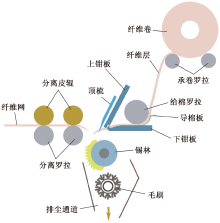
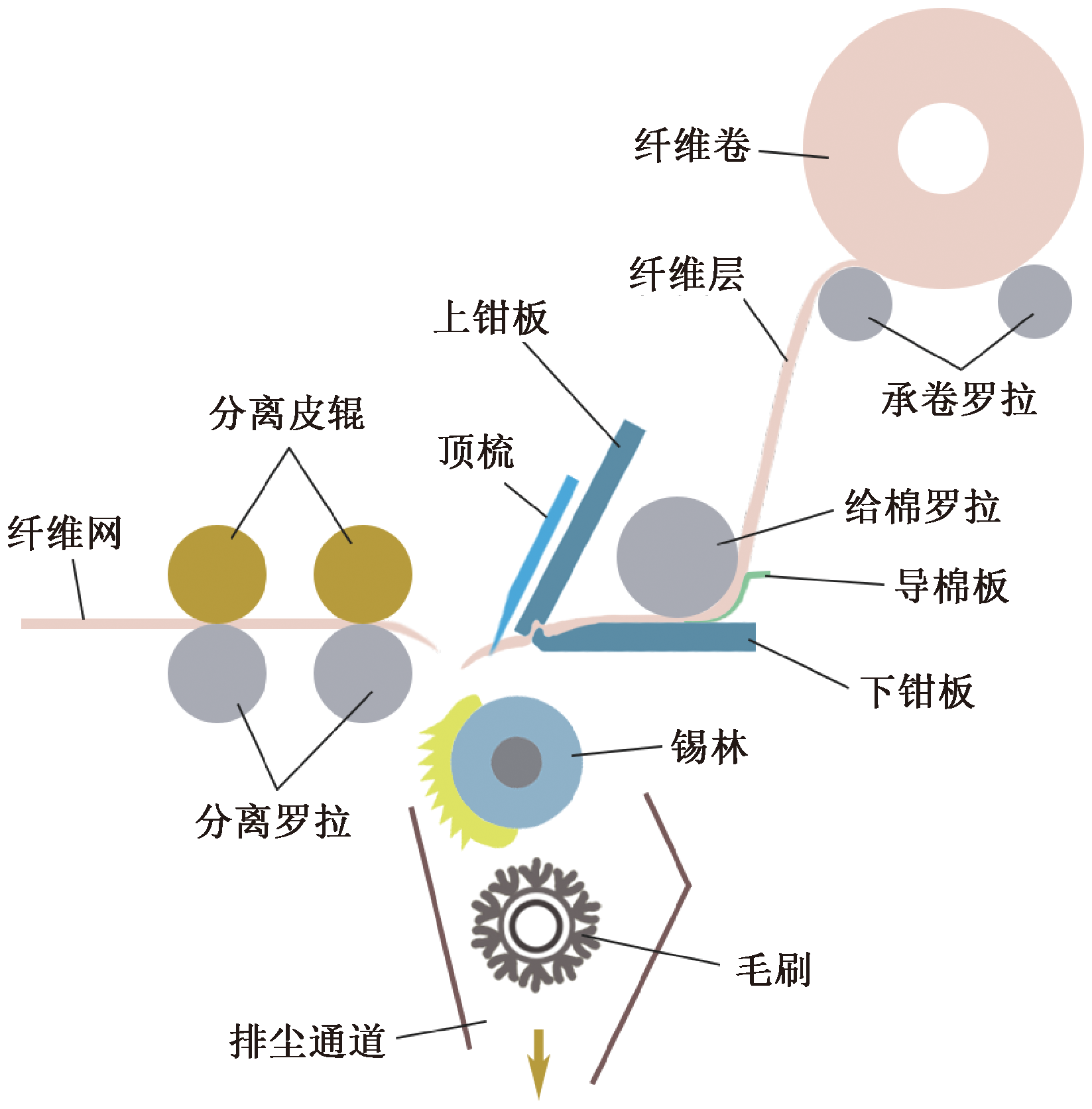
Fig.1

Combing and netting process of cotton spinning comber"

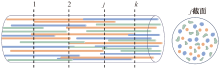
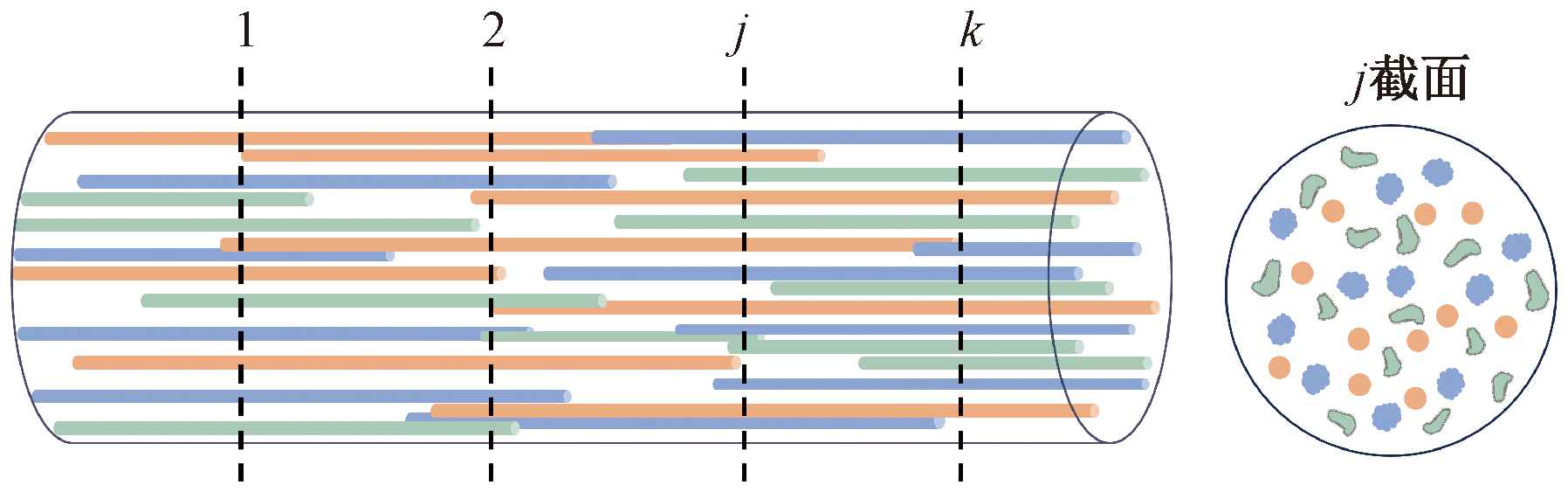
Fig.2

Blended combed yarn cross-section"

Tab.1

Design for blend ratio, fiber drop and feed ratio"

纤维种类 设计混纺比/% 落纤率/% 投料比/%
涤纶 40 4.70 38.37
30 15.76 32.56
粘胶 30 5.67 29.07

Fig.3

Spinning process flowchart"

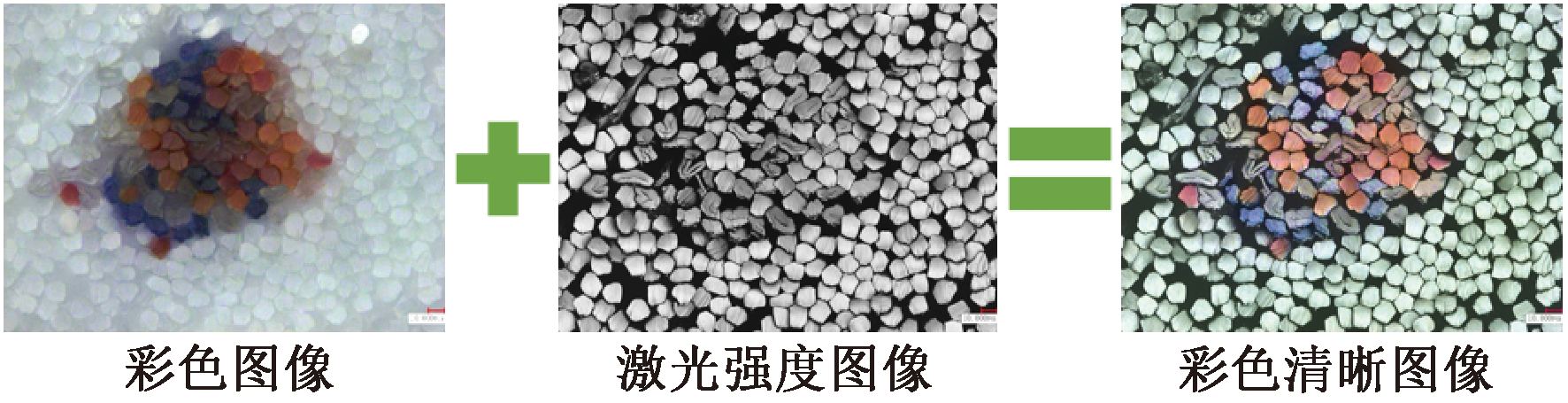
Fig.4

Color image acquisition process(×500)"

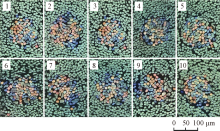
Fig.5

Yarn cross-section slices"

Tab.2

Numbers of three fibers in blended yarn cross-sections"

切片编号 N1j/ N2j / N3j/根
1 39 28 25
2 33 25 24
3 32 25 23
4 34 24 25
5 35 27 25
6 33 23 22
7 34 27 28
8 34 23 26
9 35 26 23
10 35 18 28

Tab.3

Actual blending ratios and their variance ratios"

纤维类别 ${\stackrel{-}{N}}_{ij}$/ Wi/g Pi/% δi/%
涤纶 34.4 0.122 39.21 1.98
24.6 0.137 31.48 4.93
粘胶 24.9 0.126 29.31 2.30

Tab.4

Statistical results of fibers counts in sections and their difference rates"

纤维类别 ${\stackrel{-}{N}}_{ij}$/ Wi/g Pi/% δi/%
涤纶 440.5 0.122 39.00 2.50
316.5 0.137 31.47 4.89
粘胶 323.0 0.126 29.53 1.55
[1] 任家智. 纺纱工艺学[M]. 上海: 东华大学出版社, 2010: 70-75.
REN Jiazhi. Technology of yarn spinning[M]. Shanghai: Donghua University Press, 2010:70-75.
[2] 贾国欣, 任家智. 天丝短纤棉纺精梳工艺研究[J]. 现代纺织技术, 2021, 29(1): 27-30.
JIA Guoxin, REN Jiazhi. Study on combing process of tencel staple fiber[J]. Advanced Textile Technology, 2021, 29(1): 27-30.
[3] 贾国欣, 任家智. 精梳机分离罗拉传动系统的棉型化纤加工特性分析[J]. 现代纺织技术, 2021, 29(2): 91-96.
JIA Guoxin, REN Jiazhi. Analysis of cotton type chemical fiber processing characteristics of detaching roller drive system of comber[J]. Advanced Textile Technology, 2021, 29(2): 91-96.
[4] 刘俊杰, 代佳佳, 杨圣明, 等. 混纺比对PLA棉混纺纱力学性能的影响[J]. 棉纺织技术, 2024, 9(5): 1-5.
LIU Junjie, DAI Jiajia, YANG Shengming, et al. Effect of blending ratio on mechanical property of PLA cotton blended yarn[J]. Cotton Textile Technology, 2024, 9(5): 1-5.
[5] 徐迪, 杨建平, 郁崇文. 汉麻锦纶混纺比对成纱质量的影响[J]. 棉纺织技术, 2021, 49(6): 10-14.
XU Di, YANG Jianping, YU Chongwen. Influence of blending ratio on hemp polyamide blended yarn quality[J]. Cotton Textile Technology, 2021, 49(6):10-14.
[6] 喻莉, 赵连英, 顾学锋. 纺纱方式和木棉纤维含量对Lyocell/木棉纤维/羊毛混纺纱性能的影响[J]. 毛纺科技, 2024, 52(4): 18-24.
YU Li, ZHAO Lianying, GU Xuefeng. Effect of spinning method and kapok fiber content on properties of Lyocell/kapok fiber/wool blended yarn[J]. Wool Textile Journal, 2024, 52(4): 18-24.
[7] 陈红霞, 李豪, 郑光明, 等. 不同混纺比亚麻/棉混纺纱临界捻系数的研究[J]. 上海纺织科技, 2023, 51(8): 43-45,63.
CHEN Hongxia, LI Hao, ZHENG Guangming, et al. Study on the critical twist factors of flax/cotton blended yarn with various blending ratios[J]. Shanghai Textile Science & Technology, 2023, 51(8): 43-45,63.
[8] 周宇阳, 王旭斌, 曹巧丽, 等. 双组分混纺纱断裂比功与混纺比的关系[J]. 纺织学报, 2023, 44(10): 39-47.
doi: 10.13475/j.fzxb.20220706901
ZHOU Yuyang, WANG Xubin, CAO Qiaoli, et al. Relationship between specific work of rupture and blended ratio of two-component blended yarns[J]. Journal of Textile Research, 2023, 44(10): 39-47.
doi: 10.13475/j.fzxb.20220706901
[9] 王佳慧, 刘海峰, 肖茹. 基于金属离子媒染原理的彩棉/白棉混纺定量检测[J]. 国际纺织导报, 2020, 48(8): 10-18.
WANG Jiahui, LIU Haifeng, XIAO Ru. Quantitative detection of colored cotton/white cotton blending ratio based on metal ion dyeing principles[J]. Melliand China, 2020, 48(8): 10-18.
[10] 巫莹柱, 梁家豪, 范菲, 等. 显微投影法测定棉/苎麻混纺比的不确定度评定[J]. 纺织学报, 2018, 39(11): 33-37.
doi: 10.13475/j.fzxb.20171008705
WU Yingzhu, LIANG Jiahao, FAN Fei, et al. Evaluation on uncertainty of cotton/ramie blending ratio by micro-projection[J]. Journal of Textile Research, 2018, 39(11): 33-37.
doi: 10.13475/j.fzxb.20171008705
[11] 张晓利, 巫莹柱, 黄美林, 等. PET和PBT混纺比定量分析的研究[J]. 上海纺织科技, 2016, 44(8): 46-48.
ZHANG Xiaoli, WU Yingzhu, HUANG Meilin, et al. Quantitative analysis of blending ratio of PET and PBT blends[J]. Shanghai Textile Science & Technology, 2016, 44(8): 46-48.
[1] LI Wenya, ZHOU Jian, LIAO Tanqian, DONG Zhenzhen. Structural control and spinning technology of highly wrapped core-spun yarn with thin sheath [J]. Journal of Textile Research, 2024, 45(06): 46-52.
[2] GUO Mingrui, GAO Weidong. Influence of digital yarn characteristic parameters on fabric appearance [J]. Journal of Textile Research, 2022, 43(11): 41-45.
[3] TU Li, MENG Jiaguang, LI Xin, LI Juanzi. Composition analysis and stripping process of waste wool/silk/cotton blended fabric [J]. Journal of Textile Research, 2019, 40(11): 75-80.
[4] . Analysis on properties of gradient yarns spun by three-channel digital ring spinning [J]. JOURNAL OF TEXTILE RESEARCH, 2018, 39(02): 62-67.
[5] . Research on the properties of blended fabrics with PTT/PLA/Rayon fibers [J]. JOURNAL OF TEXTILE RESEARCH, 2011, 32(8): 41-45.
[6] . The stain method for determining blending ratio of cellulose fibers and its influence factors [J]. JOURNAL OF TEXTILE RESEARCH, 2011, 32(7): 28-34.
[7] CHEN ZHIHUA;WU Peiyun. Effect of blending ratio on the bending property of cotton and bamboo / cotton mixed fabric [J]. JOURNAL OF TEXTILE RESEARCH, 2010, 31(3): 50-54.
[8] WU Li-li;HE Jun;YU Jian-yong. Crease resistance of soybean protein fiber/cotton blended fabric [J]. JOURNAL OF TEXTILE RESEARCH, 2005, 26(5): 92-94.
[9] TIAN Jun-ying;GU Zhen-ya. Application of fuzzy math to evaluating the relationships between wearability and blending ratio of linen/polyester fabric [J]. JOURNAL OF TEXTILE RESEARCH, 2005, 26(5): 49-51.
Viewed
Full text


Abstract

Cited

  Shared   
  Discussed   
No Suggested Reading articles found!