



随着人工智能、物联网的蓬勃发展,人们对便携、舒适、安全的智能可穿戴设备的需求日益增加[1-
本文采用熔融静电纺丝技术制备了聚丙烯(PP)和聚酰胺6(PA6)长丝纱,并将其分别与不锈钢纱线织造成发电织物。所制得的织物不仅柔软、轻薄、耐污,还具有可大面积制备的优势。由于熔融静电纺长丝纱中纤维直径较小,显著增加了织物表面的摩擦接触面积,从而有效提升了摩擦电效应和电输出性能。基于熔融静电纺长丝纱的TENG电输出性能远高于商业长丝纱制备的TENG,能够为微型电子设备提供稳定电力。此外,该TENG不仅展示出优异的性能稳定性,还具备在可穿戴设备和自供电系统中的广泛应用潜力。
1 实验部分
1.1 实验材料与仪器
材料:聚丙烯母粒(PP,上海伊士通新材料发展有限公司);聚酰胺母粒(PA6,江苏省国家先进功能纤维创新中心);商用PP长丝纱(线密度为133 tex,广州市兰精化纤有限公司);商用PA6长丝纱(线密度为156 tex,常熟涤纶有限公司);不锈钢纱线(线密度为31 tex,山东闻道科技有限公司)。
仪器:熔融静电纺丝装置(北京化工大学英蓝实验室自制);Gemini 500型场发射扫描电子显微镜(德国ZEISS公司);TSE502B型微机控制电子万能试验机(深圳万测试验设备有限公司);6517B型静电计、DAQ6510型万用表(美国Keithley公司);JC2000DM型接触角测量仪(上海中晨数字技术设备有限公司);YG461H型织物全自动透气量仪(宁波纺织仪器厂)。
1.2 熔融静电纺长丝纱的制备
将聚合物母粒以恒定的速率连续注入到纺丝装置的微分锥形喷嘴中并将其加热至熔融温度,熔体在喷嘴的锥形表面均匀展开,在高压电场的作用下,熔体形成多个射流。在压缩空气的辅助下,这些射流被引入涡旋气流管中,将纤维线头的一端缠绕在滚筒上,即可实现引导纤维在涡旋气流中的旋转,旋转后的纤维会在涡旋气流作用下加捻进而形成长丝纱。PP长丝纱纺丝过程所使用的电压为50 kV,熔融温度为210 ℃,纺丝距离为13 cm,收集速度为2 m/min,聚合物供给速率为12 g/h;PA6长丝纱纺丝过程所使用的电压为50 kV,熔融温度为260 ℃,纺丝距离为10 cm,收集速度为2 m/min,聚合物供给速率为40 g/h。
1.3 织物的制备
将不锈钢纱线作为经纱、熔融静电纺长丝纱或商业长丝纱作为纬纱上机织造,分别获得熔融静电纺PP织物、熔融静电纺PA6织物、商用PP织物和商用PA6织物。
1.4 测试与表征
使用场发射扫描电子显微镜表征长丝纱和织物表面形貌。使用电子万能拉伸实验机测试长丝纱的力学性能,测试的长丝纱长度为40 mm,拉伸速度为20 mm/min。使用万用表测试织物电极的电阻,织物大小为3 cm×3 cm。参考GB/T 30693—2014《塑料薄膜与水接触角的测量》,使用接触角测量仪测试织物表面的水接触角。参考GB/T 5453—1997《纺织品 透气性的测定》,使用织物全自动透气量仪测试织物的透气率。将PP织物和PA6织物组装成接触分离式的TENG(有效工作面积为3 cm×3 cm),使用静电计测试其输出性能。根据公式Pd=UI/A,计算功率密度。其中:Pd为功率密度,W/m2;U为电压,V;I为电流,A;A为有效工作面积,m2。
2 结果与讨论
2.1 熔融静电纺长丝纱的结构分析
图1
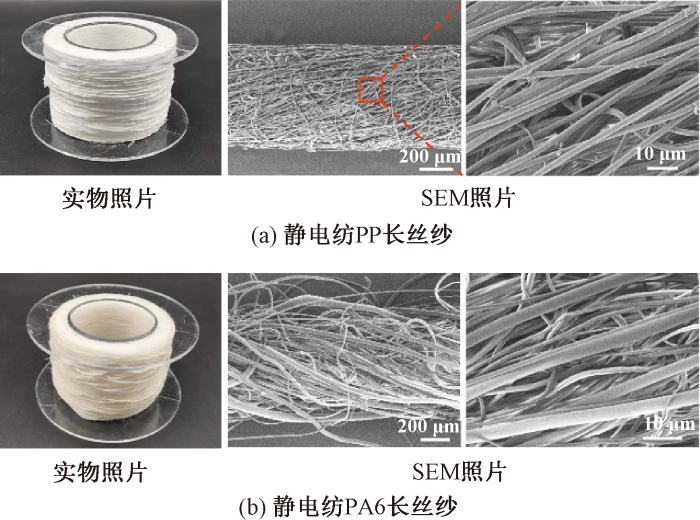
图1
熔融静电纺PP纱线和PA6纱线的实物及SEM照片
Fig.1
Real photoes and SEM images of melt-electrospun PP filament yarn (a) and PA6 filament yarn (b)
图 2 示出熔融静电纺PP和PA6长丝纱的应力-应变曲线。可以得出:PP长丝纱的断裂强度为20.4 MPa,断裂伸长率为90%;PA6长丝纱的断裂强度为21.3 MPa,断裂伸长率为72%。这表明长丝纱在实际使用过程中能够承受一定的外部应力和变形。
图2
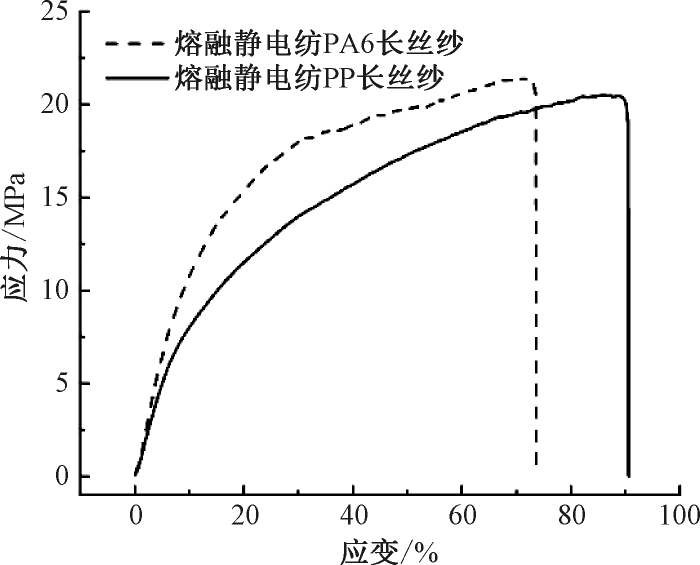
图2
熔融静电纺PP和PA6长丝纱的应力-应变曲线
Fig.2
Stress-strain curves of melt-electrospun PP and PA6 filament yarns
2.2 织物的结构和性能分析
图3

图3
织物结构示意图和实物展示
Fig.3
Fabric structure and display.
(a) Schematic diagram of fabric structure; (b) Real photo; (c) Demonstration of flexibility
图4
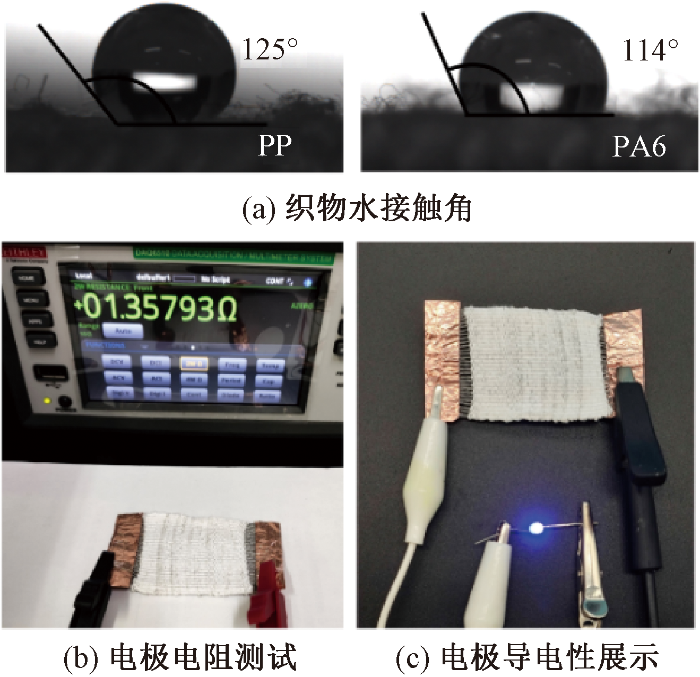
图4
织物的水接触角和电极的电阻
Fig.4
Water contact angle of fabric and conductivity of electrode.
(a) Water contact angle of fabric; (b) Resistance test of electrode; (c) Demonstration of electrode conductivity
2.3 摩擦纳米发电机的电输出性能分析
图5
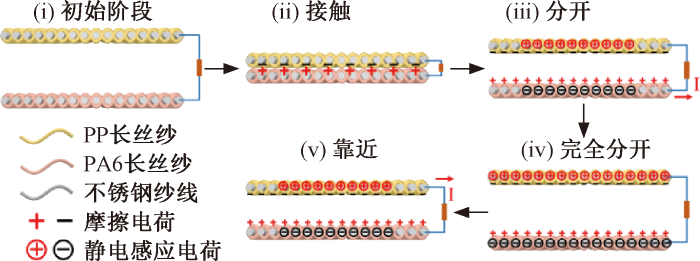
为探究熔融静电纺长丝纱在TENG中的应用,并突出其对性能优化的贡献,本文将用熔融静电纺PP长丝纱、PA6长丝纱构建的TENG与商用PP长丝纱(纤维平均直径为24 μm)和商用PA6长丝纱(纤维平均直径为38 μm)构建的TENG进行对比研究。图6示出所制备织物的实物和SEM照片,可以看出熔融静电纺长丝纱中纤维较细,所制备的织物表面结构较紧密,可有效增加摩擦工作面积。
图6
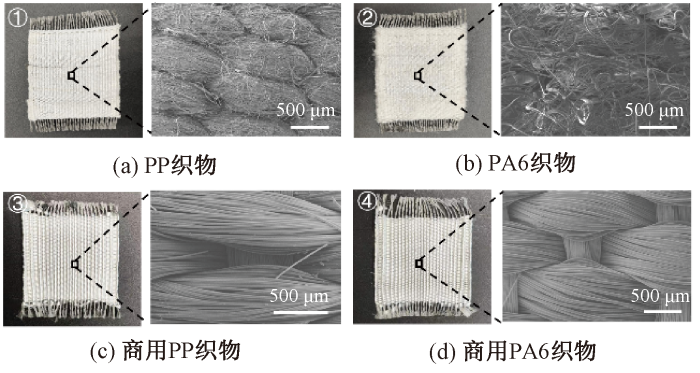
图6
4种织物的实物和SEM照片
Fig.6
Real photoes and SEM images of four fabrics.
(a) PP fabric; (b) PA6 fabric; (c) Commercial PP fabric; (d) Commercial PA6 fabric
图7示出在21 N、2 Hz的外力作用下上述织物组成的4组TENG的输出性能。可见,采用商用PP和PA6长丝纱构建的TENG的输出电压和电流分别仅为2.67 V和0.12 μA。采用PP或PA6熔融静电纺长丝纱构建的TENG的输出性能分别为29.59 V和3.53 μA、15.33 V和1.93 μA。而由熔融静电纺PP织物和PA6织物组成的TENG的电压和电流分别为110 V和11.4 μA,显著高于其它类型的TENG,且分别是商用长丝纱构建的TENG的41倍和95倍,主要是由于熔融静电纺长丝纱中纤维直径较小,可提高织物的表面粗糙度;另外所制备的织物结构较紧密,增加了有效接触面积。由此可见熔融静电纺工艺制备的长丝纱可有效提高TENG的电输出性能。
图7
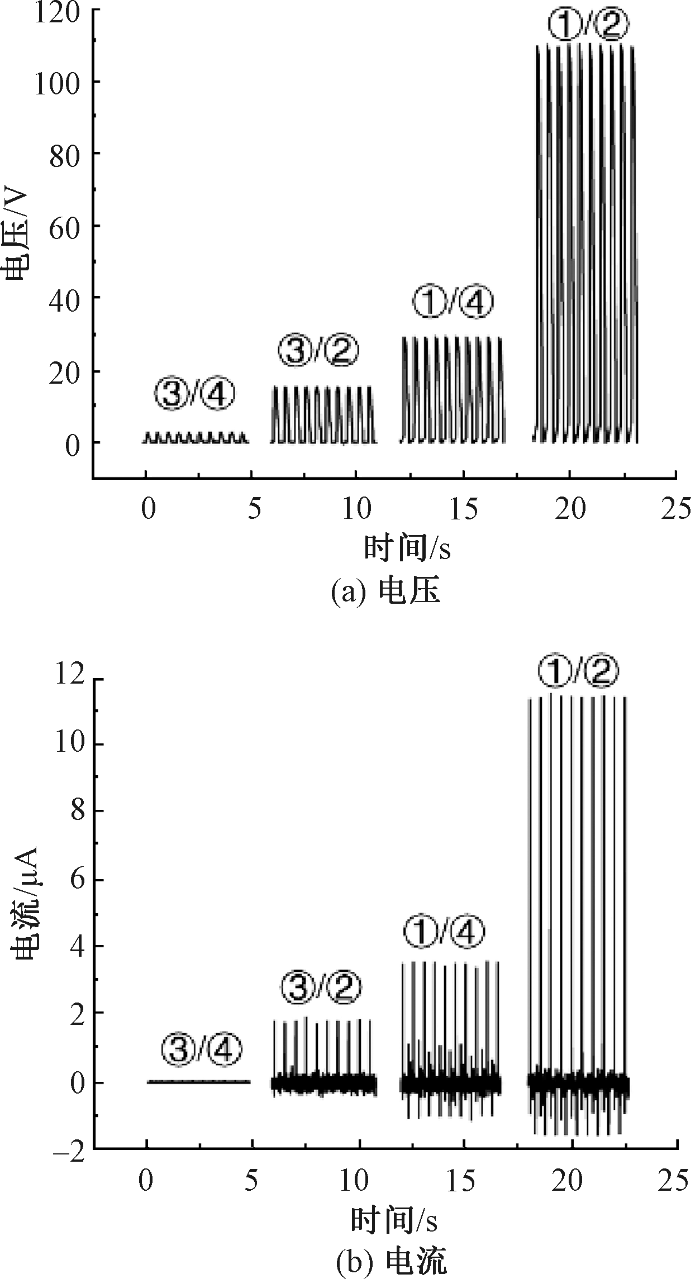
图7
4组TENG的电输出性能
Fig.7
Electrical output performance of four TENGs.
(a) Voltage; (b) Current
为评估TENG的环境的适应性,本文测试了在不同压力和不同频率下基于熔融静电纺PP和PA6长丝纱织造的织物基TENG的电输出性能。图8示出不同压力下TENG的输出性能。在工作频率为2 Hz时,随着压力的增加,TENG的电压从47 V增加到110 V,电流从0.8 μA增至11.4 μA。这是由于随着压力的增加,织物表面纤维的接触更加充分,摩擦面积增大,从而提高了电输出性能。
图8

图8
不同压力下TENG的输出性能
Fig.8
Output performance of TENG under different pressures.
(a) Voltage; (b) Current
图9
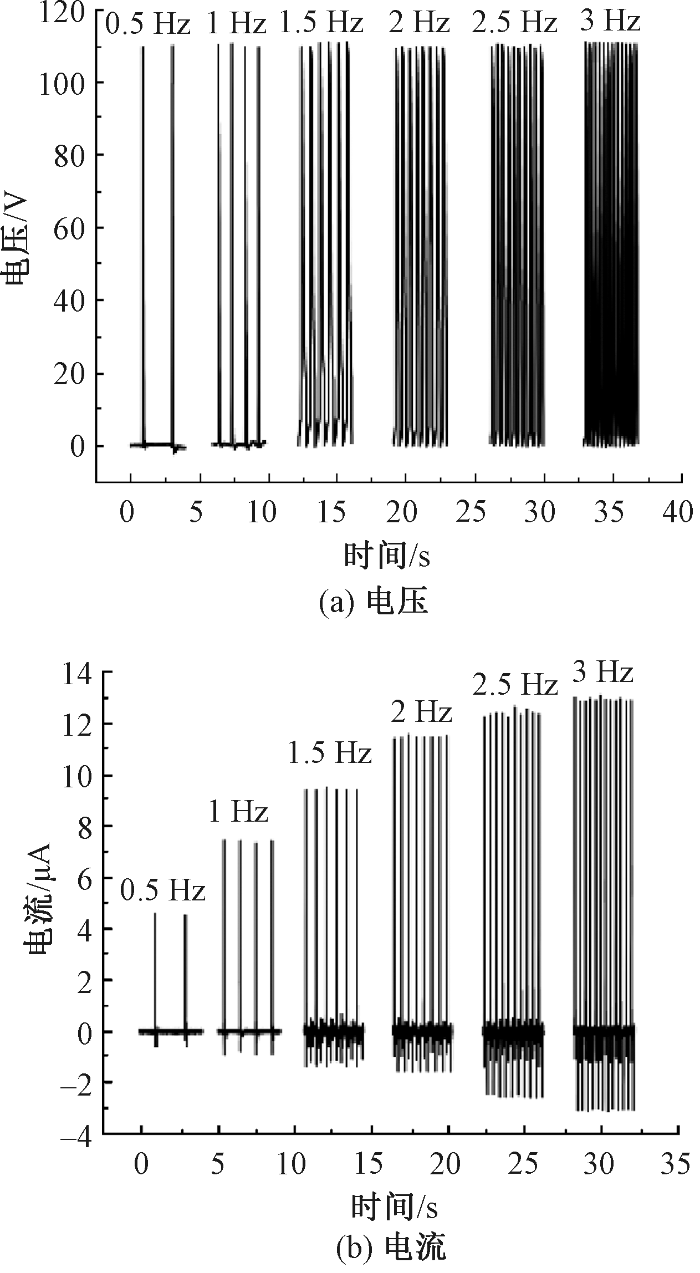
图9
不同频率下TENG的输出性能
Fig.9
Output performance of TENG under different frequencies.
(a) Voltage; (b) Current
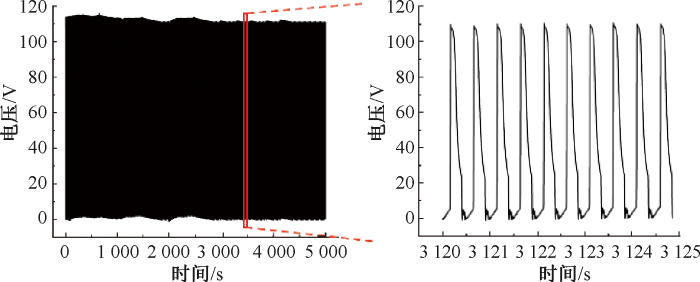
为评估TENG在长期稳定性和使用寿命,本文对其在5 000 s内工作的输出性能进行了测试,结果如图10所示。可见,TENG在长时间工作后依然能够保持优异的电输出性能,证明其具有较长的使用寿命和良好的稳定性。
图10
此外,耐水洗性也是TENG长期稳定使用的关键因素之一。图11示出PP织物和PA6织物进行多次水洗后其TENG的输出性能。结果显示,洗涤后的TENG的电输出性能没有显著下降,表明TENG具有较强的耐洗涤能力。
图11
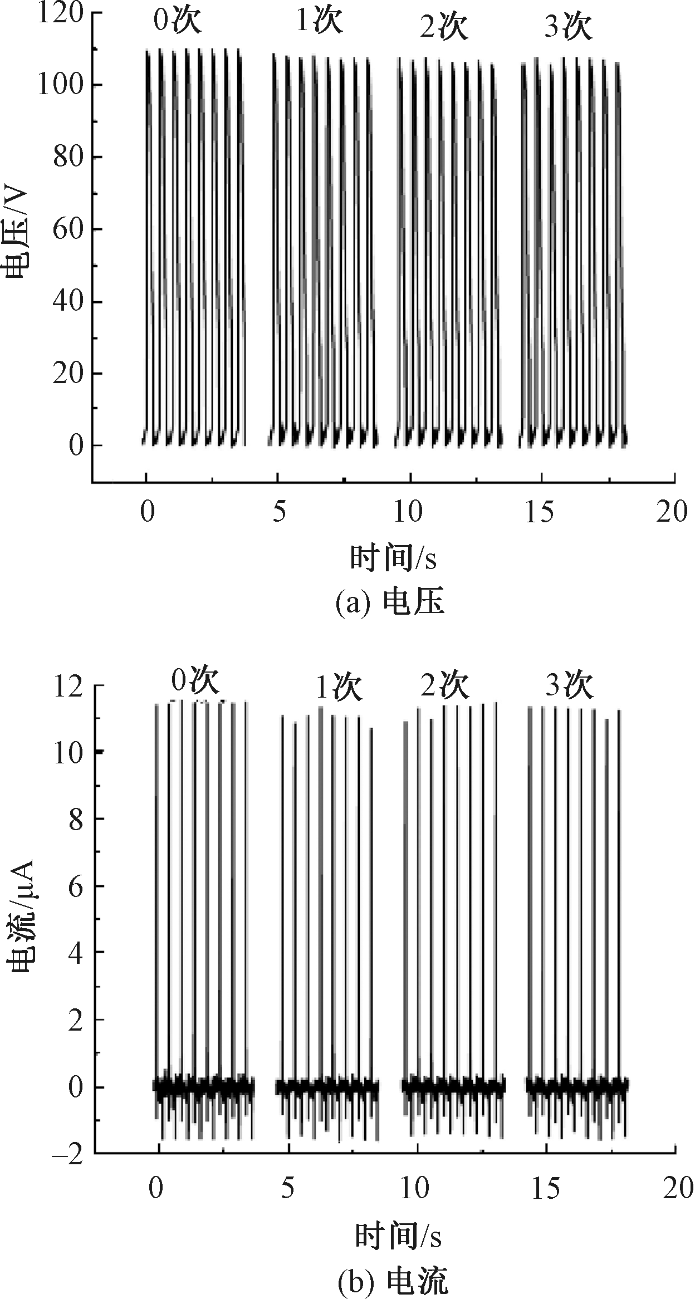
图11
不同洗涤次数下TENG的耐水洗性
Fig.11
Washing durability of TENG under different washing cycles.
(a) Voltage; (b) Current
图12
图12
不同电阻负载下TENG的输出电压、电流和功率密度
Fig.12
Output voltage and current (a) and power density (b) of TENG under different load resistances
2.4 摩擦纳米发电机的应用研究
由于其出色的电输出性能,TENG能够为小型电子设备提供稳定的电源。
图13(a)、(b)示出TENG为发光二极管(LED)灯和板上芯片(COB)灯提供电力的情况。可以看出,该TENG可点亮LED灯或18个蓝色COB灯。此外,TENG还能为不同容量的电容器进行充电。图13(c)示出TENG为不同容量的电容器充电的电压-时间曲线。可见,经充电70 s后,0.22、0.47、1、2.2、4.7、22 μF的电容器的电压分别可达27.26、10.28、6.87、4.55、2.80、0.60 V。图13(d)示出由TENG充电的电容器为电子表供电的情况。当TENG为1 μF的电容器充电14 s后,其电压可达到1.6 V,能驱动电子表工作。这充分展示了TENG为微型电子设备持续供电的应用潜力。
图13
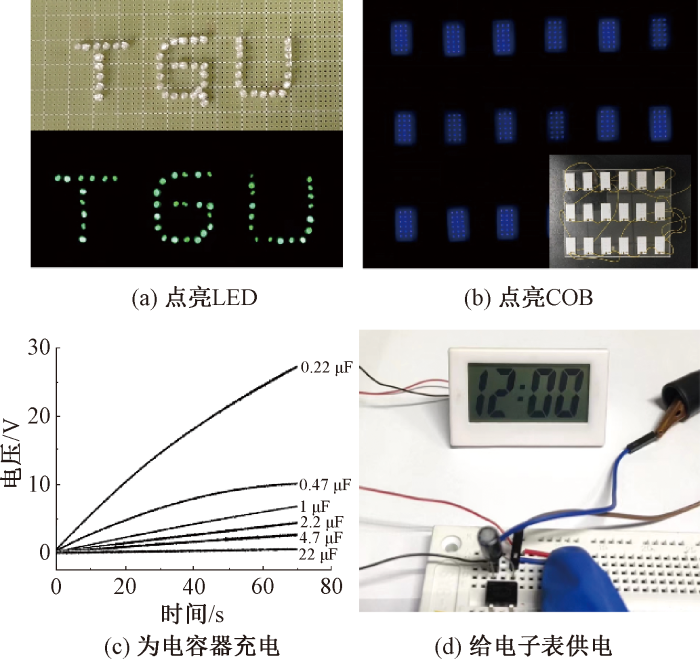
图13
TENG的应用
Fig.13
Application of TENG.
(a) Lighting LED; (b) Lighting COB; (c) Charging capacitor; (d) Charging digital watch
3 结论
本文采用熔融静电纺丝技术制备了聚丙烯(PP)和聚酰胺6(PA6)长丝纱,并结合不锈钢纱线构建了织物基摩擦纳米发电机(TENG)。熔融静电纺纱具有较小的纤维直径和优异的力学性能,可增加织物的粗糙度和有效摩擦面积,在摩擦电效应中表现出显著的优势。与商用PP和PA6长丝纱构建的TENG相比,基于熔融静电纺长丝纱的TENG不仅表现出了高电压和电流输出,分别是基于商用长丝纱的TENG的41倍和95倍,还展示了良好的长期使用稳定性和耐用性。本文研究为TENG的性能优化提供了新的思路,并展示其在可穿戴电子设备和自供电系统中的广泛应用前景。
参考文献
Smart textile triboelectric nanogenerators: current status and perspectives
[J].
High-performance textile-based triboelectric nanogenerators with damage insensitivity and shape tailorability
[J].
Thermal-triggered ″on-off″ switchable triboelectric nanogenerator based on two-way shape memory polymer
[J].
Integrating all-yarn-based triboelectric nanogenerator/supercapacitor for energy harvesting, storage and sensing
[J].
面向可穿戴电子产品的自供能摩擦电纺织品研究进展
[J].
Review on self-powered triboelectric textiles for wearable electro-nics
[J].
A self-charging power unit by integration of a textile triboelectric nanogenerator and a flexible lithium-ion battery for wearable electronics
[J].
Theoretical systems of triboelectric nanogenerators
[J].
Flexible triboelectric generator
[J].
Thermally robust hierarchical nanofiber triboelectric yarns for efficient energy harvesting in firefighting E-textiles
[J].
Fabric-based TENG woven with bio-fabricated superhydrophobic bacterial cellulose fiber for energy harvesting and motion detection
[J].
Advances in electrospun nanofibers for triboelectric nanogenerators
[J].
Continuously fabricated nano/micro aligned fiber based waterproof and breathable fabric triboelectric nanogenerators for self-powered sensing systems
[J].
Green and highly efficient preparation of superfine fiber yarns via vortex airflow-assisted melt differential electrospinning
[J].
柔性全编织摩擦纳米发电织物的制备
[J].
Preparation of flexible all-braiding triboelectric nanogenerator
[J].
Polyimide nanofiber-based triboelectric nanogenerators using piezoelectric carbon nanotube@barium titanate nanoparticles
[J].

 京公网安备11010502044800号


