



碳纳米管纤维是由轴向排列的单根碳纳米管组成的一维宏观体,也是碳纳米管高性能宏观集合体的代表之一。这种独特的结构使其能够较好地保持单根碳纳米管的优异性能。目前已经开发出许多将碳纳米管组装成碳纳米管纤维的制备技术,例如基于碳纳米管溶液的湿法纺丝技术[3]、超顺排垂直阵列碳纳米管直接抽丝技术[4]、浮游催化化学气相沉积法直接纺丝技术[5]等。这些方法的开发使碳纳米管纤维有望达到与碳纳米管单体同等水平的优异性能。然而,由于纤维中碳纳米管的单体长度短、排列取向度差、杂质和结构缺陷等问题,碳纳米管纤维目前还远未能利用和充分发挥单根碳纳米管的本征优异性能。因此,研究者们提出了多种后处理策略来优化碳纳米管纤维的结构和提升碳纳米管纤维的性能,如压制、拉伸和扭曲[6-7]。通过这些方法,碳纳米管纤维的抗拉强度达到了9.6 GPa[8],电导率达到1.06×10⁷ S/m[9]。与目前工业上常用的金属纤维和聚合物纤维相比,碳纳米管纤维在抗拉强度、弹性模量、电导率、热导率、比表面积和柔性等方面均具有优势。此外,在各类碳基纤维中,碳纳米管纤维与商业上广泛使用的碳纤维具有相当水平的力学性能,并在比表面积、电导率和柔韧性等诸多方面比碳纤维具有优势。总的来说,在当今智能化、多功能化、精细化、应用环境极端化的趋势下,碳纳米管纤维在制造先进多功能纤维状设备方面显示出巨大的应用潜力。
尽管碳纳米管纤维的理论优异性能使其成为新型功能纤维的理想构件,但作为一种纯碳材料,且其表面化学惰性和结晶性很高,在许多情况下不能直接用作功能性部件,而是需要进行功能化改进和处理后,才能满足制造先进功能纤维的需求。具体而言,分层结构设计使碳纳米管纤维能够产生较大的拉伸或扭转驱动[10],制备好的碳纳米管纤维可进一步功能化,作为传感器或执行器对各种信号刺激做出响应,如电压、热、湿度或化学信号刺激。例如,通过结合氧等离子体处理的表面改性和分层结构设计,可实现本征疏水碳纳米管纤维的湿度驱动[11]。此外,碳纳米管纤维是构建纤维电子器件的理想柔性电极[12]。碳纳米管纤维可与具有离子选择性的材料结合实现离子检测,与活性材料结合实现储能,与导电聚合物结合实现热电发电等[13]。此外,越来越多的研究将高性能的功能化碳纳米管纤维进一步集成到具有复杂结构的多功能纤维或透气纺织品中[14-15]。在工业化进展方面,目前已有公司实现了碳纳米管纤维的小规模生产,并尝试应用于轻质导线、发热织物和可穿戴织物电池等,在软机器人、医疗保健、智能纺织品和可穿戴设备等新兴前沿领域中展现出了应用潜力。但与此同时,碳纳米管功能纤维仍面临批量制备、缺陷控制、功能化策略单一、应用开发不充分等科学和技术上的挑战。本文对碳纳米管纤维的可控制备技术和功能化策略进行回顾,并对其应用研究进展进行分析与总结,期望能对碳纳米管功能纤维的可控制备、性能调控以及未来发展提供启发和借鉴。
1 碳纳米管纤维的可控制备技术
1.1 湿法纺丝技术
湿法纺丝是一类较早开发的碳纳米管纤维制备技术。在湿法纺丝过程中,碳纳米管首先在表面活性剂的作用下分散在溶液中,接着被注入到凝固液中组装成纤维[18]。与阵列纺丝和直接纺丝技术相比,湿法纺丝制备的碳纳米管纤维单体长度较短,但排列紧密度和取向度较好[19]。此外,湿法纺丝工艺将纤维的制备与碳纳米管单体生长解耦,因此其放大生产较易实现。受到棒状聚合物湿法纺丝过程的启发,Vigolo等[20]使用十二烷基硫酸钠辅助分散碳纳米管,并在聚乙烯醇溶液中将碳纳米管纺制成纤维,但是这个过程制备的碳纳米管纤维不可避免地受到聚合物和表面活性剂等杂质的影响。为解决这个问题,采用了具有强质子化能力的超强酸溶液分散碳纳米管,碳纳米管与水接触时极易沉淀,因此消除了表面活性剂和聚合物的影响,制备出纯度相对较高的碳纳米管纤维[19]。
对于湿法纺丝制备的碳纳米管纤维,碳纳米管原料的质量至关重要。Taylor等[8]使用碳纳米管单体长径比高达6 700的原料制备出高性能碳纳米管纤维。高结晶度的碳纳米管充分溶解在氯磺酸中并形成液晶,制备出的碳纳米管纤维电导率达到10.9 MS/m,抗拉强度达到4.2 GPa。
1.2 阵列抽丝技术
如从蚕茧或棉花中抽丝一样,碳纳米管也可以从可纺的碳纳米管垂直阵列中抽出并自组装成纤维。在抽丝过程中,碳纳米管束从阵列中依次脱离,并在范德华力的作用下首尾相接形成连续的丝线。但是,阵列抽丝技术对碳纳米管垂直阵列的清洁和顺排程度要求很高,只有表面干净、碳纳米管平行度较高且管间存在较强的范德华力作用的“超顺排碳纳米管阵列”才可被纺丝,这大大限制了碳纳米管的生长窗口,对碳纳米管阵列的制备提出了较为严苛的要求。Jiang等[21]首次报道了阵列纺丝技术,并制备出了长达30 cm的碳纳米管纱线;由于范德华力作用较弱,因此该纱线力学强度较差;其进一步通过乙醇处理和热处理提升了纤维强度,并成功在100 mm的硅晶圆上制备出了超顺排碳纳米管垂直阵列。
1.3 浮动催化直接纺丝技术
阵列抽丝技术虽然能够制备出较为清洁且强度较高的碳纳米管纤维,但受限于碳纳米管垂直阵列晶圆尺寸,因此其不适合于纤维的大规模连续生产[24]。近年来,对从浮动催化法生长的碳纳米管气凝胶直接纺丝成碳纳米管纤维的方法进行了大量研究,该方法可以保持较高质量的碳纳米管单体同时实现碳纳米管纤维的连续化制备。在浮动催化化学气相沉积过程中,大量漂浮生长的碳纳米管在反应器出口处自组装成宏观结构,结合加捻、溶液处理等后处理方法形成纤维。碳纳米管的制备条件,如催化剂、气体流速、温度、反应器类型等对纤维质量起到至关重要的作用。Zhou等[25]研究了卷绕速率和反应恒温区的协同作用,研究发现,当管式炉的恒温区超过一定长度时,碳纳米管的取向度随着恒温区长度的降低和卷绕速率的增加而提高,而碳纳米管单体长度随恒温区长度的增加和卷绕速度的降低而增加。通过优化条件,在无后处理的情况下制备出了抗拉强度为3.1 N/tex的碳纳米管纤维。Lee等[26]报道了一种深度注射浮动催化法,通过将前驱体和催化剂直接注入管式炉反应高温区,连续制备出了碳纳米管单体长径比和结晶度均较高的碳纳米管纤维。
2 碳纳米管纤维的功能化策略
面向实际应用的需求,碳纳米管纤维很难直接应用,而是需对其进行功能化处理来增强其本征性能或赋予其它功能。目前发展的功能化策略主要包括多级结构设计和与功能材料复合,如图1所示。本节主要总结了碳纳米管纤维的功能化策略,并对不同方法适合的不同应用方向做了分析。
图1
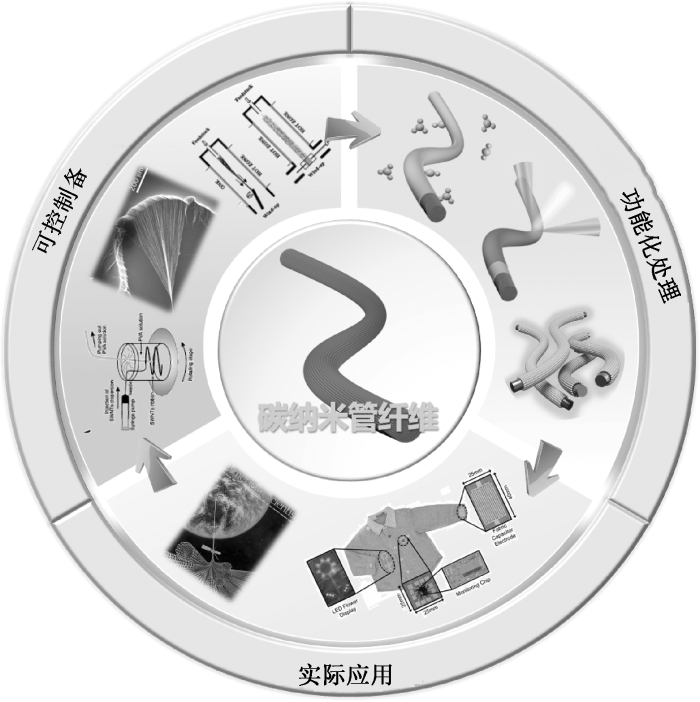
图1
碳纳米管功能纤维的可控制备及功能化处理与实际应用
Fig.1
Controlled synthesis, functionalization and application of functional carbon nanotube fibers
2.1 与功能材料复合
2.1.1 物理复合
碳纳米管纤维与功能材料的直接结合通常通过较为简单的固/液混合方法实现,为复合纤维直接带来新功能。
随着纳米科学与技术的进步,原子层沉积、磁控溅射、化学自组装等方法可以实现对材料纳米尺度的精细调控。针对碳纳米管纤维对可见光吸收率超高且表面化学惰性极强因此难以被染色这个问题,本课题组首次提出了利用结构致色实现碳纳米管彩色化的思路,通过原子层沉积技术在碳纳米管纤维表面覆盖一层厚度仅为50~300 nm的金属氧化物致密涂层,利用薄膜干涉的原理实现了碳纳米管的结构致色[32]。该复合纤维表现出良好的耐久性,且与涂层的复合提高了纤维高温下的抗氧化能力。通过精细调整氧化物的种类和厚度,还可以精确调控复合纤维的颜色。进一步地,在碳纳米管纤维表面包覆2层不同的金属氧化物(TiO2、Al2O3和ZnO),实现了碳纳米管纤维的宽色域、饱和度亮度可调节的结构致色[33],大大拓展了碳纳米管纤维在智能显示、可穿戴设备、隐身等领域的应用范围。
由于原子层沉积技术存在价格昂贵、难以放大、耗时极长等限制,不适合彩色碳纳米管纤维的大批量生产。在此背景下,本课题组进一步发展了SiO2光子晶体的自组装策略,以一种高效率且低成本的液相方式,实现了碳纳米管纤维的彩色化[34]。通过调控SiO2纳米小球的粒径,可精准调控彩色碳纳米管纤维的色彩。通过加入黏性共聚物,使彩色碳纳米管纤维呈现出很好的力学稳定性和耐水洗能力。同时,由于无定形的光子晶体结构,彩色碳纳米管纤维呈现出非虹彩的特性,能够表达出单一且准确的光学信息,便于其在智能显示、智能织物、功能涂料等方面的应用。
2.1.2 化学修饰与原子掺杂
2.2 碳纳米管功能纤维的多级结构设计
由于碳纳米管纤维具有良好的柔韧性和较高的力学强度,很容易对其进行多级结构设计以适应不同应用的需求。受到羊毛结构的启发,Liu等[30]制备了具有良好的可拉伸性的螺旋碳纳米管纤维。仿羊毛状结构使纤维内部碳纳米管间存在空隙,该纤维展现出良好的热绝缘性能。通过引入多级扭转结构制备出的碳纳米管绳索比简单的碳纳米管纤维或螺旋纤维具有更大的拉伸应变。Kim等[39]将拉伸和盘绕的碳纳米管纤维用作储能装置,可为发光二极管和电容器供电。这种有多级结构的纤维拥有更多的纳米孔道,从而可容纳更多的电解质离子。Gao等[40]制备了螺旋碳纳米管/PU复合纤维。弹簧状的纤维形状和本征具有弹性的PU的协同作用使复合纤维具有良好的可拉伸性。同时,通过扭转使得碳纳米管紧密缠绕和锁定在复合纤维中,使纤维具有良好的导电性。
3 碳纳米管纤维的应用
3.1 碳纳米管纤维基传感器件
基于碳纳米管纤维的传感器大致分为物理传感器和化学传感器2类,本节综述了近年来碳纳米管纤维基传感器的研究进展,系统讨论了这类传感器的结构设计、传感机制、制备与功能化策略,及其在健康监测、人机交互等领域的应用,并在此基础上对其未来发展方向进行展望。
3.1.1 物理传感器
1)光探测器。光探测器能够将光转换成易于输出的其它信号,随着可穿戴设备的兴起,其有望在可穿戴健康监测、成像和光通信等领域发挥重要作用。可穿戴光探测器的关键特征之一是其本征柔韧性,以及在一定范围内的弯曲、拉伸、压缩或扭转下保持稳定性能的能力;碳纳米管纤维凭借其优良特性,成为开发可穿戴式光探测器的理想候选材料之一[45]。
扭曲和屈曲是常用的纤维微结构设计方法,例如,通过预加捻可以引入螺旋结构,大大增强纤维的应变能力。此外,为改善纯碳纳米管纤维传感器的可拉伸性,常将弹性聚合物掺入碳纳米管纤维制备混合纤维,基于此制备具有高拉伸性的力学传感器[44,52]。Gao等[40]采用静电纺丝和加捻工艺制备了一种具有分层结构的螺旋碳纳米管/PU纳米纤维复合纱线,其电阻取决于拉伸过程中分级结构的变化[40]。这项研究从理论和实验上证实了微/纳米多尺度结构耦合作用对材料力学性能的增强效应,制备得到的螺旋纱线在900%拉伸范围内表现出优异的电阻恢复性和稳定性,最大拉伸伸长率为1 700%,有效解决了大应变传感下的恢复性问题[40]。同时,碳纳米管在基体中的排列、含量等参数决定了纤维拉伸过程中的有效接触面积和导电路径数量,通过对这些参数的调控可以优化导电网络,调控传感器的导电性和应变灵敏度[43]。
3.1.2 化学传感器
3.2 碳纳米管纤维基储能器件
3.2.1 超级电容器
碳纳米管纤维基超级电容器的结构大致可分为平行型、缠绕型和同轴型。2003年,Dalton等[66]首次使用2根扭曲的碳纳米管纤维制备出可集成到织物上的纤维状超级电容器[66]。相比之下,同轴型的超级电容器由核心纤维电极、固体/凝胶电解质层以及外层电极构成,层层堆叠的结构设计使其具有更高效的电极界面接触,因此具有更好的化学和力学稳定性。Chen等[67]利用取向碳纳米管纤维和薄膜作为内外电极,中间夹有凝胶电解质,这种独特的同轴结构有效降低了2个电极之间的接触电阻,器件最大放电电容达到59 F/g,远高于此前缠绕式超级电容器所报道的4.5 F/g,并在11 000次充放电循环后电容没有明显下降[67]。
然而,由于纯碳纳米管纤维的微孔体积有限,其比容量较低,纯碳纳米管纤维基超级电容器的能量密度受到其理论比容量较低的限制,表现出较差的储能性能。为提高碳纳米管纤维电极的比电容,一种常用的策略是增大材料的有效比表面积、优化电极材料的孔道结构[65]。Ren等[68]通过化学气相法沉积碳纳米管阵列,在其孔洞内引入介孔碳(OMC)后扭转形成碳纳米管/介孔碳复合丝线,同时使用聚乙烯醇-磷酸(PVA-H3PO4)凝胶电解质构建超级电容器,结果表明,引入第二相介孔碳能够有效提高纤维超级电容器的储能比容量。另一种能够有效提高比电容的策略是在纤维表面引入异质赝电容结构。研究者们通常将纤维表面与金属氧化物或导电高分子聚合物进行复合,利用金属氧化物或导电聚合物的氧化还原反应,产生赝电容效应,从而提高纤维的储能性能[63,65]。相比于刚性金属或金属氧化物,使用具有柔性的导电赝电容聚合物进行复合更有利于实现器件的高柔性和可编织性。Huang等[69]通过控制表面电沉积条件制备了3种具有不同三维分级结构的聚吡咯(PPy)/碳纳米管纤维复合电极,其中,基于垂直排列的PPy纳米阵列/碳纳米管纤维(CNTF)的超级电容器表现出最优的柔韧性和稳定性,在0.4 A/g下表现出178.14 F/g的高比电容[69]。研究表明,通过优化复合纤维电极微/纳米尺度的三维结构设计,能够有效缩短离子扩散距离,提高超级电容器的比容和充放电效率。
3.2.2 电化学电池
在电化学电池中,物质通过发生氧化还原反应实现电荷转移和能量储存,其反应原理取决于具体的电池种类,常见的电池种类有锂离子电池、金属-空气电池、水系离子电池等[63]。纤维基电化学电池由2个纤维电极、隔膜、电解质和封装层组成,通常采用平行型、缠绕型和同轴型3种结构,其中,碳纳米管纤维是纤维电极的有力候选材料,近些年受到了广泛研究。本部分将介绍基于碳纳米管纤维的常见种类的电化学电池,包括其机制、制备、优化策略及研究进展。
1)锂离子电池。锂离子电池具有能量密度高、循环寿命长、工作温度范围宽、充电效率高、环境友好等优点,其电化学性能很大程度上取决于电极材料的成分、微结构和形貌[63,70]。相比于传统的电极材料,碳纳米管纤维具有本征缠绕和弯曲特性,且其高比表面积能够提供更多的储锂位点,从而改善锂离子的扩散和脱嵌速率;然而,由于碳纳米管本身存在结构缺陷和较高的电压迟滞,基于纯碳纳米管纤维电极的锂离子电池比容量和充放电效率均较低[70]。为解决这些问题,研究者们通过引入活性材料、异质原子掺杂等方法提升纤维电极的电化学性能[70]。硅、MoS2、Li4Ti5O12、LiMn2O4等多种活性功能成分已被用于制备碳纳米管复合纤维电极,这类复合电极无需传统的金属集流体、黏合剂或其它添加剂,使用简单结构即可实现集流体和活性材料间的良好结合。Jung等[71]采用简单的热处理和原位合成法,将碳纳米管纤维合成过程中残留的铁催化剂转化为具有电化学活性的Fe2O3纳米颗粒,并将其均匀修饰于碳纳米管表面,制备出的Fe2O3/碳纳米管纱线(CNTY)电极具有高达132 MPa/(g·cm-3)的比强度和1.59×105 S/m的高电导率[71]。
碳纳米管纤维基电化学电池的大规模可控生产是限制其进一步推广的重要因素,其受限于电极的均匀修饰、高效封装和连续化工艺的开发。随着大规模可控生产技术的突破,基于碳纳米管纤维的电化学电池有望实现在智能纺织品、可穿戴设备等多个领域中的实际应用。
4 结束语
本文从可控制备方法、功能化策略及应用现状等方面系统总结了碳纳米管功能纤维的可控制备与性能调控相关的研究进展。在可控制备方面,碳纳米管纤维的制备方法主要有湿法纺丝、阵列抽丝和浮动催化直接纺丝3种。其中,浮动催化直接纺丝可在保持较高质量的碳纳米管单体的同时实现碳纳米管纤维的连续化制备,已成为碳纳米管纤维制备的主流方法。碳纳米管纤维的功能化策略主要包括与功能材料复合和多级结构设计2种。碳纳米管纤维与功能材料的复合又可分为物理复合和化学复合2种,是较为普遍使用的功能化方法。随着纳米技术的发展,通过原子层沉积、化学自组装等方法可实现对纤维结构的纳米尺度的精细调控,从而满足对纤维结构和功能更精准的需求。多级结构的设计充分利用了碳纳米管纤维高柔韧性的特点,制备出的多级结构可增强功能纤维的可拉伸性、力学和电学等性能。
本文重点介绍了碳纳米管纤维在储能、传感等领域的应用进展。相比于传统的平面式器件,碳纳米管纤维基器件更加轻便灵活,在柔韧性、稳定性和灵敏度等方面展现出无可比拟的优势,在柔性可穿戴设备与智能织物等领域具有巨大的应用前景。然而,仍需认识到虽然碳纳米管的研究已经历三十几年的发展,但目前水平还远远无法实现批量可控制备,更无法满足许多新兴或高端应用领域的需求。仍有许多科学和技术难题亟待解决,在此对碳纳米管功能纤维的未来发展方向做出以下展望。
在制备方面,大批量无缺陷碳纳米管纤维的制备受到单根碳纳米管结构和纤维后处理2方面影响。因此,一方面需要通过反应器设计、制备条件创新等手段提升碳纳米管单体的长度、排列取向度、减少结构缺陷,另一方面需要开发新型高效的纤维加捻、杂质去除等后处理技术,真正实现高性能碳纳米管纤维的可控制备,发挥碳纳米管的本征优异性能。在碳纳米管纤维的功能化策略方面,与功能材料的复合和多级结构设计仍是需大力发展的研究方向,但需注意在使用这些方法时对碳纳米管本征结构带来的影响,在不损害碳纳米管单体结构和性能的情况下制备出复合功能纤维。原子层沉积等更精确可控的制备方法受到越来越多的关注。另外,在面向大规模应用时,碳纳米管功能纤维的制造成本需进一步降低。在碳纳米管功能纤维的应用方面,目前已看到碳纳米管纤维在能源存储与转换、传感、柔性电子、可穿戴设备、航空航天等领域的应用潜力,还需结合先进制备与表征技术,进一步提升碳纳米管纤维器件性能,提高其在各种环境条件下的稳定性和耐久性,还需考虑与现有产业链和制备技术的兼容性,逐步实现多功能的集成与融合。可以预见,随着纳米科技的不断进步和新材料的开发,碳纳米管纤维的应用领域将进一步扩展,其在新材料开发和技术创新中的作用将越来越重要。
总之,越来越多的学术和工业界的研究已经说明了碳纳米管功能纤维的巨大应用前景,尤其是在智能可穿戴设备、航空航天、储能等新兴和尖端领域,这对于碳纳米管功能纤维的未来发展提出了更高的目标和要求。未来需以实际需求为导向,积极吸纳交叉学科中的概念与方法,开发碳纳米管功能纤维的先进制备技术,拓展其应用领域,真正实现其在尖端领域的广泛应用。
参考文献
Superstrong ultralong carbon nanotubes for mechanical energy storage
[J].
Understanding the mechanical and conductive properties of carbon nanotube fibers for smart electro-nics
[J].
Strong, light, multifunctional fibers of carbon nanotubes with ultrahigh conductivity
[J].
DOI:10.1126/science.1228061
PMID:23307737
[本文引用: 1]

Broader applications of carbon nanotubes to real-world problems have largely gone unfulfilled because of difficult material synthesis and laborious processing. We report high-performance multifunctional carbon nanotube (CNT) fibers that combine the specific strength, stiffness, and thermal conductivity of carbon fibers with the specific electrical conductivity of metals. These fibers consist of bulk-grown CNTs and are produced by high-throughput wet spinning, the same process used to produce high-performance industrial fibers. These scalable CNT fibers are positioned for high-value applications, such as aerospace electronics and field emission, and can evolve into engineered materials with broad long-term impact, from consumer electronics to long-range power transmission.
Strong, transparent, multifunctional, carbon nanotube sheets
[J].Individual carbon nanotubes are like minute bits of string, and many trillions of these invisible strings must be assembled to make useful macroscopic articles. We demonstrated such assembly at rates above 7 meters per minute by cooperatively rotating carbon nanotubes in vertically oriented nanotube arrays (forests) and made 5-centimeter-wide, meter-long transparent sheets. These self-supporting nanotube sheets are initially formed as a highly anisotropic electronically conducting aerogel that can be densified into strong sheets that are as thin as 50 nanometers. The measured gravimetric strength of orthogonally oriented sheet arrays exceeds that of sheets of high-strength steel. These nanotube sheets have been used in laboratory demonstrations for the microwave bonding of plastics and for making transparent, highly elastomeric electrodes; planar sources of polarized broad-band radiation; conducting appliqués; and flexible organic light-emitting diodes.
High-performance carbon nanotube fiber
[J].With their impressive individual properties, carbon nanotubes should form high-performance fibers. We explored the roles of nanotube length and structure, fiber density, and nanotube orientation in achieving optimum mechanical properties. We found that carbon nanotube fiber, spun directly and continuously from gas phase as an aerogel, combines high strength and high stiffness (axial elastic modulus), with an energy to breakage (toughness) considerably greater than that of any commercial high-strength fiber. Different levels of carbon nanotube orientation, fiber density, and mechanical properties can be achieved by drawing the aerogel at various winding rates. The mechanical data obtained demonstrate the considerable potential of carbon nanotube assemblies in the quest for maximal mechanical performance. The statistical aspects of the mechanical data reveal the deleterious effect of defects and indicate strategies for future work.
Multifunctional carbon nanotube yarns by downsizing an ancient technology
[J].By introducing twist during spinning of multiwalled carbon nanotubes from nanotube forests to make multi-ply, torque-stabilized yarns, we achieve yarn strengths greater than 460 megapascals. These yarns deform hysteretically over large strain ranges, reversibly providing up to 48% energy damping, and are nearly as tough as fibers used for bulletproof vests. Unlike ordinary fibers and yarns, these nanotube yarns are not degraded in strength by overhand knotting. They also retain their strength and flexibility after heating in air at 450 degrees C for an hour or when immersed in liquid nitrogen. High creep resistance and high electrical conductivity are observed and are retained after polymer infiltration, which substantially increases yarn strength.
Super-strong carbon nanotube fibers achieved by engineering gas flow and postsynthesis treatment
[J].
Improved properties, increased production, and the path to broad adoption of carbon nanotube fibers
[J].
High-strength carbon nanotube film from improving alignment and densification
[J].
DOI:10.1021/acs.nanolett.5b03863
PMID:26757031
[本文引用: 1]
A new method is reported for preparing carbon nanotube (CNT) films. This method involves the continuous production of a hollow cylindrical CNT assembly and its condensation on a winding drum. The alignment and densification of CNTs in the film are improved by controlling the winding rate and imposition of mechanical rolling, respectively. The prepared film has a strength of 9.6 GPa, which is well above those for all other man-made films and fibers.
Electrically, chemically, and photonically powered torsional and tensile actuation of hybrid carbon nanotube yarn muscles
[J].
DOI:10.1126/science.1226762
PMID:23161994
[本文引用: 1]
Artificial muscles are of practical interest, but few types have been commercially exploited. Typical problems include slow response, low strain and force generation, short cycle life, use of electrolytes, and low energy efficiency. We have designed guest-filled, twist-spun carbon nanotube yarns as electrolyte-free muscles that provide fast, high-force, large-stroke torsional and tensile actuation. More than a million torsional and tensile actuation cycles are demonstrated, wherein a muscle spins a rotor at an average 11,500 revolutions/minute or delivers 3% tensile contraction at 1200 cycles/minute. Electrical, chemical, or photonic excitation of hybrid yarns changes guest dimensions and generates torsional rotation and contraction of the yarn host. Demonstrations include torsional motors, contractile muscles, and sensors that capture the energy of the sensing process to mechanically actuate.
A mechanically actuating carbon-nanotube fiber in response to water and moisture
[J].
The rise of fiber electronics
[J].
Light-to-thermal conversion and thermoregulated capability of coaxial fibers with a combined influence from comb-like polymeric phase change material and carbon nanotube
[J].
Dendrimer-based biocompatible zwitterionic micelles for efficient cellular internalization and enhanced antitumor effects
[J].
Functional fibers and fabrics for soft robotics, wearables, and human-robot interface
[J].
Hierarchical structure of carbon nanotube fibers, and the change of structure during densification by wet stretching
[J].
Influence of carbon nanotube characteristics on macroscopic fiber properties
[J].
True solutions of single-walled carbon nanotubes for assembly into macroscopic materials
[J].
DOI:10.1038/nnano.2009.302
PMID:19893518
[本文引用: 1]
Translating the unique characteristics of individual single-walled carbon nanotubes into macroscopic materials such as fibres and sheets has been hindered by ineffective assembly. Fluid-phase assembly is particularly attractive, but the ability to dissolve nanotubes in solvents has eluded researchers for over a decade. Here, we show that single-walled nanotubes form true thermodynamic solutions in superacids, and report the full phase diagram, allowing the rational design of fluid-phase assembly processes. Single-walled nanotubes dissolve spontaneously in chlorosulphonic acid at weight concentrations of up to 0.5 wt%, 1,000 times higher than previously reported in other acids. At higher concentrations, they form liquid-crystal phases that can be readily processed into fibres and sheets of controlled morphology. These results lay the foundation for bottom-up assembly of nanotubes and nanorods into functional materials.
Macroscopic, neat, single-walled carbon nanotube fibers
[J].Well-aligned macroscopic fibers composed solely of single-walled carbon nanotubes (SWNTs) were produced by conventional spinning. Fuming sulfuric acid charges SWNTs and promotes their ordering into an aligned phase of individual mobile SWNTs surrounded by acid anions. This ordered dispersion was extruded via solution spinning into continuous lengths of macroscopic neat SWNT fibers. Such fibers possess interesting structural composition and physical properties.
Macroscopic fibers and ribbons of oriented carbon nanotubes
[J].A simple method was used to assemble single-walled carbon nanotubes into indefinitely long ribbons and fibers. The processing consists of dispersing the nanotubes in surfactant solutions, recondensing the nanotubes in the flow of a polymer solution to form a nanotube mesh, and then collating this mesh to a nanotube fiber. Flow-induced alignment may lead to a preferential orientation of the nanotubes in the mesh that has the form of a ribbon. Unlike classical carbon fibers, the nanotube fibers can be strongly bent without breaking. Their obtained elastic modulus is 10 times higher than the modulus of high-quality bucky paper.
Nanotechnology: Spinning continuous carbon nanotube yarns-carbon nanotubes weave their way into a range of imaginative macroscopic applications
[J].
Strong carbon-nanotube fibers spun from long carbon-nanotube arrays
[J].
Ultrastrong, stiff, and lightweight carbon-nanotube fibers
[J].
State of the art of carbon nanotube fibers: opportunities and challenges
[J].
The synergetic relationship between the length and orientation of carbon nanotubes in direct spinning of high-strength carbon nanotube fibers
[J].
Deep-injection floating-catalyst chemical vapor deposition to continuously synthesize carbon nanotubes with high aspect ratio and high crystallinity
[J].
Coating of multi-wall carbon nanotubes (MWCNTs) on three-dimensional, bicomponent nonwovens as wearable and high-performance piezoresistive sensors
[J].
Biomimetic mechanically enhanced carbon nanotube fibers by silk fibroin infiltration
[J].
Highly conductive and stretchable fiber interconnections using dry-spun carbon nanotube fibers modified with ionic liquid/poly(vinylidene fluoride) copolymer composite
[J].
Stretchable and energy-efficient heating carbon nanotube fiber by designing a hierarchically helical structure
[J].
Carbon-nanotube-wrapped spider silks for directed cardiomyocyte growth and electrophysiological detec-tion
[J].
Superdurable and fire-retardant structural coloration of carbon nanotubes
[J].
Multicolored structural coloration of carbon nanotube fibers
[J].
Scalable structural coloration of carbon nanotube fibers via a facile silica photonic crystal self-assembly strate-gy
[J].
Controlled synthesis of N-type single-walled carbon nanotubes with 100% of quaternary nitrogen
[J].
High-performance thermoelectric fabric based on a stitched carbon nanotube fiber
[J].
Bio-inspired stretchable and contractible tough fiber by the hybridization of GO/MWNT/polyurethane
[J].
Probing of polymer to carbon nanotube surface interactions within highly aligned electrospun nanofibers for advanced composites
[J].
Harvesting electrical energy from carbon nanotube yarn twist
[J].
DOI:10.1126/science.aam8771
PMID:28839068
[本文引用: 1]
Mechanical energy harvesters are needed for diverse applications, including self-powered wireless sensors, structural and human health monitoring systems, and the extraction of energy from ocean waves. We report carbon nanotube yarn harvesters that electrochemically convert tensile or torsional mechanical energy into electrical energy without requiring an external bias voltage. Stretching coiled yarns generated 250 watts per kilogram of peak electrical power when cycled up to 30 hertz, as well as up to 41.2 joules per kilogram of electrical energy per mechanical cycle, when normalized to harvester yarn weight. These energy harvesters were used in the ocean to harvest wave energy, combined with thermally driven artificial muscles to convert temperature fluctuations to electrical energy, sewn into textiles for use as self-powered respiration sensors, and used to power a light-emitting diode and to charge a storage capacitor.Copyright © 2017 The Authors, some rights reserved; exclusive licensee American Association for the Advancement of Science. No claim to original U.S. Government Works.
Winding-locked carbon nanotubes/polymer nanofibers helical yarn for ultrastretchable conductor and strain sensor
[J].
DOI:10.1021/acsnano.9b09533
PMID:32149493
[本文引用: 4]
Wearable and stretchable electronics including various conductors and sensors are featured with their lightweight, high flexibility, and easy integration into functional devices or textiles. However, most flexible electronic materials are still unsatisfactory due to their poor recoverability under large strain. Herein, we fabricated a carbon nanotubes (CNTs) and polyurethane (PU) nanofibers composite helical yarn with electrical conductivity, ultrastretchability, and high stretch sensitivity. The synergy of elastic PU molecules and spring-like microgeometry enable the helical yarn excellent stretchability, while CNTs are stably winding-locked into the yarn through a simple twisting strategy, making good conductivity. By virtue of the interlaced conductive network of CNTs in microlevel and the helical structure in macrolevel, the CNTs/PU helical yarn achieves good recoverability within 900% and maximum tensile elongation up to 1700%. With these features, it can be used as a superelastic and highly stable conductive wire. Moreover, it also can monitor the human motion as a rapid-response strain sensor by adjusting the content of the CNTs simply. This general and low-cost strategy is of great promise for ultrastretchable wearable electronics and multifunctional devices.
Applications of graphene-based materials in sensors: a review
[J].
Functional fiber materials to smart fiber devices
[J].
一维结构可穿戴柔性传感器研究进展
[J].
Research progress on wearable flexible sensors with one-dimensional struc-ture
[J].
Fabrication techniques and sensing mechanisms of textile-based strain sensors: from spatial 1-D and 2-D perspectives
[J].
Advanced functional carbon nanotube fibers from preparation to application
[J].
Materials and designs for wearable photodetectors
[J].
Structural coloration and up/down-conversion photoluminescence of carbon nanotube fibers for ultraviolet detection
[J].
纳米纤维基力学传感器研究及应用进展
[J].
Research and application progress of nanofiber-based mechanical sensors
[J].
Textile strain sensors: a review of the fabrication technologies, performance evaluation and applica-tions
[J].
Wearable and stretchable strain sensors: materials, sensing mechanisms, and applications
[J].
轻薄型取向碳纳米纤维膜的应变传感性能
[J].
Strain sensing performance for thin and aligned carbon nanofiber membrane
[J].
Extremely elastic wearable carbon nanotube fiber strain sensor for monitoring of human motion
[J].
DOI:10.1021/acsnano.5b00599
PMID:26038807
[本文引用: 1]
The increasing demand for wearable electronic devices has made the development of highly elastic strain sensors that can monitor various physical parameters an essential factor for realizing next generation electronics. Here, we report an ultrahigh stretchable and wearable device fabricated from dry-spun carbon nanotube (CNT) fibers. Stretching the highly oriented CNT fibers grown on a flexible substrate (Ecoflex) induces a constant decrease in the conductive pathways and contact areas between nanotubes depending on the stretching distance; this enables CNT fibers to behave as highly sensitive strain sensors. Owing to its unique structure and mechanism, this device can be stretched by over 900% while retaining high sensitivity, responsiveness, and durability. Furthermore, the device with biaxially oriented CNT fiber arrays shows independent cross-sensitivity, which facilitates simultaneous measurement of strains along multiple axes. We demonstrated potential applications of the proposed device, such as strain gauge, single and multiaxial detecting motion sensors. These devices can be incorporated into various motion detecting systems where their applications are limited to their strain.
Hierarchically buckled sheath-core fibers for superelastic electro-nics, sensors, and muscles
[J].
柔性可穿戴电子传感器研究进展
[J].
DOI:10.6023/A16030156
[本文引用: 1]
随着智能终端的普及,可穿戴电子设备呈现出巨大的市场前景.传感器作为核心部件之一,将影响可穿戴设备的功能设计与未来发展.柔性可穿戴电子传感器具有轻薄便携、电学性能优异和集成度高等特点,使其成为最受关注的电学传感器之一.综述了近年来柔性可穿戴电子传感器的研究进展,包括压阻、电容、压电、力致发光和摩擦电等信号转换机理,金属、无机半导体、有机和碳材料等柔性可穿戴电子的常用材料,柔性电子传感器的印刷制造及其在体温和脉搏检测、表情识别和运动监测等方面的最新应用,最后提出了柔性可穿戴电子传感器面临的挑战与未来发展方向.
Research progress in flexible wearable electronic sensors
[J].
DOI:10.6023/A16030156
[本文引用: 1]
With the development of intelligent terminals, wearable electronic devices show a great market prospect. As one core component of the wearable electronic device, the sensor will exert a significant influence on the design and function of the wearable electronic device in the future. Compared with the traditional electrical sensors, flexible wearable sensors have the advantages of being light, thin, portable, highly integrated and electrically excellent. It has become one of the most popular electronic sensors. This review focused on recent research advances of flexible wearable sensors, including signal transduction mechanisms, general materials, manufacture processes and recent applications. Piezoresistivity, capacitance and piezoelectricity are three traditional signal transduction mechanism. For accessing the dynamic pressure in real time and developing stretchable energy harvesting devices, sensors based on the mechanoluminescent mechanism and triboelectric mechanism are promising. Common materials used in flexible wearable electronic sensors, such as flexible substrates, metals, inorganic semiconductors, organics and carbons, are also introduced. In addition to the continuously mapping function, wearable sensors also have the practical and potential applications, which focused on the temperature and pulse detection, the facial expression recognition and the motion monitoring. Finally, the challenges and future development of flexible wearable sensors are presented.
Stretchable and self-powered mechanoluminescent triboelectric nanogenerator fibers toward wearable amphibious electro-optical sensor textiles
[J].
Microelectrode biosensors for in vivo analysis of brain interstitial fluid
[J].
Carbon nanotube fiber-based flexible microelectrode for electrochemical glucose sensors
[J].
DOI:10.1021/acsomega.2c06594
PMID:36687067
[本文引用: 1]
Electrochemical sensors are gaining significant demand for real-time monitoring of health-related parameters such as temperature, heart rate, and blood glucose level. A fiber-like microelectrode composed of copper oxide-modified carbon nanotubes (CuO@CNTFs) has been developed as a flexible and wearable glucose sensor with remarkable catalytic activity. The unidimensional structure of CNT fibers displayed efficient conductivity with enhanced mechanical strength, which makes these fibers far superior as compared to other fibrous-like materials. Copper oxide (CuO) nanoparticles were deposited over the surface of CNT fibers by a binder-free facile electrodeposition approach followed by thermal treatment that enhanced the performance of non-enzymatic glucose sensors. Scanning electron microscopy and energy-dispersive X-ray analysis confirmed the successful deposition of CuO nanoparticles over the fiber surface. Amperometric and voltammetric studies of fiber-based microelectrodes (CuO@CNTFs) toward glucose sensing showed an excellent sensitivity of ∼3000 μA/mM cm, a low detection limit of 1.4 μM, and a wide linear range of up to 13 mM. The superior performance of the microelectrode is attributed to the synergistic effect of the electrocatalytic activity of CuO nanoparticles and the excellent conductivity of CNT fibers. A lower charge transfer resistance value obtained via electrochemical impedance spectroscopy (EIS) also demonstrated the superior electrode performance. This work demonstrates a facile approach for developing CNT fiber-based microelectrodes as a promising solution for flexible and disposable non-enzymatic glucose sensors.© 2023 The Authors. Published by American Chemical Society.
Engineering carbon nanotube fiber for real-time quantification of ascorbic acid levels in a live rat model of alzheimer's disease
[J].
DOI:10.1021/acs.analchem.6b04168
PMID:28208253
[本文引用: 1]
Ascorbic acid (AA) levels are closely correlated with physiological and pathological events in brain diseases, but the mechanism remains unclear, mainly due to the difficulty of accurately analyzing AA levels in live brain. In this study, by engineering tunable defects and oxygen-containing species in carbon nanotubes, a novel aligned carbon nanotube fiber was developed as an accurate microsensor for the ratiometric detection of AA levels in live rat brains with Alzheimer's disease (AD). AA oxidation is greatly facilitated on the fiber surface at a low potential, leading to high sensitivity as well as high selectivity against potential sources of interference in the brain. Additionally, an unexpected, separate peak from the fiber surface remains constant as the AA concentration increases, enabling real-time and ratiometric detection with high accuracy. The results demonstrated that the AA levels were estimated to be 259 ± 6 μM in cortex, 264 ± 20 μM in striatum, and 261 ± 21 μM in hippocampus, respectively, in normal condition. However, the overall AA level was decreased to 210 ± 30 μM in cortex, 182 ± 5 μM in striatum, and 136 ± 20 μM in hippocampus in the rat brain model of AD. To the best of our knowledge, this work is the first to accurately detect AA concentrations in the brains of live animal model of AD.
Functionalized helical fibre bundles of carbon nanotubes as electrochemical sensors for long-term in vivo monitoring of multiple disease biomarkers
[J].
DOI:10.1038/s41551-019-0462-8
PMID:31659307
[本文引用: 1]
Mechanical mismatches between implanted electronics and biological tissues can lead to inaccurate readings and long-term tissue damage. Here, we show that functionalized multi-walled carbon nanotubes twisted into helical fibre bundles that mimic the hierarchical structure of muscle can monitor multiple disease biomarkers in vivo. The flexible fibre bundles are injectable, have a low bending stiffness and display ultralow stress under compression. As proof-of-concept evidence of the sensing capabilities of these fibre bundles, we show that the fibre bundles enable the spatially resolved and real-time monitoring of HO when implanted in tumours in mice, and that they can be integrated with a wireless transmission system on an adhesive skin patch to monitor calcium ions and glucose in the venous blood of cats for 28 d. The versatility of the helical fibre bundles as chemically functionalized electrochemical sensors makes them suitable for multiple sensing applications in biomedicine and healthcare.
Evaluation of carbon nanotube fiber microelectrodes for neurotransmitter detection: correlation of electrochemical performance and surface properties
[J].
DOI:S0003-2670(17)30130-7
PMID:28366206
[本文引用: 1]
Fibers made of CNTs are attractive microelectrode sensors because they can be directly fabricated into microelectrodes. Different protocols for making CNT fibers have been developed, but differences in surface structure and therefore electrochemical properties that result have not been studied. In this study, we correlated the surface and electrochemical properties for neurochemical detection at 3 types of materials: CNT fibers produced by wet spinning with (1) polyethylenimine (PEI/CNT) or (2) chlorosulfonic acid (CA/CNT), and (3) CNT yarns made by solid-based CNT drawing. CNT yarns had well-aligned, high purity CNTs, abundant oxygen functional groups, and moderate surface roughness which led to the highest dopamine current density (290 ± 65 pA/cm) and fastest electron transfer kinetics. The crevices of the CNT yarn and PEI/CNT fiber microelectrodes allow dopamine to be momentarily trapped during fast-scan cyclic voltammetry detection, leading to thin-layer cell conditions and a response that was independent of applied waveform frequency. The larger crevices on the PEI/CNT fibers led to a slower time response, showing too much roughness is detrimental to fast detection. CA/CNT fibers have a smoother surface and lower currents, but their negative surface charge results in high selectivity for dopamine over uric acid or ascorbic acid. Overall, small crevices, high conductivity, and abundant oxygen groups led to high sensitivity for amine neurotransmitters, such as dopamine and serotonin. Thus, different surfaces of CNT fibers result in altered electrochemical properties and could be used in the future to predict and control electrochemical performance.Copyright © 2017 Elsevier B.V. All rights reserved.
All-in-one multifunctional and stretchable electrochemical fiber enables health-monitoring textile with trace sweat
[J].
面向智能可穿戴纺织品的聚合物基柔性传感器的研究进展
[J].
Research progress of polymer-based flexible sensor for smart wearable textiles
[J].
烯碳纤维基能源器件的研究进展
[J].
Progress on carbonene fibers for energy devices
[J].
纺织基超级电容器研究进展
[J].
Textile-based for supercapacitors: a review
[J].
超级电容器研究进展:从电极材料到储能器件
[J].
DOI:10.12028/j.issn.2095-4239.2016.0041
[本文引用: 3]
随着绿色储能器件的快速发展,超级电容器作为兼具高比能量与高比功率的优点,在储能领域具有重要发展潜力的新型储能器件,本综述从超级电容器的电极材料出发,详细概括了超级电容器电极材料的发展,包括双电层电容材料、赝电容材料以及双电层/赝电容复合材料;在此基础上,基于固态电解质,深入讨论了近年来全固态超级电容器的典型构型,针对性地总结了提高储能器件储能容量的关键问题。最后,基于电极材料与电解液的研究焦点,对超级电容器的研究提出了未来发展方向。
Advances in supercapacitors: from electrodes materials to energy storage devices
[J].
DOI:10.12028/j.issn.2095-4239.2016.0041
[本文引用: 3]
With the sustainable development of green energy storage devices, supercapacitors that hold both high energy density and power density have shown significant potential in the energy storage filed. In this work, we reviewed the advancement achieved in the supercapacitor electrodes, including electrical double-layer, pseudo-capacitive and their hybrid electrodes. On the basis of the electrodes, the typical prototypes of all-solid-state supercapacitors have been intensively discussed with the employment of solid-state electrolytes, and key parameters for promoting the energy density of the devices have been summarized. According to the critical issues in the electrodes and electrolytes, the perspective toward supercapacitor research and development has been proposed.
Super-tough carbon-nanotube fibres
[J].
Novel electric double-layer capacitor with a coaxial fiber structure
[J].
Flexible and weaveable capacitor wire based on a carbon nanocomposite fiber
[J].
Facile construction of three-dimensional architectures of a nanostructured polypyrrole on carbon nanotube fibers and their effect on supercapacitor performance
[J].
锂离子电池用纳米碳材料研究进展
[J].
Progress in carbon nanomaterials for lithium-ion batteries
[J].
One step preparation and excellent performance of CNT yarn based flexible micro lithium ion batteries
[J].
纤维电化学储能器件的研究进展
[J].
Research progress of fiber-shaped electrochemical energy storage devices
[J].
Flexible and stretchable lithium-ion batteries and supercapacitors based on electrically conducting carbon nanotube fiber springs
[J].
Super-stretchy lithium-ion battery based on carbon nanotube fiber
[J].
Recent advances in flexible fiber-shaped metal-air batteries
[J].
DOI:10.1016/j.ensm.2020.03.015
[本文引用: 2]
Metal-air batteries in fiber shape, which are theoretically endowed with high energy densities, have emerged as a versatile platform for the advance of next-generation flexible electronics. The past decade has witnessed the booming development of fiber-shaped metal-air batteries including flexible lithium-air (oxygen) batteries, zinc-air batteries, aluminum-air batteries and lithium-CO2 batteries. Here the recent advances of fiber-shaped metal-air batteries are briefly summarized, with particular emphasis on the fabrication of flexible electrodes, the electrolyte exploitation and encapsulating material optimization. The remaining challenges and promising directions are highlighted to provide clues for the practical implementation of fiber-shaped metal-air batteries.
An ultraflexible silicon-oxygen battery fiber with high energy density
[J].
Advanced carbons nanofibers-based electrodes for flexible energy storage devices
[J].
Metal-organic framework-derived NiS2 nanoflowers supported on carbon nanotube fibers for aqueous rechargeable nickel-zinc batteries
[J].
Making fiber-shaped Ni//Bi battery simultaneously with high energy density, power density, and safety
[J].
Lithium-sulfur battery cable made from ultralight, flexible graphene/carbon nanotube/sulfur composite fibers
[J].
An ultra-high endurance and high-performance quasi-solid-state fiber-shaped Zn-Ag2O battery to harvest wind energy
[J].
DOI:10.1039/c8ta10807b
[本文引用: 2]
With the development of wearable electronics, sustainable energy-charged fiber-shaped aqueous rechargeable batteries have become attractive power sources. Environmentally benign zinc-silver oxide (Zn-Ag2O) batteries with high energy density and ultra-stable output voltage have been demonstrated to be promising energy-storage devices. However, the major bottleneck for extensive application of Zn-Ag2O batteries is poor cyclic performance and low energy density due to structural pulverization, migration of Ag ions, and low loading of active substances. Herein, a quasi-solid-state fiber-shaped Zn-Ag2O battery was constructed employing Ag2O on a metal-organic framework (MOF)-derived N-doped carbon nanosheet array (NC) with a poly(3,4-ethylenedioxythiophene) poly(styrenesulfonate) (PEDOT:PSS) buffer layer as the cathode. A PEDOT:PSS protective layer could suppress structural pulverization and alleviate the migration of Ag ions. An MOF-derived NC skeleton enabled maintenance of structural integrity and increased the mass loading of Ag2O. This resulted in a quasi-solid-state fiber-shaped Zn-Ag2O battery delivering a high energy density of 1.57 mW h cm(-2) and remarkable cyclic durability (79.5% after 200 cycles), which are higher than those reported for any state-of-the-art Zn-Ag2O battery. More importantly, the as-fabricated Zn-Ag2O battery could be charged solely by wind energy. Thus, the present work provides a new way to harvest clean and renewable wind energy for portable and wearable electronics.
High-performance cable-type flexible rechargeable Zn battery based on MnO2@CNT fiber microelectrode
[J].

 京公网安备11010502044800号
