



纤维状水系锌离子电池(FAZIBs)因其独特的特性而受到广泛关注[16-17]。Zn的标准电位为-0.763 V,其理论体积容量高达5 855 mA·h/cm3,相较于其它一价和二价金属电池,具有更优的体积能量存储能力[18]。在安全性方面,Zn在水相中的高可逆性降低了火灾和爆炸的风险。此外,Zn电池的成本相对较低,适合大规模生产。FAZIBs在成本效益、安全性和稳定性方面的综合性能优于锂电池和镁电池[8]。特别是在环境友好性、力学稳定性和多功能化方面,FAZIBs更符合可穿戴电子设备的需求。因此,FAZIBs不仅为可穿戴设备提供了更安全、经济的能源解决方案,也促进了智能电子设备与纤维电池的集成,展现出巨大的应用潜力。
综上所述,FAZIBs作为一种新兴的能源储存技术,已成为推动可穿戴电子设备研究的一个重要方向。为此,本文聚焦于FAZIBs的基本组成、工作原理及当前研究现状,深入探讨其在未来柔性储能设备中的应用潜力和未来发展方向。
1 水系锌离子电池的储能原理与材料
1.1 纤维状水系锌离子电池储能机制
FAZIBs作为一种新型的电化学储能装置,在充放电过程中,Zn2+作为载流子在电解液中穿梭,实现化学能与电能的相互转换[19
图1
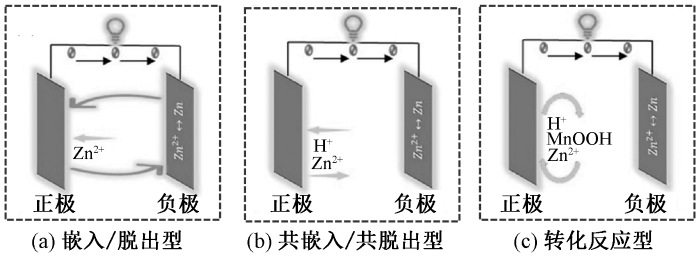
图1
FAZIBs储能机制
Fig.1
Energy storage mechanisms of FAZIBs.
(a) Intercalation/deintercalation type; (b) Co-intercalation/ co-deintercalation type; (c) Conversion type
1.2 纤维状水系锌离子电池储能材料
电极材料在FAZIBs的性能中起着关键作用。为了提高设备的能量密度,正极材料需具备更高的储Zn电位和容量。目前,常用的正极材料包括锰基材料、钒基材料、普鲁士蓝类似物等,这些材料的选择和改进对电池性能至关重要。
1.2.1 锰基材料
锰是地壳中第十丰富的元素,因其高电化学活性、成本低且毒性低,在电化学储能领域受到了广泛关注。锰基材料因其环境友好和经济实惠的特性,成为Zn2+、储能材料的理想选择。锰的化合物主要包括MnO2、Mn3O4、MnO等[23-24]。锰的多价态使得锰基材料能够适应Zn2+的嵌入,并具有1.2~1.4 V的高电压平台,因此备受关注。在众多锰基材料中,MnO2因其独特的隧道和层状结构,使得Zn2+能够在其体相中自由且稳定嵌入与脱出,成为目前最热门的FAZIBs材料。早在1980年,碱性Zn‖MnO2电池便在市场上发挥了重要作用。然而,该电池的能量密度有限,且碱性电解液易造成环境污染,这些因素制约了其进一步发展。直到2012年,Xu等[24]发现α-MnO2在中性电解液中基于材料的可逆相变反应,能够有效实现Zn2+的存储,展现出210 mA·h/g的高容量。
尽管如此,MnO2在循环过程中会因Jahn-Teller效应而显著影响电极材料的长循环稳定性,因此,后续研究不仅关注能量密度的提升,更加注重材料的长循环稳定性。Pan等[25]采用电解液添加剂策略,引入微量的Mn2+以抑制Mn3+的歧化反应,从而显著提高了MnO2的循环稳定性,所制备的材料具有285 mA·h/g的高容量,且在循环5 000次后仍具有92%的容量保持率。Gao等[26]采用碳纳米纤维素和碳纳米管复合材料与MnO2纳米线混合作为浆料用于湿法纺丝纤维正极,MnO2和Zn颗粒均匀分布在碳纳米纤维素和碳纳米管的网状结构中,因此所组装的FAZIBs在0.25 A/g时表现出281.5 mA·h/g的高比容量。此外,通过调控材料的微观结构和晶体形貌,也可提升材料的力学强度和化学稳定性,进而减少在充放电循环中的损失,并有望在提高循环稳定性的同时进一步增加能量密度。XU等[27]通过离子预插层的方法,将N
1.2.2 钒基材料
钒基化合物在自然界中储量丰富,合成简便且成本低廉,是Zn2+储能材料的理想候选者。钒的多价态(V2+、V3+、V4+、V5+)能够进行多步氧化还原反应,V—O多面体结构的多样性赋予了钒基材料较高的理论比容量,并展现出优异的Zn2+存储性能[28-
尽管钒基材料展现出卓越的电化学性能,但其较低的工作电位限制了其能量密度的提升。此外,氧化物中钒的溶解可能引发副反应,生成中间相,限制了其应用范围。为解决这些问题,近年来研究者通过表面修饰和涂层技术构建稳定的电极-电解质界面。部分研究还提出优化电解质配方和界面工程,通过调控电解质的成分和浓度,减少分解反应,以提升钒基材料的电化学性能。Cheng及其团队[31]报道了商用V2O5在Zn2+电池中的应用,证实Zn2+在充放电过程中的可逆嵌入和脱出,通过使用优化的高浓度水系电解液,显著提高了Zn-V2O5电池的循环稳定性和倍率性能,实现了470 mA·h/g的高容量,且循环4 000次后具有91.1%的容量保持率。Guo等[32]通过原位电化学氧化Ca掺杂VO2纳米阵列成功制备了自支撑非晶态Ca掺杂V2O5(Ca-V2O5),用于FAZIBs正极材料。Ca元素掺杂和自支撑结构的构建有效激发了非晶V2O5的储Zn潜力,在充分利用丰富的活性位点获得高体积容量的同时,实现快速反应动力学以获得优异的倍率性能。此外,钒基材料的可调性使其能够在不同的电解液体系中表现出良好的适应性,这为其在实际应用中的推广提供了更多可能性。钒基材料在FAZIBs领域展现出广阔的应用前景,但仍需进一步研究以解决其工作电位低和副反应等问题,以实现更高效的能量存储解决方案。未来研究可集中在优化材料结构、提高电池界面稳定性以及探索新型钒基材料上,以推动其在电化学储能领域的应用。
1.2.3 普鲁士蓝类似物材料
普鲁士蓝类似物以其三维开放框架结构、无毒性和低成本特性而备受瞩目。这类材料凭借其稳定的晶格结构,展现出卓越的倍率性能和较高的工作电压(1.5~1.8 V),因此在FAZIBs的正极材料领域得到了广泛研究[21,33]。普鲁士蓝类似物的化学式可表示为AxM1[M2(CN)6]y·nH2O,其中A为碱金属元素,M1和M2为过渡金属元素(如Mn、Cu、Ni、Co、Zn等)。丰富的过渡金属元素和碱金属元素在间隙位置提供了多样的还原活性中心,显著提升了其电化学性能。然而,由于结构中存在大量铁空位和间隙水,导致其能量密度和稳定性相对较低。早期研究主要通过调整金属元素来探索适用于Zn2+存储的正极材料,如ZnHCF、CuHCF和FeHCF等。为提高循环稳定性,开发满足这些需求的新型材料显得尤为重要。其中,元素掺杂和复合包覆是常用的材料改性方法。
2024年,Ma等[34]通过一步热还原法获得了三维导电碳框架的石墨烯自组装纤维(GSAF),并通过原位共沉淀法在GSAF表面生长了钒铁氰化物(KVO-HCF)纳米单元,制备出GSAF/KVO-HCF复合材料。这种结构的优势在于PBAs与三维碳架构紧密结合,缩短了Zn2+的传输距离,增强了系统导电性,并抑制了钒的溶解。这对于提高FAZIBs的电化学性能具有重要意义。同年,Wang等[35]开发了一种新型的六氰合铁酸银材料(AgHCF)。该材料具有空位/无水的开放骨架结构,层间距高达0.711 nm。在Zn2+嵌入和脱出过程中,发生Fe3+/Fe2+和Ag+/Ag0的氧化还原反应,实现可逆的四电子转移,赋予材料优异的容量和倍率性能。这个发现为普鲁士蓝类似物在FAZIBs中的应用提供了新的思路,展现了其在电化学储能领域的巨大潜力。此外,普鲁士蓝类似物的结构可调性使其能够在不同的电解液和工作条件下表现出良好的适应性,为其在实际应用中的推广提供了更多可能性。未来研究应集中在优化材料的合成工艺、改进电极-电解质界面以及探索新型掺杂元素,以进一步提升其电化学性能和循环稳定性。总之,作为FAZIBs正极材料的普鲁士蓝类似物,尽管已展现出良好的电化学性能,但仍需进一步研究以优化其结构,提高能量密度与稳定性,实现更高效的能量存储解决方案。
2 纤维电池的制备技术及器件结构
2.1 纤维电极制备技术
在FAZIBs的研究中,纤维电极的制备技术是关键环节之一,直接影响电池的性能和应用潜力。目前,表面涂覆、原位生长和湿法纺丝等方法已成为构建高性能纤维电极的重要技术。
2.1.1 表面涂覆技术
表面涂覆技术作为一种简便且高效的纤维电极制备方法,将活性电极材料、导电碳材料和黏结剂按特定比例混合成浆料,随后涂覆于柔性纤维导电集流体上,形成功能性涂层[36]。此方法不仅可以显著提升纤维电极的电化学性能,而且可以最大限度地保持其柔韧性。导电碳材料确保了活性电极材料与集流体之间的良好电接触,从而保障了电极的电子导电性。常见的黏结剂有聚偏二氟乙烯(PVDF)、羧甲基纤维素钠(CMC)、聚四氟乙烯(PTFE)、聚乙烯醇(PVA)和丁苯橡胶(SBR)等,其主要作用是将活性材料、导电剂和集流体结合成一个整体。由于这些黏结剂的广泛适用性,这种制备方法在FAZIBs领域得到了广泛的应用。Li等[37]采用滚动浸涂法(见图2(a)),成功将MnO2活性材料均匀涂覆于导电纱线表面,实现了纤维状电极的批量制备,并组装成FAZIBs。该电池不仅具备高达302.1 mA·h/g的容量和53.8 mW·h/cm3的能量密度,还表现出良好的稳定性和柔韧性,能够有效监测人体运动。此外,Zhang等[36]将α-MnO2涂覆在钛线表面作为正极,锌线作为纤维负极,构筑了准固态的FAZIBs。得益于α-MnO2大的比表面积,制备的纤维状锌离子电池在0.1 A/g时表现出280 mA·h/g的高容量,396 W·h/kg的高能量密度,优异的稳定性(300次循环后容量保持率80.6%)和灵活性。
图2
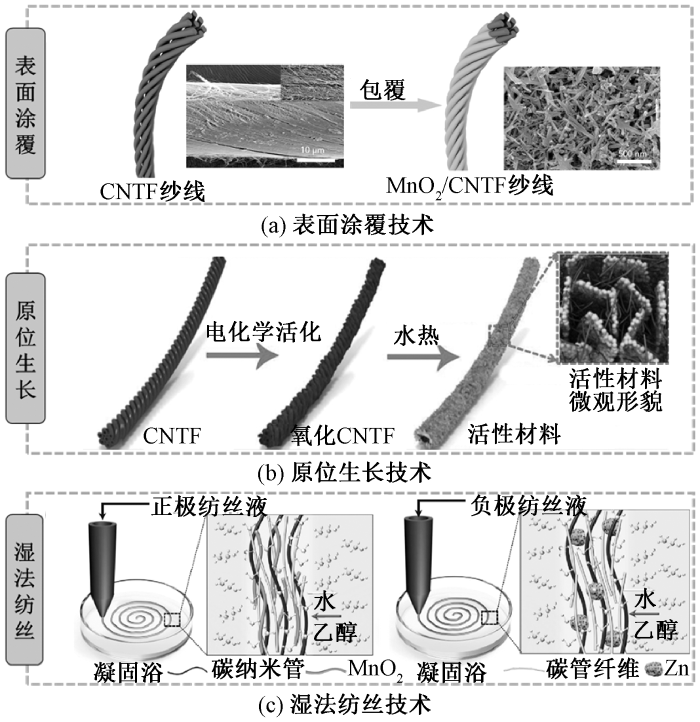
图2
纤维电极制备技术
Fig.2
Fiber electrode fabrication techniques.
(a) Surface coating; (b) In-situ growth; (c) Wet-spinning
在涂覆过程中,溶剂蒸发导致溶质在纤维表面沉积,从而形成所需的活性功能层。为确保涂层的附着力,通常采用化学键合或物理吸附等方法,增强涂层与基材之间的结合力,从而提高电池的稳定性和使用寿命。涂层的关键参数,如黏度、施涂速度和干燥环境,都会影响涂层的均匀性和稳定性。黏度过高可能导致涂层不均匀,而施涂速度过快则可能导致涂层厚度不一致。此外,干燥条件(如温度和湿度)的变化也会显著影响涂层的质量。这些因素直接影响纤维在实际应用中的柔性、稳定性及其电化学性能。
为优化涂覆过程,需特别关注涂层的厚度和均匀性,或通过使用改性溶剂来改善涂层的流动性和附着力。此外,通过后处理技术(如热处理或化学交联)可以进一步增强涂层的稳定性和耐用性,从而提升纤维电极在长期使用中的性能。不同类型的活性材料(如金属纳米颗粒、导电聚合物、石墨烯等)对涂层性能有显著影响,选择合适的材料可以优化电极的导电性和电化学性能。涂覆工艺的多样性也不容忽视,除传统的浸涂和喷涂方法外,电化学沉积和雾化喷涂等新兴技术近年来也得到了应用,它们能够提供更高的涂层均匀性和控制精度。在涂覆过程中,环境因素,如空气流动和污染物,也可能对涂层质量产生影响。因此,涂层的长期稳定性对电池性能至关重要。通过采取这些措施,可以有效提升纤维电极的整体性能,进而推动其在可穿戴设备和其它柔性电子应用中的广泛应用潜力。
2.1.2 原位生长技术
在纤维表面原位生长电极材料是一种创新且高效的制备Zn2+储能材料的方法。这种技术通过在导电纤维的表面直接合成活性电极材料,以形成均匀、稳定的涂层,相比于表面涂覆制备的电极,通过原位生长制备的电极避免了黏结剂等无电化学活性添加剂的使用,能够展示出更为独特的物理化学性质。原位生长不仅能够优化电极与基材之间的结合力,还能有效提高电荷转移效率和电池的整体性能。该过程通常涉及水热法、溶液化学法、气相沉积或电化学沉积等。在这些过程中,前驱体材料在特定条件下被还原或沉积到纤维表面,从而形成所需的电极材料。Pan等[38]通过简单的水热法在碳纳米管纤维表面原位生长了Zn3(OH)2V2O7·2H2O纳米片(见图2(b)),其作为FAZIBs的正极材料,表现出优异的电化学性能。并通过与在CNTF上原位生长的Zn纳米片,构筑了准固态的DAZIBs,展现出超高的倍率性能(电流密度增加100倍容量保持率69.7%),循环2 000次具有88.6%的容量保持率。Li等[54]在碳纳米管纤维上用电化学法聚合聚吡咯(PPy)纳米线三维支架,然后在其上经溶剂热合成法生长氧化钒(VOx)纳米片,最后通过在惰性气体中高温退火,使PPy纳米线碳化为氮掺杂碳(NC)的三维导电支架,同时热解出氨气,原位氮掺杂VOx形成氮掺杂的VO2(N-VO2),制备出了高性能N-VO2/NC/CNTF纤维电极,具有优异的电化学性能和柔性,组装的FAZIBs在0.2 A/cm3的电流密度下具有441.383 mA·h/cm3的高容量和313.13 mW·h/cm3的高能量密度,在弯曲条件下循环4 000次仍具有96.70%的容量保持率。此外,原位生长的电极材料可以通过调节反应条件(如温度、时间和浓度)来精确控制其形貌和结构,从而优化电池的电化学性能。由于电极材料直接附着在纤维上,能够显著提高电极的力学稳定性和柔韧性,使其更适合于可穿戴和柔性电子设备的应用。总之,在纤维表面原位生长电极材料不仅提升了Zn2+储能材料的性能,也为实现高效、可靠的纤维状电池提供了新的思路,展现出广泛的应用前景。
2.1.3 湿法纺丝技术
湿法纺丝技术,作为FAZIBs电极制备的关键技术之一,因其低成本、高操作灵活性以及高制造效率等优势,在电池制造领域受到了广泛关注[1,39]。在湿法纺丝过程中,基于聚合物或聚合物复合材料的纺丝溶液通过喷丝头挤出,随后进入由非溶剂(即凝固剂)组成的凝固浴中。凝固剂逐渐渗透至挤出的聚合物溶液纤维中,使纺丝溶液达到临界浓度,并在凝固浴中以纤维形态沉淀[40]。湿法纺丝技术已被广泛应用于制备用于组织工程、电化学能量存储与转换以及传感器等领域的功能性聚合物基纤维。此外,该技术还能够适应增材制造技术,通过制备合适的油墨并精确控制湿纺纤维在三维空间中的沉积,从而以可控、高效且可扩展的方式打印出复杂的结构[41]。湿法纺丝技术最具吸引力的特性在于其能够连续生产多样化的精细结构电极。例如,Wu等[42]采用一步微通道自组装和原位相分离的方法,成功通过湿法纺丝制备了异质结构的聚合物金属氧化物/多孔石墨烯纤维。Yang等[43]则展示了一种工业化的湿法纺丝方法,用以制造石墨烯增强的聚乙烯醇导电聚合物纤维(CPFs)。这种CPFs通过一步湿法纺丝过程,展现了低成本和高耐用性、高韧性的特点,其电导率(33.6 S/m)和力学性能(强度4.82 cN/dtex,应变16.2%)均达到了可纺织水平。此外,Gao等[26]利用含有纤维素纳米纤维/碳纳米管、二元复合网络和二氧化锰纳米线的粘性复合油墨,以及商用Zn粉,分别作为湿法纺丝纤维的正极和负极(见图2(c))。由此组装的FAZIBs在0.25 A/g的电流密度下,能够提供281.5 mA·h/g的高比容量,并实现了131.3 mW·h/cm3的高体积能量密度。
综上所述,湿法纺丝技术在制备FAZIBs电极方面具有显著的结构可控性、高比表面积和良好的力学性能等优势,但同时也面临着环境污染、能耗高等挑战。通过不断优化与改进,湿法纺丝技术为制备高效、可靠的纤维状电池提供了新的研究方向,并展现出广阔的应用前景。
2.2 器件结构
在设计FAZIBs时,电池的组装方式对其性能、稳定性及适用性有显著影响,合理的器件结构能有效提高电池的能量转换效率、柔韧性和适应性。基于这个需求,当前主要开发了平行结构、缠绕结构和同轴结构3种不同的器件组装方式。每种方法不仅在电池的离子传导和结构稳定性上表现出独特的优势,还为FAZIBs在不同应用场景中的拓展提供了多种可能性。下文将探讨这3种器件结构的设计原理、制备工艺及其应用潜力。
2.2.1 平行结构
平行结构的FAZIBs是最常见的组装方式之一。在制备过程中,2根纤维电极以特定间距并行排列,确保彼此间无物理接触。水凝胶电解质被填充于2根纤维电极之间的空隙中,该电解质不仅能够有效传导离子,还能防止电极短路。由于电极间缺乏直接接触,电解质必须具备优异的离子导电性。这种结构简单、易于制造的组装方法在FAZIBs中得到了广泛应用,多数已报道的FAZIBs均采用此结构。在组装过程中,可以通过调整电极间距和电解质厚度来优化电池性能。此外,采用半固态或固态电解质的设计,可以进一步提升电池的稳定性和安全性,降低短路风险。
平行结构的设计有助于实现电池的大规模生产,简化了制造流程并降低了工艺要求。采用这种方法,可有效构建出性能优良且具有可扩展性的FAZIBs,为柔性可穿戴设备及其它应用领域提供了创新的解决方案。
2.2.2 缠绕结构
与平行结构相比,缠绕结构更能适应外部应力和变形,保持较高的结构稳定性和柔韧性,因此在可穿戴和柔性电子设备中具有更佳的应用前景。然而,在大角度弯曲条件下,电极与电解质界面会发生分离,导致缠绕结构的力学稳定性降低。在剧烈弯曲或扭曲变形下,电极会发生滑落。这要求对水凝胶电解质及加捻工艺提出更高的要求,以确保电池在极端条件下的可靠性。
2.2.3 同轴结构
与平行结构和缠绕结构不同,同轴结构的纤维状电池采用芯鞘式设计,该设计提供了更短的离子传输路径和更卓越的机械弯曲稳定性。同轴纤维状电池通常通过逐层组装技术制备,其中一根纤维电极充当核心,随后在核心纤维上依次缠绕隔膜或凝胶电解质以及另一根电极。这种核壳结构使得所有组件沿同一轴线排列,类似于平面器件中的三明治结构。该设计不仅提升了电池的反应速率和界面兼容性,还增强了其在动态应用环境中的耐用性,显示出其在可穿戴设备和智能纺织品等领域的广泛应用前景。
3 纤维状水系锌离子电池研究进展
图3
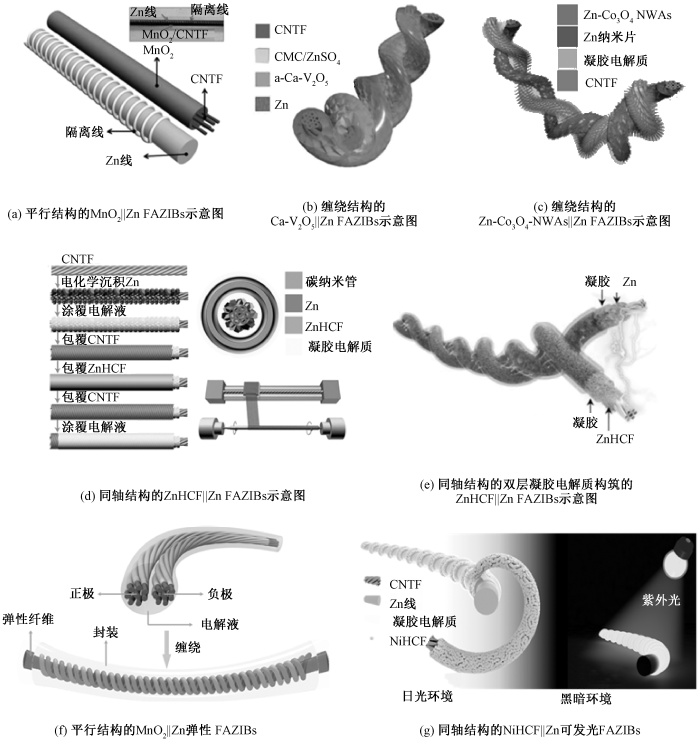
图3
FAZIBs的研究进展
Fig.3
Research progress of FAZIBs.
(a) Schematic of parallel-structured MnO2‖Zn FAZIBs; (b) Schematic of twisted-structure Ca-V2O5‖Zn FAZIBs; (c) Schematic of twisted-structure Zn-Co3O4-NWAs‖Zn FAZIBs; (d) Schematic of coaxial-structured ZnHCF‖Zn FAZIBs; (e) Schematic of coaxial-structured ZnHCF‖Zn FAZIBs constructed with dual-layer gel electrolyte; (f) Schematic of elastic parallel-structured MnO2‖Zn FAZIBs; (g) Schematic of coaxial-structured NiHCF‖ Zn light-emitting FAZIBs
该电池通过Zn线和碳纤维表面涂覆的MnO2,并将电解质封装于柔性塑料软管中,这种设计确保了电池在弯曲时的安全性和可靠性。然而,该电池的放电容量较低,且放电平台在0.15 mA的电流下放电容量为0.15 mA·h/cm;1.3 V的放电平台也限制了其实际的应用。为进一步提高FAZIBs的容量,Guo等[32]通过原位电化学氧化Ca掺杂VO2纳米阵列成功制备了a-Ca-V2O5,并用于FAZIBs的正极,Ca的引入可以显著降低VO2的形成能,并在充放电过程中实现非晶态到晶态的可逆转换,从而进一步提高了a-Ca-V2O5的可逆容量。作为可穿戴器件的应用展示(如图3(b)所示),组装的FAZIBs实现了408.37 mW·h/cm3高的能量密度,且弯曲350次后性能不发生衰减。Li等[48]成功通过Zn掺杂制备了Co3O4纳米线阵列(Zn-Co3O4 NWAs),并将其用于高性能柔性水系Co‖Zn电池的正极材料。Zn的引入显著提升了Co3O4的电导率,并在电化学测试中展示出优异的比容量和倍率性能。如图3(c)所示,组装的纤维状Co‖Zn电池表现出1.25 mA·h/cm2的高容量密度,在772.6 mW·h/cm3能量密度条件下,即使在20 mA/cm2的高电流密度下也具有良好的循环稳定性。尽管上述研究在提升FAZIBs的容量方面取得了显著进展,但实际应用中的稳定性仍需进一步优化。随着能量密度的提升,电池在复杂应力环境下的力学稳定性和电化学性能的持久性也变得更加重要。为此,未来研究将更加注重改善FAZIBs在实际应用场景中的可靠性,特别是在多次形变或长时间使用条件下的性能保持。
Zhang等[49]开发了一种兼具柔性和高压特性的同轴结构的FAZIBs(如图3(d)所示)。该研究利用ZnCuHCF/CNTF作为正极材料,采用简单的同轴纤维结构,成功实现了100.2 mA·h/cm3的高容量和195.39 mW·h/cm3的能量密度,显著超越了现有的纤维型可充电电池。此外,该电池在弯曲3 000次后仍保持93.2%的容量,展现出优异的灵活性和稳定性。这项工作为下一代可穿戴能源存储设备提供了新的设计理念。近期,Li等[50]提出了一种双层凝胶电解质策略,如图3(e)所示,通过将具有高流动性的PVA-Zn(AC)内层与高强度Zn藻酸盐外层相结合。这种设计有效解决了Zn剥离和电极弯曲过程中的界面分离问题,并在Zn负极表面形成固体电解质界面,显著提升了电池的循环寿命。基于这种双层凝胶电解质的Zn‖Zn对称电池在1 mA/cm2电流密度和0.1 Hz动态弯曲频率下实现了超过800 h的稳定循环。此外,组装的纤维状Zn‖ZnHCF电池经过500次弯曲后仍保持97.7%的容量保持率,展示出卓越的力学稳定性和柔性。这些设计不仅有望提升器件在动态应用环境中的耐用性,还可为FAZIBs在可穿戴设备等领域的实际应用提供更有力的支持。
在解决了FAZIBs的能量密度和稳定性问题后,研究的重点逐渐转向实现更多功能,以满足可穿戴和智能电子设备的多样化需求。多功能化的发展方向不仅可进一步增强电池的适应性和实用性,还能扩展其在复杂应用场景中的潜力。特别是,在柔性电子设备中,具有可拉伸和发光功能的FAZIBs展示了创新的应用前景。这些特性不仅能够使电池在承受多种形变的同时稳定工作,还可以在智能服装和健康监测等领域提供视觉反馈和信号展示的额外功能。针对这种需求,随后Li等[37]开发了高性能、防水、可定制和可拉伸的FAZIBs(见图3(f)),采用双螺旋纱线电极和交联聚丙烯酰胺(PAM)电解质。PAM电解质和螺旋状结构提供了高离子电导率,使得电池具有优异的比容量(302.1 mA·h/g)和体积能量密度(53.8 mW·h/cm3)。FAZIBs可被剪裁成小段,且每段仍能正常工作。利用其可编织和可剪裁的特性,1.1 m的FAZIBs被切成8段编织成纺织品,并为长柔性皮带上的100个LED和100 cm2柔性电致发光面板供电,从而为柔性可穿戴储能设备提供了设计灵感。LIU等[51]将纤维状普鲁士蓝电极与Zn线同轴缠绕,并涂覆荧光凝胶电解质,成功组装了荧光FAZIBs(见图3(g))。器件在紫外光环境下表现出多色发光,并可以驱动多个电子元件。
尽管FAZIBs作为一种新型储能技术展现出巨大潜力和前景,但其大规模商业化仍面临挑战[54]。高昂的生产成本、复杂的制造工艺、稳定性和可靠性问题限制了其应用。未来研究需优先考虑成本效益、制造可扩展性和环境可持续性。提高电极材料和电解质配方之间的兼容性对于增强循环稳定性至关重要。将纱线电池集成到可穿戴设备中并确保可清洗性是重大工程挑战。同时,探索FAZIBs与物联网、人工智能和可再生能源系统等新兴技术的协同作用,以实现新的功能和应用。随着技术进步和投资增加,FAZIBs有望成为储能领域的关键创新,为可持续发展做出重大贡献。
4 结束语
随着智能电子设备的普及,尤其是在可穿戴电子设备领域,对高效能、柔韧性和轻便的能源存储设备的需求日益增加。作为一种新兴技术,纤维状锌离子电池(FAZIBs)凭借其高体积能量密度、良好的安全性以及环境友好性等独特优势,逐渐成为研究热点。本文综述了FAZIBs的基本组成、工作原理、材料选择、制备技术及器件结构,并探讨了当前研究的现状、面临的挑战和未来发展方向。
在材料选择方面,FAZIBs的正极材料包括锰基材料、钒基材料、普鲁士蓝类似物和有机材料等。每种材料都有其独特的优势和不足。例如,锰基材料具有较高的电压平台和较好的循环稳定性;钒基材料由于具有多价态,展现出较优的电化学性能;普鲁士蓝类似物具有开放的框架结构和良好的环境友好性;有机材料则以轻便、易制备和种类繁多为特点。然而,这些材料在能量密度、循环稳定性和导电性等方面仍面临挑战。因此,未来研究应重点优化材料结构、提升电化学性能,并探索新型复合材料的开发。在制备技术方面,湿法纺丝、表面涂覆和原位生长等方法已广泛应用于纤维电极的构建。湿法纺丝技术因其低成本、高操作灵活性和较高的生产效率,受到广泛关注。然而,这个技术仍面临环境污染和较高能耗等问题,需进一步优化。表面涂覆技术则以简便高效为特点,但涂层的均匀性和附着力问题仍需解决。原位生长技术能显著提升电极与基材的结合力,从而增强电荷转移效率。在器件结构方面,平行结构、缠绕结构和同轴结构是目前FAZIBs的主要编织方式。每种结构在电池性能、稳定性和适用性方面都有其独特的优势和局限。例如,平行结构简单易制,但电极间缺乏直接接触会影响电荷传输效率;缠绕结构增大了电极间的接触面积,从而提高了电荷传输效率,但在大角度弯曲时易发生电极滑落;同轴结构则提供了更短的离子传输路径和更好的力学弯曲稳定性,但其制备工艺相对复杂。
当前,FAZIBs的研究热点主要集中在提高能量密度、循环稳定性和多功能化方面。研究者们通过优化材料结构、改进制备工艺和设计新型器件结构,不断推动FAZIBs性能的提升。以下是对未来研究的几点展望。
1)优化电极材料与电解质:通过材料改性、复合等手段,进一步提高电极材料的储Zn能力和循环稳定性。同时,开发新型电解质,如高导电性、高稳定性的凝胶电解质或固态电解质,以提升电池的离子导电性和安全性。此外,探索电解质添加剂的使用,以抑制Zn枝晶的生长,提高电池的稳定性和循环寿命。
2)创新器件结构设计:探索新型器件结构,如三维立体结构、集成化结构等,以提高电池的能量密度和柔韧性。这些新结构应能更好地适应复杂应用场景的需求,如可穿戴设备、智能纺织品等,并考虑其制造可行性和成本效益。
3)实现多功能化:将FAZIBs与其它功能材料或器件集成,实现多功能化。例如,将FAZIBs与传感器、发光材料等结合,开发出具有自供电、自监测、自显示等功能的新型智能设备,从而拓展FAZIBs的应用领域并提高其市场竞争力。
4)提高生产效率和降低成本:随着FAZIBs技术的不断成熟,实现大规模生产、降低制造成本将成为未来的重要研究方向。研究者们应关注生产工艺的优化、材料的选择与替代等方面,以提高生产效率和降低成本。
5)加强环境适应性研究:FAZIBs在实际应用中可能面临各种复杂的环境条件,如高温、低温、潮湿等。因此,加强环境适应性研究,提高电池在不同环境下的稳定性和性能,是未来的重要课题。
随着研究的深入,FAZIBs将越来越注重成本效益、制造可扩展性和环境可持续性。未来研究应着重提升电极材料与电解质之间的兼容性,增强电池的循环稳定性,并推动纤维状电池在可穿戴设备中的集成应用,确保其可清洗性和长期使用的稳定性。此外,探索FAZIBs与物联网、人工智能、可再生能源等新兴技术的结合,将为其在更多领域的应用开辟新的机遇。随着技术的进步和投资的增加,FAZIBs有望在储能领域成为重要的创新技术,为可持续发展贡献力量。
参考文献
Scalable production of high-performing woven lithium-ion fiber batteries
[J].
Recent advances in zinc anodes for high-performance aqueous Zn-ion batteries
[J].
An anionic-MOF-based bifunctional separator for regulating lithium deposition and suppressing polysulfides shuttle in Li-S batteries
[J].
All-solid-state flexible micro-supercapacitor arrays with patterned graphene/MWNT electrodes.
[J].
Tough hydrogel diodes with tunable interfacial adhesion for safe and durable wearable batteries
[J].
Poly (dimethyl-siloxane) thin film as a stable interfacial layer for high-performance lithium-metal battery anodes
[J].
Achieving ultrahigh energy density and long durability in a flexible rechargeable quasi-solid-state Zn-MnO2 battery
[J].
Advanced rechargeable zinc-based batteries: recent progress and future perspectives
[J].
DOI:10.1016/j.nanoen.2019.05.059
[本文引用: 2]

Featuring with low cost, exceptional inherent safety and decent electrochemical performance, rechargeable Znbased batteries (RZBs) have attracted increased attention and revived research efforts recently as a compelling alternative battery chemistry to Li-ion. However, some challenges still stand in the way of the development of these energy storage systems, such as low operation voltage, instability of cathode materials as well as dissolution of Zn electrode, etc. In this review, we present a comprehensive overview of recent progress in different RZBs systems including mild electrolyte RZBs, alkaline RZBs, hybrid RZBs, Zn-ion capacitors and Zn air batteries. The fundamental chemistry of various RZB systems, different cathode materials, optimization of Zn anode as well as various types of electrolytes and their influence on the battery performance are summarized. The major issues of different components along with respective strategies to alleviate them are discussed, aiming at providing a general guide for design and construction of high-performance RZBs. Additionally, the development of RZBs with different features in the last few years are summarized. Finally, we discuss the limitations and challenges that need to be overcome, providing potential future research directions in the field of next-generation RZBs.
Cable-type flexible lithium ion battery based on hollow multi-helix electrodes.
[J].
Elastic and wearable wire-shaped lithium-ion battery with high electrochemical performance
[J].
A cable-shaped lithium sulfur battery: advanced materials
[J].
DOI:10.1002/adma.201504241
[本文引用: 1]
A carbon nanostructured hybrid fiber is developed by integrating mesoporous carbon and graphene oxide into aligned carbon nanotubes. This hybrid fiber is used as a 1D cathode to fabricate a new cable-shaped lithium-sulfur battery. The fiber cathode exhibits a decent specific capacity and lifespan, which makes the cable-shaped lithium-sulfur battery rank far ahead of other fiber-shaped batteries.
A quasi-solid-state flexible fiber-shaped Li-CO2 battery with low overpotential and high energy efficiency
[J].
A novel flexible fiber-shaped dual-ion battery with high energy density based on omnidirectional porous Al wire anode
[J].
DOI:10.1016/j.nanoen.2019.03.062
[本文引用: 1]
Fiber-shaped dual-ion batteries (FSDIBs) are one of the promising flexible energy storage candidates for wearable electronics owing to their one-dimensional structure, good flexibility and high energy density. To the best of our knowledge, the fabrication of the FSDIBs has not been reported yet. One of the main challenges is to find the appropriate one-dimensional electrode with high capacity, high flexibility and good structure stability under different bending states and in reversible cycle processes. Herein, we report a proof of concept experiment on designing FSDIBs for the first time with high energy density, good reversibility and high cycle stability, which consists of the omnidirectional porous Al wire as the anode and the graphite on the Al wire as the cathode. The assembled battery shows high mass specific energy density of 173.33 Wh kg(-1) based on the total mass of the two electrodes (volumetric specific energy density of 10.4 mWh cm(-3)) and excellent flexibility under different bending states. The proposed mechanism is clearly revealed by the in-situ XRD measurements and in-situ Raman spectroscopy, showing that the PF6- anions are reversibly intercalated/de-intercalated into/from graphite interlayers in the charge/discharge processes to a large extent.
All-metal phosphide electrodes for high-performance quasi-solid-state fiber-shaped aqueous rechargeable Ni-Fe batteries
[J].
Cobalt-doped MoS2·nH2O nanosheets induced heterogeneous phases as high-rate capability and long-term cyclability cathodes for wearable zinc-ion batteries
[J].
Porous V2O5 nanofibers as cathode materials for rechargeable aqueous zinc-ion batteries
[J].
DOI:10.1016/j.jechem.2018.12.023
[本文引用: 1]
Rechargeable aqueous zinc-ion batteries are recently gaining incremental attention because of low cost and material abundance, but their development is plagued by limited choice of cathode materials with satisfactory cycling performance. Here, we report a porous V<sub>2</sub>O<sub>5</sub> nanofibers cathode with high Znstorage performance in an aqueous Zn(CF<sub>3</sub>SO<sub>3</sub>)<sub>2</sub> electrolyte. We propose a reaction mechanism based on phase transition from orthorhombic V<sub>2</sub>O<sub>5</sub> to zinc pyrovanadate on first discharging and reversible Zn<sup>2+</sup> (de)intercalation in the open-structured hosts during subsequent cycling. This open and stable architecture enables a high reversible capacity of 319 mAh g<sup>-1</sup> at 20 mA g<sup>-1</sup> and a capacity retention of 81% over 500 cycles. The remarkable electrochemical performance makes V<sub>2</sub>O<sub>5</sub> a promising cathode for aqueous zinc-ion batteries.
Electrospun V2O5 nanofibers as high-capacity cathode materials for zinc-ion batteries
[J].
Recent advances and perspectives of Zn-metal free ″rocking-chair″-type Zn-ion batteries
[J].
A review on solutions to overcome the structural transformation of manganese dioxide-based cathodes for aqueous rechargeable zinc ion batteries
[J].
Active materials for aqueous zinc ion batteries: synthesis, crystal structure, morphology, and electrochemistry
[J].
DOI:10.1021/acs.chemrev.9b00628
PMID:32786670
[本文引用: 1]
Aqueous zinc ion batteries (ZIBs) are truly promising contenders for the future large-scale electrical energy storage applications due to their cost-effectiveness, environmental friendliness, intrinsic safety, and competitive gravimetric energy density. In light of this, massive research efforts have been devoted to the design and development of high-performance aqueous ZIBs; however, there are still obstacles to overcome before realizing their full potentials. Here, the current advances, existing limitations, along with the possible solutions in the pursuit of cathode materials with high voltage, fast kinetics, and long cycling stability are comprehensively covered and evaluated, together with an analysis of their structures, electrochemical performance, and zinc ion storage mechanisms. Key issues and research directions related to the design of highly reversible zinc anodes, the exploration of electrolytes satisfying both low cost and good performance, as well as the selection of compatible current collectors are also discussed, to guide the future design of aqueous ZIBs with a combination of high gravimetric energy density, good reversibility, and a long cycle life.
A review on hexacyanoferrate-based materials for energy storage and smart windows: challenges and perspectives
[J].
Redox-active phenanthrenequinone triangles in aqueous rechargeable zinc batteries
[J].
DOI:10.1021/jacs.9b12436
PMID:31895548
[本文引用: 1]
Aqueous rechargeable zinc batteries (ZBs) have received considerable attention recently for large-scale energy storage systems in terms of rate performance, cost, and safety. Nevertheless, these ZBs still remain a subject for investigation, as researchers search for cathode materials enabling high performance. Among the various candidate cathode materials for ZBs, quinone compounds stand out as candidates because of their high specific capacity, sustainability, and low cost. Quinone-based cathodes, however, suffer from the critical limitation of undergoing dissolution during battery cycling, leading to a deterioration in battery life. To address this problem, we have introduced a redox-active triangular phenanthrenequinone-based macrocycle () with a rigid geometry and layered superstructure. Notably, we have confirmed that Zn ions, together with HO molecules, can be inserted into the organic cathode, and, as a consequence, the interfacial resistance between the cathode and electrolytes is decreased effectively. Density functional theory calculations have revealed that the low interfacial resistance can be attributed mainly to decreasing the desolvation energy penalty as a result of the insertion of hydrated Zn ions in the cathode. The combined effects of the insertion of hydrated Zn ions and the robust triangular structure of serve to achieve a large reversible capacity of 210 mAh g at a high current density of 150 mA g, along with an excellent cycle-life, that is, 99.9% retention after 500 cycles. These findings suggest that the utilization of electron-active organic macrocycles, combined with the low interfacial resistance associated with the solvation of divalent carrier ions, is essential for the overall performance of divalent battery systems.
Rechargeable aqueous zinc-manganese dioxide batteries with high energy and power densities
[J].
Energetic zinc ion chemistry: the rechargeable zinc ion battery
[J].
Reversible aqueous zinc/manganese oxide energy storage from conversion reactions
[J].
Wet spinning of fiber-shaped flexible Zn-ion batteries toward wearable energy storage
[J].
DOI:10.1016/j.jechem.2022.02.040
[本文引用: 2]
High-performance flexible one-dimensional (1D) electrochemical energy storage devices are crucial for the applications of wearable electronics. Although much progress on various 1D energy storage devices has been made, challenges involving fabrication cost, scalability, and efficiency remain. Herein, a high-performance flexible all-fiber zinc-ion battery (ZIB) is fabricated using a low-cost, scalable, and efficient continuous wet-spinning method. Viscous composite inks containing cellulose nanofibers/carbon nanotubes (CNFs/CNTs) binary composite network and either manganese dioxide nanowires (MnO<sub>2</sub> NWs) or commercial Zn powders are utilized to spinning fiber cathodes and anodes, respectively. MnO<sub>2</sub> NWs and Zn powders are uniformly dispersed in the interpenetrated CNFs/CNTs fibrous network, leading to homogenous composite inks with an ideal shear-thinning property. The obtained fiber electrodes demonstrate favorable uniformity and flexibility. Benefiting from the well-designed electrodes, the assembled flexible fiber-shaped ZIB delivers a high specific capacity of 281.5 mAh g<sup>-1</sup> at 0.25 A g<sup>-1</sup> and displays excellent cycling stability over 400 cycles. Moreover, the wet-spun fiber-shaped ZIBs achieve ultrahigh gravimetric and volumetric energy densities of 47.3 Wh kg<sup>-1</sup> and 131.3 mWh cm<sup>-3</sup>, respectively, based on both cathode and anode and maintain favorable stability even after 4000 bending cycles. This work offers a new concept design of 1D flexible ZIBs that can be potentially incorporated into commercial textiles for wearable and portable electronics.
Hydrogen-bond chemistry inhibits Jahn-Teller distortion caused by Mn 3d orbitals for long-lifespan aqueous Zn//MnO2 batteries
[J].
Recent advances in cathode materials of rechargeable aqueous zinc-ion batte-ries
[J].
Vanadium-based cathode materials for rechargeable multivalent batteries: challenges and opportunities
[J].
Design strategies for vanadium-based aqueous zinc-ion batteries
[J].
Rechargeable aqueous Zn-V2O5 battery with high energy density and long cycle life
[J].
Emerging amorphous to crystalline conversion chemistry in Ca-doped VO2 cathodes for high-capacity and long-term wearable aqueous zinc-ion batteries
[J].
A prussian blue/zinc secondary battery with a bio-ionic liquid-water mixture as electrolyte
[J].
Synthesis of ultrasmall vanadium ferricyanide nanocrystallines with the aidance of graphene self-assembled fibers towards reinforced zinc storage performance
[J].
Dual redox reactions of silver hexacyanoferrate Prussian blue analogue enable superior electrochemical performance for zinc-ion storage
[J].
Advanced fiber-shaped aqueous zn ion battery integrated with strain sensor
[J].
Waterproof and tailorable elastic rechargeable yarn zinc ion batteries by a cross-linked polyacrylamide electr-olyte
[J].
DOI:10.1021/acsnano.7b09003
PMID:29589438
[本文引用: 2]
Emerging research toward next-generation flexible and wearable electronics has stimulated the efforts to build highly wearable, durable, and deformable energy devices with excellent electrochemical performances. Here, we develop a high-performance, waterproof, tailorable, and stretchable yarn zinc ion battery (ZIB) using double-helix yarn electrodes and a cross-linked polyacrylamide (PAM) electrolyte. Due to the high ionic conductivity of the PAM electrolyte and helix structured electrodes, the yarn ZIB delivers a high specific capacity and volumetric energy density (302.1 mAh g and 53.8 mWh cm, respectively) as well as excellent cycling stability (98.5% capacity retention after 500 cycles). More importantly, the quasi-solid-state yarn ZIB also demonstrates superior knittability, good stretchability (up to 300% strain), and superior waterproof capability (high capacity retention of 96.5% after 12 h underwater operation). In addition, the long yarn ZIB can be tailored into short ones, and each part still functions well. Owing to its weavable and tailorable nature, a 1.1 m long yarn ZIB was cut into eight parts and woven into a textile that was used to power a long flexible belt embedded with 100 LEDs and a 100 cm flexible electroluminescent panel.
Stitching of Zn3(OH)2V2O7·2H2O 2D nanosheets by 1D carbon nanotubes boosts ultrahigh rate for wearable quasi-solid-state zinc-ion batteries
[J].
DOI:10.1021/acsnano.9b07956
PMID:31869204
[本文引用: 1]
Several layer-structured vanadates of two-dimensional (2D) nanosheet morphologies have been investigated recently for flexible quasi-solid-state aqueous zinc-ion batteries (ZIBs), where one of the challenging issues is the poor electronic conductivity and mechanical stability especially in the cross-2D nanosheet direction, leading to insufficient rate capability and mechanical stability and shortened cycle life. Herein, we have devised a strategy of using one-dimensional (1D) carbon nanotubes (CNTs) to stitch zinc pyrovanadate (Zn(OH)VO·2HO, CNT-stitched ZVO) 2D nanosheets that are directly grown on oxidized CNT fiber (CNT-stitched ZVO NSs@OCNT fiber). With the CNT-stitched 2D nanosheet structure, the open frameworks of ZVO provide required spacing for reversible Zn (de)intercalation, and the stitching CNTs offer the desperately needed electronic conductivity and mechanical robustness across the ZVO 2D nanosheets. As a result, the fiber-shaped quasi-solid-state ZIB, assembled using the CNT-stitched ZVO NSs@OCNT as the cathode and Zn NSs@CNT fiber (electrodeposited zinc nanosheets on CNT fiber) as the anode, demonstrates an ultrahigh rate capability (69.7% retention after a 100-fold increase in current density), an impressively stack volumetric energy density of 71.6 mWh cm, together with a long-term stability (88.6% retention after 2000 cycles). The present work proves the proof-of-concept of developing 2D nanosheets purposely stitched together by 1D conducting nanotubes/nanowires as a class of advanced cathodes for quasi-solid-state ZIBs in future portable electronics.
Recent advances and prospects of fiber-shaped rechargeable aqueous alkaline batteries
[J].
Microfluidic fabrication of hierarchical-ordered ZIF-L(Zn)@Ti3C2T core-sheath fibers for high-performance asymmetric supercapacitors
[J].
Microfluidic-oriented synthesis of graphene oxide nanosheets toward high energy density super-capacitors
[J].
Interfacial polymetallic oxides and hierarchical porous core-shell fibres for high energy-density electrochemical supercapacitors
[J].
Organic-inorganic hybrid conductive network to enhance the electrical conductivity of graphene-hybridized polymeric fibers
[J].
Weavable transparent conductive fibers with harsh environment tolerance
[J].
Large-scale wet-spinning of highly electroconductive MXene fibers
[J].
Scalable production of ultrafine polyaniline fibres for tactile organic electrochemical transistors
[J].
Flexible fiber-type zinc-carbon battery based on carbon fiber electr-odes
[J].
Boosting Zn-ion storage capability of self-standing Zn-doped Co3O4 nanowire array as advanced cathodes for high-performance wearable aqueous rechargeable Co//Zn batteries
[J].
Flexible and high-voltage coaxial-fiber aqueous rechargeable zinc-ion battery
[J].
DOI:10.1021/acs.nanolett.9b01403
PMID:31082244
[本文引用: 1]
Extensive efforts have been devoted to construct a fiber-shaped energy-storage device to fulfill the increasing demand for power consumption of textile-based wearable electronics. Despite the myriad of available material selections and device architectures, it is still fundamentally challenging to develop eco-friendly fiber-shaped aqueous rechargeable batteries (FARBs) on a single-fiber architecture with high energy density and long-term stability. Here, we demonstrate flexible and high-voltage coaxial-fiber aqueous rechargeable zinc-ion batteries (CARZIBs). By utilizing a novel spherical zinc hexacyanoferrate with prominent electrochemical performance as cathode material, the assembled CARZIB offers a large capacity of 100.2 mAh cm and a high energy density of 195.39 mWh cm, outperforming the state-of-the-art FARBs. Moreover, the resulting CARZIB delivers outstanding flexibility with the capacity retention of 93.2% after bending 3000 times. Last, high operating voltage and output current are achieved by the serial and parallel connection of CARZIBs woven into the flexible textile to power high-energy-consuming devices. Thus, this work provides proof-of-concept design for next-generation wearable energy-storage devices.
High-fluidity/high-strength dual-layer gel electrolytes enable ultra-flexible and dendrite-free fiber-shaped aqueous zinc metal battery
[J].
Fluorescent fiber-shaped aqueous zinc-ion batteries for bifunctional multicolor-emission/energy-storage textiles
[J].
DOI:10.1021/acsnano.3c06245
PMID:37698337
[本文引用: 1]
Wearable smart textiles are natural carriers to enable imperceptible and highly permeable sensing and response to environmental conditions via the system integration of multiple functional fibers. However, the existing massive interfaces between different functional fibers significantly increase the complexity and reduce the wearability of the textile system. Thus, it is significant yet challenging to achieve all-in-one multifunctional fibers for realizing miniaturized and lightweight smart textiles with high reliability. Herein, as bifunctional electrolyte additives, fluorescent carbon dots with abundant zincophilic functional groups are introduced into electrolytes to develop fluorescent fiber-shaped aqueous zinc-ion batteries (FFAZIBs). Originating from effective dendrite suppression of Zn anodes and multiple active sites of freestanding Prussian blue cathodes, high energy density (0.17 Wh·cm) and long-term cyclability (78.9% capacity retention after 1500 cycles) are achieved for FFAZIBs. More importantly, the one-dimensional structure ensures the same luminance in all directions of FFAZIBs, enabling the form of multicolor display-in-battery textiles.
A high-capacity yarn-shaped Zn-MnO2 battery for wearable electronics
[J].
Fiber-shaped aqueous zinc ion batteries for wearable energy solutions
[J].
Flexible and antifreezing fiber-shaped solid-state zinc-ion batteries with an integrated bonding structure
[J].

 京公网安备11010502044800号


