



近年来,智能织物在各领域的应用日益广泛,尤其在健康监测、环境感知及运动追踪等方面。可穿戴传感织物通过实时采集健康数据,为疾病早期诊断与长期监测提供便捷、个性化的手段。其主要分为2类:一类监测物理指标,如脉搏、生物电信号;另一类监测汗液或血液中的代谢物,提供分子水平的健康信息[1]。与血液相比,汗液监测具有无创、实时的优势,因此,发展可穿戴电化学传感器进行汗液检测具有重要潜力。
目前,可穿戴电化学传感织物已实现健康监测功能,但仍主要依赖于传统硬质电池,存在体积大、安全性差等局限。纤维状和水系电池技术的快速发展将推动其在可穿戴领域逐步取代传统刚性及薄膜平面电池。
本文介绍了电化学传感器及水系电池在智能织物领域的应用,并对二者的结合进行了展望,从纤维基与织物基2个方面讨论了监测离子、分子的可穿戴电化学传感器与液态、凝胶态水系电池的研究进展,最后指出其未来发展方向。期望为面向可穿戴健康管理智能织物的电化学传感器与柔性水系电池的研发与应用提供新思路,推动可穿戴智能设备与纺织产品的交叉融合发展。
1 可穿戴电化学传感织物
图1
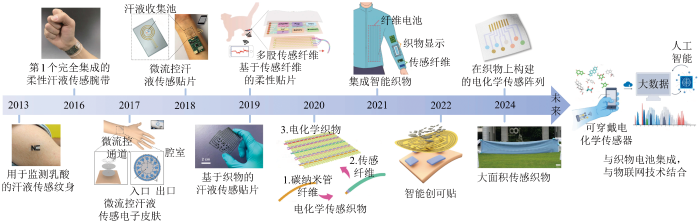
图1
可穿戴电化学传感器实现与织物集成的发展时间线
Fig.1
Timeline of wearable electrochemical sensors enabling integration with fabrics
1.1 纤维基可穿戴电化学传感器
纤维基电化学传感器可通过纺织技术将传感单元与织物无缝集成,同时保持其柔性、透气性和舒适性。由于汗液中包含丰富的生物标志物,如电解质、代谢物与蛋白质等[14],本文将根据生物标志物分类来概述纤维基电化学传感器。
1.1.1 电解质离子传感器
电解质是被广泛研究的汗液生物标志物,反映人体代谢状况,且对维持水合作用、渗透平衡及神经转导等功能至关重要。
离子传感器由离子选择性电极(ISE)和参比电极构建。用于pH值检测的ISE由导电纤维基底和离子-电子转导层构成,通常用聚苯胺(PANI)作离子-电子转导层,通过其质子化程度的变化来检测氢离子浓度。其它离子(例如K+、Na+等)ISE通常由导电纤维基底上覆盖的离子-电子转导层和离子选择性膜(ISM)构成。例如,通过电沉积聚(3,4-乙烯二氧基噻吩)聚苯乙烯磺酸盐作为离子-电子转导层,覆盖钠离子选择性膜[15],成功制备了具有高灵敏度(58.9 mV/lg[Na+])和长期稳定性的钠离子选择性电极。
1.1.2 代谢物分子传感器
汗液中的葡萄糖、乳酸和尿酸的浓度变化可反映身体代谢状态、疲劳程度及潜在疾病风险,是3种研究最广泛的代谢物指标。
糖尿病是一种慢性病,对葡萄糖水平的实时监测需求推动了可穿戴葡萄糖传感器的发展。汗液中葡萄糖浓度与血糖密切相关[18]。酶类传感器通过葡萄糖氧化酶(GOx)催化反应产生的电流变化实现对葡萄糖的量化检测。研究者将聚(3,4-乙烯二氧噻吩)-聚苯乙烯磺酸涂覆于棉纱线构建电极基底[19],随后在表面修饰GOx构建传感电极,但酶类传感器易受环境影响失活,稳定性差。为此,基于金属、过渡金属及其氧化物的非酶类传感器应运而生。用镍催化葡萄糖氧化反应,通过监测电流变化分析葡萄糖浓度[20]。金属有机框架(MOF)因其高比表面积和良好的柔性,已应用于非酶类传感器。有研究者研发了基于镍-钴MOF修饰银/氧化石墨烯/聚氨酯纤维的葡萄糖电化学传感器[21],测试其7 d后的氧化峰电流保持率为97.1%,在24~38 ℃范围内响应变化较小,展现出优异的长期稳定性和温度鲁棒性。
汗液中的乳酸含量能评估个体健康状态,如压力缺血和氧化代谢不足等,对运动员等群体至关重要。酶类电化学传感器是常用的乳酸监测技术,但因酶类受环境不稳定性限制,分子印迹聚合物(MIP)电化学传感器应运而生。在乳酸分子的存在下,功能单体形成高分子聚合物,移除模版后留下有特异性作用位点的空腔,能与目标分子结合并产生与浓度相关的电信号。本文课题组设计了一种基于MIP的乳酸检测传感纤维[11],碳纳米管(CNT)内的多尺度通道提高了传感电极的灵敏度与稳定性,能支持超400次的原位汗液检测。利用工业缝纫技术,这种传感纤维可集成到不同图案的衣物中,成功构建了长20 m、宽50 m的传感织物,展现出大规模应用的潜力。
1.1.3 其它分子传感器
皮质醇是与压力水平密切相关的类固醇激素。本文课题组将MIP固定于CNT纤维表面,能精确监测1 pmol/L到10 μmol/L范围内的皮质醇[26]。该传感器可通过乙醇洗涤实现超100次的重复检测,并能在各种形变下保持性能,具备长期使用潜力。
1.2 织物基可穿戴电化学传感器
织物基可穿戴电化学传感器通过表面修饰技术集成传感单元和柔性电路。随着丝网印刷、喷墨印刷与光刻等技术的发展,电极制备变得更高效和精确,推动其在智能织物领域的应用。
丝网印刷技术利用刮刀将浆料推过丝网图案区域,沉积在织物表面形成所需图案。研究者用该技术制备了K+、Na+传感织物,并将其集成到衣服和表带等织物中[27]。该传感器不仅能在极端应力下稳定传递电位响应,且具有优异的选择性、高灵敏度(59.4 mV/lg[Na+]和56.5 mV/lg[K+])和低检测限(10-4.9 mol/L)。然而,浆料与织物的机械失配可能导致形变过程中产生裂纹甚至分层,影响传感器性能。同时,浆料与多孔织物的结合和扩散也限制了图案精度。
本文总结了上述部分柔性传感器使用的材料及其性能,详情见表1。
表1 纤维/织物基电化学传感器的材料和性能
Tab.1
| 标志物 | 识别元件 | 灵敏度 | 稳定性 | 文献 |
|---|---|---|---|---|
| 乳酸 | MIP | 109.6 nA/lg[C(μmol/L)] | >400次 | [11] |
| 钠离子 | ISM | 58.9 mV/lg[[Na+](mmol/L)] | 24 h | [15] |
| 葡萄糖 | MOF | 425.9 μA/(mmol/L·cm2) | 存储7 d | [21] |
| 尿酸 | PtNP | 3.4 nA/(μmol/L) | 1 000次 | [23] |
| IL-6 | 适配体 | — | — | [25] |
| 皮质醇 | MIP | — | — | [26] |
| 钠离子 | ISM | 59.4 mV/lg[Na+] | — | [27] |
| 钾离子 | ISM | 56.5 mV/lg[K+] | — | [27] |
| 钾离子 | ISM | 66.0 mV/lg[K+] | 存储28 d | [28] |
| pH | PANI | 54.9 mV/lg[H+] | — | [29] |
注:C代表乳酸的浓度。
2 柔性水系电池
随着可穿戴电化学传感系统朝着连续实时监测与多功能集成的方向发展,迫切需要灵活、安全和可持续的电源解决方案。传统锂离子电池虽然应用广泛,但由于其结构刚性、有机电解质易燃、潜在的环境污染等原因,难以满足这些要求。基于水系电解质的柔性电池因其本征安全性、高离子电导率等优势脱颖而出。其中,织物电池因其可穿戴性、柔性、便携性和易于集成等优势,成为理想的供能解决方案。因此本文主要讨论柔性水系织物电池。
织物电池可通过2种方式制备[30]。一种是基于导电纱线基底制备纤维状电池,并通过纺织工艺编织成适应不同形状和尺寸需求的织物电池;另一种是在导电织物基底直接负载活性物质制备电极,进而构建织物基柔性电池。
2.1 纤维基柔性水系电池
纤维基电池由电极和电解质等构成。电解质可分为液态、凝胶态与固态。固态电解质能防止短路和泄漏,但存在力学性能差和高界面电阻问题。本文重点介绍液态和凝胶态纤维基电池。
2.1.1 液态纤维基柔性水系电池
水系钠离子电池因资源丰富和生物相容性,逐渐取代在可穿戴领域占主导的锂离子电池,但其能量密度和循环稳定性仍需改进。有研究者将具有纳米片阵列结构的Bi2O3/Bi2S3分层异质结构材料用作电极[34],获得了3倍于纯相材料的容量。在Na2SO4电解液中,分别在2.0、20 mA/cm2下表现出1.51、0.74 mA·h/cm2的高可逆容量。为进一步获得高比容量和优异的循环稳定性的水系钠离子电池,本文课题组提出了一种全聚合物柔性水系电池策略[35]。通过调节电解质溶剂化层和形成固体-电解质界面来提升电池稳定性。该电池在90°弯曲角度下仍能以122 mA·h/g的比容量稳定充放电,且具备大规模制备潜力。
水系液态纤维电池虽能有效避免有机电解质的安全问题,但电解质泄露仍是柔性电池反复形变中的挑战。开发更具力学稳定性的水系电解质将是推动其在可穿戴供能领域应用的关键。
2.1.2 凝胶态纤维基柔性水系电池
水凝胶作为高水溶胀聚合物网络,兼具优异的离子导电性、可拉伸性和防泄漏特性;还可抑制枝晶生长,防止纤维电极形变时短路。水凝胶纤维基电池因其性能优越近年来备受关注。研究者设计的全水凝胶锂离子同轴纤维电池在0.5 A/g下表现出84.8 mA·h/g的放电比容量[36],且其445 kPa的弹性模量与生物组织适配。锌离子水凝胶纤维电池也具有独特优势。研究者用锌负极、PANI正极和聚乙烯醇基凝胶电解质组装纤维电池[37],在2 000 mA/g下的放电比容量为83.96 mA·h/g,弯曲100次后容量保持率为86.4%,正极可溶性醌的形成和负极腐蚀导致容量衰减。研究者通过添加甲磺酸改善电解质[38],抑制了PANI降解和锌腐蚀,容量保持率在弯曲500次和2 000次后分别为92.7%和88.1%。
水凝胶电解质面临离子电导率与力学性能的平衡难题。增加水含量可提高离子电导率,但会降低其强度;而交联位点影响离子运输。研究者开发了一种具有高离子电导率和优异力学性能的水凝胶电解质[39],通过极性电解质的高吸盐性和较高的孔隙连通性,实现3.93 mS/cm的离子电导率;同时,其聚合物链通过缠结而非交联连接,实现了350%的伸长率和446 kPa的抗拉强度,组装的纤维基电池在不同弯曲角度下仍能稳定放电。
目前,水凝胶纤维基电池仍面临电极与电解质界面接触不良的问题。为此,研究者设计了有协同作用的双层凝胶电解质[40],内层为高流动性的聚乙烯醇-醋酸锌,外层为高力学强度的海藻酸锌,电池在500次弯曲后的容量保持率高达97.7%。
2.2 织物基柔性水系电池
与纤维基电池相比,直接使用织物基底可避免编织过程中的形变,且制备过程与纺织加工兼容,其高生产效率和大规模制造能力为织物基电池商业化生产提供了可能。
2.2.1 液态织物基柔性水系电池
2.2.2 凝胶态织物基柔性水系电池
凝胶电解质因其优异的可拉伸性和皮肤适配性,成为可穿戴器件的理想选择。基于此,研究者开发出织物基柔性电池[43],在100%应变下,仍能稳定放电(3.875 mA·h/cm2);2个串联电池在拉伸至150%并扭曲90°时,仍能为发光二极管供电。此外,有研究者用丝网印刷法[44],将MnO2正极、Zn负极与ZnCl2水凝胶电解质组装成织物基电池,可实现3.1 mA·h/cm2的面容量,但上述电池使用前需封装,无法与日常织物无缝集成。因此,开发对环境变化不敏感的凝胶电解质可实现免封装设计,不仅能与织物无缝集成,还能提高电池能量密度,满足可穿戴设备的微型化和轻量化需求。本文总结了上述部分柔性电池的材料和性能,详情见表2。
表2 纤维/织物基柔性水系电池的材料和性能
Tab.2
| 正极‖ 负极 | 电解 质盐 | 放电 电压/V | 比容量/ (mA·h·g-1) | 容量保 持率/% | 循环 数 | 文献 |
|---|---|---|---|---|---|---|
| LMO‖PI | Li2SO4 | 1.40 | 123.00 | 98.0 | 1 000 | [31] |
| LMO‖LTO | LiCl | 2.40 | 61.03 | 72.6 | 500 | [33] |
| PANI‖PANI | NaTFSI | 1.10 | 122.00 | — | — | [35] |
| LMO‖LTO | LiCl | 1.50 | 85.70 | 92.0 | 100 | [36] |
| PANI‖Zn | ZnCl2- NH4Cl | 1.15 | 119.41 | 95.4 | 200 | [37] |
| PANI‖Zn | ZnCl2- NH4Cl | 1.20 | 141.90 | 88.1 | 2 000 | [38] |
| MnO2‖Zn | ZnSO4- MnSO4 | 1.32 | 393.00 | 83.9 | 1 300 | [42] |
注:正极‖负极代表活性物质。
展望未来,电化学传感织物与水系织物电池的集成具有显著优势:在柔性适配和穿戴舒适性方面,二者均采用纤维或织物形态,可直接编织入衣物,保持纺织品固有的柔韧性和透气性,避免传统刚性电子器件对穿戴体验的干扰;在安全性和生物相容性方面,水系织物电池显著降低了安全隐患,提供了更安全、环保的能源选择,尤其适合贴身使用;在环境友好与可持续性方面,水系电池避免使用有害溶剂,生产过程更环保。
3 结束语
本文系统介绍了纤维基与织物基电化学传感器在监测汗液中离子与分子的应用,以及可为其供能的水系纤维基和织物基电池的研究进展。认为电化学传感织物与柔性水系电池集成的技术代表了可穿戴电子向“无形融入”的重要跨越,未来或推动个性化医疗、智能物联网服装的普及。在未来发展中,以下几个方面值得关注。
1)智能织物的轻量化。通过创新制造工艺,将电化学传感器与水系电池高效集成在同一柔性平台上,避免因过度设计导致的织物体积与重量增加的问题,实现更轻便、更舒适的穿戴体验。
2)传感织物的灵敏度和选择性。通过优化材料和生物标志物的靶向作用和提高制造工艺的精度等方法,提高传感织物的灵敏度与选择性。
3)柔性水系电池的能量密度。需通过材料创新和电解质优化来提升其性能,以解决可穿戴设备的续航问题。
4)数据分析的准确性。结合人工智能技术以实现数据的深度分析和高级化处理,实现精准、智能、个性化的医疗预诊断与疾病跟踪治疗。
5)长期稳定性。通过构建强界面相互作用的纤维基底-活性材料体系,提高智能织物中电化学传感器与水系电池的循环稳定性。
参考文献
Recent developments in sensors for wearable device applications
[J].
DOI:10.1007/s00216-021-03602-2
PMID:34389877
[本文引用: 1]

Wearable devices are a new means of human-computer interaction with different functions, underlying principles, and forms. They have been widely used in the medical and health fields, in applications including physiological signal monitoring; sports; and environmental detection, while subtly affecting people's lives and work. Wearable sensors as functional components of wearable devices have become a research focus. In this review, we systematically summarize recent progress in the development of wearable sensors and related devices. Wearable sensors in medical health applications, according to the principle of measurement, are divided into physical and chemical quantity detection. These sensors can monitor and measure specific parameters, thereby enabling continuously improvements in the quality and feasibility of medical treatment. Through the detection of human movement, such as breathing, heartbeat, or bending, wearable sensors can evaluate body movement and monitor an individual's physical performance and health status. Wearable devices detecting aspects of the environment while maintaining high adaptability to the human body can be used to evaluate environmental quality and obtain more accurate environmental information. The ultimate goal of this review is to provide new insights and directions for the future development and broader application of wearable devices in various fields.Graphical abstract.© 2021. Springer-Verlag GmbH Germany, part of Springer Nature.
Electrochemical tattoo biosensors for real-time noninvasive lactate monitoring in human perspiration
[J].
DOI:10.1021/ac401573r
PMID:23815621
[本文引用: 1]
The present work describes the first example of real-time noninvasive lactate sensing in human perspiration during exercise events using a flexible printed temporary-transfer tattoo electrochemical biosensor that conforms to the wearer's skin. The new skin-worn enzymatic biosensor exhibits chemical selectivity toward lactate with linearity up to 20 mM and demonstrates resiliency against continuous mechanical deformation expected from epidermal wear. The device was applied successfully to human subjects for real-time continuous monitoring of sweat lactate dynamics during prolonged cycling exercise. The resulting temporal lactate profiles reflect changes in the production of sweat lactate upon varying the exercise intensity. Such skin-worn metabolite biosensors could lead to useful insights into physical performance and overall physiological status, hence offering considerable promise for diverse sport, military, and biomedical applications.
Fully integrated wearable sensor arrays for multiplexed in situ perspiration analysis
[J].
Thin, soft, skin-mounted microfluidic networks with capillary bursting valves for chrono-sampling of sweat
[J].
A wearable microfluidic sensing patch for dynamic sweat secretion analysis
[J].
Integrated textile sensor patch for real-time and multiplex sweat analysis
[J].
Functionalized helical fibre bundles of carbon nanotubes as electrochemical sensors for long-term in vivo monitoring of multiple disease biomarkers
[J].
Weaving sensing fibers into electrochemical fabric for real-time health monitoring
[J].
Scalable production of high-performing woven lithium-ion fibre batteries
[J].
Well-defined in-textile photolithography towards permeable textile electronics
[J].
DOI:10.1038/s41467-024-45287-y
PMID:38291087
[本文引用: 1]
Textile-based wearable electronics have attracted intensive research interest due to their excellent flexibility and breathability inherent in the unique three-dimensional porous structures. However, one of the challenges lies in achieving highly conductive patterns with high precision and robustness without sacrificing the wearing comfort. Herein, we developed a universal and robust in-textile photolithography strategy for precise and uniform metal patterning on porous textile architectures. The as-fabricated metal patterns realized a high precision of sub-100 µm with desirable mechanical stability, washability, and permeability. Moreover, such controllable coating permeated inside the textile scaffold contributes to the significant performance enhancement of miniaturized devices and electronics integration through both sides of the textiles. As a proof-of-concept, a fully integrated in-textiles system for multiplexed sweat sensing was demonstrated. The proposed method opens up new possibilities for constructing multifunctional textile-based flexible electronics with reliable performance and wearing comfort.© 2024. The Author(s).
Large-scale flexible fabric biosensor for long-term monitoring of sweat lactate
[J].
Wireless, closed-loop, smart bandage with integrated sensors and stimulators for advanced wound care and accelerated healing
[J].
Wearable chemical sensors for biomarker discovery in the omics era
[J].
检测汗液用可穿戴电化学传感器的研究进展
[J].
Research progress on wearable electrochemical sensors for sweat detection
[J].
A physicochemical-sensing electronic skin for stress response monitoring
[J].
Elimination of undesirable water layers in solid-contact polymeric ion-selective electrodes
[J].
DOI:10.1021/ac800823f
PMID:18671410
[本文引用: 1]
This study aimed to develop a novel approach for the production of analytically robust and miniaturized polymeric ion sensors that are vitally important in modern analytical chemistry (e.g., clinical chemistry using single blood droplets, modern biosensors measuring clouds of ions released from nanoparticle-tagged biomolecules, laboratory-on-a-chip applications, etc.). This research has shown that the use of a water-repellent poly(methyl methacrylate)/poly(decyl methacrylate) (PMMA/PDMA) copolymer as the ion-sensing membrane, along with a hydrophobic poly(3-octylthiophene 2,5-diyl) (POT) solid contact as the ion-to-electron transducer, is an excellent strategy for avoiding the detrimental water layer formed at the buried interface of solid-contact ion-selective electrodes (ISEs). Accordingly, it has been necessary to implement a rigorous surface analysis scheme employing electrochemical impedance spectroscopy (EIS), in situ neutron reflectometry/EIS (NR/EIS), secondary ion mass spectrometry (SIMS), and small-angle neutron scattering (SANS) to probe structurally the solid-contact/membrane interface, so as to identify the conditions that eliminate the undesirable water layer in all solid-state polymeric ion sensors. In this work, we provide the first experimental evidence that the PMMA/PDMA copolymer system is susceptible to water "pooling" at the interface in areas surrounding physical imperfections in the solid contact, with the exposure time for such an event in a PMMA/PDMA copolymer ISE taking nearly 20 times longer than that for a plasticized poly(vinyl chloride) (PVC) ISE, and the simultaneous use of a hydrophobic POT solid contact with a PMMA/PDMA membrane can eliminate totally this water layer problem.
PVC-based ion-selective electrodes with a silicone rubber outer coating with improved analytical performance
[J].
DOI:10.1021/acs.analchem.9b01490
PMID:31333015
[本文引用: 1]
An outer layer of pure silicone rubber (SR), i.e. SR without any plasticizer, ionophore, or lipophilic anion, was applied on top of a conventional poly(vinyl chloride) (PVC) based K-selective membrane in a solid-contact ion-selective electrode (SC-ISE). The influence of the outer SR coating on the analytical performance of the K-ISEs was studied. The presence of the SR coating did not affect the selectivity of the SC-ISE, indicating that the plasticizer, ionophore, and lipophilic anion are spontaneously distributed from the PVC-based membrane into the SR layer. This was confirmed by electrochemical impedance spectroscopy (EIS). Interestingly, the reproducibility of the standard potential of the conditioned SC-ISE was significantly improved from ± 35.3 mV to ± 3.5 mV simply by adding the SR coating on top of the plasticized PVC based K-selective membrane. Moreover, the adsorption of bovine serum albumin (BSA) was significantly reduced at the SR coated ion-selective membrane. Thus, the addition of a SR coating on a plasticized PVC ion-selective membrane seems to be a feasible method to improve the analytical performance and to reduce the biofouling of potentiometric ion sensors.
A non-enzymatic flexible and wearable sensor based on thermal transfer printing technology for continuous glucose detection in sweat
[J].
All-fiber integrated thermoelectrically powered physiological monitoring biosensor
[J].
Fabrication of hollow CuO/PANI hybrid nanofibers for non-enzymatic electrochemical detection of H2O2 and glucose
[J].
Highly stretchable wearable electrochemical sensor based on Ni-Co MOF nanosheet-decorated Ag/rGO/PU fiber for continuous sweat glucose detection
[J].
A laser-engraved wearable sensor for sensitive detection of uric acid and tyrosine in sweat
[J].
DOI:10.1038/s41587-019-0321-x
PMID:31768044
[本文引用: 1]
Wearable sweat sensors have the potential to provide continuous measurements of useful biomarkers. However, current sensors cannot accurately detect low analyte concentrations, lack multimodal sensing or are difficult to fabricate at large scale. We report an entirely laser-engraved sensor for simultaneous sweat sampling, chemical sensing and vital-sign monitoring. We demonstrate continuous detection of temperature, respiration rate and low concentrations of uric acid and tyrosine, analytes associated with diseases such as gout and metabolic disorders. We test the performance of the device in both physically trained and untrained subjects under exercise and after a protein-rich diet. We also evaluate its utility for gout monitoring in patients and healthy controls through a purine-rich meal challenge. Levels of uric acid in sweat were higher in patients with gout than in healthy individuals, and a similar trend was observed in serum.
All-in-one multifunctional and stretchable electrochemical fiber enables health-monitoring textile with trace sweat
[J].
Measurement of cytokines in sweat patches and plasma in healthy women: validation in a controlled study
[J].
A wearable electrochemical fabric for cytokine monit-oring
[J].
Wearable and regenerable electrochemical fabric sensing system based on molecularly imprinted polymers for real-time stress management
[J].
A textile-based stretchable multi-ion potentiometric sensor
[J].
DOI:10.1002/adhm.201600092
PMID:26959998
[本文引用: 3]
A textile-based wearable multi-ion potentiometric sensor array is described. The printed flexible sensors operate favorably under extreme mechanical strains (that reflect daily activity) while offering attractive real-time noninvasive monitoring of electrolytes such as sodium and potassium.© 2016 WILEY-VCH Verlag GmbH & Co. KGaA, Weinheim.
A monolithically integrated in-textile wristband for wireless epidermal biosensing
[J].
Well-defined in-textile photolithography towards permeable textile electronics
[J].
Screen printed flexible water activated battery on woven cotton textile as a power supply for e-textile applications
[J].
A fiber-shaped aqueous lithium ion battery with high power density
[J].
Voltage issue of aqueous rechargeable metal-ion batteries
[J].
DOI:10.1039/c9cs00131j
PMID:31781706
[本文引用: 1]
Over the past two decades, a series of aqueous rechargeable metal-ion batteries (ARMBs) have been developed, aiming at improving safety, environmental friendliness and cost-efficiency in fields of consumer electronics, electric vehicles and grid-scale energy storage. However, the notable gap between ARMBs and their organic counterparts in energy density directly hinders their practical applications, making it difficult to replace current widely-used organic lithium-ion batteries. Basically, this huge gap in energy density originates from cell voltage, as the narrow electrochemical stability window of aqueous electrolytes substantially confines the choice of electrode materials. This review highlights various ARMBs with focuses on their voltage characteristics and strategies that can effectively raise battery voltage. It begins with the discussion on the fundamental factor that limits the voltage of ARMBs, i.e., electrochemical stability window of aqueous electrolytes, which decides the maximum-allowed potential difference between cathode and anode. The following section introduces various ARMB systems and compares their voltage characteristics in midpoint voltage and plateau voltage, in relation to respective electrode materials. Subsequently, various strategies paving the way to high-voltage ARMBs are summarized, with corresponding advancements highlighted. The final section presents potential directions for further improvements and future perspectives of this thriving field.
Synergistic dual co-solvents hybrid electrolyte design enabling high-voltage flexible aqueous lithium-ion fiber batteries
[J].
Construction of Bi2O3/Bi2S3hierarchical heterostructures as advanced multi-ions storage electrodes for fibrous aqueous batteries
[J].
Energetic and durable all-polymer aqueous battery for sustainable, flexible power
[J].
Ultrasoft all-hydrogel aqueous lithium-ion battery with a coaxial fiber structure
[J].
Plasma-assisted surface modification on the electrode interface for flexible fiber-shaped Zn-polyaniline batteries
[J].
Flexible, fiber-shaped, quasi-solid-state Zn-polyaniline batteries with methanesulfonic acid-doped aqueous gel electrolyte
[J].
Highly entangled hydrogel enables stable zinc metal batteries via interfacial confinement effect
[J].
High-fluidity/high-strength dual-layer gel electrolytes enable ultra-flexible and dendrite-free fiber-shaped aqueous zinc metal battery
[J].
Fabrication of a flexible aqueous textile zinc-ion battery in a single fabric layer
[J].
Scalable fabrication of printed Zn//MnO2 planar micro-batteries with high volumetric energy density and exceptional safety
[J].
DOI:10.1093/nsr/nwz070
PMID:34692018
[本文引用: 2]
The rapid development of printed and microscale electronics imminently requires compatible micro-batteries (MBs) with high performance, applicable scalability, and exceptional safety, but faces great challenges from the ever-reported stacked geometry. Herein the first printed planar prototype of aqueous-based, high-safety Zn//MnO MBs, with outstanding performance, aesthetic diversity, flexibility and modularization, is demonstrated, based on interdigital patterns of Zn ink as anode and MnO ink as cathode, with high-conducting graphene ink as a metal-free current collector, fabricated by an industrially scalable screen-printing technique. The planar separator-free Zn//MnO MBs, tested in neutral aqueous electrolyte, deliver a high volumetric capacity of 19.3 mAh/cm (corresponding to 393 mAh/g) at 7.5 mA/cm, and notable volumetric energy density of 17.3 mWh/cm, outperforming lithium thin-film batteries (≤10 mWh/cm). Furthermore, our Zn//MnO MBs present long-term cyclability having a high capacity retention of 83.9% after 1300 cycles at 5 C, which is superior to stacked Zn//MnO batteries previously reported. Also, Zn//MnO planar MBs exhibit exceptional flexibility without observable capacity decay under serious deformation, and remarkably serial and parallel integration of constructing bipolar cells with high voltage and capacity output. Therefore, low-cost, environmentally benign Zn//MnO MBs with in-plane geometry possess huge potential as high-energy, safe, scalable and flexible microscale power sources for direction integration with printed electronics.© The Author(s) 2019. Published by Oxford University Press on behalf of China Science Publishing & Media Ltd.
Highly stretchable alkaline batteries based on an embedded conductive fabric
[J].
Printed batteries and conductive patterns in technical textiles
[J].
An autonomous wearable biosensor powered by a perovskite solar cell
[J].

 京公网安备11010502044800号
