



本文系统阐述了包括辐射冷却织物、辐射加热织物和双模式辐射热管理织物在内的3种辐射热管理织物的光谱设计准则以及基于此的主要辐射热管理织物类型,讨论了织物的材料选择,结构设计以及节能降碳效果,提出了现存问题及未来的发展方向,以期为相关领域的研究提供有益参考。
1 辐射热管理织物的光谱设计
辐射热管理织物的热转移路径是通过设计织物在太阳辐射波段(0.2~2.5 μm)和大气透明窗口(8~13 μm)的吸收/反射/透射率实现的。热辐射能量交换基于ε+ρ+τ=1(其中ε为吸收率/发射率;τ为透过率;ρ反射率)这个简单的公式得以实现。在室温(25 ℃)下,任何物体都源源不断地对外进行热辐射,其辐射波长与大气透明窗口(8~13 μm)重叠的部分,可以与低温宇宙(3 K)发生直接的辐射热交换,具有最高的辐射冷却效率。而辐射波长与大气透明窗口不重叠的部分,受到大气组分(N2,O2,CO2)吸收的影响,无法与低温宇宙进行直接的辐射热交换,只能与低温大气产生辐射热交换,因此辐射冷却效率相对更低。影响辐射热管理效果的另一个重要因素是太阳辐射。太阳辐射达到地表的强度超过1 000 W/m2,考虑到地面物体对太阳辐射的吸收不尽相同,由光热效应引起的升温也不同,因此,对辐射热管理织物的设计须同时考虑到人体自发热辐射、太阳辐射、大气辐射等条件,其光谱设计覆盖紫外-可见-近红外-中远红外波段。目前,辐射热管理织物按其光谱设计大致可分为辐射冷却织物和辐射加热织物,其中辐射冷却织物又可分为中红外高透明、中红外选择性发射和中红外非选择性发射这3类。
图1(a)、(b)示出理想的辐射冷却织物的光谱设计,其在太阳辐射波段需具备高反射率(ρ=1)以最大程度地减少光热效应引起的内能增加。在中红外波段则有3种不同的选择,第1种是中红外高透明(τ=1)的辐射冷却织物。这种织物降低了对人体自发热辐射的阻挡,使人体与低温环境甚至是低温宇宙发生直接辐射热交换,实现高效的辐射冷却效果,是最为理想的光谱设计。第2种和第3种是中红外高发射(ε=1)辐射冷却织物。此类织物是将自身作为辐射源,通过织物自身的降温间接地降低人体温度。对于中红外选择性发射(ε8-13=1)的辐射冷却织物而言,其在大气透明窗口的吸收/发射率为1,在非大气透明窗口的吸收/发射率为0。由于避免了非大气透明窗口对织物的辐射加热作用,理论上有望取得更低的平衡温度。而对于非选择性辐射冷却织物(ε2.5-25=1)而言,其在中红外的吸收/发射率均为1,理论上可以实现更高的辐射冷却功率。因此,当织物的温度高于室温时,非选择性的光谱设计可以获得更高的制冷功率。相反,当织物温度低于室温时,选择性的光谱设计则具有更好的制冷效果。
图1
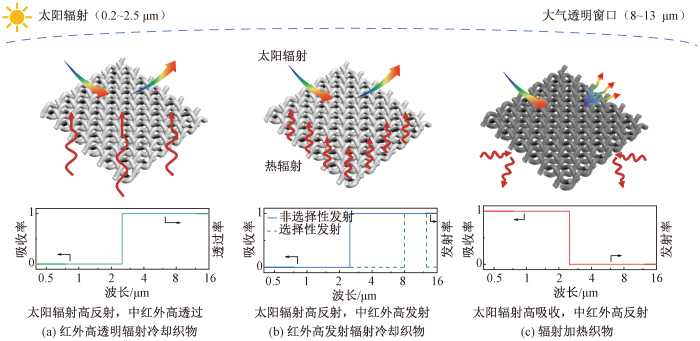
图1
辐射热管理织物的光谱设计
Fig.1
Spectral design of radiative thermal management fabrics.
(a) Radiative cooling fabrics with high infrared transmittance; (b) Radiative cooling fabrics with high infrared emissivity; (c) Radiative heating fabrics
图1(c)示出辐射加热织物的光谱设计。表明对于理想的辐射加热织物的光谱设计遵从增加红外反射率的原则。由于人体热辐射处于中红外波段,这种光谱设计通过反射人体表面热辐射,最大程度地降低人体自发的辐射热耗散,起到优良的保温作用。此外,太阳辐射加热是不可忽略的因素。在太阳辐射波段具有高吸收率的织物可将太阳能充分地转化为热能,实现优异的升温效果,因此,对于理想的辐射加热织物而言,需同时在太阳辐射波段具有高吸收率且在中红外波段具有高反射率,二者的协同作用赋予了织物卓越的升温效果。
双模式辐射热管理织物的光谱设计则是辐射冷却和辐射加热光谱特性的有机结合,大致可分为基于异质结构的静态双模式热管理织物和基于致动器结构的动态双模式热管理织物。前者是在同一件织物的正反面同时集成了辐射冷却和辐射加热光谱,通过人为翻转该织物实现制冷和加热的功能。而后者则是刺激响应性材料在外界刺激下(温度、湿度等)产生形变,导致织物微观或宏观结构发生变化,进而实现制冷或加热的目标。
2 辐射热管理织物的研究进展
2.1 辐射冷却织物
图2
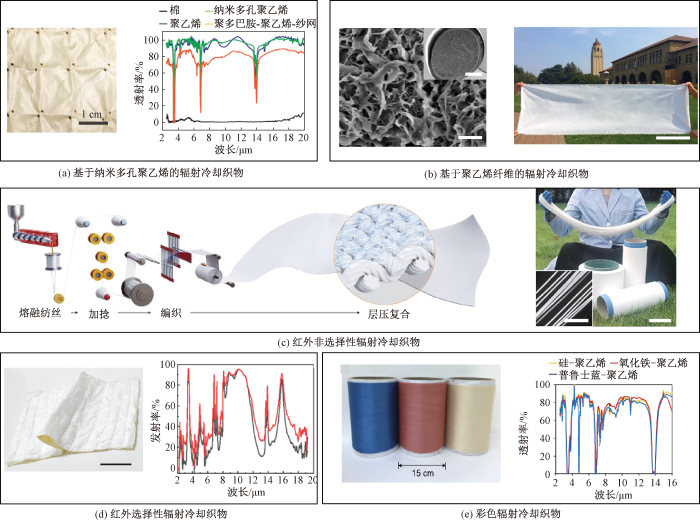
图2
辐射冷却织物研究进展
Fig.2
Research progress of radiation cooling fabrics.
(a) Radiative cooling fabrics based on nano porous PE; (b) Radiative cooling fabrics based on PE fiber; (c) Radiative cooling fabrics with non-selective MIR emittance; (d) Radiative cooling fabrics with selective MIR emittance; (e) Colored radiative cooling fabrics with high MIR transmittance
由于聚乙烯中C—C,C—H键的吸收峰位于3.4, 3.5, 6.8, 7.3 和13.7 μm,远离人体的红外辐射波段,因此对人体热辐射有很高的透过率。此外,这种纳米多孔聚乙烯薄膜中分布着50~1 000 nm的孔洞结构,由于米氏散射的作用,可以高效散射太阳辐射,降低光热效应引起的升温。因此,在太阳辐照下,这种纳米多孔聚乙烯不仅避免了自发升温,而且有利于人体的辐射热耗散。在此基础上,利用微针冲孔和层压复合等改性手段提升了织物的可穿戴性和耐水洗性。最终,这种辐射冷却织物在中红外的透过率高达0.8,而相应的商用棉织物则几乎为0。实验结果表明,志愿者穿着这种辐射冷却织物可显著降低体表温度,在维持相同热舒适的前提下提高空调的设定温度以实现节能降碳效果。除此之外,图2(b)展示了在普通聚乙烯材料中引入多孔结构制备红外高透明辐射冷却织物的策略[14]。该织物也具有同纳米多孔聚乙烯类似的辐射冷却效果。除聚乙烯外,非芳烃锦纶、聚丙烯、聚四氟乙烯等材料也具有较高的红外透射率,基于上述材料的辐射冷却织物也具有类似的冷却效果 [14-
红外高发射辐射冷却织物的冷却效果要低于红外高透明辐射冷却织物,但具有更好的加工特性和丰富的材料选择性,因此易于实现功能化的设计[17]。图2(c)展示了陶光明团队设计的一种跨尺度超构织物[18]。该织物具有双层结构,底层为二氧化钛和聚乳酸的复合织物,顶层为50 μm聚四氟乙烯薄膜,二者经层压复合得到中红外高发射的辐射冷却织物。得益于表面分级结构设计,该织物在可见光和近红外波段具有广谱高反射率(0.924),因此织物展现出超白的外观。同时,该织物在中红外具有广谱高发射率(0.945),可持续地将热量辐射至低温环境,有望实现低于室温的辐射冷却效果。户外实测中,该织物表现出比商用棉织物低4.8 K的降温效果。这类红外高发射的辐射冷却织物通常是高分子和无机纳米粒子的复合材料,其中无机纳米粒子(TiO2[19]、Al2O3[20]、SiO2[21]等)提供太阳辐射波段的高反射率,而高分子材料(蚕丝[7]、聚甲醛[22]、聚偏氟乙烯共六氟丙烯[18]、醋酸纤维素[23]等)则增强织物整体在中红外波段的发射率,结合纳米粒子的粒径设计或织物的表面光子结构设计,这类非选择性红外高发射辐射冷却织物有望取得日间低于室温的辐射冷却效果。相反,图2(d)展示了张如范团队基于聚甲醛/竹纤维/导热硅胶设计的一种中红外选择性发射的辐射冷却织物[22],该织物在大气透明窗口的发射率高达0.8,在非透明窗口的发射率很低[22]。结合太阳辐射波段的高反射率(0.96),该织物可实现低于室温9.6 K的降温。同时,这种织物还具有快速吸湿特性和高界面热导率,更有利于炎热环境下人体的快速降温。总之,得益于丰富的材料选择性,中红外高发射织物甚至可以结合其它主动或被动热管理技术,大幅度拓宽人体温度舒适区。
为实现日间低于室温的辐射冷却效果,织物本身需具有极高的阳光反射率,因此不可避免地导致织物本身展现出超白或银白色的外观,难以不满足服装行业对美学的要求[24]。目前,研究人员普遍通过引入红外透明染料(氧化铁、普鲁士蓝等)[25]和结构色这2种方式赋予织物色彩。图2(e)展示了一种基于红外透明染料的辐射冷却织物[25],这种彩色辐射冷却织物在中红外波段具有高透过率(0.8),而在太阳辐射波段却不可避免地存在选择性吸收。因此,这类织物在室内展现出比普通棉织物更好的冷却效果,而在室外仍无法实现低于室温的辐射冷却效果。此外,红外透明染料的种类较少,有限的颜色选择性限制其进一步的发展。基于结构色的辐射冷却织物解决了颜色和选择性光谱的矛盾。通过选择在太阳辐射波段低吸收,在中红外波段高发射的材料作为结构色的构筑单元,这种彩色辐射冷却织物可真正实现日间低于室温的辐射冷却效果。但由于长程有序的精细结构,这种基于结构色的辐射冷却织物通常展现出虹彩的外观特征和有限的观测角度。此外,这种精细结构难以实现大面积低成本的制备,因此,这类彩色辐射冷却织物的大规模应用仍然面临挑战。
2.2 辐射保温/加热织物
图3
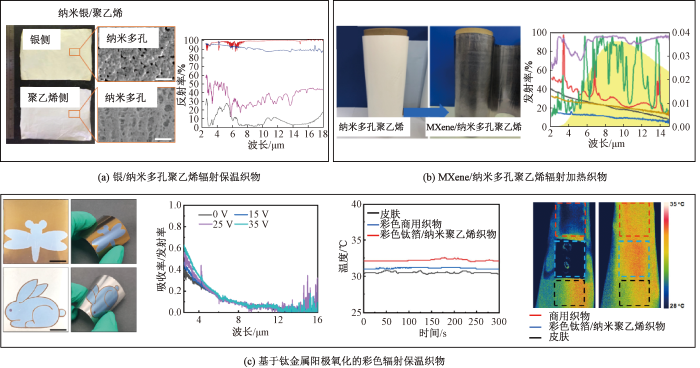
图3
辐射保温/加热织物研究进展
Fig.3
Research progress of radiative warming/heating fabrics.
(a) Radiative warming fabrics based on Ag/Nano PE; (b) Radiative heating fabrics based on MXene/Nano PE; (c) Radiative warming fabrics based on Ti anodization
2.3 双模式辐射热管理织物
尽管针对单模式辐射热管理织物的研究取得了丰富的进展,但这种固定的光谱设计无法满足温度剧烈变化下人体的热管理需求。错误的热管理模式会造成人体的过热或过冷,影响人体热舒适,甚至造成不可逆的损伤。因此,研究人员提出了具有光谱可调性的热管理织物这个概念,甚至在同一件织物正反面集成2种光谱特性以实现双模式热管理。这种双模式辐射热管理织物大致可分为2类,一类是基于异质结构的静态双模式辐射热管理织物,另一类是基于致动器结构的动态双模式辐射热管理织物。
静态双模式辐射热管理织物,其本质是在织物正反面同时集成了具有辐射加热和辐射冷却光谱特性的材料,通过人为主动翻转实现与环境温度对应的热管理模式[33]。图4(a)展示了崔屹团队制备的一种基于铜箔和炭黑的双层热管理织物,并将铜箔和炭黑包覆在厚度不等的纳米多孔聚乙烯薄膜中[34]。当炭黑朝外时,织物表面红外发射率为0.9,有利于实现高效的辐射热耗散。底部单层的纳米多孔聚乙烯降低了织物与体表的热阻,同时高热导率的铜箔更有利于将人体热量传导至辐射层,二者的协同作用促进了人体高效的散热。此时,织物处于冷却模式。相反,当铜箔层向外时,铜箔的低发射率(0.3)降低了织物的辐射热耗散,此时处于保温模式。同时底层较厚的纳米多孔聚乙烯层增加了热阻,更有利于人体的保温。
图4
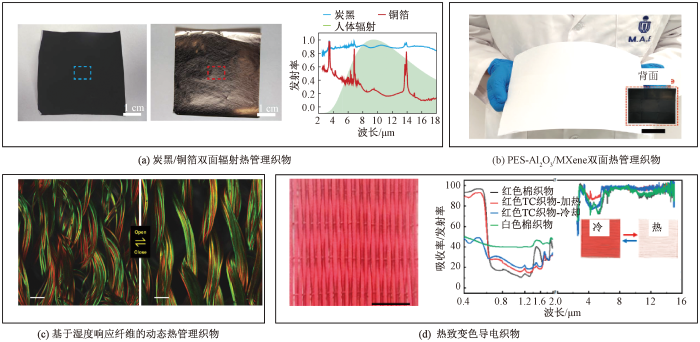
图4
双模式辐射热管理织物的研究进展
Fig.4
Research progress of dual-mode radiative thermal management fabrics.
(a) Dual-mode radiative thermal management fabrics based on carbon/Cu foil; (b) Dual-mode radiative thermal management fabrics based on PES-Al2O3/MXene; (c) Dynamic radiative thermal management fabrics based on humidity-responsive fiber; (d) Thermochromic conductive fabrics
动态双模式热管理织物,其本质是刺激响应性材料在温度湿度作用下产生形变,进而带动织物结构变化,实现热管理模式的切换[36-
相比于单模式热管理织物,双模式热管理织物更符合动态环境下人体所需的热管理,但还未能实现人体的热舒适。就静态双模式辐射热管理织物而言,其辐射加热侧在标准太阳辐射下可以升温至60 ℃以上,而人体温度的舒适区仅为35~37.5 ℃。过高的织物温度不仅不满足人体热舒适,甚至可能造成高温烫伤。因此,具有光谱吸收/发射率连续调节能力的动态辐射热管理织物更符合人体热舒适的基本要求。通过逐级调控织物在可见光-近红外-中红外波段的吸收/发射率,实现与环境相匹配的光谱模式,保证人体温度舒适区的恒定,是热管理织物发展的未来目标。
3 结束语
目前,针对单模式和双模式的辐射热管理织物的研究均取得了长足的进展,但仍有一些关键问题等待解决,以弥合科学研究和实际应用的沟壑。
1)人体温度的舒适区要远低于环境温度的变化区间,上述无论是单模式还是双模式的热管理织物均无法实现光谱发射率/吸收率的连续调节,故无法实现温度的连续调节,难以满足个人热舒适。因此,研究具有光谱连续可调特性的动态热管理织物,实现与环境温度实时匹配的动态热管理具有重要意义。
2)尽管大量研究已实现了对于辐射热管理织物的大面积制备,但是大面积制备却不等同于大批量制备。受限于功能材料的量产,精细结构的构筑和织物制备方法等问题,大量已报道的具有优异热管理效果的织物成本高昂且仅限于实验室规模的制备,不利于其实际应用。因此,辐射热管理织物低成本连续化生产制备对于其实际应用具有重要意义。
3)赋予功能性织物颜色是服装行业的必然要求,现已报道的基于结构色策略的彩色辐射热管理织物解决了颜色和选择性光谱的矛盾,如引入低阳光吸收、高红外发射的构筑单元实现辐射冷却效果,或引入高阳光吸收、低红外发射的构筑单元实现辐射加热效果等。但上述方案均面临有限的观测角度,颜色选择性少,难于大面积制备等问题。因此,在满足选择性光谱要求的前提下,简化制备方法、降低制备成本,有助于推广彩色辐射热管理织物的应用。
4)为实现特定的热管理效果,功能性材料的引入必不可少;但是,功能性材料的引入显著降低了织物的穿着舒适度,如辐射冷却织物中无机纳米粒子的引入大幅降低了织物的柔顺性,辐射加热织物中致密的金属镀膜减少了织物的吸湿排汗性等问题,因此,辐射热管理织物的设计中需兼顾热管理性能和可穿戴性。
尽管如此,已有研究已经充分证明辐射热管理织物在满足人体热舒适方面的巨大潜力。不仅如此,这种零能耗的热管理织物降低了人们在日常生活中对主动式热管理设备的需求,直接起到节能降碳的作用,这对于推动社会可持续发展,保护环境具有深远意义。
参考文献
Emerging materials and strategies for personal thermal manage-ment
[J].
Highly sunlight reflective and infrared semi-transparent nanomesh textiles
[J].
DOI:10.1021/acsnano.1c04104
PMID:34661392

Radiative cooling in textiles is one of the important factors enabling cooling of the human body for thermal comfort. In particular, under an intense sunlight environment such as that experienced with outdoor exercise and sports activities, high near-infrared (NIR) reflectance to block sunlight energy influx along with high IR transmittance in textiles for substantial thermal emission from the human body would be highly desirable. This investigation demonstrates that a nanoscale geometric control of textile structure alone, instead of complicated introduction of specialty polymer materials and composites, can enable such desirable NIR and IR optical properties in textiles. A diameter-dependent Mie scattering event in fibers and associated optical and thermal behavior were simulated in relation to a nonwoven, nanomesh textile. As an example, a nanomesh structure made of PVDF (polyvinylidene fluoride) electrospun fibers with ∼600 nm average diameter was examined, which exhibited a significant radiative cooling performance with over 90% solar and NIR reflectance to profoundly block the sunlight energy influx as well as ∼50% IR transmittance for human body radiative heat dissipation. An extraordinary cooling effect, as much as 12 °C, was obtained on a simulated skin compared to the normal textile fabric materials. Such a powerful radiative cooling performance together with IR transmitting capability by the nanomesh textile offers a way to efficiently manage sunlight radiation energy to make persons, devices, and transport vehicles cooler and help to save energy in an outdoor sunlight environment as well as indoor conditions.
A moisture-wicking passive radiative cooling hierarchical metafabric
[J].
A thermally insulating textile inspired by polar bear hair
[J].
Scalable and reconfigurable green electronic textiles with personalized comfort management
[J].
DOI:10.1021/acsnano.2c04252
PMID:35930746
Electronic textiles, inherited with the wearability of conventional clothes, are deemed fundamental for emerging wearable electronics, particularly in the Internet of Things era. However, the electronic waste produced by electronic textiles will further exacerbate the severe pollution in traditional textiles. Here, we develop a large-scale green electronic textile using renewable bio-based polylactic acid and sustainable eutectic gallium-indium alloys. The green electronic textile is extremely abrasion resistant and can degrade naturally in the environment even if abrasion produces infinitesimal amounts of microplastics. The mass loss and performance change rates of the reconstituted green electronic textiles are all below 5.4% after going through the full-cycle recycling procedure. This green electronic textile delivers high physiological comfort (including electronic comfort and thermal-moisture comfort), enables wireless power supply (without constraints by, e.g., wires and ports), has 2 orders of magnitude better air and moisture permeability than the body requires, and can lower skin temperature by 5.2 °C.
Advanced textiles for personal thermal management and energy
[J].
Subambient daytime radiative cooling textile based on nanoprocessed silk
[J].
DOI:10.1038/s41565-021-00987-0
PMID:34750560
[本文引用: 2]
Decreasing energy consumption is critical to sustainable development. Because temperature regulation for human comfort consumes vast amounts of energy, substantial research efforts are currently directed towards developing passive personal thermal management techniques that cool the human body without any energy consumption. Although various cooling textile designs have been proposed previously, textile-based daytime radiative cooling to a temperature below ambient has not been realized. Silk, a natural protein fabric produced by moth caterpillars, is famous for its shimmering appearance and its cooling and comforting sensation on skin. It has been recently recognized that silk, with its optical properties derived from its hierarchical microstructure, may represent a promising starting point for exploring daytime radiative cooling. However, the intrinsic absorption of protein in the ultraviolet region prevents natural silk from achieving net cooling under sunlight. Here we explore the nanoprocessing of silk through a molecular bonding design and scalable coupling reagent-assisted dip-coating method, and demonstrate that nanoprocessed silk can achieve subambient daytime radiative cooling. Under direct sunlight (peak solar irradiance >900 W m) we observed a temperature of ~3.5 °C below ambient (for an ambient temperature of ~35 °C) for stand-alone nanoprocessed silks. We also observed a temperature reduction of 8 °C for a simulated skin when coated with nanoprocessed silk, compared with natural silk. This subambient daytime radiative cooling of nanoprocessed silk was achieved without compromising its wearability and comfort. This strategy of tailoring natural fabrics through scalable nanoprocessing techniques opens up new pathways to realizing thermoregulatory materials and provides an innovative way to sustainable energy.© 2021. The Author(s), under exclusive licence to Springer Nature Limited.
Continuous fabrication of polyethylene microfibrilar bundles for wearable personal thermal management fabric
[J].
Designing heat transfer pathways for advanced thermoregulatory textiles
[J].
Biomimetic, knittable aerogel fiber for thermal insulation textile
[J].
DOI:10.1126/science.adj8013
PMID:38127754
[本文引用: 1]
Aerogels have been considered as an ideal material for thermal insulation. Unfortunately, their application in textiles is greatly limited by their fragility and poor processability. We overcame these issues by encapsulating the aerogel fiber with a stretchable layer, mimicking the core-shell structure of polar bear hair. Despite its high internal porosity over 90%, our fiber is stretchable up to 1000% strain, which is greatly improved compared with that of traditional aerogel fibers (~2% strain). In addition to its washability and dyeability, our fiber is mechanically robust, retaining its stable thermal insulation property after 10,000 stretching cycles (100% strain). A sweater knitted with our fiber was only one-fifth as thick as down, with similar performance. Our strategy for this fiber provides rich possibilities for developing multifunctional aerogel fibers and textiles.
Outdoor personal thermal management with simultaneous electricity generation
[J].
A trimode thermoregulatory flexible fibrous membrane designed with hierarchical core-sheath fiber structure for wearable personal thermal management
[J].
DOI:10.1021/acsnano.2c04971
PMID:35947793
[本文引用: 1]
Advanced textiles designed for personal thermal management contribute to thermoregulation in an individual and energy-saving manner. Textiles incorporated with phase changing materials (PCMs) are capable of bridging the supply and demand for energy by absorbing and releasing latent heat. The integration of solar heating and the Joule heating function supplies multidriving resources, facilitates energy charging and storage, and expands the service time and application scenarios. Herein, we report a fibrous membrane-based textile that was developed by designing the hierarchical core-sheath fiber structure for trimode thermal management. Especially, coaxial electrospinning allows an effective encapsulation of PCMs, with high heat enthalpy density (106.9 J/g), enabling the membrane to buffer drastic temperature changes in the clothing microclimate. The favorable photothermal conversion performance renders the membrane with the high saturated temperature of 70.5 °C (1 sun), benefiting from the synergistic effect of multiple light harvesters. Moreover, a conductive coating endows the composite membrane with an admirable electrothermal conversion performance, reaching a saturated temperature of 73.8 °C (4.2 V). The flexible fibrous membranes with the integrated performance of reversible phase change, multi-source-driven heating, and energy storage present great advantages for all-day, energy-saving, and wearable individual thermal management applications.
Radiative human body cooling by nanoporous polyethylene textile
[J].Thermal management through personal heating and cooling is a strategy by which to expand indoor temperature setpoint range for large energy saving. We show that nanoporous polyethylene (nanoPE) is transparent to mid-infrared human body radiation but opaque to visible light because of the pore size distribution (50 to 1000 nanometers). We processed the material to develop a textile that promotes effective radiative cooling while still having sufficient air permeability, water-wicking rate, and mechanical strength for wearability. We developed a device to simulate skin temperature that shows temperatures 2.7° and 2.0°C lower when covered with nanoPE cloth and with processed nanoPE cloth, respectively, than when covered with cotton. Our processed nanoPE is an effective and scalable textile for personal thermal management.Copyright © 2016, American Association for the Advancement of Science.
Nanoporous polyethylene microfibres for large-scale radiative cooling fabric
[J].
Spectrally selective nanocomposite textile for outdoor personal cooling
[J].
Infrared-transparent visible-opaque fabrics for wearable personal thermal management
[J].
Aerogel-functionalized thermoplastic polyurethane as waterproof, breathable freestanding films and coatings for passive daytime radiative cooling
[J].
Hierarchical-morphology metafabric for scalable passive daytime radiative cooling
[J].
DOI:10.1126/science.abi5484
PMID:34353954
[本文引用: 2]
Incorporating passive radiative cooling structures into personal thermal management technologies could effectively defend humans against intensifying global climate change. We show that large-scale woven metafabrics can provide high emissivity (94.5%) in the atmospheric window and high reflectivity (92.4%) in the solar spectrum because of the hierarchical-morphology design of the randomly dispersed scatterers throughout the metafabric. Through scalable industrial textile manufacturing routes, our metafabrics exhibit desirable mechanical strength, waterproofness, and breathability for commercial clothing while maintaining efficient radiative cooling ability. Practical application tests demonstrated that a human body covered by our metafabric could be cooled ~4.8°C lower than one covered by commercial cotton fabric. The cost-effectiveness and high performance of our metafabrics present substantial advantages for intelligent garments, smart textiles, and passive radiative cooling applications.Copyright © 2021, American Association for the Advancement of Science.
Temperature-dependent dual-mode thermal management device with net zero energy for year-round energy saving
[J].
Creating an eco-friendly building coating with smart subambient radiative cooling
[J].
Colloidal photonic assemblies for colorful radiative cooling
[J].
DOI:10.1021/acs.langmuir.0c00051
PMID:32370514
[本文引用: 1]
Radiative cooling has proven to be a powerful strategy for sustainable thermal management. Nanophotonic structures enabling broadband reflection lead to minimization of sunlight absorption, which has brought nighttime-limited radiative cooling into daytime applications. However, this broadband reflection strategy in turn restricts the accessible colorization of radiative coolers to white or neutral, consequently hindering their practical applications, particularly for aesthetic purposes. With a few exceptions, selective absorption at a specific visible wavelength has been the most prevalent paradigm for colorization of radiative coolers. However, this absorption-based colorization inevitably makes the radiative cooler prone to heating, thus decreasing the cooling efficiency. Here, we demonstrate an undiscovered usage of opals for advancing color-preserved daytime radiative coolers. Opals, which have served mainly as Bragg reflective color pigments thus far, can be considered an effective homogeneous medium in the mid-infrared region. Thus, opals can also be envisioned as reflectively colorful metamaterials capable of radiative cooling even under the direct summer sun. Together with the soft fluidity of colloidal suspensions, opals can serve as platforms for easy-to-craft, large-scale, and colorful radiative coolers with minimal solar absorption.
Radiative cooling meta-fabric integrated with knitting perspiration-wicking and coating heat conduction
[J].
DOI:10.1021/acsnano.4c12196
PMID:39810371
[本文引用: 3]
Radiative cooling is an emerging zero-energy-consumption technology for human body cooling in outdoor scenarios during hot seasons. However, existing radiative cooling textiles are limited by low intrinsic cooling power, high hydrophobicity, and heat-insulating properties, which seriously impede a satisfying cooling effect, perspiration-wicking, and heat dissipation, thus limiting human thermal comfort in practical situations. Here, we developed a radiative cooling meta-fabric that was integrated with high perspiration-wicking and thermal conduction capacity. The meta-fabric included a polyoxymethylene (POM) nanotextile on the front side as a selective radiative emitter, a skin-friendly silicone on the reverse side as a thermal conductor, and patterned bamboo yarns (a cellulose fiber derived from bamboo with excellent hydrophilicity) as the water transport channels. As a result, the meta-fabric could rapidly wick away perspiration (within seconds) and had a high thermal conductivity of 1.5 W/(m·K), exhibiting high-performance human body cooling with a temperature of 10.9 °C lower than the meta-fabric without perspiration. Besides, even without perspiration, the meta-fabric still exhibited a temperature of 9.6 °C lower than commercial cotton fabrics. The work provides an alternative method to design smart textiles for personal thermal management in real applications.
Protecting ice from melting under sunlight via radiative cooling
[J].
Colored and paintable bilayer coatings with high solar-infrared reflectance for efficient cooling
[J].
Temperature regulation in colored infrared-transparent polyethylene textiles
[J].
DOI:10.1016/j.joule.2019.03.015
[本文引用: 2]
Effectively regulating heat flow between the human body and its environment not only increases thermal comfort but also presents a novel and potentially cost-effective approach to reducing building energy consumption. Infrared property-engineered textiles have been shown to passively regulate radiative heat dissipation for effective cooling and warming of the human body. However, a lack of dyes that can tune the textile color without compromising the infrared properties remains a major impediment to textile commercialization. Here, we report a new strategy utilizing inorganic nanoparticles as a coloring component for scalable brightly colored, infrared-transparent textiles. The as-fabricated composite textiles not only show a high infrared transparency of similar to 80% and a passive cooling effect of similar to 1.6 degrees C-1.8 degrees C but also exhibit intense visible colors with good stability againstwashing. This facile coloration approachwill promote the commercialization of radiative cooling textiles in temperature-regulating wearable applications for effective energy savings.
Thermal insulation properties of multifunctional metal composite fabrics
[J].
Personal thermal management by metallic nanowire-coated textile
[J].
Warming up human body by nanoporous metallized polyethylene textile
[J].
DOI:10.1038/s41467-017-00614-4
PMID:28928427
[本文引用: 1]
Space heating accounts for the largest energy end-use of buildings that imposes significant burden on the society. The energy wasted for heating the empty space of the entire building can be saved by passively heating the immediate environment around the human body. Here, we demonstrate a nanophotonic structure textile with tailored infrared (IR) property for passive personal heating using nanoporous metallized polyethylene. By constructing an IR-reflective layer on an IR-transparent layer with embedded nanopores, the nanoporous metallized polyethylene textile achieves a minimal IR emissivity (10.1%) on the outer surface that effectively suppresses heat radiation loss without sacrificing wearing comfort. This enables 7.1 degrees C decrease of the set-point compared to normal textile, greatly outperforming other radiative heating textiles by more than 3 degrees C. This large set-point expansion can save more than 35% of building heating energy in a cost-effective way, and ultimately contribute to the relief of global energy and climate issues.
Ultrathin titanium carbide (MXene) films for high-temperature thermal camouflage
[J].
Robust silk fibroin/graphene oxide aerogel fiber for radiative heating textiles
[J].
Ti3C2Tx MXene-decorated nanoporous polyethylene textile for passive and active personal precision heating
[J].
DOI:10.1021/acsnano.1c00903
PMID:34165297
[本文引用: 1]
Heating the human body to maintain a relatively constant temperature is pivotal for various human functions. However, most of the current heating strategies are energy-consuming and energy-wasting and cannot cope with the complex and changing environment. Developing materials and systems that can heat the human body precisely via an efficient energy-saving approach no matter indoors/outdoors, day/night, and sunny/cloudy is highly anticipated for mitigating the growing energy crisis and global warming but is still a great challenge. Here, we demonstrate the low mid-infrared radiative (mid-IR) emissivity characteristic of TiCT MXene and then apply it for energy-free passive radiative heating (PRH) on the human body. Our strategy is realized by simply decorating the cheap nanoporous polyethylene (nanoPE) textile with MXene. Impressively, the as-obtained 12 μm thick MXene/nanoPE textile shows a low mid-IR emissivity of 0.176 at 7-14 μm and outstanding indoor PRH performance on the human body, which enhances by 4.9 °C compared with that of traditional 576 μm thick cotton textile. Meanwhile, the MXene/nanoPE textile exhibits excellent active outdoor solar heating and indoor/outdoor Joule heating capability. The three heating modes integrated in this wearable MXene/nanoPE heating system can be switched easily or combined arbitrarily, making this thin heating system able to heat the human body precisely in various scenarios like indoors/outdoors, day/night, and sunny/cloudy, providing multiple promising and energy-saving solutions for future all-day personal precision thermal management.
Anodization-processed colored radiative thermoregulatory film
[J].
DOI:10.1021/acs.nanolett.4c04073
PMID:39514293
[本文引用: 1]
Colored radiative thermal management materials (RTMM) not only provide superior thermoregulatory performance but also satisfy aesthetic requirements. However, the complexity of the preparation procedures and constrained color selection have hindered their widespread adoption. Here, we presented a facile one-step anodizing strategy for fabricating colored dual-mode RTMM based on titanium film (Ti) and P(VDF-HFP) with mid-infrared (MIR) emissivities of 0.07 and 0.96, respectively, which allow for on-demand temperature modulation (rise of 28.2 K and drop of 9 K) without energy consumption. Furthermore, demonstrations of a colored radiative warming membrane also validate the effectiveness of anodizing treatment. The colored Ti/nano PE membrane with 10.8 μm thickness enables a temperature rise of 2.3 K on real human skin, which is much higher than that of commercial fabric with 120 μm thickness (0.7 K). This strategy provides insights for the scalable fabrication and application of colored low emissivity materials, contributing to the goal of a sustainable society.
Scalable fabrication of dual-function fabric for zero-energy thermal environmental management through multiband, synergistic, and asymmetric optical modulations
[J].
A dual-mode textile for human body radiative heating and cooling
[J].
A Janus textile capable of radiative subambient cooling and warming for multi-scenario personal thermal manage-ment
[J].
Thermoregulatory clothing with temperature-adaptive multimodal body heat regulation
[J].
Metalized polyamide heterostructure as a moisture-responsive actuator for multimodal adaptive personal heat management
[J].
Thermochromic silks for temperature management and dynamic textile displays
[J].
Dynamic gating of infrared radiation in a textile
[J].
DOI:10.1126/science.aau1217
PMID:30733415
[本文引用: 1]
The human body absorbs and loses heat largely through infrared radiation centering around a wavelength of 10 micrometers. However, neither our skin nor the textiles that make up clothing are capable of dynamically controlling this optical channel for thermal management. By coating triacetate-cellulose bimorph fibers with a thin layer of carbon nanotubes, we effectively modulated the infrared radiation by more than 35% as the relative humidity of the underlying skin changed. Both experiments and modeling suggest that this dynamic infrared gating effect mainly arises from distance-dependent electromagnetic coupling between neighboring coated fibers in the textile yarns. This effect opens a pathway for developing wearable localized thermal management systems that are autonomous and self-powered, as well as expanding our ability to adapt to demanding environments.Copyright © 2019 The Authors, some rights reserved; exclusive licensee American Association for the Advancement of Science. No claim to original U.S. Government Works.
Thermochromic conductive fibers with modifiable solar absorption for personal thermal management and temperature visualization
[J].
DOI:10.1021/acsnano.3c06289
PMID:37831602
[本文引用: 1]
Thermal management textiles provide an energy-efficient strategy for personal thermal comfort by regulating heat flow between the human body and the environment. However, textiles with a single heating or cooling mode cannot realize temperature regulation under dynamic weather. Furthermore, monocolor textiles do not satisfy aesthetic requirements in a garment. Here, we develop a thermochromic (TC) conductive fiber with a coaxial structure composed of a conductive core and thermochromic shell. The TC conductive fiber-woven fabric has the ability of low-energy dynamic thermal management by combining Joule heating and modulation of solar absorption. Compared with commercial white fabrics, TC conductive fabrics exhibit a maximum temperature drop of 2.5 K, while the temperature of colored commercial fabrics is 7.5-16 K higher than that of commercial white fabrics in the hot. In the cold, the combination of Joule heating and the photothermal effect can provide desired thermal comfort for humans. Meanwhile, heat obtained from solar absorption brings the temperature of a fabric to a predetermined level, which saves energy of 625 W/m compared to a conductive-fiber-based textile. In addition, TC conductive fabrics with trichromatic evolution provide a sensitive and instant temperature visualization capable of identification of invisible and intense infrared radiation. These results provide another path to expand potential applications of wearable, flexible electronics.

 京公网安备11010502044800号


