



现有过滤材料体系主要包括纤维过滤材料与膜分离材料二大类别。纤维材料因其三维网状拓扑结构与多级贯通孔道特征,在亚微米级颗粒捕集方面具有显著优势。目前报道最多的空气过滤材料主要包括超细玻璃纤维纸、驻极熔喷非织造材料和纳米纤维膜。玻璃纤维纸因具有优良的耐高温性能而作为主要的高效空气过滤器介质,但是玻璃纤维易发生纤维间的剥离或脱落,人体吸入后有致癌的危险。当前,大多数空气过滤介质采用熔喷技术制造。由于熔喷材料经过电晕放电处理后会产生强静电吸附作用,其对空气的过滤效率得到显著提升。但是驻极熔喷布在高湿、高温的使用环境下仍存在电荷衰减问题[3],因此,开发更高品质的高除尘、低压阻且可重复使用的高效空气过滤材料,是近年来纤维过滤材料的重要研究方向。
静电纺纳米纤维膜(ENMs)具有高比表面积和自极化特性,结合仿生结构可提升过滤效率,并集成抗菌、智能传感等功能展现出卓越的过滤性能优化潜力,因此,纳米纤维膜已成为制备高效低阻空气过滤器的重要发展方向。对于纳米纤维膜空气过滤性能的评估指标通常包括过滤效率和过滤阻力 2项。其中品质因子是综合评价过滤材料性能的重要参数,高品质因子意味着过滤器在高效捕获颗粒物的同时,气流阻力较低,综合性能更优。
鉴于空气中微生物(如细菌)、挥发性有机物(VOCs)及超细颗粒物(PM2.5)等污染物的复合污染特征,要求空气净化材料必须具备多功能集成特性[4],因此,构建多功能化纳米纤维膜体系正成为该领域的研究热点。理想的静电纺丝空气过滤介质需兼具超细纤维直径与高孔隙率特征,以实现颗粒物的高效捕获与低过滤阻力的平衡。传统静电纺丝纳米纤维大都呈现光滑表面与随机沉积结构,此类构型对过滤性能的改善幅度有限。目前采用静电纺丝技术已成功制备出纳米凸起、串珠、褶皱、多孔、核壳、中空、带状、树枝状、蛛网状等多级结构纳米纤维。本文系统综述了基于静电纺多级结构纳米纤维膜及其与抗菌、催化氧化VOCs、光催化、吸附等功能耦合的空气过滤材料研究进展,并讨论了其面临的挑战和发展前景。
1 多级结构纳米纤维膜
1.1 纳米凸起
纳米凸起结构的引入为静电纺丝纤维过滤介质带来了突破性改进。其通过构建多尺度粗糙表面形貌,在微观尺度上形成三维高孔隙网络,这种分级结构一方面通过优化气流路径显著降低压降,另一方面纳米凸起的存在有效增大了纤维比表面积,强化了拦截效应与扩散效应的双重作用。掺杂粒子自身的功能特性差异,赋予了纳米凸起结构纤维多元化的功能表现。图1示出静电纺纳米凸起结构纤维膜微观形貌。可见,聚砜/二氧化钛纳米粒子(PSU/TiO2 NPs)膜表面均匀分布着高密度纳米凸起,且随着TiO2掺杂量的增加,膜表面粗糙度呈现梯度增强趋势,TiO2掺杂量不同的纤维膜命名为PSU/TiO2-X X为TiO2的质量分数。其中,PSU/TiO2(5%)膜显示出最佳的过滤性能以及呈现出最大的品质因子值。该纤维膜的特殊表面形貌导致边界层流场重构,粗糙纤维表面形成的湍流边界层有效增加了前置停滞区面积,使无滑移流动区域的纤维阻力系数降低,从而实现了过滤效率与压降损耗的协同优化[5]。
图1
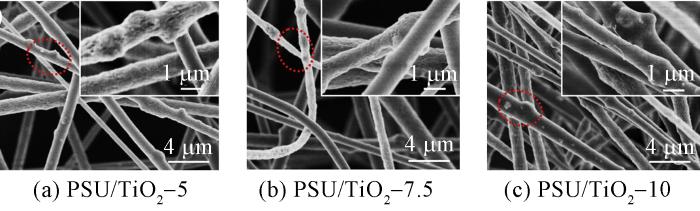
图1
静电纺纳米凸起结构纤维膜微观结构照片
Fig.1
Microstructure of nanoconvex structured fiber membrane by electrospinning
微纳米凸起结构的纳米纤维复合膜可有效调节纤维间的堆积方式,优化气流路径,可以解决纳米纤维膜容尘量偏低的问题,且多以物理掺杂这一简单的方式制备。所以纳米凸起结构在未来静电纺纳米纤维空气过滤材料发展中前景广阔。
1.2 串珠结构
图2
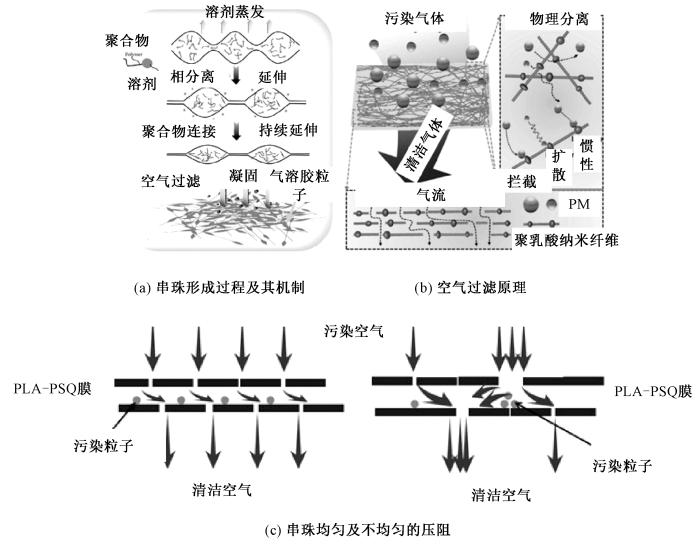
图2
静电纺纳米纤维膜串珠结构形成机制及过滤原理
Fig.2
Formation mechanism and filtration principle diagram of electrospun bead structured nanofiber membrane. (a) Formation process of beads and its mechanism; (b) Air filtration principle; (c) Uniform and uneven pressure resistance of beads
串珠的直径明显比纤维的直径粗,并且珠状结构有助于填充纤维之间的结构和降低压降、增加纤维膜的表面积,提升空气过滤效率。串珠纤维膜的空气过滤原理如图2(b)所示。在串珠纤维的研究中,学者们通过调整纺丝液的成分来优化纤维膜的性能。Lima等[9]揭示了串珠大小作为影响过滤效率和阻力的重要因素,其优化对于提升纤维膜的整体性能至关重要。随后,Zhang等[10]对串珠尺寸的大小与过滤效率以及压降之间的关系进行了系统的模拟研究。结果显示无论是球形还是椭圆形串珠,都有助于降低压降,其中椭圆形的性能稍优。这一发现为串珠纤维膜的形状设计提供了理论依据。此外,随着珠粒尺寸因子(珠高与纤维直径之比)的增加,过滤效率会降低。对于珠粒形状研究发现,珠粒形状因子(珠长与珠高之比)对过滤效率的影响相对较小。然而,当形状因数为1.5时,颗粒捕获效率以及品质因数均达到最高值。这一发现有助于进一步提升其空气过滤性能。
Cao等[11]的研究结果进一步验证了纤维表面均匀分布的串珠状结构可显著提升孔隙的规整性与尺寸均一性。在保持相同分离效率的前提下,串珠均匀分布膜的压降与不均匀分布的膜相比,降低了约43%(见图2(c))。这种结构特征使粉尘颗粒在孔隙通道内经历更小的流动阻力,从而实现过滤效率与空气阻力的协同优化。基于对高效过滤材料的需求探索,Liu等[12]创新性地采用超声辅助静电纺丝技术,成功制备了聚ε-己内酯/玉米蛋白/银纳米颗粒复合纳米纤维膜。该膜不仅保持了高过滤效率,更因银纳米颗粒的均匀负载而展现出优异的抗菌性能。该膜对粒径≥0.3 μm颗粒的过滤效率高达97.5%,同时对大肠埃希菌和金黄色葡萄球菌的抗菌率均超过97%。
当前关于珠状结构膜的厚度调控、填充密度优化及其与空气过滤性能关联性的研究报道仍显不足。特别是珠粒在三维空间中的堆积位置对ENMs过滤性能的影响机制尚未得到充分揭示。未来的研究应集中在调控纤维表面积和孔隙分布对过滤性能的影响方面。
1.3 褶皱结构
褶皱结构纳米纤维不仅具有非常高的表面积,而且增加了纤维之间的平均距离,与光滑的纤维相比,褶皱纳米纤维在吸附、捕集或分离应用方面显示出巨大的潜力[13]。通过物理掺杂和化学处理均可制得表面褶皱的纤维。通常大多数的褶皱纤维是由于在静电纺丝过程中溶剂和非溶剂的蒸发速度不同导致纤维表面不均匀塌陷形成。
物理掺杂在功能性改善方面优势显著。在口罩滤芯的优化上,Xu等[14]通过仿生结构设计,开发出具有多尺度纤维直径与分级孔径结构的口罩滤芯,经银纳米颗粒掺杂改性后,滤芯表面形成有效抗菌界面,对病原菌的灭活率达99%(见图3(a)),同时对PM0.3颗粒物的过滤效率达99.1%,在10.67 cm/s的迎面风速下,压降仅为105 Pa。在气体处理方面,Kwon等[15]添加的锐钛矿相TiO2纳米颗粒,使材料在紫外光照下对NO气体展现出78.6%的光催化去除效率。其独特的褶皱结构显著增大了比表面积,通过形成丰富的防滑区和颗粒停滞区,强化了污染物的吸附捕获能力(见图3(b))。除物理掺杂外,还可借助化学处理在纤维膜表面构建特殊结构的层次形态。Zhang等[16]巧妙地构筑了聚酰亚胺(PI)/MnO2-Cl复合膜。该膜在低空气阻力下,不仅实现了PM的高效过滤,而且氯元素的引入显著增强了臭氧分解能力。在90%相对湿度的严苛条件下,该膜仍能保持94.5%的臭氧分解效率,展现出优异的综合净化性能(见图3(c))。在纤维膜的气流动力学特性方面,采用Knudsen数可精准描述单个纤维在过滤过程中的气流运动状态。如果纳米纤维网络的气流处于过渡流态,气体分子的平均自由程(分子间碰撞的平均距离)与流动的特征长度(如管道直径、物体尺寸等)处于同一量级,气体分子可相对容易地通过纳米纤维膜,使压降降低。Deng等[17]基于形态调控策略,热处理诱导形成聚乙烯醇/海藻酸钠/羟基磷灰石(T-PVA/SA/HAP)独特的褶皱螺旋结构(见图3(d))。这种分级结构在保持生态友好性和生物安全性的同时,实现过滤性能与压降特性的优化平衡,独特的褶皱螺旋结构设计使纤维褶皱表面纹理与分级纳米孔隙协同作用,提升了复合膜的过滤效率。
图3
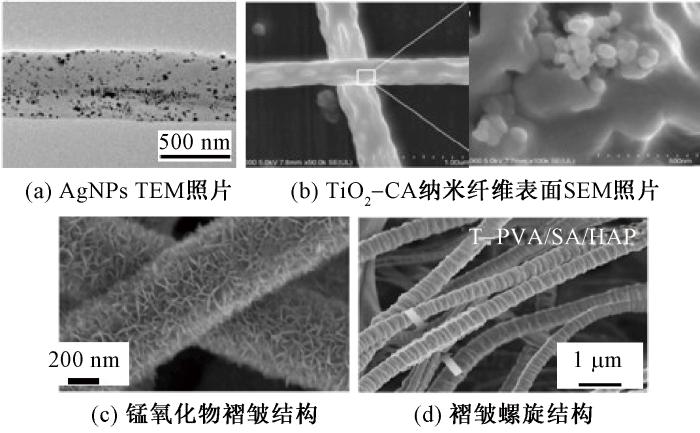
图3
静电纺纤维膜褶皱结构典型图像
Fig.3
Typical images of electrospun folding structure fiber membrane. (a) TEM image of AgNPs; (b) Surface SEM morphology of TiO2-CA nanofibers; (c) Image of manganese oxide pleated structure; (d) Image of pleated spiral structure
褶皱结构纳米纤维膜在空气过滤中表现出高过滤效率、低空气阻力、延缓堵塞和多功能性等显著优势,但其制备成本高、力学强度不足、颗粒物积累问题和均匀性难控制等需要在实际应用中加以考虑和解决。
1.4 多孔结构
图4
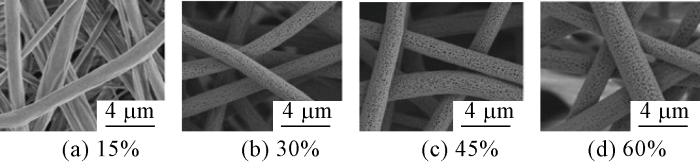
图4
静电纺纤维膜不同湿度下多孔结构典型图像
Fig.4
Typical image of porous structure of electrospun fiber membrane under different humidity
图5
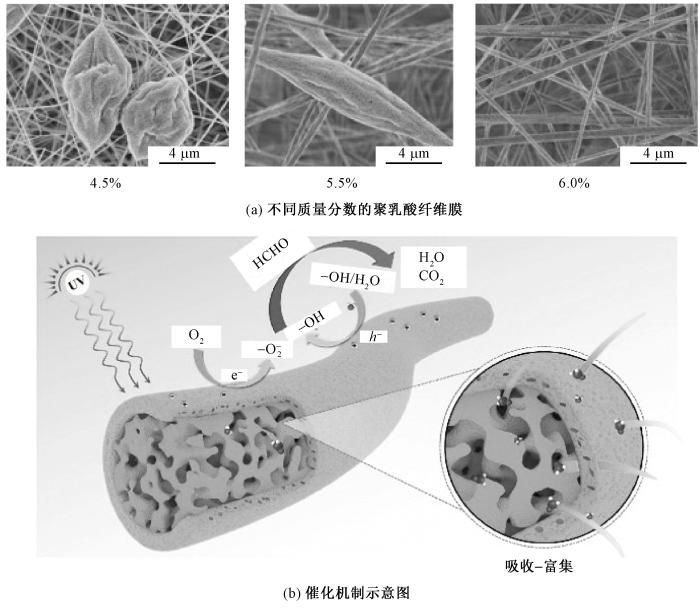
图5
不同含量下纤维膜的SEM照片(m(DCM)∶m(DMAC)=10∶1)和甲醛催化机制示意图
Fig.5
SEM images (m(DCM)∶m(DMAC)=10∶1)(a)and schematic diagram of formaldehyde catalytic mechanism (b)
由于多孔材料的独特结构和化学可调性在气体分离和催化领域引起了广泛的关注。研究人员成功制备出具有可调内部多孔结构的TiO2/SiO2(TS)杂化纤维。由于多孔结构的存在使TiO2纳米颗粒均匀分布在杂化纤维上[20]。Shi等[21]更系统研究了该TS纤维膜在催化与空气过滤领域的性能表现。多孔结构赋予TS纤维膜高达351.4 m2/g的比表面积和1 079.4 m3/(m2·h·kPa)的优异透气性。在5.33 cm/s的流速下,该膜对PM2.5的过滤效率达到99.98%,而空气阻力仅为69.3 Pa。在催化反应过程中,TS纤维膜展现出高效的甲醛降解能力,其降解机制如图5(b)所示。在600 L/(g·h)的高风速条件下,光催化去除率仍达到98.46%。
静电纺丝纤维的多孔结构在材料、工艺和应用方面有巨大潜力,尽管当下有些多孔纤维已经应用到商业中,但仍需解决力学性能差、均匀性低、生产效率低等问题。
1.5 核壳结构
静电核壳结构纤维独特的皮-芯构型与可调的物理化学特性,为功能化改性提供了丰富的活性位点。内核材料(如聚乳酸(PLA)、聚偏二氟乙烯(PVDF)、纤维素)主要负责提供力学支撑,而外壳层(如活性炭、MOF、金属氧化物)则通过构建多孔或纳米结构层,形成微孔-介孔-大孔分级孔隙系统。这种结构设计不仅使比表面积提升(最高可达1 000 m2/g以上),还显著增强了PM2.5、VOCs等污染物的吸附容量。更重要的是,外壳层的纳米纤维网络或多孔结构能够定向引导气流流动,有效延长污染物与材料表面的接触时间,从而提升单次过滤效率。
核壳结构在空气过滤中的优势源于其分级结构增强吸附与稳定性、多功能集成突破单一性能局限。Zhu等[22]在可生物降解纤维的研究基础上构筑了具有核壳结构的BG-PLA4纳米纤维膜(见图6),创新性地实现了对电生理信号的实时监测功能。与纯PLA纤维膜相比,该核壳结构膜展现出更优的长期过滤性能,过滤效率接近98.0%而压降仅53 Pa。更重要的是,该纤维膜在呼吸振动作用下能产生摩擦电输出,实现对电生理信号的实时原位监测,显著拓展了可生物降解纳米纤维的研究维度。功能化策略还为基材表面接枝光活性物质提供了有效路径,拓展了其在空气过滤领域的功能化应用潜力。Zhou等[23]研究的核壳结构膜不仅实现对PM2.5的高效率去除(达99.99%),而且在室温下即可完全催化分解甲醛(去除率100%)。
图6
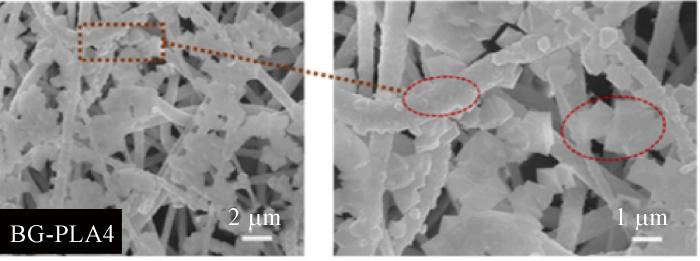
图6
静电纺纤维膜核壳结构典型图像
Fig.6
Typical images of core-shell structure of electrospun nanofiber membranes
核壳结构在空气过滤中的优势源于其分级结构增强吸附与稳定性、多功能集成突破单一性能局限。未来通过智能响应外壳(如pH/光响应)和生物降解核材料的开发,将进一步推动其在绿色空气净化领域的应用。
1.6 中空结构
基于同轴静电纺丝技术,已成功制备出多种聚合物基中空纳米纤维[24](见图7(a))。与核壳结构纤维相比,表面多孔且结构中空的纤维构型独具优势,为气体传输开辟了直通通道,在保障高过滤效率的同时,显著降低了气流阻力[25]。然而,在异形纤维研究过程中,Zhang等[26]发现静电纺丝时溶剂挥发能力的差异会导致纤维塌陷,原本圆柱形的纤维因塌陷形成带状纤维。纤维塌陷不仅降低了过滤效率,还扰乱了气流路径,进而增加过滤阻力。因此,在确保纤维形态不塌陷的基础上,提升纤维孔隙率成为提高空气过滤效率的关键途径。对于纳米级颗粒物(如PM0.1)和气态污染物(如挥发性有机物VOCs),单纯依靠物理拦截作用效果有限,需借助表面吸附或化学改性来增强去除效果。Gao等[27] 针对此问题展开系统研究,聚焦于空心α-Fe2O3纳米纤维的吸附特性,并采用染料分子(甲基橙,MO)作为探针分子进行验证。研究过程中,将通过静电纺丝法制备的PVA纳米纤维膜经后处理制得中空纳米纤维,其形貌特征通过SEM清晰表征(见图7(b))。吸附性能测试结果显示,该α-Fe2O3中空纤维对MO的去除效果显著,10 min内去除率可达约93%,15 min内即可实现100%吸附,充分彰显了其作为高效吸附剂的卓越性能。
图7
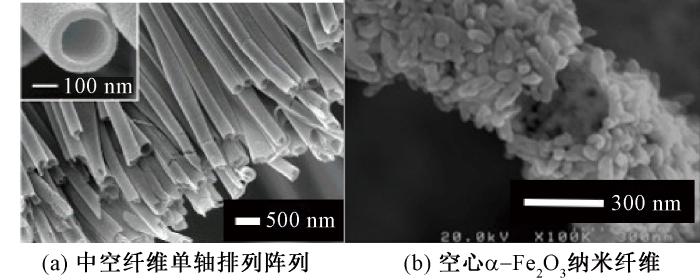
图7
静电纺纳米纤维膜中空结构图像
Fig.7
Image of hollow structure of electrospun nanofiber membrane. (a) Uniaxially aligned array of hollow fibers;(b) Hollow α-Fe2O3 nanofibers
中空纤维的过滤性能本质上是孔径分布与纤维堆积密度的函数。虽然密堆积结构能提升过滤效率,但过高的堆积密度会导致气流阻力(压降)呈指数级增长,显著增加系统能耗。若通过增大孔径或降低纤维密度来缓解压降问题,则会导致对小粒径颗粒(特别是PM0.1)的过滤效率显著下降。由于被截留的颗粒物会在纤维表面孔隙处逐渐堆积形成“滤饼层”,导致压降急剧上升,迫使系统频繁进行反冲洗或更换滤芯。面对高浓度颗粒物或黏性污染物(如油雾),堵塞问题更为突出。因此,后续研究应聚焦于开发梯度孔径结构或异形截面纤维,以期在压降与过滤效率之间实现更优平衡。
1.7 带状结构
图8
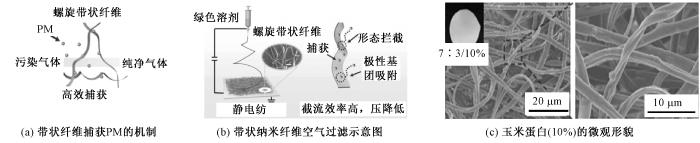
图8
静电纺纳米纤维膜带状结构微观形貌照片和PM的过滤机制以及有机污染物的去除过程
Fig.8
Micromorphology of ribbon structure of ENMs,filtration mechanism of PM. (a) Mechanism of belt-like fibers capturing PM; (b) Schematic diagram of belt-like nanofiber air filtration; (c) Microstructure of corn protein (10%)
在静电纺纤维形态的研究领域,诸多成果揭示了纤维形态与性能之间的内在关联。Yan等[29] 在探究静电纺纤维形态的影响因素时发现,在相对湿度为40%的条件下,纤维形态呈现为带状。深入分析表明,这种带状形态的形成与溶剂的非均相蒸发密切相关,非均相蒸发在带状纤维形态的形成中起到了决定性的作用[30]。Deng等[31] 在此基础上进一步探索了纤维形态的调控策略发现,带状纤维的形成与乙醇/水混合溶剂体系中乙醇的低沸点特性紧密相关。随着溶剂的持续蒸发,纤维表面发生塌陷,进而形成带状纤维。而塌陷方向的随机性则使得部分纤维呈现出螺旋构型。这种由弯曲带状结构的纳米纤维构筑的纳米纤维膜,在过滤性能方面展现出了显著的优势。它凭借形态拦截效应与表面极性基团的协同吸附作用,实现了对PM1.0的高效率去除(>99%),同时保持了低空气阻力(57.5 Pa)和长期稳定的过滤性能,其制备工艺流程与多级过滤机制如图8(b)所示。在带状纤维的应用拓展方面,Zhang等[26]通过引入ZIF-8,赋予了带状纤维对有机气体的吸附能力(见图8(c))。同时也发现,玉米蛋白含量超出适宜范围会导致纤维膜的力学性能下降,并影响有机气体的完全降解。当乙醇/水的质量比为7∶3时,溶剂的蒸发速率超过了扩散速率,同时ZIF-8的添加量为10%时,可获得最优的性能表现。这种优化配方不仅确保了物理吸附容量与纤维力学强度的平衡,还在低压降(54.87 Pa)条件下实现了PM2.5的高效过滤(99.04%)、甲醛的有效去除(98.8%)以及优异的光催化抗菌性能。这一系列研究成果为静电纺纤维在空气过滤和有机气体吸附等领域的应用提供了重要的理论依据和技术支持。
未来基于静电纺丝技术构筑的带状结构纳米纤维膜,可通过优化气流路径设计实现低压降与高过滤效率的协同调控,同时,通过复合功能粒子,构建集物理拦截、催化降解与抗菌杀菌于一体的多功能协同体系。
1.8 树枝结构
受自然界树木由许多树干和更多树枝组成的层次结构的启发,设计具有多尺度树枝状结构纳米材料可显著增强比表面积而赋予其更高的过滤性能。由于仿生分支结构纤维利用多层次拦截效应和复杂孔隙网络,实现了过滤效率的提升与压降的降低,这一领域已成为近年来的研究热点。天津工业大学康卫民教授团队创新性地在纺丝液中引入有机支化盐四丁基氯化铵(TBAC),成功制备出具有显著分级结构的PVDF树枝状纳米纤维膜。树枝状结构形成机制如图9(a)[32]所示。树枝状纤维膜因射流劈裂机制形成直径为100~500 nm的主干纤维和5~100 nm的分支纤维(见图9(b))。这种分级结构显著增大了纤维膜的比表面积,降低了纤维膜孔径尺寸,使其在分离膜领域展现出优异的应用潜力[33]。受此启发,Cheng等[34]在PLA纺丝液中添加TBAC成功纺制了树枝状纳米纤维膜并将其应用到空气过滤中,树枝的分支结构增加了纤维间的连接从而提升了纤维膜的断裂应力(23 MPa)。由于TBAC是一种强吸湿性盐,在很多应用领域受限。为突破这一局限,Li等[35]创新性地以疏水支化盐四丁基六氟磷酸铵(TBAHP)替代传统TBAC,通过静电纺丝技术成功构筑了具有多级结构的锦纶6纳米纤维膜(PA6 MSNM)。此技术在改善膜强力的同时,该膜材料在0.20~4.59 μm粒径范围的油性气溶胶过滤试验中展现出卓越的过滤性能,平均过滤效率高达99.80%,同时保持较低的空气阻力(压降为251 Pa),其品质因数达到0.024 8 Pa-1,充分验证了分级结构在纳米尺度颗粒物捕获中的独特优势。除引入支化盐外,Lu等[36]则另辟蹊径,向芳纶基体纤维中引入羧化多壁碳纳米管(MWCNTs-COOH),成功纺制出芳纶树状纳米纤维膜。该膜在酸碱处理和高温处理后仍保持结构稳定性,且拉伸力学强度不降反升。该性能提升归因于MWCNTs-COOH在芳纶基体中的均匀分散及其与基体间增强的界面结合作用(见图9(c))。为进一步拓展树状纳米纤维膜在空气过滤中的功能化应用,Li等[37-38]通过引入Ag纳米粒子构建了树枝状纳米复合膜。该膜展现出高效过滤性能(PM4.0以下的颗粒平均过滤效率达99.88%)、低压阻特性(128 Pa)、循环稳定性(经100次循环后过滤效率与压降保持稳定)以及抗菌活性(对大肠埃希菌和金黄色葡萄球菌生长具有显著抑制作用)。
图9
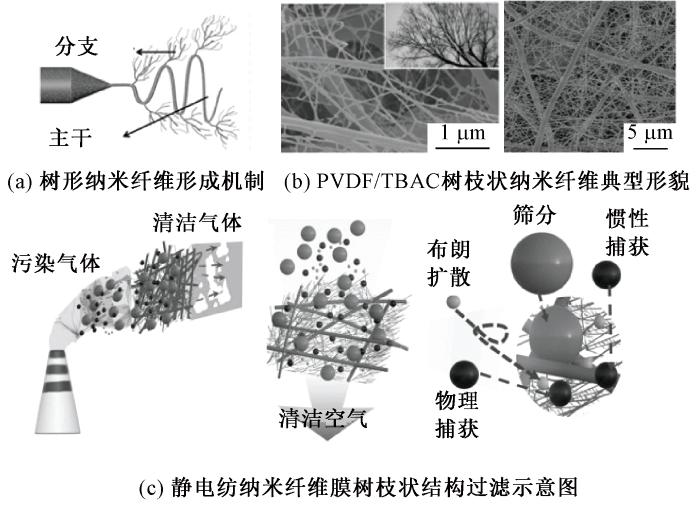
图9
树枝状纳米纤维的形成机制、典型形貌照片及过滤机制示意图
Fig.9
Schematic diagram of formation mechanism of tree-like nanofibers (a),typical morphology images of PVDF/TBAC tree-like nanofibers (b) and schematic diagram of filtering mechanism (c)
1.9 蛛网结构
图10
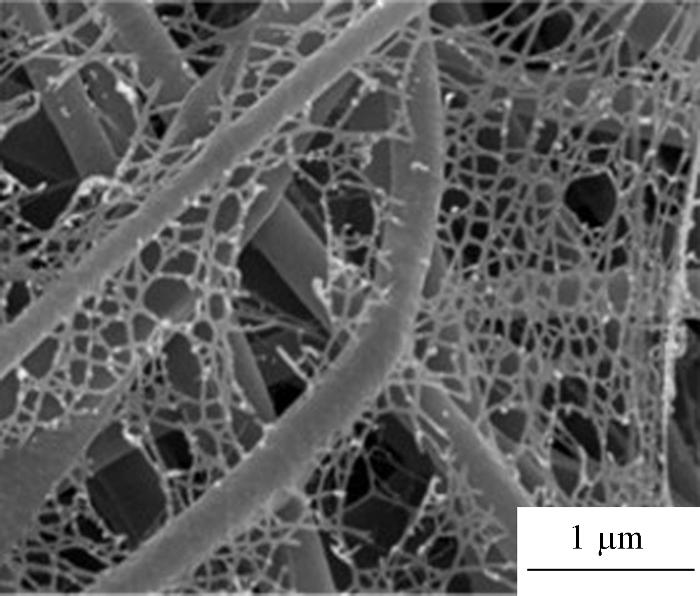
图10
静电纺纳米纤维膜蛛网结构的典型形貌
Fig.10
Typical morphology of spider web structure of ENM
在空气过滤材料的研究领域,基于静电纺丝技术制备的蛛网状纳米纤维膜展现出显著优势,Wang等[40]率先开展相关研究,利用静电纺丝技术将PA-66纳米蛛网纤维膜复合到PP微米纤维材料上。这种独特的蛛网状纳米纤维膜由粗纤维(<360 nm)和分布在其内部的超细纤维(30 nm)相互连接构成。试验结果显示,该复合蛛网膜对PM0.3以下的NaCl颗粒的过滤效率接近95%,而阻力仅为100 Pa。其出色的性能得益于蛛网结构的纳米纤维膜能促进空气分子的“滑移效应”,有效降低过滤阻力,进而增大纤维膜的过滤效率。Zhao等[41]则采用双喷流同步静电纺丝技术,通过精准调控纺丝溶液特性,一步法制备出具有多尺度超疏水结构的蛛网状聚乳酸纳米纤维膜(见图10)。该膜不仅具有优异的疏水性(接触角143.2°),而且在相对湿度90%的环境下,历经长达6个月的长期稳定性测试,仍能保持对PM0.3颗粒高于99.37%的过滤效率和18 Pa的低压降,展现出卓越的环境适应性和稳定性。在功能化应用方面,Zhu等[42]报道了一种新型的仿生蛛网状PVA/ZIF-8-SiO2复合纳米纤维膜。由于纤维表面ZIF-8具有优异的吸附能力,当入口质量浓度为282 mg/m3时,ZIF-8-SiO2复合膜在5 min后出口质量浓度仅为0.04 mg/m3,烟雾PM的去除率高达99.96%,在有害颗粒物去除方面表现出色。尽管纳米纤维网膜展现出优异的过滤性能,但当前网状结构过滤器仍存在随机旋转沉积导致的堆积结构不可控、力学性能欠佳等不足,以及面临生产规模化、环境适应性和功能单一等挑战。
2 结束语
静电纺纳米纤维膜因其高比表面积、高孔隙率、结构可调等优点被认为是去除空气污染物的新一代膜材料。本文主要介绍了不同表面结构的静电纺丝纳米纤维的常用制备方法并对其过滤机制进行了探讨。虽然静电纺纳米纤维在环境领域已有一些实际应用,但仍有一系列的挑战需要解决,因此未来的研究需要重点关注以下方面:1)单个纳米纤维周围的气流状态以及各种表面结构对气流流型、过滤效率和过滤阻力的影响;2)尽管目前静电纺丝纤维膜规模化生产技术与装备已经日趋成熟,但生产成本仍然偏高,后续应针对静电纺专用聚合物原料进行开发,以进一步提升静电纺产能,降低生产成本,满足工业化应用需求;3)溶液静电纺所用的溶剂大多数是有毒的,水溶性聚合物或绿色无溶剂熔体静电纺纳米纤维空气过滤材料将是未来纳米纤维空气过滤材料发展的重要方向;4)单一结构纳米纤维的性能各异,后续可通过制备多种结构复合的纳米膜进一步提升过滤性能;5)为应对复杂的空气条件,功能化的空气过滤材料将是未来的发展趋势,如抗菌、催化氧化挥发性有机物、光催化、吸附等功能。
参考文献
Impact of air pollution on the burden of chronic respiratory diseases in China: time for urgent action
[J].DOI:10.1016/S0140-6736(16)31597-5 URL [本文引用: 1]
Electrospun nanofibers for high-performance air filtration
[J].
DOI:10.1016/j.coco.2019.06.003
[本文引用: 1]

The development of air filtration materials (AFMs) has drawn increasing research interest due to the fact that air pollution is posing an enormous threat to human health on a global scale. However, the fabrication of AFMs with both high filtration efficiency and low pressure drop remains a challenge. Owing to the advantages of small fiber diameter, tunable porous structure, and substantial charges in situ injected, electrospun nanofibers have emerged as one of the most promising candidates for AFMs. In this review, universal strategies for preparing high-performance electrospun AFMs (EAFMs) are concluded, involving the construction of structures and the enhancement of electrostatic effect. For the structures, not only the two-dimensional membranes that composed of smooth fibers and hierarchically structured fibers but also the recently developed three-dimensional nanofibrous aerogels are comprehensively summarized. As to the electrostatic effect, two primary techniques for fabricating charged EAFMs are discussed. This review finally concludes with challenges and perspectives, aiming to provide practical guidance for the further development of EAFMs.
空气过滤用静电纺纳米纤维材料研究进展
[J].
Research progress in electrospun nanofiber materials for air filtration
[J].
Efficient air filtration through advanced electrospinning techniques in nanofibrous materials: a review
[J].DOI:10.1016/j.seppur.2024.127773 URL [本文引用: 1]
Hierarchically structured polysulfone/titania fibrous membranes with enhanced air filtration performance
[J].
DOI:10.1016/j.jcis.2013.11.009
PMID:24407655
[本文引用: 1]
Hierarchically structured, superhydrophobic filter medium exhibiting robust filtration performance to airborne particulate were prepared by a facile deposition of electrospun polysulfone/titania nanoparticles (PSU/TiO2 NPs) on a conventional nonwoven substrate. The air permeability, tensile strength and abrasion resistance of pristine PSU fibrous membranes could be finely controlled by regulating the solvent composition and number ratios of jets. By employing the TiO2 NPs incorporation, the pristine PSU fibers were endowed with promising superhydrophobicity with a water contact angle of up to 152°. The quantitative hierarchical roughness analysis using N2 adsorption method has confirmed the major contribution of TiO2 NPs on enhancing the porous structure and surface fractal features with irregular rough structure. Filtration performance studies have revealed that the filtration efficiency and pressure drop of resultant hybrid membranes could be manipulated by tuning the surface composition as well as the hierarchical structures. Furthermore, the as-prepared PSU/TiO2-5 membrane exhibited improved filtration efficiency (99.997%) and pressure drop (45.3 Pa) compared with pristine PSU membrane, which would make them a promising media for fine particle filtration, and a new insight was also provided into the design and development of high performance filter medium based on hierarchical structured fibers.Copyright © 2013 Elsevier Inc. All rights reserved.
An efficient atmospheric pollution control using hierarchical porous nanofibers containing zeolitic-imidazolate-frameworks and hydroxyapatite nanoparticles
[J].DOI:10.1016/j.jece.2023.111798 URL [本文引用: 1]
Zeolitic-imidazolate-framework filled hierarchical porous nanofiber membrane for air cleaning
[J].DOI:10.1016/j.memsci.2019.117467 URL [本文引用: 1]
Controlling numbers and sizes of beads in electrospun nanofibers
[J].DOI:10.1002/pi.v57:4 URL [本文引用: 1]
Analysis of recycled polystyrene electrospinning process: fiber diameter, morphology, and filtration applications
[J].DOI:10.1016/j.jece.2025.115435 URL [本文引用: 1]
Nanoscale architecture: enhancing the performance of nanofiber air filters with bead-on-string structures
[J].DOI:10.1016/j.seppur.2024.131004 URL [本文引用: 1]
Electrospun bead-in-string fibrous membrane prepared from polysilsesquioxane-immobilising poly(lactic acid) with low filtration resistance for air filtration
[J].DOI:10.1007/s10965-019-1919-x [本文引用: 1]
Electrospun antibacterial and antiviral poly(ε-caprolactone)/zein/Ag bead-on-string membranes and its application in air filtration
[J].DOI:10.1016/j.mtadv.2021.100173 URL [本文引用: 1]
A mini-review on wrinkled nanofibers: preparation principles via electrospinning and potential applications
[J].
DOI:10.1177/15280837241255396
URL
[本文引用: 1]
Tailoring the surface morphology of nanofibers determines its application to an excessive extent. At present, different structures of nanofibers have been produced such as wrinkled, grooved, porous, rough, etc. Amongst them, wrinkled nanofibers have attracted the attention of researchers due to their exceptional structure and properties such as coarse surface, high surface energy, high specific surface area, excellent mechanical properties, and good piezoelectricity resulting in serving successfully in various fields such as energy harvesting, air filtration, water filtration, gas sensors, biomedical applications, fuel cells, and energy storage. Therefore, this work aims to spotlight the importance of the wrinkled structure, methods, and strategies used for producing electrospun wrinkled nanofibers of various materials. This review focuses on the materials, preparation methods, and applications of the electrospun wrinkled nanofibers. This review can serve as an essential reference for the materials, formation methods, and applications of wrinkled nanofibers prepared via electrospinning.
Multi-layered micro/nanofibrous nonwovens for functional face mask filter
[J].
DOI:10.1007/s12274-022-4350-2
PMID:35578617
[本文引用: 1]
The worldwide COVID-19 pandemic has led to an attention on the usage of personal protective face masks. However, the longevity and safety of the commercial face masks are limited due to the charge dissipation of the electret meltblown nonwovens, which are dominate in the face mask filters. Herein, we design a type of multi-layer structured nonwovens using meltblowing and electrospinning technologies. The complex nonwovens involving meltblown and electrospun fibers are designed to possess multilevel fiber diameters and pore sizes. The micro/nanofibers with porous and wrinkled surface morphologies can well capture particulate matters (PMs), and the multilevel pore sizes contribute to low air resistance under high filtration efficiency. Airflow field simulation was carried out to understand the pressure distribution within the nonwovens in the filtration process. Meanwhile, by adding Ag nanoparticles (AgNPs) as additives, the nonwovens exhibit excellent antibacterial performance. The resultant nonwovens exhibit filtration efficiency of 99.1% for PM and low pressure drop of 105 Pa under the 10.67 cm/s inlet air velocity, and antibacterial rate of > 99.99% for. These performances and functions make the designed complex nonwovens a promising filter core for face masks.Supplementary material (Fig. S1. The filtration efficiencies of a brand of surgical mask changes with the storage time under the condition of 100% humidity. Fig. S2. The FE-SEM images of the fibers after blocking PMs. Fig. S3. Illustration of 3D structure models of the nonwovens. Fig. S4. Diameter distribution of AgNPs. Table S1. The structure parameters and filtration performances of the PP-M fibers with and without pores and wrinkles. Table S2. Filtration performance of PP-M/PLA-M/PLA-N nonwovens and commercial face masks. Table S3. The structural parameters for the nonwovens. Table S4. The filtration efficiencies and pressure drops of the PP, PE spunbonded nonwovens, and PP-M/PLA-M/PLA-N@AgNPs nonwovens) is available in the online version of this article at 10.1007/s12274-022-4350-2.© Tsinghua University Press 2022.
Photocatalytic activity and filtration performance of hybrid TiO2-cellulose acetate nanofibers for air filter applications
[J].
DOI:10.3390/polym13081331
URL
[本文引用: 1]
A facile method to prepare hybrid cellulose acetate nanofibers containing TiO2 (TiO2-CA nanofibers) by emulsion electrospinning technique was developed for the denitrification and filtration of particulate matters (PMs). This work found that hybrid TiO2-CA nanofibers mainly contain the anatase form of TiO2, contributing to the photodecomposition of NO gas under UV irradiation. The TiO2-CA nanofibers also showed an excellent filtration efficiency of 99.5% for PM0.5 and a photocatalytic efficiency of 78.6% for NO removal. Furthermore, the results implied that the morphology of the TiO2-CA nanofibers, such as micro-wrinkles and protrusions, increased the surface hydrophobicity up to 140°, with the increased addition of TiO2 nanoparticles. The proposed TiO2-CA nanofibers, as a result, would be promising materials for highly efficient and sustainable air filters for industrial and home appliance systems.
Arming nanofibers with MnO2 nanosheets for fast and durable removal of ozone and particulate matter from air
[J].DOI:10.1016/j.memsci.2025.123915 URL [本文引用: 1]
Morphology engineering processed nanofibrous membranes with secondary structure for high-performance air filtra-tion
[J].DOI:10.1016/j.seppur.2022.121093 URL [本文引用: 1]
Preparation of hierarchical structured nano-sized/porous poly(lactic acid) composite fibrous membranes for air filtra-tion
[J].DOI:10.1016/j.apsusc.2015.08.211 URL [本文引用: 1]
Porous bead-on-string poly(lactic acid) fibrous membranes for air filtra-tion
[J].DOI:10.1016/j.jcis.2014.11.041 URL [本文引用: 1]
Tailoring nanonets-engineered superflexible nanofibrous aerogels with hierarchical cage-like architecture enables renewable antimicrobial air filtration
[J].DOI:10.1002/adfm.v31.49 URL [本文引用: 1]
Hierarchical porous structure endowing fiber membranes efficient PM removal and HCHO decomposition
[J].DOI:10.1016/j.memsci.2025.123750 URL [本文引用: 1]
Bio-inspired gradient poly(lactic acid) nanofibers for active capturing of PM0.3 and real-time respiratory monitoring
[J].DOI:10.1016/j.jhazmat.2024.134781 URL [本文引用: 1]
Core-dual-shell structure MnO2@Co-C@SiO2 nanofiber membrane for efficient indoor air cleaning
[J].DOI:10.1016/j.memsci.2023.121644 URL [本文引用: 1]
Direct fabrication of composite and ceramic hollow nanofibers by electrospinning
[J].DOI:10.1021/nl049590f URL [本文引用: 1]
An analysis on energy demands in airborne particulate matter filtration using hollow-fiber mem-branes
[J].DOI:10.1016/j.egyr.2021.05.005 URL [本文引用: 1]
Spiral grass inspired eco-friendly zein fibrous membrane for multi-efficient air purification
[J].DOI:10.1016/j.ijbiomac.2023.125512 URL [本文引用: 2]
Novel hollow α-Fe2O3 nanofibers via electrospinning for dye adsorp-tion
[J].DOI:10.1186/s11671-015-0874-7 URL [本文引用: 1]
Recent advances in electrospinning of nanofibers from bio-based carbohydrate polymers and their applications
[J].
The formation of ultrafine polyamide 6 nanofiber membranes with needleless electrospinning for air filtration
[J].DOI:10.1002/pat.v30.7 URL [本文引用: 1]
Porous ionic liquids for oxidative desulfurization influenced by electrostatic solvent effect
[J].
DOI:10.1016/j.jcis.2024.02.052
PMID:38340515
[本文引用: 1]
Developing a highly efficient strategy for the stabilization of the solid-liquid interface is a persistent pursuit for researchers. Herein, porous ionic liquids based on UiO-66 (Zr) porous materials were synthesized and applied to the selective desulfurization catalysis, which integrates the permanent pores of porous solids with the exceptional properties of ionic liquids. Results show that porous ionic liquids possess high activity and selectivity for dibenzothiophene. Experimental analysis and density functional theory calculations revealed that the ionic liquids moiety served as an extractant to enrich dibenzothiophene into the porous ionic liquids phase through the π···π and CH···π interactions. Additionally, the electrostatic solvent effect in the porous ionic liquids contributes to the stabilization solid-liquid interface, which was favorable for UiO-66 moiety to catalytically activate hydrogen peroxide (HO) to generate ·OH radicals, and subsequently oxidized dibenzothiophene to the corresponding sulfone. It is hoped that the development of porous ionic liquids could pave a new route to the stabilization of the solid-liquid interface for catalytic oxidation.Copyright © 2024 Elsevier Inc. All rights reserved.
Multi-hierarchical nanofiber membrane with typical curved-ribbon structure fabricated by green electrospinning for efficient, breathable and sustainable air filtration
[J].DOI:10.1016/j.memsci.2022.120857 URL [本文引用: 1]
Fabrication of polyvinylidene fluoride tree-like nanofiber via one-step electrospinning
[J].
树枝状PVDF纳米纤维膜负载TiO2吸附-光催化降解染料废水
[J].
Adsorption-photocatalytic degradation of dye wastewater for tree-like PVDF nanofibrous membrane supported TiO2
[J].
静电纺树枝状聚乳酸纳米纤维膜的制备及其过滤性能
[J].
DOI:10.13475/j.fzxb.20180801206
[本文引用: 1]
为开发可用于空气过滤的纳米纤维,利用静电纺丝技术一步法制备了树枝状聚乳酸(PLA)纳米纤维膜,探讨了溶剂种类、四丁基氯化铵(TBAC)添加量和纺丝电压对纤维膜形貌结构和性能的影响,同时研究了TBAC 添加量和纤维膜厚度对纤维膜过滤效果的影响。结果表明:溶剂为二氯甲烷,PLA 和TBAC 质量比为8:1,纺丝电压为30 kV 时,制得的纤维膜树枝状结构最为明显,其断裂应力和品质因数分别为23 MPa 和0. 068,优于纯PLA 纤维膜的5 MPa 和0. 059;随TBAC 质量分数的增加,纤维膜的接触角由118°降低至54. 5°;当具有明显树枝状结构的纤维膜厚度从10 μm 增加至40 μm 时,过滤效率和压降均增大,且当膜厚度为20 μm 时,过滤效率达到99. 89%,阻力约为96. 08 Pa,可满足高效空气过滤需求。
Fabrication of polylactic acid tree-like nanofiber membrane and its application in filtration
[J].
DOI:10.13475/j.fzxb.20180801206
[本文引用: 1]
In order to develop nanofibers with efficient air filtration performance, polylactic acid (PLA) tree-like nanofiber membranes were prepared by electrospinning. The effects of solvent type, addition amount of tetrabutylammonium chloride (TBAC) and spinning voltage on the morphology and properties of fiber membranes were investigated. In addition, the effect of TBAC addition and fiber membrane thickness on filtration efficiency was also studied. The results show that when the solvent is dichloromethane, the PLA/ TBAC mass ratio is 8 ∶ 1, and the spinning voltage is 30 kV, the fiber membrane has obvious tree-like structure. The fracture stress and quality factor of fiber membrane with obvious tree-like structure are 23 MPa and 0. 068, respectively, which is higher than 5 MPa and 0. 059 of the pure PLA fiber membrane. With the increase of the TBAC content, the contact angle of fiber membrane decreases from 118° to 54. 5°. For PLA nanofiber membranes with distinct tree-like structure, when the thickness of the fiber membrane increases from 10 μm to 40 μm, both filtration efficiency and pressure drop increase, especially, when the film thickness is 20 μm, the filtration efficiency of the fiber membrane is 99. 89%, and the resistance is about 96. 08 Pa, which can meet the demand for efficient air filtration.
Electrospun PA6 multi-stage structured nanofiber membrane with high filtration performance for oily particles
[J].DOI:10.1080/09593330.2023.2213831 URL [本文引用: 1]
Electrospun carboxylated MWCNTs modified PMIA tree-like nanofibrous membrane with excellent thermal stability and chemical resistance for efficient particulate matter removal
[J].DOI:10.1016/j.psep.2024.06.009 URL [本文引用: 1]
A nanofiber Murray membrane with antibacterial properties for high efficiency oily particulate filtration
[J].DOI:10.1016/j.eurpolymj.2023.112036 URL [本文引用: 1]
Electrospun Ag-doped PA6 multi-stage structured nanofiber membrane with antibacterial property for oily particulate matters filtration
[J].DOI:10.1002/app.v140.38 URL [本文引用: 1]
Steiner trees and polyhedra
[J].DOI:10.1016/S0166-218X(00)00311-5 URL [本文引用: 1]
Tunable fabrication of three-dimensional polyamide-66 nano-fiber/nets for high efficiency fine particulate filtra-tion
[J].DOI:10.1039/C1JM14299B URL [本文引用: 1]
One-step fabrication of polylactic acid (PLA) nanofibrous membranes with spider-web-like structure for high-efficiency PM0.3 capture
[J].DOI:10.1016/j.jhazmat.2023.133232 URL [本文引用: 1]
ZIF-8@SiO2 composite nanofiber membrane with bioinspired spider web-like structure for efficient air pollution control
[J].DOI:10.1016/j.memsci.2019.03.075 URL [本文引用: 1]

 京公网安备11010502044800号


