



目前,用于检测H2O2的方法有滴定法、分光光度法、化学发光法、电化学法等。其中电化学法由于具备响应迅速快、灵敏度高、检测范围广以及能够实时监测等优点而引起广泛关注[5]。生物酶作为一类具备催化功能的蛋白质分子,能够特异性地识别底物。基于酶构建的电化学生物传感器具备特异性强、反应速度快以及灵敏度高等显著优势,但是常见的生物酶固定方法存在固定效率偏低、负载量较少以及酶易于失活等问题[6]。特定金属离子对生物酶的活性具有激活作用[7-8],有机/无机杂化纳米花是一种利用金属离子与蛋白质之间的相互作用固定生物酶的新技术,该方法制备工艺简单,具有酶活性较高、稳定性较强以及制备过程简便等优点。Ge等 [9]利用蛋白质与Cu2+之间的相互作用,形成了具有花瓣形状纳米结构的微米粒子。由于该结构具有较大的比表面积,漆酶纳米花的活性提高了2.5倍。Tan等 [10]制备生物矿化的Mn3(PO4)2/C-反应蛋白配体对C反应蛋白进行电化学检测具有增强性。由此可见,利用金属离子固定生物酶是一种可高效固定酶且能确保较高活性的方法。
1 实验部分
1.1 实验材料与仪器
材料:碳纤维(12 K),日本东丽株式会社;辣根过氧化物酶(HRP,>200 U/mg),上海阿拉丁化学试剂有限公司;无水硫酸铜(CuSO4)、浓盐酸、柠檬酸钾、碳酸钠(Na2CO3)、甲醛、氢氧化钠(NaOH)、硫酸镍(NiSO4)、氯化钠(NaCl)、氯化钾(KCl)、磷酸氢二钠(Na2HPO4)、磷酸二氢钾(KH2PO4)、H2O2(30%),国药集团化学试剂有限公司;葡萄糖(Glu)、抗坏血酸(AA)、尿素(UA),上海麦克林生化有限公司;氯化亚锡(SnCl2,99%),上海易恩化学技术有限公司;氯化钯(PdCl2,59%~60%),上海迈瑞尔生化科技有限公司。
仪器:JSM-IT300型扫描电子显微镜, 日本电子株式会社;JEC-3000FC型离子溅射仪,捷欧路(北京)科贸有限公司;X-Stream2 SDD型能量色散X射线光谱仪, 牛津仪器科技(上海)有限公司;PGSTAT302 N型电化学工作站,瑞士万通中国有限荷兰公司;ET430B型万用表,杭州中创电子有限公司。
1.2 样品制备
首先,将碳纤维裁剪成4 cm,用去离子水清洗以去除表面灰尘和杂质,随后在200 mg/mL的NaOH溶液中浸渍30 min进行粗化,再先后浸渍于由2%盐酸溶液配制的10 mg/mL SnCl2溶液和0.5 mg/mL PdCl2中10 min进行敏化和活化,最后浸渍在镀液(14 g/L CuSO4、46 g/L 柠檬酸钾、4.2 g/L Na2CO3、9 g/L NaOH、0.5 g/L NiSO4、51 mL/L甲醛)中施镀,施镀时间分别选择15 min、30 min、60 min、3 h、19 h。清洗晾干后,制得表面负载金属铜的碳纤维样品。
将3个表面负载金属铜的碳纤维样品浸渍在由0.01 mol/L磷酸盐(PBS,8 g/L NaCl、0.2 g/L KCl, 1.44 g/L Na2HPO4、0.24 g/L KH2PO4)缓冲溶液配制的0.1 mg/mL HRP溶液中,浸渍时间分别为3.5、16、63 h。随后将纤维清洗晾干,制得表面修饰HRP的碳纤维样品。以此为工作电极,铂电极为对电极,Ag/AgCl为参比电极,0.1 mol/L PBS缓冲溶液为电解液,构建出基于三电极工作体系的电化学传感器。
1.3 测试与表征
1.3.1 样品形貌观察
首先采用离子溅射仪对样品表面进行30 s喷金处理,然后采用扫描电子显微镜,在10 kV的工作电压下观察样品的形态结构。
1.3.2 元素组成表征
采用能量色散X射线光谱仪对样品表面元素进行表征,加速电压为10 kV。
1.3.3 电化学性能测试
采用万用表测试1 cm长碳纤维的电阻,测试3次,取平均值。
采用电化学工作站测试循环伏安曲线和安培计时电流曲线。循环伏安法测试电位范围为-0.6 ~ 0.6 V,扫描速度为0.05 V/s。安培计时电流法的测试电位为-0.35 V, 间隔时间为100 s,向30 mL 0.1 mol/L PBS缓冲溶液中依次滴加0.1、0.1、0.2、0.4、0.4、0.4、0.4 mmol/L H2O2进行测试。
根据下式计算检测限:
式中:σ为未添加H2O2空白样的标准偏差;S为H2O2浓度-电流拟合曲线的斜率。
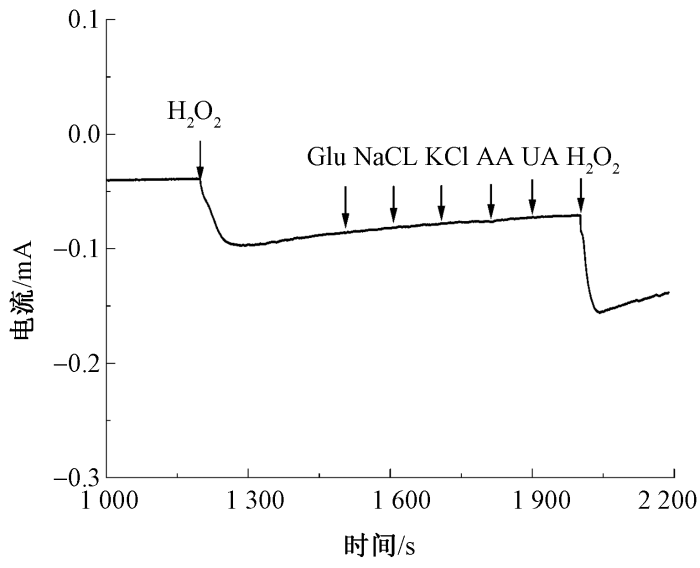
向电解液中依次加入0.1 mmol/L H2O2、Glu、NaCl、KCl、AA、UA、H2O2,采用电化学工作站记录电流变化情况,表征修饰后碳纤维的抗干扰性能。
2 结果与讨论
2.1 形貌与结构
图1
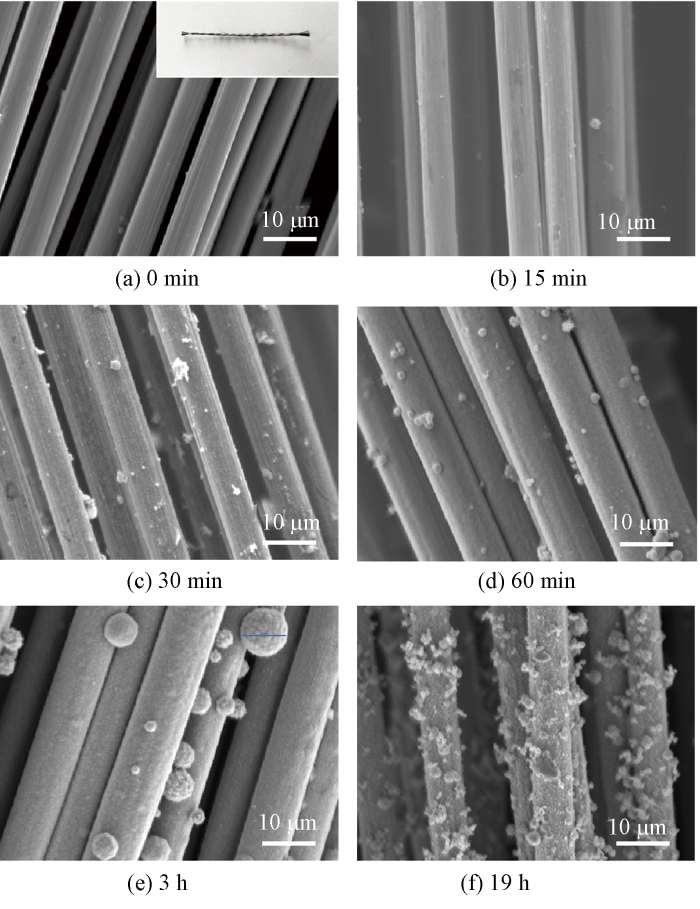
图1
不同施镀时间下碳纤维表面SEM照片
Fig.1
SEM images of carbon fiber surface under different plating time
图2
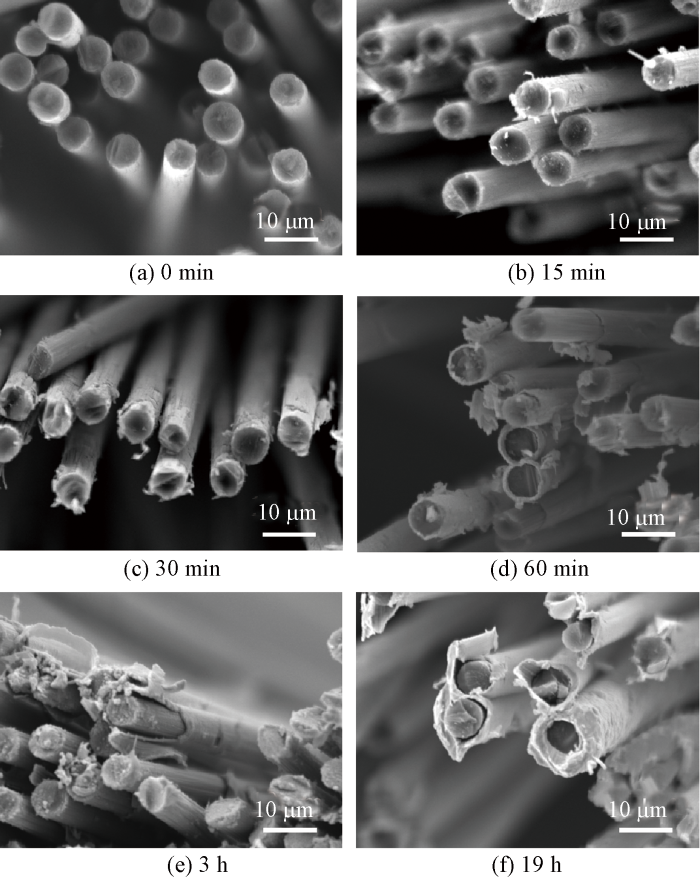
图2
不同施镀时间下碳纤维截面SEM照片
Fig.2
SEM images of carbon fiber cross section under different plating time
将所制备的表面负载金属铜的碳纤维浸渍在HRP溶液中,基材表面的金属被氧化成铜离子,其先与HRP的酰胺发生螯合形成晶核,再与缓冲溶液中的磷酸根离子结合实现晶体生长,晶粒逐渐聚集形成花瓣形状,最终生长成花状结构[6,13]。图3示出表面负载金属铜的碳纤维在HRP溶液中浸渍不同时间后的扫描电镜照片。可以看出:经过3.5 h的浸渍,碳纤维表面出现微颗粒;浸渍时间延长到16 h,碳纤维表面均匀生长出片层结构,且与纤维结合紧密;浸渍63 h后,碳纤维表面颗粒呈花状结构,直径增大,数量减小,且在实验中发现溶液中会出现蓝色颗粒,表明随着浸渍时间的增加,碳纤维表面的花状颗粒出现脱落的现象。这是由于随着浸渍时间的延长,碳纤维表面的铜氧化程度加大所导致的。但对于已形成在碳纤维表面的花状颗粒,经过多次清洗并不易脱落。
图3
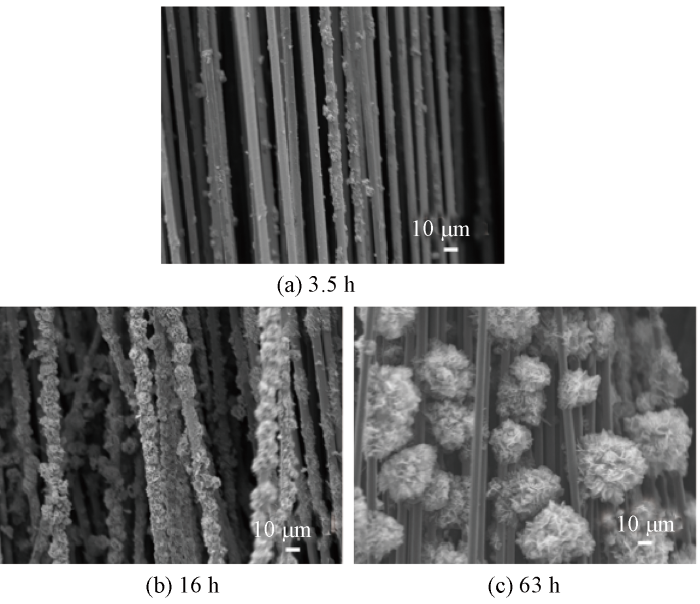
图3
表面负载金属铜的碳纤维在HRP溶液中浸渍不同时间后的扫描电镜照片
Fig.3
SEM images of copper-loaded carbon fiber after soaking in HRP solution for different times
图4

图4
表面负载金属铜的碳纤维浸渍HRP溶液后的元素分布
Fig.4
Element distribution of copper-loaded carbon fiber after soaking in HRP solution
2.2 H2O2电化学检测性能
选用浸渍HRP 溶液16 h 的样品进行电化学性能测试,其电阻约为15 Ω。图5(a)示出碳纤维和经过HRP修饰后碳纤维的循环伏安曲线。可以看出,与碳纤维相比,修饰后的碳纤维具有较强的氧化还原峰。这是由于其表面负载辣根过氧化物酶和铜离子,可催化H2O2氧化分解,从而引起电流变化。修饰后的碳纤维在0.15、-0.35、-0.02 V电位下出现氧化还原峰。在0.15 V处的阳极峰表示HRP(还原态)与H2O2反应生成氧化态的HRP和水,同时Cu+氧化为Cu2+;阴极峰表示HRP(氧化态)还原为HRP(还原态)以及Cu2+还原为Cu+。
图5
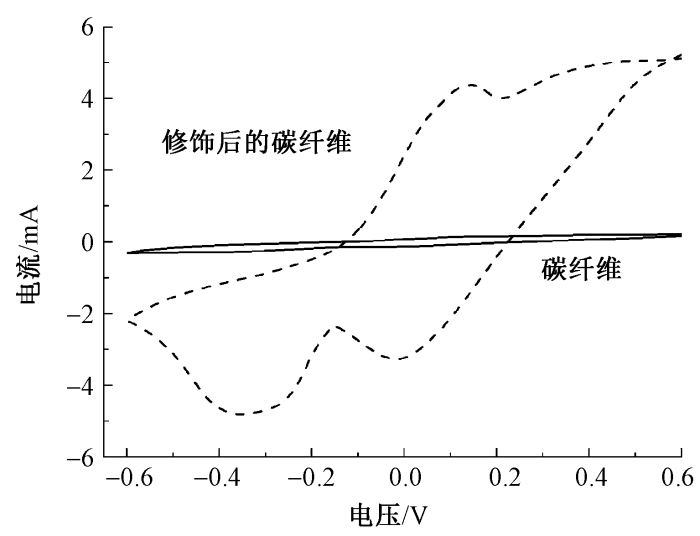
图5
碳纤维和修饰后碳纤维的循环伏安曲线
Fig.5
Cyclic voltammetry curves of carbon fiber and modified carbon fiber
图6为碳纤维和修饰后的碳纤维对H2O2的响应图。可以看出:碳纤维对H2O2响应低,而修饰后的碳纤维对H2O2有较好的响应,当添加的H2O2浓度相同时,电流增加幅度基本一致,呈明显阶梯状;当添加的H2O2浓度逐渐增加时,电流响应逐渐增强。
图6
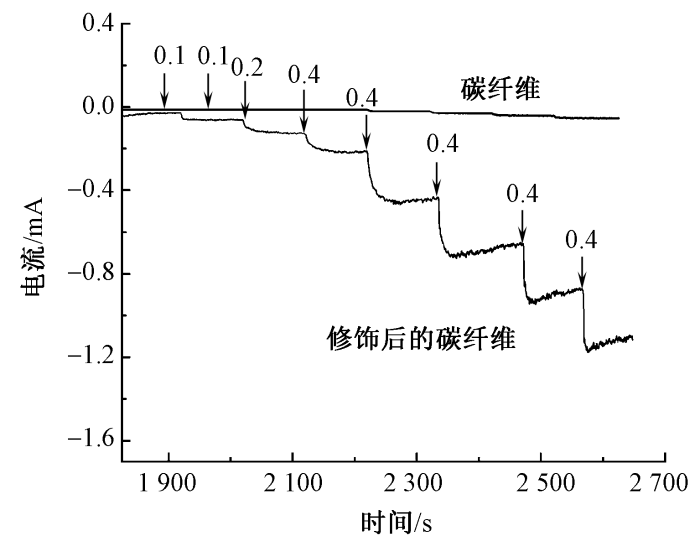
图6
连续滴加H2O2的碳纤维和修饰后碳纤维的电流响应曲线
注:图中数字为加入的H2O2的浓度,单位为mmol/L。
Fig.6
Current response curves of carbon fiber and modified carbon fiber with successive addition of H2O2
将响应电流(x)与H2O2浓度(y)进行拟合,拟合曲线见图7。碳纤维所对应的线性回归方程为y=-0.021x-0.007,其线性相关系数
图7
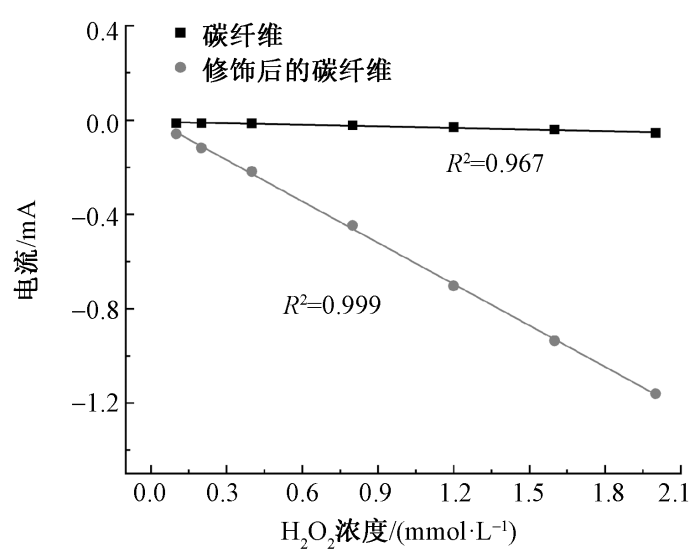
图7
H2O2浓度和电流的线性拟合曲线
Fig.7
Linear fitting curves of current and H2O2 concentration
为评价修饰后的碳纤维对H2O2检测的实用性能,对其抗干扰性能进行研究,结果如图8所示。可以看出:当加入0.1 mmol/L H2O2时,电流发生明显变化;当加入相同浓度Glu、NaCl、KCl、AA、UA时,电流无变化,表明修饰后的碳纤维具有良好的抗干扰性。
图8
3 结论
本文以高导电的碳纤维为基材,通过原位生长法制备出表面带有辣根过氧化物酶和磷酸铜有机/无机纳米花的碳纤维H2O2电化学传感器。经过修饰的碳纤维具有优异的电催化性能,在H2O2浓度为0.1 ~2 mmol/L范围内呈现出良好的线性关系,线性相关系数R2为0.999,灵敏度为146.3 μA/(mmol·L-1 ·cm),检测限为0.441 μmol/L。此外,该电极对葡萄糖、NaCl、KCl、抗坏血酸、尿素无电流响应,具有优异的抗干扰性能。
参考文献
Bimetal-organic framework-integrated electrochemical sensor for on-chip detection of H2S and H2O2 in cancer tissues
[J].
基于MWCNTs和Co-Fe双金属普鲁士蓝类似物的电化学传感检测牛奶中的H2O2
[J].
Electrochemical sensor based on MWCNTs and Co-Fe bimetallic prussian blue analogues for the detection of H2O2 in milk
[J].
过氧化氢检测方法研究进展
[J].
DOI:10.13475/j.fzxb.20200102308
[本文引用: 1]

为实现对纺织生产过程中过氧化氢(HP)浓度的宽量程检测,提升检测精度、效率及其工艺适应性,对现阶段有关HP浓度检测方法及数学模型进行了介绍。阐述了HP浓度6种检测方法:常规滴定法、电化学分析法、分光光度法、荧光/化学发光法、折射率法和微波法,分析了各检测方法工作原理、研究进展及适用性,剖析了相关数学模型。研究发现:常规滴定法虽然精度高但耗时耗力;电化学分析法响应快,抗干扰能力强;分光光度法成本较高,相对复杂;荧光/化学发光法灵敏度高,但干扰较多;折射率和微波法灵敏度高,但目前只能测量单质溶液。经分析得知,电化学分析法比较适用于纺织领域中HP的检测问题,可有效解决高浓度HP所引起的欧姆降问题,是未来HP检测研究重点。
Research progress in detection of hydrogen peroxide concentration
[J].
DOI:10.13475/j.fzxb.20200102308
[本文引用: 1]
In order to effectively solve problems in the concentration detection of hydrogen peroxide (HP) in textile process, and to improve the accuracy, efficiency and range of the detection, this paper reviewed on the detection method and mathematical model of HP. Six methods for detecting HP concentration were examined, including conventional titration, electrochemical analysis, spectrophotometry, fluorescence/chemiluminescence, refractive index and microwave. The principle, research progress and applicability of each method were analyzed. It is found that although the conventional titration method has high precision, it is more time and energy consuming. Electrochemical analysis has fast response and strong anti-interference ability. The cost of spectrophotometry is high and it is relatively more complicated. Fluorescence/chemiluminescence method has high sensitivity but more shows interference. The refractive index and microwave methods are highly sensitive, but at present they apply only to single component solutions. According to the analysis, electrochemical analysis is deemed to be more suitable for detecting HP in the textile process, and the effective solution to ohmic drop caused by high concentration of HP would be the one of the focuses for future research.
铁碳纳米纤维电沉积普鲁士蓝用于过氧化氢的高灵敏检测
[J].
Prussian blue deposition on Fe-CNF by in-situ Fe releasing and highly sensitive detection of hydrogen peroxide
[J].
基于MB@ZIF-8/COOH-MWCNTs复合材料的比率型电化学传感器检测过氧化氢
[J].
MB@ZIF-8/COOH-MWCNTs composite-based ratiometric electrochemical sensor for detection of hydrogen pero-xide
[J].
Facile fabrication of HRP-Cu3(PO4)2 hybrid nanoflowers on screen-printed electrode for electrochemical detection of H2O2
[J].
Ca2+-based metal-organic framework as enzyme preparation to promote the catalytic activity of amylase
[J].
Amorphous metal-organic frameworks on PtCu hydrogels: enzyme immobilization platform with boosted activity and stability for sensitive biosensing
[J].
Protein-inorganic hybrid nanoflowers
[J].
Biomineralized Mn3(PO4)2/aptamer nanosheets for enhanced electrochemical determination of C-reactive protein
[J].
钴酞菁与碳纳米管共修饰碳纤维织物传感器的制备及其电化学性能
[J].
Preparation and electrochemical properties of carbon fiber fabric sensors co-modified by cobalt phthalocyanine and carbon nanotubes
[J].
Preparation of carbon fiber composite modified by cobalt lanthanum oxides and its electrochemical simultaneous determination of amlodipine and acetaminophen
[J].
Supported growth of inorganic-organic nanoflowers on 3D hierarchically porous nanofibrous membrane for enhanced enzymatic water treatment
[J].

 京公网安备11010502044800号


