



随着人们生活水平的不断提升,消费者对智能服装的需求与日俱增。作为智能服装的核心单元,导电纤维因其质量轻、柔韧性和导电性可控等优异特性而受到众多研究人员的关注[1-
针对这一技术瓶颈,基于液态金属的新型导电纤维体系为突破传统性能桎梏提供了新思路。液态金属作为新兴多功能材料,凭借其优异的导电性和生物相容性备受关注。该材料在接近室温条件下兼具液态流动性与金属特性,成为制造本征可拉伸导电纤维的理想选择。由其制成的导电纤维不仅保持高导电性,更具备自修复性和界面相容性优势,在智能服装领域展现出广阔的应用前景[9-10]。当前制备液态金属基导电纤维主要包括2种技术路径:其一是基于微流控的管道注射技术,通过真空负压将液态金属注入弹性纤维管制备可拉伸导电纤维,但该工艺受限于纤维长度(管内阻力与长度呈正相关),难以实现长纤维连续化生产[11-12];其二为表面功能化涂覆技术,需先对基体纤维进行界面预处理(如黏合剂涂覆或表面改性),再实施液态金属涂层工艺[13-14]。前者受限于真空泵的功率适配问题:当制备的纤维较长时,对真空泵的功率要求高,难以实现。后者则面临纤维进行多极化处理造成的工艺流程复杂这一难题。
为克服现有涂覆技术的界面结合难题,本文提出镍掺杂工艺调控策略。针对聚酰胺导电纤维在长期循环使用中易产生微裂纹的问题,通过优化镍掺杂工艺有效调控液态金属表面张力,使其与纤维载体形成稳定结合界面,最终实现液态金属在镀银聚酰胺纤维表面的均匀涂覆。基于此策略,成功制备出兼具循环稳定性和环境适应性的液态金属复合纤维(LMC纤维)。进一步系统研究了镍掺杂复合膏体对LMC纤维性能与穿戴性能的协同影响,并探讨了LMC纤维在智能服装领域的应用前景。
1 实验部分
1.1 实验材料与仪器
材料:镓铟锡液态金属(Ga、In、Sn的质量分数分别为68.5%、21.5%、10%,熔点为16 ℃),河南商水豫鑫合金有限公司;28.5 tex镀银聚酰胺纤维,青岛志远翔宇功能性面料有限公司;高纯导电镍粉(粒径为30 μm),河北元英新材料有限公司。
仪器:9205A万用表,深圳晨洲岛智能有限科技公司;KS-X1000超景深显微镜,江苏南京凯视迈科技有限公司 ;68TM-5拉力机,英特斯朗(上海)试验设备贸易有限公司;HY3005B可调直流稳压电源,浙江杭州华谊电子实业有限公司;TC55可编程多轴控制器,北京多普康自动化技术有限公司;HM-TPK20-3AQF手持热成像仪,浙江杭州海康微影传感科技有限公司;Alpha 6400 APS-C微单数码相机,索尼(中国)有限公司。
1.2 液态金属复合膏体的制备
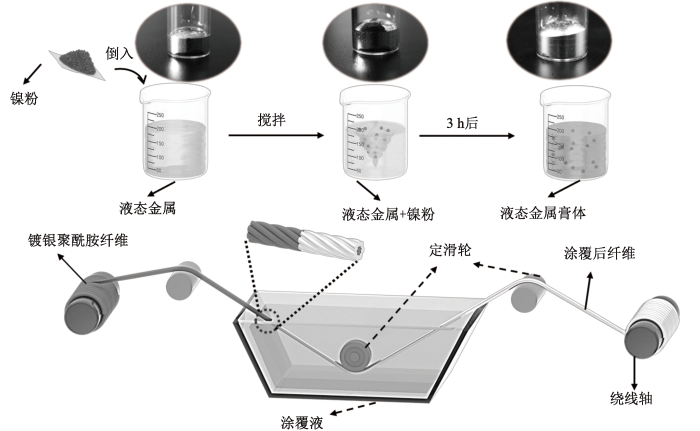
将0.04 g的镍粉掺杂至9.96 g的液态金属中并充分搅拌3h,制得质量分数为0.4%的液态金属复合膏体。
1.3 液态金属复合纤维的制备
将制备的液态金属复合膏体注入直径为20 mm、高为23 mm的圆柱形涂覆池内。涂覆装置包括1个给线轴、1个绕线轴、1个涂覆池和1个牵拉卷曲装置。将镀银聚酰胺纤维穿过涂覆池,缠绕在与上述给线轴型号相同的收线轴上,以5 r/min的转速牵拉卷曲,进行连续制造。该过程中液态金属复合膏体会均匀涂覆在镀银聚酰胺纤维表面,得到液态金属复合纤维(LMC纤维),制备流程如图1所示。同时,以液态金属为涂覆液,制备表面涂覆液态金属的镀银聚酰胺纤维(LM纤维)作为对比。
图1
1.4 表征与测试
1.4.1 形貌观察
采用超景深显微镜分别观察镀银聚酰胺纤维、LM纤维、LMC纤维的表面形貌结构。用图像分析软件ImageJ测量3种纤维的直径,并进行对比。
1.4.2 黏附性能测试
采用倾斜玻璃法评估液态金属经复合改性后的黏附性能变化。实验设计如下:将5 mL标准塑料滴管固定,分别装载液态金属及其复合膏体,以3 cm恒定高度向倾斜12°的玻璃基底(尺寸24 mm×75 mm)实施垂直滴加,通过微单数码相机记录液滴动态过程。
1.4.3 电导率测试
使用万用表测量纤维电阻,每个试样测量3次,并取平均值。电导率计算公式为
式中:σ为电导率,S/m;l为纤维长度,m;r为纤维半径,m;R为纤维电阻,Ω。
1.4.4 抗氧化性能测试
LMC纤维的抗氧化特性通过空气暴露实验中的电阻稳定性进行定量评估。具体而言,将纤维试样(有效测试长度为15 cm)置于空气中进行24 h加速氧化实验,随后采用万用表进行电阻测量。该测试包含3个平行试样,取平均值。
1.4.5 弯曲电学性能测试
将LMC纤维截成8 cm,采用万用表测量其在不同弯曲角度(0°、60°和120°)下的电阻。
1.4.6 水下电学性能测试
将LMC纤维浸没在水中,采用万用表测量其入水前后的电阻变化,以分析LMC纤维在水中的导电稳定性。测量时间为1 h,纤维长度为15 cm。
1.4.7 力学性能测试
采用拉力机对LMC纤维、LM纤维以及镀银聚酰胺纤维进行拉伸性能测试。测试时试样的夹持距离为20 mm,拉伸速率为10 mm/min。
1.4.8 电加热性能测试
采用手持热成像仪对LMC纤维的热响应特性进行原位表征。实验设置如下:将15 cm标准试样连接至可编程直流电源,施加1.62 V恒定电压触发焦耳热效应,持续通电30 s后,通过手持热成像仪的红外探测器捕获纤维表面温度场分布。
2 结果与讨论
2.1 液态金属复合纤维的微观形貌
镀银聚酰胺纤维、LM纤维、LMC纤维的结构形态表征结果见图2。
图2
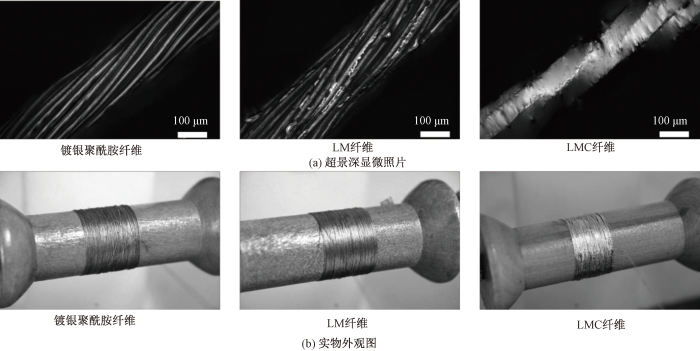
图2
3种纤维的超景深显微照片及实物外观
Fig.2
Ultra-depth-of-field photomicrographs (a) and physical appearances (b) of three fibers
由图2(a)所示3种纤维的微观形貌照片可见,LMC纤维的直径为248 μm,与镀银聚酰胺纤维和LM纤维的直径(223 μm)相比,纤维直径增加了11.2%。将LM纤维与LMC纤维进行对比发现,LMC纤维表面涂有一层致密的液态金属复合膏体,而LM纤维表面仅有少量的液态金属滴附着在表面。即在同等涂覆条件下,液态金属复合膏体在纤维表面的附着力要远强于液态金属的附着力。这是因为液态金属复合膏体的氧化物含量要多于液态金属。氧化物的存在大幅度降低了液态金属的表面张力,增强了黏附性能。由图2(b)所示镀银聚酰胺纤维、LM纤维和LMC纤维的实物外观照片可清楚地观察到,LMC纤维表面涂覆有一层液态金属复合膏体。为探究涂层对纤维质量的影响,对镀银聚酰胺纤维和LMC纤维的质量进行测试,2种纤维质量与长度的关系如表1所示。可知,纤维长度为10 km时,镀银聚酰胺纤维和LMC纤维的质量分别为0.285 kg和0.570 kg。这一结果表明,在镀银聚酰胺纤维表面通过涂覆少量液态金属复合膏体,就可显著改变纤维的电学性能,从而制备出导电性优异的 LMC 纤维。
表1 纤维规格参数
Tab.1
| 试样名称 | 长度/km | 质量/kg |
|---|---|---|
| 镀银聚酰胺纤维 | 10 | 0.285 |
| LMC纤维 | 10 | 0.570 |
2.2 液态金属复合膏体的黏附性能
液态金属的高表面张力和黏附性差是其广泛应用的重要障碍[15],因此降低液态金属表面张力并改善黏附性至关重要。图3示出液态金属和液态金属复合膏体滴落在倾斜12°的玻璃板上的运动状态。如图3(a)所示,液态金属液滴与玻璃板表面接触的瞬间,在重力作用下开始滑动。1 s时,液态金属液滴滑过一半路程;2 s时,液态金属液滴滑到玻璃板底部。由图3(b)可知,液态金属复合膏体液滴落在玻璃板表面后,并未出现滑动现象,而是稳定地附着于玻璃板上,2 s时,液态金属复合膏体液滴仍停留在原处。通过比较分析二者的运动状态可得出,液态金属复合膏体的黏附性能要远强于液态金属。这是因为液态金属复合膏体整体的氧化程度要高于液态金属。液态金属与镍粉颗粒的界面相互作用机制可解析为动态氧化层演变过程:在机械搅拌作用下,镍粉颗粒与液态金属表面Ga2O3氧化层发生持续接触,导致氧化物逐渐转移并包覆于颗粒表面。随着氧化层的耗尽,镍粉颗粒渗透到液态金属中,同时暴露的镓元素与环境中的氧气发生自发氧化反应,形成新的氧化层。这种氧化-渗透-再氧化的循环机制实现了氧化层的不断累积,氧化层的存在大大降低了液态金属的表面张力,从而增强了与基材的黏附性[16]。
图3
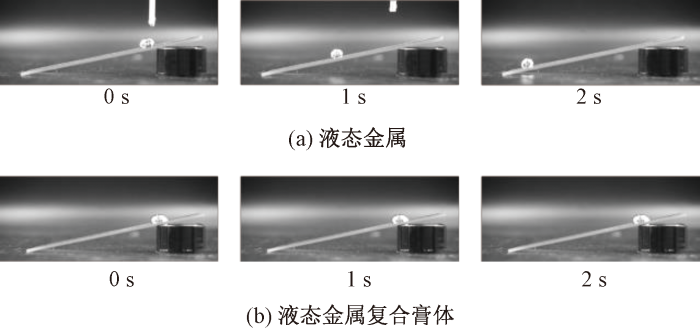
图3
液态金属和液态金属复合膏体滴落在玻璃板上的运动状态
Fig.3
Diagram of movement of liquid metal (a) and liquid metal paste (b) on glass plate
2.3 液态金属复合纤维的基础电学性能
图4
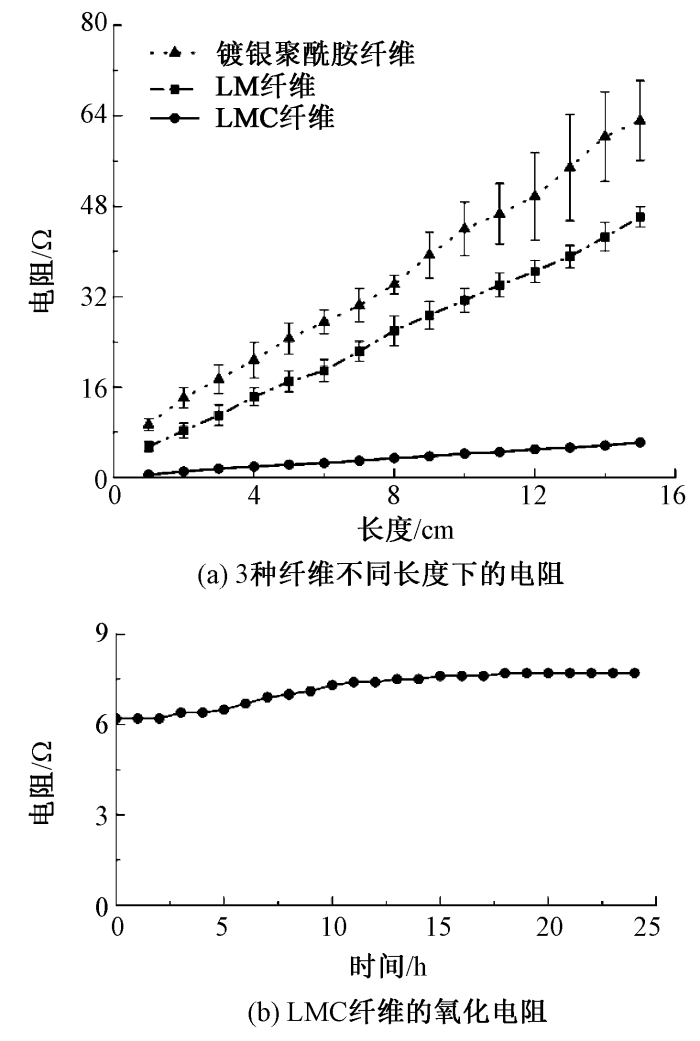
图4
纤维的电学性能
Fig.4
Electrical properties of fibers. (a) Resistance of three fibers with different lengths; (b) Oxidation resistance of LMC fibers
2.4 液态金属复合纤维的力学性能
图5
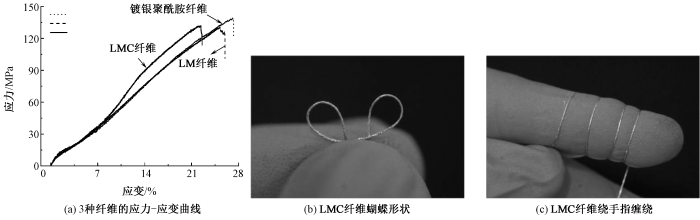
图5
3种纤维的应力-应变曲线和LMC纤维的造型图
Fig.5
Stress-strain curves for three fibers and modeling plots for LMC fibers. (a) Stress-strain curves for three types of fibers; (b) Butterfly shape of LMC fiber; (c) LMC fiber wrapping finger
2.5 液态金属复合纤维的弯曲电学性能
图6
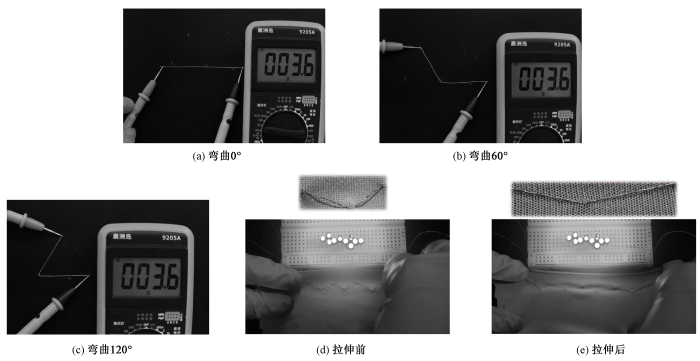
图6
LMC纤维的弯曲性能图
Fig.6
Diagram of flexural properties of LMC fiber. (a) Bending 0°; (b) Bending 60°; (c) Bending 120°; (d) Before stretching; (e) After stretching
2.6 液态金属复合纤维的水下电学性能
图7示出采用可调直流稳压电源点亮LED灯泡,分析LMC纤维入水后对导电性能的影响。可知,LMC纤维在水中连续浸泡1 h,作为导通电路连接10个LED灯泡,该过程中灯泡亮度无明显变化。用万用表对LMC纤维入水前后的电阻进行测量,相较于入水前的电阻,入水1 h后LMC纤维的电阻仅降低了1.9%。这得益于液态金属复合膏体结构致密,水分不会通过膏体进入纤维内部,从而保证了LMC纤维稳定的导电能力。
图7

图7
LMC纤维入水前后的导电性能
Fig.7
Electrical conductivity of LMC fiber before(a) and after(b) entering water
2.7 液态金属复合纤维的电加热性能
图8
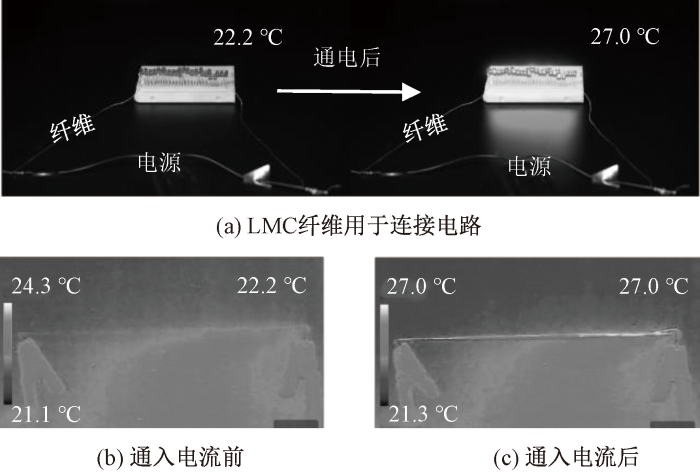
图8
LMC纤维的电加热图
Fig.8
Electric heating diagram of LMC fibers. (a) Connect circuit with LMC fiber; (b) Before powering on; (c) After powering on
3 结论
本文通过镍掺杂技术,实现了液态金属表面氧化膜的动态更替,制备出导电性能优异、黏附性能强的液态金属复合膏体。进一步将该膏体涂覆于镀银聚酰胺纤维表面,成功制备出兼具优异导电性和良好柔韧性的液态金属复合纤维,其电导率高达4.8×10⁵ S/m。应力-应变测试表明,在纤维表面涂覆液态金属复合膏体并未对其力学性能造成显著的不利影响,确保了纤维在实际应用中的结构稳定性与可靠性。此外,液态金属复合纤维在弯曲状态或水下环境中均表现出优异的稳定性。基于液态金属复合纤维的电热性能,还可将其作为热管理材料应用于相关领域。综上所述,该纤维在智能服装领域具有良好的应用前景。
参考文献
弹性导电复合纤维的制备及其应变与温度传感性能
[J].
DOI:10.13475/j.fzxb.20230706201
[本文引用: 1]

为满足柔性可穿戴传感器的多功能传感需求,实现应变和温度传感具有重大的意义。采用湿法纺丝技术制备聚(3,4-乙烯二氧噻吩)-聚苯乙烯磺酸(PEDOT:PSS)/银纳米线(AgNWs)/聚氨酯(PU)弹性复合导电纤维,研究其拉伸应变传感性能和温度传感性能。结果表明:当AgNWs质量分数为20%,(PEDOT:PSS)与PU质量比为1∶3时,纤维热电性能达到最佳,电导率为47.4 S/cm,塞贝克系数为13.8 μV/K,功率因数为902.7 nW/(m·K<sup>2</sup>),此外,该弹性导电复合纤维具有良好的力学性能,断裂伸长率可达800%,能够检测0%~90%的应变范围,并在100次循环拉伸/回复下依旧保持良好稳定性;同时可将其作为温度传感器,快速检测人体与环境温度。
Preparation of elastic conductive composite fibers and their strain and temperature sensing properties
[J].
DOI:10.13475/j.fzxb.20230706201
[本文引用: 1]
<p id="p00010"><strong>Objective</strong> In order to promote the development of multi-functional flexible wearable sensors, it is of great significance to develop a sensor which could sense both strain and temperature. PEDOT:PSS is a conductive polymer with excellent thermoelectric properties, and can be employed as an ideal base material for stretchable strain sensor and temperature sensor. In this research, a composite conductive fiber was prepared by wet spinning method to achieve strain and temperature sensing.</p><p id="p00015"><strong>Method</strong> The composite conductive fibers with different PU content were prepared by the wet spinning method. The conductivity, Seebeck coefficient, power factor and mechanical property of the composite conductive fiber were measured and analyzed. To verify the ability of this fiber as a strain sensor for motion detection, it was fixed on the index finger and wrist respectively, and the resistance response at different bending angles was measured. Furthermore, the fiber was sewn into a glove, and the temperature-sensing performance was studied.</p><p id="p00020"><strong>Results</strong> With the increase of PU content, the conductive network was destructed by the non-conductive component, resulting in a decrease in conductivity, but the Seebeck coefficient of the composite remained stable because the thermoelectric material was unchanged. The stress and strain of composite fiber were both increased with the increase of PU content. This fiber showed wide work strain range (0%-90%), high sensitivity and good stability. The finger and wrist were bent for 5 times, the maximum resistance changes were basically the same, indicating that the elastic composite wire fiber sensor has good stability. The tensile deformation caused by wrist bending was larger than that caused by finger bending, the corresponding resistance change rate was also much larger than that caused by finger bending. When it is used as a temperature sensor, the voltage is generated by the temperature difference formed at the two ends of the fiber. With the temperature difference increasing, the voltage was increasing too. To detect the water temperature, the fiber was sewn into the glove. Once the hand touches the beaker filled with warm/cold water, a temperature difference was created between the inside and outside of the glove, then a voltage signal was generated. When holding a beaker containing warm water of about 37 ℃, a positive voltage of about 35 μV was generated. After release, the voltage dropped back gradually. When clenched again, the voltage rises at almost the same height. When holding a beaker with ice water at about 0 ℃, a negative voltage of about 50 μV was generated. After release, the voltage returns to 0. When clenched again, a negative voltage of about 45 μV was generated. The result demonstrated that this fiber has great promise for temperature sensing.</p><p id="p00025"><strong>Conclusion</strong> The conductive PEDOT:PSS/AgNWs/PU fiber was prepared by wet spinning method. The AgNWs were added to improve the conductivity of the composite fiber. The mechanical properties of PEDOT:PSS could be increased by adjusting the ratio of PU. The PEDOT:PSS/AgNWs/PU composite fiber has good mechanical properties, elongation at break can reach 800%, able to detect 0%-90% strain range, and still maintain good stability under 100 cycles of stretching/recovery. In addition, it can also be used as a temperature sensor to quickly detect human body and environmental temperature, showing great potential in health monitoring.</p>
聚(3,4-乙撑二氧噻吩):聚苯乙烯磺酸基复合导电纤维的制备及其性能
[J].
Preparation and properties of poly(3,4-ethylpropodoxythiophene): polystyrene sulfonic acid-based composite conductive fiber
[J].
聚氨酯/导电炭黑复合纤维的制备及其柔性电热性能
[J].
Preparation of polyurethane/conductive carbon black composite fiber and its flexible electrothermal proper-ties
[J].
Preparation of core/shell electrically conductive fibers by efficient coating carbonnanotubes on polyester
[J].
智能可穿戴纺织品用电活性纤维材料
[J].
Electroactive fiber materials for smart wearable textiles
[J].
Electrically conductive coatings for fiber-based e-textiles
[J].
Highly conductive fiber with waterproof and self-cleaning properties for textile electronics
[J].
A stretchable and conductive fiber for multifunctional sensing and energy harvesting
[J].
Enhanced sensing performance of superelastic thermally drawn liquid metal fibers through helical architecture while eliminating directional signal errors
[J].
Liquid metal fibers
[J].
Elastic multifunctional liquid-metal fibers for harvesting mechanical and electromagnetic energy and as self-powered sensors
[J].
碳纳米管/热塑性聚氨酯弹性导电复合纤维的制备及性能
[J].
Preparation and properties of carbon nanotube/thermoplastic polyurethane elastic conductive composite fibers
[J].
Smart semiliquid metal fibers with designed mechanical properties for room temperature stimulus response and liquid welding
[J].
Permeable and patternable super-stretchable liquid metal fiber for constructing high-integration-density multifunctional electronic fibers
[J].
Direct writing and repairable paper flexible electronics using nickel-liquid metal ink
[J].
Directly printable and adhesive liquid metal ink for wearable devices
[J].

 京公网安备11010502044800号


