



随着全球经济的发展和人口的增加,对能源的需求持续增长。传统能源如煤炭、石油和天然气等的储量有限,且使用过程中会带来环境污染和气候变化等问题。因此,寻找可持续、可再生的新能源成为当务之急[1]。目前,大规模开发使用的可再生新能源包括风能[2]、光伏[3]和水电[4]等,这些能源环境依赖性较高,因此开发新的可再生能源显得尤为重要。河水与海水之间巨大的渗透差是一种潜在的、含量丰富的可再生清洁能源[5],不同盐度水混合时产生的吉布斯自由能可以被有效收集并利用。受到生物体内大量选择性离子传输通道的启发,根据双电层理论[6],具有特定孔隙结构和丰富表面电荷的纳米流体材料能够定向传输离子,应用于高效离子传输和渗透能收集。与常用的聚合物商业材料如全氟磺酸[7]、聚碳酸酯[8]和聚醚醚酮[9]相比,功能纳米材料基膜包括生物质功能材料[10]、碳纳米管(CNTs)[11]、氧化石墨烯[12]、MXenes[13]和共价有机框架[14]具有优越的输出性能,其输出功率密度通常超过商业标准(5 W/m2)。综合考虑性能与成本,基于天然生物质材料如纤维素构建的离子管理系统已成为重点研究方向。
纤维素作为一种多糖高分子,具有丰富的羟基等官能团,可以通过化学修饰或与其它材料复合来调控其表面性质[15-16],从而实现对不同离子的选择性透过[17]。纤维素的来源包括树木、棉花和细菌培养[18]等。根据来源不同,将纤维素加工成具有纳米通道材料的方法也各有不同。常见的构建策略主要有3种:利用木材的本征形态进行加工成形[19],通过化学处理或机械破碎将原料剥离成低维纳米纤维或纳米晶后再成形的“自上而下”策略[20],将纤维素溶解后再生的“自下而上”构建策略[21]。本文将从这3种构建策略展开,讨论适用于不同策略的改性方法,从多角度探讨将纤维素构建成纳米流体材料的过程,以及展望以纤维素为主体的纳米流体材料在离子传输领域的未来应用,并讨论其优势及面临的挑战。
1 本征态结构利用
木材作为地球上最丰富的生物资源之一,在为可持续发展的未来提供绿色能源和材料方面具有巨大的潜力[22]。木材的细胞壁主要由纤维素、半纤维素和木质素组成[23],沿着生长方向有序排列[24],并形成独特的多孔结构[25](见图1)。天然的序构化多孔结构为获得纳米级离子传输通道提供条件,以实现离子的定向传输。然而,细胞壁中存在的木质素和半纤维素增加了刚性,难以进行结构调控[26]。通过脱除木质素和半纤维素,可以有效提升木材的韧性,而不完全脱除则有助于保持木材结构的稳定性[27]。自然结构的孔径较大(超过50 μm),远远超过德拜长度(小于 30 nm)[28],这使得天然木材对离子选择性较差,因此,对孔隙的调控显得尤为重要。常见的调控方法包括渗透复合和物理致密化等(见图1)。渗透复合操作简单,但微观结构变化不可控;而物理方法通过致密化可以获得孔隙结构均匀的微观结构,但致密化过程中会产生内应力,对材料的韧性要求较高。
图1
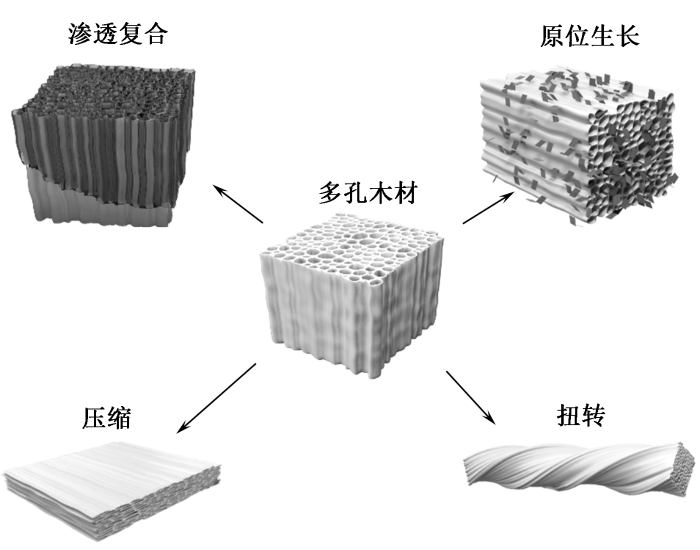
图1
多孔木材的改性方法以实现离子传输
Fig.1
Modification methods of porous wood for ion transport
1.1 渗透复合
一种常见的孔隙调控策略是利用其它物质填充孔隙,可有效降低孔尺寸的同时保留木材的本征结构。Zhang等[29]将聚乙烯醇(PVA)/聚丙烯酸(PAA)水凝胶渗透至部分脱除木质素后的木材微通道中,制备了具有高离子电导率的木材水凝胶。沿着孔隙方向,离子电导率超过0.52 mS/cm。Wu等[30]对木材进行了四甲基哌啶氧化物(TEMPO)氧化和季铵化改性,随后将木材与环氧树脂复合,通过反向电渗析(RED)技术,将阳离子选择性膜和阴离子选择性膜组合,构建出P—N结构。在1 cm2的测试面积下,获得了5.14 mW/m2的输出功率密度。显而易见,具有一定黏度的物质渗透到木材的孔隙中,固化后能保留纳米级的孔隙结构。虽然该方法操作简单,但存在一个较大问题,即固化后孔隙结构无法控制,导致孔隙率分布不均匀。
1.2 扭转
通过物理方法可控地破坏木材的本征结构是一种能够有效控制孔隙结构的策略。利用扭转将方形木材转变为类纤维结构,制备“木头离子电缆”[27],同时也可将其转变为直径约500 μm的纤维状结构,微孔结构因扭转而变得更加致密,从而提高了离子选择性。在10-5 mol/L NaCl溶液的测试条件下,离子电导率达1.5×10⁻⁴ S/cm,远超天然木材的4.0×10-5 S/cm,体现出扭转带来的致密化对调节离子传输行为的有效性。然而,该方法存在加工难度大的问题,因内应力易导致材料开裂,对处理工艺要求较高。
1.3 压缩
最常见的致密化策略是对多孔材料进行压缩处理。Chen等[25]将季铵化木材沿着生长方向的轴向进行压缩致密化处理。超级致密化的排列为离子选择性传输提供了良好条件,在10-4 mol/L的KCl溶液测试条件下,离子电导率达到1.28×10-3 S/cm,是天然木材的90倍,同时力学强度提升约20倍。这是一种可持续经济的阳离子膜合成方法。扭转和压缩是实际应用中最常见的调控孔隙率的方法。根据具体应用的需求,可选择类纤维的扭转木材或类膜的压缩木材。
1.4 原位生长
尽管天然木材可通过改性获得优异的离子传输性能,但与功能性材料相比仍存在一定差距。将木材与功能材料结合,不仅可获得优异性能,还可大幅降低功能材料的成本。木材有序的孔隙结构和丰富的表面电荷为功能性材料提供生长位点。Liu等[31]将木材作为MoS2纳米片原位生长的框架,然后压缩制备了“木材离子泵”。MoS2不仅提升了离子电导率,还引入了光响应的离子传输机制。在10-6 mol/L KCl溶液中,MoS2修饰的木材电导率为8.3×10⁻⁵ S/cm。施加光照后,MoS2产生电子和空穴分离,形成内电场。若内电场方向与离子传输方向一致,离子传输能力可提升12.6倍;若方向相反,则可逆着20倍浓度梯度进行离子传输。相较于具有优异离子传输特性的功能材料,单纯通过化学改性制备的木材难以在离子传输性能方面与之媲美;若将木材作为基体与功能材料复合,则通常可显著提升整体性能。
1.5 离子插层
离子传输的另一个重要领域是电池的应用。为解决锂离子电池中无机离子的刚性和脆性,同时提升聚合物离子导体的电导率,Yang等[32]提出在纤维素纳米纤维(CNF)中构建分子通道的策略。纤维素分子链中有大量极性官能团可溶剂化Li+,但其紧密排列不利于Li+渗透。Cu2+与纤维素纳米纤维的配位作用可在绝缘的纤维素内部开启分子通道,从而实现Li+沿聚合物链的快速传输,所得的Li-Cu-CNF离子导体具备低成本和大规模制备优点。在分子通道中,Li+与丰富的含氧官能团形成多个配位,并在H2O的帮助下,在COO—和RO—位点间跳跃移动,跳跃距离约0.3 nm。通过开放分子通道、多重Li—O配位和水分子辅助,Li-Cu-CNF获得高离子电导率(室温下1.5×10⁻³ S/cm)、高转移数(0.78)和广泛的电化学稳定窗口(0~4.5 V),成为高能量密度和安全性固态电池的潜在候选材料。
Dong等[33]还开发了可扩展且成本效益高的纤维素衍生超分子的合成方法。在Na+和OH-作用下,氢键网络被破坏,形成Na—纤维素复合物。Cu2+扩散到纤维素链间,并与去质子化羟基位点配位,进一步破坏氢键网络,重构纤维素聚合物链的晶体结构,形成Na—纤维素衍生超分子。该超分子具有三维、分层的晶体结构,由一维开放通道组成。与依赖大孔隙的传统膜相比,超分子在密集结构下仍显示高离子导电性(0.23 S/cm)。该方法适用于棉纤维、纤维素膜和纸张等多种纤维素材料。该方法所制备的离子导体结合了无机材料的高导电特性与有机高分子材料的优异韧性。
2 “自上而下”的构建策略
通过化学方法TEMPO氧化[34],或物理破碎方法高压均质[35],可将纤维素原料如木材、棉花等转化为纤维素纳米纤维。与改性木材相比,纳米纤维素具有更好的加工性和可调节性。同时,纳米纤维素拥有较高的比表面积,便于改性,且更易与功能材料复合,尤其是二维功能材料。由于二维材料的紧密堆积会减小离子通道尺寸,影响离子传输,常用的解决方法是引入纳米纤维作为插层剂[36],扩大层间距。这不仅提升了离子通量,还增强了复合材料的力学强度。目前的研究集中于特种加工成形方法,提高纳米材料的有序堆砌,增强离子传输通道的规整性,提升离子传输性能。最常见的制备方法是真空抽滤(见图2),其操作简单,但微观结构控制能力较差,制备效率低。为获得高度有序的序构化结构,开发了溶液刮涂、定向冷冻[37]、湿法纺丝等技术(见图2),以满足对具有不同溶液性质的纳米材料的构建需求。
图2
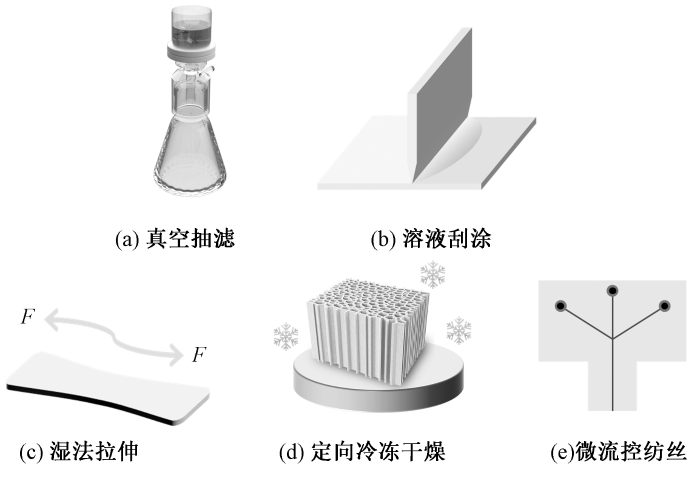
图2
用于渗透能收集的纳米纤维素组装方法
Fig.2
Assembly methods of nanomaterials for osmotic energy harvesting. (a) Vacuum filtration; (b) Blade coating; (c) Wet drawing; (d) Freeze casting; (e) Microfluidic spinning
2.1 真空抽滤
低维纳米材料组装成膜的最常见方法是真空抽滤法,通过负压将纳米材料有序组装。尽管对微观结构的调控能力较弱,但操作方便,几乎适用于任何纳米材料,成为使用范围最广的制备方法之一。Jia等[38]将TEMPO氧化处理的细菌纤维素纳米纤维与负电荷的氮化硼溶液混合,通过真空抽滤获得纳米流体膜,其截面有明显的层状结构,在50倍KCl的浓度差下,获得了4.19 W/m2的输出功率密度。尽管真空抽滤操作简单,但其制备效率较低,且对微观结构的控制能力较差。此外,具有一定黏度的溶液在抽滤过程中处理较为困难。因此,开发具有更强微观结构控制能力的新构建策略显得尤为重要。
2.2 溶液刮涂
刮涂法是一种常见的制备具有有序结构薄膜的方法,适用于具有一定黏度的溶液。Li等[39]采用循环刮涂法制备了细菌纤维素纳米纤维(BCNF)-MXene-液体金属膜,通过循环刮涂使材料分布更加均匀,以获得更有序的结构,该复合膜的取向度高达0.935,断裂强度高达908.4 MPa。该方法适用于具有一定黏度的纳米材料溶液,具有效率高、微观结构控制能力强的优点。
2.3 湿法拉伸
纤维素的另一种常见形态是纤维素水凝胶,可以通过纳米化将其转变为纳米纤维进行加工,但更简单的制备方法是直接对纤维素水凝胶进行牵伸处理。Wu等[40]对细菌纤维素(BC)进行了TEMPO氧化和季铵化改性,获得带有相反电荷的BC水凝胶膜;随后,采用湿法拉伸和热压工艺将BC膜内的纳米通道排列整齐。经过湿法拉伸和热压处理后,膜呈现出高度有序的纳米纤维结构和更密集的排列,从而提高了离子选择性和可传输性。通过模拟人工海水和河水,该膜的输出功率密度达到0.23 W/m2。这种方法操作简单,适用于纤维素水凝胶等特殊形态的纳米复合材料。
2.4 定向冷冻干燥
控制温度场来控制冷冻过程中冰晶的生长方向,可以获得高取向的多孔结构。Yuan等[41]利用定向冷冻干燥技术使海藻纤维素纳米纤维和MXene纳米片定向排列,形成定向孔结构,再经物理压缩获得致密化的层状结构。另外,还对MXene进行正电荷改性,然后和季铵化纤维素纳米纤维复合获得阴离子选择性膜,并与负电荷改性的CNF/MXene阳离子选择性膜组合构建了P—N渗透能收集系统,获得了2.52 W/m2的输出功率密度。得益于MXene的光热效应,在光照条件下,输出功率密度提升了3.52倍。尽管该方法的操作过程较为复杂,且能耗较高,但无论是稀溶液,具有一定黏度的溶液,还是水凝胶,均适用,几乎适用于所有纳米材料的构建。
2.5 湿法纺丝
相较于上述方法,湿法纺丝技术兼具连续化生产优势和高效均匀的加工特性。纤维形貌主要由纺丝针头形态决定,而微流控纺丝作为其特殊工艺形式,在传统技术基础上通过微通道精确调控纺丝液的层流行为,实现了对纤维结构的精准构筑。Lin等[42]设计了独特的微流控纺丝方法,利用不对称流体场调节海藻纤维素纳米纤维的组装过程,成功制备了扭转海藻纤维。与传统对称流体场微流控纺丝相比,扭转纤维的直径更小(33.6~20.4 μm),堆积密度更高(0.87~1.47 g/cm3),取向度也有所增加(0.77~0.89)。更重要的是,在50倍盐浓度梯度下,其输出功率密度高达12.87 W/m2。
3 “自下而上”的构建策略
纤维素分子内和分子间存在大量氢键,形成了稳定的网络结构,这使得纤维素在常规条件下难以被水或有机溶剂溶解。张俐娜团队提出NaOH/尿素溶剂可实现纤维素绿色溶解[43],随后利用不良溶剂如酸和乙醇等使纤维素溶液再生,结合湿法纺丝、铺膜牵伸、刮涂以及原位聚合等方式(见图3),可获得不同形态的纤维素基材料,如膜和纤维等[44]。将再生纤维素序构化取向后,整齐的纤维素分子链构成了有序的离子传输通道。通过复合和改性等方法,可使再生纤维素成为优异的纳米流体材料[45]。再生纤维素作为复合材料的支撑框架,可为纳米填料提供固定位点。基于纤维素材料优异的力学性能、多孔结构与纳米填料突出的离子传输特性,可构建高性能离子导体体系。但需注意纳米填料易发生过度堆积现象,可能引发离子通量衰减问题。采用原位聚合策略既可维持纤维素材料的多孔特性,又能增强离子传导效率,最终实现材料综合性能的优化提升。
图3
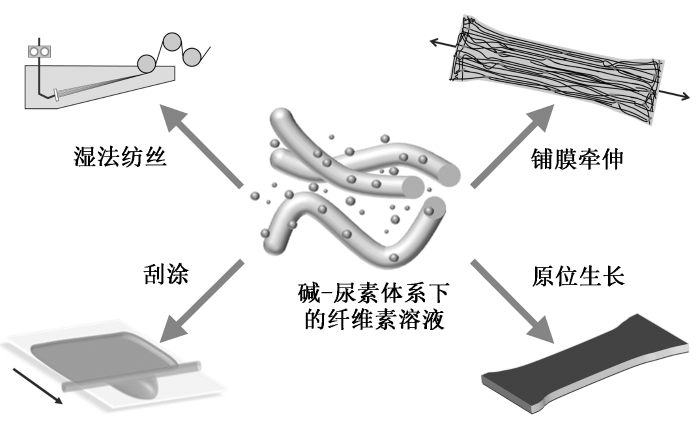
图3
纤维素溶液示意图以及常见有序化再生方法
Fig.3
Schematic diagram of cellulose solution and construction strategies of regenerated cellulose
3.1 与功能纳米材料复合
再生纤维素具有良好的加工性,能够与多种功能材料相容,便于制备各种形状和结构的复合材料。同时,再生纤维素本身具备良好的力学强度和柔韧性,与功能材料复合能够显著提升复合材料的整体性能,如强度、韧性和耐用性。对CNTs进行表面酸化,可引入丰富的含氧官能团,并显著提升分散性[46]。Zhou等[47]将酸化CNTs与再生纤维素复合,利用湿法纺丝技术制得再生纤维素/CNTs复合纤维。得益于交联的再生纤维素网络的序构化,CNTs在复合纤维中呈现出致密且有序的排列。在低盐浓度(10-3 mol/L KCl)环境下展现出29 MPa的高湿态强度以及0.07 S/cm的高离子电导率。在为期43 d的长期连续化测试中,该复合纤维维持了2.57 W/m2的输出功率密度。湿法纺丝作为一种连续化程度较高的材料制备工艺,为该材料的大规模应用提供了可靠基础。此外,二维小角X射线散射(SAXS)分析进一步验证了沿光纤轴向长距离排列的纳米纤维,显示出明显的各向异性散射强度,将多个发电系统单元串联,成功实现为计算器和LED灯供电。
纤维材料在渗透能收集领域的应用受到其单根纤维截面积较小的限制,导致在大规模应用中需要多根纤维的复杂组装。与此相比,膜基材料具备较大截面积的优势。鉴于此,Zhou等[48]首先经过化学修饰开发了溶液浇筑法来制备定向排列的再生纤维素/CNTs复合膜,然后经过电荷改性及结构致密化处理,制备出带有相反电荷,且能够分别选择性传输阳离子和阴离子的构建P—N单元,实现50倍浓度梯度下增强渗透能收集能力(5.28 W/m2)。再生纤维素作为复合材料的结构骨架,可有效固定纳米填料并赋予材料优异的离子选择性。然而需注意的是,纳米填料可能产生传质阻力增大效应,存在抑制纳米流体系统离子通量的潜在风险。
3.2 原位聚合
为充分利用再生纤维素膜的多孔结构,并赋予其不亚于功能填料的离子传输能力,Xie等[49]提出了层状聚苯胺-纤维素-聚苯胺纳米流体膜结构,通过解耦离子和电子传输通道实现渗透能收集性能的增强。能量色散X射线光谱(EDX)元素分布证明聚苯胺均匀分布在膜表面,同进利用拉曼成像技术表征了聚苯胺和纤维素的空间可视化分布,其中聚苯胺信号强度从表面到内部再到表面呈现出强-弱-强的趋势,进一步表明聚苯胺在纤维膜表面成功聚合。这种独特的结构实现了离子和电子“解耦”,表层聚苯胺和内层纤维素纳米通道分别提供电子和离子传输路径,以提升渗透能收集的能力,与聚苯胺/纤维素均匀复合膜相比,其离子电导率提高1.57倍(5.77 × 10-4 S/cm),在50倍NaCl浓度差下输出功率密度高达11.7 W/m2,远超过商业标准。该方法有效避免了纳米填料因堆积导致离子传输阻力增大的问题。作为功能层的聚苯胺仅生长于再生纤维素膜表面,在保持膜多孔结构的基础上,不仅展现出优异的离子管理能力,同时释放了体系的离子传输潜能。
4 结束语
本文系统综述了纤维素基纳米流体材料的结构构建策略及其在离子传输与渗透能转化领域的应用进展。作为天然高分子功能材料,纤维素凭借丰富的羟基官能团展现出良好的化学可修饰性,通过分子结构设计或多元复合策略可实现表面电荷分布与微纳结构的精准调控,从而构建高效离子选择性传输通道。现有制备体系主要包含3类典型策略:基于天然木材结构保留的本征材料开发,通过化学-机械协同解纤法获得纳米晶/纳米纤维的“自上而下”路径,以及基于溶剂诱导再生组装的“自下而上”策略。
纤维素基纳米流体材料凭借原料可再生优势和良好的溶液加工性,在产业化应用中展现出显著潜力。但其本征离子电导率较低,需通过化学改性或结构工程策略提升离子传输效率。值得注意的是,虽然MXene等二维材料具备优异传质特性,但其层间堆叠现象易导致离子通量衰减及力学性能不足。通过构建纤维素/二维材料“砖-泥”复合结构,纤维素既可有效抑制二维材料层间堆叠,又能通过分子间氢键网络显著增强复合体系力学性能。
纤维素基纳米流体材料面临的挑战在于如何实现功能材料与纤维素的有效复合,以及获取超高取向度的有序结构。未来,通过优化材料设计和制备工艺,纤维素基纳米流体材料在能源领域的广泛应用可期,为推动能源转型贡献力量。
参考文献
Estimation of useful-stage energy returns on investment for fossil fuels and implications for renewable energy systems
[J].
Resolving environmental effects of wind energy
[J].
An analysis on the potential of solar photovoltaic power
[J].
Current hydropower developments in Europe
[J].
DOI:10.1016/j.cosust.2019.06.002
[本文引用: 1]

Hydropower developments in Europe are impacted by economic, political and environmental boundary conditions. All involved players - from the energy supply companies to environmental organizations - have to remain flexible to the constant changes in the energy sector. To cope with these changes, integrated approaches considering demands for both (socio) economic and environmental sustainability as well as research and innovation in hydropower technology and management across national borders are needed. As a basis for discussing and developing plans for hydropower's future in Europe, this paper provides key statistics summarizing the current status of hydropower and reviews recent hydropower developments in terms of technological, environmental and economic challenges.
Nanomaterials-based nanochannel membrane for osmotic energy harves-ting
[J].
Nanofluidics for osmotic energy conversion
[J].
Commercial nafion membranes for harvesting osmotic energy from proton gradients that exceed the commercial goal of 5.0 W/m2
[J].
DOI:10.1021/acsnano.4c04152
PMID:38696339
[本文引用: 1]
Osmotic energy from proton gradients in industrial acidic wastewater can be harvested and converted to electricity through membranes, making it a renewable and sustainable power source. However, the currently designed membranes for harvesting proton gradient energy in acidic wastewater cannot simultaneously achieve excellent chemical/mechanical stability and high power density under a large-scale area and require high cost and complex operations. Here, we demonstrate that commercial Nafion membranes with high chemical/mechanical stability and proton transport selectivity can generate a power density of 5.1 W/m for harvesting osmotic energy from proton gradients under a test area of 0.2 mm, which exceeds the commercial goal of 5.0 W/m. Even under a test area of 12.5 mm, a power density of 2.1 W/m can be achieved under a strong acid condition. In addition, the heat can greatly promote proton transport, and the power density is increased, i.e., 8.1 W/m at 333 K (5.1 W/m at 293 K) under a test area of 0.2 mm. By matching membranes with ion selectivity, our work demonstrates the potential of Nafion membranes for harvesting proton gradient energy in acidic wastewater and provides an approach for large-scale conversion of osmotic energy.
Thermally enhanced osmotic power generation from salinity difference
[J].
Charge-gradient sulfonated poly(ether ether ketone) membrane with enhanced ion selectivity for osmotic energy conver-sion
[J].
Sustainable chitin-derived 2D nanosheets with hierarchical ion transport for osmotic energy harvesting
[J].
A facile strategy for the preparation of carbon nanotubes/polybutadiene crosslinked composite membrane and its application in osmotic energy harvesting
[J].
Vertically transported graphene oxide for high-performance osmotic energy conversion
[J].
The review of MXenes for osmotic energy harvesting: synthesis and properties
[J].
Ultrathin self-standing covalent organic frameworks toward highly-efficient nanofluidic osmotic energy generator
[J].
Wood nanomaterials and nanotechnologies
[J].
Cellulose dissolution, modification, and the derived hydrogel: a review
[J].
Molecular self-assembled cellulose enabling durable, scalable, high-power osmotic energy harvesting
[J].
Bacterial cellulose: strategies for its production in the context of bioeconomy
[J].
Engineered wood: sustainable technologies and applications
[J].
From wood to textiles: top-down assembly of aligned cellulose nanofibers
[J].
Recent progress in regenerated cellulose-based fibers from alkali/urea system via spinning process
[J].
Engineered wood for a sustainable future
[J].
Effect of delignification technique on the ease of fibrillation of cellulose II nanofibers from wood
[J].
Cellulose ionic conductors with high differential thermal voltage for low-grade heat harvesting
[J].
DOI:10.1038/s41563-019-0315-6
PMID:30911121
[本文引用: 1]
Converting low-grade heat into useful electricity requires a technology that is efficient and cost effective. Here, we demonstrate a cellulosic membrane that relies on sub-nanoscale confinement of ions in oxidized and aligned cellulose molecular chains to enhance selective diffusion under a thermal gradient. After infiltrating electrolyte into the cellulosic membrane and applying an axial temperature gradient, the ionic conductor exhibits a thermal gradient ratio (analogous to the Seebeck coefficient in thermoelectrics) of 24 mV K-more than twice the highest value reported until now. We attribute the enhanced thermally generated voltage to effective sodium ion insertion into the charged molecular chains of the cellulosic membrane, which consists of type II cellulose, while this process does not occur in natural wood or type I cellulose. With this material, we demonstrate a flexible and biocompatible heat-to-electricity conversion device via nanoscale engineering based on sustainable materials that can enable large-scale manufacture.
A highly conductive cationic wood membrane
[J].
The role of the hemicelluloses in the nanobiology of wood cell walls: a systems theoretic perspective
[J].
Wood ionic cable
[J].
Bio-inspired nanocomposite membranes for osmotic energy harves-ting
[J].
Wood hydrogel for efficient moisture-electric generation
[J].
Salinity-gradient power generation with ionized wood membranes
[J].
Wood ion pumps enabled by light-responsive MoS2-decorated nanocellulosic channels
[J].
Copper-coordinated cellulose ion conductors for solid-state batteries
[J].
A cellulose-derived supramolecule for fast ion transport
[J].
Diverse nanocelluloses prepared from TEMPO-oxidized wood cellulose fibers: nanonetworks, nanofibers, and nanocrystals
[J].
Fabrication of cellulose nanofiber reinforced thermoplastic compo-sites
[J].
Tailoring interlayer spacing in MXene cathodes to boost the desalination performance of hybrid capacitive deionization systems
[J].
Ultra-light MXene aerogel/wood-derived porous carbon composites with wall-like ″mortar/brick″ structures for electromagnetic interference shielding
[J].
Enhanced selective ion transport in highly charged bacterial cellulose/boron nitride composite membranes for thermo-osmotic energy harvesting
[J].
Ultrastrong MXene film induced by sequential bridging with liquid metal
[J].
DOI:10.1126/science.ado4257
PMID:38963844
[本文引用: 1]
Assembling titanium carbide (TiCT) MXene nanosheets into macroscopic films presents challenges, including voids, low orientation degree, and weak interfacial interactions, which reduce mechanical performance. We demonstrate an ultrastrong macroscopic MXene film using liquid metal (LM) and bacterial cellulose (BC) to sequentially bridge MXene nanosheets (an LBM film), achieving a tensile strength of 908.4 megapascals. A layer-by-layer approach using repeated cycles of blade coating improves the orientation degree to 0.935 in the LBM film, while a LM with good deformability reduces voids into porosity of 5.4%. The interfacial interactions are enhanced by the hydrogen bonding from BC and the coordination bonding with LM, which improves the stress-transfer efficiency. Sequential bridging provides an avenue for assembling other two-dimensional nanosheets into high-performance materials.
Oppositely charged aligned bacterial cellulose biofilm with nanofluidic channels for osmotic energy harves-ting
[J].
High-aligned oppositely-charged nanocellulose/MXene aerogel membranes through synergy of directional freeze-casting and structural densification for osmotic-energy harves-ting
[J].
Customizable twisted nanofluidic cellulose fibers by asymmetric microfluidics for self-powered urine monitoring
[J].
Novel fibers prepared from cellulose in NaOH/urea aqueous solution
[J].
Recent progress in high-strength and robust regenerated cellulose materials
[J].
Transport and elastic parameters for dense regenerated cellulose membranes
[J].
Development of enhanced multiwalled carbon nanotube (MWCNT) conductive polymeric nanocomposites by using acidified derivative of MWCNT as dispersant
[J].
Aligned regenerated cellulose-based nanofluidic fibers with ultrahigh ionic conductivity and underwater stability for osmotic energy harvesting
[J].
Scalable fabrication of regenerated cellulose nanohybrid membranes integrating opposite charges and aligned nanochannels for continuous osmotic energy harvesting
[J].
Decoupled ionic and electronic pathways for enhanced osmotic energy harvesting
[J].

 京公网安备11010502044800号


