



本文介绍了以法拉第电磁感应定律、霍尔效应和磁致弹性效应为核心工作机制的3类基于磁电效应的柔性传感器(FMES)结构构建的研究进展,并探讨了上述FMES结构构建的未来发展方向,以期为高性能纤维的研究与应用提供参考。
1 磁电式传感器结构的主要构建方法
图1
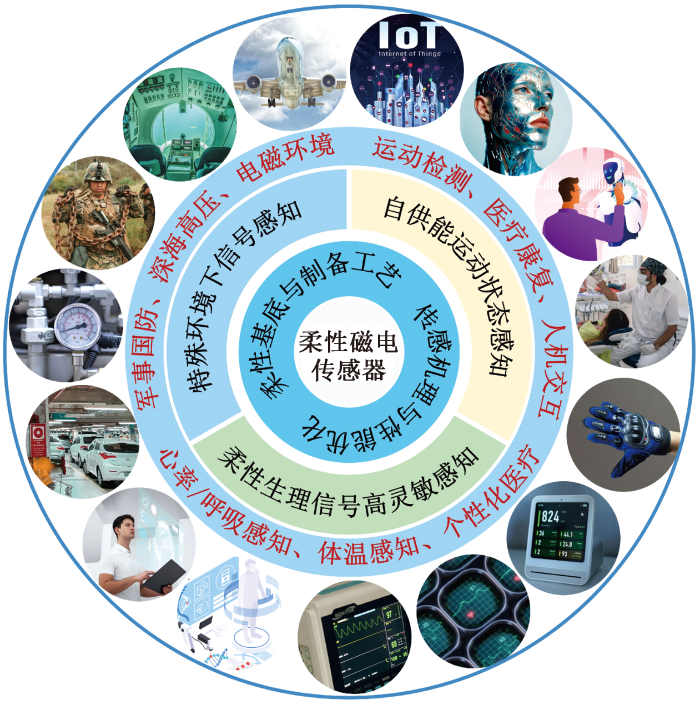
2 基于法拉第电磁感应定律的传感器
2.1 法拉第磁电柔性传感器工作机制
法拉第电磁感应定律指出,时变磁场可以产生旋转的电场,即当闭合线圈内的磁通量发生改变时,闭合线圈内会产生感应电动势[21]。通过该原理制备的柔性传感器件可以通过产生的感应电动势或电流的幅值以及频率来实现对机械信号的感知,如运动频率、强度或动作等。
该类型传感器制备难度低,且具有良好的信号响应速度、灵敏度、环境稳定性和长寿命等优点,因此,以该原理制备的磁电式柔性传感器得到广泛的关注[22]。
2.2 法拉第磁电柔性传感器发展现状
在基于法拉第电磁感应定律柔性传感器发展早期,其主要以柱状或块状形式为主。柔性化主要通过磁性体的柔性化实现,如在弹性体中混入磁性材料。而其导电体(即感应线圈部分)仍与传统发电机相似,以螺旋线圈的形式存在。例如,Zhang等[26]将磁铁放入带有螺旋铜线的中空弹性体中,制备出灵敏且稳定耐用的柔性可自供电磁弹体。将该磁弹体嵌入鞋垫,制成可监测老年人突然昏倒的“智能鞋”,在实现老年人健康监测的同时,保留了鞋子的舒适性。为进一步提高磁性体的柔性,有学者采用磁性粉末替换刚性磁体。例如,Zhang等[27]将钕铁硼(NdFeB)磁性粉末均匀分散在Ecoflex(一种具有环保特性的热塑性弹性体材料,主要由聚丁二酸-对苯二甲酸-对苯二甲酸酯组成)弹性体中,得到磁性分散浆料,将该浆料倒入带有铜线圈的模具中,经过固化和磁化后,获得稳定耐用的柔性可自供电磁弹体。将9个弹性体串联在一起,可得到输出电压高达277 μV的磁弹体陈列,用于可自供电压敏阵列和智能停车系统。Du等[28]以NdFeB与Ecoflex的混合体系作为磁性浆料,通过湿法纺丝方法制备了可拉伸的柔性磁性纤维。随后,将导电金属线缠绕在磁性纤维外部,以实现对外部机械力的感知与自供电功能。将得到的柔软轻便的磁电纤维固定在手指上,在无额外电源的条件下即可检测手指动作。由此可见,在早期阶段,学者们通常通过将高性能磁性粒子与弹性高分子材料复合,得到柔性化的磁性体。
NdFeB作为永磁体,可提供强磁场驱动磁电耦合。弹性基材解决了NdFeB脆性且难以成形的问题,从而实现磁性体的柔性化,二者结合实现了功能性与柔性的平衡。然而,由于感应线圈仍以螺旋形式存在,且材料仍以固态金属材料为主,导致这一阶段的柔性传感器的体积较大,限制其在人体上的应用。因此,基于法拉第电磁感应原理的磁电式柔性传感器,其应用拓展还受限于磁性体的柔性化水平,同时也面临导电体柔性化与轻量化的双重挑战。Huang等[29]用柔性碳纤维织物作为导电材料,包裹在由NdFeB与Ecoflex混合浆料固化后磁化得到的中空磁弹体上,制备得到具有良好稳定性与耐用性的碳纤维织物磁电触觉传感器(C-METS)。C-METS具有良好的稳定性,响应时间短、灵敏度高,能够耐酸碱腐蚀,不仅能作为可自供电压力传感器,经过组装后,还可以作为软体磁性机器人,通过磁场控制进行运动,实现其在柔性磁电传感领域中的应用。该方法虽然采用碳纤维织物作为导电材料,替换了螺旋线圈形式的导电体,但由于碳纤维织物作为完整的导电体,在线圈匝数(影响传感性能的关键参数之一)方面不具有优势,导致其传感性能受到限制。
随着柔性导电材料的迅速发展,导电线圈的柔性化与轻量化方法层出不穷。为进一步提高线圈的感应效率,学者们通过导电材料构建平面形式的线圈,在缩小线圈体积的同时,也实现了导电线圈的柔性化。Wang等[30]通过丝网印刷的方法,在聚对苯二甲酸乙二醇酯(PET)薄膜上得到由银纳米颗粒(SNP)构成的柔性矩形导电网络,将其放入软管中得到感应触须。将NdFeB与Ecoflex的混合溶液涂在中空螺旋管模具内壁上,固化后磁化得到可收缩磁弹体作为磁性体。将二者黏合,得到完整的海葵形磁电式柔性传感器。水流驱动磁弹体产生收缩与舒张,实现了感知和响应一体化,可用于水下环境监测、水下柔性传感网络、海洋机器人、生物探测等,为水下智能软体系统提供了新的设计思路。Zhang等[31]以NdFeB与聚二甲基硅氧烷(PDMS)的混合浆料作为纤维鞘材料,以液态金属作为芯层材料,通过同轴打印方法,得到一维纤维,进而通过打印得到二维线圈,经过固化和磁化后,制备了集磁致变形、高导电性、功能耐久性和环境稳定性于一体的复合结构传感器。该技术为软体机器人、可穿戴设备与微创医疗提供了高度集成、柔性和多功能的解决方案。Khan等[32]通过沉积方法在Si基底上得到Pt与Au互连的平面线圈,封装后,使用模具将Fe纳米线与PDMS的混合液固化在线圈薄膜上,形成纤毛状结构。磁化后得到磁性纤毛传感能量收集器,实现了机械能向电能的转换。纤毛状磁性结构增加了传感器受到机械刺激后磁场变化的复杂性,在一定程度上,提高了传感器的灵敏度。该传感器可用于低频振动的能量收集,并为微型传感器供电,也能与微流控技术结合,为流体传感或药物输送系统供能。上述研究表明,通过印刷、打印、沉积等方法,可在柔性基材上得到连续导电体,进一步优化传感器的结构,实现导电体柔性化与轻量化。
然而,打印或印刷方式对材料的形态要求较高,一般需要在非常平整的二维表面构建导电结构。同时,薄膜材料虽然轻薄却缺乏透气性,易在长期穿戴时产生闷热感,块状材料则因刚性和质量问题,严重限制了穿戴舒适性和活动自由度[33-
Qin等[41]将NdFeB与Ecoflex的混合溶液注入放有均匀螺旋铜线圈的模具中,固化后得到直的线圈纤维,处理后得到螺旋结构的线圈纤维,沿其螺旋轴向对纤维进行磁化,得到可自供能、耐疲劳、环境适应性强的超拉伸应变(2 485%)可穿戴三维螺旋电磁感应纤维,在水下人机交互、手势识别、仿生机器人等领域展现出极大的应用潜力。此外,Liu等[42]采用PFS和编织方法,将NdFeB磁性粉末线性均匀密封在柔性TPU条带中,制得具有良好拉伸性能的磁性纱线。最后基于电磁感应效应,将导电铜线缠绕在磁性纱线外部,从而得到稳定耐用、灵敏度高的柔性传感磁电纱线。该磁性纱线的拉伸应变高达500%,在不同拉伸速度和幅度下,该磁性纱线能够产生不同周期和幅值的电压信号。将该纱线固定在人关节处,能够有效检测关节的运动速度和角度。以上研究都是将传感器设计成纤维,用于关节监测,工艺结构简单,易规模化生产。
Qin等[43]将间隔织物铺平于NdFeB与Ecoflex混合的溶液液面,真空固化后在织物顶层缝制铜线圈,磁化后得到基于三维间隔织物的柔性磁电压力传感器。该传感器环境适应性高,可折叠扭曲,在智能驾驶、健康监测、人机交互等领域具有广阔的应用前景。该研究将三维间隔织物引入传感器的结构设计,实现了磁电一体化的同时,也提高了传感器的柔性和透气性。
为进一步优化磁性纤维的性能,且在没有刚性线圈的情况下实现传感,Zhao等[44]将NdFeB与Ecoflex的混合浆料通过喷嘴挤出,经过固化和磁化后得到直径可控的磁性弹性纤维,将纤维与镀银纱线编织在一起,得到透气、功能稳定和灵敏度高的柔性织物自供电传感器。该织物型传感器能够监测脉搏,为全天候可穿戴健康监测与远程医疗提供新思路,在软体机器人、光学调节、热管理等领域也有广阔的应用前景。该研究将传感器设计与纺织结构相结合,工艺简单,易规模化生产,实现磁电一体化的同时,也提升了传感器的舒适性与透气性。上述磁电传感器的设计均在不同程度上与纺织品的结构结合。当纺织品与电子功能结合时,能够在不牺牲穿戴体验的前提下实现智能传感,使纺织品成为可穿戴应用非常理想的选择。
表1示出基于法拉第电磁感应定律的磁电传感器的组成、形式、性能和应用场景对比。该类型传感器在材料选择上主要以弹性体或柔性材料和磁性材料为主,具有成本低,制备工艺成熟且结构设计灵活,具有灵敏度高、响应速度快,防水、耐高温、抗干扰强,无需额外供电的优势。现阶段,该类型传感器仅能检测动态磁场变化,无法测量恒定的磁场强度,比较适合低能耗穿戴和工业场景。
表1 基于法拉第电磁感应定律的磁电传感器的核心性能参数对比
Tab.1
| 磁性部分类别(基材-填料) | 导电部分 | 形式 | 性能 | 应用 | 文献 | |||
|---|---|---|---|---|---|---|---|---|
| 电压 | 电流 | 灵敏范围 | 响应时间 | |||||
| Ecoflex-磁铁 | 铜线圈 | 块 | 139 mV | 60 mA | 0.7~30 kPa | 20 ms | 智能鞋、智能穿戴 | [26] |
| Ecoflex-NdFeB | 铜线圈 | 块 | 67.5 μV | 无 | 1.18~764 kPa | 16 ms | 压敏阵列、智能停车系统 | [27] |
| Ecoflex-NdFeB | 导电金属线 | 纤维 | 9.1 μV | 3.9 μA | 无 | 112 ms | 动作传感、智能穿戴 | [28] |
| Ecoflex-NdFeB | 碳布 | 中空柱状体 | 2.2 mV | 无 | 8.2 kPa | 64 ms | 磁电压力传感器、自供电 | [29] |
| Ecoflex-NdFeB | SNP打印线圈 | 海葵形软体 机器人 | 7.3 μV | 无 | 无 | 40~42 ms | 水下监测 | [30] |
| PDMS-NdFeB | 液态金属 | 同轴纤维 | 0.52 V | 14.1 mA | 100 kPa | <0.1 s | 生物医学设备或软机器 | [31] |
| PDMS-Fe纳米线 | Pt、Au线圈 | 膜+微纤 | 206.47 μV | 约3.12 nA | 无 | 无 | 能量收集、智能穿戴 | [32] |
| 灯心草- TPU-NdFeB | 铜线圈 | 织物 | 3 V | 15 mA | 无 | 无 | 能量收集、 运动及医疗监测 | [39] |
| 聚合物条带- NdFeB | 铜线圈 | 织物 | 14.3 V | 31.2 mA | 无 | 50 ms | 服装发电机 | [40] |
| 间隔织物- Ecoflex-NdFeB | 铜线圈 | 薄膜 | 319 μV | 约100 μA | 无 | 无 | 智能驾驶、健康监测 | [43] |
| Ecoflex-NdFeB | 铜线圈 | 纤维 | 90 μV | 无 | 1.11~8.89 kPa | 无 | 人机交互、手势识别 | [41] |
| TPU-NdFeB | 导电铜线 | 纱线 | 43.9 μV | 17.9 μA | 无 | 0.63 s | 能量收集、智能穿戴 | [42] |
| Ecoflex-NdFeB | 镀银锦纶 | 织物 | 4.6 V | 15 mA | 0.05~6.52 kPa | 无 | 健康监测、远程医疗 | [44] |
综上,磁电式柔性传感器的材料组合需要同时满足磁-力-电耦合的高效性和柔性器件的服役稳定性。作为导电部分,铜线圈成本低且工艺成熟,具有优异的导电性,但柔性差且易与弹性界面剥离,仅适用于小形变场景。液态金属形变几乎无极限,与弹性体相容性好,响应速度快且无机械滞后,但易泄露,需要特殊的封装工艺,且生物相容性一般,直接接触皮肤存在致敏风险,可用于大应变柔性传感器和动态形变监测。导电纱线柔性极佳,穿戴舒适性高,且具有透气性,耐洗涤、耐疲劳性优异的优点。这使得通过纺织方法构建的柔性法拉第电磁感应形式的磁电传感器具有显著的优势。但现阶段,通过导电纱线或其它方法构建的导电通路通常存在电阻较大的问题,会导致较大的信号衰减。同时,由于磁性材料和弹性体材料本征性能的限制,使得基于纺纱和织造的柔性磁性材料相较于刚性磁体仍存在明显不足,这导致此类传感器的传感性能仍处于较低的水平。
综上,在结构方面,现阶段仍以导电体和磁性体独立存在为主,使感应线圈对磁场的利用效率难以提高到较高的水平。因此,在未来发展中,此类传感器的开发可以不同形式的纺织品为主,通过提高导电纤维本征导电性能和优化柔性磁性体的磁性提升传感器的传感性能。通过导电体和磁性体一体化构建的方式提高磁场的利用效率,进一步提高传感器的传感性能。
3 基于霍尔效应的传感器
3.1 霍尔磁电柔性传感器工作机制
将载流导体置于磁场中时,导体内的载流子会因受到由外界磁场带来的洛伦兹力的作用在导体的一侧积累,这一物理现象被命名为霍尔效应。因电荷载流子的堆积而产生的电压被称为霍尔电压,其引致的电场力会平衡洛伦兹力[45]。
3.2 霍尔磁电柔性传感器发展现状
在早期阶段,柔性霍尔传感器[46]主要是通过将刚性霍尔器件与柔性化材料混合,从而制得相对柔性化传感器[47-48]。其霍尔性能取决于刚性霍尔器件的性能。尽管在宏观形式上实现了柔性化,但其仍需要用到刚性的霍尔器件,从而导致该类传感器的体积和舒适性仍受限于刚性器件[49]。随着微纳技术的发展,霍尔传感器的完全柔性化得到了质的突破,如Melzer等[50]使用聚酰亚胺(PI)和聚醚醚酮(PEEK)薄膜作为衬底,采用磁控溅射法在衬底上沉积铋(Bi)薄膜后,再通过光刻和剥离技术在Bi薄膜上形成霍尔十字结构,真空高温退火后,得到灵敏、稳定、可列阵化的柔性可穿戴薄膜磁场传感器。该传感器能在-20 ~80 ℃范围内稳定工作,循环弯曲多次后无性能衰减,并具有可穿戴设计和阵列化能力。因此,该传感器可应用于可穿戴交互、电机磁通监测与医疗植入等领域。
Wang等[51]将光刻胶旋涂到PI薄膜基底上,通过PMMA辅助湿法将石墨烯转移至光刻胶上,再通过光刻技术和溅射沉积法在光刻胶上得到镍电极,形成稳定灵敏的柔性霍尔传感器。该传感器的厚度仅50 μm,可贴合曲面,且灵敏度无显著下降,可用于电子皮肤、可穿戴器件、人机交互、医疗植入等,在柔性电子、物联网、生物医学等领域具有广阔应用前景。
Hu等[52]开发了无线柔性磁力触觉传感器(FMTS),将NdFeB与Ecoflex混合得到的磁性浆料倒入模具中固化,将得到的磁片按照预设方向磁化,最后将4片磁片固定在Ecoflex基底上组成灵敏稳定的无线柔性传感薄膜。通过在薄膜上施加外力,用一定算法来实现位置与外力的感知测试。该传感器的灵敏度高,稳定性好,有效工作距离达30 mm,可在水下工作,抗外部磁场干扰,即使部分损坏后仍能正常工作。因此,该传感器在柔性电子、机器人技术和医疗领域具有广阔的应用前景。
Liu等[53]在纳米级单晶硅薄膜进行光刻和离子蚀刻反应,得到预设形状的单晶硅器件,再通过磁控溅射在PI膜表面沉积金属铬和金(Cr/Au),经光刻和湿法蚀刻后形成电极图案,最后用PI薄膜封装并转移到PDMS柔性基底上,制备得到微米级柔性硅基霍尔传感器(FSH)。温度变化会引发热阻效应,但FSH可以在25~45 ℃之间正常工作。该传感器能在μT~mT级的磁场中工作,噪声等效磁场低于1 μT,远低于平均地磁场。此外,其在50~100 kHz的交流磁场测试中能精准感应,可应用于生物医学监测、穿戴式生理监测、无线远程监测等领域。
Kaidarova等[54]直接刻蚀PI薄膜基底,通过局部高温加热形成三维多孔石墨烯结构,然后在石墨烯接触点溅射沉积金属Au,用于导线键合链接数据采集,最终制备得到激光刻蚀石墨烯霍尔传感器(LSG)。该传感器具有1.12 V/(A·T)的灵敏度和约50 nV/
表2示出基于霍尔效应的磁电传感器的基材、导电结构构建材料、形式、核心参数和应用场景对比。该类型传感器具有结构小、耐污染、灵敏度可控、可阵列化集成、应力分散性好、工艺兼容性强等优点,且结构比电磁感应型传感器更简单,但其目前仍存在成本高且工艺复杂,温度稳定性差,需要外接电源提供电流,拉伸范围有限,柔性基底形变易导致电极与导电层接触不良,从而使得信号波动大等问题。该类传感器可用于微型医疗传感。
表2 基于霍尔效应的磁电柔性传感器的核心性能参数对比
Tab.2
综上,现阶段基于霍尔效应的柔性磁电式传感器的构建一般以薄膜形式为主,通过不同方法在薄膜上构建霍尔器件结构。柔性霍尔传感器的基底厚度会直接影响导电层的应力分布,从而改变半导体导电层的载流子浓度和迁移率,进而定量调控灵敏度,基底越薄,应力对灵敏度的调控越显著。因此,该类传感器在结构上存在一定局限性,且对制备过程要求较高。关于导电层,建议优先选用低载流子浓度、高迁移率的半导体材料。该类传感器具有响应速度快、测量精度高等优点,应用前景广阔。在未来的发展中,若能通过有机半导体柔性材料实现霍尔器件的构建,则有望解决需要在二维平面构建的局限性。
4 基于磁致弹性效应的传感器
4.1 磁弹磁电柔性传感器工作原理
4.2 磁弹磁电柔性传感器发展现状
2020年,已有研究[55]将磁弹效应用于磁电式柔性传感器的制备。利用柔性磁体受到机械刺激后产生形变,进而导致磁场发生变化,实现对机械刺激的感知。这一原理的提出,拓宽了磁电式柔性传感器的理论体系,得到广泛的关注。Zhao等[58]将液态金属注入弹性微管中,得到可拉伸的液态金属纤维,将纤维以螺旋方式固定在模具中,再将NdFeB与Ecoflex的混合液体倒入该模具中,经过固化、磁化和封装后,得到薄膜式自供电防水生物力学传感器。该传感器具有优异的防水性、生物相容性、机械柔性和稳定性,灵敏度高,能实现3.5 Pa~2 000 kPa范围内有效感知,完全覆盖人体生理活动范围。因此,该传感器可被应用于脉搏、呼吸、关节运动等的实时健康监测,也可应用于植入式医疗设备,提供心血管检测、骨科康复评估等。此外,该传感器支持高频振动检测,能适应工厂生产检测中的极端条件。
Chen等[61]将Ecoflex和NdFeB均匀混合后倒入模具中,固化后磁化得到磁弹体。在PDMS薄膜上用导电铜线构造螺旋状线圈,作为感应线圈层。将线圈层与磁弹体堆叠起来,构成完整的具有低阻抗、高输出性能、高拉伸性、稳定耐用性和防水性的柔性自供电磁电传感器。该传感器最大功率高达27 mW,能在30 s内将660 μF电容充电至1.115 V,故可为物联网生物电子设备提供可持续的电能,也能在局部热疗中驱动焦耳加热,实现温度调节。
Zhou等[55]将Ecoflex和NdFeB充分混合,倒入模具烘干固化后磁化,将得到的多孔磁弹体作为MC层。在PDMS基底上用液态金属画出方形线圈,得到MI层。将MC层与MI层结合封装,得到具有低阻抗、高电流输出、高拉伸性、高耐用性与生物兼容性的防水自供电的柔性传感器。因此,该传感器具有可穿戴功能与植入式功能,适用于个性化医疗和物联网健康监测。Wang等[62]将Ecoflex和NdFeB充分混合,倒入模具烘干固化,将磁化后得到多孔磁弹体作为MC层,将铜箔切割成方形线圈作为MI层,将二者组装得到的双结构传感器,集成在口罩中构成口罩式磁致弹性传感器网络。该传感器质轻且防水,对呼吸模式的识别分类准确率高达94.03%。可用于呼吸监测和运动医疗监测,也可连接蓝牙和定制的APP来适应家庭护理、远程医疗等场景。上述2项研究均是通过涂层复合的方法在MC层上构建MI层。该方法简单易行,且MI层的设计自由度高。
Tat等[63]将Ecoflex和NdFeB均匀混合后倒入三维球形模具中固化后磁化,得到磁性中空半球体作为MC层,将漆包铜线绕成线圈作为MI层。将2个MC层拼接成1个完整球体,将线圈放在二者拼接处,在球内放1个玻璃球,球外用柔性硅酮外壳封装,得到软磁致弹性球。该传感器防水且力学性能良好,其压力灵敏度低至0.95 kPa,响应时间为50 ms,信噪比为64.6 dB,可识别多种运动特征,算法准确率高达98.36%,可用于帕金森病诊断、健康监测、人机交互等领域。
Chen等[64]以NdFeB与Ecoflex混合固化后磁化,得到磁性尖端作为笔尖,将柔性导电纱线绕成螺旋线圈结构固定在握把处,以铁磁流体墨水作为笔墨,得到帕金森病诊断笔。该诊断笔具有良好的防水性和力学性能,其表面书写与电流信号线性相关,可捕捉10~12 Hz的高频运动,识别帕金森患者与健康人的准确率高达96.22%,故可作为生物传感器,用于帕金森病诊断、运动评估、人机交互、辅助医疗等领域。
表3示出基于磁致弹性效应的磁电传感器的组成、形式、核心性能及其应用场景。此类传感器具有工艺成本低、制备工艺简单的优势,同时具有优异的耐疲劳性和大应变适应性,且耐洗涤、耐腐蚀,可实现力、形变、磁场变化等的同步监测,实现多模态传感功能,但其性能严重依赖磁弹性体在受到机械刺激后磁场变化率的大小。
表3 基于磁致弹性效应的柔性传感器的核心性能参数对比
Tab.3
| 磁性部分类别(基材-填料) | 导电部分类别 | 形式 | 性能 | 应用 | 文献 | ||||||
|---|---|---|---|---|---|---|---|---|---|---|---|
| 灵敏度 | 电压 | 电流 | 压力灵敏范围 | 响应时间 | |||||||
| Ecoflex-NdFeB | 液态金属芯 层纤维 | 薄膜 | 无 | 无 | 约45 μA | 3.5 Pa~ 2 000 kPa | 3 ms | 健康监测、 工厂生产监测 | [58] | ||
| Ecoflex-NdFeB | Ag涂覆羊毛纱线 | 薄膜 | 2.78 nA/kPa | 约330 μV | 约120 μA | 约40 kPa | 0.12 s | 肌肉康复检测装置 | [59] | ||
| Ecoflex-NdFeB | 导电铜线 | 薄膜 | 无 | 2.84 V | 97.17 mA | 无 | 无 | 物联网设备、 局部热疗等 | [61] | ||
| 硅胶-NdFeB | 液态金属线圈 | 薄膜 | 无 | 1.38 V | 4.77 mA | 无 | 无 | 个性化医疗、 物联网健康监测等 | [55] | ||
| Ecoflex-NdFeB | 铜箔线圈 | 薄膜 | 10.65 nA/kPa | 无 | 45.18 nA | 8~108 kPa | ≤80 ms | 运动医疗监测、 远程医疗等 | [62] | ||
| Ecoflex-NdFeB | 铜线圈 | 球 | 0.95 kPa | 约50 mV | 约20 mA | 0.95~5.67 kPa | 50 ms | 帕金森病诊断、 健康监测等 | [63] | ||
| Ecoflex-NdFeB | 导电纱线 | 笔 | 无 | 无 | 1.33±0.4 a.u. | 20~110 kPa | 无 | 帕金森病诊断、 运动评估等 | [64] | ||
综上,基于磁致弹性效应的磁电式柔性传感器具有输出信号强、抗干扰性强、结构简单且耐用的优点。在结构设计上,此类传感器的共性在于,通过磁性体形变引起内部磁偶极子分布改变,进而导致磁场发生变化,因此,如何构建兼具柔性、良好弹性和形变回复能力的柔性磁性体,且在形变过程中提高磁性体的磁性变化率,是提升此类传感器灵敏性的关键。例如,在磁弹体中构建多孔结构时,其多孔结构会影响力学柔性和磁-力耦合效率,进而影响传感器的力学性能与响应速度。
同时,与基于法拉第电磁感应原理的磁电式柔性传感器类似,导电体的形式和排布也是决定此类传感器性能的关键。不同导电体排布方式决定了如拉伸或压缩形变过程中载流子运输的连续性、电信号采集的实时性以及感应信号的强度,这直接影响传感器性能。
表4示出3类传感器的主要特征和核心性能对比。总的来说,3类传感器的传感原理不同,导致其应用领域和使用方法也不尽相同。基于法拉第电磁感应定律的磁电式柔性传感器具有成本低、易于制备、稳定性好的优点,也是现阶段磁电式柔性传感器研究最广泛的类型,其核心在于磁性体和导电体柔性化与轻量化、感应线圈形式以及磁场高效利用。基于霍尔效应的传感器在灵敏度和复杂磁场变化感知方面具有显著的优势。然而,现阶段其形式仍以平整的二维膜状为主,具有一定的局限性。同时,该类传感器的制备以半导体材料高精度构建为主,涉及光刻等高端制造工艺,制备难度大。柔性磁性体的磁致弹性原理是近年来发现的一种较为新颖的柔性电磁感应传感原理,其具有良好的环境稳定性和较高的信噪比,在实现多模态传感方面展现出突出优势。此类传感器的核心在于柔性磁性材料的性质,即材料受到机械刺激发生形变过程中产生的磁场变化程度,因此,其对磁弹性材料的性能要求较高。
表4 3类传感器核心特征对比
Tab.4
| 传感器 类型 | 传感 方式 | 主要结构 形式 | 灵敏度 | 响应速度 级别 | 信号强度 级别 | 形变能力 | 能耗 | 制备复杂 程度 | 典型 应用 | 参考 文献 |
|---|---|---|---|---|---|---|---|---|---|---|
| 法拉第 电磁 感应型 | 动态磁场、 形变 | 膜、块、 织物 | 通过线圈 匝数调控 | s~ms | (nV~mV)/ (μA~mA) 级别 | 取决于材料 和结构 | 可自供 电传感 | 一般 | 运动监测、 设备检测 | [26,28,31,40,42,65] |
| 霍尔 效应型 | 静态/ 动态磁场 | 膜 | 依赖材料 | μs~ns | (μV~mV)/mA 级别 | 通常不具备 拉伸形变 能力 | 需要外 接电源 | 较高 | 电子罗盘、 磁场成像 | [52- |
| 磁致弹性 效应型 | 力、形变、 磁场 | 膜、块、 织物 | 由磁导率 决定 | s~ms | (μV~ mV)/mA级别 | 取决于磁性体 和导电体材料 | 可自供 电传感 | 中等 | 电子皮肤、 压力检测 | [59,62,63,65] |
从3类传感器[65]的结构来看,现阶段仍以二维膜状或块状材料为主,织物形式的传感器仍处于探索阶段。其中,以法拉第电磁感应定律为传感原理的磁电式柔性传感器,在织物形式的研发上进展较快,并取得了良好的成果。纺织品的优势不仅在于良好的舒适性,更重要的是其结构上的灵活性,能够为柔性磁电式传感器赋予更优异的性能。例如,通过纺纱方式将磁性材料用化学稳定性良好的材料进行包覆保护,可使传感器具备良好的耐酸碱等恶劣环境的性能,从而适用于特殊场景[40-41]。同时,织物结构的合理设计,对改变磁场分布、提高磁场利用效率有显著作用[39,44]。综上,通过特殊纺丝、纺纱和织造方法制备柔性传感器,是构建具有更高磁场利用效率、更优传感性能和使用舒适性的磁电式柔性传感器,且实现其规模化生产的理想路径。
5 结束语
磁电式柔性传感器环境稳定性好、响应快且迟滞低,在物联网、智能穿戴、健康监测等多领域有着广阔的应用前景。其主要通过机械刺激-磁场变化-电场变化实现机械信号-电信号的高效转换。目前柔性电磁感应设备主要围绕磁性体/导电体的柔性化、传感器结构设计优化和复杂机械信号感知等方面开展研究。在磁性体和导电体柔性化方面,磁性体主要通过聚合物共混实现柔性化;导电体主要通过采用如液态金属等的柔性导电材料等,通过镀层、打印、模板法等,实现不同形状的导电感应线圈构建。在结构设计上,通过不同方法构建如纤维、纱线、织物、纤毛等,从一维至三维不同形式的特殊结构,实现磁场的高效利用和特殊控制。为实现复杂信号感知,主要通过特殊的磁场控制和针对性的电路及算法设计,实现对不同机械刺激产生的电信号进行针对性的分析和解码,实现对复杂机械刺激的准确识别。虽然已取得显著成果,但柔性电磁感应传感器仍面临磁场利用率低、结构单一、电信号波形单一从而限制复杂刺激感知三大挑战。
针对现存局限,磁电式柔性传感器未来可从纺织品集成深化、制造工艺规模化和多功能集成化三方面进行改进:磁电一体化能提升磁场利用率,保障磁-电转换的实时性与稳定性。纺织品的结构具有灵活性和可编程性,可实现磁/电体的紧密接触与特殊分布,兼顾磁场利用率与舒适性,且其生产方式适配规模化应用,是解决现阶段磁电式柔性传感器发展瓶颈的理想方案。同时,将温/湿度传感、生化标记物传感等功能与磁电传感相结合,构建具有多功能的传感纺织品,能够更加有效地检测人体的生理状态,为智能可穿戴传感器的发展提供更为重要的贡献。
参考文献
A breathable, biodegradable, antibacterial, and self-powered electronic skin based on all-nanofiber triboelectric nanogenerators
[J].
纺织基可穿戴柔性应变传感器的研究进展
[J].
DOI:10.13475/j.fzxb.20231104702
[本文引用: 1]

为推进智能可穿戴纺织品的研发和应用,基于纺织基应变传感器的研究现状,从纤维、纱线、织物3个结构尺度介绍了柔性应变传感器的设计思路和制备方法。概述了纺丝法、表面涂层和炭化改性制备纤维基应变传感器的关键问题及优缺点,总结了螺旋纱、皮芯结构复合纱等特殊纱线结构在应变传感器中的应用,对比了不同织物结构作为应变传感器基材的传感机制和性能特征。最后讨论了纺织基柔性应变传感器发展过程存在的问题和挑战:通过纺织结构设计实现传感器高灵敏度和大应变范围的要求;建立多尺度结构与传感性能之间的理论关系,充分发挥纺织材料的结构和性能优势;进一步推动纺织基应变传感器在可穿戴电子领域的实际应用。
Advances in textile-based wearable flexible strain sensors
[J].
DOI:10.13475/j.fzxb.20231104702
[本文引用: 1]
<p id="p00010"><strong>Significance</strong> Wearable flexible strain sensors can facilitate all-round monitoring of human activities and thus have broad application prospects in fields such as healthcare, public health and human-computer interaction. Compared with traditional embedded rigid strain sensors, textile structures become an ideal structural platform for flexible strain sensors with the advantages of flexibility, comfort and hyperbolic effect. However, since the raw materials used in traditional textiles generally have electrical insulating properties, they should be modified into electrically sensitive materials before being used to construct flexible strain sensors. In addition, the textile structure design is targeted on the basis of the strain sensing mechanism. Although there are some basic researches on the application of textile technology in the field of smart wearables, it is still in its infancy in the actual market application. In order to further promote the development and application of smart wearable textiles and make full use of the textile structural advantages, this paper summarizes the design concepts and preparation methods of flexible textile-based strain sensors based on the current research progress. The paper is organized on progress made in fibers, yarns and fabrics. </p> <p id="p00113"><strong>Progress</strong> For fiber-based strain sensors, integrating fibers with electrically sensitive materials to achieve conductive fiber preparation is the primary issue which needs to be addressed in the preparation of strain sensors. Currently, there are three mainstream technologies to prepare fiber materials with good electrical conductivity which are fiber spinning, fiber surface coating and carbonization modification of fibers. Compared to fiber-based strain sensors, yarn-based sensors pay more attention to the macroscopic structural design to assemble multiple functional materials, achieving multi-dimensional upgrading of sensing performance. Yarn spinning technology, on the other hand, is an effective way to integrate functional fibers into yarns to achieve a good combination of structure and function. Spiral yarn and core-spun yarn are two commonly used yarn structures in strain sensors. Different fabric structures have their own advantages and disadvantages for creating strain sensors. Knitted fabrics have high stretchability, which can meet the size change ability required for strain sensors, but the structural stability is relatively poor. In comparison, woven fabrics have stable structure but the deformation is limited. The most common method for preparing strain sensors with braided structure is to use elastic yarns as core and conductive yarns as the braided sheath. Nonwoven structures provide an ideal template for the deposition of conductive materials, which can effectively construct three-dimensional interconnected conductive paths. The disadvantage however is that the strength is low and thus nonwoven fabrics are rarely used as a separate substrate for strain sensor. Finally, embedding flexible conductive yarn into textiles through the sewing process is also one way to prepare textile-based strain sensors. In principle, it can be embedded anywhere in clothing, providing preparation flexibility and potentially reducing costs.</p> <p id="p00112"><strong>Conclusion and Prospect</strong> Although significant progress has been made in the research of textile-based strain sensors, there are still some key issues that need to be further investigated in terms of structural design, mechanism analysis, and performance optimization before academic research can be used for practical applications. 1) In order to meet the requirements of high sensitivity and large strain range of sensors, the design concept is that any slight deformation will cause changes in the conductive network inside the material, and the conductive network is always connected under different strain levels. At the same time, the interfacial properties of the conductive filler and the substrate need to be improved to ensure the repeatability and stability of the sensor. 2)The inherent insulation, viscoelasticity, and complexity of the multi-scale structure make the mechanism study of textile-based strain sensors very complex. Establishing a theoretical relationship between the multi-scale structure and the sensing performance is a necessary foundation for optimization design and performance improvement of textile-based strain sensors. 3) The performance improvement of materials in terms of washability, comfort, and adaptability with the human body is an important research direction. It is also a key issue to fully leverage the structural and performance advantages of textile materials, and consequently promoting the practical application of textile sensors in the field of wearable electronics.</p>
Smart textile-integrated microelectronic systems for wearable applications
[J].
Structural design and DLP 3D printing preparation of high strain stable flexible pressure sensors
[J].DOI:10.1002/advs.v11.37 URL [本文引用: 1]
Wearable strain sensing textile based on one-dimensional stretchable and weavable yarn sensors
[J].
Resistive sensors with smart textiles for wearable technology: from fabrication processes to integration with electronics
[J].DOI:10.1016/j.proeng.2014.11.748 URL
Conducting polymer and conducting composite strain sensors on textiles
[J].
Li-migration influencing factors and non-destructive life extension of quasi-solid-state polymer electrolytes
[J].DOI:10.1038/s41467-025-59020-w [本文引用: 1]
Oriented molecular bridge constructs homogeneous buried interface for perovskite solar cells with efficiency over 25.3%
[J].
Cellulose nanocomposite modified conductive self-healing hydrogel with enhanced mechanical property
[J].DOI:10.1016/j.eurpolymj.2020.110258 URL [本文引用: 1]
A programmable magnetoelastic sensor array for self-powered human-machine interface
[J].
DOI:10.1063/5.0094289
URL
[本文引用: 1]
Skin-integrated electronics that directly interact with machines are transforming our ways of life toward the emerging trend of the metaverse. Consequently, developing a wearable and skin-conformal interface that simultaneously features waterproofness, low cost, and low power consumption for human–machine interaction remains highly desired. Herein, a stretchable, inexpensive, and waterproof magnetoelastic sensor array has been developed as a secondary skin for self-powered human–machine interaction. The magnetoelastic sensor array utilizes the giant magnetoelastic effect in a soft system, which converts mechanical pressure to magnetic field variation and, when coupled with the magnetic induction, can generate electricity. In such a way, our magnetoelastic sensor array comprises the giant magnetomechanical coupling layer made up of nanomagnets and a porous silicone rubber matrix, and the magnetic induction layer, which are coils patterned by liquid metal. With programmable functionalities, the soft magnetoelastic sensor array can supply different commands by producing bespoke electric signals from human finger touch with an optimal signal-to-noise ratio of 34 dB and a rapid response time of 0.2s. To pursue a practical application, the soft magnetoelastic sensor array can wirelessly turn on and off a household lamp and control a music speaker via Bluetooth continuously in real time, even with contact with high-humidity environments such as heavy perspiration. With a collection of compelling features, the soft magnetoelastic sensor array puts forth a unique and savvy avenue of self-powered bioelectronic technology that practically enables a wider variety of applications for wearable human–machine interaction.
Three-dimensional shrinking electronics on freestanding and freeform curvilinear surfaces
[J].DOI:10.1126/sciadv.aea8051 URL [本文引用: 1]
Wearable sensors: modalities, challenges, and prospects
[J].
DOI:10.1039/c7lc00914c
PMID:29182185
[本文引用: 1]
Wearable sensors have recently seen a large increase in both research and commercialization. However, success in wearable sensors has been a mix of both progress and setbacks. Most of commercial progress has been in smart adaptation of existing mechanical, electrical and optical methods of measuring the body. This adaptation has involved innovations in how to miniaturize sensing technologies, how to make them conformal and flexible, and in the development of companion software that increases the value of the measured data. However, chemical sensing modalities have experienced greater challenges in commercial adoption, especially for non-invasive chemical sensors. There have also been significant challenges in making significant fundamental improvements to existing mechanical, electrical, and optical sensing modalities, especially in improving their specificity of detection. Many of these challenges can be understood by appreciating the body's surface (skin) as more of an information barrier than as an information source. With a deeper understanding of the fundamental challenges faced for wearable sensors and of the state-of-the-art for wearable sensor technology, the roadmap becomes clearer for creating the next generation of innovations and breakthroughs.
Toward wearable sensors: advances, trends, and challenges
[J].
Revival of the magnetoelectric effect
[J].
麦克斯韦方程组的对称性与电磁形式
[J].
Symmetry and electromagnetic form of Maxwell equations
[J].
Review of flexible biomedical sensors: design, application, and challenge
[J].DOI:10.1109/JSEN.2023.3334868 URL [本文引用: 1]
Double injection resonator
[J].DOI:10.1038/s41566-018-0286-1 [本文引用: 1]
A flexible hybridized electromagnetic-triboelectric multi-purpose self-powered sensor
[J].DOI:10.1016/j.nanoen.2018.01.011 URL [本文引用: 1]
On true face of magnetic field
[J].DOI:10.4028/www.scientific.net/AMR URL [本文引用: 1]
The modern electric age in relation to faraday's discovery of electromagnetic induction
[J].DOI:10.1038/128356a0 [本文引用: 1]
Self-powered stretchable strain sensors for motion monitoring and wireless control
[J].DOI:10.1016/j.nanoen.2021.106754 URL [本文引用: 1]
A faraday cage-inspired triboelectric nanogenerator enabled by alloy powder architecture for self-powered ocean sensing
[J].DOI:10.1002/eem2.v8.5 URL [本文引用: 1]
Annular electromagnetic generator for harvesting ocean wave energy
[J].
Binary cooperative flexible magnetoelectric materials working as self-powered tactile sensors
[J].DOI:10.1039/C9TC02453K URL [本文引用: 3]
Magnetoelectric soft composites with a self-powered tactile sensing capacity
[J].DOI:10.1016/j.nanoen.2019.104391 URL [本文引用: 2]
Stretchable electromagnetic fibers for self-powered mechanical sensing
[J].DOI:10.1016/j.apmt.2020.100623 URL [本文引用: 3]
Carbon fabric-based self-powered magnetoelectric tactile sensors for soft robot's sensing with resistance to acidic/alkaline environments
[J].DOI:10.1039/D1TC03416B URL [本文引用: 2]
Integration of sensing and shape-deforming capabilities for a bioinspired soft robot
[J].DOI:10.1016/j.compositesb.2021.109116 URL [本文引用: 2]
Coaxially printed magnetic mechanical electrical hybrid structures with actuation and sensing functionalities
[J].
DOI:10.1038/s41467-023-40109-z
PMID:37481621
[本文引用: 3]
Soft electromagnetic devices have great potential in soft robotics and biomedical applications. However, existing soft-magneto-electrical devices would have limited hybrid functions and suffer from damaging stress concentrations, delamination or material leakage. Here, we report a hybrid magnetic-mechanical-electrical (MME) core-sheath fiber to overcome these challenges. Assisted by the coaxial printing method, the MME fiber can be printed into complex 2D/3D MME structures with integrated magnetoactive and conductive properties, further enabling hybrid functions including programmable magnetization, somatosensory, and magnetic actuation along with simultaneous wireless energy transfer. To demonstrate the great potential of MME devices, precise and minimally invasive electro-ablation was performed with a flexible MME catheter with magnetic control, hybrid actuation-sensing was performed by a durable somatosensory MME gripper, and hybrid wireless energy transmission and magnetic actuation were demonstrated by an untethered soft MME robot. Our work thus provides a material design strategy for soft electromagnetic devices with unexplored hybrid functions.© 2023. The Author(s).
Magnetic nanocomposite cilia energy harvester
[J].
Machine-knitted washable sensor array textile for precise epidermal physiological signal monitoring
[J].DOI:10.1126/sciadv.aay2840 URL [本文引用: 1]
Smart textiles for electricity generation
[J].
DOI:10.1021/acs.chemrev.9b00821
PMID:32202762
Textiles have been concomitant of human civilization for thousands of years. With the advances in chemistry and materials, integrating textiles with energy harvesters will provide a sustainable, environmentally friendly, pervasive, and wearable energy solution for distributed on-body electronics in the era of Internet of Things. This article comprehensively and thoughtfully reviews research activities regarding the utilization of smart textiles for harvesting energy from renewable energy sources on the human body and its surroundings. Specifically, we start with a brief introduction to contextualize the significance of smart textiles in light of the emerging energy crisis, environmental pollution, and public health. Next, we systematically review smart textiles according to their abilities to harvest biomechanical energy, body heat energy, biochemical energy, solar energy as well as hybrid forms of energy. Finally, we provide a critical analysis of smart textiles and insights into remaining challenges and future directions. With worldwide efforts, innovations in chemistry and materials elaborated in this review will push forward the frontiers of smart textiles, which will soon revolutionize our lives in the era of Internet of Things.
Photon-engineered radiative cooling textiles
[J].DOI:10.1126/science.abe4476 URL [本文引用: 1]
Fiber-based wearable electronics: a review of materials, fabrication, devices, and applications
[J].DOI:10.1002/adma.v26.31 URL [本文引用: 1]
Shape adaptable and highly resilient 3D braided triboelectric nanogenerators as e-textiles for power and sensing
[J].
DOI:10.1038/s41467-020-16642-6
PMID:32513912
[本文引用: 1]
Combining traditional textiles with triboelectric nanogenerators (TENGs) gives birth to self-powered electronic textiles (e-textiles). However, there are two bottlenecks in their widespread application, low power output and poor sensing capability. Herein, by means of the three-dimensional five-directional braided (3DB) structure, a TENG-based e-textile with the features of high flexibility, shape adaptability, structural integrity, cyclic washability, and superior mechanical stability, is designed for power and sensing. Due to the spatial frame-column structure formed between the outer braided yarn and inner axial yarn, the 3DB-TENG is also endowed with high compression resilience, enhanced power output, improved pressure sensitivity, and vibrational energy harvesting ability, which can power miniature wearable electronics and respond to tiny weight variations. Furthermore, an intelligent shoe and an identity recognition carpet are demonstrated to verify its performance. This study hopes to provide a new design concept for high-performance textile-based TENGs and expand their application scope in human-machine interfacing.
Sustainable polyethylene fabrics with engineered moisture transport for passive cooling
[J].DOI:10.1038/s41893-021-00688-5 [本文引用: 1]
High-performance flexible magnetic textile fabricated using porous juncus effusus fiber for biomechanical energy harvesting
[J].DOI:10.1016/j.eng.2024.06.002 URL [本文引用: 3]
Magnetoelectrical clothing generator for high-performance transduction from biomechanical energy to electricity
[J].DOI:10.1002/adfm.v32.6 URL [本文引用: 4]
Multifunctional 3D fabric sensors enabled by electromagnetic induction
[J].
Particle flow spinning mass-manufactured stretchable magnetic yarn for self-powered mechanical sensing
[J].
Ultra-stretchable helical fiber sensor based on electromagnetic induction for real-time human-machine interaction
[J].
DOI:10.1021/acs.nanolett.4c06013
PMID:40668620
[本文引用: 2]
Fiber-based sensors, owing to their high flexibility, excellent breathability, and ease of integration into everyday clothing, have the potential to serve as a novel type of wearable electronic device. This paper presents a helical strain-sensing fiber using electromagnetic induction, made from Ecoflex and magnetic nanoparticles. It achieves up to 2485% strain and maintains stable voltage output (max 90 μV) over 2000 cycles. In conclusion, based on this novel intelligent sensing material, we developed a human-machine interaction (HMI) system operable underwater, enabling remote control of a submarine model through hand gestures. This system facilitates real-time gesture interaction, opening new research avenues for the development of wearable HMI systems and Internet of Things technology in the future.
Soft fibers with magnetoelasticity for wearable electronics
[J].
DOI:10.1038/s41467-021-27066-1
PMID:34799591
[本文引用: 3]
Magnetoelastic effect characterizes the change of materials' magnetic properties under mechanical deformation, which is conventionally observed in some rigid metals or metal alloys. Here we show magnetoelastic effect can also exist in 1D soft fibers with stronger magnetomechanical coupling than that in traditional rigid counterparts. This effect is explained by a wavy chain model based on the magnetic dipole-dipole interaction and demagnetizing factor. To facilitate practical applications, we further invented a textile magnetoelastic generator (MEG), weaving the 1D soft fibers with conductive yarns to couple the observed magnetoelastic effect with magnetic induction, which paves a new way for biomechanical-to-electrical energy conversion with short-circuit current density of 0.63 mA cm, internal impedance of 180 Ω, and intrinsic waterproofness. Textile MEG was demonstrated to convert the arterial pulse into electrical signals with a low detection limit of 0.05 kPa, even with heavy perspiration or in underwater situations without encapsulations.© 2021. The Author(s).
A magnetic twist on CO2 electrolysis
[J].DOI:10.1016/j.trechm.2022.04.002 URL [本文引用: 1]
Advances in magnetic materials and sensors for tactile perception
[J].DOI:10.1016/j.revmat.2025.100110 URL [本文引用: 1]
Graphene-based flexible magnetic tactile sensor with vertically periodic magnetization for enhanced spatial resolution
[J].
Tunable soft pressure sensors based on magnetic coupling mediated by hyperelastic materials
[J].
A soft skin with self-decoupled three-axis force-sensing taxels
[J].DOI:10.1038/s42256-024-00904-9 [本文引用: 1]
Wearable magnetic field sensors for flexible electronics
[J].DOI:10.1002/adma.v27.7 URL [本文引用: 2]
Flexible hall sensors based on graphene
[J].
DOI:10.1039/c5nr08729e
PMID:26997245
[本文引用: 2]
The excellent electronic and mechanical properties of graphene provide a perfect basis for high performance flexible electronic and sensor devices. Here, we present the fabrication and characterization of flexible graphene based Hall sensors. The Hall sensors are fabricated on 50 μm thick flexible Kapton foil using large scale graphene grown by chemical vapor deposition technique on copper foil. Voltage and current normalized sensitivities of up to 0.096 V VT(-1) and 79 V AT(-1) were measured, respectively. These values are comparable to the sensitivity of rigid silicon based Hall sensors and are the highest values reported so far for any flexible Hall sensor devices. The sensitivity of the Hall sensor shows no degradation after being bent to a minimum radius of 4 mm, which corresponds to a tensile strain of 0.6%, and after 1000 bending cycles to a radius of 5 mm.
Wireless flexible magnetic tactile sensor with super-resolution in large-areas
[J].
DOI:10.1021/acsnano.2c08664
PMID:36227202
[本文引用: 3]
Tactile recognition is among the basic survival skills of human beings, and advances in tactile sensor technology have been adopted in various fields, bringing benefits such as outstanding performance in manipulating objects and general human-robot interactions. However, promoting enhanced perception of the existing tactile sensors is limited by their sensor array arrangement and wire-connected design. Here we present a wireless flexible magnetic tactile sensor (FMTS) consisting of a multidirection magnetized flexible film (perception module) and a contactless Hall sensor (signal receiving module). The flexible magnetic film is composed of NdFeB microparticles and soft silicone elastomer microparticles, and it transfers the unambiguous transduction of external force position and magnitude into magnetic signals. Benefiting from the specific magnetization arrangement and clustering algorithm, only one Hall sensor is needed in FMTS to perceive the magnitude and position of the contact spot simultaneously with super-resolution (2.1 mm average error) on a large area (3600 mm), and the effective working distance is also greatly extended (∼30 mm), allowing for the full softness and adaptability to diverse conditions. We anticipate that this design will promote the development of soft tactile sensors and their integration into human-robot interaction and humanoid robot perception.
Conformal, ultrathin crystalline-silicon-based Hall sensor arrays with deep learning models for early-stage monitoring of three-dimensional tumor tissues
[J].
Flexible Hall sensor made of laser-scribed graphene
[J].
DOI:10.1038/s41528-021-00100-4
[本文引用: 3]
Graphene has shown considerable potential for sensing magnetic fields based on the Hall Effect, due to its high carrier mobility, low sheet carrier density, and low-temperature dependence. However, the cost of graphene in comparison to conventional materials has meant that its uptake in electronic manufacturing has been slow. To lower technological barriers and bring more widespread adoption of graphene Hall sensors, we are using a one-step laser scribing process that does not rely on multiple steps, toxic chemicals, and subsequent treatments. Laser-scribed graphene Hall sensors offer a linear response to magnetic fields with a normalized sensitivity of ~1.12 V/AT. They also exhibit a low constant noise voltage floor of ~ 50 nV/$$\\sqrt {{\\mathrm{Hz}}}$$\n \n \n Hz\n \n \n for a bias current of 100 µA at room temperature, which is comparable with state-of-the-art low-noise Hall sensors. The sensors combine a high bendability, come with high robustness and operating temperatures up to 400 °C. They enable device ideas in various areas, for instance, soft robotics. As an example, we combined a laser-scribed graphene sensor with a deformable elastomer and flexible magnet to realize low-cost, compliant, and customizable tactile sensors.
Giant magnetoelastic effect in soft systems for bioelectronics
[J].
DOI:10.1038/s41563-021-01093-1
PMID:34594013
[本文引用: 4]
The magnetoelastic effect-the variation of the magnetic properties of a material under mechanical stress-is usually observed in rigid alloys, whose mechanical modulus is significantly different from that of human tissues, thus limiting their use in bioelectronics applications. Here, we observed a giant magnetoelastic effect in a soft system based on micromagnets dispersed in a silicone matrix, reaching a magnetomechanical coupling factor indicating up to four times more enhancement than in rigid counterparts. The results are interpreted using a wavy chain model, showing how mechanical stress changes the micromagnets' spacing and dipole alignment, thus altering the magnetic field generated by the composite. Combined with liquid-metal coils patterned on polydimethylsiloxane working as a magnetic induction layer, the soft magnetoelastic composite is used for stretchable and water-resistant magnetoelastic generators adhering conformably to human skin. Such devices can be used as wearable or implantable power generators and biomedical sensors, opening alternative avenues for human-body-centred applications.© 2021. The Author(s), under exclusive licence to Springer Nature Limited.
Surface functionalization, bioanalysis, and applications: progress of new magnetoelastic biosensors
[J].DOI:10.1002/adem.v24.5 URL [本文引用: 1]
Magnetic soft materials and robots
[J].
DOI:10.1021/acs.chemrev.1c00481
PMID:35104403
[本文引用: 1]
In conventional classification, soft robots feature mechanical compliance as the main distinguishing factor from traditional robots made of rigid materials. Recent advances in functional soft materials have facilitated the emergence of a new class of soft robots capable of tether-free actuation in response to external stimuli such as heat, light, solvent, or electric or magnetic field. Among the various types of stimuli-responsive materials, magnetic soft materials have shown remarkable progress in their design and fabrication, leading to the development of magnetic soft robots with unique advantages and potential for many important applications. However, the field of magnetic soft robots is still in its infancy and requires further advancements in terms of design principles, fabrication methods, control mechanisms, and sensing modalities. Successful future development of magnetic soft robots would require a comprehensive understanding of the fundamental principle of magnetic actuation, as well as the physical properties and behavior of magnetic soft materials. In this review, we discuss recent progress in the design and fabrication, modeling and simulation, and actuation and control of magnetic soft materials and robots. We then give a set of design guidelines for optimal actuation performance of magnetic soft materials. Lastly, we summarize potential biomedical applications of magnetic soft robots and provide our perspectives on next-generation magnetic soft robots.
Giant magnetoelastic effect enabled stretchable sensor for self-powered biomonitoring
[J].
DOI:10.1021/acsnano.1c11350
PMID:35417654
[本文引用: 2]
Interfacing with the human body, wearable and implantable bioelectronics are a compelling platform technology for healthcare monitoring and medical therapeutics. However, clinical adoption of these devices is largely shadowed by their weakness in humidity resistance, stretchability, durability, and biocompatibility. In this work, we report a self-powered waterproof biomechanical sensor with stretchability up to 440% using the giant magnetoelastic effect in a soft polymer system. By manipulating the magnetic dipole alignment, the sensor achieved a particularly broad sensing range from 3.5 Pa to 2000 kPa, with a response time of ∼3 ms. To validate the excellent performance of the magnetoelastic sensor in biomonitoring, both porcine heart testing and rat model testing were performed for cardiovascular monitoring and heart disease diagnosis. With the obtained sensing data, we have successfully detected ventricular arrhythmia and ventricular fibrillation in the Sprague-Dawley rat model. Holding a collection of compelling features, including minimal hysteresis, ultrawide sensing range, waterproofness, and biocompatibility, the magnetoelastic sensor represents a unique platform technology for self-powered biomonitoring in both wearable and implantable manners.
A textile magnetoelastic patch for self-powered personalized muscle physiotherapy
[J].DOI:10.1016/j.matt.2023.06.008 URL [本文引用: 4]
In vivo skin biophysical behaviour and surface topography as a function of ageing
[J].DOI:10.1016/j.jmbbm.2013.04.008 URL [本文引用: 1]
Wearable ultrahigh current power source based on giant magnetoelastic effect in soft elastomer system
[J].
DOI:10.1021/acsnano.1c09274
PMID:34817978
[本文引用: 3]
In this study, we present the observation of the giant magnetoelastic effect that occurs in soft elastomer systems without the need of external magnetic fields and possesses a magnetomechanical coupling factor that is four times larger than that of traditional rigid metal-based ferromagnetic materials. To investigate the fundamental scientific principles at play, we built a linear model by using COMSOL Multiphysics, which was consistent with the experimental observations. Next, by combining the giant magnetoelastic effect with electromagnetic induction, we developed a magnetoelastic generator (MEG) for biomechanical energy conversion. The wearable MEG demonstrates an ultrahigh output current of 97.17 mA, a low internal impedance of around ∼40 Ω, and an intrinsic waterproof property. We further leveraged the wearable MEG as an ultrahigh current power source to drive a Joule-heating textile for personalized thermoregulation, which increased the temperature of the fiber-shaped resistor by 0.2 °C. The development of the wearable MEG will act as an alternative and compelling approach for on-body electricity generation and arouse a wide range of possibilities in the renewable energy community.
On-mask magnetoelastic sensor network for self-powered respiratory monitoring
[J].
DOI:10.1021/acsnano.5c07614
PMID:40665721
[本文引用: 3]
Respiratory monitoring is crucial because it provides key insights into a person's health and physiological conditions. Conventional respiratory sensing is significantly challenged by the presence of water vapor in exhaled breath. An on-mask magnetoelastic sensor network is developed, featuring an ultralight, intrinsically waterproof architecture to achieve continuous, long-term respiratory monitoring and real-time, high-fidelity signal acquisition. Leveraging the giant magnetoelastic effect, each soft magnetoelastic sensor is miniaturized to only 3.2 g, which markedly enhances its sensitivity to airflow-induced mechanical fluctuations during respiration while also ensuring sufficient wearing comfort for daily use. Beyond mechanical compliance, the system achieves a signal-to-noise ratio exceeding 35 dB and a rapid response time of 80 ms under the optimal conditions, and it can reliably transduce the fluid dynamics generated during respiration in the mouth-mask microenvironment into high-fidelity electrical signals for continuous respiratory monitoring. With the aid of machine learning, the on-mask magnetoelastic sensor network achieves respiration pattern recognition with a classification accuracy of up to 94.03%. Furthermore, a user-friendly, custom-designed mobile application has been developed to process respiratory signals, enabling real-time, data-driven diagnosis and one-click health data sharing with clinicians. This machine-learning-enhanced magnetoelastic sensor network is expected to support personalized respiratory management in the Internet of Things era.
A soft magnetoelastic ball for self-powered Parkinson's disease diagnosis
[J].
Neural network-assisted personalized handwriting analysis for Parkinson's disease diagnostics
[J].DOI:10.1038/s44286-025-00219-5 [本文引用: 2]
New era of electroceuticals: clinically driven smart implantable electronic devices moving towards precision therapy
[J].

 京公网安备11010502044800号
