



近年来,柔性传感器以其独特的柔韧性和可适应性,在生命健康产业中发挥着至关重要的作用。同时,生命健康产业的智能化发展也进一步提高了对兼具高灵敏度、响应速度快、可规模化制备等功能的柔性传感器的要求,因此,柔性传感器的规模化与高效率制备是实现其广泛应用的关键。体温是反映人体健康状态的关键指标,精确测温对于疾病的早期发现至关重要[1]。传统水银体温计虽然测量准确,但存在检测速度慢、易破碎、水银污染等问题;红外热成像仪虽能非接触快速测温,但要求直视目标且易受环境干扰。为解决上述问题,柔性温度传感器逐渐成为研究热点。柔性温度传感器依托柔性基底与温敏功能材料的协同设计,可实现对体表温度的实时、动态监测,为可穿戴健康监测提供了新的解决方案[2]。
石墨烯是由碳原子sp2排列形成的单层二维纳米材料,其结构类似于蜂窝状[3]。石墨烯中每个碳原子都与3个相邻的碳原子形成共价键[4]构成一个平面的六边形。这种结构使石墨烯具有非常特殊的物理和化学性质,如高的电子迁移率[5]、热导率[6]、极高的比表面积[7]、良好的化学稳定性和低摩擦因数[8],被广泛应用于电子学、光电子学、催化剂、生物传感器等领域[9]。石墨烯的热学性能也十分突出,这也使其成为目前制备温度传感器最理想的二维纳米材料,在温度检测领域展现出巨大的应用潜力。然而,传统石墨烯制备方法普遍存在工艺复杂、成本高、产率低及环境负担重等问题,制约了其在柔性器件中的规模化应用。激光诱导石墨烯(laser-induced graphene,LIG)技术通过激光在含碳前驱体表面实现原位碳化与石墨化,具有无需掩膜、工艺流程简单、可直接图案化及适于大面积制备等优点,为柔性石墨烯传感器的制造提供了有效途径[10]。在众多LIG前驱体中,聚酰亚胺(PI)凭借高碳含量、优异的热稳定性和力学柔性,成为目前应用最为成熟的基底材料。已有研究表明,PI表面的化学结构与微观形貌对激光诱导过程中的碳化行为及最终石墨烯的微结构和电学性能具有显著影响。为此,研究人员提出了多种PI预处理策略,包括等离子体改性[11]、表面涂覆层调控[12]以及化学预处理等[13]路径。其中,碱性预处理可同时调控PI的化学结构与表面形貌,降低激光诱导碳化能垒并改善能量分布均匀性,从而促进LIG的生成,显著提升其结构规整性、晶化程度及缺陷均一性。
基于此,本文以碱氧化改性的PI为前驱体,结合LIG技术制备出LIG材料,构建了柔性温度传感器,并对其温度传感性能进行了测试。本研究结果可为柔性温度传感器的制备提供新途径,且该柔性温度传感器兼具良好的可持续性与实际应用前景。
1 实验部分
1.1 实验原料与仪器
聚酰亚胺薄膜(250 μm),深圳市金源宝塑胶材料有限公司;氢氧化钾,分析纯,国药集团化学试剂有限公司;聚二甲基硅氧烷(PDMS),道康宁(Dow Corning)公司;加热固化型导电银浆,深圳鹿仙子科技有限公司;铜丝(直径0.8 mm),清河县腾丰金属材料有限公司。
PTX-FA 210电子天平,美国惠州电子科技有限公司;FSTEzcad-Series CO2激光打标机,聊城市福斯特激光科技有限公司;KH2200DE超声波清洗器,昆山禾创超声仪器有限公司;DNP-9052电热恒温鼓风干燥箱,上海精宏实验设备有限公司;Bruker Dimension Icon原子力显微镜,布鲁克(北京)科技有限公司;TG209F1热重分析仪,耐驰科学仪器商贸有限公司;SDC-100接触角测试仪,东莞市晟鼎精密仪器有限公司;SU5000场发射扫描电子显微镜,日本日立有限公司;K-Alpha X射线光电子能谱仪、IS50ATR傅里叶红外显微成像光谱仪,美国赛默飞世尔科技公司;LabRAM Odyssey共聚焦显微拉曼光谱成像仪,日本堀场有限公司;RTS-9双电测四探针测试仪,广州四探针科技有限公司;34460A数字万用表,是德科技(中国)有限公司;KY-D1103万能拉力试验机,万历科技(浙江)有限公司。
1.2 聚酰亚胺薄膜的改性
首先,取原始聚酰亚胺薄膜,将其浸入无水乙醇中,于室温下超声清洗10 min,以有效去除表面有机污染物及颗粒杂质;随后,用足量去离子水彻底冲洗样品3次,去除残留乙醇及杂质;接着,用洁净实验室级无尘纸轻柔擦干表面水分,获得洁净干燥样品,备用。然后,将该样品完全浸没于3.5 mol/L的KOH水溶液中,在室温环境下处理3.5 h,用以对薄膜表面进行改性,引入极性含氧基团。处理结束后,取出样品,立即用大量去离子水反复冲洗直至流出液呈中性,彻底清除残留碱液及反应产物。最后,将冲洗干净的样品自然晾干,获得改性PI薄膜基底,待用。
1.3 基于激光诱导石墨烯温度传感器制备
以未处理及碱氧化改性处理的PI薄膜为前驱体,采用CO2激光器进行LIG技术处理。该设备的激光功率为30 W,激光最大扫描速度为7 000 mm/s,激光波长为10.6 μm,扫描最小线宽为0.015 mm,激光工作范围为20 cm×20 cm。实验前,首先精准调节激光焦距至最佳聚焦状态,确保能量分布均匀。随后,通过设备配套的EzCad2软件设计加工图形(本研究以30 mm × 10 mm矩形区域为示范模型),设定激光扫描路径参数。通过系统性调节激光功率(20%~40%)与扫描速度(300~600 mm/s)的组合参数,分别对2种前驱体薄膜进行定向辐照,在PI薄膜表面生成LIG结构。在此过程中,激光能量密度(由功率与扫描速度共同决定)是调控LIG导电性、微观形貌及缺陷程度的关键因素。
完成LIG制备后,采用高导电性银浆将铜导线牢固粘贴于LIG电极两端作为引线。随后,将集成引线的LIG器件置于PDMS中,经真空脱气消除气泡后,于80 ℃下热固化2 h形成柔性封装层,最终制得基于LIG的柔性温度传感器。
1.4 测试与表征
1.4.1 PI薄膜的微观形貌观察
使用原子力显微镜对PI及改性PI薄膜的表面形貌进行表征。制样后放置在仪器的样品观测区,测试在室温、常压空气环境中完成,设定扫描区域为2 μm×2 μm,系统自动调节扫描速率。
使用扫描电子显微镜对由PI与改性PI薄膜制备的LIG的微观形貌进行表征。真空干燥后进行喷金处理,加速电压为5 kV。
1.4.2 PI薄膜的化学结构表征
使用傅里叶红外显微成像光谱仪对PI及改性PI薄膜进行红外光谱表征,扫描范围为4 000~500 cm-1,扫描次数为32,分辨率为2 cm-1。
1.4.3 PI薄膜的热性能测试
使用热重分析仪测试PI及改性PI薄膜的热稳定性。在氮气气氛中以10 ℃/min的升温速率进行测试,温度范围在25~800 ℃之间。
1.4.4 PI薄膜的力学性能测试
使用万能拉力试验机对PI及改性PI薄膜的力学性能进行测试。将薄膜裁切成长为10 mm,宽为5 mm的长方形样品条,设置夹具距离为10 mm,拉伸速率为10 mm/min。
1.4.5 PI薄膜的水接触角测试
使用接触角测试仪测试PI与改性PI薄膜的润湿性能。记录0 s和5 s时的接触角数值。每个样品测试5次,结果取平均值。
1.4.6 LIG的导电性测试
使用四探针测试仪对由PI与改性PI薄膜制备的LIG的方块电阻进行测试。在不同位置处重复测量3次,结果取平均值。
1.4.7 LIG的化学成分与结构表征
使用X射线光电子能谱仪对由PI与改性PI薄膜制备的LIG的元素组成进行表征。
使用共聚焦显微拉曼光谱成像仪对由PI与改性PI薄膜制备的LIG的化学结构进行表征,扫描范围为3 500~500 cm-1。
1.4.8 传感性能
温度传感器的灵敏度常用电阻温度系数(TCR,%/℃)表示,其计算公式为
式中:T为工作温度,℃;R为工作温度下的电阻值,Ω;T0为室温,本文实验中取25 ℃;R0为初始电阻,Ω。
2 结果与讨论
2.1 PI与改性PI薄膜的结构与性能分析
图1
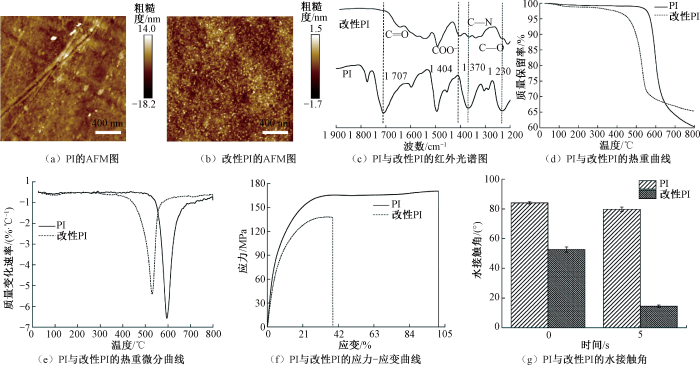
图1
PI与改性PI薄膜的结构与性能
Fig.1
Structures and properties of PI and modified PI membranes. (a) AFM image of PI; (b) AFM image of modified PI; (c) FT-IR spectra of PI and modified PI; (d) TG curves of PI and modified PI; (e) DTG curves of PI and modified PI; (f) Stress-strain curves of PI and modified PI; (g) Water contact angles of PI and modified PI
图1(c)示出PI和改性PI薄膜的红外光谱图。从图中可看到,PI薄膜表面在1 230、1 370、1 707 cm-1处出现特征峰,分别对应=C—O—C=中C—O键的芳醚伸缩振动峰、C—N键伸缩振动峰、C=O伸缩振动峰。改性PI薄膜在1 230、1 370、1 707 cm-1处特征峰减弱,并在1 404 cm-1处出现新的特征峰,这是PI反应生成聚酰胺酸的COO-伸缩振动峰。这说明KOH对PI的碱解作用,发生了酰胺化反应。
图1(f)示出PI与改性PI薄膜的应力-应变曲线。由图可知,PI薄膜的拉伸强度接近180 MPa,断裂伸长率超过100%,展现出良好的强度与韧性的平衡。改性PI薄膜的拉伸强度下降,为135 MPa左右,断裂伸长率降至约40%。这是因为碱性环境造成PI部分分子链段断裂与局部溶胀,使材料韧性与拉伸强度下降。图1(g)示出PI与改性PI薄膜的水接触角。PI薄膜的初始接触角约为85°,5 s后略有下降;改性PI初始接触角不到60°,在5 s时迅速降至约10°。这是因为碱性环境使PI的酰亚胺环发生部分开环,生成极性基团,显示出极强的亲水性[15]。开环后的分子链松弛度更高,热分解阈值下降,使激光能量更易诱导深度碳化,提高成核均匀性,并促进sp2碳骨架的形成。
2.2 LIG的结构与性能分析
2.2.1 LIG最优参数的确定
图2示出PI-LIG与改性PI-LIG的方阻变化。LIG的电学性能由激光功率与扫描速度共同决定,二者影响局部能量密度、碳化程度以及片层连续性,因此方阻随参数呈现复杂变化趋势。
图2
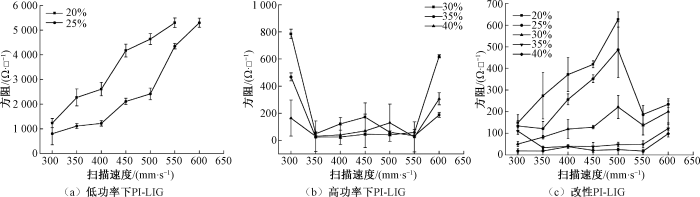
图2
PI-LIG与改性PI-LIG薄膜的方阻变化
Fig.2
Sheet resistance variation of PI-LIG and modified PI-LIG membranes. (a) PI-LIG at low power; (b) PI-LIG at high power; (c) Modified PI-LIG
如图2(a)所示,在低功率(20%、25%)下,PI-LIG的方阻随着扫描速度增加显著上升,最高接近6 000 Ω/□,此时碳化程度降低、片层缺陷增多,从而形成高方阻LIG结构。如图2(b)所示,在高功率(30%、35%、40%)下,PI-LIG在两端表现出方阻增高的趋势,当扫描速度更低时,过量能量易造成局部烧蚀;扫描速度更高时,能量不足导致碳化不充分。图2(c)示出改性PI-LIG的方阻变化。在低功率(20%、25%)下,改性PI-LIG的方阻随着扫描速度增加显著上升,最高超过600 Ω/□,说明此时激光能量不足,碳化不充分,形成的石墨烯结构不连续、导电性差。在高功率(30%、35%、40%)下,改性PI-LIG的方阻降低,并对扫描速度的依赖性减弱,表现出更好的稳定性和一致性[16]。当扫描速度为550 mm/s,激光功率为40%时,改性PI-LIG的方阻最低,为18 Ω/□。此外,PI-LIG在激光功率为20%、扫描速度为600 mm/s时,改性PI-LIG在激光功率为20%、扫描速度为550、600 mm/s时,即在低功率高扫描速度条件下,出现了单位面积能量密度不足的现象,使材料无法达到石墨化所需的瞬时高温,导致碳化不完全、片层结构难以形成且导电网络不连续,最终表现为LIG结构破坏和LIG的方阻显著升高。
2.2.2 LIG的微观形貌分析
图3示出PI-LIG和改性PI-LIG的SEM照片。可以看出,二者均具有典型的多孔泡沫状三维结构,这有利于提升比表面积与电荷传输能力。相比PI-LIG,改性PI-LIG的孔隙结构更均匀,说明碱处理能够改善材料的微观结构,有助于提升其导电性能和敏感性能。
图3

图3
LIG的扫描电镜照片
Fig.3
SEM images of LIG. (a) PI-LIG (×3 000); (b) PI-LIG(×8 000); (c) Modified PI-LIG (×3 000); (d) Modified PI-LIG (×8 000)
2.2.3 LIG的化学成分分析
图4
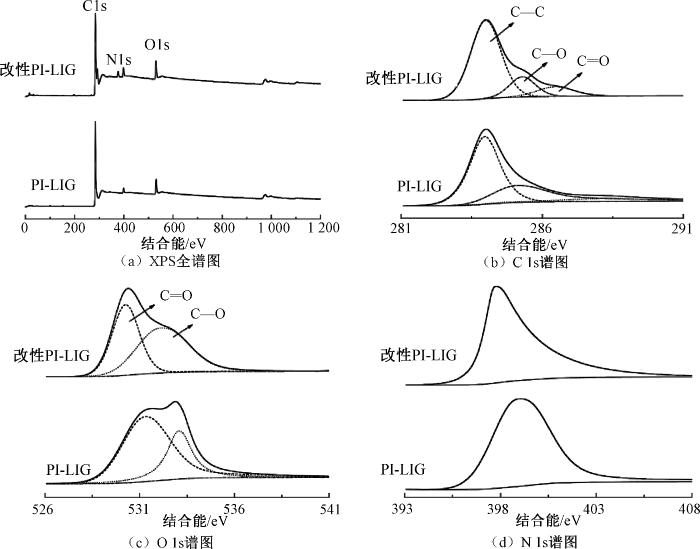
图4
LIG的XPS谱图
Fig.4
XPS spectra of LIG. (a) XPS full spectra; (b) C 1s spectra; (c) O 1s spectra; (d) N 1s spectra
图4(b)为PI-LIG和改性PI-LIG的C 1s高分辨率XPS谱图。改性PI-LIG在284.6 eV处出现显著的C—C峰,且该峰呈现更尖锐的峰形和更大的相对峰面积,表明碱氧化改性处理促进了PI激光碳化过程中sp2石墨化结构的形成。此外,285.6 eV处的C—O峰及286.7 eV处的C=O峰的面积显著增加,证明碱处理通过部分水解PI分子链引入更多含氧结构,并在激光碳化过程中得以部分保留,使碳片表面官能团更加丰富。图4(c)示出PI-LIG和改性PI-LIG的O 1s高分辨XPS谱图。改性PI-LIG中C—O与C=O相关峰的面积增加,进一步证实碱氧化改性处理导致PI表面断键与含氧基团生成;这些基团能够提升材料的亲水性与界面极性。图4(d)示出PI-LIG和改性PI-LIG的N 1s高分辨XPS谱图。改性PI-LIG总峰面积明显增大,信号更强,说明氮元素在激光过程中更倾向于形成石墨氮等有利的掺杂形态,这有助于提升材料的电子迁移率与电学性能[17]。
综上所述,碱氧化改性不仅提高了PI的激光碳化效率,使所得LIG具有更高的sp2石墨化程度,同时显著增加了表面氧、氮官能团含量。
2.2.4 LIG的化学结构分析
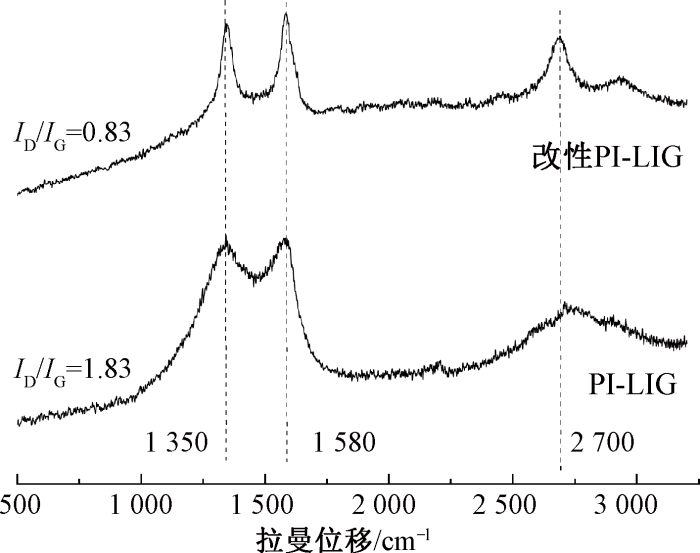
图5示出PI-LIG与改性PI-LIG的拉曼光谱图。
图5
2.3 柔性温度传感器的性能及应用
2.3.1 柔性温度传感器的传感性能分析
图6
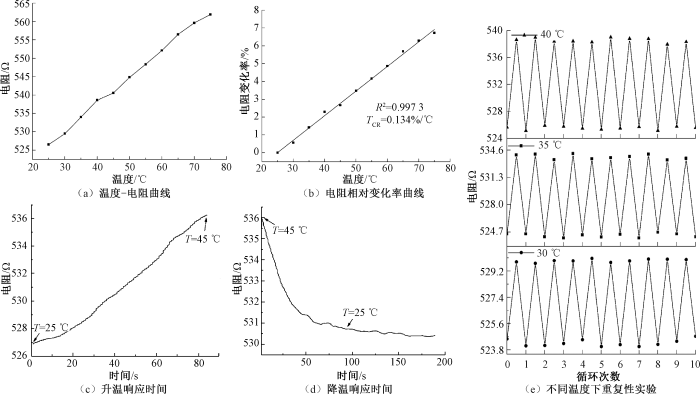
图6
柔性温度传感器的传感性能
Fig.6
Sensing performance of flexible temperature sensor. (a) Resistance-temperature curve; (b) Curve of relative change rate of resistance; (c) Heating response time; (d) Cooling response time; (e) Repeatability tests at different temperatures
如图6(b)所示,将电阻变化归一化处理,绘制出电阻变化率(△R/R0)随温度变化的关系图。拟合结果显示,传感器在此温度区间内表现出良好的线性关系,R2达0.997 3,TCR为0.134%/℃,表明该传感器具有良好的线性响应规律。
图6(e)示出传感器在3个恒定温度条件下(30、35、40 ℃)10次循环测试结果。不同温区的电阻响应曲线均呈明显的周期性振荡变化,且无显著漂移,表明该传感器在多温区范围内均具备良好的响应重复性与循环稳定性。
图7
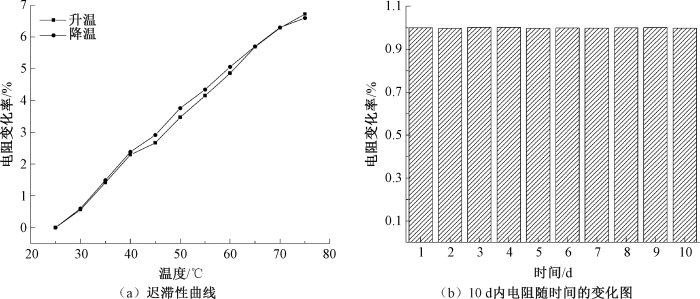
图7
柔性温度传感器的迟滞性与稳定性
Fig.7
Hysteresis and stability of flexible temperature sensors. (a) Hysteresis curve; (b) Graph showing variation of resistance over time within 10 d
图7(b)示出该传感器在10 d内的长期稳定性测试结果。△R/R0始终保持在接近1的水平,波动极小,表明所制备的柔性温度传感器在常温环境中具有优良的时间稳定性与可靠性,适用于长期温度监测场景。
综上所述,该柔性温度传感器表现出优异的热响应灵敏性、良好的线性度、快速响应速度、高循环稳定性与长期可靠性,具有广泛的应用前景。
2.3.2 柔性温度传感器的应用
图8示出柔性温度传感器在不同呼吸行为下的响应性能。成人静息状态的呼吸频率通常保持在12~18 次/min,属于生理意义上的正常呼吸范围[20]。在冥想训练、减压练习、睡眠前深呼吸以及某些心肺功能调节过程中,人的呼吸节律会显著减慢,此时常采用6~8 次/min的呼吸频率,被呼吸生理学研究定义为缓慢呼吸[21]。图8(a)、(b)分别示出缓慢呼吸和正常呼吸响应曲线。在缓慢呼吸情境下,传感器的响应曲线呈现明显的周期性电阻波动,在正常呼吸情境下,波形稳定且周期较快,反映传感器能准确跟踪日常呼吸频率的变化。该温度传感器在标准测试环境下,能够有效区分不同生理状态下的呼吸模式并具有优异的动态响应特性,可实时、高精度地检测由人体呼吸活动引起的微弱温度变化信号。图8(c)示出快速吹气条件下的响应曲线。△R/R0逐步升至约0.05%,表明在人体吹气的气流刺激下的传感器响应,显示其对主动呼气行为的良好识别能力。因此,该柔性传感器能够有效识别不同呼吸行为,适合用于个体生命体征连续监测及智能口罩等穿戴式设备的集成应用。
图8
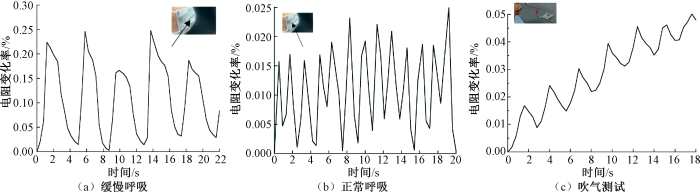
图8
柔性温度传感器的呼吸监测实验
Fig.8
Respiratory monitoring experiments using flexible temperature sensor. (a) Slow breathing; (b) Normal breathing; (c) Breathalyzer test
图9
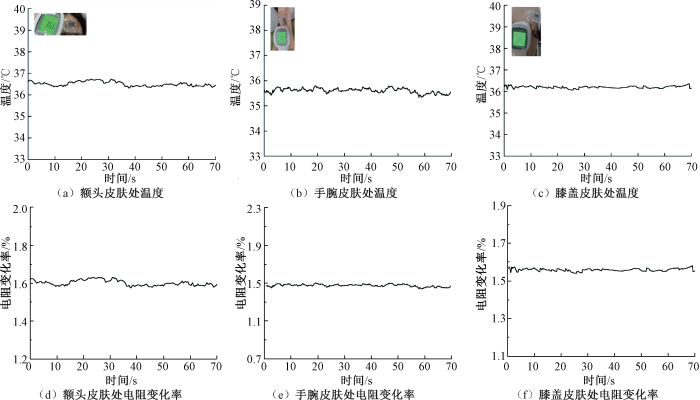
图9
人体皮肤温度及电阻变化率
Fig.9
Changes of temperature and resistance rate of human skin. (a) Temperature at forehead skin; (b) Temperature at wrist area; (c) Temperature at knee area; (d) Resistance change rate at forehead skin; (e) Resistance change rate at wrist area; (f) Resistance change rate at knee area
3 结论
1)通过将聚酰亚胺(PI)薄膜置于碱性溶液中氧化改性,成功制备了粗糙度低、引入极性含氧基团且亲水性更好的PI薄膜。
2)改性PI薄膜有利于激光诱导石墨烯(LIG)的形成并优化其结构完整性;优化激光功率与扫描速度后制得的LIG具有连续的导电网络与高电导率,适用于温度信号的灵敏传输。
3)制备的柔性温度传感器在25~75 ℃范围内展现出良好的线性响应(R2=0.997 3),灵敏度为0.134%/℃,并具备快速响应、良好重复性和长期稳定性。该传感器可灵敏响应人体不同呼吸状态以及额头、手腕、膝盖等部位的皮肤温度变化,验证了其在健康监测领域的可行性与实用性。
综上所述,LIG柔性温度传感器具有优异的性能和稳定性以及简便高效的制备工艺,展现出在智能穿戴、健康监测等领域的广阔应用前景。
参考文献
Flexible platinum temperature sensor embedded in polyimide films for curved surface temperature monitoring applications: skin temperature of human body
[J].
柔性热敏薄膜传感器阵列工艺研究
[J].
Fabrication of flexible thermal thin-film sensor array
[J].
Understanding the 2D-material and substrate interaction during epitaxial growth towards successful remote epitaxy: a review
[J].
DOI:10.1186/s40580-023-00368-4
PMID:37115353
[本文引用: 1]

Remote epitaxy, which was discovered and reported in 2017, has seen a surge of interest in recent years. Although the technology seemed to be difficult to reproduce by other labs at first, remote epitaxy has come a long way and many groups are able to consistently reproduce the results with a wide range of material systems including III-V, III-N, wide band-gap semiconductors, complex-oxides, and even elementary semiconductors such as Ge. As with any nascent technology, there are critical parameters which must be carefully studied and understood to allow wide-spread adoption of the new technology. For remote epitaxy, the critical parameters are the (1) quality of two-dimensional (2D) materials, (2) transfer or growth of 2D materials on the substrate, (3) epitaxial growth method and condition. In this review, we will give an in-depth overview of the different types of 2D materials used for remote epitaxy reported thus far, and the importance of the growth and transfer method used for the 2D materials. Then, we will introduce the various growth methods for remote epitaxy and highlight the important points in growth condition for each growth method that enables successful epitaxial growth on 2D-coated single-crystalline substrates. We hope this review will give a focused overview of the 2D-material and substrate interaction at the sample preparation stage for remote epitaxy and during growth, which have not been covered in any other review to date.© 2023. The Author(s).
Stretchable graphene pressure sensors with shar-Pei-like hierarchical wrinkles for collision-aware surgical robotics
[J].
Unconventional and dynamically anisotropic thermal conductivity in compressed flexible graphene foams
[J].
Ultrahigh electron thermal conductivity in T-graphene, biphenylene, and net-graphene
[J].DOI:10.1002/aenm.v12.28 URL [本文引用: 1]
Resin infusion process monitoring using graphene coated glass fabric sensors and infusible thermoplastic and thermoset matrices
[J].DOI:10.1002/pc.v43.5 URL [本文引用: 1]
Dynamic fluid-like graphene with ultralow frictional molecular bearing
[J].DOI:10.1002/adma.v31.43 URL [本文引用: 1]
3D macroporous graphene frameworks for supercapacitors with high energy and power densities
[J].
DOI:10.1021/nn3003345
PMID:22524516
[本文引用: 1]
In order to develop energy storage devices with high power and energy densities, electrodes should hold well-defined pathways for efficient ionic and electronic transport. Herein, we demonstrate high-performance supercapacitors by building a three-dimensional (3D) macroporous structure that consists of chemically modified graphene (CMG). These 3D macroporous electrodes, namely, embossed-CMG (e-CMG) films, were fabricated by using polystyrene colloidal particles as a sacrificial template. Furthermore, for further capacitance boost, a thin layer of MnO(2) was additionally deposited onto e-CMG. The porous graphene structure with a large surface area facilitates fast ionic transport within the electrode while preserving decent electronic conductivity and thus endows MnO(2)/e-CMG composite electrodes with excellent electrochemical properties such as a specific capacitance of 389 F/g at 1 A/g and 97.7% capacitance retention upon a current increase to 35 A/g. Moreover, when the MnO(2)/e-CMG composite electrode was asymmetrically assembled with an e-CMG electrode, the assembled full cell shows remarkable cell performance: energy density of 44 Wh/kg, power density of 25 kW/kg, and excellent cycle life.
激光诱导聚合物制备石墨烯研究进展及应用
[J].
DOI:10.19491/j.issn.1001-9278.2021.01.019
[本文引用: 1]
综述了激光诱导聚合物制备石墨烯近年来的研究进展及应用情况,重点总结了激光诱导过程中原料种类、气氛控制、激光功率、扫描速度、扫描次数等参数对所制备石墨烯的影响,及其在微型超级电容器、柔性传感、催化及环境处理领域的应用情况,最后简要讨论了该研究方向未来的发展趋势。
Research progress in preparation of laser-induced graphene and its applications
[J].
DOI:10.19491/j.issn.1001-9278.2021.01.019
[本文引用: 1]
In this paper, the recent research process in the laser?induced graphene (LIG) was reviewed and its applications were introduced. The influences of material type, atmosphere control, laser power, scanning speed, scanning times, and other parameters on the preparation of LIG were summarized. The applications of LIG in micro-supercapacitors, flexible sensors, catalyst, and environmental treatment were reviewed. In addition, the research directions in future were briefly discussed.
Plasma enhanced planar crystal growth of laser induced graphene
[J].DOI:10.1016/j.matlet.2023.134362 URL [本文引用: 1]
Laminated laser-induced graphene composites
[J].
DOI:10.1021/acsnano.0c02835
PMID:32441916
[本文引用: 1]
Laser-induced graphene (LIG) is a porous graphene foam generated by lasing carbon-based precursors. Compositing LIG expands the spectrum of applications for which the material may be used. Techniques for scale-up of LIG composites will be essential as the technology approaches commercialization. Roll-to-roll processing is of special interest, as precisely controlled patterning can be performed in conjunction with continuous formation of composites. Here, we demonstrate a simple lamination compositing method that is compatible with roll-to-roll processing and yields functional, patterned, and multilayered LIG composites with various thermoplastic films. Multiple lamination steps are used to encapsulate LIG within composites. We also demonstrate several applications for LIG that have been enabled by the lamination compositing technique. These include robust flexible electrodes generated through laminating copper foil strips into the LIG composite, LIG-based triboelectric nanogenerators to harvest waste mechanical energy, antimicrobial LIG composite bandages with varying hydrophobicity, and LIG puncture detectors.
A review of laser-induced graphene: from experimental and theoretical fabrication processes to emerging applications
[J].DOI:10.1016/j.carbon.2023.118356 URL [本文引用: 1]
The chemical deformation of a thermally cured polyimide film surface into neutral 1, 2, 4, 5-benzentetracarbonyliron and 4, 4'-oxydianiline to remarkably enhance the chemical-mechanical planarization polishing rate
[J].
DOI:10.3390/nano15060425
URL
[本文引用: 1]
The rapid advancement of 3D packaging technology has emerged as a key solution to overcome the scaling-down limitation of advanced memory and logic devices. Redistribution layer (RDL) fabrication, a critical process in 3D packaging, requires the use of polyimide (PI) films with thicknesses in the micrometer range. However, these polyimide films present surface topography variations in the range of hundreds of nanometers, necessitating chemical–mechanical planarization (CMP) to achieve nanometer-level surface flatness. Polyimide films, composed of copolymers of pyromellitimide and diphenyl ether, possess strong covalent bonds such as C–C, C–O, C=O, and C–N, leading to inherently low polishing rates during CMP. To address this challenge, the introduction of Fe(NO3)3 into CMP slurries has been proposed as a polishing rate accelerator. During CMP, this Fe(NO3)3 deformed the surface of a polyimide film into strongly positively charged 1,2,4,5-benzenetetracarbonyliron and weakly negatively charged 4,4′-oxydianiline (ODA). The chemically dominant polishing rate enhanced with the concentration of the Fe(NO3)3 due to accelerated surface interactions. However, higher Fe(NO3)3 concentrations reduce the attractive electrostatic force between the positively charged wet ceria abrasives and the negatively charged deformed surface of the polyimide film, thereby decreasing the mechanically dominant polishing rate. A comprehensive investigation of the chemical and mechanical polishing rate dynamics revealed that the optimal Fe(NO3)3 concentration to achieve the maximum polyimide film removal rate was 0.05 wt%.
Laser-induced graphene
[J].
DOI:10.1021/acs.accounts.8b00084
PMID:29924584
[本文引用: 1]
Research on graphene abounds, from fundamental science to device applications. In pursuit of complementary morphologies, formation of graphene foams is often preferred over the native two-dimensional (2D) forms due to the higher available area. Graphene foams have been successfully prepared by several routes including chemical vapor deposition (CVD) methods and by wet-chemical approaches. For these methods, one often needs either high temperature furnaces and highly pure gases or large amounts of strong acids and oxidants. In 2014, using a commercial laser scribing system as found in most machine shops, a direct lasing of polyimide (PI) plastic films in the air converted the PI into 3D porous graphene, a material termed laser-induced graphene (LIG). This is a one-step method without the need for high-temperature reaction conditions, solvent, or subsequent treatments, and it affords graphene with many five-and seven-membered rings. With such an atomic arrangement, one might call LIG "kinetic graphene" since there is no annealing in the process that causes the rearrangement to the preferred all-six-membered-ring form. In this Account, we will first introduce the approaches that have been developed for making LIG and to control the morphology as either porous sheets or fibrils, and to control porosity, composition, and surface properties. The surfaces can be varied from being either superhydrophilic with a 0° contact angle with water to being superhydrophobic having >150° contact angle with water. While it was initially thought that the LIG process could only be performed on PI, it was later shown that a host of other polymeric substrates, nonpolymers, metal/plastic composites, and biodegradable and naturally occurring materials and foods could be used as platforms for generating LIG. Methods of preparation include roll-to-roll production for fabrication of in-plane electronics and two different 3D printing (additive manufacturing) routes to specific shapes of LIG monoliths using both laminated object manufacturing and powder bed fabrication methods. Use of the LIG in devices is performed very simply. This is showcased with high performance supercapacitors, fuel cell materials for oxygen reduction reactions, water splitting for both hydrogen and oxygen evolution reactions coming from the same plastic sheet, sensor devices, oil/water purification platforms, and finally applications in both passive and active biofilm inhibitors. So the ease of formation of LIG, its simple scale-up, and its utility for a range of applications highlights the easy transition of this substrate-bound graphene foam into commercial device platforms.
Effect of the number of nitrogen dopants on the electronic and magnetic properties of graphitic and pyridinic N-doped graphene-a density-functional study
[J].DOI:10.1039/D1RA01095F URL [本文引用: 1]
Laser-induced graphene tapes as origami and stick-on labels for photothermal manipulation via Marangoni effect
[J].DOI:10.1002/adfm.v31.1 URL [本文引用: 1]
Thermomechanics of monolayer graphene: rippling, thermal expansion and elasticity
[J].DOI:10.1016/j.jmps.2014.01.011 URL [本文引用: 1]
The physiological effects of slow breathing in the healthy human
[J].
DOI:10.1183/20734735.009817
PMID:29209423
[本文引用: 1]
Slow breathing practices have been adopted in the modern world across the globe due to their claimed health benefits. This has piqued the interest of researchers and clinicians who have initiated investigations into the physiological (and psychological) effects of slow breathing techniques and attempted to uncover the underlying mechanisms. The aim of this article is to provide a comprehensive overview of normal respiratory physiology and the documented physiological effects of slow breathing techniques according to research in healthy humans. The review focuses on the physiological implications to the respiratory, cardiovascular, cardiorespiratory and autonomic nervous systems, with particular focus on diaphragm activity, ventilation efficiency, haemodynamics, heart rate variability, cardiorespiratory coupling, respiratory sinus arrhythmia and sympathovagal balance. The review ends with a brief discussion of the potential clinical implications of slow breathing techniques. This is a topic that warrants further research, understanding and discussion.Slow breathing practices have gained popularity in the western world due to their claimed health benefits, yet remain relatively untouched by the medical community.Investigations into the physiological effects of slow breathing have uncovered significant effects on the respiratory, cardiovascular, cardiorespiratory and autonomic nervous systems.Key findings include effects on respiratory muscle activity, ventilation efficiency, chemoreflex and baroreflex sensitivity, heart rate variability, blood flow dynamics, respiratory sinus arrhythmia, cardiorespiratory coupling, and sympathovagal balance.There appears to be potential for use of controlled slow breathing techniques as a means of optimising physiological parameters that appear to be associated with health and longevity, and that may extend to disease states; however, there is a dire need for further research into the area.To provide a comprehensive overview of normal human respiratory physiology and the documented effects of slow breathing in healthy humans.To review and discuss the evidence and hypotheses regarding the mechanisms underlying slow breathing physiological effects in humans.To provide a definition of slow breathing and what may constitute "autonomically optimised respiration".To open discussion on the potential clinical implications of slow breathing techniques and the need for further research.

 京公网安备11010502044800号


