



高灵敏的可穿戴传感器通常采用薄膜结构,其中包括活性层和填料层,用于监测特定生理信号[6],但每个传感器通常只能监测1种信号,通过在不同位置选择性涂覆不同的活性材料来实现多信号集成[7]。然而,这些薄膜传感器面临制造工艺复杂、高成本、易碎以及较差的舒适性和透气性等问题。将对不同环境刺激能做出反应的传感材料涂覆在纱线基底上,可形成纱线基传感器,用这些纱线基传感器编织成能够监测各种生理信号的织物可制备出织物传感器[8-
目前报道的关于纱线基传感器的研究大都集中在单一模式的传感器上,为此,本研究以镀银锦纶纱线为电极芯层,利用共轭纺纱技术将聚氨酯/碳纳米管(PU/CNTs)复合纳米纤维直接包覆其上,形成初始传感单元。然后通过原位聚合工艺,在PU/CNTs纤维表面均匀生长聚吡咯(PPy)纳米颗粒,最终构建出具有壳鞘结构的复合镀银锦纶包芯纱线(PU/CNTs/PPy)。该方法将电极与传感单元集成于单根纱线内,利用CNTs构建力学传感网络,PPy提供温/湿响应特性,实现了材料、结构与功能的一体化融合。基于电子织物作为柔性可穿戴电子设备的潜力,在复杂环境条件下,此传感纱线可同时监测外部压力、温度和湿度变化,广泛应用于医疗健康、运动监测等领域。
1 实验部分
1.1 实验材料与仪器
材料:聚氨酯(PU,相对分子量为400 000),万华化学集团股份有限公司;镀银锦纶纱线(线密度为15.56 tex),东莞市盛芯特殊绳带厂;碳纳米管(CNTs)、碳纳米管分散剂,苏州碳丰科技有限公司;吡咯,上海科丰实业有限公司;三氯化铁,天津市风船化学试剂科技有限公司;N,N-二甲基甲酰胺(DMF)、对甲苯磺酸、无水乙醇,均来自天津科密欧化学试剂有限公司。所有有机溶剂在使用前均未经进一步处理。
仪器:MS300型数显恒温磁力搅拌器(上海沪粤明科学仪器有限公司);SN-P650型单通道细胞破碎仪(广东洁盟超声实业有限公司);HZ-SX-02型纳米纺纱机(青岛诺康环保科技有限公司);S4800型冷场扫描电子显微镜(日本HITACHI公司);Nicolet iS50型傅里叶变换红外光谱仪(美国赛默飞世尔科技有限公司);Instron 5967型万能材料试验机(美国Instron公司);柔性传感器测试系统,实验室自组装。
1.2 试样制备
1.2.1 PU/CNTs纺丝液的制备
将CNTs和CNTs分散剂加入到DMF溶剂中,并在磁力搅拌器中搅拌10 min,再将混合溶液在单通道细胞破碎仪中分散30 min。然后,向分散溶液中加入PU颗粒,PU的质量分数为15%,在室温下磁力搅拌8 h,得到黑色的纺丝液。在纺丝之前,用超声清洗器对纺丝液进行进一步超声处理。
1.2.2 PU/CNTs 复合镀银锦纶包芯纱的制备
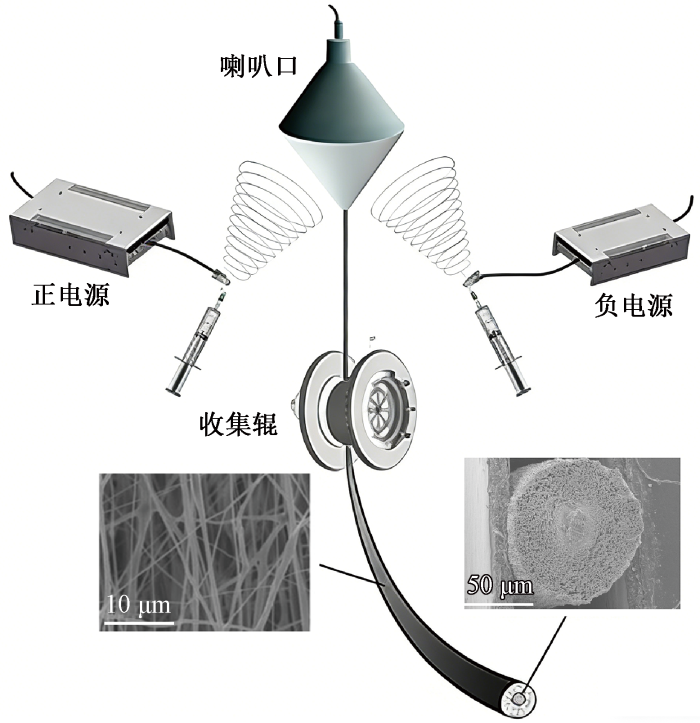
共轭静电纺丝装置示意图如图1所示。主要纺纱工艺参数:纺丝电压为15 kV,正负极喷头的纺丝溶液流速比为1∶1,喇叭转速为300 r/min,金属喷头内径为0.84 mm,喷头与金属喇叭口之间的垂直距离为13 cm。该装置将2对喷头对称布置于接地的旋转金属喇叭两侧,并分别施加正、负高压。纺丝液在电场作用下从喷头射出,被拉伸成纳米纤维并吸附于喇叭中的镀银锦纶纱线上,通过喇叭旋转和绝缘棒牵引,将PU/CNTs 复合镀银锦纶包芯纱线卷绕在筒管上。
图1
1.2.3 PU/CNTs/PPy 复合镀银锦纶包芯纱的制备
将PU/CNTs 复合镀银锦纶包芯纱浸入到0.09 mol/L的吡咯单体水溶液中,并进行磁力搅拌30 min,以确保包芯纱表面被吡咯单体均匀覆盖。随后,逐滴添加10 mL掺杂对甲苯磺酸和三氯化铁氧化剂的混合水溶液(0.5 mol/L),其中氯化铁与吡咯的量比为3∶2,在0 ℃下聚合反应6 h。最后,用去离子水和乙醇洗涤,室温下真空干燥。
1.3 测试与表征
1.3.1 表面形貌表征
使用冷场扫描电子显微镜对复合镀银锦纶包芯纱线的形貌进行表征。取制备的复合镀银锦纶包芯纱线的一段,并通过导电胶带粘贴在载物台上。然后使用喷金装置对样品进行10 min的喷金处理。之后将样品放入扫描电子显微镜中观察并记录复合纱线的形貌和结构,加速电压为10 kV,放大倍数为400~1 500倍。
1.3.2 化学结构表征
采用傅里叶变换红外光谱仪对复合镀银锦纶包芯纱的分子红外吸收特性进行测试。先将样品和KBr在100 ℃下烘干3 h,然后将样品剪碎与KBr按1∶100的比例混合研磨制样,扫描范围为1 600~400 cm-1,分辨率为4 cm-1。
1.3.3 力学性能测试
依据GB/T 3916—2013《纺织品 卷装纱 单根纱线断裂强力和断裂伸长率的测定(CRE法)》,采用万能材料试验机测试复合镀银锦纶包芯纱线的拉伸力学性能。复合纱线置于恒温恒湿(温度25 ℃,相对湿度65%)条件下平衡24 h,以消除含水量对复合纱线力学性能的影响。试样夹持距离为50 mm,拉伸速度为50 mm/min。
1.3.4 压力传感性能测试
采用实验室自组装的柔性传感器测试系统测试压力传感性能。将PU/CNTs/PPy 复合镀银锦纶包芯纱固定在柔性传感器测试系统上,然后在计算机软件界面对参数进行设置,接着将纱线与万用表相连,调试系统,最后在计算机上得到所需的电学信号、载荷、位移等数据。
传感器的压力灵敏度计算公式为
式中:SP为传感器的灵敏度;△R为传感器的总电阻的变化量,kΩ;R0为传感器的初始电阻值,kΩ;△P为压力的增加量,kPa。
压力灵敏度SP由△R/R0与△P函数的斜率可得,然而在实际测量中,该响应曲线通常呈非线性特征,因此,需先对实验数据进行函数拟合,再基于拟合曲线求导灵敏度,具体公式为
式中:yp为电阻变化量与初始电阻的比值;xp为施加的压强,kPa;A、B1、B2是拟合系数;y'p为该函数值在某个压强点的切线斜率,即为此时的压力灵敏度。
1.3.5 温湿度传感测试
将PU/CNTs/PPy 复合镀银锦纶包芯纱固定在恒温恒湿箱内,分别设置温度变化范围(20~70 ℃)和湿度变化范围(相对湿度20%~80%)。将纱线两端与Keithley 2400型电源电表连接,分别测量温度和湿度响应的电阻信号。
温度灵敏度(ST)通常定义为相对电阻变化与温度变化的百分比,其计算公式为
式中:ST为传感器的温度灵敏度;△T为温度的增加量,℃。
理论上,灵敏度ST由△R/R0与△T函数的斜率可得,然而在实际测量中,该响应曲线通常呈非线性特征,因此,需先对实验数据进行函数拟合,再基于拟合曲线求导灵敏度,具体公式为
式中:yt为电阻变化量与初始电阻的比值;xt为所处的温度,℃;y't为该函数值在某个温度点的切线斜率,即为此时的温度灵敏度。
湿度灵敏度(Sh)通常定义为相对电阻变化与湿度变化的百分比,计算公式为
式中,△rRH为相对湿度的增加量,%。
同压力与温度灵敏度,理论上湿度灵敏度可由△R/R0与△rRH函数的斜率可得,但实际也需先对实验数据进行函数拟合,再基于拟合曲线计算获得,其计算公式为
式中:yh为电阻变化量与初始电阻的比值;xh为所处的湿度;y'h为该函数值在某个湿度点的切线斜率,即为此时的湿度灵敏度。
1.3.6 可穿戴应用测试
将PU/CNTs/PPy 复合镀银锦纶包芯纱传感器单元利用医用压敏胶带分别绑在实验者的手指关节处、手肘关节处、人体喉咙处,对人体的运动信号和吞咽信号进行检测;然后将其固定于烧杯外面,检测杯中水温度变化;最后将其固定在一次性口罩内壁,检测人体呼吸的响应。
2 结果与讨论
2.1 微观形貌分析
图2
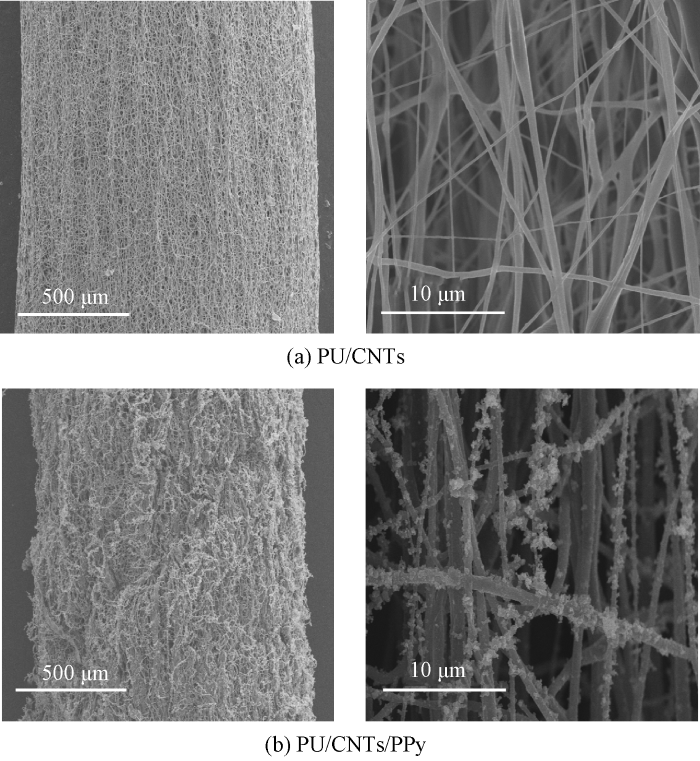
图2
复合镀银锦纶包芯纱线的电镜照片
Fig.2
SEM images of composite silver-plated polyamide core-spun yarn. (a) PU/CNTs; (b) PU/CNTs/PPy
2.2 化学结构分析
复合镀银锦纶包芯纱线的红外光谱如图3所示。由图可见:PU/CNTs/PPy 复合镀银锦纶包芯纱在3 500~3 300 cm-1之间的N—H伸缩振动吸收峰(来自PU的氨基甲酸酯基团)相较于PU/CNTs 复合镀银锦纶包芯纱发生偏移,表明PPy的N原子或CNTs的π电子与PU的N—H基团形成分子间氢键;在1 730~1 700 cm-1处的C=O伸缩振动峰在引入PPy后出现展宽并略微向低波数方向移动,进一步证实PU链段中的羰基作为氢键受体参与了界面相互作用。在1 550、1 450 cm-1处出现的明显双峰是PPy的特征吸收峰(分别对应吡咯环的C=C/C—C振动和C—N伸缩振动),而1 580 cm-1处的C=C骨架振动峰(来自CNTs的石墨烯结构)与PPy峰重叠形成复合峰,表明CNTs在PU基质中分散良好。相较于PU/CNTs镀银锦纶包芯纱,PU/CNTs/PPy镀银锦纶包芯纱在1 050 cm-1处的峰(PPy的N—H面内变形振动)和增强的1 600~1 500 cm-1区间的吸收强度,证明PPy成功聚合包覆。这些光谱特征的变化验证复合镀银锦纶包芯纱线通过氢键相互作用和π-π堆叠效应相互作用形成了稳定结构,该协同效应是赋予复合镀银锦纶包芯纱线优异传感性能的关键。
图3
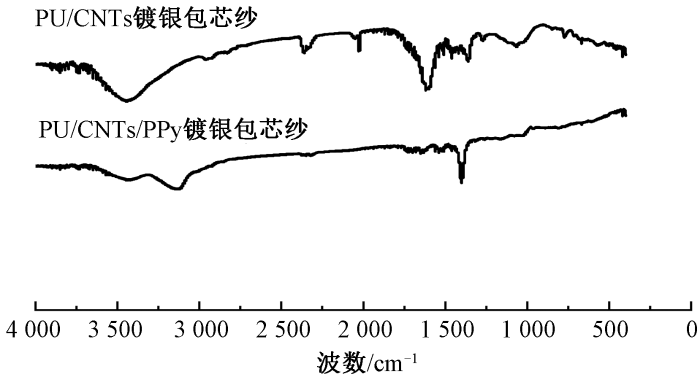
图3
复合镀银锦纶包芯纱的红外光谱图
Fig.3
FT-IR spectra of composite silver-plated nylon core-spun yarns
2.3 力学性能分析
为探究聚合PPy对PU/CNTs 复合镀银锦纶包芯纱力学性能的影响,进行了拉伸性能测试,结果如图4所示。可见,聚合PPy后,PU/CNTs 复合镀银锦纶包芯纱的应力和应变均呈现持续提升的趋势。PU/CNTs/PPy 复合镀银锦纶包芯纱的应力达到7.9 MPa,应变为412%,相比PU/CNTs 复合镀银锦纶包芯纱(6.4 MPa,300%)分别提升了23.4%和37.3%。结合电镜照片可知,原位聚合后,大量的聚合物颗粒附着在纱线、纤维表面和纤维之间的间隙上。这些颗粒提高了纤维之间的界面摩擦力,从而提高了纱线的应力和应变。
图4
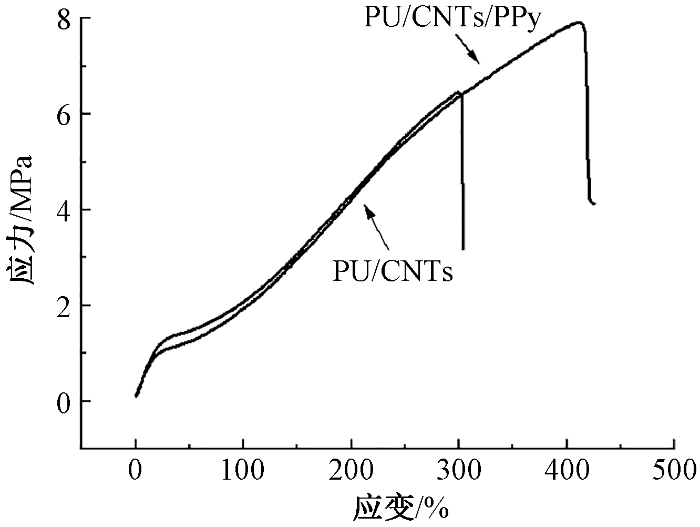
图4
复合镀银锦纶包芯纱的应力-应变曲线
Fig.4
Stress-strain curves of composite silver-plated polyamide fiber core-spun yarns
2.4 传感性能分析
2.4.1 压力传感性能分析
PU/CNTs/PPy复合镀银锦纶包芯纱传感器的压力传感性能评估结果如图5所示。
图5
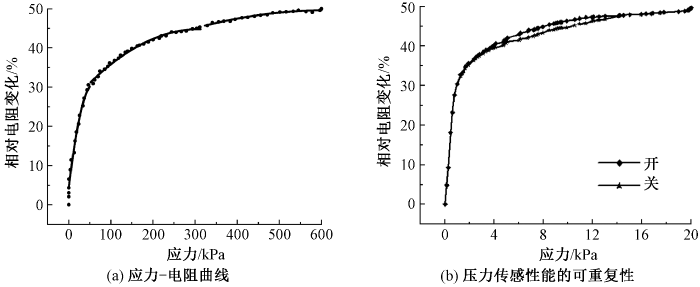
图5
PU/CNTs/PPy 复合镀银锦纶包芯纱的压力传感性能
Fig.5
Pressure sensing performance of PU/CNTs/PPy composite silver-plated polyamide core-spun yarns. (a) Stress-resistance curve; (b) Repeatability of pressure sensing performance
由图5(a)可知,在不同应力区间内PU/CNTs/PPy复合镀银锦纶包芯纱传感器表现出显著分区的灵敏度特性。实验数据经计算显示:在低应力区间(0~100 kPa)灵敏度最高(约0.2 kPa-1),主要由CNTs接触电阻变化主导;在中应力区间(100~300 kPa)灵敏度降至0.075 kPa-1,反映CNTs接触趋于饱和;在高应力区间(300~600 kPa)灵敏度进一步降低至0.017 kPa-1,表明界面电阻成为主要影响因素。
由图5(b)可知,随着应力增加,相对电阻变化逐渐增加,并呈现出非线性增长趋势。在低应力区域(0~100 kPa),相对电阻变化快速上升,表明传感器对低应力变化非常敏感;在高应力区域(300~600 kPa),相对电阻变化的增加趋于平缓,表明传感器在高应力下的响应逐渐趋于饱和。在相同应力下,加载(开)和卸载(关)曲线之间的差异反映了传感器的迟滞性。综上表明PU/CNTs/PPy复合镀银锦纶包芯纱传感器在不同应力下表现出幅度较小的迟滞性。
2.4.2 温度传感性能分析
图6
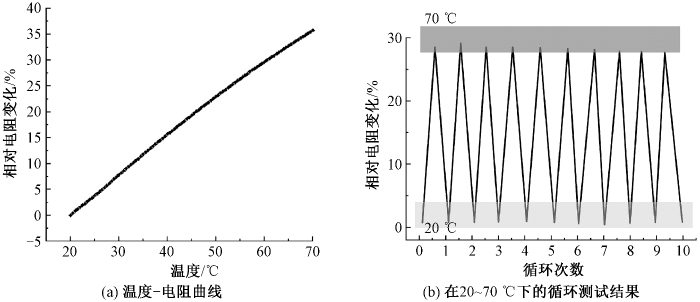
图6
PU/CNTs/PPy 复合镀银锦纶包芯纱的温度传感性能
Fig.6
Temperature sensing performance of PU/CNTs/PPy composite silver-plated polyamide core-spun yarn. (a) Temperature-resistance change rate curve; (b) Cyclic testing result at 20-70 ℃
图6(b)示出PU/CNTs/PPy复合镀银锦纶包芯纱在20~70 ℃范围内的相对电阻变化循环测试结果。图中示出10个循环周期,每个周期中相对电阻变化随温度变化呈现周期性波动,表明纱线传感器在多次温度循环测试中具有良好的稳定性和重复性。
2.4.3 湿度传感性能分析
图7
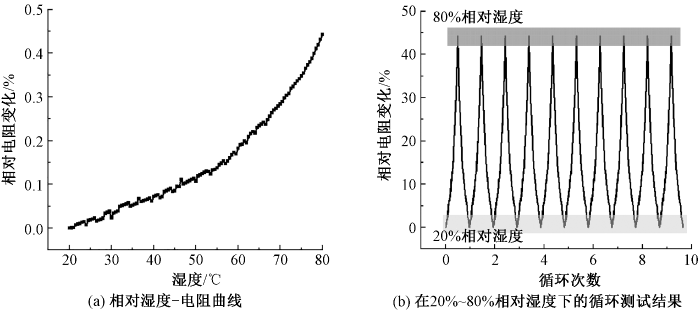
图7
PU/CNTs/PPy 复合镀银锦纶包芯纱的湿度传感性能
Fig.7
Humidity sensing performance of PU/CNTs/PPy composite silver-plated polyamide fiber core-spun yarn. (a) Humidity-resistance change rate curve; (b) Cyclic testing result at 20%-80% relative humidity
图7(b)示出传感器在相对湿度位于20%~80%之间的湿度响应循环测试结果。在每个循环中,相对电阻变化迅速达到峰值并回落,显示出传感器具有快速的响应和恢复能力。这种快速响应和恢复是高敏感性传感器的重要特征,表明传感器能够迅速适应环境湿度的变化。此外,多次循环测试中相对电阻变化的变化模式保持一致,表明传感器具有良好的湿度循环稳定性和重复性。
2.5 传感机制分析
图8示出PU/CNTs/PPy复合镀银锦纶包芯纱传感器对压力、温度和湿度信号的传感机制。当传感器处于自然状态时,其表层中的CNTs与载流子处于一种平衡的分布状态。一旦受到外界刺激(如压力、温度或湿度变化),这种分布将被改变,从而引起电阻变化。在温度传感中,温度上升使PPy和CNTs中的载流子数量增加,导致PU/CNTs/PPy复合镀银锦纶包芯纱的相对电阻变化降低,从而使其总电阻随温度升高而减小。湿度传感分为3个阶段:化学吸附、物理吸附和毛细管凝结。相对湿度低时,水分子化学吸附于材料表面活性位点,引发自电离产生H+和OH-,电导率略有提升但灵敏度较低;中等湿度时,更多水分子形成连续层,生成H3O+推动电离平衡,离子浓度显著增加,电导率明显上升;高湿时,发生毛细管凝结,形成多层水膜,离子传输加快,导电性进一步增强,湿度敏感性提高。在压力传感中,总电阻(R)由纳米纤维自身电阻(Re)和纤维间接触电阻(Rc)共同组成。Re与导电网络结构有关,Rc受接触面积和厚度影响。低压时,CNTs/PPy网络重组使电阻变化显著,灵敏度高;压力增大后导电接触趋于稳定,电阻变化减小,灵敏度降低。
图8
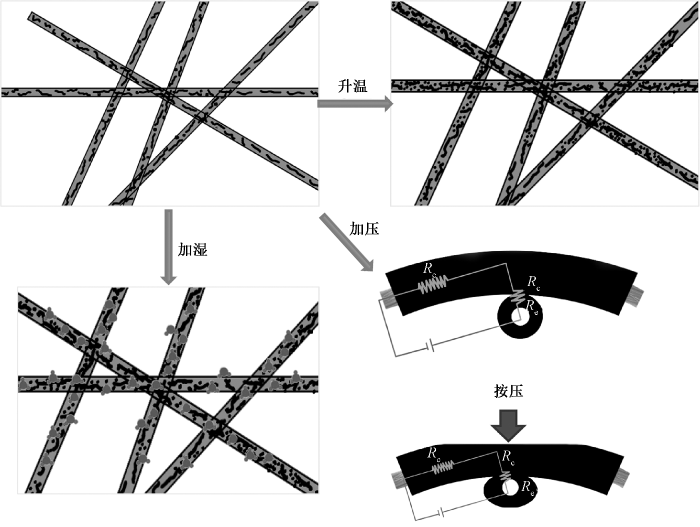
图8
PU/CNTs/PPy 复合镀银锦纶包芯纱的传感机制示意图
Fig.8
Sensing mechanism diagram of PU/CNTs/PPy composite silver-plated polyamide core-spun yarn
2.6 可穿戴应用
图9
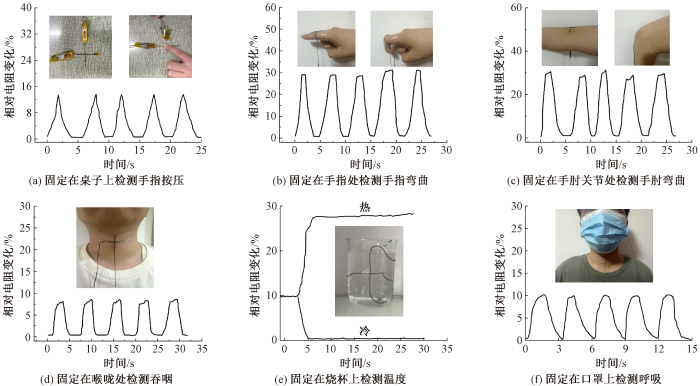
图9
PU/CNTs/PPy 复合镀银锦纶包芯纱传感器在不同场景下的应用
Fig.9
Application of PU/CNTs/PPy composite silver-plated polyamide core-spun yarn sensor in different scenarios. (a) Fixed on table to detect finger pressing; (b) Fixed on knuckles of fingers to detect finger bending; (c) Fixed on elbow joint to detect elbow bending; (d) Fixed on throat area to detect swallowing; (e) Fixed on beaker to detect temperature; (f) Fixed on mask to detect breathing
在人体运动信号检测中,传感器绑在手指关节(见图9(b))和手肘关节(见图9(c))处时,能够灵敏地捕捉关节的运动状态,电阻变化与运动角度呈对应关系,表现出良好的适应性和准确性。值得注意的是,不同部位的运动信号导致的相对电阻变化曲线存在差异,如手指关节的电阻变化曲线较为平缓,而手肘关节的电阻变化曲线则更为陡峭,反映出传感器对不同运动幅度和强度的敏感性。此外,将传感器固定于喉咙部位时(见图9(d)),可有效检测吞咽和发声引起的微小运动变化,相对电阻变化曲线呈现出短促的波动,表现出一定的敏感性。将传感器固定于烧杯外检测水温变化时(见图9(e)),相对电阻值随温度升高而逐渐减小,相对电阻变化曲线呈现出缓慢上升的趋势,显示出良好的温度响应特性。将传感器固定在口罩上对人体呼吸检测(见图9(f)),相对电阻变化随呼吸而变化,吸气时电阻逐渐增大,呼气时电阻逐渐减小。
总体而言,该传感器在多种测试场景中均表现出高灵敏度和良好的柔韧性,但其长期稳定性和重复性仍需进一步验证和优化。未来,该传感纱线可以结合多信号解耦算法模块开发智能织物系统,集成于汽车座椅、地毯地垫、床单与床垫等纺织产品中,用于监测人体的姿态、体温、湿度等多种生理健康参数,为汽车智能座舱、智慧医疗、运动健康提供新一代传感织物解决方案。
3 结论
本文通过共轭纺纱技术和原位聚合技术,以镀银锦纶纱线为芯纱作为传感器的电极,具有均匀导电网络结构的聚氨酯/碳纳米管/聚吡咯(PU/CNTs/PPy)纳米纤维复合包覆层作为传感层,将2根包芯纱交叉组装,成功制备了具有压力、温度、湿度三重响应功能的PU/CNTs/PPy复合镀银锦纶包芯纱传感器,主要得出以下结论。
1)在PU/CNTs复合镀银锦纶包芯纱表面引入PPy功能层,形成了芯鞘协同的复合传感结构,实现了压力、温度、湿度的三重响应功能。这种设计不仅显著提升了传感器的集成度,还通过芯纱直接作为电极的结构设计,简化了传感器的制备工艺,降低了对外部电极的依赖。
2)在压力响应方面,PU/CNTs/PPy复合镀银锦纶包芯纱传感器的灵敏度为0.2 kPa-1(0~100 kPa),表现出更高的灵敏度和更宽的响应范围;在温度响应方面,传感器在20~70 ℃范围内表现出0.51%/℃的高灵敏度,具有良好的线性响应和稳定性;在湿度响应方面,传感器在相对湿度为20%~80%范围内呈现双阶段特性,低湿区(相对湿度在20%~50%之间)灵敏度为0.15,高湿区(相对湿度在50%~80%之间)跃升至0.52,响应速度快且重复性好。
3)PU/CNTs/PPy 复合镀银锦纶包芯纱传感器不仅在手指按压和人体运动信号检测中表现出高灵敏度和良好的柔韧性,还展现出对温度和湿度变化的响应能力。在未来研究中,还可以结合多信号解耦算法模块开发智能织物系统,集成于汽车座椅、地毯地垫、床单床垫等纺织产品中,用于监测人体的姿态、体温、湿度等多种生理健康参数,为汽车智能座舱、智慧医疗及运动健康提供新一代传感织物解决方案。
参考文献
Smart textiles for personalized healthcare
[J].DOI:10.1038/s41928-022-00723-z [本文引用: 1]
Smart electronic textile-based wearable supercapacitors
[J].DOI:10.1002/advs.v9.31 URL [本文引用: 1]
针织一体成形电容传感器设计及其性能
[J].
DOI:10.13475/j.fzxb.20230506701
[本文引用: 1]

针对柔性电容传感器的电极易暴露于外界环境和穿着舒适性差等问题,提出一种表面绝缘电极与介质层一体成形的针织电容传感器设计方法。进一步对传感器的力学性能、表面绝缘性能和传感性能进行探究,揭示了织物厚度与间隔丝直径对其性能的影响。研究发现,织物厚度越大,间隔丝直径越小的传感器综合性能越好,其中厚度为8.0 mm、间隔丝直径为0.15 mm的传感器表现最佳,其灵敏度为0.033 kPa<sup>-1</sup>,并且具有较低的迟滞性和快速响应时间,对不同性质输入信号(不同压缩距离和不同压缩频率)均具有良好的分辨响应能力,且具有2 000次循环内的重复稳定性,在手部动作识别及液体称重场景展现出较好的压力传感能力。该传感器降低了生产成本,且应用过程中信号稳定,在可穿戴、医疗监测及人机交互界面展现出巨大的应用潜力。
Design and performance of integrated capacitive sensor based on knitting
[J].
DOI:10.13475/j.fzxb.20230506701
[本文引用: 1]
<p id="p00010"><strong>Objective</strong> The electrode of the sensor is placed in the external environment, and the surface conductive material is prone to oxidation and spalling to a certain extent during long-term use, thus affecting the performance of the sensor. Moreover, the air permeability of the packaging material is poor, which reduces the comfort of the human body. Knitting technology can knit conductive yarn into fabric structures, playing a role in improving the comprehensive performance of the sensor. This paper proposes a knitted capacitance sensor with integrated surface insulating electrode and dielectric layer.</p><p id="p00015"><strong>Method</strong> The sensor electrode was designed by double-yarn knitting technology, and cotton yarn and silver-plated yarn were selected for knitting. The cotton yarn always covered on the surface of the silver-coated yarn, so that the electrode was placed inside the sensor, avoiding direct contact with the external environment. Nylon monofilament was used to knit dielectric layer, which was combined with fabric electrode to form capacitive sensor. The spacer fabric capacitive sensor was further placed in the middle of the indenter of the Mark-10 tension/compression meter. A conductive yarn was drawn from each of the upper and lower fabric surfaces of the sensor to connect the positive and negative collets of the precision LCR digital bridge TH2830, making it a complete conductive path. During the test, the digital bridge monitors and recorded the capacitance change of the sensor in real time. By analyzing the relationship between capacitance and pressure, the influence of different spacer fabric thickness and spacer wire diameter on the sensor performance was investigated.</p><p id="p00020"><strong>Results</strong> The mechanical properties, insulation properties, sensitivity, hysteresis, response time and repeatability of the sensor were studied and analyzed. With the increase of thickness, the pressure required to achieve the same strain decreases, and the fabric was more easily compressed. The surface insulation performance of the sensor was further characterized. When the electrode pen was placed in the inner layer of the spacer fabric, the digital multimeter would detect the resistance value, indicating that the surface layer was conductive and acted as the electrode layer of the sensor. However, when the electrode pen is placed on the fabric surface layer, the multimeter would not read the resistance value of the fabric surface correctly. During the whole compression process, sensitivity showed different values in different compression strain ranges. The general trend was that as the compressive stress of the fabric increased, the capacitance change rate of the sensor was positively correlated with it. As the thickness of the spacer fabric increased, the sensitivity of the sensor increased gradually. According to the hysteresis error calculation principle, the maximum hysteresis error occurred at the stress of 6.49 kPa, and the value is 2.24%. The response time curve of the sensor showed that the response time was less than 150 ms. From the the trend of capacitance change rate with time during 2 000 cycles, it can be seen that the sensor maintained stable input and output electrical characteristics during the initial compression stage. To further verify its practical application value in the real application scenario, the capacitive sensor designed was used for the monitoring and recognition of hand movements. Based on the curve peak characteristics, the sensor was able to easily distinguish fingertip press and boxing movements.</p><p id="p00025"><strong>Conclusion</strong> It is found that the sensor with larger thickness and smaller diameter of spacer wire has better overall performance, in which the sensor with thickness of 8.0 mm and spacer wire diameter of 0.15 mm has the best performance with sensitivity being 0.033 kPa<sup>-1</sup>. Moreover, it has low hysteresis and fast response time, good resolution and response ability to input signals of different properties (different compression distances and different compression frequencies), and repeated stability within 2 000 cycles, showing good pressure sensing ability in hand motion recognition and liquid weighing scenarios. The sensor reduces the production cost, and the signal is stable during the application process, showing great application potential in wearable, medical monitoring and human-computer interaction interface.</p>
基于经编间隔织物的柔性压力传感器制备及其性能
[J].
Preparation and performance of flexible pressure sensor based on warp knitted spacer fabric
[J].
DOI:10.1177/004051757604600302
URL
[本文引用: 1]
The intense competition from manmade textile fibers makes it imperative to explore promising approaches for improvements in processing efficiency of cotton at reduced cost. Application of liquid ammonia to cotton fibers for improvement in physical properties could provide a practical means of achieving this end.
The future of smart textiles: user interfaces and health monitors
[J].DOI:10.1016/j.matt.2020.03.011 URL [本文引用: 1]
Research progress and application of multimodal flexible sensors for electronic skin
[J].
DOI:10.1021/acssensors.4c00307
PMID:38659386
[本文引用: 1]
In recent years, wearable electronic skin has garnered significant attention due to its broad range of applications in various fields, including personal health monitoring, human motion perception, human-computer interaction, and flexible display. The flexible multimodal sensor, as the core component of electronic skin, can mimic the multistimulus sensing ability of human skin, which is highly significant for the development of the next generation of electronic devices. This paper provides a summary of the latest advancements in multimodal sensors that possess two or more response capabilities (such as force, temperature, humidity, etc.) simultaneously. It explores the relationship between materials and multiple sensing capabilities, focusing on both active materials that are the same and different. The paper also discusses the preparation methods, device structures, and sensing properties of these sensors. Furthermore, it introduces the applications of multimodal sensors in human motion and health monitoring, as well as intelligent robots. Finally, the current limitations and future challenges of multimodal sensors will be presented.
导电复合材料涂覆式全织物基柔性压阻传感器制备
[J].
DOI:10.13475/j.fzxb.20230705701
[本文引用: 1]
针对目前织物基柔性压阻传感器制备工艺相对复杂、导电材料与织物结合度有限等问题,提出以聚二甲基硅氧烷(PDMS)-多壁碳纳米管(MWCNTs)/炭黑(CB)为导电复合材料涂覆非织造布制备压敏层,采用微滴喷射技术在织物表面直接成形叉指型金属电极,制备织物基柔性压阻传感器的方法。当CB与MWCNTs质量比为3∶2时,对不同MWCNTs填充量下导电复合材料形态及制备的压敏层微观形貌观察,并研究其对传感器灵敏度的影响,最后对制得传感器的性能及应用进行测试。结果表明:导电材料在PDMS中分散均匀,导电复合材料与织物结合紧密;当MWCNTs质量分数为2.5%时,所制传感器灵敏度最高可达0.353 kPa<sup>-1</sup>,检测范围为0~25 kPa,响应/恢复时间为150/200 ms,最低检测限约为49 Pa,具有良好的重复稳定性(约1 600次)。此外,该传感器可识别出手指按压以及手指和腕部弯曲的压力信号,可应用于人体健康、运动等信号监测。
Preparation of all-fabric flexible piezoresistive sensors based on conductive composite coating
[J].
DOI:10.13475/j.fzxb.20230705701
[本文引用: 1]
<p id="p00010"><strong>Objective</strong> Smart textiles are a new type of textile material that highly integrates flexible electronic devices with fabrics, which has great application potential in medical health and sports monitoring. The fabrication of flexible piezoresistive sensors, which enable the interaction between the human body and external information, is crucial for achieving smartness in textiles. Addressing the challenges posed by the intricate preparation process of flexible piezoresistive sensors and the integration of conductive materials with fabrics, this study presents a fabric-based approach to overcome these limitations.</p><p id="p00015"><strong>Method</strong> Polydimethylsiloxane-multi-walled carbon nanotubes/carbon black (PDMS-MWCNTs/CB) was used as a conductive composite material for coating non-woven fabric, aiming to fabricate a piezoresistive layer. Microdrop injection technique was utilized to pattern fork-finger metal electrodes directly on the fabric surface, thereby facilitating the construction of flexible piezoresistive sensors based on fabric. Characterization and analysis of the fabric metal electrodes, conductive composites, piezoresistive layers, and sensors were carried out using an RTS-4 four-probe tester, field-emission scanning electron microscope, tensiometer, digital bridge, and a self-assembled cyclic recirculation device.</p><p id="p00020"><strong>Results</strong> Conductive composites with different mass ratios of CB and MWCNTs were prepared, and the piezoresistive properties of the conductive composites with varying ratios of mass were investigated. The results showed that the resistance increment (<i>R</i><sub>0</sub>-<i>R</i>) of conductive composites tended to increase and then decrease with the increase of CB content under the same pressure. When the mass ratio was 3∶2, the conductive composites exhibited superior piezoresistive response characteristics. Conductive composites and pressure-sensitive layers, incorporating MWCNTs with varying filling contents, were fabricated and investigated. The study encompassed morphological examination of the conductive composites and microstructural analysis of the pressure-sensitive layers. The findings revealed that MWCNTs could be uniformly dispersed within PDMS, with a denser conductive network emerging as the filling quality increased. A synergistic conductive network, characterized by a "grape cluster"-like arrangement, was observed to interconnect MWCNTs and CB within the conductive network. The conductive composite material was uniformly deposited on both the surface and within the nonwoven fabric. Flexibility tests demonstrated that the conductive composite material could be securely adhered to the fabric, with no separation of the conductive material from the nonwoven base. Sensitivity quantifies the ability of the sensor to reflect external stimuli accurately. Sensors with varying MWCNT fillings were prepared and tested to assess sensitivity. The results revealed that the resistance change rate escalated with increasing pressure. The sensor exhibited its highest sensitivity of 0.353 kPa<sup>-1</sup> when the MWCNT filling mass fraction reached 2.5%. The comprehensive performance of the sensor was examined, focusing on aspects such as hysteresis, response/recovery time, repeatability stability, and resolution. The sensor, filled with 2.5% MWCNTs, demonstrated a hysteresis rate of approximately 31.2%, attributed to the inherent structure of the nonwoven material. Its response/recovery time was 150/200 ms, with a minimum detection limit of approximately 49 Pa and excellent repeatability stability (about 1 600 times). Furthermore, the responsiveness of the sensor to human motion signals, including pressure signals from finger presses and finger/wrist flexion, was tested. The results indicated that the sensor could detect and provide feedback on finger pressure, finger bending angle, and continuous wrist bending signals, rendering it suitable for applications in human health and motion signal monitoring.</p><p id="p00025"><strong>Conclusion</strong> This research addresses the difficulty in achieving efficient integration between conductive materials and textiles. The textile-based flexible piezoresistive pressure sensors demonstrate superior sensing capabilities, rendering them appropriate for monitoring human motion signals. These sensors exhibit considerable potential for further development in applications related to human health and movement tracking. Enhanced sensing performance can be achieved by optimizing conductive composite preparation techniques and developing flexible sensors. This sensor may be further enhanced by exploring and incorporating additional fabric substrates.</p>
柔性织物传感器技术现状与发展
[J].
Technology status and development of flexible fabric sensor
[J].
Textile-based flexible tactile force sensor sheet
[J].
皮芯结构微纳米纤维复合纱线的制备及其性能
[J].
Preparation and properties of skin-core structure micro/nano fiber composite yarns
[J].
柔性纺织结构力敏传感器
[J].
DOI:10.7536/PC240103
[本文引用: 1]
近年来,材料科学、微/纳结构设计和加工技术的发展赋予了纤维和纺织品各种功能,使其在生理监测、医疗诊断、触觉感知和人机交互等领域具有广泛的应用前景。为进一步推动纤维和纺织品在可穿戴设备领域的应用,本文综述了近几年纺织结构力敏传感器的研究和发展现状及应用。首先,分别从纤维、纱线和纺织品层次出发对纺织结构力敏传感器进行分类,简要介绍了不同纺织结构力敏传感器的优缺点。其次,从制备工艺角度重点讨论了纺织结构力敏传感器的制备方法,包括纺丝技术、涂层技术和织物成型技术,并分析了各种制备方法的优劣。其次,对纺织结构力敏传感器在运动和体育训练、健康监测和人机交互等领域的应用进行了系统总结。最后,展望了纺织结构力敏传感器在智能可穿戴领域的未来发展趋势,以期为新一代可穿戴力敏传感器的研究提供新的思路。
Flexible textile structure force sensor
[J].
DOI:10.7536/PC240103
[本文引用: 1]
<p id="p00005">In recent years, the development of material science, micro/nano structure design and processing technology have endowed fibers and textiles with various functions, which promote the wide range of applications in the fields of physiological monitoring, medical diagnosis, tactile perception and human-computer interaction. In order to further promote the application of fiber and textile in the field of wearable devices, this paper reviews the recent research and development status and application of textile structure force sensors recently. Firstly, the textile structure force sensors are classified from fiber, yarn and textile level, and the advantages and disadvantages of different textile structure force sensors are briefly introduced. Secondly, the preparation methods of textile structural force sensors are discussed from preparation techniques, including spinning techniques, coating techniques and textile forming techniques, and the advantages and disadvantages of various preparation methods are discussed. Then, the applications of textile structure force sensors in sports and physical training, health monitoring and human-machine interaction are systematically elaborated. Finally, the future development trend of textile structure force sensors in the field of smart wearables is prospected in the hope of providing a novel way for the research of the next generation of wearable force sensors.</p> <p id="p00010"><strong>Content</strong></p> <p id="p00015">1 Introduction</p> <p id="p00020">2 Classification of textile structure force sensor</p> <p id="p00025">2.1 Fiber-based force sensor</p> <p id="p00030">2.2 Yarn-based force sensor</p> <p id="p00035">2.3 Textile-based force sensor</p> <p id="p00040">3 Preparation method of textile structure force sensor</p> <p id="p00045">3.1 Spinning techniques</p> <p id="p00050">3.2 Coating techniques</p> <p id="p00055">3.3 Textile forming techniques</p> <p id="p00060">4 Application of textile structure force sensor</p> <p id="p00065">4.1 Sports and physical training</p> <p id="p00070">4.2 Health monitoring</p> <p id="p00075">4.3 Human-machine interaction</p> <p id="p00080">5 Conclusions and outlook</p>
基于复合纳米纤维膜的离子传感器制备及其性能
[J].
Preparation and performance of ion sensors based on composite nanofiber membranes
[J].
A smart acoustic textile for health monitoring
[J].
DOI:10.1038/s41928-025-01386-2
PMID:40584700
[本文引用: 1]
Wearable electronics, such as smart textiles, are of potential use in healthcare monitoring, human-machine interfaces and environmental analysis. However, the scalability and reliability of the technology is restricted due to challenges related to rapid material degradation, potential toxicity, high production costs and heavy computational workload. Here we report an acoustic-based smart textile technology. The approach, which we term SonoTextiles, uses piezoelectric transducers that are mounted at both ends of glass microfibres and act as transmitters and receivers of acoustic waves. The flexible glass microfibres act as acoustic waveguides and are embedded into the textile substrate, providing precise sensing by measuring wave propagation and energy loss along the fibre in response to stimuli such as touch and bending. We also use acoustic frequency selectivity and frequency-domain signal processing algorithms to enhance computational efficiency. Our acoustic textile is breathable, durable and stable under thermal fluctuations, and we show that it can be used in distributed tactile sensing, hand gesture recognition and respiratory rate monitoring.© The Author(s) 2025.
Electrostatically spun nanofiber yarns for textile electronics
[J].DOI:10.1016/j.colcom.2023.100742 URL [本文引用: 1]
A super-elastic wearable strain sensor based on PU/CNTs yarns for human-motion detection
[J].DOI:10.1016/j.coco.2024.102017 URL [本文引用: 1]
Highly sensitive, self-powered and wearable electronic skin based on pressure-sensitive nanofiber woven fabric sensor
[J].
DOI:10.1038/s41598-017-13281-8
PMID:29021591
[本文引用: 1]
The wearable electronic skin with high sensitivity and self-power has shown increasing prospects for applications such as human health monitoring, robotic skin, and intelligent electronic products. In this work, we introduced and demonstrated a design of highly sensitive, self-powered, and wearable electronic skin based on a pressure-sensitive nanofiber woven fabric sensor fabricated by weaving PVDF electrospun yarns of nanofibers coated with PEDOT. Particularly, the nanofiber woven fabric sensor with multi-leveled hierarchical structure, which significantly induced the change in contact area under ultra-low load, showed combined superiority of high sensitivity (18.376 kPa, at ~100 Pa), wide pressure range (0.002-10 kPa), fast response time (15 ms) and better durability (7500 cycles). More importantly, an open-circuit voltage signal of the PPNWF pressure sensor was obtained through applying periodic pressure of 10 kPa, and the output open-circuit voltage exhibited a distinct switching behavior to the applied pressure, indicating the wearable nanofiber woven fabric sensor could be self-powered under an applied pressure. Furthermore, we demonstrated the potential application of this wearable nanofiber woven fabric sensor in electronic skin for health monitoring, human motion detection, and muscle tremor detection.
纳米纤维纱线静电纺制备技术研究进展
[J].
DOI:10.13475/j.fzxb.20230902402
[本文引用: 1]
针对静电纺纳米纤维纱线制备技术的产率低、纱线力学性能较差以及生产过程有安全风险和环保隐患的技术现状,对静电纺纳米纤维纱线制备技术进行了综述。首先从纳米纤维聚集加捻原理出发,概述了手动加捻法、电场诱导成纱法、高速旋转加捻法、水浴成纱法和气流辅助成纱法的成纱机制、技术特点及研究现状,指出高速旋转加捻法以纱线制备连续稳定可控等优势成为静电纺纳米纤维纱线制备技术的主流;随后从纤维特性及纱线结构出发,探讨工艺、装置与材料对纱线力学性能的影响,研究认为静电纺纳米纤维纱线增强的本质在于提升纤维取向、纤维抱合紧密度与单纤维力学性能。最后介绍了静电纺纳米纤维纱线的产率现状及影响因素,指出熔体或绿色纺丝液体系的无针静电纺技术与成纱技术的结合是静电纺纳米纤维纱线高效制备的有效途径。
Research progress in electrospinning technology for nanofiber yarns
[J].
DOI:10.13475/j.fzxb.20230902402
[本文引用: 1]
<p id="p00010"><strong>Significance</strong> The development of high-performance yarn materials is a focal point of research in textile engineering and materials science. Electrospun nanofibers possess high specific surface area, porosity, unique interfacial properties, and rich physicochemical properties, and the aggregation of these fibers into yarns is an important approach to developing high-performance yarn materials. In addition, the yarns with anisotropic structural properties allow them to be made into 2-D or 3-D products using weaving or knitting technology. The versatile product structure and ease of functionalization make electrospun nanofiber yarns exhibit excellent properties in fields such as tissue engineering, moisture and heat management, energy sensing, and defense industry applications. However, current electrospinning techniques face challenges in low preparation efficiency and weak mechanical properties, which require further breakthroughs.</p> <p id="p00011"><strong>Progress</strong> In this paper, the forming methods of electrospun yarns from the principle of fiber aggregation and twisting are firstly reviewed, and the representative techniques are summarized. These yarn forming methods can be divided into manual twisting, electricity inducement, water bathing, high speed rotation and airflow coordination. At present, the fiber collector rotary twisting is the most commonly used method for electrospun yarn preparation, which has the advantages of good fiber orientation, yarn uniformity and stable yarn formation process. Subsequently, the influence factors affecting the yield of electrospun nanofiber yarns are discussed and summarized. The yarn yield is affected by the fiber yield, molding method, and material properties and other aspects. As the fiber yield increases, the yarn yield also increases significantly. The combination of four-nozzle needleless electrospun technology and yarn forming technology increases the yarn yield by 5 m/min, but it is still much smaller than that of the conventional spinning method. Finally, the effects of process, device and material on the mechanical properties of yarns were investigated from the perspective of yarn microstructure and fiber properties and are summarized. Moderate twist, high fiber orientation and high fiber crystallinity are all conducive to the yarn strength. At present, the polyacrylonitrile (PAN) electrospun yarns treated by hot drafting and bifunctional poly (ethylene glycol) bisazide (PEG-BA) modification are shown to have the most attractive mechanical properties. The yarn strength reached 1 236 MPa with the tenacity of 118 J/cm<sup>3</sup>, which initially reached the level of spider silk.</p> <p id="p00012"><strong>Conclusion and prospect</strong> The paper systematically reviews the preparation method, influencing factors influencing yield and strength of electrospun yarns. In order to address the issues of inadequate mechanical properties electrospun nanofiber film, electrospun nanofiber yarns have been prepared using various techniques such as manual twisting, electricity inducement, water bathing, high speed rotation and airflow coordination. The current technology for preparing electrospun nanofiber yarn is primarily based on a solution electrospinning system with single/double needles, resulting in low fiber yield and subsequently low yarn yield. Enhancing the yield of yarn can be achieved by combining needle-free electrospinning systems with spinning technologies, for which it is necessary to investigate the motion patterns of needle-free multi-jet electrospinning and orientation deposition twist methods. Simultaneously, developing an environmentally friendly spinning liquid system is crucial to mitigate risks posed by common organic solvents and achieve a sustainable preparation process. Melt electrospinning technology offers advantages such as complete conversion of raw materials into fibers, minimal jet whipping effects, and solvent-free preparation processes. Exploring novel approaches for enhancing the yield of melt electrospinning fiber thinning and controlling jet aggregation into yarn represents a pivotal avenue towards the sustainable production of electrospun nanofiber yarns. The reinforcement of electrostatically spun nanofiber yarns necessitates a harmonious integration of material system, device design, process control, and post-processing techniques to optimize yarn orientation and mechanical properties at the single fiber level. Investigating the spatial dynamics of electrospun fibers and evolving characteristics of the spinning jet during the fabrication process emerges as an indispensable means to enhance both yarn alignment and tensile strength. Furthermore, implementing post-treatments effectively enhances yarn structure and individual fiber strength, thereby significantly improving overall mechanical performance.</p>
基于静电纺纤维包芯纱的电容式扭转传感器构建及其传感性能
[J].
Construction and sensing performance of capacitive torsion sensor made from electrospinning fiber core-spun yarn
[J].

 京公网安备11010502044800号


