



随着公共卫生事件频发以及人们对职业健康与环境安全的重视不断提高,医用防护材料的研发与应用受到广泛关注[1-2]。防护服、隔离衣和医用口罩等关键医疗防护制品,不仅需具备良好的液体与气溶胶阻隔性能,还应兼顾轻量化、舒适性及环境友好性,这对纤维材料的综合性能提出了更高要求[3-4]。聚乙烯(PE)作为一种力学性能优异的热塑性聚合物,具有高比强度、耐化学腐蚀、低掉毛和低致敏等特性[5]。借助闪蒸纺、熔喷纺、瞬时释压纺等非织造技术,PE可形成纤维-膜复合的多尺度网状结构,在有效阻隔液体与颗粒物的同时,仍保持良好的透湿性与力学支撑性[6-7]。综上,PE纤维独特的结构与性能优势为其在医疗防护领域的应用提供了广阔前景[8]。
1 医疗防护适配性
1.1 分子结构与力学性能
PE为典型半结晶聚合物,链段取向与结晶度决定了其比强度、抗撕裂与耐磨损等关键指标。在纤维成形过程中,通过调控拉伸取向与结晶行为,可在较低密度条件下使材料达到防护所需的强度与耐久性,从而兼顾轻量化与穿着舒适性。例如,瞬时释压纺PE可直接得到亚微/微米尺度的非织造纤维网络,利于构建阻隔、透湿兼顾的层状体系[14-15]。相关研究与综述显示,PE微细纤维的细度与层厚显著影响过滤、阻隔与力学性能平衡[16-
1.2 表面性质与生物相容性
此外,与PE直接相关的体外/体内生物相容性数据在多项研究中得到验证。例如,PE与铜复合材料在L929成纤维细胞MTT毒性实验中显示无细胞毒性,并通过皮肤刺激、皮内反应及肌肉植入等动物实验,表明其在长期接触条件下仍具备良好的生物安全性[22]。此外,另一项基于HDPE/羟基磷灰石复合体系的研究也表明,细胞可在PE表面有效黏附与增殖,进一步印证了PE基体的生物相容性[23]。另有研究指出,经等离子体活化处理的PE表面可显著增强成纤维细胞和平滑肌细胞的黏附铺展行为,显示更优的细胞相容性。该结果说明,通过温和的表面改性可在不破坏基体惰性的前提下改善细胞界面响应,对需长期与皮肤接触的防护制品(如敷料或贴合部位)具有重要意义[24]。综上所述,PE所具备的惰性、低毒性等特性,为其在防护服、医用贴合件及包装材料中的应用奠定了生物安全基础。
2 防护用聚乙烯微细纤维的制备
2.1 传统熔体纺丝技术
熔体纺丝技术,包括熔融纺丝、熔喷纺丝和纺黏法,是目前PE微细纤维规模生产的主流方法。三者的核心共同点在于通过“热熔、牵伸、固化”这一物理过程来实现纤维的成形与细化。这些技术具有高生产效率和成本可控的优势,同时为医疗防护材料等领域的纤维制备提供了强有力的支持。然而,这些纺丝方法也面临着PE结晶度低、纤维细化难度大等技术瓶颈。
图1
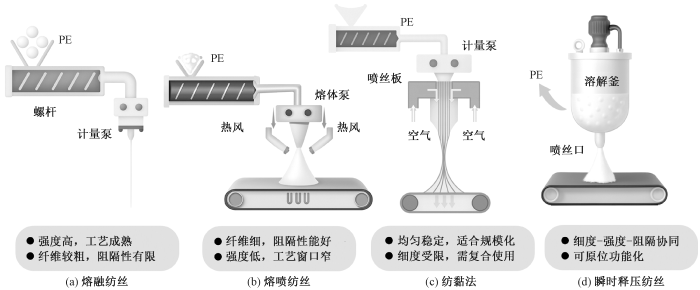
图1
不同PE微细纤维制备工艺
Fig.1
Different preparation processes for PE microfibers. (a) Melt spinning; (b) Melt-blown spinning; (c) Spunbonding; (d) Instantaneous pressure-release spinning
熔喷纺丝则依靠高速热气流对聚合物熔体进行极度牵伸,并在接收装置上直接近场成网,可制备出如图1(b)所示的孔径在亚微米到微米级、具有优异阻隔性能的超细纤维网。通过系统调控热风温度、压力、接收距离等参数,可实现有效的纤维细化进而获得较高的过滤效率与阻隔性能[26]。当前研究重点主要包括对聚合物进行改性、设计新型熔喷模具以及调整加工条件等[27-28]。例如,有研究明确指出不同熔喷工艺参数(如模头温度、空气压力和收集器间距)能够显著影响PE熔喷非织造布的孔径、空气渗透性和力学性能[29]。通过提高空气牵伸程度与热能输入以及延长模头到收集器距离能够延长纤维冷却和牵伸时间,能够细化纤维并缩小孔径,改善阻隔效果,为设计高性能PE熔喷纤维材料提供了工艺依据。针对PE纤维细化难题,李长金等[30]提出在传统熔喷基础上改进模头并引入电场辅助,使PE超细纤维的平均直径从约10 μm降至更低水平,从而提升了过滤效率和疏水性能,这表明静电场改性有助于PE熔喷工艺的优化。上述研究表明,通过对熔喷工艺参数、设备及辅助场等的合理设计,能够弥补PE本身加工性差的不足,使其在过滤、隔离等应用中展现出竞争力。
纺黏法则通过如图1(c)所示的纺丝—冷却—牵伸—铺网—热黏合等一系列连续工序实现高效生产。纺黏工艺主要通过较慢的冷却速率改善纤维的成网均匀性和力学强度,制备的非织造布均匀性良好、生产一致性高,在医用防护材料中多用作贴身外层或支撑层[31]。其常与熔喷中间层复合成纺黏—熔喷—纺黏(SMS)结构,其中纺黏层提供了必要的力学强度和耐久性,而熔喷层则贡献了核心的阻隔功能,二者共同构成了防护材料主要架构。但由于纺黏纤维结晶度较低,力学性能较弱,为提升纤维的结晶度和强度,需优化拉伸过程和冷却速率,以增强分子链的取向性和结晶速率[32-33]。总而言之,传统熔体纺丝技术凭借其工艺成熟及成本可控等优势,构建了现代医疗防护产业的材料基础。然而,这些技术均高度依赖复杂的机械牵伸系统和精确的温控技术,难以进一步将纤维直径细化。此外,为获得高性能PE纤维材料往往面临着高能耗、设备复杂和工艺窗口窄等问题。
2.2 闪蒸及瞬时释压纺丝
闪蒸纺丝的核心在于通过高压溶液瞬间泄压,通过一步制备“膜纤维交织”的微细纤维结构。此微结构由连续的膜状部分和细纤维网组成,膜状部分主要提供液体与气溶胶的屏障,而微细纤维网络则维持材料的透湿性和力学性能[15]。纺丝过程中聚合物浓度作为关键工艺参数,会影响纤维的形貌演化、结晶行为及最终力学性能。研究表明,提高纺丝溶液中的聚合物浓度可有效促进分子链有序排列与结晶完善度,从而显著提升纤维的结晶性与宏观力学强度。在特定溶剂体系及PE浓度窗口下,可实现纤维结构“高强度-高伸长”的协同效应[14]。更进一步的实验表明,闪蒸纺丝还可以在纺丝阶段一体化嵌入功能相,如铁氧体纳米粒子进一步实现磁性相关功能集成,为多功能材料的设计提供了新的思路[34]。然而,闪蒸纺丝在实际产业化过程中仍面临诸多挑战。其中,纤维网的铺网均匀性问题尤为突出。由于纺丝液在闪蒸过程中存在流体湍流、溶剂汽化不均及电场扰动等因素,导致纤维在成网阶段分布起伏、取向不一,形成局部纤网偏薄或结团现象,在一定程度上制约了闪蒸纺非织造材料性能的一致性及其在高端医疗领域中的应用。
需要强调的是,PE微细纤维及非织造布虽满足防护服的基础使用性能,但在高湿、长时间穿着或高负荷暴露条件下,表面仍可能发生生物膜黏附与细菌残留风险。因此,近年来研究通过表面改性(等离子体活化、仿生黏附、抗菌层构筑等)与原位纺丝(熔融纺、熔喷纺、瞬时释压纺等)嵌入抗菌粒子,实现“被动阻隔+主动抑菌”的有效协同。
3 聚乙烯微细纤维抗菌改性策略
近年来,PE纤维的抗菌研究可以分为“表面改性与功能层构筑”以及“原位纺丝或复合改性”两大方向,如图2所示。研究者通过纳米复合、仿生黏附、中间层构建及纤维成形协同等方式,力求在兼顾力学性能、表面稳定性和抗菌效果的基础上,实现绿色环保与规模化生产。
图2
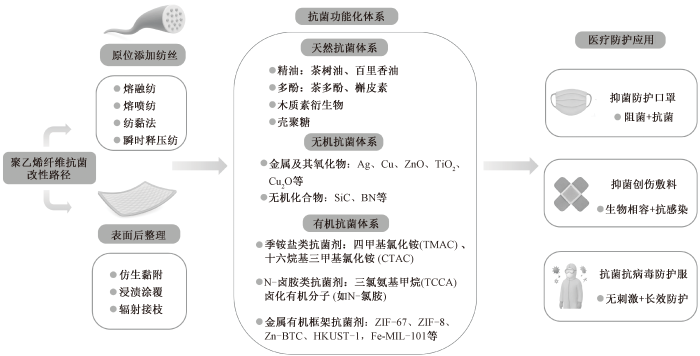
图2
抗菌PE微细纤维防护材料制备方法及应用
Fig.2
Preparation methods and applications of antibacterial PE microfiber protective materials
3.1 表面改性与功能层构筑
由于PE纤维表面难以直接固定抗菌成分,因此表面改性技术成为了赋予此类惰性基体以持久、高效抗菌性能的核心策略[35]。目前研究主要采用辐射接枝、浸渍改性或仿生黏附等方式,先在纤维表面引入反应位点,再负载纳米金属、光催化剂或天然抗菌物质。这类方法的优点在于工艺灵活、可在既有非织造布生产线上实施,且抗菌组分主要分布在材料表层,与微生物的接触效率高。
3.1.1 辐射接枝
辐射接枝技术是一种有效的PE表面改性方法,通过将功能性单体引入PE基体,赋予其抗菌性能。这一过程主要利用高能辐射(如电子束或伽玛射线)在PE表面引发自由基反应,然后与接枝单体(如季铵盐、银纳米颗粒等)发生化学反应,形成具有抗菌功能的复合材料[8]。
Xu等[36]在PE膜上接枝苯乙烯磺酸钠、苯乙烯三甲基氯化铵从而使得薄膜具备温度响应性和抗菌性。研究表明,接枝后PE薄膜的抗菌性能显著增强,尤其在对革兰氏阳性菌和阴性菌的抑制作用上表现优异。这表明通过辐射接枝方法不仅能有效实现PE的功能化改性,还可通过温度等多重响应机制实现按需抗菌。
3.1.2 浸渍/涂覆改性
通过浸渍、喷涂等工艺将抗菌剂负载于PE表面,其结合方式可包括物理吸附、配位键合或离子相互作用。Zhai等[12]通过左右旋聚乳酸制备的立构交联网络黏结层在瞬时释压纺PE非织造布表面负载氧化锌-银(ZnO-Ag)纳米颗粒,使抗菌剂固着于PE表面,实现了耐磨、耐洗的抗菌性能,同时强调卷对卷浸涂的可放大性,明显对接医用防护服外层抗菌升级需求。Dai等[21]在活化后的瞬时释压PE非织造布表面构筑Pd—N配位键,以0.14%的Pd负载量即可实现对革兰阴性菌大肠埃希菌(E. coli)与革兰阳性菌枯草芽孢杆菌(B. subtilis)大于99.9%的抑菌率。在实现持续主动杀菌的同时,可有效抑制微生物在纤维表面的黏附与生物膜形成,从而赋予材料显著的自清洁特性。同时,研究证实了制备的抗菌非织造布在磨损150次及水洗50次后抗菌性能没有明显下降。
除传统策略外,近年来光响应抗菌材料作为绿色、长效抗菌体系,逐渐成为研究热点[37]。光催化抗菌涂层通过在PE纤维表面构筑含光催化剂的复合层,利用光照产生活性氧物种可实现高效、广谱的抗菌效果。Yu等[38]在PE薄膜表面负载了壳聚糖复合核壳结构氧化锌/氧化锡(ZnO/SnOx)光催化涂层,通过形成II型异质结促进了光生电荷分离,从而显著增强光催化活性。抗菌实验结果表明,在60 W光源照射48 h后,PE抗菌薄膜对B. subtilis抑菌圈直径从38 mm增大至60 mm,展现出显著的光催化抗菌长效性。类似地,二氧化钛/铂/二氧化硅(TiO2/Pt/SiO2)光催化涂层织物在阳光或实验室常规环境光条件下表现出自清洁抗菌活性,也为PE纤维材料的长期防护提供新的绿色参考策略[39]。
在绿色可持续抗菌方面,Innocent等[40]提出了基于绿色双功能儿茶酚的抗菌涂层策略制备了高效抗菌的PE防护服。通过合成包含多巴胺甲基丙烯酰胺和己基化乙烯基吡啶(QVP)单元的阳离子共聚物,并通过自由基聚合和N-烷基化反应制备了季铵盐型共聚物。该共聚物在水溶液中表现出良好的抗菌性能,且含有较高QVP单元的共聚物抗菌活性和产率更高。此外,所制备的抗菌瞬时释压纺PE非织造布对E. coli和B. subtilis表现出大于99.9%的抑菌率,且多次洗涤后抗菌性能未受影响,显示出其在抗菌防护用品中的潜力。
在长效抗菌方面,Wang等[41]通过重氮化学法将ZIF-8金属有机框架均匀负载于PE纤维表面,成功制备了具有广谱和长效抗菌性能的PE@ZIF-8非织造布。该材料通过结合光催化和Zn2+离子释放机制,实现了对多种细菌的有效抑制,并保持了良好的力学性能和透气性,满足了医疗防护服对舒适性和功能性的双重要求。
3.1.3 仿生黏附
仿生学启发的策略借鉴自然界中生物的黏附机制,通过模仿如贻贝、章鱼等生物体内的黏附蛋白和分子机制,赋予PE微细纤维和非织造布抗菌功能。这些生物黏附机制通常依赖于特定的分子结构,如聚多巴胺(PDA)、肽链等含有氨基和羧基的分子,这些分子能够与多种材料表面牢固结合,且对外界环境具有较强的适应性和耐久性。
例如,Wang等[42]提出一锅聚合自组装策略,利用仿贻贝生物基PDA自聚合作为仿生黏附底层提升ZnO-Ag与PE纤维结合牢度,显著改善了耐久性。该方法可作为医用防护纤维材料的后处理升级方法,工艺简洁且与现有产线兼容。Fan等[43]利用PDA自聚合机制在聚对苯二甲酸乙二醇酯/PE复合非织造布表面原位生长硫化铜纳米颗粒,成功将抗菌和光热性能集成在一起制备了一体化热疗膜。非织造布展现出卓越的光热转换能力,在5 cm的近红外激光照射下升温至40 ℃,为医疗防护材料的多功能化提供了新的方向。Tang等[44]采用仿生策略,通过自聚合PDA将埃洛石纳米管和Cu2O负载到HDPE纤维表面,从而增强其抗菌性能和生物相容性。改性后的PE微细纤维展现出显著的抗菌效果,对E. coli和B. subtilis展现出高达到99.99%的抑菌率。此外,在50次洗涤循环后,抗菌纤维的抗菌率仍能维持在90%以上。
在抗真菌方面,Grafia等[45]通过将纳他霉素(Natamycin)涂覆到PE膜表面,开发了一种具有抗真菌性能的材料。研究表明,PE薄膜表面经过纳他霉素处理后,能有效抑制Aspergillus niger的生长,且该材料在抗真菌实验中展现出高达99%的抑菌率。此外,经过多次提取测试后,涂层仍能保持良好的抗菌活性,表明纳他霉素与PE基体结合牢固,具有长效的抗真菌性能。
3.2 原位纺丝与复合改性
与表面改性相比,原位纺丝与复合改性强调在纤维成形过程中直接引入抗菌组分。这类方法通常通过熔融纺、熔喷纺及瞬时释压纺等工艺,将抗菌剂(包括天然、有机及无机等类型)与PE基体均匀混合并固定,从而保证抗菌功能组分不易流失,显著提升耐久性和稳定性,且具备连续化、规模化生产的潜力[46]。
在无机抗菌剂方面,金属及其氧化物纳米粒子是常用的添加组分[49]。例如,Rojas等[50]通过熔融共混法将ZnO纳米粒子均匀分散在PE基体中,从而有效提升材料的抗菌性能。研究表明,PE/ZnO复合材料对E. coli和S. aureus抑菌率可达到96%以上。此外,ZnO的引入不仅增强了材料的抗菌活性,还提高了其热稳定性和紫外线屏蔽能力。Roy等[51]用银、铜和氧化锌纳米颗粒修饰改性蒙脱土(MMT),并用作添加剂通过熔融纺制备HDPE/改性MMT纳米复合单丝(质量分数1%~5%)。其中,HDPE/Ag-MMT单丝对E. coli和S. aureus的抑菌率大于99%。上述研究均证实了PE纤维通过原位纺丝进行抗菌功能化改性的可行性,同时凸显了其在实现抗菌功能性与大规模生产方面的显著优势。
另一类研究则通过向PE复合材料引入天然抗真菌添加剂使其获得抗真菌效能[56]。如向PE基体中分散天然产物(印楝提取物和姜黄)等粒子,所制备材料对白色念珠菌等病原体的增殖产生明显抑制,表明天然抗真菌组分在绿色复合材料中的应用价值。
4 挑战与展望
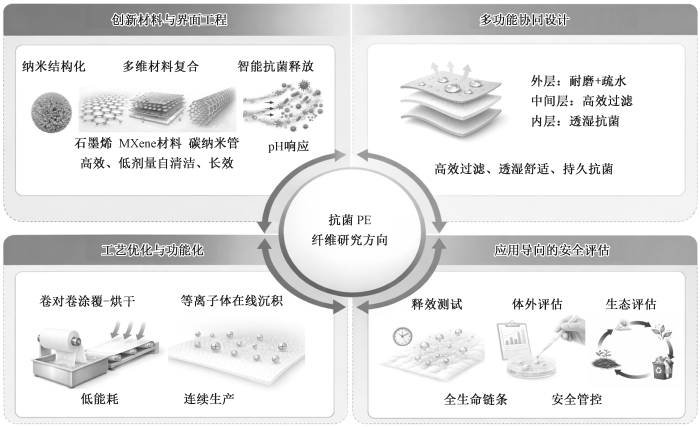
随着对公共卫生安全的日益重视,PE非织造布在医疗防护材料中的应用潜力逐渐凸显。如图3所示,未来功能化PE抗菌非织造布的研究方向将集中在绿色低剂量化、多功能协同、工艺优化与规模化生产和应用导向的安全评估等方面。
图3
4.1 绿色与低剂量化
未来低剂量抗菌的关键在于通过界面工程与新材料体系提升效能。利用纳米结构化及二维材料复合技术,可将抗菌剂稳定锚定于PE表面,避免金属粒子脱落,同时赋予材料长效抗菌与自清洁性能。天然抗菌剂则可通过智能生物网络实现刺激响应释放,达成精准抗菌。此外,引入量子点或纳米碳等新型载体能显著提升表面活性、降低用量,并改善生物相容性与可降解性,从而突破传统金属基抗菌剂的局限。
4.2 多功能协同
医疗防护纤维材料的实际需求是“综合防护”,其中抗菌性能是重要组成部分。随着真菌性疾病的增加,抗真菌材料的需求日益增多。因此,未来医疗防护材料的发展不仅要注重对细菌灭杀性能的提升,还应着重加强抗真菌功能的研究,以全面应对多种微生物的挑战。
此外,研究应聚焦多功能协同设计的原则,在保证抗菌效果的基础上优化耐磨性、透湿性等基础特性。在实际设计中,抗菌层的设计应尽量薄而高效,以避免过厚的涂层影响材料的透气性和增加气流的阻力。同时为提升耐磨性,可通过引入柔性增韧网络来增强,或通过在纤维表面构建纳米粗糙结构,以提升材料的抗磨损能力。透湿性则可以通过设计具有水汽选择性通道的微孔涂层,或通过亲水-疏水梯度结构来实现单向导湿效果,从而确保材料既能有效阻挡外部有害物质,又能保持舒适的透气性和湿度调节能力。
4.3 工艺优化与规模化
当前,抗菌PE非织造布的生产虽然能够满足基本的性能要求,但在绿色化学和环保法规日益严格的背景下,如何优化生产工艺以降低能耗和废料排放,成为亟待解决的问题。未来工艺路径应明确聚焦在3类可工业化的单元:一是卷对卷、水系涂覆/浸轧-烘干,配合低温固化体系,实现低挥发性有机化合物、低能耗连续处理;二是在线等离子体/电晕活化+即时涂覆,在不改变主体纤维结构的情况下提高表面能与涂层附着力,解决PE惰性表面导致的涂层易脱落问题;三是原位生成/沉积以降低纳米粒子团聚并提高分布均匀性,进而实现工业化抗菌PE非织造布的稳定生产。
4.4 应用导向的安全评估
医疗防护材料的安全评估应从单一的“毒性评估”转向为“全生命周期评估框架”,具体包括暴露、迁移和累积3个方面。为此,需实施一套可操作的评估方案:首先,在材料设计上优先采用“强结合—低迁移”的结构策略(配位网络、共价锚定、包覆层),将安全性从后期安全评估前移到结构设计流程;其次,建立模拟使用场景的释放测试体系,例如在人工汗液、酒精/含氯消毒液、反复弯折摩擦条件下,测定金属离子与颗粒单位时间/单位面积释放速率曲线;再次,进行细胞相容性与皮肤刺激的体外评价,并与释放数据建立关联,明确安全阈值;最后,开展环境端的可降解性与生态风险评估,研究抗菌组分在废水中的形态转化与沉积行为。
5 结束语
抗菌聚乙烯(PE)非织造布作为医用防护材料的重要组成部分,未来的发展前景广阔,但也面临诸多挑战。从绿色低剂量化、多功能协同、工艺优化、标准化评价体系建设,到应用导向的安全评估,均需要在技术创新与工程应用之间找到平衡。随着研究不断深入,抗菌PE非织造布有望在确保性能的同时,兼顾环保与可持续发展,最终推动防护材料向更高效、安全、绿色的方向发展。
参考文献
Multi-inspired bump-liked medical protective clothing for effectively profuse perspiration management
[J].DOI:10.1016/j.cej.2024.156448 URL [本文引用: 1]
Ultra-fast bacterial inactivation of Cu2O@halloysite nanotubes hybrids with charge adsorption and physical piercing ability for medical protective fabrics
[J].
Eco-friendly versatile protective polyurethane/triclosan coated polylactic acid nonwovens for medical covers application
[J].DOI:10.1016/j.jclepro.2020.124455 URL [本文引用: 1]
防护口罩研究进展及其发展趋势
[J].
Research progress and its developing trend of protective masks
[J].
聚乙烯超细纤维非织造工艺研究进展
[J].
DOI:10.19491/j.issn.1001-9278.2025.02.019
[本文引用: 1]

为深入了解化工产品聚乙烯超细纤维制备现状,从纤维细度出发,对国内外聚乙烯超细纤维非织造工艺进行综述分析。梳理了凝胶纺丝、闪蒸相分离、静电纺丝、熔喷4条路线的成丝机理、细化方法及目前存在的问题,剖析了凝胶纺丝中溶胀、溶解行为及高品质凝胶液与超倍拉伸的关联;探讨了闪蒸相分离中的相态变化、超临界CO<sub>2</sub>“绿色制造”方法;针对聚乙烯非极性、分子量大、黏度高的物性,归纳了使用溶剂、添加导电粒子的溶液电纺以及通过共混小分子极性物质、提高降解温度升温降黏、增设环境温度延长鞭动时间来细化纤维的熔体电纺;分析了工艺参数对共混熔喷后开纤剥离多组分纤维的影响。最后指出使用超临界绿色流体、无卤素环境友好型溶剂等绿色制备方式为未来热点研究方向。
Research progress in nonwoven technology of polyethylene ultrafine fibers
[J].
DOI:10.19491/j.issn.1001-9278.2025.02.019
[本文引用: 1]
To understand the development status of polyethylene (PE) ultrafine fibers as a chemical product, the nonwoven technology of ultrafine fibers at home and abroad was introduced and analyzed from the aspect of fiber fineness, and the spinning mechanisms, refining methods, and existing problems of wet spinning, flash phase separation, electrospinning, and melt blowing methods were reviewed. The key factors of wet spinning were high⁃quality gel solution and super drawing. The morphology of the prepared fibers was directly influenced by the degree of entanglement of polymer molecular chains, phase changes, and degree of synergistic curing and stretching of multiphase flow in flash evaporation phase separation. Due to the non⁃polar nature, high molecular weight, and high viscosity, PE is mostly electrospun through using solvents and conductive particles in solutions. However, greener melt electrospinning has attracted attention, because it can refine the fibers through blending small molecular substances, improving degradation temperature, lowering viscosity, and setting environmental temperature to extend whip time. The effect of process parameter on the separation of multi⁃component fibers after blending and melt spraying was analyzed. Finally, the hot research directions in future were pointed out, including the sustainable development technologies for supercritical green fluids and halogen⁃free environmentally friendly solvents.
超高分子量聚乙烯纤维防护机理研究综述
[J].
Review on protective mechanism of UHMWPE fiber
[J].
Sustainable personal protective clothing for healthcare applications: a review
[J].DOI:10.1021/acsnano.0c05537 URL [本文引用: 1]
抗菌功能纺织品的研究进展
[J].
Advances on antibacterial textiles
[J].
Fabrication of a textile-based triboelectric nanogenerator toward high-efficiency energy harvesting and material recognition
[J].
DOI:10.1039/d3mh00618b
PMID:37431538
[本文引用: 1]
Textile-based triboelectric nanogenerator (T-TENG) devices, particularly, narrow-gap mode, have been conceived and developed for obtaining energy harvesting and tactile sensing devices unaffected by the external environment. Enhancing the interfacial area of T-TENG materials offers exciting opportunities to improve the device output performance. In this work, a narrow-gap T-TENG was fabricated with a facile process, and a new strategy for improving the device output is proposed. The new structural sensor (polydimethylsiloxane (PDMS)-encapsulated electroless copper plating (EP-Cu) cotton) with multiple electricity generation mechanism was designed and fabricated for enhancing recognition accuracy. The result shows that only PDMS layer strain was established at an external stress of 1.24-12.4 kPa and the fibers laterally slip at a stress of 12.4-139 kPa; more importantly, the output performance of the TENG displayed a linear relationship under corresponding stress ranges. The as-fabricated device demonstrated the ability to convert different energies such as vibration, raindrops, wind and human motions into electrical energy with excellent sensitivity. Interestingly, the output signal of the as-fabricated TENG device is a combination of output signals from PDMS/EP-Cu and PDMS/recognition object devices. To be precise, there are two TENG devices (PDMS/EP-Cu and PDMS/recognition object) that work when the as-fabricated TENG device is under 12.4-139 kPa stress. Accompanied by unique characteristics, the generated TENG signals are capable of recognition of contact materials. Combining the TENG signal and deep learning technology, we explore a strategy that can enable the as-fabricated device to recognize 8 different materials with 99.48% recognition accuracy in the natural environment.
Micro/nanofibrous nonwovens with high filtration performance and radiative heat dissipation property for personal protective face mask
[J].DOI:10.1016/j.cej.2021.130175 URL [本文引用: 1]
High-density polyethylene Janus fibrous membrane with enhanced breathability and moisture permeability via PDA assisted hydrophilic modification
[J].DOI:10.1002/marc.v46.11 URL [本文引用: 1]
Scalable, high-strength, wear-resistant, antibacterial polyethylene micro-nano fiber protective materials
[J].DOI:10.1016/j.cej.2024.150735 URL [本文引用: 3]
Fabrication of silver ions aramid fibers and polyethylene composites with excellent antibacterial and mechanical properties
[J].DOI:10.1515/epoly-2022-0082 URL [本文引用: 2]
高密度聚乙烯瞬时释压非织造布制备及其性能
[J].
Preparation and properties of high-density polyethylene nonwoven fabrics by instantaneous pressure release
[J].
基于闪蒸法制备再生聚乙烯无纺布及其性能研究
[J].
DOI:10.19491/j.issn.1001-9278.2022.05.003
[本文引用: 2]
以2种熔体流动速率(MFR)不同的再生聚乙烯为原料,二氟一氯甲烷和四氟二氯乙烷混合物为溶剂,采用闪蒸法制备了2种再生聚乙烯无纺布,并通过扫描电子显微镜(SEM)、差示扫描量热仪(DSC)、电子强力机和数字透气度仪等对其表观形貌、热性能、力学性能、透气性和抗水压性等进行了表征和测试。结果表明,基于闪蒸法制备的再生聚乙烯无纺布由超细纤维黏连堆叠而成,其最大拉伸断裂强力为233 N/5 cm,最大断裂伸长率为77 %,且具有良好的透气性、抗静水压性、印染性和阻隔性;制备的再生聚乙烯无纺布具有良好的综合性能,实现了再生聚乙烯赋能增值的目标,符合可持续发展理念,具有广阔的市场前景。
Preparation and properties of recycled polyethylene non-woven fabrics based on flash evaporation
[J].
DOI:10.19491/j.issn.1001-9278.2022.05.003
[本文引用: 2]
Two types of recycled polyethylene non?woven fabrics were prepared by a flash evaporation method using two types of recycled polyethylene with different melt flow rates as raw materials and a mixture of difluorochloromethane and tetrafluorodichloroethane as solvents. Their morphology, thermal properties, mechanical properties, air permeability, and water resistance were investigated using a scanning electron microscope, a differential scanning calorimeter, an electron intensity meter, and a digital air permeability meter. The results indicated that the recycled polyethylene non?woven fabrics were both composed of ultra?fine fibers. They exhibited maximum tensile breaking strength of 233 N/5 cm, maximum elongation break of 77 %, good air permeability, high resistance to hydrostatic pressure, good printing and dyeing properties, and satisfactory barrier performance. With such good comprehensive properties, the recycled polyethylene non?woven fabrics reach the goal for achieving addition value in the recycled polyethylene. This matches the sustainable development target and shows a broad market prospect in near future.
Structure and mechanical properties of polyethylene melt blown nonwovens
[J].
DOI:10.1108/IJCST-09-2015-0099
URL
[本文引用: 1]
Recently, the usage of melt blown products in many areas has increased. In melt blown process, generally polymers have been used. There are a variety of polymers. Characteristics of melt blown nonwovens have changed significantly depending on the polymer type. Also, there are several parameters such as die temperature, die-to-collector distance (DCD), air pressure, etc. that modify the nonwovens in melt blown process. The purpose of this paper is to investigate the effect of these parameters on the characteristics of nonwovens made up of polyethylene (PE).
A review of the mechanical and physical properties of polyethylene fibers
[J].
DOI:10.3390/textiles1010006
URL
Since the 1970s and 1980s, a major effort has been made to study UHMWPE (Ultra-High Molecular Weight PolyEthylene) fibers with remarkable mechanical properties, based on a basic polymer such as PE (PolyEthylene). These performances are above all associated with a very strong alignment of the molecules and the microfibrillar structures formed using various processes. However, they vary greatly depending on many parameters, and particularly on the draw ratio. Thus, these characteristics have been extensively analyzed by dynamic, static tensile, and creep tests, and are predominantly viscoelastic. The behavior appears to be associated with physical considerations and with the characteristic orthorhombic-hexagonal solid phase transition. The presence of a hexagonal phase is detrimental to the behavior because the chains slide easily relative to each other. Shifting this transition to higher temperatures is a challenge and many factors influence it and the temperature at which it takes place, such as the application of stress or annealing. The objective here is to give an overview of what has been done so far to understand the behavior of UHMWPE yarns. This is important given future numerical modeling work on the dimensioning of structural parts in which these UHMWPE yarns will be reinforcements within composites.
高密度聚乙烯超细纤维篷布的闪蒸-水刺法制备及其防水透湿性
[J].
Flash spinning-hydroentangling process of high-density polyethylene microfibrous tarpaulin and its waterproof and permeable performance
[J].
Enhancing mechanical properties of flash-spun filaments by pressure-induced phase separation control in supercritical high-density polyethylene solution
[J].
DOI:10.1038/s41598-022-22781-1
[本文引用: 1]
Flash-spun nonwoven (FS-NW) is gaining attention in the PPE field due to its excellent barrier and mechanical properties resulting from its non-uniform diameter distribution and unique filament morphology. The unique network structure of flash-spun filaments (FSF) comprising the FS-NW can be controlled by phase separation behavior in the supercritical fluid (SCF) process. This study proposes a simple method to control the microstructure of FSFs by controlling the pressure-induced phase separation (PIPS) process in polymer/SCF solution. This phase separation behavior of an HDPE/SCF solution was confirmed by using a high-pressure view cell. A multistage nozzle allowing for phase-separated pressure to form different phases was also designed. HDPE-FSFs were synthesized by flash-spinning, and their morphology, crystallinity, and mechanical properties were investigated. The results demonstrated that the filaments obtained by PSP control at 220 °C and with an HDPE concentration of 8 wt% showed a network structure composed of strands, wherein the diameters ranged from 1.39 to 40.9 μm. Optimal FSF was obtained at 76 bar, with a crystallinity of 64.0% and a tenacity of 2.88 g/d. The PIPS method can thus effectively control the microstructure more feasibly than temperature- or solvent-induced techniques and can allow the effective synthesis of various products.
A comparative study of UHMWPE fibers prepared by flash-spinning and gel-spinning
[J].DOI:10.1016/j.matlet.2015.02.046 URL [本文引用: 1]
Low-Addition, strongly bonded PE-Pd nonwoven fabric with enhanced antibacterial and biofilm-resistance for protective clothing
[J].DOI:10.1016/j.cej.2025.164086 URL [本文引用: 2]
Biological evaluation of the copper/low-density polyethylene nanocomposite intrauterine device
[J].DOI:10.1371/journal.pone.0074128 URL [本文引用: 1]
Biocompatibility studies of HDPE-HA composites with different HA content
[J].DOI:10.1007/s00289-015-1454-9 URL [本文引用: 1]
Enhanced adherence of mouse fibroblast and vascular cells to plasma modified polyethylene
[J].DOI:10.1016/j.msec.2015.03.052 URL [本文引用: 1]
Improvement of polyethylene fiber wettability and mechanical properties through an environmentally sustainable spinning process
[J].DOI:10.1016/j.ijadhadh.2022.103250 URL [本文引用: 1]
低密度聚乙烯熔喷工艺及其非织造布性能
[J].
DOI:10.13475/j.fzxb.20230701201
[本文引用: 1]
为探究高效制备工艺,获得综合性能优良的超细聚乙烯非织造材料,以低密度聚乙烯(LDPE)为原料,制备了低密度聚乙烯熔喷非织造布。研究了热风温度、热风流量、模头温度、接收距离和熔体流量等熔喷工艺参数对LDPE纤维平均直径的影响规律,并进一步考察了熔喷非织造布的过滤性能和力学性能。结果表明:提高热风温度、热风流量和模头温度等均有助于降低纤维的平均直径,所制备纤维最小平均直径可达5.3 μm,熔喷非织造布的最大拉伸强力为6.12 N,抗拉强度为2.16 MPa;经过热压工艺处理后,面密度为120 g/m<sup>2</sup>的LDPE非织造布在32 L/min流量下的过滤效率可达75%以上,平均过滤阻力为80 Pa。
Melt-blown process of low-density polyethylene and its nonwovens properties
[J].
DOI:10.13475/j.fzxb.20230701201
[本文引用: 1]
<p id="p00010"><strong>Objective</strong> Polyethylene (PE) nonwovens have excellent characteristics such as softness, corrosion resistance and hydrophobicity, and have broad application prospects in medical packaging, clothing, filtration and other fields. However, the traditional preparation process of high-performance polyethylene nonwovens is cumbersome, and the production process involves a large number of toxic solvents, and the production efficiency is low. Exploring the efficient preparation process of ultrafine polyethylene nonwovens has become an urgent research problem to be solved. Melt-blown technology is a common and efficient preparation method for microfiber, and the preparation of polyethylene microfiber by melt-blown method is rarely reported.</p><p id="p00015"><strong>Method</strong> The preparation of low-density polyethylene(LDPE) melt-blown nonwovens was achieved by using a self-assembled melt-blown testing machine. The effects of different processes on the diameter of LDPE fibers were studied by controlling a single variable and adjusting the melt-blown process parameters in the experiment, including hot air temperature, hot air flow, mold temperature, melt flow and receiving distance. In addition, the filtration efficiency and tensile properties of LDPE melt-blown nonwovens were also studied.</p><p id="p00020"><strong>Results</strong> The effects of melt-blown process parameters on the diameter of LDPE fibers were studied, including different hot air temperature, hot air flow rate, die temperature, receiving distance and melt flow rate. The results showed that increasing the hot air temperature, hot air flow rate and die temperature would reduce the average diameter of the fiber, and the average diameter of the fiber would increase after increasing the receiving distanc and melt flow rate. The minimum average diameter of the prepared fibers reached 5.3 μm, offering reference value for further preparation of polyethylene microfibers. The filtration performance of LDPE melt-blown nonwovens with different areal densities was explored, and the effect of areal density on LDPE filtration efficiency and filtration resistance was established, with the increase of areal density, the filtration efficiency and filtration resistance of melt-blown nonwovens showed a gradual upward trend. The filtration resistance was increased from 5.1 Pa to 20.9 Pa, and the filtration efficiency increased from 52.89% to 59.32%. After hot pressing treatment, the filtration efficiency of the 120 g/m<sup>2</sup> nonwoven fabric reached more than 75% at a flow rate of 32 L/min, and the average filtration resistance is 80 Pa. The mechanical properties of LDPE melt-blown nonwovens with areal densities of 25 g/m<sup>2</sup>, 50 g/m<sup>2</sup> and 120 g/m<sup>2</sup> were investigated. The nonwovens with higher areal density were found to withstand greater tensile strength, and when the areal density is 25 g/m<sup>2</sup>, the LDPE melt-blown nonwovens demonstrated the highest elongation at break, up to 75%. When the areal density was 120 g/m<sup>2</sup>, the maximum pulling force and tensile strength of melt-blown nonwovens were the highest, reaching 6.12 N and 2.16 MPa, respectively.</p><p id="p00025"><strong>Conclusion</strong> The melt-blown process can realize the efficient preparation of LDPE nonwovens, and the average diameter of the fiber decreases with the increase in hot air temperature, hot air flow rate and die temperature, and increases with the increase of receiving distance and melt flow, and the filtration efficiency, filtration resistance and tensile strength of melt-blown membrane increase with the increase of surface density of nonwoven. Process parameters would affect the microstructure and pore morphology of the fiber membrane, resulting in changes in mechanical properties and filtration properties. Furthermore, the microstructure of the melt-blown nonwoven can be changed by post-treatment processes such as hot pressing, and products with better performance can be obtained. So as to enhance the market potential and application value of polyethylene melt-blown nonwovens in the field of medical protection.</p>
Fabrication of nanofiber meltblown membranes and their filtration properties
[J].DOI:10.1016/j.memsci.2012.09.050 URL [本文引用: 1]
Melt blown nanofibers: fiber diameter distributions and onset of fiber breakup
[J].DOI:10.1016/j.polymer.2007.04.005 URL [本文引用: 1]
Porosity and barrier properties of polyethylene meltblown nonwovens
[J].DOI:10.1080/00405000.2016.1218109 URL [本文引用: 1]
静电喷纺低密度聚乙烯超细纤维及其性能
[J].
DOI:10.19491/j.issn.1001-9278.2025.05.004
[本文引用: 1]
为解决聚乙烯纤维细化难题,实现聚乙烯超细纤维及其膜材的制备与应用,在传统熔喷工艺的基础上改进熔喷模头并引入静电场,制备了低密度聚乙烯(PE⁃LD)超细纤维及其非织造布。研究了静电场强度和静电场作用距离对非织造布形态、纤网结构和直径分布的影响,进一步地,对比了引入电场前后非织造布在过滤、疏水和力学性能方面的差异。结果表明,随着静电场强度增加,纤维的平均直径从9.82 μm减少到8.07 μm,纤维的直径分布变窄,非织造布的过滤效率增加。在流量为32 L/min时,最高过滤效率可达73.65 %,过滤阻力19.1 Pa,且随着电场的增强,非织造布的疏水效果得到提升。这种静电喷纺方法可适用于高黏度熔体的微纳纤维及其非织造布的连续性制备,在滤材及包装等市场具备广阔的应用前景。
Preparation and performance of electrostatic melt-blown low-density polyethylene microfibers
[J].
DOI:10.19491/j.issn.1001-9278.2025.05.004
[本文引用: 1]
To address the challenges in refining polyethylene (PE) fibers and realize the preparation and applications of ultra⁃fine PE fibers and their membranes, a type of low⁃density PW (PE⁃LD) ultra⁃fine fibers and their nonwoven fabrics were successfully produced through improving the traditional melt⁃blown process by modifying the melt⁃blown die and introducing an electrostatic field. The effects of electrostatic field strength and distance on the morphology, web structure, and diameter distribution of the nonwoven fabrics were investigated. Furthermore, the differences in filtration, hydrophobicity, and mechanical properties of the nonwoven fabrics before and after introducing the electrostatic field were compared. The results indicated that the average fiber diameter decreased from 9.82 μm to 8.07 μm with an increase in the electrostatic field strength, and the fiber diameter distribution became narrow. This improved the filtration efficiency of the nonwoven fabrics. At a flow rate of 32 L/min, the highest filtration efficiency reached 73.65 % at a filtration resistance of 19.1 Pa. In addition, the hydrophobic performance of the nonwoven fabrics was enhanced with an increase in the electrostatic field. Such an electrostatic spinning method is suitable for the continuous preparation of high⁃viscosity melt micro⁃nano fibers and their nonwoven fabrics. The obtained products presented broad application prospects in the markets such as filtration materials and packaging.
Experimental analysis on fiber diameter of spunbond nonwoven fabrics through Plackett-Burman and Box-Behnken designs and its impact on mechanical properties
[J].DOI:10.1002/pls2.v6.1 URL [本文引用: 1]
Prediction of crystallinity of spunbond webs
[J].
DOI:10.1063/5.0029358
URL
[本文引用: 1]
Polymer crystallization is accompanied by a partial macromolecular chain alignment process, which has significant effects on the mechanical, thermal, and optical properties of polymer materials. Particularly, the properties of such widely used nonwoven products as spunbond webs are strongly affected by the degree of crystallinity achieved during their manufacturing. The present work aims at predicting the degree of crystallinity of spunbond webs accounting for thermally-driven and flow-induced crystallization coupled with the dynamics and thermal history of spunbond fibers. In principle, the degree of crystallinity could be in the 0–1 range; however, for semi-crystalline polymers, the degree of crystallinity practically saturates at a lower-than-one value. The degree of crystallinity of 100 spunbond fibers is predicted coupled with the fiber evolution and the final three-dimensional structure of a nonwoven web. The predicted evolution of the degree of crystallinity and its distribution in a three-dimensional spunbond web is discussed in detail. The results reveal that the distribution of the degree of crystallinity over the spunbond web is non-uniform. The effects of nozzle temperature, air-blowing speed, and belt speed on spunbond web characteristics, including the degree of crystallinity, are also investigated in detail.
Theoretical analysis of the spunbond process and its applications for polypropylenes
[J].DOI:10.1002/adv.2018.37.issue-6 URL [本文引用: 1]
Flash spinning polyethylene/Fe3O4 magnetic drive fibers for oil absorption underwater
[J].DOI:10.1016/j.cej.2024.151333 URL [本文引用: 1]
汽车座椅用抗菌涤纶针织物制备及其性能
[J].
Preparation and performance of antibacterial polyester knitted fabric for automotive seats
[J].
DOI:10.1177/004051757504500207
URL
[本文引用: 1]
A drying method involving the use of a thermobalance was employed to determine the bound water in mechanical and chemical pulp fibers. The precision of this method is dependent on the uniformity of the test materials. The coefficient of variability of bound water determination on mechanical pulps ranged from 15 to 18% based on one in dividual sample. This variability decreased in chemical pulps, 10 to 12%, and about 2% in α-cellulose. For a precision superior to ±10% (95% confidence level) a minimum of 10 individual mechanical pulp samples have to be tested. Similary, seven and one tests have to be made on chemical pulps and α-cellulose, respectively. The method should be useful to the study of the drying behavior of homogenous materials such as low-yield pulps and cotton or other textile materials.
用辐射接枝法对HDPE膜进行功能化改性
[J].
Functional modification of HDPE membranes by radiation-induced grafting
[J].
光动力抗菌技术在纺织品上的应用研究进展
[J].
DOI:10.13475/j.fzxb.20200903610
[本文引用: 1]
为研究光敏剂在纺织材料上负载的抗菌效果和其在纺织品改性中应用的可能性,通过文献调研的方式对光动力抗菌的研究背景、光敏剂的种类、抗菌纺织品的应用情况、光敏剂常用的负载形式进行归纳整理。研究表明:作为一种能高效杀菌的新型抗菌材料,光动力抗菌纺织品具有良好的发展前景;通过化学共价键合光敏剂的改进负载方法能够解决常见负载方式中出现的结合牢度差、重复利用性不佳等问题,进一步拓宽抗菌材料的研发途径;目前光敏剂对其光敏抗菌性能均未能做到精准调控,今后的研究应当通过控制光敏剂的种类及光敏剂浓度等因素实现对光敏抗菌性能的把控。
Progress in application of photodynamic antibacterial technology for textiles
[J].
DOI:10.13475/j.fzxb.20200903610
[本文引用: 1]
In order to study the antibacterial effect of photosensitizers loaded on textile materials and the possibility of its application for textile modifications, the research background of photodynamic antibacterial, types of photosensitizers, current applications of antibacterial textiles, and photosensitizers were systematically reviewed. The commonly used loading forms of the drug are examined, and the conclusions and future prospects are summarized. The review indicates that photodynamic antibacterial textiles are a new type of antibacterial material that can be effectively sterilized and has a good development prospect. The improved loading method through chemical covalent bonding of photosensitizers can solve the problems of poor binding fastness and poor reusability associated with the commonly used loading methods, and can further broaden the research and development path of antibacterial materials. At the same time, it is realized that the current photosensitizers have not been able to control accurately their photosensitizing antibacterial properties. Future research should control the photosensitive antibacterial properties by controlling the types of photosensitizers and the concentration of photosensitizers.
Chitosan-photocatalyst nanocomposite on polyethylene films as antimicrobial coating for food packaging
[J].DOI:10.1016/j.porgcoat.2023.108069 URL [本文引用: 1]
Superhydrophilic self-cleaning fabric with enhanced antibacterial and UV protection properties
[J].DOI:10.1007/s10570-024-06346-1 [本文引用: 1]
Bifunctional catechol-based coating strategy to construct highly effective antimicrobial polyethylene microfibers for personal protective equipment
[J].DOI:10.1016/j.porgcoat.2024.108916 URL [本文引用: 1]
Dual inactivation mechanism of photocatalysis and metal ions induces broad-spectrum antibacterial polyethylene fabric to resist bio-infection
[J].DOI:10.1016/j.jhazmat.2025.139817 URL [本文引用: 1]
Surface self-assembly via one-pot polymerization to construct high-strength and antibacterial polyethylene fabric
[J].DOI:10.1016/j.cej.2024.152246 URL [本文引用: 1]
In-situ anchoring of nano-CuS onto PET@PE nonwoven fabrics: developing flexible, robust, and all-in-one integrated thermotherapy films
[J].
Dopamine-assisted functionalized cuprous oxide induced high biocompatibility and antibacterial polyethylene fibers
[J].DOI:10.1016/j.compositesa.2025.108947 URL [本文引用: 1]
Development of an antifungal film by polyethylene surface modification with natamycin
[J].DOI:10.1016/j.fpsl.2018.11.001 URL [本文引用: 1]
抗菌纳米材料在医用织物消毒灭菌中的应用研究进展
[J].
Research progress on the application of antibacterial nanomaterial in disinfection and sterilization of medical textiles
[J].
纺织用抗菌材料及其应用研究进展
[J].
Research progress of antibacterial materials for textiles and their applications
[J].
Weathering of antibacterial melt-spun polyfilaments modified by pine rosin
[J].
DOI:10.3390/molecules26040876
URL
[本文引用: 1]
For many antibacterial polymer fibres, especially for those with natural functional additives, the antibacterial response might not last over time. Moreover, the mechanical performance of polymeric fibres degrades significantly during the intended operation, such as usage in textile and industrial filter applications. The degradation process and overall ageing can lead to emitted volatile organic compounds (VOCs). This work focused on the usage of pine rosin as natural antibacterial chemical and analysed the weathering of melt-spun polyethylene (PE) and poly lactic acid (PLA) polyfilaments. A selected copolymer surfactant, as an additional chemical, was studied to better integrate rosin with the molecular structure of the plastics. The results reveal that a high 20 w-% of rosin content can be obtained by surfactant addition in non-oriented PE and PLA melt-spun polyfilaments. According to the VOC analysis, interestingly, the total emissions from the melt-spun PE and PLA fibres were lower for rosin-modified (10 w-%) fibres and when analysed below 60 ℃. The PE fibres of the polyfilaments were found to be clearly more durable in terms of the entire weathering study, i.e., five weeks of ultraviolet radiation, thermal ageing and standard washing. The antibacterial response against Gram-positive Staphylococcus aureus by the rosin-containing fibres was determined to be at the same level (decrease of 3–5 logs cfu/mL) as when using 1.0 w-% of commercial silver-containing antimicrobial. For the PE polyfilaments with rosin (10 w-%), full killing response (decrease of 3–5 logs cfu/mL) remained after four weeks of accelerated ageing at 60 ℃.
无机抗菌织物的研究进展
[J].
DOI:10.13475/j.fzxb.20210309409
[本文引用: 1]
为深入了解无机抗菌剂的优缺点,制备性能更加优异的抗菌织物,对国内外相关研究进展进行了综述。分析了金属型和光催化型无机抗菌剂的抗菌机制,介绍了银系、铜系、锌系以及复合型的无机抗菌剂在纺织品领域的研究进展。指出:与其他类型的抗菌剂相比,无机抗菌剂具有广谱性强、不易使细菌产生耐药性等优点,但是在实际应用中也存在着一些问题,如银系抗菌剂价格昂贵;铜系抗菌剂颜色较深;锌系抗菌剂抗菌效果较弱等,通过与其他抗菌剂进行复合可以制备性能优异的复合抗菌织物,未来的研究方向应该是开发具有功能复合化、智能化、舒适性好等特性的多功能抗菌织物。
Research progress of inorganic antibacterial fabrics
[J].
DOI:10.13475/j.fzxb.20210309409
[本文引用: 1]
To gain an in-depth understanding of the advantages and disadvantages of inorganic antimicrobial agents and to prepare antimicrobial fabrics with improved performance, the relevant research progress was reviewed. The antimicrobial mechanisms of metal-based and photocatalytic inorganic antimicrobial agents were briefly introduced, and the research progress of silver-based, copper-based, zinc-based, and composite inorganic antimicrobial agents in the field of textiles was mainly introduced. Compared with other types of antimicrobial agents, inorganic antimicrobial agents have the advantages in strong broad-spectrum and are not easy to make bacteria resistant, but there are some problems in practical application, including silver antimicrobial agents being expensive, copper antimicrobial agents darker, zinc antimicrobial agents weaker and so on. By compounding with other antimicrobial agents, compound antimicrobial fabrics with excellent performance are possible to be achieved. The future research direction should be the development of multi-functional antibacterial fabrics with the characteristics of functional compounding, intelligence, and good comfort.
Effective antimicrobial materials based on low-density polyethylene (LDPE) with zinc oxide (ZnO) nanoparticles
[J].DOI:10.1016/j.compositesb.2019.05.054 URL [本文引用: 1]
Antimicrobial performance of polyethylene nanocomposite monofilaments reinforced with metal nanoparticles decorated montmorillonite
[J].DOI:10.1016/j.colsurfb.2019.02.045 URL [本文引用: 1]
High-performance electret and antibacterial polypropylene meltblown nonwoven materials doped with boehmite and ZnO nanoparticles for air filtration
[J].DOI:10.1007/s12221-022-4786-8 [本文引用: 1]
Research progress in preparation, properties, and applications of medical protective fiber materials
[J].DOI:10.1016/j.apmt.2023.101792 URL [本文引用: 1]
Preparation of Ag@ZIF-8@PP melt-blown nonwoven fabrics: air filter efficacy and antibacterial effect
[J].
DOI:10.3390/polym13213773
URL
[本文引用: 1]
Serving as matrices, polypropylene (PP) melt-blown nonwoven fabrics with 4% electrostatic electret masterbatch were incorporated with a 6%, 10%, 14%, or 18% phosphorus-nitrogen flame retardant. The test results indicate that the incorporation of the 6% flame retardant prevented PP melt-blown nonwoven fabrics from generating a molten drop, which, in turn, hampers the secondary flame source while increasing the fiber diameter ratio. With a combination of 4% electrostatic electret masterbatch and the 6% flame retardant, PP melt-blown nonwoven fabrics were grafted with ZIF-8 and Ag@ZIF-8. The antibacterial effect of ZIF-8 and Ag@ZIF-8 was 40% and 85%, respectively. Moreover, four reinforcing measures were used to provide Ag@ZIF-8 PP melt-blown nonwoven fabrics with synergistic effects, involving lamination, electrostatic electret, and Ag@ZIF-8 grafting, as well as a larger diameter because of the addition of phosphorus-nitrogen flame retardants. As specified in the GB2626-2019 and JIS T8151-2018 respiratory resistance test standards, with a constant 60 Pa, Ag@ZIF-8 PP melt-blown nonwoven membranes were tested for a filter effect against PM 0.3. When the number of lamination layers was five, the filter effect was 88 ± 2.2%, and the respiratory resistance was 51 ± 3.6 Pa.
一种具有抗菌功能的纤维材料及其制备方法, 118932522B
[P]. 2025-09-16.
A fiber material with antibacterial function and its preparation method, 118932522B
[P]. 2025-09-16.
Antibacterial and antifungal properties of composite polyethylene materials reinforced with neem and turmeric
[J].
DOI:10.3390/antibiotics9120857
URL
[本文引用: 1]
With the increased scientific interest in green technologies, many researches have been focused on the production of polymeric composites containing naturally occurring reinforcing particles. Apart from increasing mechanical properties, these additions can have a wide range of interesting effects, such as increasing the resistance to bacterial and fungal colonization. In this work, different amounts of two different natural products, namely neem and turmeric, were added to polyethylene to act as a natural antibacterial and antifungal product for food packaging applications. Microscopic and spectroscopic characterization showed that fractions of up to 5% of these products could be dispersed into low-molecular weight polyethylene, while higher amounts could not be properly dispersed and resulted in an inhomogeneous, fragile composite. In vitro testing conducted with Escherichia coli, Staphylococcus aureus, and Candida albicans showed a reduced proliferation of pathogens when compared to the polyethylene references. In particular, turmeric resulted in being more effective against E. coli when compared to neem, while they had similar performances against S. aureus. Against C. albicans, only neem was able to show a good antifungal behavior, at high concentrations. Tensile testing showed that the addition of reinforcing particles reduced the mechanical properties of polyethylene, and in the case of turmeric, it was further reduced by UV irradiation.

 京公网安备11010502044800号


