纺织学报 ›› 2026, Vol. 47 ›› Issue (03): 156-165.doi: 10.13475/j.fzxb.20250904802
王琎祺1,2, 翟倩1,2, 俞森龙1,2, 朱倩沁1,2,3, 周哲1,2, 相恒学1,2( ), 朱美芳1,2
WANG Jinqi1,2, ZHAI Qian1,2, YU Senlong1,2, ZHU Qianqin1,2,3, ZHOU Zhe1,2, XIANG Hengxue1,2(), ZHU Meifang1,2
摘要:
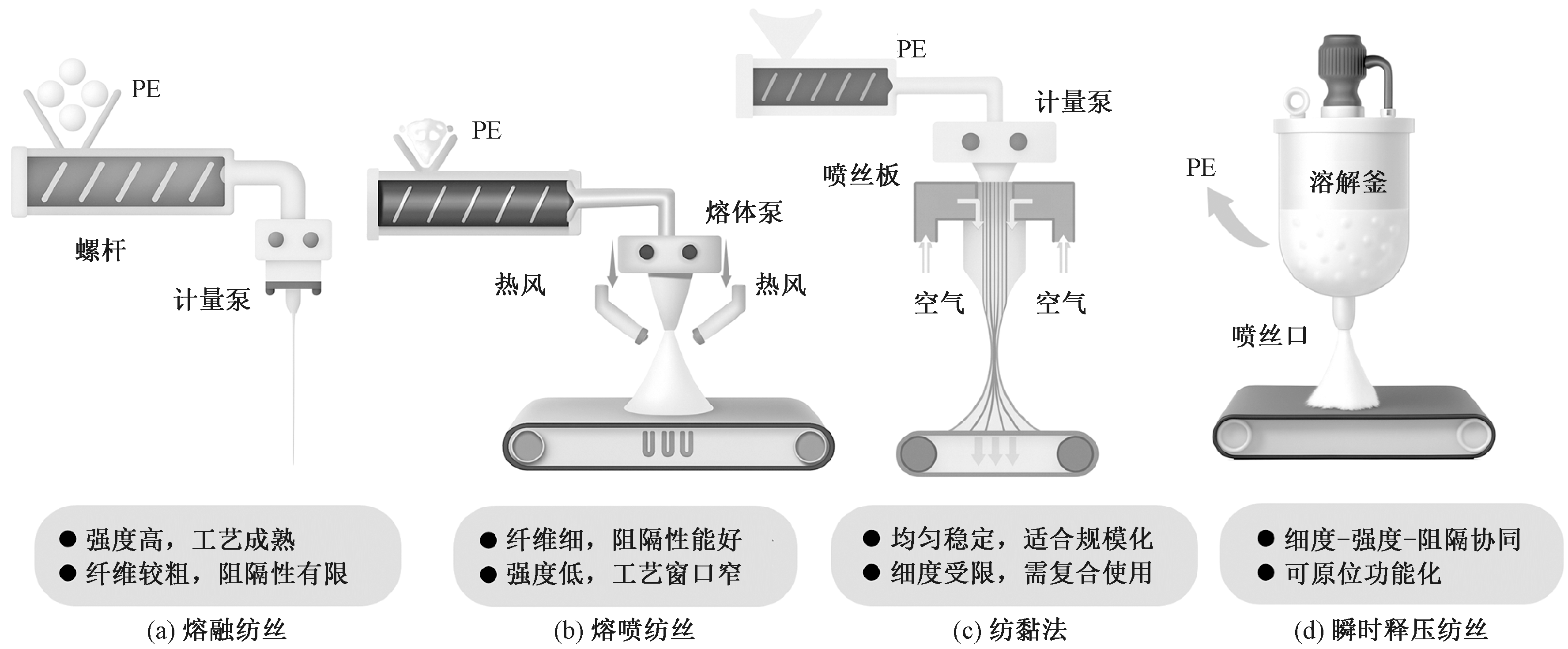
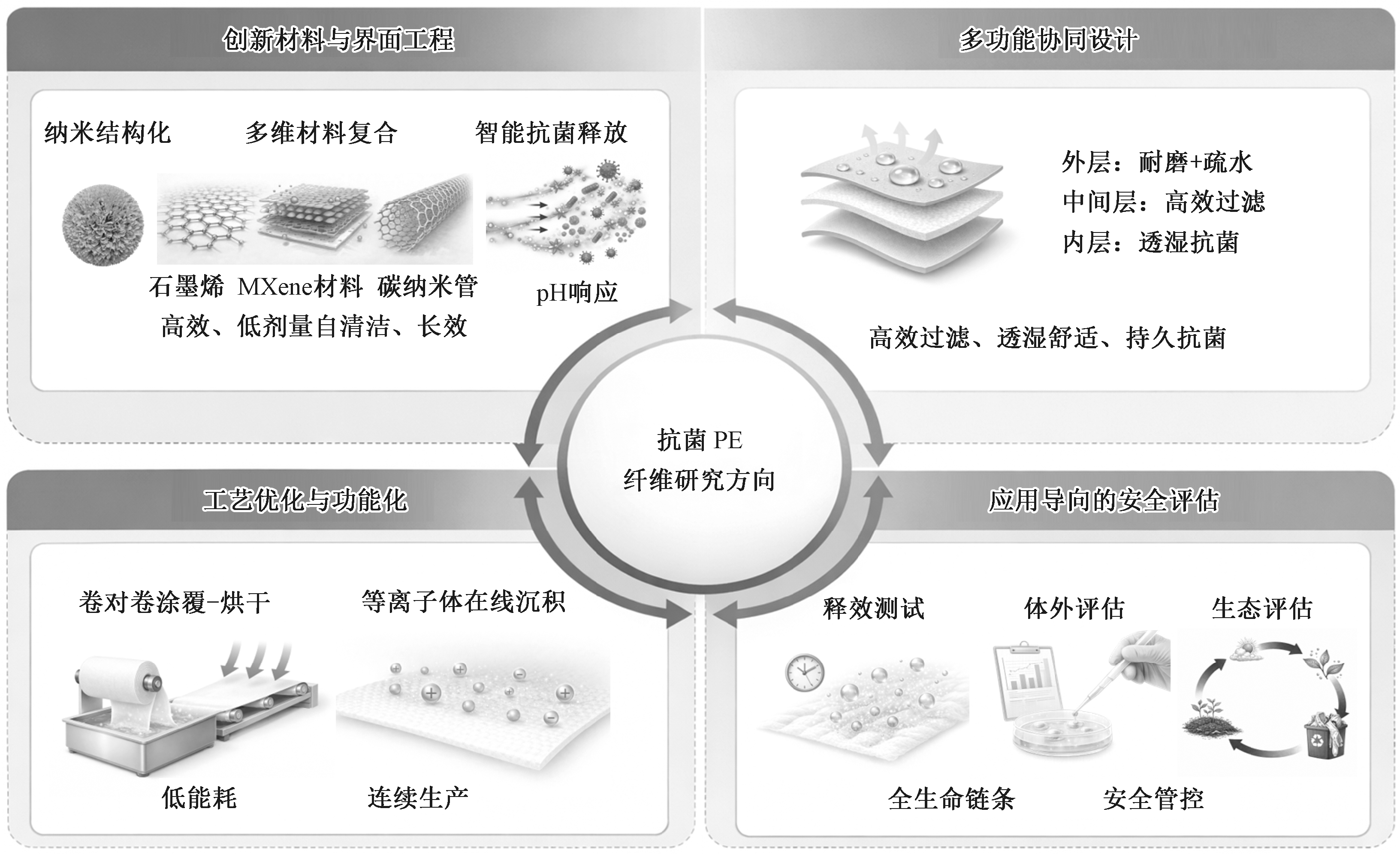
为阐明聚乙烯微细纤维实现高效医疗防护的性能基础与优化路径,从构效关系这一根本问题出发,系统梳理了该材料的物理化学特性及熔喷纺、静电纺等主流成形技术。进一步从原位纺丝功能化和表面改性两大策略入手,对抗菌聚乙烯微细纤维的抗菌功能化改性研究进展进行了归纳总结,并从抗菌粒子引入与防护表现出发总结共性规律,剖析了抗菌聚乙烯纤维在界面结合、耐久性及规模化生产中面临的技术挑战。最后,面向聚乙烯微细纤维高性能与可持续并重的发展目标,提出了应强化绿色与低剂量化理念、推动多功能协同的一体化设计、持续推进工艺优化与放大验证及完善与应用场景相匹配的安全评估与规范化评价体系4条建议,以期为推动其医疗防护应用提供研究参考。
中图分类号:
| [1] |
WANG H, ZHU Y J, MIN S Q, et al. Multi-inspired bump-liked medical protective clothing for effectively profuse perspiration management[J]. Chemical Engineering Journal, 2024, 499: 156448.
doi: 10.1016/j.cej.2024.156448 |
| [2] | WANG Y P, WANG Q Q, WU G Y, et al. Ultra-fast bacterial inactivation of Cu2O@halloysite nanotubes hybrids with charge adsorption and physical piercing ability for medical protective fabrics[J]. Journal of Materials Science & Technology, 2022, 122: 1-9. |
| [3] |
ZHANG Y, LI T T, SHIU B C, et al. Eco-friendly versatile protective polyurethane/triclosan coated polylactic acid nonwovens for medical covers application[J]. Journal of Cleaner Production, 2021, 282: 124455.
doi: 10.1016/j.jclepro.2020.124455 |
| [4] | 陈凤翔, 翟丽莎, 刘可帅, 等. 防护口罩研究进展及其发展趋势[J]. 西安工程大学学报, 2020, 34(2): 1-12. |
| CHEN Fengxiang, ZHAI Lisha, LIU Keshuai, et al. Research progress and its developing trend of protective masks[J]. Journal of Xi'an Polytechnic University, 2020, 34(2): 1-12. | |
| [5] |
张莉彦, 殷荣政, 谭晶, 等. 聚乙烯超细纤维非织造工艺研究进展[J]. 中国塑料, 2025, 39(2): 100-105.
doi: 10.19491/j.issn.1001-9278.2025.02.019 |
|
ZHANG Liyan, YIN Rongzheng, TAN Jing, et al. Research progress in nonwoven technology of polyethylene ultrafine fibers[J]. China Plastics, 2025, 39(2): 100-105.
doi: 10.19491/j.issn.1001-9278.2025.02.019 |
|
| [6] | 莫根林, 刘静, 金永喜, 等. 超高分子量聚乙烯纤维防护机理研究综述[J]. 兵器装备工程学报, 2021, 42(10): 23-28. |
| MO Genlin, LIU Jing, JIN Yongxi, et al. Review on protective mechanism of UHMWPE fiber[J]. Journal of Ordnance Equipment Engineering, 2021, 42(10): 23-28. | |
| [7] |
KARIM N, AFROJ S, LLOYD K, et al. Sustainable personal protective clothing for healthcare applications: a review[J]. ACS Nano, 2020, 14(10): 12313-12340.
doi: 10.1021/acsnano.0c05537 |
| [8] | 南清清, 曾庆红, 袁竟轩, 等. 抗菌功能纺织品的研究进展[J]. 纺织学报, 2022, 43(6): 197-205. |
| NAN Qingqing, ZENG Qinghong, YUAN Jingxuan, et al. Advances on antibacterial textiles[J]. Journal of Textile Research, 2022, 43(6): 197-205. | |
| [9] |
HUANG J J, WANG S L, ZHAO X K, et al. Fabrication of a textile-based triboelectric nanogenerator toward high-efficiency energy harvesting and material recognition[J]. Materials Horizons, 2023, 10(9): 3840-3853.
doi: 10.1039/d3mh00618b pmid: 37431538 |
| [10] |
XU Y Q, ZHANG X M, HAO X B, et al. Micro/nanofibrous nonwovens with high filtration performance and radiative heat dissipation property for personal protective face mask[J]. Chemical Engineering Journal, 2021, 423: 130175.
doi: 10.1016/j.cej.2021.130175 |
| [11] |
LIU Q Q, LI Z D, LU T Y, et al. High-density polyethylene Janus fibrous membrane with enhanced breathability and moisture permeability via PDA assisted hydrophilic modification[J]. Macromolecular Rapid Communications, 2025, 46(11): 2400854.
doi: 10.1002/marc.v46.11 |
| [12] |
ZHAI Y L, SU X L, JIA C, et al. Scalable, high-strength, wear-resistant, antibacterial polyethylene micro-nano fiber protective materials[J]. Chemical Engineering Journal, 2024, 487: 150735.
doi: 10.1016/j.cej.2024.150735 |
| [13] |
LIU W, WU X, LI Y, et al. Fabrication of silver ions aramid fibers and polyethylene composites with excellent antibacterial and mechanical properties[J]. e-Polymers, 2022, 22(1): 917-928.
doi: 10.1515/epoly-2022-0082 |
| [14] | 范新宇, 朱倩沁, 何力军, 等. 高密度聚乙烯瞬时释压非织造布制备及其性能[J]. 东华大学学报(自然科学版), 2025, 51(5): 35-40. |
| FAN Xinyu, ZHU Qianqin, HE Lijun, et al. Preparation and properties of high-density polyethylene nonwoven fabrics by instantaneous pressure release[J]. Journal of Donghua University (Natural Science), 2025, 51(5): 35-40. | |
| [15] |
夏云霞, 李磊, 罗章生, 等. 基于闪蒸法制备再生聚乙烯无纺布及其性能研究[J]. 中国塑料, 2022, 36(5): 14-18.
doi: 10.19491/j.issn.1001-9278.2022.05.003 |
|
XIA Yunxia, LI Lei, LUO Zhangsheng, et al. Preparation and properties of recycled polyethylene non-woven fabrics based on flash evaporation[J]. China Plastics, 2022, 36(5): 14-18.
doi: 10.19491/j.issn.1001-9278.2022.05.003 |
|
| [16] |
YESIL Y, BHAT G S. Structure and mechanical properties of polyethylene melt blown nonwovens[J]. International Journal of Clothing Science and Technology, 2016, 28(6): 780-793.
doi: 10.1108/IJCST-09-2015-0099 |
| [17] |
ROIRON C, LAINÉ E, GRANDIDIER J C, et al. A review of the mechanical and physical properties of polyethylene fibers[J]. Textiles, 2021, 1(1): 86-151.
doi: 10.3390/textiles1010006 |
| [18] | 叶孔萌, 秦子轩, 康桂田, 等. 高密度聚乙烯超细纤维篷布的闪蒸-水刺法制备及其防水透湿性[J]. 纺织学报, 2025, 46(1): 25-33. |
| YE Kongmeng, QIN Zixuan, KANG Guitian, et al. Flash spinning-hydroentangling process of high-density polyethylene microfibrous tarpaulin and its waterproof and permeable performance[J]. Journal of Textile Research, 2025, 46(1): 25-33. | |
| [19] |
WEE J H, BAE Y, CHO N P, et al. Enhancing mechanical properties of flash-spun filaments by pressure-induced phase separation control in supercritical high-density polyethylene solution[J]. Scientific Reports, 2022, 12: 18030.
doi: 10.1038/s41598-022-22781-1 |
| [20] |
XIA L, XI P, CHENG B W. A comparative study of UHMWPE fibers prepared by flash-spinning and gel-spinning[J]. Materials Letters, 2015, 147: 79-81.
doi: 10.1016/j.matlet.2015.02.046 |
| [21] |
DAI X, WANG J Q, ZHOU J L, et al. Low-Addition, strongly bonded PE-Pd nonwoven fabric with enhanced antibacterial and biofilm-resistance for protective clothing[J]. Chemical Engineering Journal, 2025, 516: 164086.
doi: 10.1016/j.cej.2025.164086 |
| [22] |
HU L X, HE J, HOU L, et al. Biological evaluation of the copper/low-density polyethylene nanocomposite intrauterine device[J]. PLoS One, 2013, 8(9): e74128.
doi: 10.1371/journal.pone.0074128 |
| [23] |
HERMÁN V, GONZÁLEZ G, NORIS-SUÁREZ K, et al. Biocompatibility studies of HDPE-HA composites with different HA content[J]. Polymer Bulletin, 2015, 72(12): 3083-3095.
doi: 10.1007/s00289-015-1454-9 |
| [24] |
REZNICKOVA A, NOVOTNA Z, KOLSKA Z, et al. Enhanced adherence of mouse fibroblast and vascular cells to plasma modified polyethylene[J]. Materials Science and Engineering: C, 2015, 52: 259-266.
doi: 10.1016/j.msec.2015.03.052 |
| [25] |
SEYHAN A, GUNAYDIN B N, POLAT Y, et al. Improvement of polyethylene fiber wettability and mechanical properties through an environmentally sustainable spinning process[J]. International Journal of Adhesion and Adhesives, 2022, 119: 103250.
doi: 10.1016/j.ijadhadh.2022.103250 |
| [26] |
刘文龙, 李好义, 何东洋, 等. 低密度聚乙烯熔喷工艺及其非织造布性能[J]. 纺织学报, 2024, 45(10): 31-38.
doi: 10.13475/j.fzxb.20230701201 |
|
LIU Wenlong, LI Haoyi, HE Dongyang, et al. Melt-blown process of low-density polyethylene and its nonwovens properties[J]. Journal of Textile Research, 2024, 45(10): 31-38.
doi: 10.13475/j.fzxb.20230701201 |
|
| [27] |
HASSAN M A, YEOM B Y, WILKIE A, et al. Fabrication of nanofiber meltblown membranes and their filtration properties[J]. Journal of Membrane Science, 2013, 427: 336-344.
doi: 10.1016/j.memsci.2012.09.050 |
| [28] |
ELLISON C J, PHATAK A, GILES D W, et al. Melt blown nanofibers: fiber diameter distributions and onset of fiber breakup[J]. Polymer, 2007, 48(11): 3306-3316.
doi: 10.1016/j.polymer.2007.04.005 |
| [29] |
YESIL Y, BHAT G S. Porosity and barrier properties of polyethylene meltblown nonwovens[J]. The Journal of the Textile Institute, 2017, 108(6): 1035-1040.
doi: 10.1080/00405000.2016.1218109 |
| [30] |
李长金, 刘文龙, 杨卫民, 等. 静电喷纺低密度聚乙烯超细纤维及其性能[J]. 中国塑料, 2025, 39(5): 25-29.
doi: 10.19491/j.issn.1001-9278.2025.05.004 |
|
LI Changjin, LIU Wenlong, YANG Weimin, et al. Preparation and performance of electrostatic melt-blown low-density polyethylene microfibers[J]. China Plastics, 2025, 39(5): 25-29.
doi: 10.19491/j.issn.1001-9278.2025.05.004 |
|
| [31] |
ABDEL-MOUTTALIB K, NADI A, TETOUANI S, et al. Experimental analysis on fiber diameter of spunbond nonwoven fabrics through Plackett-Burman and Box-Behnken designs and its impact on mechanical properties[J]. SPE Polymers, 2025, 6(1): e10163.
doi: 10.1002/pls2.v6.1 |
| [32] |
CHEN K L, YARIN A L, POURDEYHIMI B. Prediction of crystallinity of spunbond webs[J]. Journal of Applied Physics, 2020, 128(20): 205101.
doi: 10.1063/5.0029358 |
| [33] |
KANAI T, KOHRI Y, TAKEBE T. Theoretical analysis of the spunbond process and its applications for polypropylenes[J]. Advances in Polymer Technology, 2018, 37(6): 2085-2094.
doi: 10.1002/adv.2018.37.issue-6 |
| [34] |
SHU D K, LONG X Y, ZHAO P J, et al. Flash spinning polyethylene/Fe3O4 magnetic drive fibers for oil absorption underwater[J]. Chemical Engineering Journal, 2024, 490: 151333.
doi: 10.1016/j.cej.2024.151333 |
| [35] | 李倩倩, 郭晓玲, 崔文豪, 等. 汽车座椅用抗菌涤纶针织物制备及其性能[J]. 纺织学报, 2024, 45(6): 127-133. |
|
LI Qianqian, GUO Xiaoling, CUI Wenhao, et al. Preparation and performance of antibacterial polyester knitted fabric for automotive seats[J]. Journal of Textile Research, 2024, 45(6): 127-133.
doi: 10.1177/004051757504500207 |
|
| [36] | 许零, William Lee, 须郎高信, 等. 用辐射接枝法对HDPE膜进行功能化改性[J]. 辐射研究与辐射工艺学报, 1999, 17(4): 231-238. |
| XU Ling, LEE William, SUGO Takanobu, et al. Functional modification of HDPE membranes by radiation-induced grafting[J]. Journal of Radiation Research and Radiation Processing, 1999, 17(4): 231-238. | |
| [37] |
王志辉, 徐羽菲, 郭豪玉, 等. 光动力抗菌技术在纺织品上的应用研究进展[J]. 纺织学报, 2021, 42(11): 187-196.
doi: 10.13475/j.fzxb.20200903610 |
|
WANG Zhihui, XU Yufei, GUO Haoyu, et al. Progress in application of photodynamic antibacterial technology for textiles[J]. Journal of Textile Research, 2021, 42(11): 187-196.
doi: 10.13475/j.fzxb.20200903610 |
|
| [38] |
YU D K, BASUMATARY I B, LIU Y, et al. Chitosan-photocatalyst nanocomposite on polyethylene films as antimicrobial coating for food packaging[J]. Progress in Organic Coatings, 2024, 186: 108069.
doi: 10.1016/j.porgcoat.2023.108069 |
| [39] |
PAKDEL E, DAOUD W A, KASHI S, et al. Superhydrophilic self-cleaning fabric with enhanced antibacterial and UV protection properties[J]. Cellulose, 2025, 32(3): 1937-1958.
doi: 10.1007/s10570-024-06346-1 |
| [40] |
INNOCENT M, ZHAI G X, INNOCENT M T, et al. Bifunctional catechol-based coating strategy to construct highly effective antimicrobial polyethylene microfibers for personal protective equipment[J]. Progress in Organic Coatings, 2025, 198: 108916.
doi: 10.1016/j.porgcoat.2024.108916 |
| [41] |
WANG J Q, ZHU Q Q, SU X L, et al. Dual inactivation mechanism of photocatalysis and metal ions induces broad-spectrum antibacterial polyethylene fabric to resist bio-infection[J]. Journal of Hazardous Materials, 2025, 498: 139817.
doi: 10.1016/j.jhazmat.2025.139817 |
| [42] |
WANG J Q, SU X L, ZHU Q Q, et al. Surface self-assembly via one-pot polymerization to construct high-strength and antibacterial polyethylene fabric[J]. Chemical Engineering Journal, 2024, 492: 152246.
doi: 10.1016/j.cej.2024.152246 |
| [43] | FAN J H, SONG Y H, SHA Z, et al. In-situ anchoring of nano-CuS onto PET@PE nonwoven fabrics: developing flexible, robust, and all-in-one integrated thermotherapy films[J]. Journal of Materials Science & Technology, 2025, 226: 172-180. |
| [44] |
TANG N, WANG J Q, DAI X, et al. Dopamine-assisted functionalized cuprous oxide induced high biocompatibility and antibacterial polyethylene fibers[J]. Composites Part A: Applied Science and Manufacturing, 2025, 194: 108947.
doi: 10.1016/j.compositesa.2025.108947 |
| [45] |
GRAFIA A L, VÁZQUEZ M B, BIANCHINOTTI M V, et al. Development of an antifungal film by polyethylene surface modification with natamycin[J]. Food Packaging and Shelf Life, 2018, 18: 191-200.
doi: 10.1016/j.fpsl.2018.11.001 |
| [46] | 程家国, 张露平, 刘敏, 等. 抗菌纳米材料在医用织物消毒灭菌中的应用研究进展[J]. 中华医院感染学杂志, 2026, 36(1): 164-168. |
| CHENG Jiaguo, ZHANG Luping, LIU Min, et al. Research progress on the application of antibacterial nanomaterial in disinfection and sterilization of medical textiles[J]. Chinese Journal of Nosocomiology, 2026, 36(1): 164-168. | |
| [47] | 翟丽莎, 王宗垒, 周敬伊, 等. 纺织用抗菌材料及其应用研究进展[J]. 纺织学报, 2021, 42(9): 170-179. |
| ZHAI Lisha, WANG Zonglei, ZHOU Jingyi, et al. Research progress of antibacterial materials for textiles and their applications[J]. Journal of Textile Research, 2021, 42(9): 170-179. | |
| [48] |
KANERVA M, MENSAH-ATTIPOE J, PUOLAKKA A, et al. Weathering of antibacterial melt-spun polyfilaments modified by pine rosin[J]. Molecules, 2021, 26(4): 876.
doi: 10.3390/molecules26040876 |
| [49] |
曹聪聪, 汤龙世, 刘元军, 等. 无机抗菌织物的研究进展[J]. 纺织学报, 2022, 43(11): 203-211.
doi: 10.13475/j.fzxb.20210309409 |
|
CAO Congcong, TANG Longshi, LIU Yuanjun, et al. Research progress of inorganic antibacterial fabrics[J]. Journal of Textile Research, 2022, 43(11): 203-211.
doi: 10.13475/j.fzxb.20210309409 |
|
| [50] |
ROJAS K, CANALES D, AMIGO N, et al. Effective antimicrobial materials based on low-density polyethylene (LDPE) with zinc oxide (ZnO) nanoparticles[J]. Composites Part B: Engineering, 2019, 172: 173-178.
doi: 10.1016/j.compositesb.2019.05.054 |
| [51] |
ROY A, JOSHI M, BUTOLA B S. Antimicrobial performance of polyethylene nanocomposite monofilaments reinforced with metal nanoparticles decorated montmorillonite[J]. Colloids and Surfaces B: Biointerfaces, 2019, 178: 87-93.
doi: 10.1016/j.colsurfb.2019.02.045 |
| [52] |
HAN M C, HE H W, KONG W K, et al. High-performance electret and antibacterial polypropylene meltblown nonwoven materials doped with boehmite and ZnO nanoparticles for air filtration[J]. Fibers and Polymers, 2022, 23(7): 1947-1955.
doi: 10.1007/s12221-022-4786-8 |
| [53] |
SU X L, JIA C, XIANG H X, et al. Research progress in preparation, properties, and applications of medical protective fiber materials[J]. Applied Materials Today, 2023, 32: 101792.
doi: 10.1016/j.apmt.2023.101792 |
| [54] |
SHIU B C, ZHANG Y, YUAN Q Y, et al. Preparation of Ag@ZIF-8@PP melt-blown nonwoven fabrics: air filter efficacy and antibacterial effect[J]. Polymers, 2021, 13(21): 3773.
doi: 10.3390/polym13213773 |
| [55] | 相恒学,一种具有抗菌功能的纤维材料及其制备方法, 118932522B[P]. 2025-09-16. |
| XIANG Hengxue, A fiber material with antibacterial function and its preparation method, 118932522B[P]. 2025-09-16. | |
| [56] |
SUNTHAR T P M, MARIN E, BOSCHETTO F, et al. Antibacterial and antifungal properties of composite polyethylene materials reinforced with neem and turmeric[J]. Antibiotics, 2020, 9(12): 857.
doi: 10.3390/antibiotics9120857 |
| [1] | 施楣梧. 纺织品抗菌新技术研究进展[J]. 纺织学报, 2026, 47(03): 201-207. |
| [2] | 林晓静, 毛迎, 陈文兴, 吕汪洋. 载姜黄素静电纺丝纤维膜的制备及其抗菌与抗氧化性能[J]. 纺织学报, 2026, 47(03): 217-224. |
| [3] | 李瑞瑞, 文鹏, 张勇, 陈学军. 新型抗菌纤维的制备及其性能[J]. 纺织学报, 2026, 47(03): 233-239. |
| [4] | 邵英海, 朴洪伟, 曹继鹏, 张月, 许兰杰, 于学智, 张明光. 天然彩棉/柞蚕短纤维混纺纱的制备及其抗菌性能[J]. 纺织学报, 2026, 47(03): 240-246. |
| [5] | 易珊, 王丽芳, 陈黎, 邱虹, 唐一卡, 张国清, 王美英, 高艳春, 葛秀敏, 刘丽芳. 纳米纤维素基pH响应型抗菌抗氧化伤口敷料的制备及其性能[J]. 纺织学报, 2026, 47(03): 26-34. |
| [6] | 张宝华, 夏杰, 项复玉, 汪瑱, 吴韶华, 张彩丹. 负载肉桂醛的聚琥珀酰亚胺静电纺纤维膜抗菌敷料制备及其性能[J]. 纺织学报, 2026, 47(03): 35-43. |
| [7] | 杨潇, 章语墨, 李彦, 王璐, 王富军. 糖触抗菌与渗液管理一体化的短纤维重构复合敷料及其性能[J]. 纺织学报, 2026, 47(03): 44-51. |
| [8] | 薛宝霞, 冯佳昕, 邵子洋, 路佳鑫, 刘晶, 牛梅, 张利. 预交联铜离子对羧甲基纤维素抗菌气凝胶纤维结构与性能的影响[J]. 纺织学报, 2026, 47(03): 52-59. |
| [9] | 刘鹏碧, 任经岗, 张宽祥, 曹东阳, 刘熙, 郭昌盛. 植酸/苯扎氯铵一步共沉积涂层聚丙烯补片的制备及其抗菌性能[J]. 纺织学报, 2026, 47(03): 77-86. |
| [10] | 魏建斐, 魏艳颖, 马超慧, 胡晓鹏, 邴琳涵, 樊瑜, 林彬泽, 董振峰, 朱志国, 王锐. 碳点的宏量制备及其对聚酰胺66阻燃与力学性能协同增强机制[J]. 纺织学报, 2026, 47(02): 37-46. |
| [11] | 王彬, 侯泽明, 徐英俊, 王玉忠. 高阻燃性再生纤维素纤维的制备及其性能[J]. 纺织学报, 2026, 47(02): 47-55. |
| [12] | 王世杰, 孙辉, 于斌. 聚乙烯醇/牡丹皮提取物复合纳米静电纺丝膜的制备及其抗菌性能[J]. 纺织学报, 2026, 47(02): 56-64. |
| [13] | 顾家玉, 张炜栋, 董永春, 孙璇, 徐良军. 银杏叶黄酮对羊毛和蚕丝织物的抗菌整理[J]. 纺织学报, 2026, 47(01): 142-150. |
| [14] | 赵婧雯, 袁香楠, 高晶, 王璐. 聚丙烯腈-普鲁士蓝/月桂酸/环丙沙星光热响应性抗菌敷料的制备及其性能[J]. 纺织学报, 2026, 47(01): 20-28. |
| [15] | 王嘉禧, 袁国澍, 陈晓宇, 陈双婷, 缪莹, 付驰宇, 唐文杨. 纤维基比色气体传感器研究现状和发展趋势[J]. 纺织学报, 2026, 47(01): 259-267. |
|
||
 京公网安备11010502044800号